
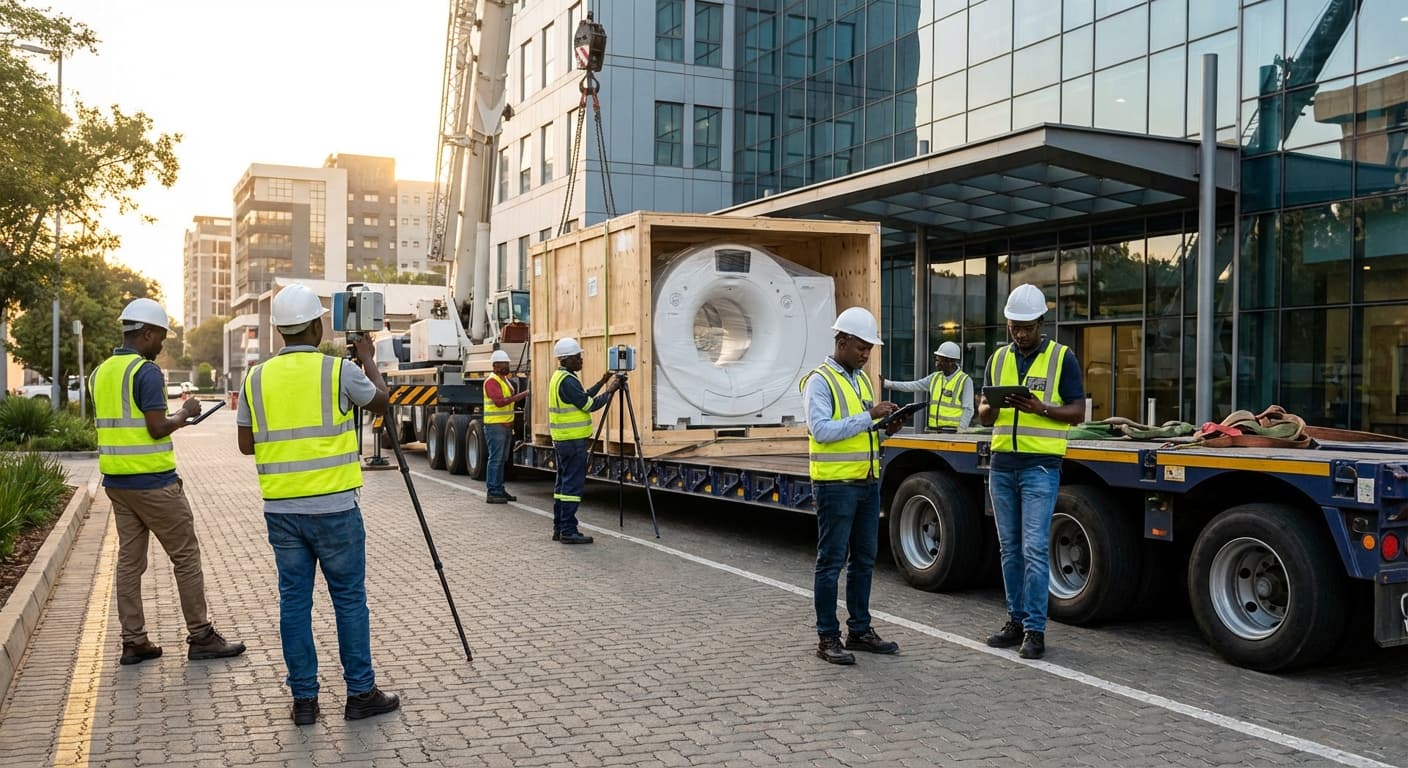
Route Survey & Rigging Plan Service for Heavy Medical Equipment in Congo (Kinshasa)
Engineering Excellence & Technical Support
Route Survey & Rigging Plan Service for Heavy Medical Equipment High-standard technical execution following OEM protocols and local regulatory frameworks.
Precision Route Mapping for Unhindered Access
Leveraging advanced GPS and GIS technologies, we conduct meticulous route surveys to identify and map the optimal path for heavy medical equipment transit within Kinshasa. Our detailed analysis accounts for critical factors such as road width, bridge load capacities, overhead obstructions (e.g., power lines, trees), and traffic patterns to ensure unimpeded and safe passage, minimizing delays and potential damage.
Customized Rigging & Lifting Strategies
Our expert rigging teams develop bespoke lifting and handling plans tailored to the unique specifications and weight distribution of each medical equipment unit. We utilize state-of-the-art, load-rated equipment and employ advanced engineering principles to execute complex lifts, transfers, and placements, guaranteeing the integrity and safety of sensitive and high-value medical machinery throughout the entire process.
Risk Mitigation & Comprehensive Safety Protocols
We prioritize safety above all. Our service includes a thorough risk assessment of the entire operation, from origin to installation site. This encompasses identifying potential hazards, developing robust mitigation strategies, and implementing strict adherence to international safety standards and local regulations. Comprehensive safety briefings, specialized training for our personnel, and the use of protective measures ensure zero incidents and the secure delivery of critical medical equipment.
What Is Route Survey & Rigging Plan Service For Heavy Medical Equipment In Congo (Kinshasa)?
Route Survey & Rigging Plan Service for Heavy Medical Equipment in Congo (Kinshasa) is a specialized engineering and logistics service focused on the safe, efficient, and compliant transportation and installation of oversized and overweight medical apparatus within the Democratic Republic of Congo, specifically Kinshasa. This service is critical due to the unique logistical challenges inherent in the region, including infrastructure limitations, varying road conditions, urban congestion, and stringent import/export regulations. The service encompasses a comprehensive assessment of the transportation route, the development of detailed rigging and lifting strategies, and the execution of these plans to ensure the integrity of both the equipment and the surrounding environment during transit and installation. It leverages advanced surveying techniques, engineering principles, and experienced personnel to mitigate risks associated with moving and positioning high-value, sensitive medical technology.
| Who Needs This Service? | Typical Use Cases | |||||
|---|---|---|---|---|---|---|
| Hospitals and Healthcare Facilities (public and private) undertaking expansion or renovation projects requiring the installation of new, large-scale medical imaging systems, surgical suites, or laboratory equipment. | Installation of MRI scanners (e.g., Siemens MAGNETOM series, GE SIGNA) | Deployment of CT scanners (e.g., Philips Ingenuity, Toshiba Aquilion) | Relocation and installation of Linear Accelerators (LINACs) for radiotherapy. | Installation of large-scale laboratory equipment such as electron microscopes or high-capacity centrifuges. | Transportation and installation of modular operating theatres or specialized diagnostic units. | Procurement and installation of heavy, specialized hospital beds or patient handling systems. |
| Medical Equipment Manufacturers and Suppliers managing the delivery and installation of their products in Congo. | Governmental Health Ministries or Agencies responsible for equipping public healthcare infrastructure. | International Aid Organizations and NGOs involved in healthcare development projects in the region. | Project Management firms overseeing large infrastructure or development initiatives that include medical facilities. | Logistics and Freight Forwarding companies specializing in oversized and heavy cargo requiring expert planning and execution. | Construction companies involved in building or renovating medical facilities where complex equipment integration is required. |
Key Components of Route Survey & Rigging Plan Service
- Route Assessment and Analysis:
- Infrastructure Evaluation: Detailed examination of road networks, bridges, tunnels, railway lines, and ports to determine load-bearing capacities, clearance limitations (height, width, length), and potential obstructions.
- Environmental Survey: Assessment of prevailing weather conditions, soil stability (for temporary supports), and potential environmental impact zones.
- Traffic Management Planning: Analysis of traffic patterns, peak hours, and development of diversion or escort strategies.
- Permitting and Regulatory Compliance: Identification and acquisition of all necessary permits and approvals from relevant governmental and local authorities.
- Rigging and Lifting Plan Development:
- Equipment Characterization: Thorough understanding of the medical equipment's dimensions, weight, center of gravity, fragility, and specific handling requirements.
- Method Statement Generation: Creation of detailed step-by-step procedures for lifting, securing, and maneuvering the equipment.
- Crane and Equipment Selection: Specification of appropriate lifting devices (cranes, hoists, forklifts) based on load capacity, reach, and site accessibility.
- Ancillary Equipment Specification: Identification of necessary rigging gear (slings, shackles, spreader bars), transport vehicles (low-bed trailers, specialized carriers), and safety equipment.
- Stress and Load Analysis: Engineering calculations to ensure structural integrity of equipment, lifting apparatus, and support structures during the operation.
- Execution and Supervision:
- On-site Survey and Verification: Pre-operation verification of the chosen route and installation site against the developed plans.
- Deployment of Specialized Personnel: Provision of experienced riggers, crane operators, engineers, and safety officers.
- Logistics Coordination: Management of the entire transportation chain, including customs clearance, warehousing (if required), and final delivery.
- Real-time Monitoring and Adjustment: Continuous oversight of the operation with the ability to adapt plans based on unforeseen circumstances.
- Post-Installation Verification: Confirmation of correct placement and initial system checks.
Who Needs Route Survey & Rigging Plan Service For Heavy Medical Equipment In Congo (Kinshasa)?
Navigating the complexities of transporting and installing heavy medical equipment in Congo (Kinshasa) demands specialized expertise. Route Survey & Rigging Plan Services are crucial for ensuring the safe, efficient, and compliant movement of these vital assets. This service goes beyond simple logistics, encompassing a deep understanding of infrastructure, environmental factors, and the precise handling required for delicate and bulky medical machinery. Without proper planning, significant risks of damage, delays, and cost overruns can arise, impacting healthcare delivery. This service is particularly vital for organizations undertaking large-scale medical equipment installations or upgrades.
| Target Customer Segment | Key Departments Involved | Specific Needs Addressed by Route Survey & Rigging Plan |
|---|---|---|
| Government & Public Health Sector | Ministry of Health, Ministry of Infrastructure, Procurement Directorate | Ensuring national health infrastructure development, compliance with national regulations, cost-effective project execution, and timely availability of critical medical equipment for public health services. |
| International Aid & Development Organizations (NGOs) | Program Management, Logistics & Operations, Procurement Department | Facilitating the delivery of medical aid to remote areas, safe installation of donated equipment, adherence to donor requirements, and maximizing the impact of humanitarian efforts. |
| Private Healthcare Providers (Hospitals & Clinics) | Hospital Administration, Biomedical Engineering Department, Facilities Management, Procurement Department | Minimizing disruption to patient care during installation, ensuring the longevity of expensive equipment, optimizing space utilization, and complying with safety standards. |
| Medical Equipment Manufacturers & Suppliers | Project Management, Technical Support, Logistics Department, Sales & After-Sales Service | Guaranteeing successful on-site delivery and installation, protecting their brand reputation, reducing warranty claims due to mishandling, and providing end-to-end customer solutions. |
| Large-Scale Healthcare Project Developers | Project Management Office (PMO), Engineering Team, Construction Management | Integrating equipment installation into overall project timelines, managing complex logistics for multiple components, and ensuring the structural integrity of the facility to support heavy equipment. |
Target Customers and Departments Requiring Route Survey & Rigging Plan Services for Heavy Medical Equipment in Congo (Kinshasa)
- Government Ministries responsible for healthcare infrastructure and public health.
- International Non-Governmental Organizations (NGOs) involved in healthcare development and aid.
- Private Hospitals and large Medical Centers undertaking expansions or new facility constructions.
- Manufacturers and Suppliers of heavy medical equipment seeking reliable installation partners.
- Procurement Departments responsible for acquiring and managing high-value medical assets.
- Logistics and Supply Chain Departments managing the import and distribution of medical equipment.
- Project Management Offices (PMOs) overseeing significant healthcare infrastructure projects.
- Facility Management Departments responsible for the ongoing operation and maintenance of medical facilities.
- Technical and Engineering Departments involved in the installation and commissioning of medical equipment.
Route Survey & Rigging Plan Service For Heavy Medical Equipment Process In Congo (Kinshasa)
This document outlines the comprehensive workflow for our Route Survey & Rigging Plan Service for the process of handling and installing heavy medical equipment in Congo (Kinshasa). Our service ensures safe, efficient, and compliant transit and placement of critical medical assets from arrival at the port of entry to their final designated location within the healthcare facility. We manage all logistical, technical, and safety aspects to minimize risk and disruption.
| Stage | Key Activities | Deliverables | Timeline (Indicative) | Key Stakeholders Involved | Critical Considerations |
|---|---|---|---|---|---|
| Receive client inquiry, understand equipment specifications (weight, dimensions, fragility), project scope, and destination details. Discuss preliminary requirements and constraints. | Initial understanding of project scope, preliminary risk assessment, confirmation of service scope. | 1-3 business days | Client (Hospital/Clinic Management, Procurement Team), Service Provider (Project Manager, Technical Lead) | Accurate equipment specifications are crucial. Clear understanding of project urgency and budget. |
| Conduct detailed on-site survey of the entire route: port of entry, road conditions, bridge capacities, building access points (entrances, corridors, elevators), final installation location. Measure dimensions, identify obstacles, assess ground stability, and evaluate potential hazards. | Detailed route survey report, obstacle identification log, preliminary access feasibility report, photographic evidence. | 3-7 business days (depending on complexity and travel) | Client (Facility Engineers, Security), Service Provider (Survey Team, Logistics Coordinator), Local Authorities (if required for access) | Need for detailed maps and site plans. Weather conditions can impact survey. Local knowledge is invaluable. |
| Based on survey data and equipment specs, develop a comprehensive rigging plan. This includes: load calculations, selection of appropriate lifting and moving equipment (cranes, forklifts, dollies, gantries), rigging gear (slings, shackles), lifting points, safety procedures, and personnel requirements. | Detailed rigging plan document, equipment specifications, safety protocols, emergency response plan, personnel deployment plan. | 5-10 business days | Service Provider (Rigging Engineers, Safety Officers), Equipment Suppliers, Client (Technical Representatives) | Adherence to international rigging standards and local safety regulations. Redundancy in critical equipment and safety measures. |
| Obtain all necessary permits and authorizations from relevant government bodies, port authorities, road transport agencies, and facility management for route clearance, road closures (if applicable), and site access. Ensure compliance with all local regulations. | All required permits and authorizations, signed approvals from authorities, communication logs. | 5-15 business days (highly variable based on bureaucracy) | Service Provider (Permitting Specialist), Client (Liaison), Local Government Agencies, Port Authorities, Police | Early engagement with authorities is key. Understanding local bureaucratic processes is vital. |
| Mobilize specialized rigging equipment and transport vehicles to the site. Coordinate logistics for transportation of heavy medical equipment from the port of entry to the healthcare facility. Implement strict security measures during transit. | Mobilized equipment, deployed transport vehicles, secure transit route, security escort (if needed), initial equipment unloading plan. | 3-7 business days (concurrent with other stages) | Service Provider (Logistics Team, Drivers, Security), Client (Port Authority, Facility Security) | Robust transport planning to account for road conditions and transit times. Ensure equipment is properly secured for transport. |
| Execute the rigging plan. Safely lift, maneuver, and place the heavy medical equipment at its designated installation location. This involves skilled rigging crews, precise positioning, and adherence to all safety protocols. Conduct initial checks for damage during transit and placement. | Equipment successfully positioned, preliminary installation checks completed, site safety maintained throughout the process. | 1-5 business days (per equipment piece) | Service Provider (Rigging Crew, Supervisors, Safety Officers), Client (Facility Engineers, End-Users, Project Management) | Strict adherence to the rigging plan is paramount. Continuous communication between the rigging crew and the client. Minimal disruption to facility operations. |
| Conduct final checks and testing of the equipment's position and immediate surroundings. Ensure the area is clean and safe. Officially hand over the equipment to the client's technical team and provide necessary documentation. | Final inspection report, completed handover documentation, confirmation of client acceptance. | 0.5-1 business day | Service Provider (Project Manager, Technical Lead), Client (Technical Team, Facility Management) | Confirmation of all safety checks completed. Ensure client understands any immediate post-installation requirements. |
| Provide a comprehensive project report summarizing the entire process, including executed plans, challenges encountered, lessons learned, and final safety records. Finalize all contractual obligations and invoicing. | Final project report, photographic documentation of the entire process, final invoices, client feedback form. | 3-5 business days | Service Provider (Project Manager, Finance Department), Client (Procurement, Management) | Documentation serves as a valuable record for future projects and demonstrates due diligence. |
Workflow Stages
- Initial Inquiry & Consultation
- Site Assessment & Route Survey
- Rigging Plan Development
- Permitting & Approvals
- Equipment Mobilization & Transportation
- On-Site Rigging & Installation
- Post-Installation & Handover
- Project Closeout & Reporting
Route Survey & Rigging Plan Service For Heavy Medical Equipment Cost In Congo (Kinshasa)
Providing route survey and rigging plan services for heavy medical equipment in Congo (Kinshasa) involves several critical factors that influence the final cost. These services are essential for ensuring the safe and efficient transportation and installation of specialized, often oversized and delicate, medical machinery. The pricing is highly project-specific and can vary significantly. Key considerations include the complexity of the route, the weight and dimensions of the equipment, the required rigging techniques, access limitations, transportation methods, insurance needs, and the mobilization costs for specialized personnel and equipment. Local currency pricing in the Democratic Republic of Congo (DRC), primarily the Congolese Franc (CDF), will also be affected by exchange rates and local economic conditions. Estimates provided are indicative and subject to detailed site surveys and equipment assessments.
| Service Component | Estimated Cost Range (CDF) | Estimated Cost Range (USD - Indicative) |
|---|---|---|
| Route Survey & Feasibility Study (Per km or per site assessment) | 500,000 - 2,500,000 CDF | $250 - $1,250 USD |
| Rigging Plan Development (Based on equipment complexity) | 1,000,000 - 5,000,000 CDF | $500 - $2,500 USD |
| Specialized Personnel Mobilization (Surveyors, Rigging Engineers, Supervisors - per day) | 200,000 - 800,000 CDF | $100 - $400 USD |
| Local Labor (Skilled Riggers, Handlers - per day) | 50,000 - 150,000 CDF | $25 - $75 USD |
| Equipment Rental (Cranes, Forklifts, specialized trailers - daily rates vary significantly) | 1,000,000 - 15,000,000+ CDF | $500 - $7,500+ USD |
| Permits & Approvals (Estimate, highly variable) | 500,000 - 3,000,000 CDF | $250 - $1,500 USD |
| Logistics & Site Management (Includes local coordination, escorts) | 800,000 - 4,000,000 CDF | $400 - $2,000 USD |
| **Comprehensive Project (Small to Medium Equipment) | 5,000,000 - 30,000,000 CDF | $2,500 - $15,000 USD |
| **Comprehensive Project (Large/Complex Equipment) | 30,000,000 - 100,000,000+ CDF | $15,000 - $50,000+ USD |
Key Pricing Factors for Route Survey & Rigging Plan Service
- Equipment Characteristics: Weight, dimensions, fragility, and specific handling requirements of the medical equipment are paramount. Heavier and larger items necessitate more robust planning and potentially specialized lifting gear.
- Route Survey Complexity: This includes the distance to be covered, the terrain (urban vs. rural, road conditions, inclines, bridges), and the presence of any obstacles (power lines, low-hanging structures, narrow passages).
- Rigging & Lifting Requirements: The type of cranes, forklifts, or other lifting apparatus needed, the expertise of the rigging crew, and the complexity of the lifting operation itself.
- Site Access & Preparation: Evaluating the accessibility of the delivery point and the installation site, including the need for site clearing, reinforcement, or temporary infrastructure development.
- Transportation Mode: The choice of transport (truck, trailer, specialized vehicle) and its associated costs, including permits and escorts.
- Logistical Challenges: Potential for delays due to infrastructure issues, customs clearance, local regulations, and security concerns in Kinshasa and surrounding areas.
- Specialized Personnel: The cost of experienced route surveyors, rigging engineers, crane operators, and skilled labor. This includes their travel, accommodation, and daily rates.
- Insurance Coverage: The level and type of insurance required for the transportation and installation of high-value medical equipment.
- Permits and Approvals: Obtaining necessary permits from local authorities for road closures, oversized transport, and specialized operations.
- Contingency Planning: Building in a buffer for unforeseen circumstances, which is crucial in a dynamic environment like Kinshasa.
Affordable Route Survey & Rigging Plan Service For Heavy Medical Equipment Options
Navigating the complexities of transporting and installing heavy medical equipment requires specialized expertise. Our Affordable Route Survey & Rigging Plan Service is designed to provide you with comprehensive pre-installation planning at a cost-effective price point. We understand the critical nature of these operations and the potential for significant expenses if not managed efficiently. Our service minimizes risk, prevents costly delays, and ensures the safe, successful installation of your valuable medical assets. We offer flexible value bundles and implement strategic cost-saving measures to make essential pre-installation planning accessible for a wide range of medical facilities.
| Service Component | Description | Value Bundle Inclusion | Cost-Saving Strategy |
|---|---|---|---|
| Route Survey | Detailed assessment of transportation routes, including access points, potential obstructions (e.g., doorways, elevators, stairwells), and structural integrity of pathways. | Included in all bundles | Leveraging technology for virtual surveys where possible; bulk route planning for multiple installations. |
| Rigging Plan Development | Creation of a comprehensive plan detailing the necessary lifting equipment, rigging gear, precise lifting points, and safe execution procedures for moving and positioning the equipment. | Included in all bundles | Standardized rigging templates; collaborative planning with your on-site team to utilize existing resources. |
| Site Assessment | Evaluation of the installation location, including floor load capacity, power/utility access, and environmental controls required for the specific medical equipment. | Included in Standard & Premium Bundles | Pre-designed site assessment checklists; discounted rates for repeat site assessments within the same facility. |
| Risk Analysis & Mitigation Report | Identification of potential hazards and proposed solutions to ensure a safe operation. This includes emergency preparedness. | Included in Premium Bundle | Data-driven risk assessment leading to optimized resource allocation, reducing the need for over-engineering. |
| On-Site Consultation (Optional) | A physical presence of our expert at your facility to conduct surveys and initial planning discussions. | Add-on service; discounted rates for bundled consultations with route surveys. | Focus on high-impact consultations; flexible scheduling to minimize disruption. |
| Expedited Service (Optional) | Prioritized scheduling for route surveys and rigging plan development for urgent installations. | Add-on service | Efficient workflow management and dedicated project managers for expedited requests. |
Key Benefits of Our Service
- Risk Mitigation: Proactive identification of potential challenges during transport and installation, preventing costly accidents and equipment damage.
- Cost Control: Avoidance of unexpected expenses due to logistical hurdles, site limitations, or specialized equipment needs.
- Time Efficiency: Streamlined planning process that accelerates installation timelines and minimizes operational downtime.
- Compliance Assurance: Ensuring adherence to all safety regulations and manufacturer specifications.
- Peace of Mind: Expert planning by certified professionals gives you confidence in the entire process.
Verified Providers In Congo (Kinshasa)
Finding reliable and qualified healthcare providers is paramount in any region, and Congo (Kinshasa) is no exception. Navigating the healthcare landscape can be challenging, which is why identifying verified providers and understanding their credentials is crucial for ensuring quality care. Franance Health stands out as a leading choice due to its rigorous vetting process and commitment to excellence. This document outlines why Franance Health credentials represent the best option for accessing healthcare services in Congo (Kinshasa).
| Credential Type | Franance Health Verification Focus | Significance for Patients |
|---|---|---|
| Medical Licensing & Registration | Confirmation of valid, current licenses with relevant national and regional medical boards. | Ensures providers are legally authorized to practice and meet minimum educational and competency requirements. |
| Educational Background | Verification of degrees, diplomas, and certifications from accredited institutions. | Confirms a strong foundational understanding of medical principles and practices. |
| Specialized Training & Certifications | Validation of post-graduate training, fellowships, and specialized certifications in specific medical fields. | Identifies expertise in particular areas of medicine, leading to more targeted and effective treatment. |
| Professional Experience | Assessment of years of practice, types of institutions worked in, and patient case experience. | Indicates practical application of knowledge and ability to handle diverse medical situations. |
| Ethical Conduct & Disciplinary History | Thorough background checks for any past or present disciplinary actions, malpractice claims, or ethical violations. | Ensures providers adhere to a high standard of professional integrity and patient trust. |
| Continuing Medical Education (CME) | Confirmation of active participation in ongoing professional development and learning. | Guarantees that providers are up-to-date with the latest medical advancements, technologies, and treatment protocols. |
Why Franance Health Credentials Matter
- Rigorous Verification Process: Franance Health employs a multi-stage verification protocol to ensure that all listed providers meet stringent criteria for competence, ethical practice, and legal standing.
- Comprehensive Credential Assessment: Beyond basic licensing, Franance Health scrutinizes educational background, specialized training, professional experience, and any disciplinary actions.
- Commitment to Quality and Safety: The focus is on identifying providers who demonstrate a consistent commitment to patient safety, effective treatment, and adherence to international healthcare standards.
- Patient-Centric Approach: Franance Health prioritizes providers who exhibit strong communication skills, empathy, and a dedication to patient well-being.
- Ongoing Monitoring: Verification is not a one-time event. Franance Health engages in ongoing monitoring to ensure providers maintain their high standards over time.
Scope Of Work For Route Survey & Rigging Plan Service For Heavy Medical Equipment
This Scope of Work (SOW) outlines the services required for a comprehensive route survey and detailed rigging plan for the transportation and installation of heavy medical equipment. The objective is to ensure the safe, efficient, and compliant movement of sensitive and high-value equipment from its point of arrival to its final installation location within a facility.
| Phase | Activity | Deliverables | Standard Specifications / Notes |
|---|---|---|---|
| Phase 1: Pre-Survey & Planning | Information Gathering | Equipment Specifications (weight, dimensions, lifting points, fragility), Facility Layouts (blueprints, CAD drawings), Site Access Information (loading docks, entry points, elevator dimensions, ceiling heights), Vendor Requirements | Obtain all necessary documentation from the client, equipment vendor, and facility management. Review for completeness and accuracy. |
| Phase 1: Pre-Survey & Planning | Preliminary Route Assessment | Initial identification of potential route challenges and critical path elements | Based on provided drawings and information. No site visit required at this stage. |
| Phase 2: On-Site Route Survey | Physical Route Inspection | Detailed survey of the proposed transportation route from point of arrival (e.g., loading dock) to final installation location. Includes all corridors, doorways, elevators, stairwells, and any temporary pathways. | Document all dimensions, clearances (vertical and horizontal), inclines, tight turns, floor load capacities, and potential obstructions. Use of laser measuring devices and photographic documentation is mandatory. |
| Phase 2: On-Site Route Survey | Obstacle Identification & Mitigation Planning | Identification of all potential hazards (e.g., structural limitations, electrical conduits, HVAC systems, fire suppression systems, existing equipment). Recommendations for temporary modifications or protective measures. | Detailed notes on any required modifications to the building infrastructure or temporary removal of fixtures. Assessment of the need for specialized access equipment (e.g., scissor lifts, stair climbers). |
| Phase 2: On-Site Route Survey | Ground & Floor Load Capacity Assessment | Assessment of the structural integrity of floors and pathways to support the weight of the equipment and rigging gear. | Consultation with facility engineers or structural assessments if significant concerns arise. |
| Phase 2: On-Site Route Survey | Environmental Conditions Assessment | Assessment of temperature, humidity, and dust control requirements if specified by the equipment manufacturer. | Identification of any sensitive areas requiring special protection during transport. |
| Phase 3: Rigging Plan Development | Lift Plan Design | Detailed 3D or 2D drawings of lifting and rigging configurations. Specification of all rigging hardware (slings, shackles, spreader bars, etc.), crane/hoist requirements, and load calculations. | Must comply with relevant standards (e.g., ASME B30 series) and manufacturer's lifting point guidelines. Rigging gear must be certified and rated for the load. |
| Phase 3: Rigging Plan Development | Method Statement | Step-by-step operational procedures for lifting, moving, and positioning the equipment. Includes personnel roles and responsibilities. | Clear, concise, and easy to follow instructions. Emphasis on safety procedures at each step. |
| Phase 3: Rigging Plan Development | Equipment & Personnel Requirements | Identification of all necessary rigging equipment, specialized moving tools, and skilled personnel required for the operation. | Includes number and certification of riggers, crane operators, and supervisors. |
| Phase 3: Rigging Plan Development | Risk Assessment & Mitigation | Formal identification of all residual risks after planning and proposed mitigation strategies. | Contingency plans for unexpected events (e.g., equipment failure, unforeseen obstructions). |
| Phase 4: Technical Deliverables & Documentation | Final Route Survey Report | Comprehensive report detailing all findings from the on-site survey. Includes annotated maps, photographs, and measured dimensions. | Clearly identifies the optimal route and any potential challenges. |
| Phase 4: Technical Deliverables & Documentation | Detailed Rigging Plan | Includes lift plans, method statements, equipment lists, personnel requirements, and risk assessment. | Formatted for clear understanding by the execution team. May include CAD drawings, 3D renderings, and photographic illustrations. |
| Phase 4: Technical Deliverables & Documentation | Equipment Moving & Installation Checklist | A comprehensive checklist for the execution team to follow during the actual move and installation. | To ensure all critical steps are completed and documented. |
| Phase 4: Technical Deliverables & Documentation | Final Sign-off Documentation | Formal sign-off from relevant parties (client, facility management) acknowledging the adequacy of the plan. | Confirms understanding and acceptance of the proposed plan. |
Objectives of the Route Survey & Rigging Plan Service
- Identify and mitigate all potential risks associated with the transportation and installation of heavy medical equipment.
- Develop a detailed, step-by-step rigging and installation plan that adheres to industry best practices and equipment manufacturer specifications.
- Ensure compliance with all relevant safety regulations, building codes, and facility-specific requirements.
- Minimize downtime and disruption to facility operations.
- Provide clear and concise documentation for all survey findings and planning activities.
Service Level Agreement For Route Survey & Rigging Plan Service For Heavy Medical Equipment
This Service Level Agreement (SLA) outlines the performance standards and commitments for the Route Survey and Rigging Plan Service for Heavy Medical Equipment provided by [Your Company Name] (hereinafter referred to as "Provider"). This SLA aims to ensure the successful, safe, and timely planning and execution of complex equipment relocations for our clients (hereinafter referred to as "Client").
| Service Component | Response Time Commitment | Uptime Guarantee / Availability |
|---|---|---|
| Initial Consultation & Request Acknowledgment | Within 4 business hours of client request submission. | N/A (Service is initiated upon request) |
| Route Survey Commencement (On-site or remote assessment) | Within 2 business days of receiving all necessary client information and site access. | N/A (Service is initiated upon request) |
| Draft Rigging Plan Submission | Within 5 business days of route survey completion and confirmation of all site data. | N/A (Service is initiated upon request) |
| Revision Incorporation (based on client feedback) | Within 2 business days of receiving documented client feedback. | N/A (Service is initiated upon request) |
| Final Deliverable Submission (Route Survey Report & Rigging Plan) | Within 1 business day of final client approval. | N/A (Service is initiated upon request) |
| Support during On-site Rigging Execution (for issues directly related to the provided plan) | On-call support within 1 hour during scheduled rigging operations. | 99.5% Availability (for on-call support during scheduled operations) |
Scope of Service
- Comprehensive route survey to identify potential obstacles, accessibility issues, and optimal pathways for heavy medical equipment transportation.
- Detailed rigging plan development, including equipment specifications, lifting strategies, personnel requirements, and safety protocols.
- On-site assessment and verification of survey findings and rigging plan feasibility.
- Coordination with relevant stakeholders (e.g., facility management, transportation providers, regulatory bodies).
- Final documentation and handover of all survey and rigging plan deliverables.
Frequently Asked Questions

Ready when you are
Let's scope your Route Survey & Rigging Plan Service for Heavy Medical Equipment in Congo (Kinshasa) project in Congo (Kinshasa).

Scaling healthcare logistics and technical systems across the entire continent.