
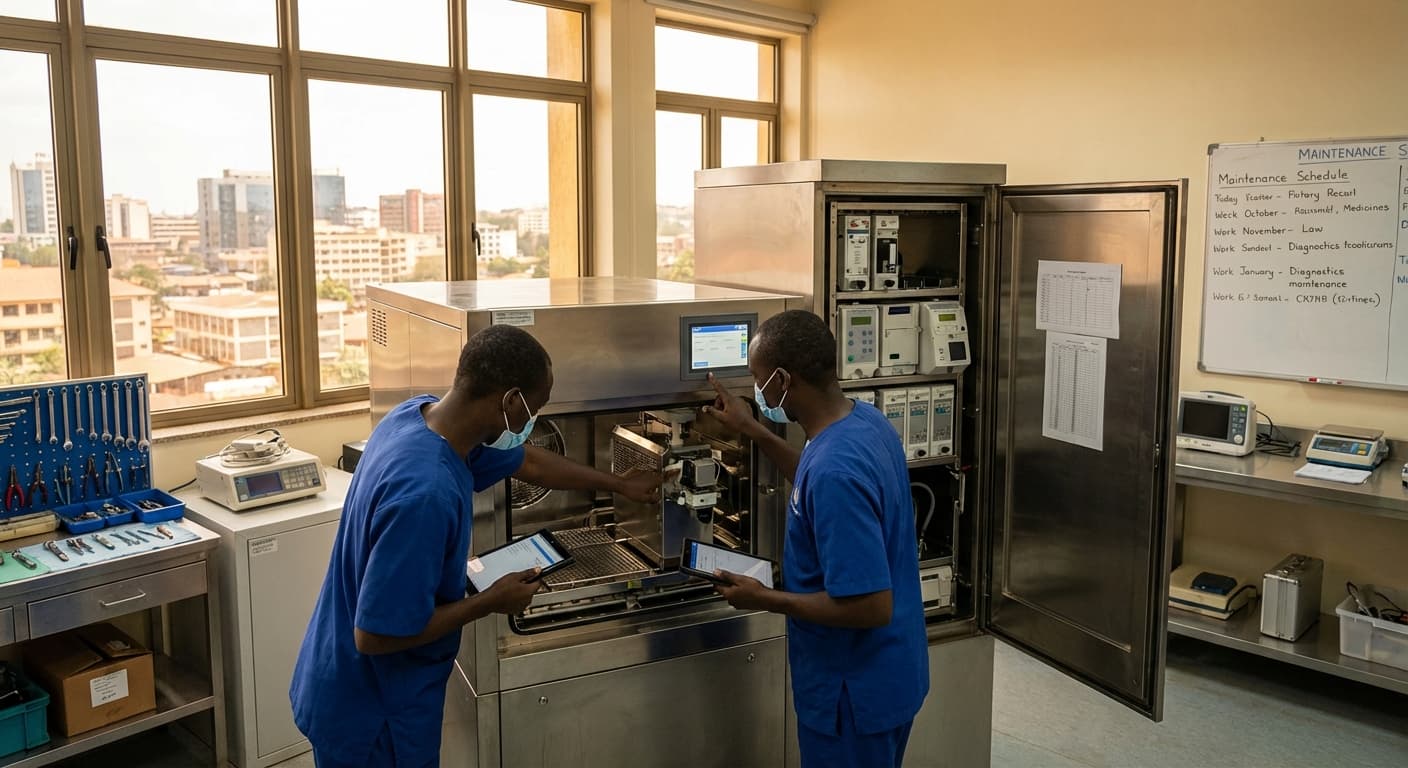
Total Cost of Ownership (TCO) & Lifecycle Budgeting Service in Congo (Kinshasa)
Engineering Excellence & Technical Support
Total Cost of Ownership (TCO) & Lifecycle Budgeting Service High-standard technical execution following OEM protocols and local regulatory frameworks.
Predictive Cost Modeling for Infrastructure Projects
Leveraging advanced analytics and historical data specific to the Congolese market, our TCO service provides hyper-accurate predictive cost models for infrastructure projects. We analyze everything from initial procurement and construction to ongoing maintenance, energy consumption, and eventual decommissioning, ensuring predictable budgeting and mitigating unforeseen expenses in dynamic economic conditions.
Lifecycle Asset Performance & Risk Management
We go beyond initial investment to optimize the entire lifecycle of your assets in Kinshasa. Our service integrates real-time performance monitoring with comprehensive risk assessments for equipment and infrastructure, identifying potential failures, optimizing replacement cycles, and ensuring compliance with local regulations to minimize downtime and maximize operational efficiency throughout the asset's lifespan.
Strategic Procurement Optimization for Long-Term Value
Our TCO and Lifecycle Budgeting service scrutinizes procurement strategies in the Congolese context. We analyze supplier performance, market trends, and total cost of acquisition versus long-term operational benefits to secure the most advantageous terms for materials, equipment, and services, driving significant savings and enhancing the overall financial viability of your projects from inception to retirement.
What Is Total Cost Of Ownership (Tco) & Lifecycle Budgeting Service In Congo (Kinshasa)?
Total Cost of Ownership (TCO) and Lifecycle Budgeting services in Congo (Kinshasa) represent a comprehensive financial management approach focused on evaluating the full economic impact of acquiring, operating, maintaining, and eventually disposing of an asset or system over its entire useful life. This methodology transcends the initial purchase price to encompass all direct and indirect costs. TCO analysis provides a more accurate understanding of financial commitments, enabling informed decision-making and strategic resource allocation for organizations operating within the Congolese economic landscape.
| Who Needs TCO & Lifecycle Budgeting Services? | Typical Use Cases in Congo (Kinshasa) |
|---|---|
| Government Agencies and Public Sector Entities (e.g., ministries, state-owned enterprises): For managing public funds, infrastructure projects, and technology procurements to ensure long-term value for money and accountability. | Procurement and capital expenditure planning for large infrastructure projects (e.g., roads, power plants, telecommunications networks). Evaluating the long-term financial viability of public service delivery systems. Strategic IT investment decisions for government digital transformation initiatives. |
| Large Corporations and Multinational Companies: For optimizing operational expenses, managing risk, and making strategic investment decisions in assets, technology, and facilities. | Fleet management optimization (vehicles, heavy machinery) considering fuel, maintenance, and depreciation. Evaluating the TCO of IT infrastructure (servers, networks, software) to select the most cost-effective solutions. Real estate and facility management, including operational costs, maintenance, and potential renovations or expansions. |
| Non-Governmental Organizations (NGOs) and Development Agencies: To maximize the impact of donor funds and ensure the sustainability of programs and projects. | Project planning and budgeting for development initiatives requiring significant asset investment. Evaluating the cost-effectiveness of different operational models and technological solutions for program delivery. Long-term financial planning for program sustainability and expansion. |
| Industrial and Manufacturing Sector: For managing production assets, supply chains, and operational efficiency. | Capital investment decisions for new machinery and production lines. Optimizing maintenance strategies for critical industrial equipment. Supply chain logistics analysis and cost optimization. |
| Resource Extraction and Mining Companies: For managing high-value, long-lifecycle assets in challenging environments. | Capital budgeting for exploration, extraction, and processing equipment. Operational cost management for remote sites, including logistics, power, and maintenance. Environmental remediation and asset decommissioning planning. |
Key Components of TCO & Lifecycle Budgeting Services
- Acquisition Costs: Includes purchase price, shipping, installation, licensing, and initial configuration.
- Operating Costs: Encompasses consumables, utilities (electricity, water), software subscriptions, and personnel directly involved in operation.
- Maintenance and Support Costs: Covers routine maintenance, repairs, warranty services, technical support contracts, and spare parts.
- Upgrade and Enhancement Costs: Budgets for planned upgrades, system enhancements, and feature additions to maintain relevance and performance.
- Downtime and Productivity Loss: Quantifies the economic impact of system failures, planned outages, and reduced operational efficiency.
- Decommissioning and Disposal Costs: Includes costs associated with retirement, data sanitization, environmental compliance, and asset disposal or resale.
- Training and Skill Development: Accounts for the cost of training personnel on new systems or technologies.
- Financing Costs: Includes interest payments on loans or leasing arrangements.
Who Needs Total Cost Of Ownership (Tco) & Lifecycle Budgeting Service In Congo (Kinshasa)?
In Congo (Kinshasa), understanding the true cost of an asset or project over its entire lifespan is crucial for efficient financial management and strategic decision-making. Total Cost of Ownership (TCO) and Lifecycle Budgeting services provide this essential insight, helping organizations move beyond initial purchase prices to account for all associated expenses. This ensures more accurate budgeting, better investment choices, and optimized operational efficiency, ultimately contributing to long-term financial health and sustainability within the Congolese market.
| Target Customers | Key Departments Requiring the Service |
|---|---|
| Large Enterprises (Mining, Oil & Gas, Telecommunications, Manufacturing) | Finance/Accounting, Procurement, Operations, Asset Management, Capital Planning, Engineering |
| Public Sector (Government Ministries, State-Owned Enterprises) | Treasury, Planning & Budgeting, Public Works, Infrastructure Development, Sector-Specific Ministries (e.g., Health, Education) |
| International Organizations & NGOs | Finance, Program Management, Logistics & Procurement, Operations |
| Infrastructure Developers & Construction Companies | Project Management, Finance, Estimating, Operations, Asset Management |
| Financial Institutions (Banks, Investment Firms) | Risk Management, Investment Analysis, Corporate Finance, Asset Management |
Who Needs TCO & Lifecycle Budgeting Service in Congo (Kinshasa)?
- Businesses and organizations operating in Congo (Kinshasa) that invest in significant assets or undertake complex projects.
- Government agencies responsible for public infrastructure and service delivery.
- Non-governmental organizations (NGOs) managing donor-funded projects and sustainable development initiatives.
- Companies in sectors with high capital expenditure and long asset lifecycles.
- Any entity seeking to improve financial predictability, optimize resource allocation, and mitigate long-term financial risks.
Total Cost Of Ownership (Tco) & Lifecycle Budgeting Service Process In Congo (Kinshasa)
This document outlines the service process for Total Cost of Ownership (TCO) and Lifecycle Budgeting in Congo (Kinshasa). Our service is designed to provide clients with a comprehensive understanding of the long-term financial implications of their assets and projects, enabling informed decision-making and strategic financial planning. The workflow is structured to ensure clarity, collaboration, and accurate delivery.
| Stage | Description | Key Activities | Deliverables | Timeline (Approximate) |
|---|---|---|---|---|
| The client expresses interest in TCO & Lifecycle Budgeting services. | Initial contact, understanding client's general needs and objectives. Scheduling a preliminary meeting. | Confirmation of interest, initial understanding of client requirements. | 1-3 Business Days |
| Defining the specific assets, projects, or systems to be analyzed and the depth of the study. | Detailed discussion of client's assets/projects, identifying key stakeholders, outlining specific objectives, defining the scope of work, preparing a formal proposal with methodology, timeline, and cost. | Signed Service Agreement, detailed Scope of Work (SOW), Project Plan. | 3-7 Business Days |
| Gathering all relevant financial, operational, and technical data pertaining to the asset/project lifecycle. | Collecting historical costs (acquisition, operation, maintenance, disposal), performance data, anticipated upgrades, regulatory requirements, and market trends. Data validation and quality assurance. | Validated dataset for TCO & Lifecycle Budgeting analysis. | 7-21 Business Days (highly dependent on data availability and complexity) |
| Developing a robust model to forecast all costs associated with the asset/project over its entire lifespan. | Building financial models incorporating direct and indirect costs, risk factors, inflation, discount rates, and potential revenue streams. Scenario planning and sensitivity analysis. | Developed TCO & Lifecycle Budgeting model, initial cost projections. | 7-14 Business Days |
| Communicating the findings, insights, and recommendations to the client. | Generating comprehensive reports detailing TCO, lifecycle costs, key cost drivers, risk assessments, and strategic recommendations. Presenting findings to client stakeholders, answering questions, and facilitating discussion. | Final TCO & Lifecycle Budgeting Report, Presentation Deck. | 5-10 Business Days |
| Assisting the client in integrating the TCO findings into their decision-making processes and operational plans. | Providing guidance on implementing recommendations, supporting strategic asset management, and conducting periodic reviews of the model and actual costs against projections. | Actionable insights integrated into client's strategies, revised models (if necessary). | Ongoing (as per client needs/agreement) |
| Formally concluding the engagement and ensuring client satisfaction. | Final review of deliverables, obtaining client feedback, archiving project documentation, and discussing potential future engagements. | Project Completion Sign-off, Client Satisfaction Survey. | 2-3 Business Days |
Service Workflow Stages
- Inquiry & Initial Consultation
- Scope Definition & Proposal Development
- Data Collection & Analysis
- TCO & Lifecycle Budgeting Model Creation
- Reporting & Presentation
- Implementation Support & Review
- Project Closure
Total Cost Of Ownership (Tco) & Lifecycle Budgeting Service Cost In Congo (Kinshasa)
Estimating the Total Cost of Ownership (TCO) and Lifecycle Budgeting for services in Congo (Kinshasa) involves a complex interplay of local market conditions, operational realities, and specific service requirements. TCO encompasses all direct and indirect costs associated with acquiring, operating, maintaining, and eventually retiring a service or asset over its entire lifespan. Lifecycle budgeting integrates these TCO considerations into long-term financial planning. Pricing factors are heavily influenced by the volatile economic environment, infrastructure challenges, and the availability of specialized skills and resources within the DRC.
| Cost Component Category | Estimated Pricing Range (CDF per annum) | Notes |
|---|---|---|
| Consulting & Planning (TCO/Lifecycle Assessment) | 5,000,000 - 30,000,000+ | Varies significantly based on the complexity of the assessment and the reputation of the consulting firm. Expatriate consultants will command higher fees. |
| Software Licensing & Acquisition (Annual Recurring) | 3,000,000 - 50,000,000+ | Highly dependent on the type of software (ERP, CRM, specialized industry software), number of users, and vendor. Cloud-based solutions may have different pricing structures (subscription). |
| Hardware Acquisition & Maintenance (Annualized) | 2,000,000 - 40,000,000+ | Includes servers, networking equipment, end-user devices. Maintenance contracts and potential replacement costs are factored in. Higher reliability requirements increase costs. |
| Implementation & Integration Services | 10,000,000 - 100,000,000+ | One-time cost, but can be spread over the initial project duration. Includes system setup, customization, and integration with other platforms. |
| Managed Services & Support (Monthly/Annual) | 4,000,000 - 60,000,000+ | Covers IT infrastructure management, helpdesk support, cybersecurity monitoring. Can be outsourced to local or international providers. |
| Personnel Costs (Internal Team Salaries & Benefits) | 7,000,000 - 80,000,000+ per FTE | Includes salaries for IT managers, system administrators, developers, etc. Expatriate staff will significantly increase this cost. |
| Training & Capacity Building (Project/Annual) | 1,000,000 - 15,000,000+ | Includes initial training for new systems and ongoing professional development for IT staff. |
| Contingency & Risk Mitigation | 5% - 15% of total TCO | Essential to account for unexpected issues, currency fluctuations, and unforeseen operational challenges. |
Key Pricing Factors for TCO & Lifecycle Budgeting Services in Congo (Kinshasa)
- Scope and Complexity of the Service: The more intricate and extensive the service, the higher the TCO. This includes the number of systems, integration points, and data volumes involved.
- Duration of the Lifecycle: Longer lifecycles naturally lead to higher cumulative costs, especially for ongoing maintenance, support, and eventual upgrades or replacements.
- Infrastructure and Technology: The cost of acquiring and maintaining the necessary hardware, software, and network infrastructure is a significant factor. This can be amplified by the need for robust, reliable systems in a challenging environment.
- Personnel and Expertise: The cost of skilled IT professionals, project managers, and specialized technicians (both local and expatriate) directly impacts the budget. Scarcity of certain skills can drive up salaries.
- Implementation and Integration Costs: This includes costs for initial setup, configuration, customization, and integration with existing systems.
- Maintenance and Support: Ongoing costs for software licenses, hardware maintenance contracts, technical support, and system monitoring are crucial.
- Training and Capacity Building: Investing in training local staff to manage and operate the service independently is essential for long-term sustainability and can be a significant upfront or ongoing cost.
- Security and Compliance: Implementing robust security measures and adhering to local and international compliance standards can add considerable costs, especially in a region with evolving regulatory frameworks.
- Logistics and Travel: For services requiring physical presence, site visits, or the deployment of equipment, logistics, transportation, and accommodation costs can be substantial.
- Inflation and Exchange Rate Volatility: The Congolese Franc (CDF) can experience significant fluctuations, and high inflation rates necessitate careful budgeting and contingency planning.
- Taxes and Duties: Applicable import duties, value-added tax (VAT), and other local taxes on goods and services will impact the overall cost.
- Vendor/Provider Selection: The reputation, experience, and pricing models of the service provider or vendor will play a crucial role. Local providers may offer lower rates but might have limitations in scope or expertise compared to international firms.
- Risk Mitigation: Costs associated with managing operational risks, potential disruptions, and ensuring business continuity need to be factored in.
Affordable Total Cost Of Ownership (Tco) & Lifecycle Budgeting Service Options
Our Affordable Total Cost of Ownership (TCO) & Lifecycle Budgeting services are designed to provide comprehensive financial visibility and control over your assets from acquisition to disposal. We understand that true cost savings extend far beyond the initial purchase price. Our approach integrates strategic planning, proactive maintenance, and informed decision-making to minimize expenses throughout an asset's entire lifespan. We offer flexible value bundles tailored to your specific needs, ensuring you receive maximum benefit without unnecessary expenditure. By leveraging our expertise, you can unlock significant cost reductions, optimize resource allocation, and achieve greater financial predictability.
| Cost-Saving Strategy | Description | TCO Impact | Typical Benefit |
|---|---|---|---|
| Predictive Maintenance | Utilizing data and analytics to anticipate and address potential equipment failures before they occur. | Reduces emergency repair costs, minimizes downtime, extends asset lifespan. | 15-30% reduction in maintenance expenditure. |
| Energy Efficiency Upgrades | Implementing technologies and practices that reduce energy consumption of assets. | Lowers operational utility costs, contributes to sustainability goals. | 10-25% reduction in energy bills. |
| Optimized Procurement | Leveraging bulk purchasing, strategic vendor negotiations, and competitive bidding. | Reduces acquisition costs, secures favorable terms for consumables and spare parts. | 5-15% reduction in capital and operational expenses. |
| Extended Asset Lifespan Management | Implementing robust maintenance, refurbishment, and upgrade programs. | Defers capital expenditure on replacement assets, maximizes return on investment. | Significant postponement of CapEx, improved ROI. |
| Strategic Disposal & Recycling | Planning for efficient and environmentally responsible end-of-life management of assets. | Recovers residual value, minimizes disposal fees, mitigates environmental liabilities. | Potential revenue generation, reduced landfill costs. |
| Lease vs. Buy Analysis | Carefully evaluating the financial implications of leasing versus purchasing assets based on usage patterns and depreciation. | Optimizes cash flow, reduces upfront capital investment, aligns costs with usage. | Variable, depending on asset type and usage. |
Key Value Bundles & Cost-Saving Strategies
- {"title":"Value Bundle 1: Foundational TCO Analysis & Planning","description":"This bundle provides a clear understanding of your current asset costs and establishes a baseline for future budgeting. It includes initial TCO modeling, identification of major cost drivers, and preliminary lifecycle budgeting recommendations."}
- {"title":"Value Bundle 2: Proactive Maintenance & Optimization","description":"Focuses on minimizing operational expenses through strategic maintenance planning. Includes predictive maintenance strategies, optimized repair schedules, and recommendations for extending asset life, thus deferring capital replacement costs."}
- {"title":"Value Bundle 3: Lifecycle Cost Reduction & Strategic Sourcing","description":"A comprehensive bundle aimed at reducing costs across the entire lifecycle. Involves deep dives into procurement strategies, vendor management, energy efficiency improvements, and end-of-life disposal optimization."}
- {"title":"Value Bundle 4: Integrated TCO & ESG Reporting","description":"Combines financial lifecycle management with Environmental, Social, and Governance (ESG) considerations. Identifies cost savings opportunities related to sustainability initiatives and provides reporting to meet stakeholder demands."}
Verified Providers In Congo (Kinshasa)
In the Democratic Republic of Congo (DRC), specifically in Kinshasa, ensuring access to reliable and high-quality healthcare is paramount. When seeking medical assistance, it is crucial to identify verified providers who meet stringent standards. Franance Health has emerged as a leading name in this regard, offering a suite of credentials and services that position them as the best choice for many seeking healthcare solutions in Kinshasa. This document outlines Franance Health's credentials and highlights the reasons for their superior standing.
| Criteria | Franance Health Advantage | Why it Matters for Patients in Kinshasa |
|---|---|---|
| Provider Verification | Meticulous vetting process including license and qualification checks. | Ensures you are seeing a legitimate and qualified medical professional, reducing risks associated with unqualified practitioners. |
| Quality of Care | Partnerships with accredited facilities and adherence to international standards. | Promises higher standards of treatment, patient safety, and hygiene, crucial in any healthcare setting. |
| Accessibility | Extensive network covering various medical specialties and locations within Kinshasa. | Simplifies finding the right specialist or facility for your specific medical needs, saving time and reducing stress. |
| Patient Support | Assistance with appointments, communication, and navigating the healthcare system. | Provides a guiding hand through complex medical processes, offering peace of mind and better patient outcomes. |
| Trust and Reliability | Commitment to transparency and building a dependable healthcare ecosystem. | Offers a reliable source of healthcare information and services, fostering confidence in the medical care received. |
Franance Health Credentials and Key Differentiators:
- Accreditation and Certifications: Franance Health partners with and supports facilities and professionals who hold recognized national and international accreditations. This ensures adherence to best practices in patient care, safety, and ethical conduct. (Specific accreditations may vary by facility, but a commitment to quality is a core principle.)
- Rigorous Provider Vetting: Unlike many general directories, Franance Health employs a robust vetting process for all affiliated healthcare providers. This includes verification of medical licenses, specialized training, professional history, and adherence to ethical guidelines.
- Comprehensive Service Network: Franance Health provides access to a wide spectrum of medical services, from general practitioners to highly specialized surgeons and diagnostic centers. This integrated approach simplifies the process of finding the right care for diverse health needs.
- Patient-Centric Approach: The organization prioritizes patient experience, offering support services that include appointment scheduling, facilitating communication between patients and providers, and assisting with understanding medical information and treatment plans.
- Technology Integration: Franance Health leverages technology to enhance the healthcare experience, including potential for telemedicine consultations, digital health records, and efficient referral systems, thereby improving accessibility and responsiveness.
- Focus on Transparency and Trust: By offering verified information and clear service descriptions, Franance Health builds trust and empowers patients to make informed decisions about their healthcare. This transparency is a cornerstone of their operation.
Scope Of Work For Total Cost Of Ownership (Tco) & Lifecycle Budgeting Service
This Scope of Work (SOW) outlines the services provided for a Total Cost of Ownership (TCO) and Lifecycle Budgeting assessment. The objective is to develop a comprehensive understanding of all costs associated with an asset, system, or project over its entire lifespan, enabling informed decision-making, strategic planning, and optimized resource allocation. The service will involve data collection, analysis, modeling, and reporting. The technical deliverables will include detailed TCO models, lifecycle budget forecasts, risk assessments, and actionable recommendations.
| Deliverable | Description | Format | Standard Specifications | |||
|---|---|---|---|---|---|---|
| TCO Model | A detailed quantitative model that quantifies all costs incurred over the asset's/system's/project's lifecycle, from acquisition to disposal. | Microsoft Excel spreadsheet or specialized TCO software | Clearly defined cost categories (e.g., acquisition, installation, operation, maintenance, repair, upgrades, decommissioning, disposal). | Time-phased cost breakdown over the defined lifecycle period. | Assumptions and data sources clearly documented. | Ability to perform sensitivity analysis for key cost drivers. |
| Lifecycle Budget Forecast | A projected budget outlining all anticipated expenditures over the defined lifecycle of the asset/system/project. | Microsoft Excel spreadsheet or financial reporting tool | Breakdown by year/period and by cost category. | Alignment with TCO model assumptions. | Inclusion of contingency planning for unforeseen events. | Presentation of cumulative and annual budget requirements. |
| Risk Assessment Report | An analysis of potential risks that could impact TCO and lifecycle budget, including their likelihood and potential financial consequences. | Microsoft Word document or PDF | Identification of key risk categories (e.g., technological obsolescence, operational failures, regulatory changes, market fluctuations). | Qualitative and quantitative assessment of risk impact. | Proposed mitigation strategies and their potential cost implications. | |
| Recommendations Report | Actionable insights and strategies to optimize TCO, improve budget accuracy, and manage lifecycle costs effectively. | Microsoft Word document or PDF | Prioritized list of recommendations based on potential cost savings, risk reduction, and strategic alignment. | Specific, measurable, achievable, relevant, and time-bound (SMART) recommendations. | Guidance on implementation and ongoing monitoring. | |
| Executive Summary Presentation | A high-level overview of the TCO analysis, key findings, and strategic recommendations for senior management. | Microsoft PowerPoint presentation or similar | Concise summary of TCO drivers and lifecycle budget requirements. | Highlight of critical risks and recommended mitigation strategies. | Focus on strategic implications and actionable next steps. |
Service Activities
- Project Kick-off and Requirements Gathering
- Data Collection and Validation (Historical, Current, and Projected)
- Cost Category Identification and Definition
- TCO Model Development (including direct, indirect, and hidden costs)
- Lifecycle Budget Forecasting (including capital expenditure, operating expenditure, and disposal costs)
- Risk Identification and Impact Assessment on TCO and Lifecycle Budget
- Scenario Analysis and Sensitivity Testing
- Development of Actionable Recommendations and Optimization Strategies
- Final Report Generation and Presentation
Service Level Agreement For Total Cost Of Ownership (Tco) & Lifecycle Budgeting Service
This Service Level Agreement (SLA) outlines the performance expectations, response times, and uptime guarantees for the Total Cost of Ownership (TCO) and Lifecycle Budgeting Service provided by [Your Company Name] to [Client Company Name]. This agreement aims to ensure the reliability, availability, and timely support of the TCO and Lifecycle Budgeting Service, enabling [Client Company Name] to effectively manage its asset investments and financial planning.
| Service Component | Response Time (Business Hours) | Uptime Guarantee |
|---|---|---|
| Critical Issues (e.g., system outage, complete inability to access TCO tools) | 1 Business Hour | 99.9% Monthly |
| High Severity Issues (e.g., major functionality defect impacting multiple users, inaccurate critical data reporting) | 2 Business Hours | 99.5% Monthly |
| Medium Severity Issues (e.g., minor functionality defect, performance degradation affecting a single user) | 4 Business Hours | 99.0% Monthly |
| Low Severity Issues (e.g., general inquiries, requests for information, minor enhancements) | 8 Business Hours | N/A (Best Effort) |
| New Report Generation/Data Analysis Requests | As per agreed project timelines | N/A (Service Delivery) |
| Scheduled Maintenance | Not applicable (advance notification provided) | N/A (Scheduled downtime excluded from uptime calculation) |
Scope of Services
- Provision of TCO calculation models and tools.
- Assistance with data collection and validation for TCO inputs.
- Development and maintenance of lifecycle cost estimates.
- Support for budget forecasting and scenario analysis.
- Regular reporting and performance reviews of TCO and lifecycle budgets.
- User training and documentation for the TCO and Lifecycle Budgeting Service.
Frequently Asked Questions

Ready when you are
Let's scope your Total Cost of Ownership (TCO) & Lifecycle Budgeting Service in Congo (Kinshasa) project in Congo (Kinshasa).

Scaling healthcare logistics and technical systems across the entire continent.