
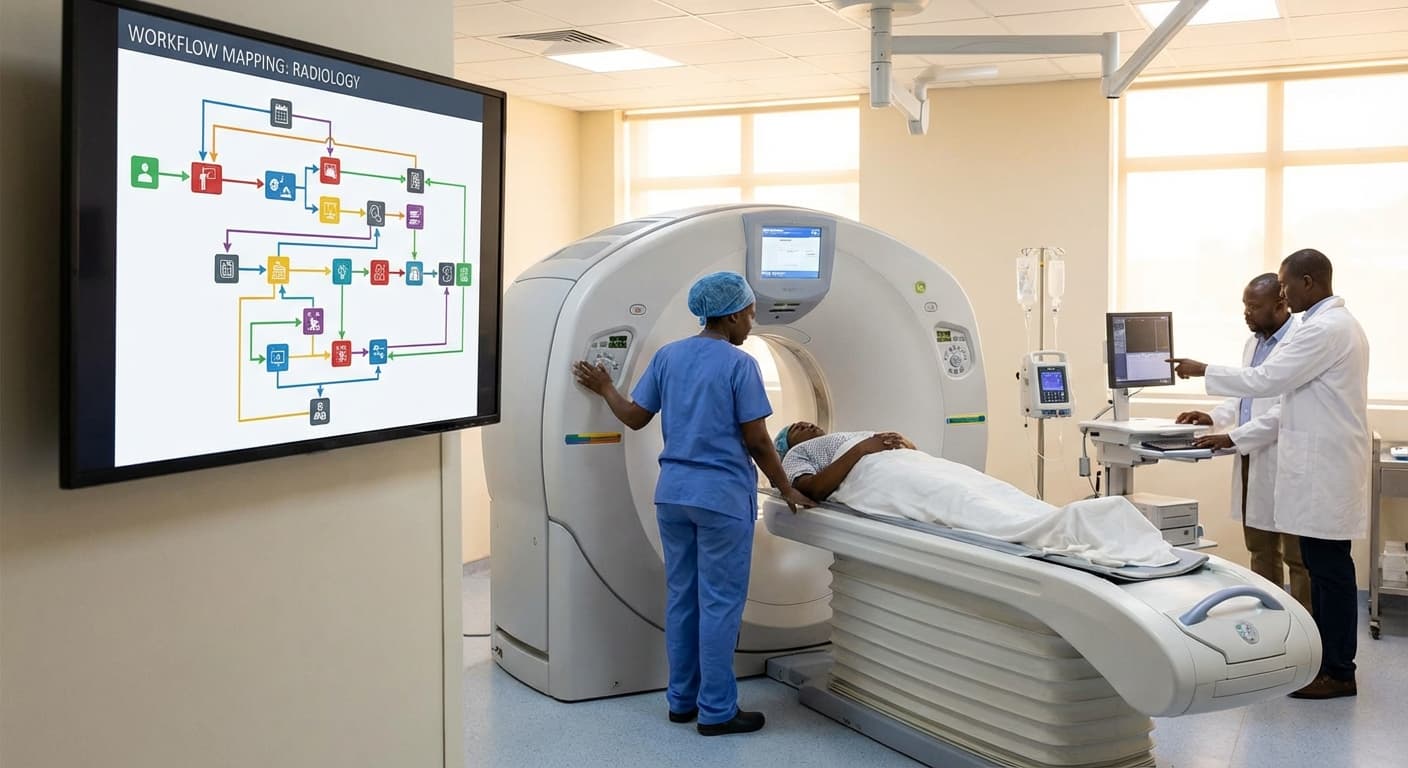
Department Workflow Mapping Service (Radiology/ICU/OT/Lab/Dialysis) in Congo (Kinshasa)
Engineering Excellence & Technical Support
Department Workflow Mapping Service (Radiology/ICU/OT/Lab/Dialysis) High-standard technical execution following OEM protocols and local regulatory frameworks.
Optimized Radiology Imaging Workflow
Streamlined patient journey from referral to report generation in Kinshasa's radiology departments, reducing turnaround times and improving diagnostic efficiency through clear, mapped processes for imaging acquisition, interpretation, and result delivery.
Enhanced ICU Patient Flow Management
Mapped critical care pathways within Kinshasa's ICUs, ensuring seamless patient transitions, optimized resource allocation (ventilators, staff), and improved coordination between medical teams for better patient outcomes.
Streamlined Operating Theater Scheduling & Logistics
Visualized and optimized the entire OT lifecycle in Kinshasa hospitals, from pre-operative patient preparation and scheduling to post-operative care, minimizing cancellations, maximizing OR utilization, and improving surgical team efficiency.
What Is Department Workflow Mapping Service (Radiology/icu/ot/lab/dialysis) In Congo (Kinshasa)?
Department Workflow Mapping Service in Congo (Kinshasa) refers to a specialized consulting and implementation process focused on systematically analyzing, documenting, and optimizing the operational processes within critical healthcare departments such as Radiology, Intensive Care Units (ICU), Operating Theatres (OT), Laboratories, and Dialysis Centers. This service employs methodologies to identify bottlenecks, inefficiencies, redundancies, and potential risks within existing workflows. The objective is to create a clear, visual representation of how tasks are performed, resources are utilized, and information flows, ultimately leading to enhanced efficiency, improved patient care quality, reduced costs, and better regulatory compliance. The service typically involves data collection through interviews, observations, process flowcharting, and analysis of existing documentation.
| Stakeholder Group | Needs Addressed | Typical Use Cases |
|---|---|---|
| Hospital Administration/Management | Improved operational efficiency, cost reduction, enhanced patient throughput, better resource allocation, strategic planning, quality improvement initiatives. | Identifying reasons for long patient wait times in Radiology; optimizing bed management and patient flow in the ICU; reducing surgical case cancellations in OT; increasing lab test turnaround times; streamlining patient scheduling in Dialysis. |
| Department Heads/Managers (Radiology, ICU, OT, Lab, Dialysis) | Standardization of procedures, increased staff productivity, improved communication, reduced errors, enhanced patient safety, compliance with standards. | Developing standardized protocols for image acquisition and reporting in Radiology; establishing clear escalation pathways for critical patients in ICU; defining pre-operative, intra-operative, and post-operative checklists in OT; implementing quality control measures in the Lab; optimizing dialysis session scheduling and patient monitoring. |
| Healthcare Professionals (Physicians, Nurses, Technicians) | Clearer understanding of roles and responsibilities, reduced administrative burden, improved access to information, safer patient care pathways, optimized use of specialized equipment. | Streamlining the referral process for imaging in Radiology; defining roles in managing ventilators and hemodynamic monitoring in ICU; improving communication between surgical teams and anesthesia in OT; ensuring accurate sample handling and reporting in the Lab; managing patient fluid balance and medication administration in Dialysis. |
| IT/Information Management Teams | Identification of opportunities for EMR/HIS integration, data standardization, digital transformation, improved data integrity and accessibility. | Mapping data entry points for diagnostic reports in Radiology; integrating patient monitoring data from ICU into EMR; digitalizing surgical logs and inventory in OT; automating lab requisition and result reporting; connecting dialysis machine data to patient records. |
| Regulatory Bodies/Accreditation Agencies | Demonstration of adherence to quality standards, safety protocols, and efficient operational management. | Providing documented evidence of standardized workflows for accreditation audits; showcasing patient safety initiatives through process mapping; ensuring compliance with infection control protocols in all departments. |
Key Components of Department Workflow Mapping Service
- Process Analysis and Documentation: Detailed mapping of all steps, decisions, and handoffs within a department's operations.
- Bottleneck Identification: Pinpointing areas of delay, underutilization, or excessive workload.
- Resource Optimization: Assessing the efficient allocation and utilization of personnel, equipment, and consumables.
- Information Flow Analysis: Tracing the movement of patient data, reports, and administrative information.
- Risk Assessment: Identifying potential failure points, safety hazards, and compliance gaps.
- Recommendations and Redesign: Proposing concrete strategies for process improvement, automation, and technological integration.
- Implementation Support: Assisting in the rollout of new workflows and providing training.
- Performance Monitoring: Establishing metrics and mechanisms for ongoing evaluation of workflow efficiency.
Who Needs Department Workflow Mapping Service (Radiology/icu/ot/lab/dialysis) In Congo (Kinshasa)?
A Department Workflow Mapping Service is crucial for optimizing operations, enhancing patient care, and improving efficiency within critical hospital departments in Congo (Kinshasa). By meticulously documenting and analyzing existing processes, healthcare facilities can identify bottlenecks, redundant steps, and areas for improvement. This leads to better resource allocation, reduced wait times, improved accuracy, and ultimately, better patient outcomes. This service is particularly vital in high-pressure environments like Radiology, Intensive Care Units (ICU), Operating Theatres (OT), Laboratories, and Dialysis Centers, where precision and speed are paramount.
| Target Customer/Institution | Key Departments Benefiting | Specific Needs Addressed |
|---|---|---|
| Public Hospitals (e.g., Hôpital Général de Kinshasa, Hôpital Universitaire de Kinshasa) | Radiology, ICU, OT, Lab, Dialysis | Addressing high patient volumes, limited resources, need for standardized protocols, improving turnaround times for diagnostics and treatment. |
| Private Hospitals and Clinics (e.g., Cliniques Ngaliema, Hôpital Mère et Enfant du Roi Baudouin) | Radiology, ICU, OT, Lab, Dialysis | Focusing on premium patient care, operational excellence, competitive advantage, staff efficiency, and revenue cycle management. |
| Tertiary Care Centers and Specialized Medical Facilities | Radiology, ICU, OT, Lab, Dialysis | Optimizing complex multi-disciplinary workflows, advanced diagnostic and therapeutic processes, research integration, and specialized patient pathways. |
| Non-Governmental Organization (NGO) Hospitals and Health Initiatives | Radiology, ICU, OT, Lab, Dialysis | Maximizing impact with limited budgets, ensuring efficient delivery of essential services, training local staff, and adapting to specific community health needs. |
| Emerging Healthcare Providers and New Hospital Developments | Radiology, ICU, OT, Lab, Dialysis | Establishing best practices from inception, designing efficient layouts and workflows, preventing future inefficiencies, and building a strong foundation for growth. |
Why is Department Workflow Mapping Essential in Congo (Kinshasa)?
- Improving operational efficiency and reducing costs.
- Enhancing patient safety and reducing medical errors.
- Optimizing resource utilization (staff, equipment, time).
- Streamlining communication and collaboration between departments.
- Facilitating training and onboarding of new staff.
- Ensuring compliance with regulatory standards.
- Identifying and mitigating risks.
- Boosting overall quality of patient care.
Department Workflow Mapping Service (Radiology/icu/ot/lab/dialysis) Process In Congo (Kinshasa)
This document outlines the workflow for the Department Workflow Mapping Service, specifically tailored for key departments within a healthcare facility in Congo (Kinshasa). The service aims to analyze and optimize operational processes within Radiology, Intensive Care Unit (ICU), Operating Theatre (OT), Laboratory, and Dialysis departments. The process begins with an initial inquiry and progresses through detailed analysis, mapping, recommendations, and final execution and reporting.
| Phase | Description | Key Activities | Deliverables/Outcomes |
|---|---|---|---|
| Initial contact and understanding of the client's needs regarding workflow mapping within specific departments. | Client expresses interest, initial meeting to define scope, identify target departments, discuss objectives and desired outcomes, preliminary assessment of existing documentation. | Scope of Work document, high-level project plan, identification of key stakeholders. |
| Gathering detailed information about the current state of operations within each mapped department. | Interviews with department staff (doctors, nurses, technicians, administrators), observation of daily operations, review of existing protocols and SOPs, collection of relevant data (e.g., patient flow, turnaround times, resource utilization, error rates). | Documented current state workflows (flowcharts, process diagrams), identification of bottlenecks, inefficiencies, and areas for improvement, qualitative and quantitative data summaries. |
| Translating collected data into visual representations of current and proposed future state workflows. | Developing detailed process maps and flowcharts for each department, identifying critical steps, decision points, and interdependencies, collaborating with stakeholders to validate current state maps, designing optimized future state workflows incorporating best practices and addressing identified issues. | Current State Workflow Maps, Proposed Future State Workflow Maps, identification of roles and responsibilities, proposed system or technology integration points (if applicable). |
| Formulating actionable recommendations for workflow improvement based on the mapped processes. | Analyzing future state maps for potential risks and benefits, developing specific, measurable, achievable, relevant, and time-bound (SMART) recommendations for process changes, resource allocation, training needs, and technology adoption, prioritizing recommendations based on impact and feasibility. | Detailed Recommendations Report, prioritized list of improvement initiatives, potential ROI analysis for key recommendations. |
| Developing a strategic plan for implementing the proposed workflow changes. | Creating a phased implementation plan with clear timelines, assigning responsibilities, developing change management strategies, identifying training requirements for staff, defining key performance indicators (KPIs) for monitoring progress. | Implementation Roadmap, Communication Plan, Training Plan, KPI Framework. |
| Overseeing the implementation of the new workflows and tracking their effectiveness. | Managing the rollout of new processes, providing support to departmental staff during the transition, collecting data on KPIs, conducting regular reviews to assess progress and identify any deviations from the plan. | Implemented workflows, performance data against KPIs, issue logs, progress reports. |
| Summarizing the project findings, outcomes, and providing final documentation. | Compiling a comprehensive final report detailing the entire process, the implemented changes, achieved results, and lessons learned, presenting the findings to stakeholders, formally handing over all project documentation. | Final Project Report, updated SOPs (if applicable), post-implementation review, project closure documentation. |
Key Departments Covered
- Radiology
- Intensive Care Unit (ICU)
- Operating Theatre (OT)
- Laboratory
- Dialysis
Department Workflow Mapping Service (Radiology/icu/ot/lab/dialysis) Cost In Congo (Kinshasa)
Estimating the cost of Department Workflow Mapping Services in Congo (Kinshasa) for departments like Radiology, ICU, OT (Operating Theatre), Lab, and Dialysis requires a nuanced understanding of local economic conditions, service provider expertise, and the specific scope of work. These services involve analyzing existing processes, identifying bottlenecks, recommending improvements, and often implementing new workflows to enhance efficiency, patient safety, and resource utilization. Pricing is not standardized and will vary significantly based on several key factors.
| Department Type | Estimated Cost Range (CDF - Congolese Francs) | Notes on Range |
|---|---|---|
| Radiology | 1,500,000 - 5,000,000 | Covers from basic imaging services to advanced modalities. Includes patient flow, equipment utilization, reporting turnaround times. |
| ICU (Intensive Care Unit) | 2,500,000 - 8,000,000 | High complexity due to critical care, specialized equipment, multidisciplinary teams, and patient monitoring. Focus on rapid response and patient outcomes. |
| OT (Operating Theatre) | 2,000,000 - 7,000,000 | Encompasses pre-operative, intra-operative, and post-operative phases. Includes scheduling, room utilization, instrument sterilization, and staffing. |
| Laboratory | 1,000,000 - 4,000,000 | Ranges from general pathology to specialized diagnostics. Focus on sample handling, testing turnaround, quality control, and result reporting. |
| Dialysis | 1,200,000 - 4,500,000 | Includes patient scheduling, machine utilization, treatment protocols, and staff-patient ratios. Emphasis on patient safety and treatment efficacy. |
Key Pricing Factors for Workflow Mapping Services in Congo (Kinshasa)
- Service Provider Expertise and Reputation: Well-established consultants or firms with a proven track record in healthcare process improvement, particularly within the Congolese context, will command higher fees.
- Scope and Complexity of the Department(s): Mapping the workflow for a highly specialized and complex department like the ICU will naturally be more time-consuming and costly than for a smaller, less intricate lab section. The number of sub-processes, staff involved, and interconnectedness of systems all contribute to complexity.
- Duration of the Engagement: The length of time required for assessment, analysis, recommendation development, and potential implementation support will directly impact the overall cost. Shorter, focused projects will be less expensive than comprehensive, multi-phase engagements.
- Geographic Location within Kinshasa: While Kinshasa is the capital, travel and logistical considerations for service providers to reach specific hospitals or clinics within the city can influence costs.
- Data Collection and Analysis Methods: The intensity of data collection (e.g., direct observation, interviews, surveys, system data extraction) and the sophistication of the analytical tools used will affect pricing. Advanced simulation or modeling will increase costs.
- Deliverables Required: The nature of the final outputs – basic reports, detailed process diagrams, standard operating procedures (SOPs), training materials, or implementation plans – will influence the cost.
- Client's Existing Documentation and Preparedness: If the healthcare facility has some existing process documentation, it can expedite the mapping process and potentially reduce costs. Conversely, starting from scratch will be more resource-intensive.
- Regulatory and Compliance Requirements: Understanding and incorporating specific Congolese healthcare regulations and quality standards into the workflow design will add to the complexity and cost.
- Technology Integration: If the workflow mapping involves the integration or optimization of specific healthcare IT systems (e.g., HIS, LIS, RIS, PACS), this can be a significant cost driver.
- Currency Exchange Rate Fluctuations: While pricing is often quoted in Congolese Francs (CDF), the stability of the exchange rate against major currencies can influence how international consultants price their services or how local businesses factor in potential import costs for tools or software.
Affordable Department Workflow Mapping Service (Radiology/icu/ot/lab/dialysis) Options
Our Affordable Department Workflow Mapping Service offers a comprehensive solution for optimizing operational efficiency across critical hospital departments. By meticulously analyzing and visualizing your existing workflows in Radiology, ICU, Operating Theatre (OT), Laboratory, and Dialysis, we identify bottlenecks, redundancies, and areas for improvement. This service is designed to be cost-effective, delivering significant ROI through streamlined processes, reduced waste, and enhanced patient care. We offer flexible value bundles tailored to your specific departmental needs and budget, coupled with proven cost-saving strategies to maximize your investment.
| Value Bundle | Included Services | Target Department(s) | Key Cost-Saving Strategies Enabled | Estimated Price Range (USD) |
|---|---|---|---|---|
| Essential Mapping | Core workflow mapping for one primary department, bottleneck identification, initial recommendations. | Radiology, Lab, Dialysis (Choose One) | Reduced waiting times, optimized equipment utilization, minimized manual data entry. | $2,500 - $5,000 |
| Integrated Department | Workflow mapping for up to two interconnected departments (e.g., ICU & OT, Lab & Dialysis), detailed analysis, phased implementation plan. | Radiology/ICU/OT/Lab/Dialysis (Choose Two) | Improved patient flow between departments, reduced equipment sharing conflicts, enhanced interdisciplinary communication. | $4,500 - $9,000 |
| Comprehensive Optimization | Full workflow mapping across three or more departments, root cause analysis, SOP development, change management framework, benchmarking. | Radiology, ICU, OT, Lab, Dialysis (Choose Three or More) | Significant reduction in operational costs through automation, waste minimization, improved staff productivity, enhanced resource allocation. | $8,000 - $15,000+ |
| Custom Solutions | Tailored packages based on specific departmental needs, complexity, and desired outcomes. Includes all levels of service. | All Departments | Highly specific cost savings aligned with unique departmental challenges and strategic goals. | Quote-Based |
Key Features and Benefits
- Detailed workflow visualization using industry-standard notation (e.g., BPMN).
- Identification of bottlenecks, inefficiencies, and resource utilization gaps.
- Recommendations for process optimization and standardization.
- Development of standard operating procedures (SOPs) for key workflows.
- Training and change management support for implementation.
- Customizable service packages for individual or multiple departments.
- Focus on enhancing patient safety, turnaround times, and staff satisfaction.
- Scalable solutions to accommodate varying department sizes and complexities.
Verified Providers In Congo (Kinshasa)
Navigating healthcare in a new or unfamiliar country can be daunting. In Congo (Kinshasa), finding reliable and credentialed healthcare providers is crucial for ensuring quality care and peace of mind. Franance Health stands out as a premier choice due to its rigorous vetting process and commitment to excellence. This document outlines why verified providers, particularly those associated with Franance Health, represent the best option for individuals and organizations seeking healthcare services in the region.
| Provider Aspect | Franance Health Verification Process | Why It Matters for You |
|---|---|---|
| Medical Licenses and Certifications | Franance Health independently verifies all professional licenses and certifications with relevant medical boards and issuing authorities. | Ensures you are treated by a legitimately qualified and licensed medical professional. |
| Educational Background and Training | We confirm the authenticity of educational degrees and specialized training from recognized institutions. | Guarantees that your provider possesses the necessary theoretical knowledge and practical skills. |
| Professional Experience and References | Franance Health may conduct background checks and solicit references from previous employers or professional colleagues where applicable and permissible. | Provides assurance of a provider's history of competence and ethical practice. |
| Language Proficiency and Cultural Competency | While not always a primary verification point, Franance Health prioritizes providers who can communicate effectively and understand cultural nuances relevant to patient care in Kinshasa. | Enhances patient-provider communication and builds trust, leading to better health outcomes. |
| Adherence to Ethical Standards | Through our vetting, we aim to associate with providers who uphold high ethical standards in patient care and professional conduct. | Offers peace of mind that you will receive compassionate and professional medical treatment. |
Key Benefits of Choosing Verified Providers
- Ensured Professional Qualifications: Verified providers have their medical licenses, certifications, and educational backgrounds meticulously checked.
- Adherence to International Standards: Many verified providers in Kinshasa are trained or have experience in international healthcare systems, ensuring a higher standard of care.
- Patient Safety and Trust: Verification significantly reduces the risk of encountering unqualified practitioners, fostering a safer environment for patients.
- Access to Specialized Care: Verified networks often include specialists across various medical disciplines, catering to diverse healthcare needs.
- Streamlined Access and Coordination: Working with a reputable verification body like Franance Health can simplify the process of finding and accessing care, including coordination with insurance or employer benefits.
Scope Of Work For Department Workflow Mapping Service (Radiology/icu/ot/lab/dialysis)
This Scope of Work (SOW) outlines the services to be provided for a Department Workflow Mapping Service, focusing on critical healthcare departments: Radiology, Intensive Care Unit (ICU), Operating Theatre (OT), Laboratory, and Dialysis. The objective is to comprehensively document and analyze existing workflows within these departments to identify inefficiencies, bottlenecks, and areas for improvement. This service will deliver detailed workflow maps, process analyses, and recommendations for optimization. The technical deliverables will adhere to standard specifications ensuring clarity, consistency, and actionable insights.
| Department | Key Workflows to Map (Examples) | Primary Stakeholders for Input | Key Deliverables per Department |
|---|---|---|---|
| Radiology | Patient Registration & Scheduling, Image Acquisition (X-ray, CT, MRI, Ultrasound), Image Interpretation & Reporting, Image Archiving & Retrieval, Contrast Media Management, Equipment Maintenance & Calibration, Billing & Coding. | Radiologists, Technologists, Radiographers, Department Managers, IT Support, Front Desk Staff, Billing Department. | Detailed Process Flow Diagrams (Visio/Lucidchart), Data Flow Diagrams, Stakeholder Analysis, Bottleneck Identification Report, Initial Recommendations Report. |
| Intensive Care Unit (ICU) | Patient Admission & Triage, Monitoring & Vital Sign Management, Medication Administration, Ventilator Management, Procedures (e.g., central line insertion, intubation), Rounds & Handovers, Communication Protocols (inter-disciplinary), Discharge Planning, Equipment Sterilization & Management. | Intensivists, Critical Care Nurses, Respiratory Therapists, Pharmacists, Biomedical Engineers, Unit Managers, Social Workers. | Detailed Process Flow Diagrams, Swimlane Diagrams, RACI Charts, Critical Path Analysis, Risk Assessment Matrix, Improvement Opportunity Report. |
| Operating Theatre (OT) | Pre-operative Patient Preparation, Surgical Scheduling, Patient Transfer to OT, Anesthesia Induction, Surgical Procedure Execution, Post-operative Patient Transfer, Instrument Sterilization & Management, Sterilization Cycle Monitoring, OR Room Turnover, Inventory Management (supplies, implants). | Surgeons, Anesthesiologists, Scrub Nurses, Circulating Nurses, Surgical Technicians, OR Managers, Biomedical Engineers, Central Sterile Supply Department (CSSD) Staff. | Process Flow Diagrams, Value Stream Maps, Time Studies (where applicable), Resource Allocation Analysis, Efficiency Metrics Baseline, Recommendation for Standard Operating Procedures (SOPs). |
| Laboratory | Specimen Collection & Handling, Specimen Reception & Registration, Sample Processing (e.g., centrifugation, aliquotting), Test Analysis (e.g., hematology, chemistry, microbiology), Quality Control Procedures, Result Validation & Reporting, Equipment Calibration & Maintenance, Inventory Management (reagents, consumables), LIMS Interaction. | Pathologists, Medical Technologists, Laboratory Technicians, Phlebotomists, Lab Managers, IT Support (LIMS), Procurement Staff. | Process Flow Diagrams, Data Flow Diagrams, Queue Analysis, Turnaround Time (TAT) Analysis, Quality Assurance Checklist, Recommendations for Automation & Integration. |
| Dialysis | Patient Pre-treatment Assessment, Scheduling & Patient Flow Management, Patient Preparation for Dialysis, Dialysis Procedure (Hemodialysis/Peritoneal Dialysis), Equipment Setup & Disinfection, Water Treatment System Operation, Post-treatment Care, Dialysis Record Keeping, Machine Maintenance & Troubleshooting, Waste Management. | Nephrologists, Dialysis Nurses, Dialysis Technicians, Biomedical Engineers, Unit Managers, Patients (for feedback where appropriate), Water Treatment Specialists. | Process Flow Diagrams, Swimlane Diagrams, Risk Assessment for Procedure Steps, Equipment Utilization Analysis, Patient Safety Point Identification, Recommendations for Workflow Standardization & Technology Adoption. |
Objectives
- To accurately document the current state of all significant workflows within Radiology, ICU, OT, Laboratory, and Dialysis departments.
- To identify critical touchpoints, decision points, and potential points of failure within each mapped workflow.
- To analyze the efficiency and effectiveness of existing processes, identifying bottlenecks, redundancies, and areas of waste.
- To facilitate a shared understanding of departmental operations across stakeholders.
- To provide data-driven recommendations for process improvement, technology integration, and resource optimization.
- To establish a baseline for future performance monitoring and continuous improvement initiatives.
Service Level Agreement For Department Workflow Mapping Service (Radiology/icu/ot/lab/dialysis)
This Service Level Agreement (SLA) outlines the guaranteed response times and uptime for the Department Workflow Mapping Service, specifically designed for Radiology, Intensive Care Unit (ICU), Operating Theatre (OT), Laboratory, and Dialysis departments. This SLA ensures consistent and reliable performance of the workflow mapping tools and associated support.
| Service Component | Uptime Guarantee | Response Time (Critical Incident) | Response Time (Standard Request) | Downtime Notification |
|---|---|---|---|---|
| Core Workflow Mapping Application | 99.9% | 1 hour | 4 business hours | Minimum 48 hours for scheduled maintenance; immediate notification for unscheduled downtime. |
| Data Synchronization and Integration (with EMR/LIS/RIS) | 99.5% | 2 hours | 8 business hours | Minimum 48 hours for scheduled maintenance; immediate notification for unscheduled downtime. |
| User Support & Helpdesk | N/A (Service Availability) | 1 business hour (acknowledgement) | 4 business hours (acknowledgement) | N/A |
| Reporting & Analytics Module | 99.8% | 2 hours | 8 business hours | Minimum 48 hours for scheduled maintenance; immediate notification for unscheduled downtime. |
Service Scope and Definitions
- Department Workflow Mapping Service: Refers to the provision, maintenance, and support of the digital tools and processes used to map, analyze, and optimize workflows within the specified hospital departments.
- Radiology: Includes all imaging and interventional radiology procedures.
- ICU (Intensive Care Unit): Encompasses critical care patient management.
- OT (Operating Theatre): Covers surgical procedures and related pre- and post-operative processes.
- Lab (Laboratory): Pertains to all laboratory testing and analysis services.
- Dialysis: Includes hemodialysis and peritoneal dialysis services.
- Uptime: The percentage of time the Service is operational and accessible to authorized users.
- Response Time: The maximum time allowed for the system to acknowledge and begin addressing a reported issue or fulfilling a service request.
- Downtime: Any period during which the Service is unavailable to authorized users due to planned maintenance or unplanned incidents.
- Scheduled Maintenance: Planned periods of unavailability for system updates, upgrades, or maintenance. Advance notice will be provided.
Frequently Asked Questions

Ready when you are
Let's scope your Department Workflow Mapping Service (Radiology/ICU/OT/Lab/Dialysis) in Congo (Kinshasa) project in Congo (Kinshasa).

Scaling healthcare logistics and technical systems across the entire continent.