
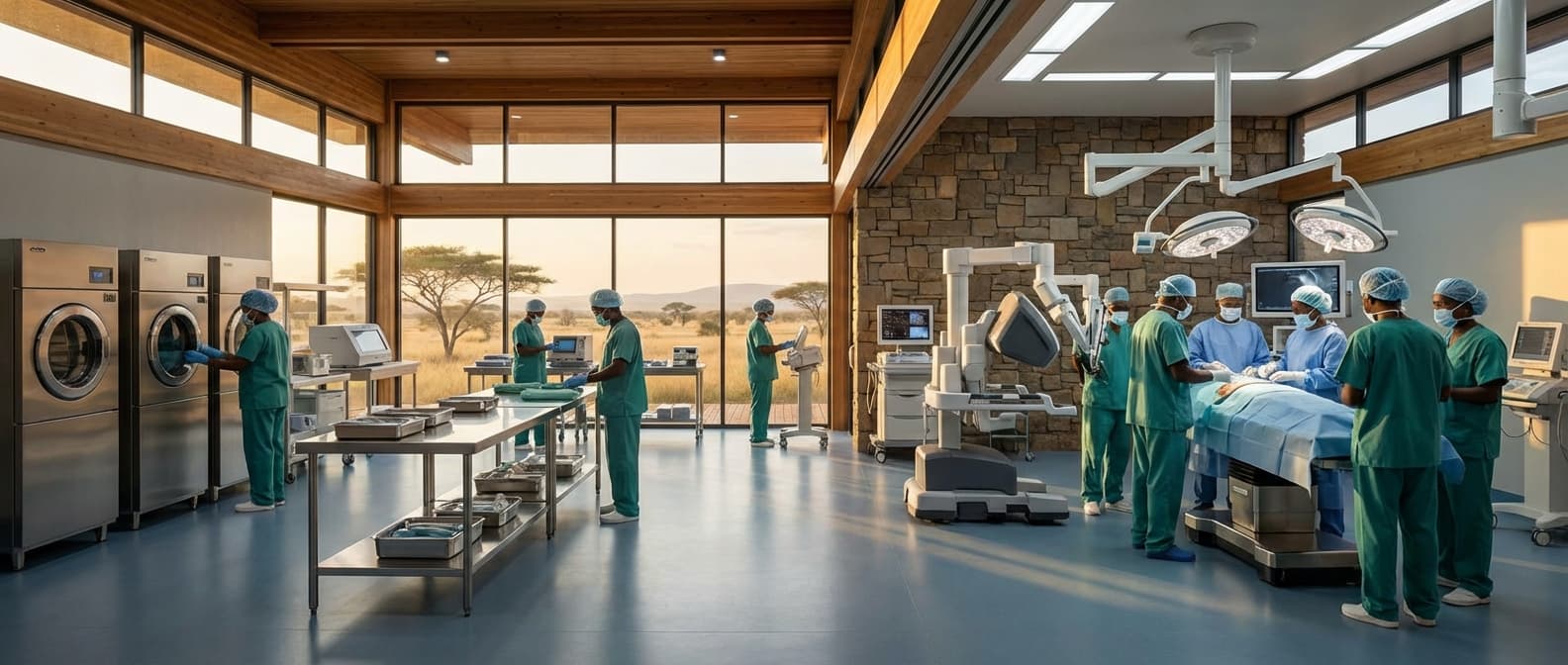
Operating Theatre Turnkey Build in Congo (Kinshasa)
Engineering Excellence & Technical Support
Complete OR design, equipment integration and commissioning High-standard technical execution following OEM protocols and local regulatory frameworks.
Robust Infection Control Systems
Implemented advanced HEPA filtration and negative pressure HVAC systems, exceeding international standards to ensure sterile environments, minimize airborne contamination, and protect both patients and surgical teams within the challenging Kinshasa climate.
Integrated Medical Gas Infrastructure
Designed and installed a fully redundant, piped medical gas system (oxygen, medical air, vacuum) with integrated alarms and emergency backup, guaranteeing reliable and continuous supply essential for critical life support during complex surgeries, even in areas with inconsistent power grids.
Site-Specific Structural Resilience
Engineered the operating theatre structure to withstand local seismic considerations and environmental factors, utilizing reinforced concrete and specialized foundation techniques to guarantee long-term stability and operational safety for this critical healthcare facility.
What Is Operating Theatre Turnkey Build In Congo (Kinshasa)?
An Operating Theatre Turnkey Build in Congo (Kinshasa) refers to the complete, end-to-end provision and construction of a fully functional surgical suite, from initial design and planning through to commissioning and handover. This service encompasses all aspects of creating a sterile, technologically advanced, and compliant operating environment. It involves the integration of architectural design, specialized medical equipment, sophisticated HVAC and air filtration systems, robust electrical and plumbing infrastructure, lighting, and safety features, all delivered as a single, integrated solution ready for immediate use. The 'turnkey' nature signifies that the client receives a completed facility requiring minimal further input beyond its initial specification.
| Who Needs It? | Typical Use Cases | ||||||
|---|---|---|---|---|---|---|---|
| Hospitals (Public & Private): Established healthcare facilities requiring upgrades or new surgical capacity. | Establishment of new hospitals or clinics with dedicated surgical departments. | Expansion of existing healthcare infrastructure to accommodate increased surgical demand. | Government health ministries seeking to improve healthcare access and quality in underserved regions. | Non-governmental organizations (NGOs) involved in humanitarian healthcare initiatives. | Military field hospitals or medical units requiring deployable or rapidly installable surgical facilities. | Research institutions with a need for specialized surgical suites for experimental procedures. | |
| General Surgery | Orthopedic Surgery | Cardiothoracic Surgery | Neurosurgery | Ophthalmology | Gynecology & Obstetrics | Emergency Surgery | Minimally Invasive Surgery (Laparoscopic, Endoscopic) |
Key Components of an Operating Theatre Turnkey Build:
- Architectural Design & Planning: Site assessment, layout optimization, compliance with international healthcare standards (e.g., ISO, local regulations).
- Civil Works & Construction: Building the physical structure, including walls, flooring, ceilings, and ensuring appropriate structural integrity.
- Medical Gas Systems: Installation of oxygen, medical air, vacuum, and nitrous oxide supply lines, complete with regulators and alarms.
- HVAC & Air Filtration: Design and implementation of specialized ventilation systems to maintain positive pressure, control air changes per hour (ACH), and achieve HEPA filtration for sterile environments.
- Electrical Systems: Redundant power supplies, emergency generators, uninterruptible power supplies (UPS), specialized lighting, and grounding.
- Surgical Lighting: Installation of advanced, shadowless, and adjustable surgical light fixtures.
- Monitoring & Control Systems: Integration of patient monitoring equipment, audiovisual systems for recording/teaching, and centralized control panels.
- Sterilization Equipment: Provision and installation of autoclaves and other necessary sterilization units.
- Specialized Furniture & Fixtures: Surgical instrument trolleys, sterile storage cabinets, scrub sinks, and durable, easy-to-clean surfaces.
- Commissioning & Validation: Thorough testing of all systems to ensure optimal performance, safety, and compliance with operational requirements.
- Training: On-site training for medical and technical staff on the operation and maintenance of installed equipment and systems.
Who Needs Operating Theatre Turnkey Build In Congo (Kinshasa)?
In the heart of Kinshasa, a city rapidly developing yet facing persistent healthcare infrastructure challenges, the demand for specialized medical facilities like operating theatres is paramount. A 'turnkey' solution – a complete, ready-to-use operating theatre facility built from scratch – offers a comprehensive and efficient approach to addressing critical healthcare needs. This service is crucial for entities aiming to rapidly enhance surgical capacity and improve patient outcomes without the complexities of managing multiple construction and installation phases independently.
| Target Customer/Entity | Primary Departments/Needs | Key Benefits of Turnkey Solution |
|---|---|---|
| Existing Hospitals (Public & Private) | Surgical Departments (General Surgery, Orthopedics, Gynecology, Urology, ENT) Expansion/Upgrade Needs: Outdated facilities, increased patient volume, need for specialized procedures. Benefits: Rapid deployment of modern surgical capacity, improved infection control, enhanced patient safety, compliance with international standards, minimal disruption to ongoing hospital operations. | Accelerated Project Completion: Get a state-of-the-art operating theatre operational much faster than traditional construction. Single Point of Responsibility: Simplifies project management, reduces risk of delays and cost overruns. Cost Predictability: Fixed pricing for a complete solution. Access to Expertise: Leverages specialized knowledge in medical facility design, engineering, and equipment integration. |
| Newly Established Surgical Centers | Comprehensive Surgical Suites: Designed for specific specialties (e.g., cardiac, neurosurgery, ophthalmology) requiring dedicated, high-specification facilities. Benefits: Ensures the facility meets the highest standards of sterility, equipment functionality, and workflow efficiency from day one. Eliminates the learning curve for setting up complex surgical environments. | Optimized Workflow Design: Tailored layouts for specific surgical disciplines. Integrated Technology: Seamless installation of advanced surgical equipment and integrated systems. Faster Market Entry: Allows the center to begin serving patients sooner. |
| NGOs and International Aid Organizations | Emergency/Disaster Relief Surgical Units: Rapidly deployable medical infrastructure in crisis zones. Long-Term Healthcare Development Projects: Establishing or upgrading surgical facilities in underserved regions. Benefits: Swift establishment of life-saving surgical capabilities in critical situations. Provides reliable, durable, and fully equipped surgical units that can be operational quickly, maximizing impact. | Rapid Deployment: Essential for responding to humanitarian crises and providing immediate surgical care. Self-Sufficiency: Turnkey solutions can include power, water, and waste management systems. Sustainable Infrastructure: Focus on durable and maintainable facilities for long-term use. |
| Government Health Ministries | Public Hospitals (Regional & National): Addressing a shortage of modern surgical facilities and improving public healthcare access. Specialized Medical Institutes: Establishing centers of excellence for advanced surgical training and treatment. Benefits: Significant enhancement of national healthcare infrastructure. Standardized, high-quality surgical units can be replicated across different regions, ensuring equitable access to advanced medical care. | Scalability: Ability to build multiple similar units efficiently. Capacity Building: Supports training and skill development through modern infrastructure. Improved Public Health Outcomes: Direct impact on reducing morbidity and mortality rates. |
| Industrial Companies (Mining, Oil & Gas) | On-site Occupational Health Facilities: Providing immediate surgical and trauma care for employees in remote or hazardous work environments. Benefits: Ensures the health and safety of personnel by having immediate access to surgical intervention, reducing the need for costly and time-consuming medical evacuations. | Remote Location Suitability: Facilities designed for challenging environments. Emergency Response: Critical for immediate care in industrial accidents. Reduced Evacuation Costs: On-site surgical capabilities minimize risks and expenses associated with patient transport. |
Who Needs Operating Theatre Turnkey Build in Congo (Kinshasa)?
- Hospitals (Public and Private)
- Specialized Surgical Centers
- NGOs and International Aid Organizations
- Government Health Ministries
- Mining and Oil Companies (for on-site medical facilities)
Operating Theatre Turnkey Build Process In Congo (Kinshasa)
Executing a turnkey operating theatre build in Kinshasa, Congo, is a complex but manageable process when approached systematically. This workflow outlines the journey from the initial client inquiry to the final handover and commissioning of a fully functional operating theatre suite. It emphasizes the unique considerations of working in Kinshasa, such as logistical challenges, local regulatory frameworks, and the importance of cultural understanding.
| Phase | Key Activities | Deliverables/Milestones | Key Considerations for Kinshasa |
|---|---|---|---|
| Phase 1: Inquiry & Initial Consultation | Initial client contact, understanding project scope, budget, and desired timelines. Site visit (if feasible) for preliminary assessment. | Project brief, preliminary understanding of client needs, Go/No-Go decision. | Establish communication channels, understand client's primary goals, initial assessment of site accessibility and existing infrastructure. |
| Phase 2: Feasibility Study & Needs Assessment | Detailed site survey (access, utilities, structural integrity), regulatory review, budget refinement, risk assessment, preliminary equipment list. | Feasibility report, detailed needs assessment, preliminary budget and schedule. | Identify power stability, water availability, waste management systems. Research local building codes and healthcare regulations. Assess security of supply chain for materials and personnel. |
| Phase 3: Design & Engineering | Architectural design, MEP (Mechanical, Electrical, Plumbing) engineering, medical gas system design, specialized equipment integration. Develop detailed construction drawings and specifications. Obtain necessary permits. | Approved architectural and engineering drawings, detailed specifications, material lists, permit applications. | Design for redundancy in power supply (generators are crucial). Specify materials resistant to local climate. Engage local architects/engineers for local expertise and permit navigation. Ensure compliance with international healthcare design standards (e.g., ASHRAE, HTM). |
| Phase 4: Procurement & Logistics | Sourcing of all materials, equipment, and specialized systems. Managing import/export processes, customs clearance, and transportation to the site. Vendor selection and contract negotiation. | Procurement plan, signed supplier contracts, import permits, shipping schedules. | Long lead times for imported goods. Work with experienced freight forwarders familiar with Congolese customs. Secure storage and warehousing. Consider local sourcing options where quality permits. |
| Phase 5: Construction & Installation | Site preparation, civil works, installation of MEP systems, medical gas pipelines, electrical infrastructure, specialized wall and ceiling systems, flooring, lighting. Installation of major medical equipment (e.g., operating lights, tables, X-ray). | Completed structural work, installed MEP systems, finished interior, installed major equipment. | Manage skilled labor (local and expatriate). Implement strict quality control and safety protocols. Adapt to potential delays due to weather or infrastructure issues. Maintain secure site access. |
| Phase 6: Testing, Commissioning & Training | Rigorous testing of all systems (electrical, mechanical, medical gases, HVAC, infection control). Calibration of medical equipment. Training of hospital staff on equipment operation and maintenance. Validation of the entire theatre suite. | Commissioning reports, validation certificates, trained personnel. | Ensure all systems meet stringent healthcare standards. Provide comprehensive, hands-on training in a language understood by staff. Document all testing procedures thoroughly. |
| Phase 7: Handover & Post-Completion Support | Final inspection and handover to the client. Provision of as-built drawings, operation & maintenance manuals. Agreement on warranty periods and post-completion support services. | Signed handover certificate, comprehensive documentation, warranty agreements, service contracts. | Establish clear communication for ongoing support. Provide readily available spare parts. Offer ongoing technical assistance and preventative maintenance contracts to ensure long-term operational efficiency. |
Turnkey Operating Theatre Build Workflow: Kinshasa, Congo
- Phase 1: Inquiry & Initial Consultation
- Phase 2: Feasibility Study & Needs Assessment
- Phase 3: Design & Engineering
- Phase 4: Procurement & Logistics
- Phase 5: Construction & Installation
- Phase 6: Testing, Commissioning & Training
- Phase 7: Handover & Post-Completion Support
Operating Theatre Turnkey Build Cost In Congo (Kinshasa)
The cost of a turnkey operating theatre build in Kinshasa, Congo, is highly variable, influenced by a multitude of factors. These can range from the size and complexity of the theatre, the level of technology and equipment installed, the quality of finishes and materials used, to site-specific challenges and the contractor's overheads. Understanding these drivers is crucial for accurate budgeting. Local currency (Congolese Franc - CDF) pricing means that fluctuations in exchange rates and inflation can also impact the final cost. Turnkey solutions typically encompass design, civil works, MEP (Mechanical, Electrical, and Plumbing) systems, medical gases, specialized finishes, and integrated medical equipment.
| Category | Estimated Cost Range (Millions of CDF) | Notes |
|---|---|---|
| Basic Operating Theatre (Smaller, General Purpose) | 150 - 300 | Includes essential equipment, standard finishes, and basic MEP. |
| Standard Operating Theatre (Medium Size, General or Semi-Specialized) | 300 - 600 | Higher quality finishes, more advanced MEP, and a wider range of integrated equipment. |
| Advanced/Specialized Operating Theatre (Larger, High-Tech) | 600 - 1,500+ | State-of-the-art equipment, complex MEP, specialized finishes, and potential for imaging integration. |
| Turnkey Project Management Fee | 5% - 15% of total project cost | Covers design, procurement, construction oversight, and coordination. |
Key Pricing Factors for Turnkey Operating Theatre Builds in Kinshasa:
- Size and Square Footage: Larger theatres requiring more space for surgical procedures, recovery areas, and ancillary rooms will naturally incur higher costs.
- Level of Specialization: A general-purpose theatre will be less expensive than a highly specialized unit (e.g., cardiac surgery, neurosurgery) requiring specific equipment and infrastructure.
- Medical Equipment Integration: The type, brand, and quantity of surgical lights, tables, anesthesia machines, imaging equipment, and other critical devices significantly impact the budget. High-end, state-of-the-art equipment will drive up costs considerably.
- MEP Systems: Sophisticated HVAC systems for air filtration and pressure control, specialized electrical systems for power redundancy and surge protection, and medical gas pipelines (oxygen, medical air, vacuum) are complex and costly to install.
- Finishes and Materials: Antimicrobial wall finishes, specialized flooring (seamless, non-porous), durable cabinetry, and high-quality lighting contribute to both cost and the operational integrity of the theatre.
- Ancillary Spaces: The inclusion and complexity of pre-operative holding areas, sterile processing departments (CSSD), scrub areas, changing rooms, and recovery units will add to the overall build cost.
- Architectural and Engineering Design: The scope and detail of the design phase, including consultations with surgical teams and compliance with international standards, influence pricing.
- Contractor Selection and Experience: The reputation, experience, and overheads of the chosen turnkey contractor will play a role. Local contractors may offer cost advantages but can vary in expertise and adherence to international standards.
- Site Preparation and Accessibility: The condition of the existing site, the need for demolition, excavation, or special foundation work, and the logistics of transporting materials and equipment to Kinshasa can affect costs.
- Regulatory Compliance and Approvals: Navigating local building codes, health regulations, and obtaining necessary permits can involve fees and delays that impact the total project cost.
- Contingency: It is essential to factor in a contingency for unforeseen issues, especially in complex construction projects in developing regions.
Affordable Operating Theatre Turnkey Build Options
Establishing an operating theatre can be a significant undertaking, involving substantial capital investment. However, several affordable operating theatre turnkey build options exist, designed to provide comprehensive solutions at competitive price points. These options often come as 'value bundles,' encompassing pre-designed modules, essential equipment, and installation services. Cost-saving strategies are integrated into these bundles to maximize efficiency and minimize expenditure without compromising on critical safety and functionality standards. Understanding these bundles and strategies is crucial for healthcare facilities seeking to expand or upgrade their surgical capacity within budgetary constraints.
| Cost-Saving Strategy | Description | Benefit |
|---|---|---|
| Pre-engineered Designs | Utilizing standardized, pre-engineered architectural and engineering plans that meet regulatory requirements. | Reduces design fees and speeds up the planning phase. |
| Bulk Purchasing Power | Bundling multiple components (e.g., lighting, anesthesia machines, surgical lights) into single procurement orders. | Leverages economies of scale for discounted pricing on equipment and materials. |
| Modular Off-Site Fabrication | Constructing significant portions of the operating theatre in a controlled factory environment. | Minimizes on-site disruption, reduces weather-related delays, and improves quality control, leading to lower labor and material waste costs. |
| Phased Implementation | Offering options for basic operational setups initially, with the ability to upgrade or add advanced features later. | Spreads capital expenditure over time and allows for immediate functionality. |
| Focus on Essential Features | Prioritizing core functionalities and offering optional add-ons for specialized needs. | Reduces upfront costs by avoiding unnecessary advanced features for general-purpose operating theatres. |
| Standardized Material Selection | Using robust, proven, and readily available materials for finishes and infrastructure. | Ensures durability and ease of maintenance while avoiding premium material costs. |
| Streamlined Project Management | Employing integrated project management from a single vendor to oversee design, procurement, and construction. | Reduces overheads associated with managing multiple contractors and minimizes coordination errors. |
Key Components of Affordable Turnkey Operating Theatre Builds
- Modular Construction: Pre-fabricated units reduce on-site construction time and labor costs.
- Standardized Equipment Packages: Bundled equipment offers bulk purchasing discounts and ensures compatibility.
- Integrated HVAC and Air Filtration: Essential for sterile environments, often included as a standard package.
- Basic Lighting and Power Infrastructure: Core electrical and lighting systems designed for functional operating rooms.
- Medical Gas Outlets: Standardized outlets for essential medical gases.
- Waste Management Systems: Integrated solutions for safe and efficient waste disposal.
- Installation and Commissioning: Professional setup and testing of all components.
- Basic Finishing: Durable and easy-to-clean wall, floor, and ceiling finishes.
Verified Providers In Congo (Kinshasa)
Finding reliable and credentialed healthcare providers in Congo (Kinshasa) can be a significant challenge. Franance Health stands out as a premier platform for identifying and accessing these verified professionals. Their rigorous vetting process ensures that all listed providers meet high standards of medical expertise, ethical practice, and patient care. This commitment to quality is crucial for individuals seeking safe and effective medical treatment in a region where such assurance is paramount. Franance Health's credentials represent a trust mark, offering peace of mind to patients by connecting them with practitioners who have been thoroughly assessed and validated.
| Credential Aspect | Franance Health's Verification Standard | Patient Benefit |
|---|---|---|
| Medical Licenses | Confirmed validity and up-to-date status | Ensures legal and authorized practice |
| Specialized Training & Certifications | Verification of advanced degrees and specialized qualifications | Guarantees expertise in specific medical fields |
| Professional Experience | Thorough review of work history and practice duration | Indicates practical skill and established competence |
| Reputation & Background Checks | Assessment of professional conduct and absence of disciplinary actions | Protects patients from unqualified or unethical practitioners |
| Adherence to Best Practices | Evaluation based on current medical guidelines and patient feedback | Promotes high-quality, evidence-based care |
Why Franance Health is the Best Choice for Verified Providers:
- Rigorous Credentialing Process: Franance Health meticulously verifies the qualifications, licenses, and experience of every healthcare provider on their platform.
- Commitment to Ethical Practice: Providers are assessed for adherence to ethical medical standards and patient-centered care principles.
- Enhanced Patient Safety: By ensuring providers are verified, Franance Health significantly contributes to improved patient safety and trust.
- Accessibility to Quality Care: The platform streamlines the process of finding competent healthcare professionals, improving access to quality medical services.
- Peace of Mind: Knowing that providers are credentialed by a reputable organization like Franance Health offers significant reassurance to patients.
Scope Of Work For Operating Theatre Turnkey Build
This Scope of Work outlines the requirements for the turnkey construction and equipping of an operating theatre. It details the technical deliverables expected and the standard specifications to be adhered to throughout the project lifecycle, from design and construction to commissioning and handover.
| Parameter | Standard Specification / Requirement | Notes |
|---|---|---|
| Ventilation (HVAC) | ISO 14644-4 (Cleanrooms and associated controlled environments - Part 4: Design, construction and commissioning), ASHRAE Standard 170 (Ventilation of Health Care Facilities). Air changes per hour (ACH) as per standard for operating rooms (e.g., 20 ACH with 3-5 air changes from fresh air). Pressure differentials: Positive pressure relative to adjacent areas (+10 Pa typically). Temperature & Humidity control: 20-24°C and 40-60% RH. | Monitored and recorded continuously. |
| Medical Gases | ISO 7396-1 (Medical gas pipeline systems - Part 1: General requirements), HTM 02-01 (Health Technical Memorandum - Medical gas pipeline systems). Purity and pressure of medical gases to meet international standards. | Alarm systems for pressure deviations and gas supply status. |
| Lighting | IEC 60601-2-41 (Medical electrical equipment - Part 2-41: Particular requirements for the basic safety and essential performance of surgical luminaires and luminaires for examination). Illuminance levels of at least 160,000 lux for surgical lights. Color rendering index (CRI) >90. Collimation and focus adjustment. | Dimmable, shadowless, and color temperature adjustable. |
| Electrical Safety | IEC 60601 series (Medical electrical equipment). Grounding and bonding integrity. UPS for critical equipment (e.g., anesthesia machine, vital signs monitors, surgical lights). Redundant power circuits. | Regular testing and certification required. |
| Infection Control | Seamless, non-porous, and easily cleanable surfaces (e.g., epoxy flooring, laminate or phenolic wall panels). Anti-microbial coatings where specified. Smooth transitions between surfaces. | Durability and resistance to disinfectants are crucial. |
| Audiovisual | High-definition imaging, real-time video transmission, and recording capabilities. Integration with PACS/RIS systems where applicable. Secure data transmission. | User-friendly interface for surgeons. |
| Noise Levels | Ambient noise levels not exceeding 45-50 dBA within the operating theatre. | Achieved through careful equipment selection and acoustic design. |
Key Stages and Technical Deliverables
- Design and Planning: Detailed architectural, structural, mechanical, electrical, and plumbing (MEP) drawings, including layout, ventilation, lighting, and power distribution. Compliance with national and international healthcare building codes and standards.
- Construction: Site preparation, building shell construction, interior fit-out, including wall finishes, flooring, ceiling, and door systems. Installation of all MEP systems.
- Equipment Installation: Procurement, installation, and calibration of all surgical equipment, including operating tables, surgical lights, anesthesia machines, patient monitors, electrosurgical units, and sterilizers.
- Medical Gas Systems: Installation and testing of medical air, oxygen, vacuum, and nitrous oxide pipelines.
- Cleanroom Technology: Implementation of HEPA filtration systems, laminar flow, and pressure differentials to maintain sterile environments.
- Lighting and Power: Specialized surgical lighting (e.g., LED surgical lights), general illumination, and robust power distribution with UPS backup for critical equipment.
- Audiovisual and Communication Systems: Integration of imaging systems, recording devices, and communication infrastructure for surgical teams.
- Waste Management Systems: Design and implementation of safe and compliant medical waste disposal systems.
- Safety Systems: Fire detection and suppression systems, emergency lighting, and access control.
- Commissioning and Validation: Thorough testing and validation of all installed systems and equipment to ensure functionality, safety, and performance as per specifications. This includes HVAC performance, electrical safety, medical gas purity and flow rates, and equipment calibration.
- Training: Comprehensive training for medical and technical staff on the operation and maintenance of all installed equipment and systems.
- Documentation and Handover: Provision of all as-built drawings, operation and maintenance manuals, equipment warranties, and validation certificates.
Service Level Agreement For Operating Theatre Turnkey Build
This Service Level Agreement (SLA) outlines the response times and uptime guarantees for the operating theatre turnkey build project. It defines the expected performance standards and the remedies available in case of non-compliance. This SLA is an integral part of the contract between [Client Name] (the "Client") and [Provider Name] (the "Provider").
| Service Component | Uptime Guarantee | Response Time (Business Hours) | Response Time (24/7) |
|---|---|---|---|
| Core Operating Theatre Systems (e.g., HVAC, lighting, medical gases) | 99.5% | 2 Business Hours | 4 Business Hours |
| Integrated Medical Equipment (e.g., surgical lights, imaging systems, anesthesia machines) | 99.0% | 4 Business Hours | 8 Business Hours |
| Ancillary Systems (e.g., communication, monitoring, environmental controls) | 98.0% | 8 Business Hours | 12 Business Hours |
Key Definitions
- Operating Theatre Turnkey Build: The complete delivery, installation, and commissioning of a fully functional operating theatre, including all necessary infrastructure, equipment, and systems.
- Service Credits: Financial compensation provided to the Client for failure to meet the defined uptime guarantees.
- Downtime: Any period during which the operating theatre is unavailable for scheduled use due to a fault, defect, or failure attributed to the Provider's scope of work, excluding scheduled maintenance.
- Response Time: The maximum time allowed for the Provider to acknowledge and begin addressing a reported issue.
Frequently Asked Questions

Ready when you are
Let's scope your Operating Theatre Turnkey Build in Congo (Kinshasa) project in Congo (Kinshasa).

Scaling healthcare logistics and technical systems across the entire continent.