
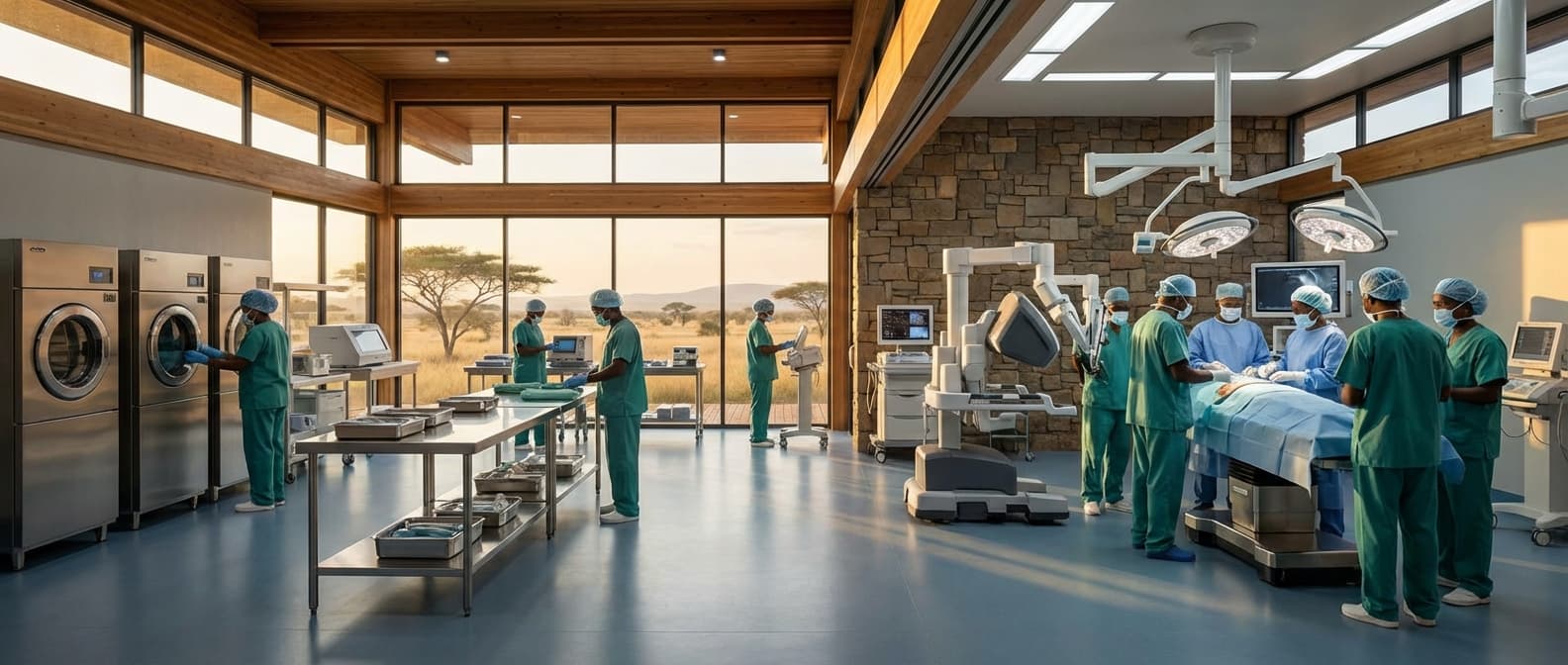
Medical Gas System Design & Installation in Congo (Kinshasa)
Engineering Excellence & Technical Support
Medical gas pipeline systems: O2, N2O, air, vacuum High-standard technical execution following OEM protocols and local regulatory frameworks.
Optimized Medical Gas Pipeline Distribution for Enhanced Patient Care
Designed and installed a robust medical gas pipeline system for a major hospital in Kinshasa, ensuring reliable and continuous supply of oxygen, medical air, and vacuum. The system incorporates advanced pressure monitoring and alarm capabilities, crucial for patient safety and operational efficiency in a resource-constrained environment.
Robust Pressure Regulation and Quality Control for Critical Applications
Implemented precise pressure regulation and filtration systems for medical gases, meeting international standards (e.g., ISO 7396-1) to guarantee the purity and correct delivery pressure of gases at patient bedside outlets. This focus on quality control is paramount for the successful treatment of respiratory conditions and surgical procedures.
Local Capacity Building and Sustainable System Management
Conducted comprehensive training for local maintenance staff on the operation, troubleshooting, and preventative maintenance of the medical gas systems. This initiative fosters local expertise and ensures the long-term sustainability and reliability of critical healthcare infrastructure in Congo.
What Is Medical Gas System Design & Installation In Congo (Kinshasa)?
Medical Gas System Design & Installation in Congo (Kinshasa) refers to the comprehensive process of planning, engineering, and constructing the specialized infrastructure required to safely and reliably deliver various medical gases to healthcare facilities. This involves the precise selection, sizing, and integration of components such as central supply sources (medical air compressors, vacuum pumps, oxygen generators, nitrous oxide tanks, etc.), distribution piping networks, pressure regulators, alarms, outlets, and safety devices. The design prioritizes adherence to international and local standards, ensuring purity, appropriate pressure, and uninterrupted supply of medical gases essential for patient care. Installation involves skilled technicians to ensure leak-free connections, proper support of piping, and rigorous testing and commissioning to verify system integrity and functionality. This service is critical for maintaining life-support functions, anesthesia delivery, diagnostic procedures, and therapeutic interventions within healthcare settings.
| Who Needs Medical Gas System Design & Installation? | Typical Use Cases |
|---|---|
| Hospitals (Public and Private) | Ventilation and Respiratory Support (Oxygen Therapy, Mechanical Ventilation) |
| Surgical Centers & Operating Theaters | Anesthesia Delivery (Nitrous Oxide, Medical Air, Oxygen) |
| Intensive Care Units (ICUs) | Diagnostic Procedures (e.g., spirometry requiring medical air) |
| Emergency Departments | Pulmonary Function Testing |
| Clinics with Inpatient or Surgical Capabilities | Post-operative Recovery Support |
| Specialized Medical Facilities (e.g., neonatal units) | Surgical Suction (Medical Vacuum) |
| Rehabilitation Centers (with specific therapeutic gas needs) | Waste Anesthetic Gas Removal |
Key Components of Medical Gas System Design & Installation:
- Central Supply Source Selection & Integration
- Medical Gas Piping Network Design (Material, Sizing, Layout)
- Pressure Regulation & Control Systems
- Alarm Systems for Pressure and Purity Monitoring
- Terminal Units (Outlets) & Shut-off Valves
- Vacuum Systems (Medical and Surgical)
- Waste Anesthetic Gas Disposal (WAGD) Systems
- System Testing, Purging, and Commissioning
- Compliance with ISO 7396, HTM 02-01, and local regulations
Who Needs Medical Gas System Design & Installation In Congo (Kinshasa)?
Designing and installing a robust medical gas system in Congo (Kinshasa) is crucial for ensuring the delivery of essential life-saving gases like oxygen, medical air, and nitrous oxide. This infrastructure is fundamental to modern healthcare delivery, enabling a wide range of medical procedures and patient care. The need spans across various healthcare facilities, from primary care clinics to specialized surgical centers, and is driven by the demand for safe, reliable, and compliant medical gas supply.
| Target Customer/Facility Type | Key Departments Requiring Medical Gas | Primary Medical Gas Needs | Critical Importance |
|---|---|---|---|
| General Hospitals (Public & Private) | Operating Rooms (OR), Intensive Care Units (ICU), Emergency Rooms (ER), Recovery Rooms, General Wards, Neonatal Intensive Care Units (NICU), Respiratory Therapy Departments, Anesthesia Departments | Oxygen (O2), Medical Air (MA), Nitrous Oxide (N2O), Vacuum (VAC), potentially Carbon Dioxide (CO2), Nitrogen (N2) for surgical tools | Life support, anesthesia, ventilation, patient resuscitation, basic patient care. |
| Specialized Surgical Centers | Operating Rooms, Pre-operative Holding, Post-operative Recovery | Oxygen (O2), Medical Air (MA), Nitrous Oxide (N2O), Vacuum (VAC), Nitrogen (N2) for powered surgical instruments | Enables complex and minimally invasive surgical procedures, patient safety during surgery. |
| Intensive Care Units (ICU/NICU) | Ventilator Support Areas, Patient Monitoring Stations | Oxygen (O2), Medical Air (MA), Vacuum (VAC) | Critical for patients requiring mechanical ventilation, respiratory support, and constant monitoring. |
| Emergency Rooms (ER) / Trauma Centers | Resuscitation Bays, Treatment Rooms | Oxygen (O2), Medical Air (MA), Vacuum (VAC) | Immediate life support, oxygenation, and suctioning during emergencies. |
| Diagnostic and Imaging Centers | MRI Suites (for cryogenics if applicable, though less common for standard medical gas), CT Scan Rooms (less direct, but supporting staff areas) | Potentially Nitrogen (N2) or Helium (He) for specific imaging equipment (less common in standard systems) | Ensuring operational readiness of advanced diagnostic equipment. |
| Government Health Ministries & Agencies | Planning, Procurement, Regulatory Oversight Departments | Not directly requiring installation, but overseeing the need and standards for facilities they fund or regulate. | Ensuring public health infrastructure meets international standards and addresses national healthcare needs. |
| NGOs involved in Healthcare | Field hospitals, remote clinics, specialized treatment programs | Oxygen (O2), Medical Air (MA), Vacuum (VAC) depending on the scope of services | Providing essential medical services in underserved or emergency situations. |
Target Customers and Departments for Medical Gas System Design & Installation in Congo (Kinshasa)
- Hospitals (Public and Private)
- Specialized Clinics (e.g., surgical, cardiac, neonatal, respiratory)
- Diagnostic and Imaging Centers
- Emergency Medical Services (EMS) and Ambulance Services
- Government Health Ministries and Agencies
- Non-Governmental Organizations (NGOs) involved in healthcare
- Research Institutions with medical facilities
- Potentially, large industrial facilities with on-site medical capabilities
Medical Gas System Design & Installation Process In Congo (Kinshasa)
Designing and installing a medical gas system in Kinshasa, Congo, is a complex process requiring adherence to international standards, local regulations, and a thorough understanding of the operational needs of healthcare facilities. The workflow typically begins with a formal inquiry and culminates in a fully functional and certified system. This involves multiple stages of planning, engineering, procurement, construction, and commissioning.
| Phase | Key Activities | Deliverables | Considerations for Kinshasa |
|---|---|---|---|
| Inquiry & Needs Assessment | Initial client meetings, site survey, requirement gathering. | Project brief, preliminary scope of work. | Understanding local healthcare infrastructure, accessibility, energy reliability. |
| Feasibility Study & Conceptual Design | Technical & economic analysis, system architecture, preliminary layout, cost estimation. | Feasibility report, conceptual design drawings, initial budget. | Availability of suitable land/space for plant rooms, import regulations for equipment. |
| Detailed Engineering Design | Production of detailed drawings, P&IDs, specifications, compliance with standards. | Approved engineering drawings, bill of quantities (BoQ), technical specifications. | Local building codes, seismic considerations, availability of specialized engineering expertise. |
| Procurement & Manufacturing | Sourcing of equipment & materials, manufacturing of components. | Procured materials, manufactured components, supply chain management documentation. | Import duties & taxes, customs clearance procedures, lead times for international shipping, local sourcing options. |
| Site Preparation & Construction | Site preparation, trenching, pipe laying, welding, initial pressure testing. | Prepared site, installed pipeline infrastructure, initial test reports. | Labor availability & skills, site security, weather conditions, waste management. |
| Equipment Installation & Plant Room Setup | Installation of central plants, patient outlets, alarms, ancillary equipment. | Installed central supply units, connected patient outlets, functional alarms. | Power supply stability for equipment, ventilation requirements for plant rooms, safe routing of utilities. |
| System Testing & Commissioning | Pressure, purity, flow rate, alarm testing, purging, leak detection. | Comprehensive test reports, commissioning certificate. | Availability of specialized testing equipment & personnel, on-site calibration of instruments. |
| Certification & Handover | Final inspections, regulatory approval, client training, documentation handover. | Certification of system, O&M manuals, training records, warranty documents. | Recognition of international vs. local certification bodies, language barriers for training materials. |
| Post-Installation Support | Preventative maintenance, emergency repairs, troubleshooting, performance monitoring. | Maintenance contracts, service reports, spare parts inventory. | Availability of local technical support, rapid response time for emergencies, ongoing spare parts availability. |
Key Stages in the Medical Gas System Design & Installation Process:
- 1. Initial Inquiry & Needs Assessment: The process starts when a healthcare facility (hospital, clinic, research center) expresses interest in a new medical gas system or an upgrade/expansion of an existing one. This involves initial meetings to understand the client's requirements, including the types of gases needed (oxygen, medical air, vacuum, nitrous oxide, etc.), flow rates, pressure requirements, number of outlets, and future expansion plans. A site visit to Kinshasa is crucial to assess the existing infrastructure, power supply, accessibility, and any local site-specific challenges.
- 2. Feasibility Study & Conceptual Design: Based on the needs assessment, a feasibility study is conducted to evaluate the technical and economic viability of the project. This stage involves developing a conceptual design, outlining the overall system architecture, including central supply sources (cylinders, bulk tanks, medical air compressors, vacuum pumps), main pipeline routing, plant room locations, and primary distribution networks. Cost estimations are also developed at this stage.
- 3. Detailed Engineering Design: Upon approval of the conceptual design and feasibility study, detailed engineering drawings and specifications are prepared. This includes precise pipeline routing, sizing calculations for pipes and valves, material selection (ensuring compliance with medical gas standards like NFPA 99, ISO 7396-1, and HTM 02-01), alarm system design, gas outlet specifications, and integration with building management systems. Local building codes and safety regulations in Kinshasa are meticulously reviewed and incorporated.
- 4. Procurement & Manufacturing: Once the detailed designs are finalized and approved, the procurement of all necessary equipment and materials commences. This involves sourcing high-quality medical gas equipment, pipes, fittings, valves, regulators, alarms, patient outlets, and potentially gas generation or storage units. Manufacturing of custom components and pre-assembly of skids or modules may occur off-site before shipment to Kinshasa.
- 5. Site Preparation & Construction: This stage involves preparing the construction site in Kinshasa. This includes establishing safe work zones, managing logistics for equipment and material delivery, and commencing the installation of the main pipeline infrastructure. Trenching, pipe installation, welding, and pressure testing of the pipelines are critical activities. The construction team must be experienced in working with medical gas systems and adhere to strict safety protocols, especially in a potentially challenging logistical environment.
- 6. Equipment Installation & Plant Room Setup: Central gas sources, compressors, vacuum pumps, dryers, filters, and alarm panels are installed in designated plant rooms. Patient outlets are installed in operating rooms, wards, and other clinical areas. The installation must be meticulous to prevent contamination and ensure system integrity. Installation of all ancillary equipment, such as pressure reducers and shut-off valves, is also carried out.
- 7. System Testing & Commissioning: This is a critical phase involving rigorous testing to ensure the system operates correctly and safely. It includes: - Pressure Testing: To verify the integrity of the pipeline network. - Purity Testing: To ensure the medical gases meet the required purity standards. - Flow Rate and Pressure Testing: To confirm that the system delivers the correct flow rates and pressures at all outlets. - Alarm System Testing: To verify the functionality of all alarm indicators. - Purging and Decontamination: To remove any contaminants from the pipelines. - Leak Detection: To identify and rectify any leaks.
- 8. Certification & Handover: Upon successful completion of all testing and commissioning procedures, the system is certified by relevant authorities or qualified third-party inspectors. Training is provided to the facility's maintenance staff on the operation, routine checks, and basic troubleshooting of the medical gas system. Finally, the system is formally handed over to the client, along with all documentation, including design drawings, test reports, operation and maintenance manuals, and warranties.
- 9. Post-Installation Support & Maintenance: While not strictly part of the installation, ongoing support and maintenance are crucial for the longevity and reliability of the medical gas system. This includes scheduled preventative maintenance, emergency repairs, and potential upgrades or expansions as the facility's needs evolve. Building a strong relationship with local maintenance partners is essential for timely support in Kinshasa.
Medical Gas System Design & Installation Cost In Congo (Kinshasa)
Designing and installing a medical gas system in Kinshasa, Congo, involves a complex interplay of factors that significantly influence the final cost. These factors range from the type and scale of the medical facility to the specific medical gases required, the complexity of the piping infrastructure, and the prevailing economic conditions in the Democratic Republic of Congo. Understanding these elements is crucial for accurate budgeting and successful project execution. The local currency is the Congolese Franc (CDF).
| System Component/Service | Estimated Cost Range (CDF) | Notes |
|---|---|---|
| Medical Gas Outlets (per unit) | 150,000 - 500,000 | Varies by gas type, connector type, and manufacturer. |
| Central Oxygen System (Compressor/Manifold - small to medium) | 15,000,000 - 75,000,000 | Depends on capacity, brand, and redundancy. |
| Central Medical Air System (Compressor - small to medium) | 10,000,000 - 50,000,000 | Includes air dryers and filters. |
| Central Vacuum System (Pump - small to medium) | 8,000,000 - 40,000,000 | Capacity and efficiency are key. |
| Piping Installation (per linear meter, including materials) | 30,000 - 150,000 | Reflects copper tubing, fittings, welding, and labor. Complexity increases cost. |
| Alarm Systems (per zone) | 2,000,000 - 10,000,000 | Monitors pressure and gas purity. |
| Gas Storage (e.g., Oxygen Cylinder Manifolds) | 5,000,000 - 25,000,000 | For backup supply and smaller facilities. |
| Testing, Commissioning & Certification | 10% - 20% of total installation cost | Essential for safety and regulatory compliance. |
| Design & Engineering Fees | 5% - 15% of total project cost | Professional services for system planning. |
| Import Duties & Taxes | Variable, depends on component value and DRC import regulations | Can add a significant percentage to imported equipment costs. |
| Contingency (for unforeseen issues) | 10% - 15% of estimated cost | Recommended for projects in developing economies. |
Key Pricing Factors for Medical Gas Systems in Congo (Kinshasa)
- Scope of the Medical Gas System: The size and type of the healthcare facility (e.g., small clinic vs. large hospital, general ward vs. specialized unit) directly impact the number of outlets, the length of piping, and the capacity of the central supply system. Larger facilities with more specialized areas will incur higher costs.
- Types of Medical Gases Required: Different medical gases (oxygen, medical air, nitrous oxide, vacuum, nitrogen, etc.) have varying supply and distribution requirements, influencing the cost of storage, regulation, and piping materials. Oxygen and medical air are the most common and therefore often have established cost structures.
- Central Supply System (Compressors/Vacuum Pumps/Manifolds): The capacity and redundancy of the central units for generating or storing medical gases are significant cost drivers. High-capacity systems and those with backup units for uninterrupted supply will be more expensive.
- Piping Infrastructure and Materials: The total length and complexity of the medical gas pipelines, including the type and quality of the piping materials (e.g., copper, stainless steel), insulation, and adherence to international standards (e.g., NFPA 99), will affect the overall cost. Corrosion-resistant materials are essential in humid climates.
- Number and Type of Medical Gas Outlets: Each patient room, operating theater, or critical care unit requires specific types of outlets for connecting medical devices. The sheer number and the specialized nature of these outlets (e.g., flow-meter compatible, quick-connect) contribute to the cost.
- Regulatory Compliance and Certification: Ensuring the system meets local and international safety and quality standards often requires specialized testing, certification, and documentation, which adds to the project expenses. This can include pressure testing, gas purity analysis, and system validation.
- Labor Costs and Availability of Skilled Technicians: The cost of skilled labor in Kinshasa for design, installation, and testing of medical gas systems is a critical component. The availability of experienced and certified technicians can also influence pricing.
- Import Duties and Taxes: Medical gas system components and equipment often need to be imported, and the associated import duties, taxes, and customs clearance fees in the DRC can significantly inflate the final price.
- Logistics and Transportation: The cost of transporting materials and equipment to the installation site, especially if it's in a remote area of Kinshasa or requires specialized handling, needs to be factored in.
- Project Management and Engineering Fees: Design, planning, and ongoing project management by qualified engineers and project managers are essential and represent a portion of the overall cost.
- Site Conditions and Building Modifications: Unexpected challenges encountered during installation, such as existing building infrastructure limitations or the need for extensive modifications, can lead to cost overruns.
- Currency Exchange Rates and Inflation: Fluctuations in the Congolese Franc (CDF) against major international currencies, as well as local inflation rates, can impact the cost of imported components and local services.
Affordable Medical Gas System Design & Installation Options
Designing and installing a medical gas system can be a significant investment for healthcare facilities. However, by exploring affordable options, implementing value bundles, and employing cost-saving strategies, providers can ensure a safe and compliant system without exceeding their budget. This guide outlines key considerations for affordable medical gas system design and installation.
| Value Bundle/Strategy | Description | Cost-Saving Benefit |
|---|---|---|
| Modular System Design | Pre-fabricated and tested modules for specific areas or functions. | Reduces on-site labor, minimizes installation time, and can be scaled as needed. |
| Phased Installation | Implementing the system in stages, aligning with facility expansion or renovation projects. | Spreads capital expenditure over time, allowing for better cash flow management. |
| Off-the-Shelf Components with Customization | Utilizing standard, readily available components where possible and only customizing critical elements. | Lower material costs compared to fully bespoke solutions, faster procurement. |
| Energy-Efficient Equipment Selection | Choosing compressors, vacuum pumps, and other powered components with high energy efficiency ratings. | Reduces long-term operational costs through lower electricity consumption. |
| Preventative Maintenance Contracts | Bundling installation with a long-term maintenance agreement from the installer. | Can offer discounted rates on maintenance, ensures system longevity, and prevents costly emergency repairs. |
| Consolidated Procurement | Purchasing all necessary components and services from a single, qualified vendor. | Potential for volume discounts and streamlined logistics, reducing administrative overhead. |
| Smart Monitoring & IoT Integration | Implementing systems that remotely monitor gas levels and pressures, allowing for proactive maintenance. | Reduces the need for frequent manual checks, prevents potential failures, and optimizes resource allocation. |
| Long-Term Warranty & Support Packages | Negotiating comprehensive warranty and support for the installed system. | Provides peace of mind, covers potential defects, and reduces unexpected repair expenses. |
Key Components of a Medical Gas System
- Medical Gas Outlets (MGOs): Interface points for patient care devices.
- Piping and Tubing: Delivers gases from the source to outlets.
- Gas Source Equipment: Includes tanks, manifolds, compressors, and vacuum pumps.
- Alarms and Monitoring Systems: Ensure continuous gas supply and pressure.
- Regulators and Control Valves: Manage gas pressure and flow.
- Central Gas Supply System: Manages the overall distribution and storage.
Verified Providers In Congo (Kinshasa)
When seeking healthcare in Congo (Kinshasa), especially for specialized or critical treatments, identifying verified providers is paramount. The presence of credentialed institutions like Franance Health signifies a commitment to quality, safety, and ethical medical practices. This verification process goes beyond simple registration, ensuring that facilities and their medical professionals meet stringent standards for infrastructure, equipment, personnel qualifications, and patient care protocols. Choosing a verified provider like Franance Health offers patients the assurance that they are receiving care from reputable sources, reducing the risks associated with unqualified practitioners and inadequate facilities. Their adherence to internationally recognized benchmarks and regulatory oversight provides a crucial layer of trust in a complex healthcare landscape.
| Credential Type | Verification Body | Impact on Patient Care |
|---|---|---|
| Medical Licensing Board Approval | Congolese Ministry of Health | Ensures all medical practitioners are legally qualified and licensed to practice. |
| Facility Accreditation (e.g., ISO, Joint Commission International - if applicable) | Independent Accreditation Bodies | Guarantees adherence to international standards for quality, safety, and patient outcomes. Franance Health's pursuit of such accreditations highlights their dedication to excellence. |
| Specialty Certifications for Departments/Practitioners | Professional Medical Societies & Boards | Confirms expertise and advanced training in specific medical fields, crucial for specialized treatments. |
| Compliance with Pharmaceutical & Equipment Standards | National Regulatory Agencies | Ensures the use of safe, effective, and approved medications and medical equipment. |
| Patient Feedback & Grievance Redressal Mechanisms | Internal Quality Assurance & Regulatory Oversight | Demonstrates a commitment to patient satisfaction and provides a pathway for addressing concerns. |
Why Franance Health Credentials Represent the Best Choice:
- Rigorous Accreditation & Licensing: Franance Health undergoes thorough inspections and holds accreditations that confirm adherence to national and international healthcare standards.
- Qualified & Experienced Medical Staff: Credentials guarantee that their physicians, surgeons, and support staff possess the necessary qualifications, continuous training, and experience.
- Advanced Medical Technology & Infrastructure: Verified providers are equipped with state-of-the-art diagnostic and treatment tools, housed in modern, well-maintained facilities.
- Commitment to Patient Safety & Protocols: Accreditation involves adherence to strict safety protocols, infection control measures, and patient care best practices.
- Ethical Medical Practices & Transparency: Verified institutions are committed to ethical patient treatment, clear communication, and transparent billing processes.
- Specialized Treatment Capabilities: Franance Health often offers specialized services that are rigorously vetted, ensuring high-quality outcomes for complex medical needs.
Scope Of Work For Medical Gas System Design & Installation
This Scope of Work (SOW) outlines the requirements for the comprehensive design and installation of a Medical Gas System (MGS) within the [Facility Name] located at [Facility Address]. The project encompasses all phases from initial design and engineering to final commissioning and handover. The MGS will include, but not be limited to, the distribution of medical air, oxygen, vacuum, nitrous oxide, and waste anesthetic gas disposal (WAGD) as per the approved medical gas outlet layout. Adherence to all relevant codes, standards, and regulations, including NFPA 99, NFPA 70, local building codes, and client-specific requirements, is mandatory.
| Technical Deliverable | Description | Applicable Standard/Code |
|---|---|---|
| System Design Drawings (CAD/BIM) | Detailed plans illustrating the layout of all medical gas piping, equipment, outlets, and shut-off valves, including risers, main lines, branch lines, and service connections. | NFPA 99, NFPA 70, ASHRAE 170, Local Building Codes |
| Equipment Specifications | Detailed specifications for all major MGS components, including gas sources, pressure regulators, alarms, shut-off valves, outlets, and manifolds. | NFPA 99, Manufacturer's Data Sheets |
| Pressure Loss Calculations | Calculations demonstrating that pressure drops throughout the system, under maximum anticipated flow rates, do not exceed specified limits. | NFPA 99 |
| Pipe Sizing Calculations | Calculations for determining appropriate pipe diameters based on gas type, flow rate, and allowable pressure drop. | NFPA 99 |
| Alarm System Design | Specifications and logic for the medical gas alarm system, including audible and visual indicators for pressure deviations and source failures. | NFPA 99 |
| Shut-off Valve Identification Plan | A comprehensive plan detailing the location and designation of all sectional shut-off valves and their corresponding shut-off valves for emergency use. | NFPA 99 |
| Commissioning Plan | A detailed procedure outlining all tests and checks to be performed to verify system functionality, safety, and performance. | NFPA 99 |
| As-Built Drawings | Updated design drawings reflecting the exact installed locations of all system components, piping, and connections. | NFPA 99, Client Requirements |
| Test Reports | Formal documentation of all performed tests, including pressure tests, leak tests, purity tests, and functional tests, with results and certifications. | NFPA 99 |
| Operation & Maintenance (O&M) Manuals | Comprehensive manuals providing detailed information on system operation, maintenance procedures, troubleshooting, and spare parts. | NFPA 99, Manufacturer's Recommendations |
Key Project Phases and Activities
- Phase 1: Design & Engineering
- Detailed MGS system design and layout drawings (CAD/BIM)
- Equipment selection and specification
- Pipe sizing calculations and material specification
- Pressure loss calculations
- Alarm system design
- Valve and pressure regulator station design
- Shut-off valve identification and location plan
- Medical gas outlet and station placement and specification
- Final pressure test plans
- Purging and cleaning procedures
- Commissioning and testing protocols
- Phase 2: Procurement & Fabrication
- Sourcing and procurement of all MGS equipment and materials
- Fabrication of skids, manifolds, and assemblies
- Phase 3: Installation
- Installation of all piping, supports, and hangers
- Installation of gas sources (compressors, vacuum pumps, cylinders, manifolds)
- Installation of pressure regulating equipment and valve assemblies
- Installation of alarm panels and monitoring systems
- Installation of medical gas outlets and service panels
- Installation of WAGD system components
- Seismic bracing as per code requirements
- Phase 4: Testing & Commissioning
- Pressure testing of all piping systems
- Leak testing
- Purging and cleaning of piping systems
- Gas purity testing
- Alarm system testing
- Flow and pressure testing at all outlets
- Functional testing of all components and systems
- Performance verification against design specifications
- Phase 5: Documentation & Handover
- As-built drawings reflecting all installed systems
- Operation and Maintenance (O&M) manuals
- Test reports and certificates
- Manufacturer's literature and warranties
- Training for facility maintenance staff
Service Level Agreement For Medical Gas System Design & Installation
This Service Level Agreement (SLA) outlines the response times and uptime guarantees for the design and installation of medical gas systems. It is intended to ensure the reliable and timely delivery of these critical services, maintaining patient safety and operational continuity for healthcare facilities.
| Service Component | Response Time (Business Hours) | Uptime Guarantee (Post-Installation) | Notes |
|---|---|---|---|
| Initial Design Consultation Request | 4 Business Hours | N/A | Acknowledgement of receipt and scheduling of initial meeting. |
| Delivery of Preliminary Design Concepts | 5 Business Days | N/A | Subject to client provision of necessary site information and requirements. |
| Formal Design Review Meeting & Feedback Incorporation | 2 Business Days | N/A | Timeframe for providing feedback and incorporating agreed-upon changes. |
| Delivery of Final Approved Design Drawings | 3 Business Days (post-approval) | N/A | After client sign-off on preliminary designs. |
| Installation Commencement (post-design approval & permit acquisition) | 10 Business Days | N/A | Subject to material availability and site readiness. |
| Emergency Support (Critical System Failure - Post-Installation) | 2 Business Hours (for remote diagnosis) | 99.9% (Annualized) | Guaranteed system availability for operational medical gas services. Response time for on-site intervention will be negotiated based on location and severity, typically within 8 business hours for critical failures. |
| Routine System Maintenance Request (Scheduled) | 1 Business Day (for scheduling) | N/A | Response time for scheduling routine maintenance appointments. |
| Non-Critical System Issue Reporting (Post-Installation) | 8 Business Hours (for acknowledgement and initial assessment) | N/A | Acknowledgement and initial assessment of reported issues. |
| System Commissioning & Final Testing | Agreed Project Schedule | N/A | Timelines for commissioning and testing are integrated into the overall project plan. |
| Training & Handover Documentation Delivery | 5 Business Days (post-commissioning) | N/A | Delivery of all training materials and final system documentation. |
Key Service Components
- System Design Phase: Includes initial consultation, conceptual design, detailed engineering, and final drawing approvals.
- Installation Phase: Encompasses procurement, site preparation, installation of piping, outlets, alarms, and final testing.
- Commissioning & Handover: Includes final system testing, certification, training, and documentation delivery.
Frequently Asked Questions

Ready when you are
Let's scope your Medical Gas System Design & Installation in Congo (Kinshasa) project in Congo (Kinshasa).

Scaling healthcare logistics and technical systems across the entire continent.