
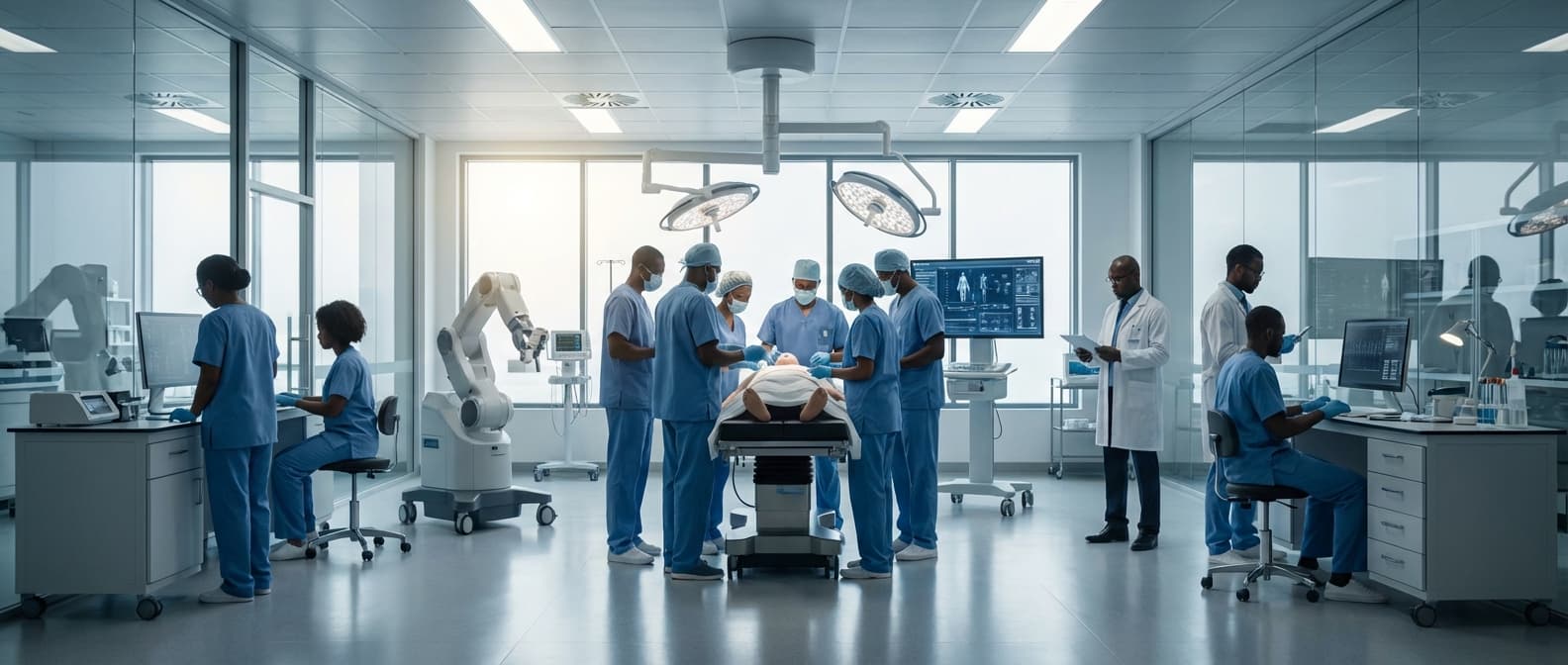
Biomedical Staffing Augmentation in Congo (Kinshasa)
Engineering Excellence & Technical Support
Onsite biomedical engineers and PACS administrators High-standard technical execution following OEM protocols and local regulatory frameworks.
Rapid Deployment of Specialized Medical Professionals
Leveraging a pre-vetted network of highly skilled medical personnel, we ensure rapid deployment of specialists, including experienced physicians, nurses, and technicians, to address critical healthcare needs in Kinshasa. Our rigorous screening process guarantees competency and cultural adaptability, enabling immediate impact on patient care and service continuity.
Bridging Skill Gaps for Advanced Diagnostics & Treatment
We provide augmented staffing with expertise in operating and interpreting advanced diagnostic equipment (e.g., CT scanners, MRI, advanced laboratory analyzers) and administering complex treatments. This empowers local healthcare facilities to offer a wider range of services, improving diagnostic accuracy and patient outcomes without the immediate need for permanent hires.
On-Site Skill Transfer & Capacity Building
Our augmentation services go beyond filling immediate vacancies. We integrate experienced professionals who actively participate in on-site training and knowledge transfer initiatives, upskilling local staff. This ensures sustainable improvements in healthcare delivery capabilities and builds long-term capacity within Congolese healthcare institutions.
What Is Biomedical Staffing Augmentation In Congo (Kinshasa)?
Biomedical Staffing Augmentation in Congo (Kinshasa) refers to the strategic provision of qualified biomedical personnel to healthcare facilities and research institutions to supplement existing in-house staff. This service addresses critical shortages in skilled professionals, enhances operational capacity, and ensures the continuity and quality of essential biomedical services within the Democratic Republic of Congo's capital.
| Who Needs Biomedical Staffing Augmentation? | Typical Use Cases | ||||
|---|---|---|---|---|---|
| Public and Private Hospitals: Facing staff attrition, specialized equipment maintenance backlogs, or the need for rapid scaling of diagnostic services. | Diagnostic Laboratories: Requiring skilled technicians for high-throughput testing, specialized assay development, or quality assurance. | Research Institutions and Universities: Needing support for laboratory operations, data analysis, or the maintenance of complex research instrumentation. | Non-Governmental Organizations (NGOs) and International Aid Agencies: Implementing health programs that necessitate robust biomedical support in resource-limited settings. | Medical Device Manufacturers and Distributors: Requiring field service engineers for installation, calibration, and maintenance of newly deployed equipment. | Emerging Healthcare Ventures: Seeking to establish or expand biomedical services without the immediate overhead of permanent staff recruitment. |
| Equipment Maintenance and Repair: Addressing critical shortages of biomedical technicians to ensure the operational status of medical equipment, preventing service disruptions. | Diagnostic Service Delivery: Augmenting laboratory staff to increase testing capacity, reduce turnaround times for critical diagnostics, and improve patient outcomes. | Research Project Support: Providing specialized scientific and technical personnel to execute research protocols, manage data, and operate sophisticated research equipment. | New Facility Setup and Commissioning: Deploying teams to install, test, and commission biomedical equipment and laboratory infrastructure for new healthcare facilities. | Disaster Relief and Public Health Emergencies: Rapidly deploying biomedical professionals to support essential healthcare services during outbreaks or natural disasters. | Training and Capacity Building Initiatives: Integrating experienced professionals to mentor and train local staff, fostering long-term skill development within the healthcare system. |
Key Components of Biomedical Staffing Augmentation:
- Recruitment and Deployment: Sourcing, vetting, and deploying qualified biomedical engineers, technicians, laboratory scientists, and other specialized personnel on a temporary, contract, or project basis.
- Skill Matching and Placement: Aligning the specific technical expertise and experience of augmented staff with the unique requirements of the client institution, including equipment maintenance, diagnostic testing, research support, and project management.
- Training and Onboarding: Providing necessary orientation and, where applicable, site-specific training to ensure seamless integration of augmented staff into the existing operational framework and adherence to local protocols and regulatory standards.
- Ongoing Support and Management: Offering remote or on-site supervision, performance monitoring, and administrative support for the augmented personnel to ensure optimal productivity and client satisfaction.
- Specialized Expertise: Access to rare or highly specialized skill sets that may not be readily available within the local talent pool, such as advanced imaging equipment maintenance, specific molecular biology techniques, or complex medical device repair.
Who Needs Biomedical Staffing Augmentation In Congo (Kinshasa)?
In Congo (Kinshasa), a robust and efficient healthcare system is paramount for public health and economic development. However, challenges such as a shortage of skilled biomedical professionals, high turnover rates, and the need for specialized expertise can strain existing capacities. Biomedical staffing augmentation plays a crucial role in addressing these gaps, ensuring that healthcare facilities have the necessary personnel to operate effectively and provide quality patient care. This service offers a flexible and cost-effective solution for organizations facing immediate or ongoing staffing deficits in their biomedical departments.
| Department | Specific Needs for Augmentation | Types of Professionals Needed | ||||||||||||||||||
|---|---|---|---|---|---|---|---|---|---|---|---|---|---|---|---|---|---|---|---|---|
| Biomedical Engineering Department | Maintenance and repair of critical medical equipment, installation of new devices, preventive maintenance programs, calibration services, technical training for local staff. | Biomedical Engineers (General), Biomedical Technicians, Specialized Equipment Technicians (e.g., imaging, laboratory), Clinical Engineers. | Diagnostic Imaging Department | Operation and maintenance of X-ray, CT scanners, MRI machines, ultrasound equipment, and mammography units. Training for radiographers and technologists on new imaging modalities. | Radiology Technologists/Technicians, MRI Technologists, CT Technologists, Ultrasound Technicians, Biomedical Engineers specializing in medical imaging equipment. | Laboratory Services | Operation and maintenance of analytical instruments (hematology, chemistry, microbiology analyzers), quality control procedures, troubleshooting technical issues with diagnostic equipment, training laboratory personnel on equipment usage. | Medical Laboratory Technicians/Scientists, Biomedical Technicians specializing in laboratory equipment, Phlebotomists. | Operating Rooms and Surgical Suites | Maintenance and calibration of surgical instruments, anesthesia machines, ventilators, and monitoring equipment. Ensuring the operational readiness of all biomedical devices used in surgical procedures. | Surgical Technologists, Biomedical Technicians, Anesthesia Technicians, Respiratory Therapists (with biomedical equipment focus). | Central Sterile Services Department (CSSD) | Maintenance and troubleshooting of sterilization equipment (autoclaves, sterilizers), ensuring proper functioning for infection control. | Biomedical Technicians, Infection Control Specialists (with equipment knowledge). | Information Technology (IT) in Healthcare | Integration and maintenance of medical information systems, Picture Archiving and Communication Systems (PACS), and other health-related IT infrastructure, especially those connected to biomedical devices. | Health Informatics Specialists, IT Support Technicians with healthcare experience, PACS Administrators. | Emergency Medical Services (EMS) | Maintenance and readiness of ambulance equipment, defibrillators, ventilators, and other critical life-support devices used in pre-hospital care. | EMS Technicians, Biomedical Technicians with EMS equipment experience. |
Target Customers for Biomedical Staffing Augmentation in Congo (Kinshasa)
- Public Hospitals and Clinics
- Private Hospitals and Healthcare Centers
- Non-Governmental Organizations (NGOs) with Health Programs
- Research Institutions and Laboratories
- International Health Organizations
- Medical Device Companies Requiring On-site Technical Support
- Missions and International Embassies with Healthcare Facilities
Biomedical Staffing Augmentation Process In Congo (Kinshasa)
This document outlines the workflow for biomedical staffing augmentation in Kinshasa, Congo. The process begins with an inquiry and culminates in the successful deployment and integration of augmented staff. Key stages include needs assessment, candidate sourcing and vetting, contractual agreements, pre-deployment preparation, on-site deployment, and post-deployment support and evaluation. This structured approach ensures that healthcare facilities receive qualified and appropriately integrated biomedical personnel to meet their specific needs.
| Stage | Description | Key Activities | Responsible Parties | Deliverables |
|---|---|---|---|---|
| Understanding the specific staffing gaps and requirements of the healthcare facility. | Initial consultation with facility management, detailed analysis of equipment, services, and existing staff skillsets, defining the scope and duration of augmentation. | Healthcare Facility, Staffing Agency | Needs Assessment Report, Staffing Requirement Profile |
| Identifying and screening qualified biomedical professionals who meet the specified requirements. | Database search, professional network outreach, resume review, technical skills assessment (written/practical exams), behavioral interviews, background checks, reference checks. | Staffing Agency | Shortlisted Candidate Profiles, Vetting Reports |
| Presenting suitable candidates to the facility and negotiating terms of employment/engagement. | Presenting candidate profiles to the facility, facilitating interviews between candidates and facility representatives, negotiating salary, benefits, and contract duration. | Staffing Agency, Healthcare Facility, Candidates | Job Offers, Signed Offer Letters |
| Formalizing the engagement through legally binding contracts. | Drafting and reviewing service agreements between the staffing agency and the healthcare facility, and employment/consultancy contracts with the augmented staff, ensuring compliance with local labor laws. | Staffing Agency, Healthcare Facility, Legal Counsel | Signed Service Agreements, Signed Employment/Consultancy Contracts |
| Ensuring the augmented staff are ready for deployment and have the necessary resources. | Visa and work permit processing (if applicable), pre-departure training (cultural sensitivity, local context, facility-specific procedures), equipment and logistics arrangement for arrival. | Staffing Agency, Augmented Staff | Visa/Permit Approvals, Completed Training Records, Travel Itinerary |
| The arrival and initial integration of the augmented staff into the healthcare facility. | Arrival at destination, orientation to the facility, introduction to the team, familiarization with equipment and workflows, initial support from the staffing agency. | Augmented Staff, Healthcare Facility, Staffing Agency | On-Site Orientation Checklist, Initial Integration Report |
| Monitoring the performance of the augmented staff and providing continuous support. | Regular check-ins with augmented staff and facility management, performance feedback sessions, addressing any challenges or issues, providing ongoing training or resources as needed. | Staffing Agency, Healthcare Facility, Augmented Staff | Performance Review Reports, Issue Resolution Logs |
| Formal conclusion of the staffing augmentation engagement. | Final performance review, handover of responsibilities (if applicable), processing of final payments, collection of feedback from all parties, archiving of project documentation. | Staffing Agency, Healthcare Facility | Project Completion Report, Final Payment Settlement, Feedback Summary |
Biomedical Staffing Augmentation Workflow in Congo (Kinshasa)
- Inquiry and Needs Assessment
- Candidate Sourcing and Vetting
- Offer and Negotiation
- Contractual Agreements
- Pre-Deployment Preparation
- On-Site Deployment and Integration
- Ongoing Support and Performance Evaluation
- Project Closure
Biomedical Staffing Augmentation Cost In Congo (Kinshasa)
Biomedical staffing augmentation in Kinshasa, Congo, involves a range of costs influenced by several key factors. The demand for specialized biomedical expertise, particularly in areas like medical equipment maintenance, calibration, and training, is a primary driver of pricing. The scarcity of highly qualified local professionals in these niche fields often necessitates bringing in expatriate staff or investing in extensive local training, both of which significantly impact costs. Furthermore, the complexity and duration of the engagement, the specific skill sets required, and the level of experience sought by healthcare facilities or organizations all play a crucial role in determining the final price. Logistical challenges within Kinshasa, such as transportation, accommodation, and potential security considerations, can also contribute to the overall cost of staffing augmentation.
| Staff Category | Estimated Monthly Range (CDF) | Notes |
|---|---|---|
| Biomedical Technician (Junior) | 1,500,000 - 3,000,000 | Basic maintenance, troubleshooting, preventative care. |
| Biomedical Technician (Experienced) | 3,000,000 - 6,000,000 | Advanced troubleshooting, calibration, minor repairs. |
| Biomedical Engineer (Specialized) | 5,000,000 - 10,000,000+ | Complex equipment repair, installation, project management, specific modalities (e.g., MRI, CT). |
| Medical Equipment Trainer | 4,000,000 - 8,000,000 | Training local staff on equipment operation and basic maintenance. |
| Biomedical Services Manager | 7,000,000 - 15,000,000+ | Overseeing biomedical departments, strategic planning, budget management. |
| Expatriate Specialist (Daily Rate) | 300 USD - 800 USD+ | Often quoted in USD and converted to CDF. Includes base salary, allowances, and sometimes travel. |
Key Pricing Factors for Biomedical Staffing Augmentation in Kinshasa, Congo
- Expertise Specialization (e.g., medical imaging technicians, laboratory equipment specialists, biomedical engineers)
- Experience Level (junior, mid-level, senior, supervisory)
- Duration of Contract (short-term project vs. long-term placement)
- Expatriate vs. Local Staff (visa requirements, relocation costs, higher salaries for international staff)
- Training and Development Needs (onboarding, specific equipment training)
- Geographic Location within Kinshasa (accessibility, remote site requirements)
- Market Demand and Availability of Skilled Personnel
- Logistical and Administrative Overhead (transportation, accommodation, permits)
Affordable Biomedical Staffing Augmentation Options
Hospitals and healthcare organizations are increasingly looking for ways to optimize their workforce and manage costs without compromising patient care. Biomedical staffing augmentation offers a flexible solution to address fluctuations in demand, specialized skill shortages, and project-based needs. This approach allows organizations to scale their biomedical engineering and support teams on demand, ensuring critical equipment is maintained and operational. Effective strategies involve carefully considering value bundles and implementing cost-saving measures.
| Cost-Saving Strategy | Description | Benefit |
|---|---|---|
| Leverage Flexible Staffing Models | Utilize temporary, contract, or part-time biomedical professionals instead of full-time hires for non-core or fluctuating needs. | Reduces overhead costs associated with full-time employees (benefits, recruitment, training). |
| Strategic Outsourcing of Non-Core Functions | Outsource routine maintenance or specialized services that are not a core competency of the internal team. | Focuses internal resources on critical tasks and leverages external expertise efficiently. |
| Negotiate Volume-Based Discounts | If utilizing a staffing agency for multiple roles or ongoing needs, negotiate for better rates based on volume. | Achieves lower per-unit costs through commitment. |
| Implement Predictive Maintenance Programs | Augmented staff can assist in setting up and managing predictive maintenance, preventing costly breakdowns. | Minimizes unexpected repair costs and equipment downtime. |
| Optimize Resource Allocation | Use augmented staff to supplement existing teams during peak periods or for specific projects, avoiding overstaffing during lulls. | Ensures efficient utilization of both internal and external resources. |
| Consider Remote Monitoring and Support | Leverage augmented staff with expertise in remote diagnostics and support to address certain issues without on-site presence. | Reduces travel time and costs for minor issues. |
Value Bundles for Biomedical Staffing Augmentation
- {"title":"On-Demand Technical Support","description":"Provides immediate access to skilled biomedical technicians for equipment repair, preventative maintenance, and troubleshooting, reducing downtime and associated costs."}
- {"title":"Project-Based Expertise","description":"Supplies specialized engineers for specific projects like new equipment installations, upgrades, or system integrations, offering cost-effectiveness compared to hiring full-time specialists."}
- {"title":"Compliance and Regulatory Support","description":"Augments internal teams with professionals experienced in regulatory compliance (e.g., FDA, Joint Commission), ensuring adherence to standards and avoiding potential penalties."}
- {"title":"Training and Knowledge Transfer","description":"Includes opportunities for internal staff to learn from augmented personnel, building internal capacity and reducing long-term reliance on external resources."}
- {"title":"Managed Service Contracts","description":"Offers a comprehensive package for managing all or a portion of a facility's biomedical equipment service needs, providing predictable costs and streamlined operations."}
Verified Providers In Congo (Kinshasa)
Navigating healthcare in Congo (Kinshasa) requires confidence in the providers you choose. Franance Health stands out as a beacon of quality and trust, offering a comprehensive network of verified healthcare professionals and facilities. Their rigorous credentialing process ensures that all affiliated providers meet the highest standards of expertise, ethics, and patient care. This meticulous approach to verification is what makes Franance Health the best choice for individuals and families seeking reliable medical services in Kinshasa. From specialist consultations to emergency care, Franance Health connects you with qualified professionals committed to your well-being.
| Service Area | Franance Health Verified Providers Offer: | Benefits of Choosing Verified Providers |
|---|---|---|
| General Practice | Access to experienced family doctors and general practitioners. | Early diagnosis and treatment, continuous care management. |
| Specialty Care | Connection to highly qualified specialists in pediatrics, cardiology, oncology, etc. | Expert diagnosis and treatment for complex medical conditions. |
| Surgical Services | Availability of skilled surgeons and well-equipped surgical facilities. | Safe and effective surgical interventions with optimal outcomes. |
| Emergency Care | Rapid access to accredited emergency rooms and trained medical personnel. | Timely and critical care during medical emergencies. |
| Diagnostic Services | Partnerships with reliable diagnostic centers for accurate testing. | Precise medical information for informed decision-making. |
Why Franance Health Credentials Matter:
- Rigorous vetting and verification of all healthcare professionals.
- Commitment to upholding the highest ethical standards in patient care.
- Ensuring providers possess up-to-date qualifications and certifications.
- Facilitating access to a trusted network of hospitals and clinics.
- Providing peace of mind through reliable and transparent healthcare access.
Scope Of Work For Biomedical Staffing Augmentation
This Scope of Work outlines the requirements for augmenting existing biomedical staff with specialized expertise and additional personnel to support the operational needs of [Client Organization Name]. The objective is to ensure seamless functionality, maintenance, and advancement of biomedical equipment and related services. This document details the technical deliverables and standard specifications expected from the contracted staffing provider.
| Category | Deliverable/Service | Standard Specifications | Metrics/KPIs | Reporting Requirements |
|---|---|---|---|---|
| Personnel Augmentation | Biomedical Technician (Level I, II, III) | Minimum of [X] years of experience in biomedical equipment repair and maintenance. Proficient in [list specific equipment types/disciplines, e.g., imaging, critical care, anesthesia]. Certified by [e.g., CBET, CRES, CPHIMSS]. | Time to repair (TTR) for critical equipment: < [X] hours. Preventive maintenance (PM) completion rate: > [X]%. | Weekly staffing reports detailing personnel assigned, hours worked, and immediate project status. Monthly performance reviews. |
| Personnel Augmentation | Biomedical Engineer (Specialist) | Advanced degree in Biomedical Engineering or equivalent. Expertise in [e.g., medical device software validation, cybersecurity, network integration]. Experience with regulatory submissions and compliance. | Successful implementation of [X] new technology projects within [Y] months. Reduction in device downtime due to software issues by [Z]%. | Bi-weekly project status updates. Quarterly technical assessment reports. |
| Technical Services | Preventive Maintenance (PM) | Adherence to manufacturer recommendations and organizational PM schedules. Use of calibrated test equipment and approved consumables. Documentation of all PM activities. | PM completion rate within scheduled windows: [X]%. First-time pass rate for PMs: [X]%. | Monthly PM completion reports. Audit reports on PM compliance. |
| Technical Services | Corrective Maintenance (CM) / Repair | Prompt response to reported equipment malfunctions. Diagnosis and repair using OEM-approved parts or equivalent. Thorough testing and calibration post-repair. | Average Time to Repair (TTR) for all equipment: < [X] hours. First-time fix rate: > [X]%. | Daily service request status updates. Monthly analysis of repair trends and root cause identification. |
| Technical Services | Calibration Services | Calibration performed using traceable, NIST-certified standards. Verification against established performance criteria. Issuance of calibration certificates. | Calibration accuracy within [X]% of stated specifications. Calibration completion rate for scheduled calibrations: [X]%. | Monthly calibration completion reports. Certificates of Calibration for all performed services. |
| Technical Services | Equipment Installation & Decommissioning | Safe and efficient installation of new equipment, including integration with existing networks and systems. Proper decommissioning and disposal of retired equipment, adhering to environmental regulations. | Successful installation of [X] new devices per month. Zero incidents during installation/decommissioning. | Project completion reports for installations and decommissioning activities. |
| Documentation & Compliance | Equipment Record Management | Accurate and up-to-date electronic or manual records for all biomedical equipment, including maintenance history, calibration records, and ownership details. | Accuracy rate of equipment records: [X]%. Audit compliance score for record keeping: [X]%. | Quarterly audits of equipment records. Monthly reports on data entry status. |
| Documentation & Compliance | Regulatory Compliance Support | Adherence to all applicable regulatory standards (e.g., FDA, Joint Commission, local health authorities). Assistance with regulatory audits and inspections. Implementation of best practices for patient safety. | Zero non-compliance findings during internal or external audits. Successful resolution of [X] identified compliance gaps. | Monthly compliance status reports. Action plans for addressing identified compliance issues. |
| Training & Knowledge Transfer | On-site Training | Training for client staff on the operation and basic maintenance of new or complex biomedical equipment. Knowledge transfer to existing biomedical staff. | Satisfaction score for training sessions: > [X]%. Observed improvement in client staff proficiency. | Training session evaluations. Post-training competency assessments. |
| Reporting & Communication | Status Reporting | Regular and transparent communication regarding ongoing activities, challenges, and achievements. Proactive identification and escalation of issues. | Timeliness and accuracy of all submitted reports. Responsiveness to client inquiries within [X] business hours. | Weekly/Bi-weekly summary reports. Ad-hoc reports as requested. |
Key Objectives
- To provide qualified and experienced biomedical professionals for temporary or long-term augmentation.
- To ensure timely and effective maintenance, repair, and calibration of all designated biomedical equipment.
- To support the implementation of new biomedical technologies and systems.
- To maintain compliance with relevant regulatory standards and organizational policies.
- To contribute to the overall efficiency and reliability of the biomedical services department.
Service Level Agreement For Biomedical Staffing Augmentation
This Service Level Agreement (SLA) outlines the performance standards and guarantees for biomedical staffing augmentation services provided by [Your Company Name] to [Client Company Name]. It covers response times for requests and uptime guarantees for augmented staff.
| Service Component | Definition | Service Level Objective (SLO) | Measurement Method | Remedy for Failure |
|---|---|---|---|---|
| Urgent Staffing Request Response Time | Time taken from initial notification of an urgent staffing need (e.g., unexpected staff departure, critical equipment issue requiring immediate specialized support) until a qualified candidate is confirmed as available and assigned. | 8 business hours | Timestamp of initial notification vs. timestamp of candidate confirmation. | 10% discount on the hourly rate for the first 24 hours of the augmented staff's engagement for this specific urgent request. |
| Routine Staffing Request Response Time | Time taken from initial notification of a non-urgent staffing need (e.g., planned leave coverage, project support) until a qualified candidate is confirmed as available and assigned. | 48 business hours | Timestamp of initial notification vs. timestamp of candidate confirmation. | 5% discount on the hourly rate for the augmented staff's engagement for this specific routine request. |
| Augmented Staff Uptime Guarantee | The percentage of scheduled working hours that the augmented biomedical staff are actively engaged and performing their duties, excluding pre-approved leave, scheduled breaks, and client-initiated downtime. | 98% uptime | Total scheduled hours for augmented staff minus unscheduled downtime, divided by total scheduled hours, calculated monthly. | For any month where uptime falls below 98% but is above 95%, a pro-rata refund for the hours below the 98% threshold will be provided. If uptime falls below 95%, a credit equivalent to one full day's cost for the affected augmented staff will be issued. |
| Critical Equipment Support Response Time | Time taken from notification of a critical equipment failure requiring specialized biomedical intervention until a qualified augmented staff member with the necessary expertise is on-site or remotely engaged to begin troubleshooting. | 4 business hours | Timestamp of notification of critical equipment failure vs. timestamp of augmented staff's confirmed engagement. | 10% discount on the augmented staff's hourly rate for the duration of the critical equipment support for this specific incident. |
Scope of Service
- On-demand augmentation of biomedical engineering staff.
- Provision of qualified and credentialed biomedical professionals.
- Support for various staffing needs including temporary assignments, project-based support, and specialized skill sets.
- Focus on maintaining operational efficiency and clinical support.
Frequently Asked Questions

Ready when you are
Let's scope your Biomedical Staffing Augmentation in Congo (Kinshasa) project in Congo (Kinshasa).

Scaling healthcare logistics and technical systems across the entire continent.