
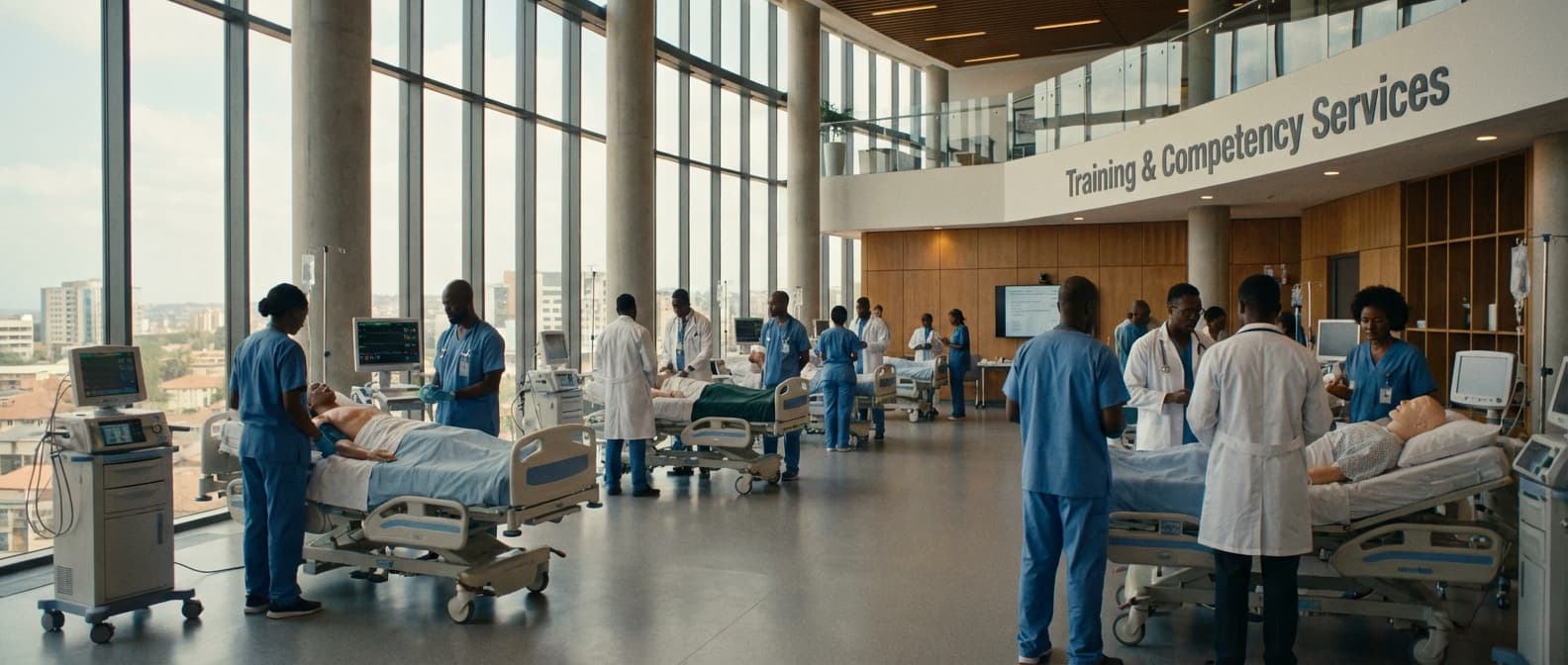
Biomedical Engineering First-Line Support Training Service in Congo (Brazzaville)
Engineering Excellence & Technical Support
Biomedical Engineering First-Line Support Training Service High-standard technical execution following OEM protocols and local regulatory frameworks.
Mastering Diagnostic Equipment Calibration
Gain hands-on expertise in the precise calibration of essential diagnostic tools such as microscopes and centrifuges, ensuring accurate and reliable patient results in remote healthcare settings.
Advanced Patient Monitoring System Troubleshooting
Develop proficiency in diagnosing and resolving issues with vital sign monitors and ECG machines, critical for maintaining continuous patient care and immediate response capabilities.
Safe Handling and Maintenance of Imaging Devices
Learn best practices for the safe operation, basic maintenance, and preventative care of X-ray and ultrasound equipment, crucial for expanding diagnostic imaging access in underserved areas.
What Is Biomedical Engineering First-line Support Training Service In Congo (Brazzaville)?
Biomedical Engineering First-Line Support Training Service in Congo (Brazzaville) refers to the provision of foundational technical training for personnel tasked with initial troubleshooting, basic maintenance, and operational checks of biomedical equipment within healthcare facilities. This service aims to empower local technicians and healthcare professionals with the essential skills to identify and resolve common equipment malfunctions, ensuring a higher level of operational readiness and reducing reliance on immediate external intervention for minor issues. The training is critical for maintaining the functionality of medical devices in resource-constrained environments, thereby improving patient care outcomes.
| Who Needs Biomedical Engineering First-Line Support Training? | Typical Use Cases | ||||||
|---|---|---|---|---|---|---|---|
| Biomedical Technicians: Newly hired or existing technicians in hospitals and clinics who require foundational skills to manage day-to-day equipment issues. | Healthcare Professionals (Nurses, Doctors): To perform basic operational checks, understand equipment status indicators, and report malfunctions effectively, ensuring patient safety during procedures. | Laboratory Personnel: For basic maintenance and troubleshooting of diagnostic and analytical instruments. | IT Support Staff (in facilities with integrated systems): To understand the interfaces and basic troubleshooting of networked medical devices. | Biomedical Engineering Students/Interns: As a prerequisite for practical experience in healthcare settings. | Maintenance Staff in Remote Healthcare Centers: To provide essential support where specialized biomedical engineering services are scarce. | ||
| Daily operational checks of vital signs monitors before patient use. | Troubleshooting and restarting an infusion pump displaying a basic error code (e.g., occlusion alarm). | Performing scheduled cleaning and battery checks on portable medical devices. | Identifying and replacing a faulty power cord on a patient monitor. | Ensuring proper functioning of basic sterilization equipment prior to use. | Documenting routine maintenance activities in an equipment logbook. | Reporting a critical equipment failure to the central biomedical engineering department or service provider. | Performing basic calibration verification on a digital thermometer. |
Key Components of Biomedical Engineering First-Line Support Training:
- Equipment Familiarization: Understanding the basic principles of operation, intended use, and key components of common biomedical devices (e.g., vital signs monitors, infusion pumps, basic laboratory equipment, sterilization units).
- Preventive Maintenance: Training on scheduled checks, cleaning procedures, calibration verification, and battery management to prolong equipment lifespan and prevent failures.
- Troubleshooting Fundamentals: Instruction on systematic approaches to diagnose common issues, interpreting error codes, and performing basic corrective actions within predefined service manuals.
- Safety Protocols: Emphasis on electrical safety, radiation safety (if applicable), infection control related to equipment, and proper handling procedures.
- Documentation and Reporting: Training on accurate recording of maintenance activities, incident reporting, and inventory management for biomedical assets.
- Basic Repair Techniques: Introduction to simple repair tasks such as replacing fuses, recalibrating sensors, or reseating connections, often involving modular component replacement.
- Communication and Escalation: Understanding when an issue exceeds the scope of first-line support and requires escalation to specialized biomedical engineers or external service providers.
Who Needs Biomedical Engineering First-line Support Training Service In Congo (Brazzaville)?
This document outlines the critical need for first-line support training services in biomedical engineering for healthcare facilities in Congo (Brazzaville). Effective first-line support is crucial for ensuring the reliable operation of medical equipment, minimizing downtime, and ultimately improving patient care. Such training empowers local technicians to perform essential maintenance, troubleshooting, and minor repairs, reducing reliance on external expertise and enhancing the sustainability of healthcare infrastructure.
| Customer Type | Primary Departments Requiring Training | Rationale for Training |
|---|---|---|
| Government Hospitals | Biomedical Engineering Department, Central Stores, Radiology, Cardiology, Intensive Care Unit (ICU), Operating Theatre (OT) | Largest patient volume, diverse equipment, often budget-constrained, need for in-house capacity to maintain essential services. |
| Private Hospitals | Biomedical Engineering Department, Radiology, Surgery Department, Laboratory, Neonatal Intensive Care Unit (NICU) | Focus on service quality and patient satisfaction, need to minimize equipment downtime to maintain reputation and revenue. |
| Clinics and Health Centers | Laboratory, Pharmacy, Diagnostic Imaging (if available), General Medical Staff | Often have limited or no dedicated biomedical staff, need basic troubleshooting and maintenance skills for common diagnostic and therapeutic devices. |
| NGO Healthcare Facilities | Biomedical Engineering Unit (if established), Clinical Staff | May operate in remote areas with limited access to external support, crucial for ensuring the functionality of donated or procured medical equipment. |
| Medical Research Institutions | Research Laboratories, Technical Support Units | Require specialized equipment to be operational for research continuity, need for trained personnel to handle sensitive research instrumentation. |
| Medical Equipment Suppliers and Distributors | Field Service Technicians, Technical Support Staff | Enhance their local support capabilities, provide better after-sales service to clients, and potentially reduce the need for international travel for basic issues. |
Target Customers and Departments for Biomedical Engineering First-Line Support Training Service in Congo (Brazzaville)
- Government Hospitals
- Private Hospitals
- Clinics and Health Centers
- Non-Governmental Organization (NGO) Healthcare Facilities
- Medical Research Institutions
- Medical Equipment Suppliers and Distributors
Biomedical Engineering First-line Support Training Service Process In Congo (Brazzaville)
This document outlines the workflow for the Biomedical Engineering First-Line Support Training Service in Congo (Brazzaville). The process begins with an initial inquiry from a client and proceeds through assessment, training design, execution, and post-training follow-up.
| Stage | Description | Key Activities | Responsible Party |
|---|---|---|---|
| Inquiry & Initial Contact | The client expresses interest in biomedical engineering first-line support training. | Receive inquiry (email, phone, referral). Acknowledge receipt. Gather basic information about the client's needs. | Client, Service Provider Representative |
| Needs Assessment & Consultation | Understanding the specific training requirements, existing skill levels, and available equipment. | Conduct detailed consultation. Assess current technical proficiency. Identify specific equipment and systems requiring support training. Determine target audience and desired learning outcomes. | Service Provider (Training Specialist), Client Representative |
| Proposal & Agreement | Developing a tailored training plan and securing client commitment. | Develop detailed training proposal (objectives, curriculum, duration, cost, schedule). Present proposal to client. Negotiate terms. Sign service agreement/contract. | Service Provider (Sales/Training Manager), Client |
| Training Material Development | Creating or adapting training resources to meet identified needs. | Curate existing materials. Develop new training modules, presentations, practical exercises, and assessment tools. Ensure materials are relevant to local context and equipment. | Service Provider (Training Content Developer) |
| Logistics & Scheduling | Arranging all practical aspects for training delivery. | Confirm training dates and venue. Arrange for equipment (if needed for demonstration/practice). Coordinate trainer availability. Inform participants of schedule and prerequisites. | Service Provider (Operations/Logistics), Client |
| Training Delivery (Execution) | The core phase where training is conducted. | Deliver theoretical sessions. Conduct practical demonstrations and hands-on exercises. Facilitate Q&A sessions. Adapt delivery based on participant engagement and understanding. | Service Provider (Trainer) |
| Assessment & Feedback | Evaluating participant learning and gathering feedback on the training. | Administer knowledge assessments (quizzes, tests). Observe practical skills. Collect feedback from participants and supervisors on training effectiveness and trainer performance. | Service Provider (Trainer), Participants, Client Supervisors |
| Certification & Documentation | Providing formal recognition of successful completion and documenting the training. | Issue certificates of completion to successful participants. Compile training report (attendance, assessment results, feedback summary). Archive training records. | Service Provider (Administration) |
| Post-Training Support & Follow-up | Ensuring continued support and addressing any post-training queries. | Provide limited post-training technical advice. Offer optional refresher courses or advanced training. Conduct follow-up calls/surveys to assess long-term impact. | Service Provider (Support Team), Client |
Key Stages of the Training Service Process
- Inquiry & Initial Contact
- Needs Assessment & Consultation
- Proposal & Agreement
- Training Material Development
- Logistics & Scheduling
- Training Delivery (Execution)
- Assessment & Feedback
- Certification & Documentation
- Post-Training Support & Follow-up
Biomedical Engineering First-line Support Training Service Cost In Congo (Brazzaville)
Providing first-line support training for biomedical engineering in Congo (Brazzaville) involves a range of costs influenced by several key factors. These factors contribute to the overall pricing structure, making it essential for organizations to understand them for accurate budgeting. The local currency, the Central African CFA franc (XAF), is used for all pricing estimations.
Key Pricing Factors:
- Duration and Intensity of Training: A short, introductory workshop will naturally be less expensive than a comprehensive, multi-day training program. The number of hours dedicated to theory, practical sessions, and assessments directly impacts the cost.
- Curriculum Customization: Standardized training packages are generally more affordable than highly customized programs tailored to specific equipment, hospital workflows, or unique challenges faced by local healthcare facilities.
- Trainer Expertise and Credentials: Highly experienced biomedical engineers with specialized knowledge and recognized certifications will command higher fees. The number of trainers involved also affects the total cost.
- Training Location and Logistics: Training conducted on-site at a healthcare facility might incur additional costs for travel, accommodation, and per diems for trainers. Off-site training at a dedicated training center or hotel also adds costs for venue rental and related amenities.
- Training Materials and Resources: The provision of comprehensive training manuals, access to online learning platforms, simulation equipment, or hands-on practice kits will influence the overall price. This includes the cost of printing, digital licenses, or purchasing/renting specific tools.
- Number of Participants: While per-participant costs might decrease with larger groups due to economies of scale, the overall project cost will increase. Conversely, smaller, more personalized training sessions will have a higher per-participant cost but a lower total project cost.
- Accreditation and Certification: If the training leads to a recognized certification, there might be additional fees associated with the accreditation body, exam administration, and certification issuance.
- Technology and Equipment Used: The use of advanced simulation equipment, virtual reality tools, or specialized diagnostic devices for practical training will increase the cost. The maintenance and calibration of this equipment also contribute.
- Language of Instruction: While XAF is the currency, if training needs to be conducted in a language other than French (the official language of Congo), or with specialized translators, it will incur additional costs.
Pricing Ranges (Estimated in XAF):
Based on the factors above, the cost of first-line biomedical engineering support training in Congo (Brazzaville) can vary significantly. These are indicative ranges and may not reflect all possible scenarios.
- Basic Workshop (1-2 days, introductory level): 250,000 XAF - 750,000 XAF
- Intermediate Training Program (3-5 days, hands-on focus): 750,000 XAF - 2,000,000 XAF
- Comprehensive & Customized Training (5+ days, specialized equipment/workflows): 2,000,000 XAF - 5,000,000+ XAF
It is highly recommended to obtain detailed quotes from several training providers, clearly outlining the scope of work, deliverables, and any associated costs, to ensure the most suitable and cost-effective training solution is selected.
| Training Level | Estimated Cost Range (XAF) |
|---|---|
| Basic Workshop (1-2 days, introductory) | 250,000 - 750,000 |
| Intermediate Training Program (3-5 days, hands-on) | 750,000 - 2,000,000 |
| Comprehensive & Customized (5+ days, specialized) | 2,000,000 - 5,000,000+ |
Factors Influencing Biomedical Engineering First-Line Support Training Costs in Congo (Brazzaville)
- Duration and Intensity of Training
- Curriculum Customization
- Trainer Expertise and Credentials
- Training Location and Logistics
- Training Materials and Resources
- Number of Participants
- Accreditation and Certification
- Technology and Equipment Used
- Language of Instruction
Affordable Biomedical Engineering First-line Support Training Service Options
This document outlines affordable training service options for first-line biomedical engineering support. We focus on providing essential skills and knowledge to new technicians and engineers, ensuring they can effectively handle initial troubleshooting and maintenance tasks. This approach not only reduces the burden on senior staff but also improves equipment uptime and patient safety. We explore value bundles that combine multiple training modules at a reduced price and discuss cost-saving strategies to make high-quality training accessible.
| Bundle Name | Included Modules | Value Proposition | Typical Cost-Saving (%) | Ideal For |
|---|---|---|---|---|
| Foundation Essentials | Introduction to Medical Device Fundamentals, Essential Electrical Safety, Basic Troubleshooting Methodologies | Covers core knowledge for immediate impact on basic support tasks. | 15-20% | Entry-level technicians, new hires with limited prior experience. |
| Preventive & Proactive Care | Preventive Maintenance Procedures, Understanding Technical Manuals, Documentation Best Practices | Empowers support staff to reduce equipment failures and improve record-keeping. | 10-15% | Technicians focusing on routine maintenance and data management. |
| Comprehensive Onboarding | All modules listed in 'Key Training Modules' | Provides a holistic and well-rounded skillset for all aspects of first-line support. | 20-25% | Organizations seeking to fully equip their entire first-line support team. |
Key Training Modules for First-Line Biomedical Engineering Support
- Introduction to Medical Device Fundamentals (Anatomy, Physiology, Basic Principles)
- Essential Electrical Safety and Grounding Practices
- Basic Troubleshooting Methodologies and Diagnostic Tools
- Preventive Maintenance Procedures for Common Medical Equipment
- Understanding and Interpreting Technical Manuals and Schematics
- Introduction to Networking and IT Infrastructure in Healthcare
- Documentation and Reporting Best Practices
- Regulatory Compliance Basics (e.g., FDA, ISO)
Verified Providers In Congo (Brazzaville)
In the Republic of Congo (Brazzaville), navigating the healthcare landscape and finding truly verified providers can be a significant challenge. This is where Franance Health emerges as a beacon of trust and quality. Understanding their credentials and the rigorous processes they employ is crucial for anyone seeking reliable and effective medical care. Franance Health doesn't just offer access to healthcare professionals; they guarantee a level of verified expertise and ethical practice that sets them apart from others.
| Credential Type | Franance Health Verification Process | Benefit to Patients | Example Providers |
|---|---|---|---|
| Medical Licenses & Certifications | Franance Health actively cross-references all medical licenses and certifications with the relevant national and international medical boards, ensuring their authenticity and current standing. | Guarantees that practitioners are legally qualified and have met the minimum standards for medical practice in Congo (Brazzaville). | Dr. Alain Dubois (General Practitioner), Nurse Agnès Mbongo (Pediatrics) |
| Educational Qualifications | We meticulously review diplomas and degrees, verifying their origin from accredited medical schools and ensuring they align with the claimed specializations. | Ensures providers possess the foundational knowledge and specialized training necessary for accurate diagnosis and effective treatment. | Dr. Sylvie Nkouka (Cardiologist - verified degree from Université de Lyon) |
| Professional Experience | Franance Health conducts in-depth verification of past employment, references, and clinical experience, assessing the duration and nature of their practice. | Provides confidence in the provider's practical skills and ability to manage a wide range of medical conditions. | Dr. Jean-Pierre Ossama (Surgeon - 15 years of experience in Paris) |
| Specialization & Expertise | We validate certifications and training related to specific medical specialties, ensuring that providers are truly experts in their declared fields. | Allows patients to access specialized care from highly qualified professionals, leading to better health outcomes. | Dr. Martine Bayonne (Dermatologist - certified by the French Society of Dermatology) |
| Ethical Conduct & Reputation | While formal verification is key, Franance Health also incorporates checks for any reported ethical violations or disciplinary actions, and gathers insights through patient feedback mechanisms. | Fosters trust and ensures that patients receive compassionate and professional care, prioritizing their well-being and rights. | All Franance Health providers undergo a rigorous screening process that includes a review of professional conduct. |
Why Franance Health Credentials Matter
- Rigorous Verification of Medical Licenses and Certifications
- Thorough Background Checks and Criminal Record Review
- Verification of Educational Qualifications from Reputable Institutions
- Assessment of Professional Experience and Specializations
- Ongoing Monitoring of Provider Performance and Patient Feedback
- Adherence to Strict Ethical and Professional Standards
Scope Of Work For Biomedical Engineering First-line Support Training Service
This document outlines the Scope of Work for a Biomedical Engineering First-Line Support Training Service. It details the technical deliverables and standard specifications required to equip personnel with the necessary skills to provide effective initial support for biomedical equipment. The training will cover troubleshooting, basic maintenance, identification of issues, and appropriate escalation procedures for a range of medical devices.
| Deliverable | Description | Standard Specification | Metrics for Success |
|---|---|---|---|
| Training Curriculum Development | Creation of a comprehensive training manual and presentation materials covering theoretical concepts and practical exercises. | Curriculum must be modular, adaptable to different device types, and align with industry best practices and relevant regulatory standards (e.g., ISO 13485, FDA guidelines). | Curriculum approval by client's technical lead; positive feedback from pilot training sessions (>= 85% satisfaction). |
| Instructor-Led Training Sessions | Delivery of interactive training sessions by qualified and experienced biomedical engineering trainers. | Sessions will include lectures, group discussions, hands-on demonstrations, and simulated troubleshooting scenarios. Trainer-to-participant ratio not exceeding 1:10. | Completion of all scheduled training modules; participant attendance records; post-training knowledge assessment scores (average >= 80%). |
| Practical Skills Assessment | Evaluation of participants' ability to apply learned skills in simulated real-world scenarios. | Assessment will involve practical troubleshooting exercises on representative biomedical equipment. Competency-based evaluation against predefined checklists. | Successful completion of at least 90% of practical assessment tasks by participants; documented evidence of skill demonstration. |
| Troubleshooting Guides & Cheat Sheets | Development of concise, easy-to-understand reference materials for common issues and procedures. | Pocket-sized guides or digital cheat sheets with clear diagrams and step-by-step instructions for rapid issue resolution. | Distribution of guides to all trained personnel; feedback on utility and clarity from end-users. |
| Post-Training Support Resources | Provision of access to a knowledge base or online forum for ongoing learning and support. | A secure, searchable repository of training materials, FAQs, and a platform for peer-to-peer support facilitated by trainers. | Uptime of knowledge base >= 99.9%; engagement metrics (e.g., number of queries, active users). |
| Training Report | A comprehensive report summarizing the training activities, participant performance, and recommendations. | Report to include attendance, assessment results, feedback summaries, and analysis of training effectiveness. | Timely submission of the final report within 5 business days of training completion; client acceptance of report findings. |
Key Training Objectives
- Develop proficiency in identifying common biomedical equipment malfunctions.
- Acquire foundational knowledge of the operational principles of key medical devices.
- Master basic troubleshooting methodologies for first-line support.
- Understand and adhere to safety protocols and procedures related to biomedical equipment.
- Learn effective communication techniques for reporting issues and interacting with users and senior engineers.
- Gain competence in performing routine preventative maintenance checks (where applicable).
- Understand the process for documenting support activities and escalating complex issues.
Service Level Agreement For Biomedical Engineering First-line Support Training Service
This Service Level Agreement (SLA) outlines the response times and uptime guarantees for the Biomedical Engineering First-Line Support Training Service. This agreement is designed to ensure that users receive timely and effective support for their training needs related to first-line biomedical engineering support.
| Service Metric | Definition | Target | Measurement |
|---|---|---|---|
| Training Module Availability | The percentage of time the training platform and all its modules are accessible and operational. | 99.5% | Monitored 24/7 using automated uptime monitoring tools. |
| Response Time for Technical Issues (Non-Critical) | The maximum time from the submission of a support ticket to the first acknowledgment and initial assessment by the support team. | 4 Business Hours | Ticket submission timestamp vs. first response timestamp in the ticketing system. |
| Response Time for Technical Issues (Critical) | The maximum time from the submission of a critical support ticket to the first acknowledgment and initiation of troubleshooting by the support team. | 1 Business Hour | Ticket submission timestamp vs. first response timestamp in the ticketing system. |
| Resolution Time for Critical Issues | The target time to resolve issues that prevent users from accessing or completing essential training modules. | 8 Business Hours | Ticket submission timestamp vs. ticket resolution timestamp in the ticketing system. |
| Scheduled Maintenance | Periods where the training service may be unavailable for planned updates or maintenance. Notification will be provided at least 48 hours in advance. | To be scheduled during off-peak hours. | Notification records and scheduled maintenance logs. |
Key Service Components
- Training Module Availability: Guarantees that all online training modules are accessible and functional.
- Response Time for Technical Issues: Defines the maximum time allowed for an initial response to reported technical problems with the training platform.
- Resolution Time for Critical Issues: Outlines the target time for resolving critical issues that significantly impact training delivery.
- Uptime Guarantee: Specifies the percentage of time the training service is expected to be operational and accessible.
Frequently Asked Questions

Ready when you are
Let's scope your Biomedical Engineering First-Line Support Training Service in Congo (Brazzaville) project in Congo (Brazzaville).

Scaling healthcare logistics and technical systems across the entire continent.