
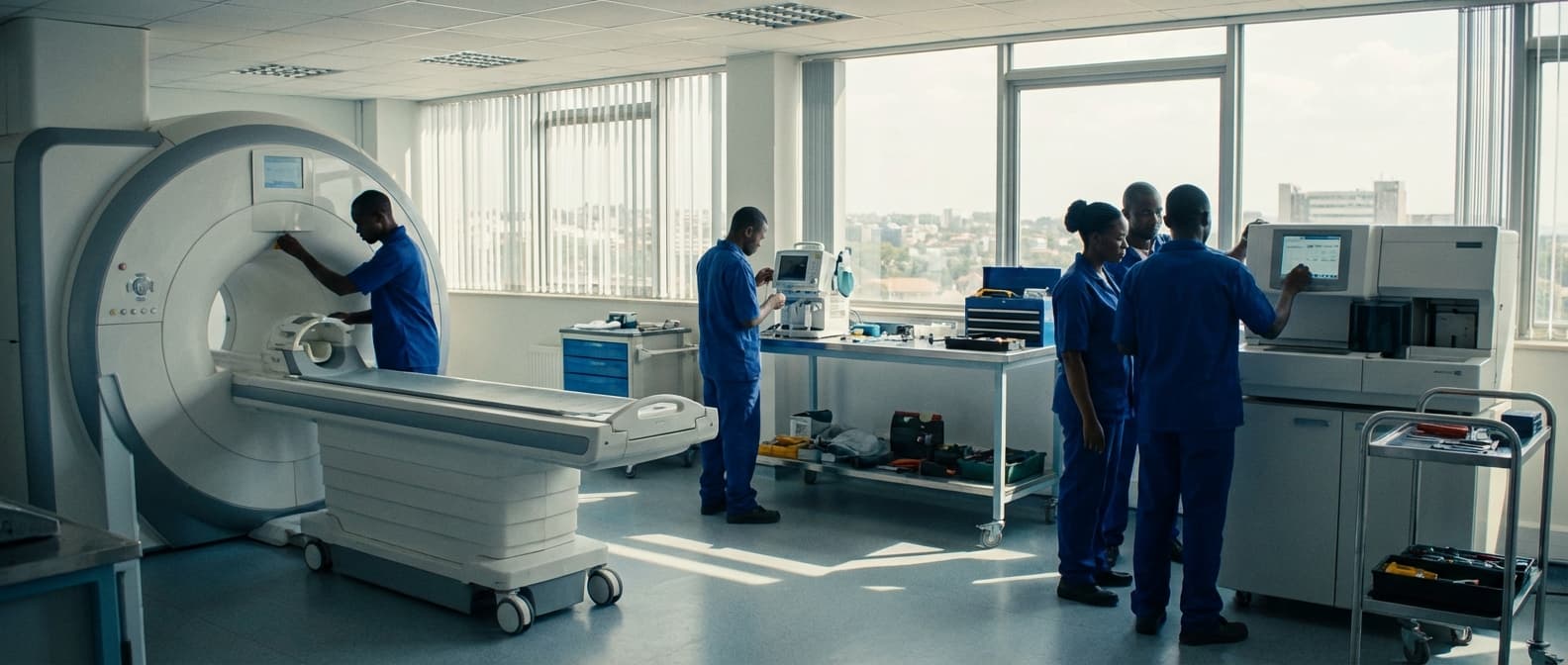
Uptime, Downtime & Root-Cause Analysis Reporting Service in Congo (Brazzaville)
Engineering Excellence & Technical Support
Uptime, Downtime & Root-Cause Analysis Reporting Service High-standard technical execution following OEM protocols and local regulatory frameworks.
Real-time Uptime Monitoring & Alerting
Gain immediate visibility into your critical infrastructure's availability across Congo (Brazzaville). Our service provides continuous, real-time uptime monitoring with customizable alerts, ensuring you're instantly notified of any service degradation or outages before they impact your users.
Comprehensive Downtime Incident Tracking
Meticulously document and analyze every downtime incident. Our reporting service captures essential details including duration, affected services, and impact scope, providing a clear historical record for performance evaluation and capacity planning within the Brazzaville operational landscape.
Advanced Root-Cause Analysis (RCA) Tools
Move beyond simply identifying outages. Our platform offers sophisticated root-cause analysis tools, leveraging historical data and correlation to pinpoint the precise origin of downtime events in your Brazzaville-based systems, enabling swift and effective preventative measures.
What Is Uptime, Downtime & Root-cause Analysis Reporting Service In Congo (Brazzaville)?
In the context of Congo (Brazzaville), Uptime, Downtime & Root-Cause Analysis Reporting Services refer to the systematic monitoring, documentation, and investigation of the operational availability and unavailability of IT infrastructure, business-critical applications, and digital services. These services aim to quantify service performance, identify the underlying causes of disruptions, and provide actionable insights to prevent recurrence, thereby enhancing overall system reliability and business continuity. The reporting component is crucial for stakeholders to understand performance trends, justify investments in infrastructure, and make informed decisions regarding service improvement.
Uptime signifies the period during which a system, service, or application is operational and accessible to its intended users. It is typically measured as a percentage of total operational time over a defined period (e.g., 99.9%, 99.99%).
Downtime refers to the period when a system, service, or application is unavailable or non-functional, rendering it inaccessible to users. Downtime can be planned (e.g., for maintenance) or unplanned (e.g., due to hardware failure, software bugs, cyberattacks).
Root-Cause Analysis (RCA) is a structured process used to identify the fundamental reason(s) for an incident or problem. The goal of RCA is not merely to fix the immediate symptom but to understand the contributing factors that led to the event, enabling the implementation of preventative measures.
| Service Component | Definition | Key Metrics | Typical Use Cases in Congo (Brazzaville) |
|---|---|---|---|
| Uptime Monitoring | Continuous tracking of system and service availability. | Availability percentage (e.g., 99.999%), Mean Time Between Failures (MTBF). | Ensuring uninterrupted mobile network coverage for business and personal use; guaranteeing accessibility of online banking services for citizens and businesses; monitoring the operational status of internet service provider (ISP) infrastructure. |
| Downtime Incident Detection & Reporting | Identification, logging, and reporting of service disruptions. | Downtime duration, number of incidents, Mean Time To Recover (MTTR). | Documenting outages in critical power grids affecting industrial zones; reporting disruptions to public transportation IT systems; tracking the impact of network failures on remote work capabilities. |
| Root-Cause Analysis (RCA) | Investigating the underlying reasons for downtime incidents. | Identification of causal factors (e.g., hardware failure, software defect, human error, cyberattack), contributing conditions, corrective actions taken. | Analyzing the cause of a major telecommunication outage impacting multiple regions; determining the vulnerability exploited during a cyberattack on a financial institution; understanding why a critical government database became inaccessible, preventing recurrence. |
| Performance Baselining & Trend Analysis | Establishing normal operational performance parameters and tracking deviations over time. | Latency, throughput, error rates, resource utilization trends. | Forecasting capacity needs for growing internet traffic; identifying performance degradation in core banking systems before they cause outages; optimizing network performance for national digital initiatives. |
| Incident Response & Escalation | Procedures for swift detection, diagnosis, and resolution of incidents, with defined escalation paths. | Time to detect, time to acknowledge, time to resolve, escalation matrices. | Rapidly restoring mobile services after a fiber cut; quickly resolving issues with point-of-sale (POS) systems in retail outlets; coordinating emergency responses for critical infrastructure failures. |
Who Needs Uptime, Downtime & Root-Cause Analysis Reporting Services in Congo (Brazzaville)?
- Telecommunication Providers: Ensuring continuous network availability (mobile, internet, landline) is paramount. Downtime directly impacts revenue and customer satisfaction.
- Financial Institutions (Banks, Microfinance): Transaction processing, online banking, and ATM services must be highly available. System outages can lead to significant financial losses and reputational damage.
- Government Agencies: Public services, e-governance platforms, and critical infrastructure management rely on uninterrupted operation.
- Energy and Utilities Companies: Maintaining uninterrupted power, water, and other essential services is a matter of public safety and economic stability.
- Large Enterprises with Distributed Operations: Businesses with multiple branches or a significant digital footprint require robust monitoring to ensure internal and external service availability.
- Cloud Service Providers and Hosting Companies: Offering reliable infrastructure to their clients necessitates comprehensive uptime monitoring and rapid incident response.
- E-commerce and Online Retailers: Continuous availability is directly correlated with sales and customer engagement.
- Healthcare Providers: Critical systems supporting patient care, electronic health records, and medical equipment must be perpetually operational.
- IT Service Providers and Managed Service Providers (MSPs): These entities are responsible for the uptime of their clients' infrastructure and applications.
Who Needs Uptime, Downtime & Root-cause Analysis Reporting Service In Congo (Brazzaville)?
In Congo (Brazzaville), businesses and organizations across various sectors rely on robust IT infrastructure for their operations. When systems go down, it leads to significant financial losses, reputational damage, and operational inefficiencies. Therefore, Uptime, Downtime & Root-Cause Analysis Reporting Services are crucial for identifying, rectifying, and preventing future disruptions. This service provides invaluable insights for proactive IT management, strategic decision-making, and ensuring business continuity.
| Customer Segment | Key Departments/Roles Benefiting |
|---|---|
| Telecommunications | Network Operations Center (NOC), IT Operations, Service Delivery, Infrastructure Management |
| Financial Services (Banks, Insurance) | IT Operations, Risk Management, Compliance, Business Continuity Planning (BCP), Information Security |
| Government & Public Sector | IT Administration, Departmental Heads, Public Service Management, Security Operations |
| Energy & Natural Resources | IT Operations, Operations Management, SCADA/Control Systems IT, Project Management |
| Healthcare | IT Infrastructure, Hospital Administration, Patient Data Management, Biomedical Engineering |
| Retail & E-commerce | IT Operations, E-commerce Management, Supply Chain IT, Customer Service |
| Manufacturing | Production IT, Plant Management, IT Infrastructure, Quality Control |
| Large Enterprises (General) | Chief Information Officer (CIO), Chief Technology Officer (CTO), IT Managers, System Administrators, DevOps Teams, Service Desk |
Target Customers and Departments in Congo (Brazzaville)
- Businesses of all sizes with critical IT systems
- Government agencies and public services
- Telecommunications providers
- Financial institutions and banks
- Energy and natural resources companies (oil, mining, etc.)
- Healthcare providers
- Educational institutions
- Logistics and transportation companies
- Manufacturing and industrial sectors
- Service providers (e.g., cloud hosting, data centers)
Uptime, Downtime & Root-cause Analysis Reporting Service Process In Congo (Brazzaville)
This document outlines the Uptime, Downtime & Root-Cause Analysis (RCA) Reporting Service Process specifically for operations in Congo (Brazzaville). It details the workflow from the initial inquiry to the final execution and reporting of findings.
| Stage | Description | Key Activities | Responsible Party/Teams | Deliverables/Outputs | Service Level Objectives (SLOs) | Notes for Congo (Brazzaville) |
|---|---|---|---|---|---|---|
| The initial stage where a client or internal stakeholder reports an incident or requests an RCA for observed downtime. | Receive and log inquiry, clarify the scope and impact of the reported downtime, identify key stakeholders, and confirm service engagement. | Client/Internal Stakeholder, Service Desk/Support Team, Account Manager | Logged Incident Ticket, Initial Scope Definition Document, Confirmation of Service Engagement | Acknowledge inquiry within 4 business hours. Confirm scope within 1 business day. | Ensure clear understanding of service boundaries and reporting expectations given local context. Account for potential language nuances. |
| Collecting all relevant data to understand the nature, extent, and timeline of the downtime. | Gather system logs, error messages, performance metrics, network traffic data, configuration changes, user reports, and any other pertinent information. Verify data accuracy and completeness. | Technical Support Teams, System Administrators, Network Engineers, Database Administrators, Client IT Department | Collected Raw Data, Verified Incident Timeline, Initial Impact Assessment | Complete data collection within 8 business hours of scoping. Data verification within 4 business hours of collection. | Facilitate access to local infrastructure and systems. Leverage local IT resources for on-site data collection if remote access is challenging. |
| The core of the process, involving the systematic investigation to determine the root cause(s) of the downtime. | Analyze collected data to identify deviations from normal operations. Apply RCA methodologies (e.g., 5 Whys, Fishbone Diagram, Fault Tree Analysis). Identify contributing factors and the ultimate root cause(s). Document the sequence of events. | Senior Technical Analysts, RCA Specialists, Subject Matter Experts (SMEs) | Identified Root Cause(s), Contributing Factors, Detailed Chronology of Events, RCA Findings Document (Draft) | Complete initial RCA analysis within 2 business days of data collection completion. | Consider potential local factors like power grid instability, unique environmental conditions, or specific local operational practices that might contribute to downtime. |
| Compiling the findings into a comprehensive and understandable report for stakeholders. | Draft the RCA report, including executive summary, incident details, timeline, root cause analysis, impact assessment, and initial recommendations. Review the draft report with key technical teams for accuracy. Submit draft for client/stakeholder review. | RCA Lead, Technical Writers, Senior Technical Teams, Account Manager | Draft RCA Report, Final RCA Report | Draft report ready for internal review within 1 business day of RCA completion. Final report submitted for stakeholder review within 2 business days of internal review. | Ensure the report is translated or presented in a manner understandable to local stakeholders, considering language and cultural communication styles. Adapt report format if necessary. |
| Developing and agreeing on corrective and preventive actions to address the identified root cause(s). | Collaborate with stakeholders to define actionable recommendations. Prioritize recommendations based on impact and feasibility. Develop an action plan with assigned responsibilities and timelines. Initiate implementation of agreed-upon actions. | Client/Internal Stakeholders, Technical Teams, Project Managers, Account Manager | Action Plan Document, Remediation Implementation Plan | Action plan agreed upon within 3 business days of final report submission. Initiation of high-priority actions within 5 business days of action plan agreement. | Factor in local procurement, logistics, and resource availability when defining remediation timelines and strategies. Partner with local vendors or service providers where applicable. |
| Monitoring the implementation of the action plan and confirming that the RCA has addressed the issue, leading to service closure. | Track the progress of remediation activities. Verify the effectiveness of implemented actions. Conduct a post-implementation review. Formally close the incident and RCA process once all actions are completed and validated. | Account Manager, Project Managers, Technical Teams, Client/Internal Stakeholders | Remediation Progress Reports, Post-Implementation Review Summary, Closed Incident/RCA Ticket | Remediation progress updates weekly. Formal closure within 10 business days of action plan completion or upon confirmation of issue resolution. | Establish clear communication channels for ongoing follow-up. Ensure local teams are empowered to provide feedback on remediation effectiveness. |
Service Workflow Stages
- Inquiry & Scoping
- Information Gathering & Verification
- Incident Analysis & RCA
- Report Generation & Review
- Action Planning & Remediation
- Follow-up & Closure
Uptime, Downtime & Root-cause Analysis Reporting Service Cost In Congo (Brazzaville)
Providing uptime, downtime, and root-cause analysis (RCA) reporting services in Congo (Brazzaville) involves a range of factors that influence cost. These services are crucial for businesses to ensure the reliability and performance of their IT infrastructure and operational systems. The pricing is typically determined by the complexity of the systems being monitored, the frequency and depth of reporting, the level of expertise required for RCA, and the service provider's operational overhead in the local market.
| Service Component | Typical Pricing Range (CFA Francs - XAF) | Notes |
|---|---|---|
| Basic Uptime/Downtime Monitoring (Automated Reports) | 200,000 - 700,000 XAF per month | Covers standard monitoring of a defined set of systems with automated, periodic reports. |
| Advanced Monitoring with Performance Metrics | 400,000 - 1,500,000 XAF per month | Includes detailed performance metrics, anomaly detection, and more frequent reporting for critical applications. |
| Basic Root-Cause Analysis (Per Incident) | 150,000 - 500,000 XAF per incident | For simpler incidents requiring basic investigation and a brief RCA report. |
| In-depth Root-Cause Analysis (Per Incident) | 400,000 - 2,000,000+ XAF per incident | For complex issues requiring significant time, specialized expertise, and detailed investigation and reporting. |
| Comprehensive RCA & Proactive Monitoring Package | 700,000 - 3,000,000+ XAF per month | Bundles advanced monitoring, proactive issue identification, and comprehensive RCA services, often with a retainer for dedicated support. |
| Consultation & Custom Reporting | 50,000 - 150,000 XAF per hour | For specific analysis, strategy development, or highly customized report generation. |
Key Pricing Factors for Uptime, Downtime & RCA Reporting Services in Congo (Brazzaville)
- Scope of Monitoring: The number of systems, applications, and network devices to be monitored significantly impacts cost. Larger and more complex infrastructures require more resources and advanced tools.
- Service Level Agreements (SLAs): The criticality of the systems dictates the required uptime and the corresponding monitoring intensity. More stringent SLAs may involve higher costs due to the need for proactive measures and faster response times.
- Reporting Frequency and Detail: Daily, weekly, monthly, or ad-hoc reports, along with the level of detail (e.g., raw data, executive summaries, trend analysis), influence pricing. Comprehensive RCA reports with in-depth analysis are generally more expensive.
- Root-Cause Analysis Expertise: The complexity of issues and the level of technical expertise needed for thorough RCA are major cost drivers. Identifying the root cause of intricate problems requires skilled engineers.
- Technology Stack & Tools: The specific monitoring tools and software used by the service provider, and whether they are licensed or proprietary, will affect the overall cost.
- On-Site vs. Remote Support: While most RCA and reporting can be done remotely, any requirement for on-site presence for diagnostics or data collection will incur additional travel and logistical expenses.
- Provider's Experience and Reputation: Established providers with a proven track record and specialized expertise may command higher prices.
- Support Level & Response Time: The availability of 24/7 support and guaranteed response times for critical incidents will impact the service cost.
- Data Retention Policies: The duration for which historical monitoring data is stored and made accessible can influence storage costs and, consequently, service pricing.
- Customization Requirements: Tailoring reporting formats, dashboards, or specific monitoring parameters to client needs can add to the cost.
Affordable Uptime, Downtime & Root-cause Analysis Reporting Service Options
Businesses of all sizes are increasingly reliant on the consistent availability of their IT infrastructure. Unexpected downtime can lead to significant financial losses, damage to reputation, and decreased productivity. Our comprehensive Uptime, Downtime, and Root-Cause Analysis (RCA) Reporting Service is designed to provide actionable insights into your system's performance, enabling proactive problem-solving and minimizing disruption. We offer flexible value bundles and cost-saving strategies to ensure this essential service is accessible and beneficial for every organization.
| Service Component | Description | Value Proposition | Cost-Saving Strategy |
|---|---|---|---|
| Basic Uptime Monitoring | Real-time tracking of service availability. | Ensures immediate awareness of outages. | Essential foundational service, often the lowest cost entry point. |
| Downtime Incident Reporting | Detailed logs of all downtime events, including duration and impact. | Quantifies losses and identifies recurring issues. | Bundled with uptime monitoring for a more complete picture. |
| Root-Cause Analysis (RCA) | In-depth investigation into the underlying reasons for downtime. | Enables permanent solutions and prevents future occurrences. | Available as an add-on or within higher-tier bundles; focus on critical incidents saves analysis costs. |
| Performance Trend Analysis | Identification of subtle performance degradations before they cause outages. | Proactive maintenance reduces emergency repair costs. | Included in mid-to-high tier bundles, or as a separate value-add. |
| Customizable Dashboards & Reports | Tailored views of your IT infrastructure performance. | Focuses on what matters most to your business, improving decision-making. | Included in most packages, with advanced customization at higher tiers. |
| Automated Alerting & Notifications | Instant alerts sent to designated personnel upon critical events. | Reduces response times and mitigates damage. | Standard feature across most service levels. |
Value Bundles & Cost-Saving Strategies
- {"title":"Tiered Service Bundles","description":"Our services are packaged into tiered bundles to cater to diverse needs and budgets. Each tier offers increasing levels of detail, support, and proactive monitoring."}
- {"title":"Scalable Reporting","description":"Start with basic uptime monitoring and evolve to in-depth root-cause analysis as your requirements grow. Pay only for the depth of reporting you need."}
- {"title":"Proactive Trend Analysis","description":"Beyond simply reporting incidents, we identify patterns and trends in your system's performance, allowing for predictive maintenance and early intervention."}
- {"title":"Automated Alerting","description":"Receive instant notifications for critical events, enabling your IT team to respond swiftly before minor issues escalate into major downtime."}
- {"title":"Customizable Reporting Dashboards","description":"Tailor your reporting dashboards to focus on the Key Performance Indicators (KPIs) most relevant to your business operations."}
- {"title":"Dedicated Support Options","description":"Choose from self-service options to fully managed support, including expert consultation for complex RCA investigations."}
- {"title":"Volume Discounts","description":"Benefit from reduced per-unit costs as your reporting needs or the number of monitored assets increase."}
- {"title":"Annual Contract Savings","description":"Commit to an annual subscription and enjoy significant discounts compared to monthly billing."}
- {"title":"Bundled Service Packages","description":"Combine uptime monitoring with downtime analysis and RCA reporting in a single, cost-effective package."}
- {"title":"Managed Service Integration","description":"If you're already using a managed IT service provider, our reporting can seamlessly integrate, offering enhanced visibility and deeper insights."}
Verified Providers In Congo (Brazzaville)
Navigating the healthcare landscape in Congo (Brazzaville) can be challenging, especially when seeking verified and reliable providers. Franance Health stands out as a leading entity in this regard, offering a robust credentialing system that ensures the highest standards of medical care. This document outlines what verified providers in Congo (Brazzaville) entail and why Franance Health's credentials represent the best choice for patients seeking quality healthcare.
| Benefit for Patients | Franance Health's Advantage | Why it's the Best Choice |
|---|---|---|
| Trust and Reliability | Franance Health's verified providers offer a guarantee of legitimate and qualified medical professionals. | Eliminates the guesswork in finding competent healthcare, reducing anxiety and risk. |
| Quality of Care | Verified credentials indicate a commitment to upholding high medical standards and best practices. | Ensures access to skilled practitioners and facilities equipped to deliver effective treatment. |
| Patient Safety | The thorough background and credential checks minimize the risk of encountering unqualified or unethical practitioners. | Provides peace of mind and a safer healthcare experience for individuals and families. |
| Access to Specialized Services | Franance Health's network often includes specialists whose credentials have been meticulously reviewed. | Facilitates finding the right expert for specific medical needs, leading to better health outcomes. |
| Streamlined Healthcare Navigation | By partnering with Franance Health, patients gain access to a curated list of trusted providers. | Simplifies the process of finding and accessing appropriate medical care in Congo (Brazzaville). |
What Franance Health Credentials Signify:
- Rigorous Verification Process: Franance Health employs a comprehensive and multi-faceted verification process for all affiliated healthcare professionals and facilities.
- Professional Licensing and Certification: This includes verifying the authenticity of medical licenses, board certifications, and any specialized accreditations.
- Education and Training Validation: Franance Health confirms the academic qualifications and ongoing professional development of its providers.
- Background Checks: Thorough background checks are conducted to ensure ethical conduct and a commitment to patient safety.
- Performance and Patient Feedback Monitoring: Continuous monitoring of provider performance and patient feedback mechanisms are in place to maintain service excellence.
- Adherence to Ethical Standards: Providers are vetted for their commitment to ethical medical practices and patient confidentiality.
Scope Of Work For Uptime, Downtime & Root-cause Analysis Reporting Service
This document outlines the Scope of Work (SOW) for a comprehensive Uptime, Downtime, and Root-Cause Analysis (RCA) Reporting Service. The service aims to provide clients with detailed insights into their system availability, identify the causes of disruptions, and recommend preventative measures. This SOW covers the technical deliverables and standard specifications required for the successful execution of this service.
| Deliverable | Description | Standard Specifications | Frequency | Format |
|---|---|---|---|---|
| Uptime/Downtime Report | Detailed reporting of system availability, including duration and percentage of uptime and downtime. | Metrics to include: Total Uptime, Total Downtime, Uptime Percentage, Downtime Percentage, Scheduled Downtime, Unscheduled Downtime. Specific systems/services covered will be defined in the Service Level Agreement (SLA). | Daily, Weekly, Monthly | PDF, CSV, Online Dashboard Access |
| Downtime Incident Report | Comprehensive documentation of each downtime event, including start time, end time, duration, and impact. | Information to include: Incident ID, System/Service Affected, Start Timestamp, End Timestamp, Duration (HH:MM:SS), Impact Level (e.g., Critical, High, Medium, Low), Affected Users/Customers, Brief Description of Event. | As needed (per incident) | PDF, Online Portal Entry |
| Root-Cause Analysis (RCA) Report | In-depth investigation into the underlying causes of downtime incidents. | Components to include: Incident Summary, Timeline of Events, Contributing Factors (e.g., Hardware failure, Software bug, Human error, Network issue, Configuration change), Analysis Methodology (e.g., 5 Whys, Fishbone Diagram), Root Cause Identification, Remedial Actions Taken, Recommendations for Prevention, Lessons Learned. | As needed (per significant incident, as defined in SLA) | PDF, Online Portal Entry |
| Performance Metrics Report | Analysis of key system performance indicators that may impact uptime or contribute to downtime. | Metrics to include: Response Times, Error Rates, Resource Utilization (CPU, Memory, Disk, Network). Specific metrics and thresholds will be defined in the SLA. | Weekly, Monthly | PDF, CSV, Online Dashboard Access |
| Trend Analysis and Recommendations | Identification of recurring patterns in downtime and performance issues, with proactive recommendations for improvement. | Analysis of historical data to identify trends, predict potential issues, and propose long-term solutions. Recommendations will be categorized (e.g., Immediate, Short-term, Long-term) and prioritized. | Monthly, Quarterly | PDF, Presentation Slides |
Objectives of the Service
- Accurately track and report system uptime and downtime metrics.
- Perform thorough root-cause analysis for all identified downtime incidents.
- Provide actionable recommendations to prevent future occurrences of downtime.
- Enhance system reliability and performance through data-driven insights.
- Maintain a comprehensive historical record of system availability and incident analysis.
Service Level Agreement For Uptime, Downtime & Root-cause Analysis Reporting Service
This Service Level Agreement (SLA) outlines the guaranteed uptime, procedures for handling downtime, and requirements for root-cause analysis reporting for the Uptime, Downtime & Root-Cause Analysis Reporting Service (hereinafter referred to as 'the Service'). This SLA is an addendum to the Master Service Agreement (MSA) between [Your Company Name] (hereinafter referred to as 'Provider') and [Client Company Name] (hereinafter referred to as 'Client').
| Metric | Guarantee | Response Time (for reporting/escalation) |
|---|---|---|
| Service Availability (Uptime) | 99.9% monthly uptime | N/A (This is a performance guarantee, not a response time) |
| Incident Notification (from Provider to Client) | N/A (Client is responsible for monitoring and reporting) | Within 15 minutes of detection of Unscheduled Downtime impacting the Client's service. |
| Root-Cause Analysis (RCA) Report Submission | N/A (This is a deliverable upon RCA completion) | Within 2 business days of resolution of Unscheduled Downtime impacting the Client's service. |
| Updates during Unscheduled Downtime | N/A (Client expectation) | Regular updates will be provided every 60 minutes during Unscheduled Downtime. |
Key Definitions
- Uptime: The percentage of time the Service is operational and accessible to the Client.
- Downtime: The percentage of time the Service is unavailable, inoperable, or inaccessible.
- Scheduled Maintenance: Planned periods where the Service may be unavailable for upgrades, patches, or other necessary maintenance. These periods will be communicated in advance.
- Unscheduled Downtime: Any Downtime that is not Scheduled Maintenance.
- Root-Cause Analysis (RCA): A detailed investigation to identify the fundamental reason for an incident or outage.
- Incident: Any event that causes or may cause an interruption to the normal operation of the Service.
- Excusable Downtime: Downtime caused by events beyond the reasonable control of the Provider, including but not limited to, acts of God, war, terrorism, natural disasters, widespread internet outages affecting multiple backbone providers, or failures of third-party infrastructure not directly managed by the Provider.
- Service Credits: Compensation provided to the Client in the event of a failure to meet the Uptime guarantees outlined in this SLA.
Frequently Asked Questions

Ready when you are
Let's scope your Uptime, Downtime & Root-Cause Analysis Reporting Service in Congo (Brazzaville) project in Congo (Brazzaville).

Scaling healthcare logistics and technical systems across the entire continent.