
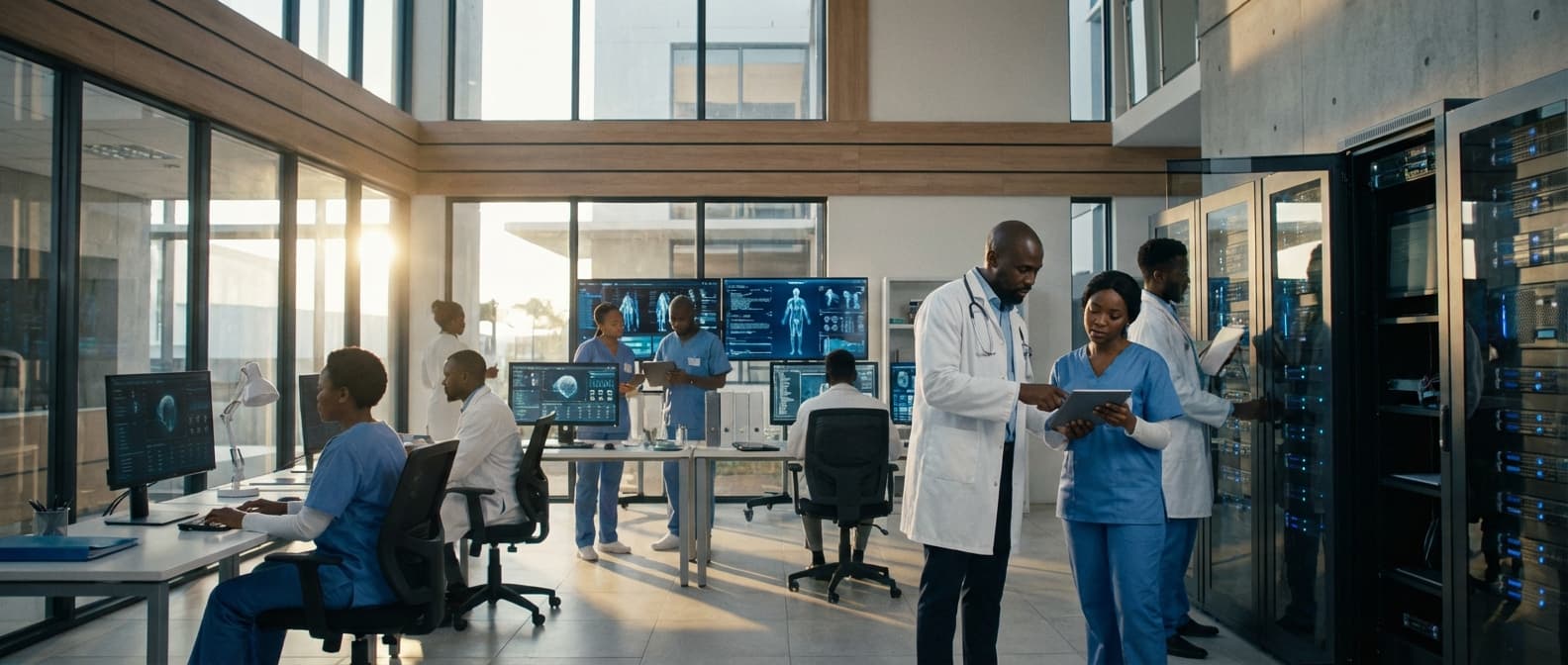
Medical IT Consultation in Congo (Brazzaville)
Engineering Excellence & Technical Support
Strategic technology consulting to optimize healthcare operations, streamline workflows, and integrate cutting-edge medical information systems. High-standard technical execution following OEM protocols and local regulatory frameworks.
Bridging Connectivity Gaps
Implementing robust satellite and cellular network solutions to ensure reliable internet access for remote healthcare facilities in Congo (Brazzaville), enabling real-time data transmission and telemedicine capabilities.
Secure Electronic Health Records (EHR) Deployment
Designing and deploying secure, cloud-based EHR systems tailored to the Congolese healthcare context, focusing on data privacy, interoperability with existing systems, and accessibility for medical professionals.
Cybersecurity Framework for Health Data
Establishing comprehensive cybersecurity protocols and training programs to protect sensitive patient information from evolving threats, ensuring compliance with international data protection standards within the Congolese healthcare infrastructure.
What Is Medical It Consultation In Congo (Brazzaville)?
Medical IT Consultation in Congo (Brazzaville) refers to specialized advisory services focused on the strategic planning, implementation, optimization, and management of information technology (IT) systems and infrastructure within healthcare organizations in the Republic of the Congo. This encompasses a broad spectrum of IT-related needs, from basic hardware and software procurement to complex electronic health record (EHR) system integration, cybersecurity enhancement, and data analytics. The objective is to leverage technology to improve operational efficiency, enhance patient care quality, ensure data security and privacy, and support clinical decision-making within the unique technological and regulatory landscape of Congo (Brazzaville).
| Who Needs Medical IT Consultation? | Typical Use Cases |
|---|---|
| Hospitals and Clinics (Public and Private): Seeking to modernize their IT infrastructure, improve patient record management, and enhance operational efficiency. | Implementing an EHR/EMR system to digitize patient records and streamline workflows. Upgrading network infrastructure to support increased data traffic and telemedicine services. Developing a cybersecurity strategy to protect patient data from evolving threats. Assessing the feasibility and implementation of telemedicine solutions to reach remote populations. |
| Government Health Agencies and Ministries: Requiring support for national health information systems, data standardization, and digital health initiatives. | Developing a national health data strategy and infrastructure. Implementing a centralized patient registry. Establishing interoperability standards between different healthcare facilities. Planning and executing digital health policies and programs. |
| Non-Governmental Organizations (NGOs) and International Health Organizations: Operating in the healthcare sector and needing to establish or improve IT capabilities for program delivery and data management. | Setting up IT infrastructure for mobile health clinics. Implementing data collection and reporting systems for public health programs. Ensuring secure data management for research projects. Deploying communication systems for field operations. |
| New Healthcare Ventures and Startups: Requiring foundational IT planning and system design for nascent operations. | Designing the initial IT architecture for a new medical facility. Selecting and implementing essential software for practice management. Establishing secure IT policies from the outset. |
| Healthcare Educational Institutions: Needing IT support for research, teaching, and administrative functions. | Developing simulation labs with advanced IT capabilities. Implementing learning management systems (LMS) for medical education. Ensuring secure access to research databases. |
Key Components of Medical IT Consultation:
- Needs Assessment and Gap Analysis: Evaluating current IT infrastructure, identifying deficiencies, and aligning IT capabilities with organizational goals and healthcare best practices.
- Strategic IT Planning: Developing long-term roadmaps for technology adoption, including EHR implementation, telemedicine solutions, and data management strategies.
- System Selection and Procurement: Advising on the selection of appropriate hardware, software, and IT services, considering factors like cost-effectiveness, scalability, and compatibility with local infrastructure.
- EHR/EMR Implementation and Optimization: Guiding healthcare providers through the selection, customization, deployment, and ongoing optimization of Electronic Health Record (EHR) or Electronic Medical Record (EMR) systems.
- Network Infrastructure Design and Management: Planning, deploying, and managing robust and secure network infrastructures to support data transmission and communication.
- Cybersecurity and Data Privacy: Implementing measures to protect sensitive patient data from unauthorized access, breaches, and ensuring compliance with relevant data protection regulations.
- Telemedicine and Remote Health Solutions: Designing and implementing platforms and strategies for remote patient monitoring, telehealth consultations, and healthcare delivery in underserved areas.
- Data Analytics and Business Intelligence: Developing capabilities for collecting, analyzing, and interpreting healthcare data to inform clinical decisions, improve patient outcomes, and optimize resource allocation.
- IT Support and Maintenance: Establishing and managing IT support services, including helpdesk functions, system maintenance, and troubleshooting.
- Regulatory Compliance and Standards: Ensuring IT systems adhere to national and international healthcare IT standards and regulations applicable in Congo (Brazzaville).
- Training and Capacity Building: Providing training to healthcare staff on the use of new IT systems and technologies.
- Project Management: Overseeing the execution of IT projects from inception to completion, ensuring timely and budget-compliant delivery.
Who Needs Medical It Consultation In Congo (Brazzaville)?
Medical IT consultation in Congo (Brazzaville) is crucial for a range of healthcare organizations aiming to improve efficiency, security, and patient care through technology. The demand spans various levels of the healthcare system, from large public hospitals to smaller private clinics and research institutions.
| Department | Key IT Needs | Benefits of Consultation |
|---|---|---|
| Administration | Patient registration, billing, scheduling, HR management, financial systems. | Improved operational efficiency, reduced administrative errors, enhanced financial reporting. |
| Clinical Departments (e.g., Cardiology, Radiology, Oncology) | Electronic Health Records (EHRs), Picture Archiving and Communication Systems (PACS), Electronic Medical Records (EMRs), specialized clinical software. | Streamlined patient care, improved diagnostic accuracy, better data accessibility for treatment planning. |
| Information Technology (IT) Department | Network infrastructure, cybersecurity, data management, system maintenance, hardware/software procurement, IT policy development. | Enhanced system reliability, robust security measures, optimized IT resource allocation, proactive issue resolution. |
| Laboratory & Pathology | Laboratory Information Systems (LIS), data analysis tools, instrument integration, sample tracking. | Increased accuracy and speed of test results, improved sample management, seamless integration with EHRs. |
| Pharmacy | Pharmacy Information Systems (PIS), inventory management, drug interaction checking, prescription management. | Accurate medication dispensing, efficient inventory control, improved patient safety regarding drug interactions. |
| Research & Development | Data management platforms, statistical analysis software, secure data storage, collaboration tools. | Facilitates data-driven research, enables secure sharing of findings, accelerates innovation. |
| Patient Records/Medical Records Department | EHR/EMR implementation and management, data archiving, retrieval systems, data security and privacy. | Ensured patient data confidentiality, efficient record retrieval, compliance with data protection regulations. |
| Telemedicine/Remote Care Services | Video conferencing platforms, remote monitoring systems, secure data transmission, patient portal integration. | Expanded healthcare access, efficient remote patient management, improved continuity of care. |
Target Customers & Departments for Medical IT Consultation in Congo (Brazzaville)
- {"title":"Hospitals (Public & Private)","description":"These institutions require robust IT infrastructure to manage patient records, streamline administrative tasks, and enhance clinical workflows. They are often the largest consumers of IT services, seeking solutions for electronic health records (EHRs), Picture Archiving and Communication Systems (PACS), hospital information systems (HIS), and cybersecurity."}
- {"title":"Clinics & Health Centers","description":"Smaller healthcare providers can benefit immensely from tailored IT solutions that optimize appointment scheduling, patient registration, basic record-keeping, and communication. They may be looking for cost-effective cloud-based solutions or support for existing infrastructure."}
- {"title":"Laboratories & Diagnostic Centers","description":"These facilities need IT systems for managing test orders, processing results, interfacing with lab equipment, and securely storing sensitive patient data. Integration with hospital systems is often a key requirement."}
- {"title":"Research Institutions & Universities with Medical Programs","description":"Organizations involved in medical research and education require IT support for data analysis, scientific databases, simulation software, and secure collaboration platforms. They may also need help with managing IT resources for academic purposes."}
- {"title":"Government Health Ministries & Agencies","description":"These entities often oversee national health initiatives and require IT consultation for developing and implementing public health information systems, disease surveillance platforms, and e-health strategies. Data management and interoperability are critical concerns."}
- {"title":"Pharmacies (Large Chains & Hospital Pharmacies)","description":"Pharmacies benefit from IT solutions for inventory management, prescription dispensing, patient medication history, and integration with healthcare provider systems. Ensuring data accuracy and compliance is paramount."}
Medical It Consultation Process In Congo (Brazzaville)
The Medical IT Consultation Process in Congo (Brazzaville) outlines the systematic approach to engaging IT professionals for healthcare facilities. This process is crucial for implementing, upgrading, or troubleshooting IT systems that support medical operations, ensuring efficiency, data security, and compliance with healthcare regulations. The workflow typically begins with an initial inquiry, followed by needs assessment, proposal development, contract finalization, project execution, and ongoing support. Each stage is designed to ensure a clear understanding of the client's requirements and the delivery of tailored IT solutions.
| Stage | Description | Key Activities | Deliverables | Responsible Parties |
|---|---|---|---|---|
| Inquiry & Initial Contact | The process begins when a healthcare facility identifies a need for IT consultation or services. | Client initiates contact (phone, email, website). Initial discussion to understand basic needs and context. | Acknowledgement of inquiry, scheduling of initial meeting. | Healthcare Facility, Medical IT Consulting Firm |
| Needs Assessment & Requirements Gathering | A thorough understanding of the client's current IT infrastructure, operational workflows, and specific challenges is established. | On-site visits, interviews with stakeholders (doctors, nurses, administrators), system audits, identification of pain points and desired outcomes. | Detailed needs assessment report, documented requirements, problem statement. | Medical IT Consulting Firm, Healthcare Facility Staff |
| Proposal Development & Presentation | Based on the gathered requirements, a tailored IT solution proposal is developed. | Defining scope of work, outlining proposed solutions (hardware, software, network, security), estimating timelines and costs, presenting solution benefits. | Formal proposal document, presentation of proposal. | Medical IT Consulting Firm |
| Contract Negotiation & Agreement | Formalizing the engagement through a legally binding contract that outlines terms, conditions, and deliverables. | Reviewing and negotiating proposal terms, pricing, payment schedules, service level agreements (SLAs), signing of the contract. | Signed contract, Statement of Work (SOW). | Medical IT Consulting Firm, Healthcare Facility |
| Project Planning & Scoping | Detailed planning for the execution of the agreed-upon IT solution. | Developing a project management plan, defining project milestones, allocating resources, risk assessment and mitigation strategies. | Project plan, Gantt chart, resource allocation matrix. | Medical IT Consulting Firm |
| System Design & Architecture | Designing the specific IT architecture that will meet the identified needs and requirements. | Designing network topology, selecting appropriate hardware and software, planning for data storage and security, ensuring interoperability with existing systems. | System architecture diagrams, technical specifications. | Medical IT Consulting Firm |
| Implementation & Deployment | The actual installation and configuration of the IT solutions. | Procurement and installation of hardware, installation and configuration of software (EHR, PACS, etc.), network setup, security implementation. | Installed and configured IT systems, functional infrastructure. | Medical IT Consulting Firm, IT Vendors |
| Testing & Quality Assurance | Ensuring that the implemented systems function as intended and meet all specifications. | Unit testing, integration testing, user acceptance testing (UAT), performance testing, security vulnerability assessments. | Test reports, UAT sign-off. | Medical IT Consulting Firm, Healthcare Facility Staff |
| User Training & Handover | Educating the healthcare facility's staff on how to effectively use the new IT systems. | Developing training materials, conducting training sessions (on-site or remote), providing user manuals, knowledge transfer. | Trained staff, user manuals, training documentation. | Medical IT Consulting Firm, Healthcare Facility Staff |
| Post-Implementation Support & Maintenance | Providing ongoing support and maintenance to ensure the continued optimal performance of the IT systems. | Helpdesk support, system monitoring, software updates and patching, hardware maintenance, troubleshooting. | Ongoing IT support, maintenance logs. | Medical IT Consulting Firm |
| Project Closure & Review | Formally closing the project and evaluating its success. | Final project report, client satisfaction survey, lessons learned documentation, final invoicing. | Project closure report, feedback summary. | Medical IT Consulting Firm, Healthcare Facility |
Medical IT Consultation Workflow in Congo (Brazzaville)
- Inquiry & Initial Contact
- Needs Assessment & Requirements Gathering
- Proposal Development & Presentation
- Contract Negotiation & Agreement
- Project Planning & Scoping
- System Design & Architecture
- Implementation & Deployment
- Testing & Quality Assurance
- User Training & Handover
- Post-Implementation Support & Maintenance
- Project Closure & Review
Medical It Consultation Cost In Congo (Brazzaville)
Consulting on medical IT in Congo (Brazzaville) can involve a range of services, from basic infrastructure assessment to complex EMR/EHR implementation and cybersecurity planning. The cost is influenced by several key factors:
Key Pricing Factors:
- Scope of Work: The complexity and breadth of the project are primary drivers. A simple network assessment will be far less expensive than a full hospital-wide digital transformation.
- Consultant Experience & Reputation: Highly experienced consultants or firms with a proven track record in healthcare IT will command higher rates.
- Duration of Engagement: Short-term, project-specific consultations will have different pricing structures than long-term advisory roles.
- Specialization: Consultants with expertise in specific medical IT areas like PACS (Picture Archiving and Communication System), LIS (Laboratory Information System), telemedicine, or data analytics will likely charge more.
- On-site vs. Remote: While remote consultations might be more cost-effective globally, for on-site work in Brazzaville, travel, accommodation, and per diem expenses for the consultant will add to the total cost.
- Technology Stack: The complexity of the existing or proposed IT infrastructure and the specific software/hardware being considered will impact the required expertise and thus the cost.
- Urgency: Rush projects often incur premium fees.
- Local vs. International Consultants: International consultants generally have higher daily rates, but local consultants may have better nuanced understanding of the local regulatory environment and existing infrastructure challenges.
Cost Ranges (Estimates in Congolese Francs - XAF):
It's challenging to provide exact figures without a detailed project scope, but here are estimated ranges based on common consultation types. These are indicative and can vary significantly.
- Hourly Rates: For ad-hoc advice or short engagements, hourly rates can range from 50,000 XAF to 150,000 XAF or more, depending on the consultant's seniority and specialization.
- Daily Rates: For dedicated on-site or remote work over several days, daily rates might fall between 250,000 XAF and 750,000 XAF.
- Project-Based Fees: For well-defined projects like EMR/EHR needs assessments, IT policy development, or cybersecurity audits, costs can range from 2,000,000 XAF to 15,000,000 XAF+ depending on the scale and complexity. Large-scale implementations or strategic planning could easily exceed this.
Important Considerations for Brazzaville:
- Local Market Dynamics: The pricing will be influenced by the availability of specialized IT professionals within Congo (Brazzaville) and the general cost of doing business.
- Travel and Logistics: If engaging consultants from outside Brazzaville or the country, factor in flights, visas, accommodation, and local transportation. These can significantly inflate project costs.
- Negotiation: It is common to negotiate rates, especially for longer-term engagements or when multiple services are bundled.
- Request for Proposals (RFPs): For substantial projects, issuing an RFP is the best way to solicit detailed proposals and pricing from various consultants or firms.
| Service Type/Duration | Estimated Cost Range (XAF) | Notes |
|---|---|---|
| Hourly Consultation (Ad-hoc Advice) | 50,000 - 150,000+ | Varies based on consultant's seniority and specialization. Can be higher for niche expertise. |
| Daily Consultation (Dedicated Work) | 250,000 - 750,000 | Applies to both on-site and remote work. Excludes travel/accommodation if on-site. |
| Project-Based (e.g., Needs Assessment, Policy Development, Cybersecurity Audit) | 2,000,000 - 15,000,000+ | Highly dependent on project scale, complexity, and deliverables. Large implementations can significantly exceed this. |
| Full EMR/EHR Implementation Planning & Oversight | 10,000,000 - 50,000,000+ | This is a broad estimate and can vary immensely based on hospital size, features, and vendor costs. |
| Travel & Accommodation (for non-local consultants) | Variable | This is an additional cost and should be factored into overall project budget. Varies by destination and duration. |
Factors Influencing Medical IT Consultation Costs in Congo (Brazzaville)
- Scope and Complexity of the Project
- Consultant's Expertise, Experience, and Reputation
- Duration of the Consultation Engagement
- Specialization in Specific Medical IT Fields (EMR/EHR, PACS, Telemedicine, Cybersecurity, etc.)
- On-site vs. Remote Service Delivery
- Nature of the Technology Stack (Existing and Proposed)
- Project Urgency and Timeline
- Location of the Consultant (Local vs. International)
- Travel and Logistical Expenses (for non-local consultants)
Affordable Medical It Consultation Options
Navigating the complex landscape of Medical IT can be daunting, especially for smaller practices or those with budget constraints. Fortunately, there are several affordable medical IT consultation options and strategies to maximize value. Understanding the nuances of value bundles and implementing cost-saving measures can significantly improve your IT infrastructure without breaking the bank.
| Strategy | Description | Cost-Saving Benefit | Key Considerations |
|---|---|---|---|
| Value Bundles | Pre-packaged IT services designed to offer a comprehensive solution at a potentially discounted rate compared to purchasing individual services. These often include a mix of support, maintenance, security, and strategic planning. | Reduces overall IT expenditure by combining services. Predictable monthly costs aid budgeting. Can streamline vendor management. | Ensure the bundle truly meets your practice's needs. Understand what's included and what's not. Compare bundle costs to individually priced services from other vendors. |
| Cloud-Based Solutions | Utilizing cloud services for EMR/EHR, data storage, backups, and software applications. This shifts IT infrastructure management and maintenance to the cloud provider. | Eliminates the need for significant upfront hardware investment and ongoing maintenance. Scalability reduces overspending on underutilized resources. Often has predictable subscription costs. | Assess data security and compliance of cloud providers. Understand data migration processes. Consider internet dependency. |
| Open-Source Software | Employing free and open-source software alternatives for certain IT functions (e.g., operating systems, office suites, some practice management tools) where robust, supported options exist. | Significant reduction in software licensing fees. Can offer flexibility and customization. | Requires in-house expertise or specialized support for implementation and maintenance. Not all open-source solutions are suitable for all medical practice needs. |
| Outsourcing Non-Core IT Functions | Delegating tasks like help desk support, cybersecurity monitoring, or IT infrastructure management to specialized third-party providers. | Allows internal staff to focus on core clinical operations. Access to specialized expertise at potentially lower costs than hiring full-time staff. Scalable as needed. | Thorough vendor vetting is crucial. Clear service level agreements (SLAs) are essential. Ensure seamless integration with existing systems. |
| Regular IT Audits and Assessments | Conducting periodic reviews of your IT infrastructure, security posture, and software/hardware usage to identify inefficiencies, redundancies, and areas for improvement. | Identifies opportunities to reduce unnecessary spending on underutilized software or hardware. Proactively addresses potential issues before they become costly problems. Ensures compliance, avoiding fines. | Requires investment in the audit process itself. Must be acted upon to realize cost savings. Can be performed by internal staff or external consultants. |
| Energy-Efficient Hardware and Practices | Selecting energy-efficient IT hardware and implementing power-saving practices (e.g., turning off equipment when not in use, optimizing server room cooling). | Reduces electricity bills. Contributes to sustainability efforts. | May involve a slightly higher upfront cost for energy-efficient equipment. Requires consistent implementation of power-saving practices. |
Affordable Medical IT Consultation Options
- Project-Based Consultations: Instead of ongoing retainers, focus on hiring IT consultants for specific, well-defined projects. This could include EMR/EHR system selection and implementation, cybersecurity assessments, network upgrades, or HIPAA compliance audits. You pay for the expertise needed for that particular task, making it more budget-friendly.
- Tiered Service Packages: Many IT providers offer tiered service packages. Lower tiers typically include basic remote support, patch management, and antivirus monitoring, while higher tiers add onsite support, proactive maintenance, and strategic planning. Choose the tier that best matches your immediate needs and budget, with the option to scale up as required.
- Managed Services with Flexible Contracts: Look for managed IT service providers that offer flexible contract terms. Avoid long, rigid contracts. Opt for month-to-month or shorter-term agreements that allow you to adapt your services based on your practice's evolving needs and financial situation.
- Specialized IT Firms: Instead of a general IT consultant, consider firms that specialize in healthcare IT. They often have a deeper understanding of healthcare regulations (like HIPAA), EMR systems, and the unique challenges faced by medical practices, potentially leading to more efficient and effective solutions.
- Local and Independent Consultants: While large IT firms have their advantages, local and independent IT consultants can often offer more competitive pricing. They may have lower overhead costs and a more personalized approach to client relationships. Thoroughly vet their experience and client testimonials.
- Virtual IT Support: For certain IT needs, virtual IT support can be a cost-effective solution. This involves remote access and support for troubleshooting, software updates, and user assistance, eliminating the need for an onsite technician for every issue.
- Leveraging Internal Resources: If your practice has tech-savvy staff, consider training them in specific IT areas. This can reduce the reliance on external consultants for day-to-day operations, freeing up consultants for more complex strategic initiatives.
Verified Providers In Congo (Brazzaville)
In the Democratic Republic of Congo (Brazzaville), accessing reliable and credentialed healthcare providers is paramount for both residents and expatriates. "Franance Health" has emerged as a distinguished entity, consistently demonstrating a commitment to high standards in medical care. Their rigorous vetting process and adherence to international best practices make them a benchmark for quality in the region. This focus on verified providers ensures that patients receive safe, effective, and ethical medical services. When seeking healthcare in Congo (Brazzaville), understanding the credentials and the value proposition of organizations like Franance Health is crucial for making informed decisions.
| Credential Type | Verification Standard | Importance for Patients | Franance Health's Role |
|---|---|---|---|
| Medical Licenses | National and International Accreditation Boards | Ensures legal authorization to practice medicine and adherence to professional ethics. | Franance Health verifies the validity and current standing of all licenses for its network providers. |
| Specialty Board Certifications | Reputable Medical Societies and Colleges | Confirms specialized training and expertise in a particular field of medicine. | Franance Health checks for recognized board certifications to ensure specialist competence. |
| Continuing Medical Education (CME) | Professional Development Requirements | Demonstrates a commitment to staying updated with the latest medical advancements and techniques. | Franance Health ensures providers are actively engaged in ongoing professional development. |
| Professional References and Background Checks | Industry Best Practices | Provides insights into a provider's reputation, work ethic, and patient interaction. | Franance Health conducts thorough background checks and seeks professional references. |
| Experience in Diverse Settings | Proven Track Record | Indicates adaptability and competence in various medical scenarios, crucial in a diverse environment. | Franance Health prioritizes providers with a proven history of successful practice. |
Why Franance Health is the Best Choice for Verified Providers in Congo (Brazzaville)
- Rigorous Credentialing and Verification Process: Franance Health meticulously vets all associated medical professionals, confirming their qualifications, licenses, and experience against international standards.
- Commitment to International Standards: Their network comprises healthcare providers who adhere to global best practices in patient care, safety, and hygiene.
- Multilingual and Culturally Sensitive Staff: Access to providers who can communicate effectively in multiple languages and understand diverse cultural needs, ensuring patient comfort and clear communication.
- Comprehensive Network of Specialists: Franance Health offers access to a wide range of medical specialties, from general practice to highly specialized fields, meeting diverse healthcare requirements.
- Proactive Patient Advocacy: They act as a trusted intermediary, assisting patients in navigating the healthcare system, understanding treatment options, and ensuring their rights are protected.
- Focus on Patient Safety and Quality Assurance: Continuous monitoring and quality control measures are in place to guarantee the highest level of care and patient satisfaction.
Scope Of Work For Medical It Consultation
This Scope of Work (SOW) outlines the services and deliverables for a Medical IT Consultation project. The primary objective is to assess, recommend, and potentially implement solutions to enhance the efficiency, security, and compliance of the client's medical IT infrastructure. This SOW details the technical deliverables and standard specifications to be adhered to throughout the project.
| Deliverable | Description | Standard Specifications / Requirements |
|---|---|---|
| Current State IT Infrastructure Report | Comprehensive analysis of existing hardware, software, network, and security systems. | Includes network diagrams, inventory of devices and software, assessment of data storage and backup solutions, and identification of security vulnerabilities. Must adhere to HIPAA technical safeguards. |
| Compliance Assessment Report | Evaluation of current IT practices against relevant healthcare regulations (e.g., HIPAA, HITECH, GDPR if applicable). | Detailed findings on compliance gaps and actionable recommendations for remediation. Specific focus on data privacy and security controls. |
| IT Strategy and Roadmap Document | Proposed future state IT architecture, including recommendations for upgrades, new technologies, and process improvements. | Prioritized recommendations based on business objectives, budget, and risk. Includes projected ROI and implementation timelines. Must align with industry best practices (e.g., HIMSS EMRAM, ONC certification requirements). |
| Security Enhancement Plan | Detailed plan to address identified security vulnerabilities and strengthen the overall security posture. | Includes recommendations for firewalls, intrusion detection/prevention systems, endpoint protection, access controls, encryption, and regular security audits. Must meet or exceed NIST cybersecurity framework guidelines. |
| Data Backup and Disaster Recovery Plan | Strategy for ensuring data integrity, availability, and business continuity. | Includes recommended backup frequency, retention policies, offsite storage solutions, and documented disaster recovery procedures. Recovery Point Objective (RPO) and Recovery Time Objective (RTO) to be defined. |
| Implementation Plan (if applicable) | Detailed project plan for implementing approved recommendations. | Includes resource allocation, timelines, budget, risk mitigation strategies, testing protocols, and change management procedures. Must adhere to project management best practices (e.g., Agile, Waterfall). |
| Training Materials and Documentation | User guides, administrator manuals, and training session outlines for new systems or processes. | Content must be clear, concise, and tailored to the target audience. Must cover all relevant functionalities and security protocols. |
| Post-Implementation Review Report (if applicable) | Evaluation of the implemented solutions' effectiveness and adherence to original objectives. | Includes performance metrics, user feedback, and recommendations for further optimization. Assesses ROI realization. |
Project Phases and Deliverables
- Phase 1: Discovery and Assessment
- Phase 2: Strategy and Recommendation
- Phase 3: Implementation Planning (Optional)
- Phase 4: Post-Implementation Review (Optional)
Service Level Agreement For Medical It Consultation
This Service Level Agreement (SLA) outlines the commitment of [Consultant Name/Company Name] (hereinafter referred to as 'Consultant') to [Client Name/Organization Name] (hereinafter referred to as 'Client') regarding the provision of Medical IT Consultation services. This SLA focuses on response times for support requests and guaranteed uptime for critical IT systems supported by the Consultant.
| Service Impact Level | Description | Target Response Time | Target Resolution Time | Uptime Guarantee |
|---|---|---|---|---|
| Critical (P1) | Complete system outage or critical functionality failure impacting patient care or core business operations. | 1 Hour | 4 Business Hours | 99.9% |
| High (P2) | Significant performance degradation or loss of non-critical functionality, impacting multiple users or workflows. | 4 Business Hours | 8 Business Hours | 99.5% |
| Medium (P3) | Minor performance issues or localized functional problems affecting a small number of users or non-essential workflows. | 8 Business Hours | 2 Business Days | N/A (Focus on resolution) |
| Low (P4) | Informational requests, general inquiries, or minor enhancements/consultation requests. | 2 Business Days | 5 Business Days | N/A (Focus on resolution) |
Key Service Components
- Scope of Services: The services covered under this SLA include [briefly list the core consultation services, e.g., EHR system optimization, cybersecurity assessments, network infrastructure planning, HIPAA compliance guidance, cloud migration strategy].
- Support Channels: Support requests will be accepted via [e.g., email, dedicated support portal, phone].
- Service Hours: Standard service hours are [e.g., Monday to Friday, 9:00 AM to 5:00 PM Local Time], excluding public holidays.
- Exclusions: This SLA does not cover issues arising from [e.g., client-provided hardware failures, third-party software not managed by the Consultant, intentional misuse of systems, force majeure events].
Frequently Asked Questions

Ready when you are
Let's scope your Medical IT Consultation in Congo (Brazzaville) project in Congo (Brazzaville).

Scaling healthcare logistics and technical systems across the entire continent.