
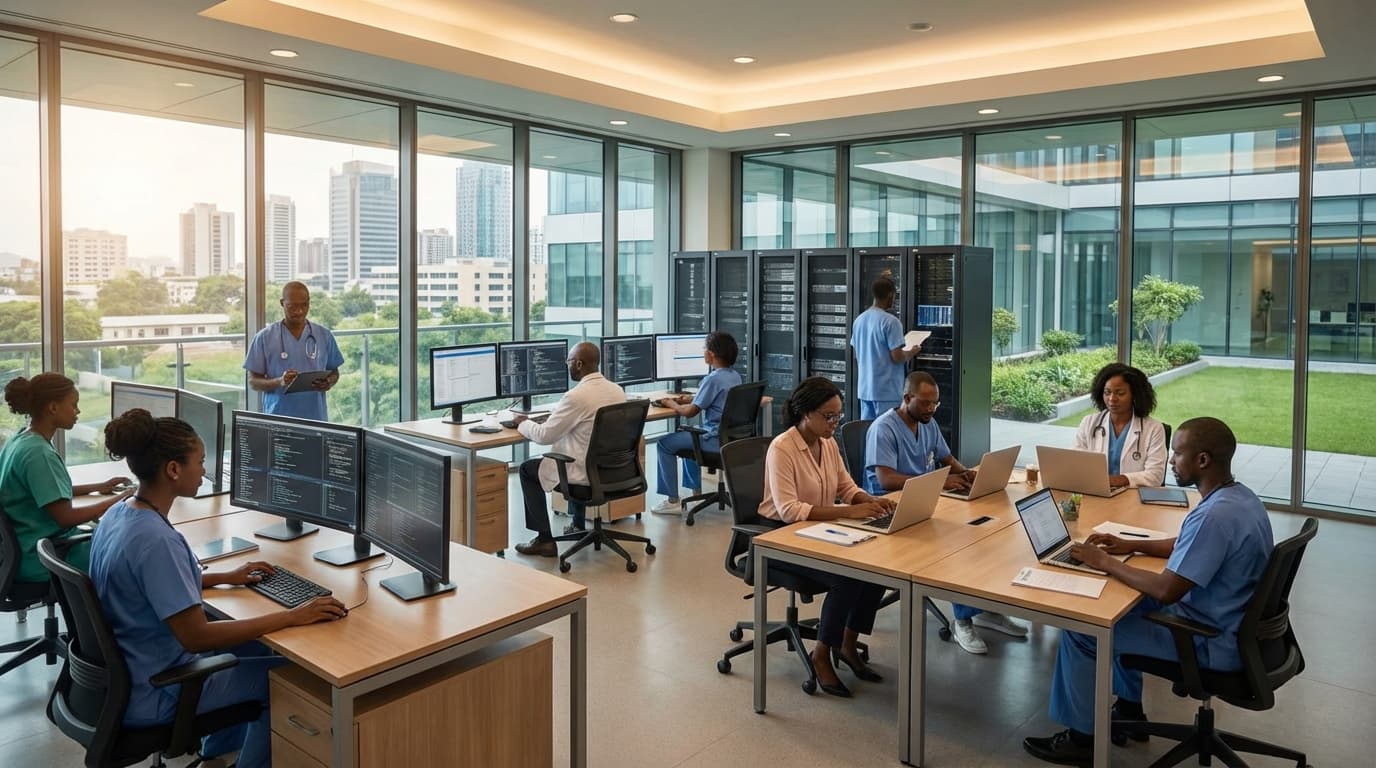
Radiology Reader & Reporting Support in Congo (Brazzaville)
Engineering Excellence & Technical Support
Remote radiology reading and reporting services High-standard technical execution following OEM protocols and local regulatory frameworks.
Advanced Diagnostic Imaging for Enhanced Patient Outcomes
Leveraging cutting-edge Picture Archiving and Communication Systems (PACS) and specialized imaging software to ensure accurate and timely diagnoses, directly improving patient treatment pathways in Congo (Brazzaville).
Remote Consultation & Expert Second Opinions
Facilitating secure telemedicine platforms for remote radiology consultations and expert second opinions from international specialists, bridging geographical gaps and elevating the standard of care in the region.
AI-Powered Workflow Optimization & Training
Implementing artificial intelligence (AI) tools for automated image analysis and workflow streamlining, coupled with comprehensive training programs for local radiologists to maximize efficiency and diagnostic precision.
What Is Radiology Reader & Reporting Support In Congo (Brazzaville)?
Radiology Reader & Reporting Support in Congo (Brazzaville) refers to a specialized service that provides remote interpretation of medical imaging studies (such as X-rays, CT scans, MRIs, and ultrasounds) and the generation of comprehensive diagnostic reports by qualified radiologists. This service is designed to augment local healthcare capabilities, particularly in regions facing a shortage of subspecialized radiologists or experiencing high imaging volumes. It facilitates timely and accurate diagnoses, thereby improving patient care pathways and clinical decision-making. The service leverages secure telecommunication infrastructure and Picture Archiving and Communication Systems (PACS) to enable seamless data transfer and communication between local healthcare facilities and remote radiology reading centers.
| Who Needs It? | Typical Use Cases | |||||
|---|---|---|---|---|---|---|
| Hospitals and Clinics in Congo (Brazzaville) facing a radiologist shortage. | Emergency departments requiring urgent interpretations of trauma scans. | Primary healthcare facilities lacking in-house radiology expertise. | Specialized medical centers needing subspecialty interpretations (e.g., oncology, neurology). | Facilities aiming to reduce turnaround times for diagnostic reports. | Healthcare providers seeking to improve the quality and consistency of radiological diagnoses. | Remote or underserved areas with limited access to diagnostic imaging specialists. |
| Interpreting complex or unusual imaging findings. | Providing second opinions on critical cases. | Managing high imaging workloads during peak periods or staff absences. | Facilitating access to advanced imaging interpretation services not available locally. | Supporting continuous medical education and training for local healthcare professionals through case reviews. | Enhancing diagnostic accuracy for conditions requiring specialized knowledge. | Enabling remote monitoring of patients requiring serial imaging studies. |
Key Components of Radiology Reader & Reporting Support:
- Remote Image Interpretation: Accessing and analyzing medical images from various modalities.
- Report Generation: Creating detailed, structured, and clinically relevant radiological reports.
- Subspecialty Expertise: Providing access to radiologists with specific expertise (e.g., neuroradiology, musculoskeletal radiology, pediatric radiology).
- Quality Assurance: Implementing robust quality control measures for image interpretation and reporting.
- Workflow Integration: Seamless integration with existing PACS and Electronic Health Record (EHR) systems.
- Secure Data Transmission: Utilizing encrypted and secure channels for image and report transfer.
- Consultation and Collaboration: Facilitating communication between referring physicians and remote radiologists.
Who Needs Radiology Reader & Reporting Support In Congo (Brazzaville)?
In Congo (Brazzaville), a critical need for radiology reader and reporting support exists across various healthcare settings, particularly for institutions facing shortages of experienced radiologists, outdated equipment, or high patient volumes. This support is essential for accurate diagnosis, timely treatment, and improved patient outcomes. The target customers and departments benefiting from such services are diverse, ranging from public hospitals to private clinics and specialized medical centers.
| Department/Area | Specific Needs | Example Imaging Modalities |
|---|---|---|
| Radiology Department (General) | Overcoming radiologist shortages, second opinions, quality assurance, teleradiology | X-ray, Ultrasound, CT, MRI |
| Emergency Room | Rapid interpretation for acute conditions, trauma, stroke | X-ray, CT, Ultrasound |
| Internal Medicine | Diagnosis of respiratory, abdominal, and musculoskeletal conditions | X-ray, Ultrasound, CT |
| Surgery | Pre-operative assessment, post-operative monitoring, detection of complications | X-ray, CT, Ultrasound |
| Oncology | Tumor staging, treatment response assessment, follow-up imaging | CT, MRI, PET-CT (if available), Ultrasound |
| Cardiology | Cardiac CT, cardiac MRI for diagnosis and management of heart conditions | Cardiac CT, Cardiac MRI |
| Neurology & Neurosurgery | Brain and spinal cord imaging for stroke, tumors, trauma, degenerative diseases | MRI, CT |
| Obstetrics & Gynecology | Fetal anomaly screening, gynecological pathology assessment | Ultrasound |
| Pediatrics | Congenital abnormalities, infections, trauma in children | X-ray, Ultrasound, CT, MRI |
| Infectious Diseases | Diagnosis and monitoring of infections like tuberculosis, pneumonia | X-ray, CT |
Target Customers and Departments Requiring Radiology Reader & Reporting Support in Congo (Brazzaville)
- Public Hospitals: These are often the primary healthcare providers for the majority of the population and frequently experience radiologist shortages and resource limitations. They require support for general radiology examinations across all departments.
- Private Clinics and Diagnostic Centers: Growing in number, these facilities cater to a segment of the population that can afford private healthcare. They seek to enhance their diagnostic capabilities and provide specialized services, demanding support for both routine and advanced imaging.
- Tertiary and Referral Hospitals: These hospitals handle complex cases and often have specialized departments. They require advanced interpretation and reporting, especially for areas like neuroimaging, cardiac imaging, and oncology.
- Maternity and Pediatric Hospitals: These facilities need specialized reading and reporting for obstetric ultrasounds, fetal imaging, and pediatric X-rays, CT scans, and MRIs.
- Infectious Disease Centers: Given the prevalence of certain infectious diseases in the region, these centers require expert interpretation of chest X-rays, CT scans, and other imaging modalities to aid in diagnosis and monitoring.
- Trauma and Emergency Centers: Rapid and accurate interpretation of imaging is crucial in trauma situations for prompt decision-making and patient management.
- Oncology Centers: These centers rely heavily on radiology for staging, treatment planning, and monitoring the response to therapy, necessitating support for complex oncological imaging.
- Research and Academic Institutions: While perhaps fewer in number, these institutions may require specialized reading and reporting for research projects involving medical imaging.
Radiology Reader & Reporting Support Process In Congo (Brazzaville)
This document outlines the Radiology Reader and Reporting Support Process implemented in Congo (Brazzaville). It details the step-by-step workflow from the initial request for a radiology interpretation to the final delivery of the report, ensuring efficient and accurate diagnostic support. The process is designed to facilitate communication, manage workload, and maintain quality control within the radiology department, leveraging available resources and expertise.
| Step | Description | Key Actors | Tools/Systems | Output/Outcome |
|---|---|---|---|---|
| A clinician or healthcare provider identifies the need for a radiology examination and submits a request for interpretation of the acquired images. | Requesting Clinician, Referring Doctor, Radiology Department Administrator | PACS (Picture Archiving and Communication System), Electronic Health Record (EHR) system (if available), Paper requisition forms | Completed radiology requisition form with patient demographics, clinical history, and imaging modality. |
| Incoming cases are reviewed by a designated radiologist or technologist to assess urgency and complexity. Critical findings or time-sensitive cases are flagged for immediate attention. | Triage Radiologist/Senior Technologist, Radiology Department Coordinator | PACS, Worklist Management System, Communication logs | Prioritized worklist, flagged cases for urgent review. |
| Cases are assigned to available and qualified radiologists based on their subspecialty, availability, and workload. This can be manual or automated through the PACS/RIS (Radiology Information System). | Radiology Department Coordinator, PACS Administrator | PACS/RIS, Worklist Management System | Assigned cases in the radiologist's worklist. |
| The assigned radiologist meticulously reviews the medical images (X-rays, CT scans, MRIs, ultrasounds, etc.) and dictates or types a preliminary report detailing their findings and diagnostic impression. | Radiologist Reader | PACS Workstation, Dictation Software, Voice Recognition Software (if available) | Preliminary radiology report, annotated images. |
| A second radiologist (or a senior radiologist for complex cases) reviews the preliminary report and the images to ensure accuracy, completeness, and adherence to standards. Feedback is provided for any necessary revisions. | Reviewing Radiologist (Peer/Senior), Quality Assurance Manager | PACS, Reporting Software, Feedback/Annotation tools | Validated preliminary report, identified areas for revision. |
| The preliminary report is finalized, incorporating any revisions from the peer review. The final report is then signed off by the responsible radiologist and archived within the PACS/EHR system. | Primary Radiologist Reader, Radiology Department Administrator | PACS/RIS, Reporting Software, Archival System | Signed-off final radiology report, Archival of images and report. |
| The final report is communicated to the requesting clinician through the PACS/EHR system, fax, or in person. Any critical findings requiring immediate action are communicated promptly. Follow-up may involve clarification requests or further consultations. | Radiology Department Administrator, Requesting Clinician, Referring Doctor | PACS/RIS, EHR, Secure Messaging systems, Phone, Fax | Report delivered to clinician, patient care continuity, potential for further diagnostic work. |
Radiology Reader & Reporting Support Process - Congo (Brazzaville)
- Inquiry & Request Submission
- Case Triage & Prioritization
- Reader Assignment
- Image Interpretation & Preliminary Report Generation
- Peer Review & Quality Assurance
- Final Report Generation & Archival
- Communication & Follow-up
Radiology Reader & Reporting Support Cost In Congo (Brazzaville)
The cost of radiology reader and reporting support in Congo (Brazzaville) can vary significantly based on several factors. These include the complexity of the imaging modalities being interpreted (e.g., X-ray, CT, MRI, Ultrasound), the volume of studies, the urgency of reporting (stat vs. routine), the qualifications and experience of the reporting radiologist, and the operational costs of the service provider. Local currency, the Congolese Franc (XAF), is used for all transactions. Specific pricing can be influenced by whether the service is provided by a local hospital department, a private clinic, or a teleradiology provider with a presence or service agreement in Congo.
| Service Type | Estimated Price Range (XAF) | Notes |
|---|---|---|
| Basic X-ray Interpretation (Routine) | 15,000 - 30,000 XAF | Per study, for a single view or common exam. |
| CT Scan Interpretation (Routine) | 40,000 - 80,000 XAF | Per study, can vary based on the number of sequences or body part. |
| MRI Scan Interpretation (Routine) | 60,000 - 120,000 XAF | Per study, highly dependent on the complexity and sequences. |
| Ultrasound Interpretation (Routine) | 20,000 - 50,000 XAF | Per study, often varies by organ or body region. |
| Emergency/Stat Read (Any Modality) |
| Added on top of the routine fee for urgent cases. |
| Teleradiology Reporting Support (Long-term contract) | Negotiable, often volume-based | Pricing is typically customized based on commitment and volume. May involve a fixed monthly fee or per-study rate. |
Key Pricing Factors for Radiology Reader & Reporting Support in Congo (Brazzaville):
- Imaging Modality: Different modalities require varying levels of expertise and time for interpretation. MRI and CT scans are generally more complex and thus command higher fees than basic X-rays.
- Study Volume: A higher volume of studies might lead to economies of scale and potentially lower per-study costs, especially for ongoing contracts.
- Reporting Urgency: 'Stat' or emergency reads, often required outside of normal working hours, will typically incur a premium charge.
- Radiologist Expertise & Experience: Highly specialized or experienced radiologists will charge more for their services.
- Teleradiology vs. In-House: Teleradiology services can sometimes offer competitive pricing due to centralized resources, but local operational costs in Brazzaville can also impact their pricing. In-house hospital departments may have different cost structures tied to hospital overhead.
- Ancillary Services: Reporting support may include additional services such as preliminary reports, detailed findings, or consultations, which can affect the overall price.
- Contractual Agreements: Long-term contracts or service level agreements can influence pricing, often offering discounted rates for guaranteed volumes or dedicated service.
Affordable Radiology Reader & Reporting Support Options
Accessing affordable radiology reading and reporting support is crucial for many healthcare providers. This ensures timely diagnoses, efficient workflow, and improved patient care without breaking the budget. Fortunately, various value bundles and cost-saving strategies are available. Value bundles often combine core reading services with additional features like preliminary reports, expedited turnaround times, or specialized subspecialty reads at a discounted package price. Cost-saving strategies can include negotiating tiered pricing based on volume, exploring offshore or nearshore reading services, leveraging AI-powered preliminary interpretation tools, and optimizing internal workflows to reduce reliance on immediate external support.
| Strategy/Bundle Type | Description | Potential Cost Savings | Considerations |
|---|---|---|---|
| Volume-Based Pricing | Pricing per study decreases as the total number of studies increases. | Significant reduction per study with high volume. | Requires accurate volume forecasting. |
| Subspecialty Packages | Combines routine reads with specialized subspecialty interpretations. | Predictable costs for complex cases. | May have minimum volume requirements for certain subspecialties. |
| Offshore/Nearshore Teleradiology | Reading services provided by radiologists in lower-cost geographical regions. | Up to 50-70% cost reduction compared to onshore. | Time zone differences, language barriers, cultural nuances, regulatory compliance. |
| AI Preliminary Interpretation | AI algorithms provide initial findings to radiologists. | Reduces radiologist interpretation time, potentially lowering per-study costs. | Accuracy of AI, integration complexity, need for radiologist oversight. |
| 'As-Needed' Overflow Support | On-demand reading services for peak periods or staff shortages. | Avoids fixed costs for unused capacity. | Can be more expensive per study than committed volumes. |
| Long-Term Commitments | Contracts of 1-3+ years with guaranteed study volumes. | Substantial discounts, price stability. | Requires careful contract negotiation and commitment. |
| Integrated IT Solutions | Bundling reading services with PACS, RIS, or reporting software. | Streamlined workflow, reduced IT overhead. | Vendor lock-in, integration challenges with existing systems. |
| Flexible Reporting Options | Offering preliminary reports, STAT reads, routine reads within defined SLAs. | Tailors costs to specific needs. | Clearly define service level agreements (SLAs) for each option. |
Key Value Bundles and Cost-Saving Strategies
- Tiered Reading Packages: Bundles priced based on volume of studies (e.g., per study, monthly cap, annual commitment). Higher volumes typically equate to lower per-study costs.
- Subspecialty Bundles: Packages that include reads from specific subspecialists (e.g., neuroradiology, musculoskeletal) for a predictable cost.
- 'As-Needed' or Overflow Support: Flexible options for when your in-house team is overwhelmed, often priced per study with no long-term commitment.
- AI-Assisted Reporting Tools: Integrating AI for preliminary findings can reduce the time radiologists spend on initial interpretation, lowering overall reading costs.
- Offshore/Nearshore Teleradiology: Partnering with reading services located in different time zones or regions can significantly reduce labor costs, especially for routine studies.
- Dedicated vs. Shared Radiologist Pools: Consider if a dedicated radiologist for your practice offers better integration and cost-effectiveness than accessing a larger shared pool.
- Long-Term Contracts with Volume Guarantees: Committing to a longer contract period with guaranteed study volumes can unlock significant discounts.
- Integrated PACS/RIS Solutions: Some providers offer bundled services that include software solutions, further streamlining operations and potentially reducing costs.
- Training and Quality Assurance Integration: Bundles that include training for your staff on reporting software or integrated QA processes can improve efficiency and reduce errors.
Verified Providers In Congo (Brazzaville)
Finding reliable and trustworthy healthcare providers in Congo (Brazzaville) can be a challenge. Franance Health has emerged as a leading platform, distinguishing itself by its rigorous credential verification process. This commitment to verifying healthcare professionals ensures that patients have access to qualified and competent medical practitioners, offering peace of mind and a higher standard of care. By prioritizing verified providers, Franance Health mitigates risks associated with unqualified individuals and promotes a safer healthcare ecosystem.
| Credential | Verification Method | Franance Health Standard |
|---|---|---|
| Medical License | Verification with Ministry of Health/Relevant Medical Council | Mandatory and confirmed active status |
| Specialty Certifications | Review of issuing bodies and confirmation of validity | Validated for all listed specialties |
| Continuing Medical Education (CME) | Proof of completed CME hours/courses | Confirmed adherence to required CME credits |
| Professional Background Checks | Review of disciplinary records and past performance | Thorough screening to identify any red flags |
| Reputation and Patient Feedback | Collection and analysis of patient testimonials and reviews | Positive and consistent feedback considered |
Why Franance Health's Verified Providers are the Best Choice:
- Uncompromising Quality Assurance: Franance Health's stringent verification protocols go beyond basic checks, ensuring practitioners meet all necessary licensing, training, and experience requirements.
- Patient Safety First: By eliminating the guesswork, Franance Health prioritizes your well-being, connecting you with providers who have demonstrated a commitment to ethical and professional standards.
- Access to Expertise: Our verified network includes specialists across various medical fields, guaranteeing you can find the right expertise for your specific health needs.
- Transparency and Trust: We believe in building trust through transparency. The verification process is clearly communicated, empowering patients to make informed decisions.
- Streamlined Healthcare Navigation: Franance Health simplifies the process of finding care, saving you time and effort by presenting you with pre-vetted and reliable options.
Scope Of Work For Radiology Reader & Reporting Support
This Scope of Work (SOW) outlines the requirements for providing professional radiology reading and reporting support services. The objective is to enhance the capacity and efficiency of the client's radiology department by providing qualified radiologists to interpret medical images and generate timely, accurate reports. This SOW details the technical deliverables and standard specifications expected from the service provider.
| Deliverable | Description | Standard Specifications | Timeline/Frequency | Format/Method |
|---|---|---|---|---|
| Diagnostic Radiology Reports | Final reports for interpreted studies. | Includes patient demographics, clinical history, findings, impression, and recommendations. Reports must be clear, concise, and medically accurate. Adherence to ACR appropriateness criteria and established departmental templates is required. | Within 24 hours for routine studies; within 1 hour for critical findings (e.g., stroke, pulmonary embolism, active bleed). | Electronic transmission via secure HL7/DICOM interface to client RIS/PACS. Hard copies may be required for specific critical findings communication. |
| Critical Findings Notification | Urgent communication of significant, life-threatening, or rapidly progressing findings. | Clear and concise verbal communication followed by a written notification. Specific protocol for identifying and communicating critical findings will be provided by the client. | Immediate upon identification (within minutes). | Phone call to designated clinical contact, followed by electronic flag in RIS/PACS and inclusion in the final report. |
| Image Interpretation | Professional review of radiological images. | Interpretation performed by board-certified or eligible radiologists with appropriate subspecialty expertise where applicable. Consistent application of diagnostic criteria. | As per client's study volume and agreed service hours. | Accessed remotely via secure VPN connection to client PACS or on-site as agreed. |
| Quality Assurance Data | Participation in department's QA program. | Provision of data for retrospective case reviews, peer reviews, and performance metrics as requested by the client's QA committee. | Monthly or as required for QA activities. | Electronic submission of requested data or participation in scheduled QA meetings. |
| System Access and Security Logs | Documentation of access to client systems. | Compliance with all client IT security policies and procedures. All remote access will be secured using multi-factor authentication and encrypted connections. | Continuous. | Maintained by service provider and subject to client audit. |
Key Services and Responsibilities
- Interpretation of various radiological imaging modalities (e.g., X-ray, CT, MRI, Ultrasound, Mammography).
- Generation of comprehensive and accurate diagnostic reports in accordance with established medical and client-specific guidelines.
- Communication of critical findings to referring physicians or appropriate clinical staff in a timely manner.
- Adherence to all relevant regulatory and compliance standards, including HIPAA.
- Maintenance of professional competency and continuing medical education.
- Secure and timely transmission of final reports.
- Participation in quality assurance and peer review processes as required.
- Availability during agreed-upon service hours.
- Utilization of the client's Picture Archiving and Communication System (PACS) and Radiology Information System (RIS) as instructed.
Service Level Agreement For Radiology Reader & Reporting Support
This Service Level Agreement (SLA) outlines the response times and uptime guarantees for the Radiology Reader & Reporting Support services provided by [Provider Name] to [Client Name]. This agreement is effective as of [Start Date] and will remain in effect until terminated by either party according to the terms outlined herein.
| Incident Severity Level | Response Time Target | Resolution Time Target (during Service Hours) | Uptime Guarantee |
|---|---|---|---|
| Critical Incident | 15 minutes | 4 hours | 99.9% Monthly Uptime |
| High Priority Incident | 30 minutes | 8 business hours | 99.9% Monthly Uptime |
| Medium Priority Incident | 2 business hours | 24 business hours | 99.9% Monthly Uptime |
| Low Priority Incident / Request | 4 business hours | 48 business hours | N/A (best effort basis within Service Hours) |
Key Definitions
- Radiology Reader & Reporting Support: Services encompassing the interpretation of medical images by qualified radiologists and the generation of associated reports.
- Service Hours: The defined period during which the support services are available, typically [Specify hours, e.g., 24x7, business hours (9 AM - 5 PM EST)], excluding designated holidays.
- Critical Incident: An event that renders the Radiology Reader & Reporting Support service completely unavailable or significantly impairs its core functionality, impacting patient care.
- High Priority Incident: An event that significantly degrades the performance of the Radiology Reader & Reporting Support service, impacting a substantial number of users or procedures, but not rendering it completely unavailable.
- Medium Priority Incident: An event that causes minor degradation of the Radiology Reader & Reporting Support service, impacting a limited number of users or procedures.
- Low Priority Incident: A request for information, a minor functional issue, or a question that does not significantly impact the operation of the service.
- Uptime: The percentage of time during Service Hours that the Radiology Reader & Reporting Support service is available and functional.
- Downtime: The percentage of time during Service Hours that the Radiology Reader & Reporting Support service is unavailable or not functional.
- Response Time: The maximum time allowed for the provider to acknowledge and begin addressing a reported incident or request.
- Resolution Time: The maximum time allowed for the provider to resolve an incident and restore service to normal operation.
Frequently Asked Questions

Ready when you are
Let's scope your Radiology Reader & Reporting Support in Congo (Brazzaville) project in Congo (Brazzaville).

Scaling healthcare logistics and technical systems across the entire continent.