
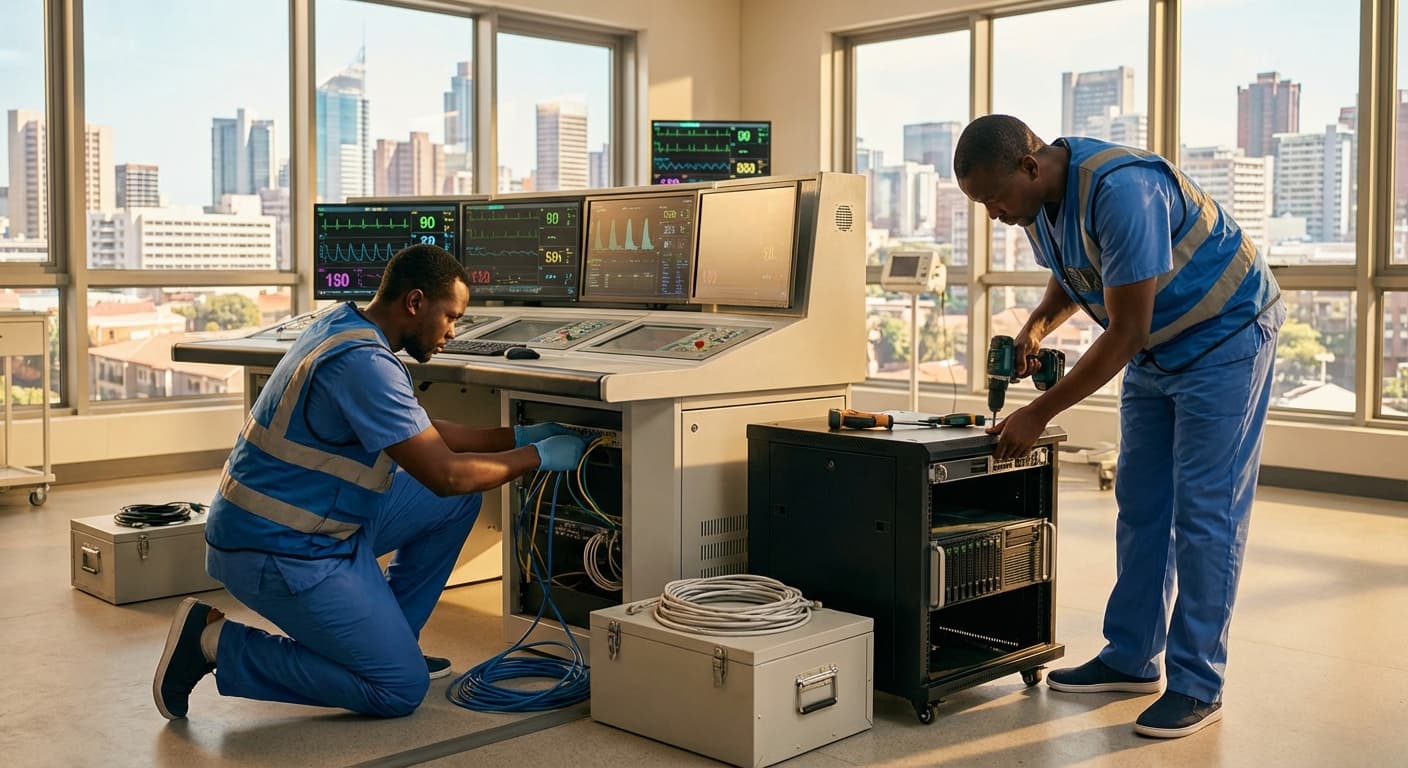
ICU Central Monitoring Station Installation Service in Congo (Brazzaville)
Engineering Excellence & Technical Support
ICU Central Monitoring Station Installation Service High-standard technical execution following OEM protocols and local regulatory frameworks.
Robust Network Infrastructure
We design and implement resilient, high-bandwidth network infrastructure tailored to the unique challenges of Congo (Brazzaville), ensuring seamless and reliable transmission of critical patient data from bedside monitors to the central station.
Secure Data Management
Our installation prioritizes the security and integrity of sensitive patient information. We configure secure data storage solutions and access controls, complying with relevant data privacy standards, even in remote or challenging environments.
Scalable and Future-Proof Systems
We deploy scalable central monitoring systems that can grow with your facility's needs. Our installations are designed for future integration of advanced features and technologies, ensuring long-term value and adaptability for healthcare institutions in Congo.
What Is Icu Central Monitoring Station Installation Service In Congo (Brazzaville)?
ICU Central Monitoring Station Installation Service in Congo (Brazzaville) refers to the comprehensive process of establishing and configuring a centralized system for real-time physiological data acquisition, display, and management within Intensive Care Units (ICUs) of healthcare facilities in Brazzaville, Republic of Congo. This service encompasses the planning, procurement, physical installation, network integration, software deployment, calibration, testing, and initial training required to bring a central monitoring system operational. The core objective is to enable clinicians to remotely observe and manage multiple critically ill patients' vital signs and parameters from a single, dedicated monitoring station, thereby enhancing patient safety, improving workflow efficiency, and facilitating timely clinical decision-making.
| Need For Service | Target Users | Typical Use Cases | |||||
|---|---|---|---|---|---|---|---|
| Enhance Patient Safety: Real-time, continuous observation of critical physiological parameters (e.g., ECG, SpO2, NIBP, respiration rate, temperature, invasive pressures) to detect early signs of deterioration and prevent adverse events. | Hospitals and Healthcare Facilities in Brazzaville: Specifically, facilities with Intensive Care Units (ICUs), Coronary Care Units (CCUs), Neonatal Intensive Care Units (NICUs), and Surgical Intensive Care Units (SICUs). | Continuous Patient Monitoring: Observing multiple high-acuity patients simultaneously from a centralized location. | Remote Patient Surveillance: Allowing clinicians to monitor patients from a nursing station or control room, optimizing staff allocation. | Alarm Management: Centralized management and filtering of patient alarms to reduce alarm fatigue and ensure critical alerts are addressed promptly. | Data Documentation and Review: Automatic recording and archiving of patient data for trend analysis, clinical review, and legal documentation. | Facilitate Team Communication: Providing a common platform for multidisciplinary teams to assess patient status and coordinate care. | Improve Workflow Efficiency: Reducing the need for individual bedside checks for routine parameter monitoring, freeing up clinical staff for direct patient care. |
| Improve Clinical Decision-Making: Providing comprehensive and accessible patient data to inform timely and evidence-based treatment adjustments. | Medical Equipment Vendors/Integrators: Companies specializing in the installation and maintenance of medical technology, acting as service providers. | Post-Operative Care: Monitoring patients recovering from major surgeries. | Management of Critically Ill Patients: Continuous observation for patients with severe medical conditions such as sepsis, respiratory failure, cardiac arrest, or neurological emergencies. | Ventilator and Hemodynamic Monitoring: Tracking complex physiological data from mechanically ventilated patients or those with circulatory instability. | Pediatric and Neonatal Critical Care: Specialized monitoring for vulnerable infant and child populations. | ||
| Optimize Resource Utilization: Better allocation of nursing staff and medical equipment by providing a holistic view of patient needs. | Government Health Agencies/Ministries: In scenarios involving the development of national healthcare infrastructure or standards. | Disaster Preparedness and Mass Casualty Incidents: In large-scale emergencies where a centralized overview of multiple critical patients is crucial for triage and management. |
Key Components and Phases of ICU Central Monitoring Station Installation Service
- Site Assessment and Planning: Evaluating existing infrastructure (power, networking, physical space), determining optimal station placement, and designing the network architecture.
- Equipment Procurement: Sourcing and acquiring central monitoring workstations, display units, patient monitoring devices (e.g., bedside monitors, ventilators with network capabilities), data servers, network switches, cabling, and related accessories.
- Physical Installation: Mounting workstations, connecting displays, deploying patient monitors to bedsides, and meticulously running and terminating all necessary data and power cables.
- Network Configuration and Integration: Establishing secure and reliable network connectivity between bedside monitors, central stations, and any associated hospital information systems (HIS) or electronic health records (EHRs). This includes IP addressing, subnetting, firewall configuration, and adherence to hospital IT policies.
- Software Deployment and Configuration: Installing and configuring the central monitoring software platform, setting up patient profiles, defining alarm parameters, establishing user roles and permissions, and integrating with data storage solutions.
- System Calibration and Testing: Verifying the accuracy and functionality of all connected patient monitors and ensuring seamless data flow to the central station. Comprehensive testing includes alarm verification, data recording, and system responsiveness under various simulated scenarios.
- User Training and Handover: Providing thorough training to clinical staff (nurses, physicians, intensivists) on the operation, maintenance, and troubleshooting of the central monitoring system, followed by a formal handover of the operational system.
- Post-Installation Support and Maintenance: Offering initial troubleshooting assistance and establishing a framework for ongoing technical support and periodic maintenance.
Who Needs Icu Central Monitoring Station Installation Service In Congo (Brazzaville)?
An ICU Central Monitoring Station (CMS) installation service is crucial for healthcare facilities in Congo (Brazzaville) looking to enhance their critical care capabilities. These sophisticated systems allow for the simultaneous monitoring of multiple intensive care unit (ICU) patients from a centralized location. This ensures real-time oversight, faster response to patient deteriorations, and improved communication among medical staff, ultimately leading to better patient outcomes. Facilities requiring advanced patient monitoring, improved workflow efficiency, and a reduction in medical errors are prime candidates for this specialized service.
| Target Customer Type | Relevant Departments | Key Needs Addressed by CMS |
|---|---|---|
| Large Public Hospitals | Intensive Care Unit (ICU), Coronary Care Unit (CCU), Surgical Intensive Care Unit (SICU), Medical Intensive Care Unit (MICU) | Centralized patient oversight, improved staff efficiency, standardized monitoring protocols, early detection of critical events. |
| Private Hospitals and Clinics | ICU, Neonatal Intensive Care Unit (NICU), Pediatric Intensive Care Unit (PICU) | Enhanced patient safety, competitive advantage through advanced technology, improved data management and reporting, streamlined patient care workflows. |
| Teaching Hospitals | ICU, All critical care units, Training and Simulation Centers | Real-time data for education, ability to observe and manage multiple patients during training, research data collection, integration with electronic health records (EHR). |
| Trauma Centers | Trauma ICU, Emergency Department (ED) overseeing ICU patients | Rapid assessment and response to critical trauma cases, continuous monitoring of vital signs, improved team communication during emergencies. |
| Cardiology/Cardiac Surgery Centers | Cardiac ICU (CICU), Post-operative Recovery Units | Continuous monitoring of cardiac rhythms and hemodynamics, immediate alerts for arrhythmias or hemodynamic instability, optimized post-surgical care. |
Target Customers and Departments for ICU Central Monitoring Station Installation Service in Congo (Brazzaville):
- {"title":"Hospitals and Major Healthcare Institutions","description":"Any hospital with an existing or planned ICU is a primary target. This includes both public and private hospitals that are expanding or upgrading their critical care infrastructure."}
- {"title":"Specialized Medical Centers","description":"Centers focusing on specific critical care areas such as cardiac surgery, neurosurgery, trauma, or neonatal intensive care."}
- {"title":"Government and Public Health Initiatives","description":"Government-funded healthcare projects aimed at improving the quality of critical care services across the nation."}
- {"title":"International Aid and Non-Governmental Organizations (NGOs)","description":"Organizations involved in developing or renovating healthcare facilities in Congo (Brazzaville) to provide advanced medical equipment."}
Icu Central Monitoring Station Installation Service Process In Congo (Brazzaville)
This document outlines the comprehensive workflow for the ICU Central Monitoring Station Installation Service Process in Congo (Brazzaville), from the initial client inquiry to the final execution and handover. The process is designed to ensure a systematic and efficient installation, meeting the specific needs and regulatory requirements of healthcare facilities in the region.
| Stage | Key Activities | Deliverables | Responsible Party | Timeline (Typical) |
|---|---|---|---|---|
| Receive client inquiry, understand project scope, identify key stakeholders, discuss preliminary requirements, and address initial queries. | Meeting minutes, initial understanding of project scope. | Client, Service Provider Sales/Technical Team. | 1-3 days |
| Conduct a detailed on-site survey to assess existing infrastructure (power, networking, physical space), identify specific monitoring needs, and gather technical specifications. | Detailed site survey report, validated technical requirements, infrastructure assessment report. | Service Provider Technical Team. | 3-7 days |
| Develop a comprehensive proposal including equipment specifications, installation plan, project timeline, detailed cost breakdown, and warranty information. | Formal proposal document, detailed quotation. | Service Provider Sales/Technical Team. | 5-10 days |
| Negotiate terms and conditions, finalize pricing, and sign a formal contract or service agreement. This may involve legal review. | Signed contract/service agreement. | Client, Service Provider Management. | 7-14 days |
| Create detailed project plans, including network architecture, cabling layouts, equipment placement, and integration strategies with existing hospital systems. | Detailed project plan, system design document, network diagrams, installation schematics. | Service Provider Technical Team & Engineering. | 10-20 days |
| Order necessary equipment and components. Manage customs clearance, transportation, and warehousing of materials in Congo (Brazzaville). | Procurement orders, shipping manifests, customs documentation, received equipment. | Service Provider Logistics & Procurement Team. | 20-60 days (dependent on lead times and shipping) |
| Site preparation (if required), installation of monitoring hardware and software, network cabling, and initial system configuration as per design. | Installed and cabled monitoring stations, configured software. | Service Provider Installation Engineers & Technicians. | 15-30 days (per ICU ward, depending on complexity) |
| Conduct rigorous testing of all system components, ensuring accurate data acquisition, transmission, alarm functionality, and integration with other hospital systems. Validate performance against specifications. | System test reports, commissioning certificates, performance validation. | Service Provider Technical Team & Quality Assurance. | 5-10 days |
| Provide comprehensive training to hospital staff (clinicians, IT personnel) on system operation, maintenance, and troubleshooting. Formal handover of the installed system. | Training materials, training attendance records, handover documentation. | Service Provider Trainers & Project Manager. | 3-7 days |
| Offer ongoing technical support, remote monitoring, scheduled maintenance, and access to software updates. Address any post-installation issues. | Service Level Agreement (SLA), support tickets, maintenance reports. | Service Provider Support Team & Maintenance Engineers. | Ongoing (as per contract) |
ICU Central Monitoring Station Installation Service Process in Congo (Brazzaville) - Workflow Stages
- Inquiry & Initial Consultation
- Site Survey & Needs Assessment
- Proposal & Quotation
- Contract & Agreement
- Planning & Design
- Procurement & Logistics
- Installation & Configuration
- Testing & Commissioning
- Training & Handover
- Post-Installation Support & Maintenance
Icu Central Monitoring Station Installation Service Cost In Congo (Brazzaville)
Installing an ICU Central Monitoring Station in Congo (Brazzaville) is a critical investment for healthcare facilities aiming to enhance patient care and improve efficiency. The cost of such an installation is subject to a variety of factors, leading to a wide price range. Understanding these factors is crucial for accurate budgeting and procurement.
The core components of an ICU Central Monitoring Station include the central display unit(s), patient bedside monitors, network infrastructure, and potentially specialized software for data management and analysis. The complexity and brand of these components significantly influence the overall price. Furthermore, the installation process itself involves skilled technicians, system integration, testing, and training, all of which contribute to the final cost. Local economic conditions, import duties, and currency fluctuations can also play a role in the pricing of imported medical equipment and services.
Key Pricing Factors:
- Number of ICU Beds: The more beds that need to be monitored, the more bedside monitors and associated infrastructure will be required, directly impacting the cost.
- Type and Features of Central Monitors: High-resolution screens, touch-screen interfaces, advanced data logging capabilities, and the ability to integrate with other hospital systems (like EMRs) will increase the price.
- Type and Features of Bedside Monitors: The sophistication of bedside monitors – including the range of parameters they measure (ECG, SpO2, NIBP, IBP, EtCO2, etc.), their accuracy, and their user interface – will determine their cost. Advanced hemodynamic monitoring modules, for example, are more expensive.
- Network Infrastructure: The need for new cabling, switches, and potentially wireless network upgrades to support the real-time data transmission from bedside monitors to the central station will add to the installation cost.
- Software and Data Management: The requirement for specialized software for data visualization, trend analysis, alarm management, and long-term data storage will impact the budget. Integration with existing hospital information systems (HIS) or electronic medical records (EMR) can also incur additional costs.
- Brand and Manufacturer: Reputable brands known for their reliability and advanced features often come with a higher price tag compared to less established manufacturers.
- Installation and Integration Services: This includes the labor costs for trained technicians, system configuration, calibration, testing, and ensuring seamless integration of all components.
- Training: Comprehensive training for nursing staff, technicians, and physicians on the operation and maintenance of the new system is essential and usually included in the service package.
- Warranty and Support: The duration and scope of the warranty, as well as ongoing technical support and maintenance contracts, are important cost considerations.
- Import Duties and Taxes: As much of the equipment will likely be imported, customs duties, taxes, and other import-related fees levied in Congo (Brazzaville) will affect the final price.
- Local Service Provider Expertise: The experience and reputation of the local installation and service provider can influence their pricing.
Estimated Price Ranges (in Congolese Francs - XAF):
Due to the significant variability in the factors above, providing an exact price is impossible without a detailed site assessment and specific equipment requirements. However, a general range for the installation of an ICU Central Monitoring Station for a moderate-sized ICU (e.g., 4-8 beds) can be estimated as follows:
- Basic Setup (Essential Features, fewer beds): XAF 15,000,000 - XAF 30,000,000
- Mid-Range Setup (Advanced Features, moderate beds): XAF 30,000,000 - XAF 60,000,000
- High-End Setup (State-of-the-art, comprehensive features, more beds): XAF 60,000,000 - XAF 120,000,000+ (and potentially much higher for very large or highly specialized ICUs).
Important Note: These figures are indicative and can fluctuate significantly based on specific project scope, negotiations with suppliers and service providers, and prevailing market conditions in Congo (Brazzaville). It is strongly recommended to obtain detailed quotes from multiple reputable medical equipment suppliers and installation services.
| Installation Scope | Estimated Cost Range (XAF) |
|---|---|
| Basic Setup (Essential Features, 4-8 beds) | 15,000,000 - 30,000,000 |
| Mid-Range Setup (Advanced Features, moderate beds) | 30,000,000 - 60,000,000 |
| High-End Setup (State-of-the-art, comprehensive, more beds) | 60,000,000 - 120,000,000+ |
Factors Influencing ICU Central Monitoring Station Installation Costs in Congo (Brazzaville)
- Number of ICU Beds
- Type and Features of Central Monitors
- Type and Features of Bedside Monitors
- Network Infrastructure Requirements
- Software and Data Management Needs
- Brand and Manufacturer Reputation
- Installation and System Integration Services
- Training for Medical Staff
- Warranty and Ongoing Support Contracts
- Import Duties, Taxes, and Logistics
- Local Service Provider's Expertise and Overhead
Affordable Icu Central Monitoring Station Installation Service Options
Installing an Intensive Care Unit (ICU) Central Monitoring Station (CMS) is a critical infrastructure upgrade for any healthcare facility. Choosing the right installation service provider can significantly impact both the effectiveness of the system and the overall cost. This guide explores affordable installation options, detailing value bundles and cost-saving strategies.
| Cost-Saving Strategy | Description | Implementation Tip |
|---|---|---|
| Phased Installation | Instead of a full-scale, immediate installation, consider rolling out the CMS in phases, prioritizing critical ICU areas first. This allows for budget management and learning from initial deployments. | Work with providers who offer flexible phased installation plans and ensure each phase delivers immediate clinical benefit. |
| Leasing vs. Purchasing Equipment | Explore leasing options for monitoring hardware and software. This can reduce upfront capital expenditure and offer predictable monthly operational costs. | Compare total cost of ownership over the lease term with outright purchase, including maintenance and upgrade costs. |
| Negotiate Service Level Agreements (SLAs) | Clearly define performance metrics, response times, and uptime guarantees in your SLA. This ensures the provider is accountable for system performance and can avoid costly downtime. | Incorporate penalties for SLA breaches and ensure uptime guarantees align with critical care needs. |
| Leverage Existing Infrastructure | Assess if your current network infrastructure, cabling, and power can be integrated with the new CMS. This can significantly reduce installation costs. | Conduct a thorough site assessment with the installation provider to identify potential re-use opportunities. |
| Consider Open-Source or Cloud-Based Solutions | While less common for highly regulated ICU environments, explore if any components or supporting systems can utilize open-source software or cloud-based solutions where security and compliance are met. | Thoroughly vet security protocols and regulatory compliance for any open-source or cloud components before integration. |
| Seek Multiple Bids and Compare Offerings | Obtain detailed proposals from several reputable CMS installation providers. Don't just compare price; evaluate the scope of services, vendor experience, and customer references. | Request detailed breakdowns of costs within each bid to ensure apples-to-apples comparisons. |
| Standardize Equipment | Where possible, standardize on a limited range of monitoring devices and equipment. This can simplify installation, training, and maintenance, potentially leading to bulk discounts. | Collaborate with clinical teams to identify the most essential and versatile monitoring needs to facilitate standardization. |
| Remote Support & Training Options | Inquire about the availability of remote troubleshooting and training sessions. These can be more cost-effective than purely on-site services. | Ensure robust remote access protocols are in place for secure and efficient support. |
Understanding Value Bundles in CMS Installation
- {"title":"What are Value Bundles?","description":"Value bundles are pre-packaged service offerings that combine multiple components of CMS installation at a potentially reduced price compared to procuring each service individually. They are designed to streamline the process and provide a predictable cost structure."}
- {"title":"Common Components in CMS Value Bundles","description":"These bundles typically include a combination of the following, tailored to facility needs:\n* Hardware Procurement & Integration: Sourcing and setting up monitoring devices, servers, and workstations.\n* Network Infrastructure Setup: Ensuring robust and secure network connectivity for data transmission.\n* Software Installation & Configuration: Deploying and customizing the CMS software to meet clinical workflows.\n* System Testing & Validation: Rigorous testing to ensure accuracy, reliability, and compliance.\n* On-site Training: Educating clinical staff on system operation and maintenance.\n* Extended Warranty & Support: Post-installation maintenance and troubleshooting packages."}
- {"title":"Benefits of Choosing Value Bundles","description":"Value bundles offer several advantages for cost-conscious facilities:\n* Cost Predictability: A single, consolidated price eliminates surprises.\n* Efficiency: Streamlined project management and reduced coordination efforts.\n* Comprehensive Coverage: Ensures all essential aspects of the installation are addressed.\n* Potential Discounts: Bundled services are often priced lower than individual components."}
Verified Providers In Congo (Brazzaville)
When seeking healthcare services in Congo (Brazzaville), it's paramount to identify Verified Providers. This verification process ensures that medical professionals and facilities meet established standards of quality, safety, and ethical practice. In this regard, Franance Health stands out as a premier organization, offering a network of credentials that signify the highest caliber of healthcare.
| Credential Type | What it Signifies | Benefit to Patient |
|---|---|---|
| Certified Medical Practitioner | Indicates successful completion of advanced medical training and adherence to professional standards. | Ensures competence and up-to-date medical knowledge. |
| Accredited Healthcare Facility | Confirms that the facility meets stringent operational, safety, and quality standards. | Guarantees a safe and well-equipped environment for treatment. |
| Specialty Board Certification | Demonstrates advanced expertise and recognition in a specific medical field. | Provides access to highly skilled specialists for complex conditions. |
| Compliance with Ethical Guidelines | Confirms adherence to a strict code of conduct and patient-centered care principles. | Assures respectful, honest, and professional treatment. |
Why Franance Health Credentials Represent the Best Choice:
- Rigorous Vetting Process: Franance Health employs a comprehensive and stringent vetting procedure for all affiliated providers. This includes background checks, verification of educational qualifications and licenses, assessment of clinical experience, and evaluation of adherence to ethical guidelines.
- Commitment to Quality Care: Franance Health's accreditation signifies a deep commitment to delivering high-quality medical services. Providers are continuously assessed on patient outcomes, adherence to best practices, and overall patient satisfaction.
- Patient Safety Focus: A core tenet of Franance Health's credentialing is the unwavering focus on patient safety. Verified providers are expected to maintain the highest standards of infection control, implement robust safety protocols, and prioritize patient well-being in all aspects of care.
- Transparency and Accountability: The Franance Health credentialing system promotes transparency by making verified provider information accessible. This accountability encourages providers to maintain excellence and fosters trust between patients and healthcare professionals.
- Access to Specialized Expertise: Franance Health's network often includes specialists across various medical disciplines. This ensures that patients can find verified providers with the specific expertise needed for their conditions.
- International Standards Alignment: Franance Health strives to align its credentialing standards with internationally recognized healthcare benchmarks, offering assurance of quality comparable to global best practices.
- Empowerment of Patients: By choosing Franance Health verified providers, patients are empowered to make informed decisions about their healthcare, confident in the knowledge that they are selecting reputable and competent professionals.
Scope Of Work For Icu Central Monitoring Station Installation Service
This Scope of Work (SOW) outlines the requirements for the installation of an Intensive Care Unit (ICU) Central Monitoring Station (CMS) service. The objective is to provide a robust and reliable system for continuous patient monitoring within the ICU, enabling healthcare professionals to efficiently observe and respond to patient vital signs and alarms. This document details the technical deliverables, standard specifications, and the overall scope of the installation services required.
| Category | Specification/Standard | Description |
|---|---|---|
| Hardware Performance | Workstation CPU/RAM | Minimum Intel Core i5 or equivalent processor, 8GB RAM (expandable to 16GB) |
| Display Resolution | Minimum 1920x1080 Full HD, with option for dual monitors | |
| Storage | Minimum 256GB SSD for OS and applications, 1TB HDD for data archiving | |
| Network Infrastructure | Network Cabling | Cat 6a or higher Ethernet cabling with proper termination and testing |
| Network Switches | Managed Gigabit Ethernet switches with sufficient port density and PoE capabilities if required | |
| Network Protocols | TCP/IP, HL7 (for HIS integration if applicable), DICOM (if image data is transmitted) | |
| Software Features | Real-time Data Display | Continuous, real-time display of all connected patient vital signs |
| Alarm Management | Configurable high and low threshold alarms for all monitored parameters, audible and visual alerts, alarm logging | |
| Data Archiving | Secure, long-term storage of patient monitoring data for review and analysis | |
| User Interface | Intuitive, user-friendly graphical interface for easy navigation and operation | |
| Security | Access Control | Role-based access control with secure login and authentication mechanisms |
| Data Encryption | Encryption of sensitive patient data in transit and at rest | |
| Environmental | Operating Temperature | 10°C to 35°C (50°F to 95°F) |
| Operating Humidity | 20% to 80% non-condensing | |
| Power Requirements | Standard hospital power outlets, with consideration for UPS backup | |
| Compliance | Regulatory Standards | Adherence to relevant medical device regulations (e.g., FDA, CE) and data privacy laws (e.g., HIPAA, GDPR) |
Key Deliverables and Responsibilities
- Project Management: Oversight of all installation activities, including planning, scheduling, resource allocation, and communication with stakeholders.
- Site Survey and Assessment: Conduct a thorough evaluation of the ICU environment to determine optimal placement for CMS hardware, network cabling routes, and power requirements.
- Hardware Installation: Procure, unbox, install, and configure all CMS workstations, servers, network switches, power distribution units, and associated peripheral devices.
- Network Infrastructure Setup: Design, install, and test the network cabling (e.g., Ethernet, fiber optic) required for seamless data transmission between patient monitoring devices and the CMS. This includes configuration of network switches and ensuring proper IP addressing.
- Software Installation and Configuration: Install and configure the CMS software on designated workstations and servers. This includes setting up user accounts, defining alarm parameters, establishing data archiving protocols, and integrating with existing hospital information systems (HIS) if applicable.
- System Integration: Connect and integrate patient monitoring devices (e.g., ventilators, ECG monitors, pulse oximeters) to the CMS via appropriate interfaces and protocols.
- Testing and Validation: Perform comprehensive system testing to ensure all functionalities are operational and meet the defined specifications. This includes unit testing, integration testing, and user acceptance testing (UAT).
- Training: Provide comprehensive training to ICU staff on the operation, maintenance, and troubleshooting of the CMS.
- Documentation: Deliver all relevant project documentation, including as-built drawings, system configuration manuals, user guides, and maintenance procedures.
- Post-Installation Support: Provide a defined period of post-installation support to address any issues or concerns that may arise after the system goes live.
Service Level Agreement For Icu Central Monitoring Station Installation Service
This Service Level Agreement (SLA) outlines the response times and uptime guarantees for the installation service of the ICU Central Monitoring Station. This SLA is an addendum to the Master Service Agreement (MSA) between [Your Company Name] ('Provider') and [Client Company Name] ('Client').
| Service Component | Response Time Target | Uptime Guarantee | Notes |
|---|---|---|---|
| Critical System Failure (e.g., inability to monitor any patients) | 1 hour (initial remote diagnosis) / 4 hours (on-site technician dispatch) | 99.9% (monthly aggregate) | Defined as a failure that prevents the monitoring of all connected patients. Remote diagnosis will be attempted first. |
| Partial System Failure (e.g., monitoring failure for a single ICU bed) | 2 hours (initial remote diagnosis) / 8 hours (on-site technician dispatch) | 99.8% (monthly aggregate) | Defined as a failure affecting a limited subset of the connected ICU beds. |
| Non-Critical Issue (e.g., minor software glitch, performance degradation) | 8 business hours (for remote support and initial assessment) | N/A | Issues that do not immediately impact patient monitoring. Resolution time will be based on severity and availability of resources. |
| Installation Scheduling and Commencement | Within 2 business days of project kickoff meeting. | N/A | Refers to the initial scheduling of the installation team. Actual installation duration will be detailed in the Project Plan. |
| Post-Installation Support (initial 30 days) | 4 business hours (for reporting and initial assessment of issues) | N/A | Covers issues arising directly from the installation service within the first 30 days. |
Scope of Service
- Installation of new ICU Central Monitoring Station hardware and software.
- Configuration and integration of the monitoring station with existing ICU medical devices.
- Initial testing and validation of the installed system.
- Basic user training for relevant ICU staff on system operation.
Frequently Asked Questions

Ready when you are
Let's scope your ICU Central Monitoring Station Installation Service in Congo (Brazzaville) project in Congo (Brazzaville).

Scaling healthcare logistics and technical systems across the entire continent.