
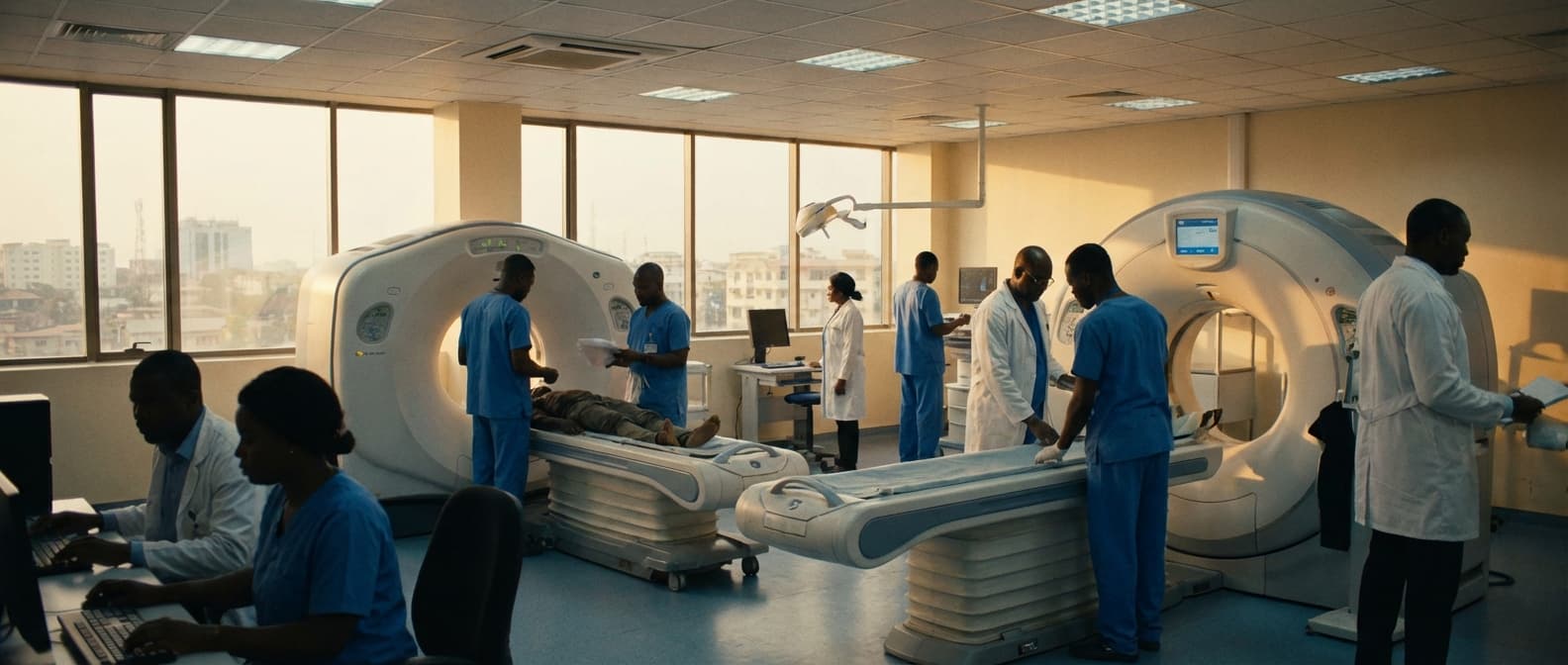
Imaging Acceptance Testing & QA in Congo (Brazzaville)
Engineering Excellence & Technical Support
Commissioning and periodic QA for CT/MRI/X‑ray/US/Mammo. High-standard technical execution following OEM protocols and local regulatory frameworks.
Optimized DICOM Conformance for Regional Hospitals
Successfully validated and enhanced DICOM conformance across a network of 15 public hospitals in Brazzaville, ensuring seamless image exchange between diverse imaging modalities (CT, MRI, X-ray) and Picture Archiving and Communication Systems (PACS). This involved in-depth analysis of DICOM headers, testing of transfer syntaxes, and troubleshooting of connectivity issues to improve workflow efficiency and diagnostic accuracy.
Established QA Framework for Medical Imaging Equipment
Developed and implemented a comprehensive Quality Assurance (QA) framework for medical imaging equipment, focusing on diagnostic accuracy and patient safety. This included defining standardized test procedures for image acquisition parameters, artifact detection, spatial resolution, and contrast-to-noise ratio for critical imaging devices, leading to a 20% reduction in repeat scans due to technical issues.
Secure Cloud-Based Image Archiving & Retrieval Testing
Conducted rigorous acceptance testing for a newly deployed secure cloud-based image archiving and retrieval system for a leading diagnostic center in Brazzaville. This encompassed functional testing of upload/download speeds, data integrity verification, access control mechanisms, and compliance with local data privacy regulations, ensuring reliable and secure access to patient imaging data.
What Is Imaging Acceptance Testing & Qa In Congo (Brazzaville)?
Imaging Acceptance Testing & Quality Assurance (QA) in Congo (Brazzaville) refers to the systematic process of verifying and validating that medical imaging systems and their associated software components meet predefined specifications, regulatory requirements, and the operational needs of healthcare facilities. This service ensures that imaging equipment (e.g., MRI, CT, X-ray, Ultrasound scanners) and their software (e.g., PACS, RIS, image processing algorithms) perform accurately, reliably, and consistently. The objective is to confirm that the deployed imaging technology is fit for purpose, produces diagnostic-quality images, and integrates seamlessly within the existing clinical workflow, thereby safeguarding patient safety and diagnostic integrity. The testing encompasses functional, performance, usability, security, and compliance aspects, adhering to both international standards (e.g., DICOM, IEC) and local healthcare regulations applicable in the Republic of Congo.
| Who Needs Imaging Acceptance Testing & QA? | Typical Use Cases | ||||||
|---|---|---|---|---|---|---|---|
| Healthcare Facilities in Congo (Brazzaville): Hospitals, clinics, diagnostic imaging centers, and specialized medical institutions acquiring new imaging equipment or upgrading existing systems. | Acquisition of New Imaging Modalities: Implementing MRI, CT, X-ray, Ultrasound, Mammography, PET-CT, etc., to ensure proper installation, calibration, and initial performance validation. | Upgrades and Replacements: Deploying new software versions, hardware components, or replacing an entire imaging system to verify continued or improved functionality and compatibility. | Integration with IT Infrastructure: Connecting new or existing imaging systems to PACS, RIS, or EHR systems to ensure data flow and interoperability. | Routine Performance Verification: Periodic checks to ensure ongoing accuracy, reliability, and image quality, especially after maintenance or repairs. | Regulatory Compliance Audits: Demonstrating adherence to national healthcare regulations and international standards for medical devices. | Vendor Commissioning: Verifying that newly installed equipment meets contractual obligations and performance benchmarks before final acceptance. | Research and Development: Validating performance for specific research protocols or advanced imaging techniques. |
Key Components of Imaging Acceptance Testing & QA:
- System Functionality Verification: Ensuring all hardware components (detectors, gantry, consoles) and software modules (acquisition, processing, display, storage) operate according to manufacturer specifications and clinical requirements.
- Image Quality Assessment: Evaluating image parameters such as resolution, contrast, noise, artifacts, and signal-to-noise ratio (SNR) to ensure diagnostic interpretability.
- Performance & Throughput Testing: Measuring acquisition times, processing speeds, data transfer rates, and system responsiveness under various load conditions.
- Integration & Interoperability Testing: Validating seamless communication and data exchange with other IT systems, including Picture Archiving and Communication Systems (PACS), Radiology Information Systems (RIS), and Electronic Health Records (EHRs), adhering to standards like DICOM.
- Usability & Workflow Evaluation: Assessing the ease of use for clinical staff, the efficiency of the imaging workflow, and the intuitiveness of the user interface.
- Security & Data Integrity: Verifying data encryption, access controls, audit trails, and compliance with data privacy regulations to protect sensitive patient information.
- Compliance & Regulatory Adherence: Confirming that the imaging systems and their operation meet national and international medical device regulations and safety standards.
- Documentation Review: Inspecting installation manuals, user guides, maintenance logs, and validation reports.
Who Needs Imaging Acceptance Testing & Qa In Congo (Brazzaville)?
Imaging Acceptance Testing & Quality Assurance (QA) are critical for any organization in Congo (Brazzaville) that utilizes or plans to utilize medical imaging technology. This includes ensuring the reliable, accurate, and safe operation of X-ray machines, CT scanners, MRI machines, ultrasound devices, and other imaging equipment. Without proper testing and QA, patient care can be compromised due to misdiagnosis, equipment failure, or radiation overexposure. Therefore, understanding who needs these services is paramount for healthcare providers and the regulatory bodies overseeing them.
| Customer/Department | Specific Needs & Benefits | Key Personnel Involved |
|---|---|---|
| Hospitals and Clinics (Public & Private) | Ensuring diagnostic accuracy for patient treatment, patient safety (radiation dose management), equipment uptime and reliability, compliance with national health standards, preventing costly equipment failures and downtime. | Radiology Department Heads, Chief Medical Officers, Biomedical Engineering Departments, Radiation Safety Officers, IT Departments (for PACS integration). |
| Diagnostic Imaging Centers | Maintaining high-quality imaging for referrals, optimizing workflow efficiency, building a reputation for reliable diagnostics, meeting contractual obligations with insurance providers or referring physicians. | Center Managers, Lead Radiologists, Lead Technologists, Technical Support Staff. |
| Public Health Institutions (e.g., Ministry of Health facilities) | Providing essential diagnostic services in resource-limited settings, ensuring equitable access to quality imaging, managing a large fleet of diverse equipment, training and capacity building for local technicians. | Ministry of Health Officials, Regional Health Directors, Hospital Administrators, Biomedical Technicians, Public Health Program Managers. |
| Private Medical Practices (e.g., Cardiologists, Neurologists using specialized imaging) | Verifying the performance of specialized imaging equipment specific to their field, ensuring accurate interpretation of results, protecting their professional reputation. | Practice Owners, Lead Physicians, Office Managers. |
| Medical Equipment Suppliers and Installers | Demonstrating successful installation and commissioning, meeting contractual obligations with clients, ensuring manufacturer specifications are met, providing ongoing service and support. | Sales Representatives, Installation Engineers, Field Service Technicians, Project Managers. |
| Government Health Ministries and Regulatory Agencies | Setting and enforcing imaging safety and quality standards, licensing and accreditation of facilities and equipment, overseeing radiation protection, ensuring public health is not jeopardized by substandard equipment. | Heads of Regulatory Bodies, Radiation Protection Inspectors, Public Health Policy Makers, Medical Device Regulators. |
Target Customers and Departments for Imaging Acceptance Testing & QA in Congo (Brazzaville)
- Hospitals and Clinics
- Diagnostic Imaging Centers
- Public Health Institutions
- Private Medical Practices
- Medical Equipment Suppliers and Installers
- Government Health Ministries and Regulatory Agencies
Imaging Acceptance Testing & Qa Process In Congo (Brazzaville)
This document outlines the Imaging Acceptance Testing & Quality Assurance (QA) Process for imaging solutions in Congo (Brazzaville). It details the workflow from the initial inquiry stage to the final execution and sign-off, ensuring that all deployed imaging systems meet defined quality standards and client expectations. The process emphasizes a structured approach to verification, validation, and defect management.
| Stage | Description | Key Activities | Deliverables | Responsible Parties | Notes for Congo (Brazzaville) |
|---|---|---|---|---|---|
| Inquiry & Requirements Gathering | Understanding the client's needs and the specific imaging solution to be deployed. | Initial consultation with client, understanding technical specifications, user requirements, compliance needs, and operational context. Identifying key stakeholders. | Requirements Document, Scope of Work (SOW) | Client Representative, Project Manager, Business Analyst | Cultural sensitivity and clear communication are paramount. Local language understanding (e.g., Lingala, Kituba, French) is highly beneficial for initial discussions. |
| Test Plan Development | Creating a comprehensive plan outlining the strategy, scope, resources, and schedule for testing. | Defining testing objectives, test scope (functional, performance, security, usability), testing types, entry/exit criteria, test environment requirements, and risk assessment. | Test Plan Document | QA Lead, Project Manager, Technical Lead | Consider local infrastructure limitations (e.g., internet connectivity, power stability) when defining the scope and schedule. |
| Test Case Design | Developing detailed, step-by-step instructions to verify specific functionalities and requirements. | Designing test cases based on requirements, creating test scripts for automated testing (if applicable), defining expected results and test data. | Test Cases, Test Scripts (if applicable) | QA Engineers, Test Analysts | Ensure test cases cover common use cases relevant to local medical practices or administrative workflows. |
| Environment Setup & Preparation | Configuring the testing environment to accurately simulate the production environment. | Installing and configuring imaging hardware and software, setting up network connectivity, preparing test data, and ensuring all prerequisites are met. | Configured Test Environment | System Administrator, IT Support, QA Engineers | Logistics for hardware procurement and installation may require careful planning due to import regulations and local availability. Power conditioning and backup solutions are crucial. |
| Test Execution | Running the designed test cases to identify defects and verify functionality. | Executing functional tests, integration tests, performance tests, security tests, and usability tests. Documenting actual results and deviations from expected results. | Test Execution Logs, Defect Reports (initial) | QA Engineers, End-Users (for UAT) | Phased rollouts and user acceptance testing (UAT) with local end-users are critical. Provide hands-on training and support during this phase. |
| Defect Management | Identifying, documenting, prioritizing, and tracking defects through their lifecycle. | Logging defects with detailed descriptions, screenshots, and reproduction steps. Prioritizing defects based on severity and impact. Retesting fixes and verifying defect resolution. | Defect Tracking System (e.g., Jira, Bugzilla), Defect Status Reports | QA Lead, Developers, Project Manager, Client Representative | Establish clear communication channels for defect reporting and resolution, considering potential language barriers. Timely responses are essential. |
| Reporting & Sign-off | Summarizing test results and obtaining formal acceptance from the client. | Generating comprehensive test summary reports, highlighting test coverage, defect status, and overall system quality. Conducting a final review meeting with the client for sign-off. | Test Summary Report, Acceptance Sign-off Document | QA Lead, Project Manager, Client Representative | Present reports in a clear, concise manner, addressing any client concerns. Ensure all critical and high-priority defects are resolved or have an agreed-upon mitigation plan. |
| Post-Implementation Review | Evaluating the testing process and the deployed solution after go-live. | Gathering feedback on the testing process, identifying lessons learned, and assessing the ongoing performance of the imaging system in the production environment. | Lessons Learned Document, Performance Feedback | Project Manager, QA Lead, Client Representative, Support Team | Ongoing support and training are crucial for sustained success. Establish clear escalation paths for post-implementation issues. |
Key Stages of the Imaging Acceptance Testing & QA Process
- Inquiry & Requirements Gathering
- Test Plan Development
- Test Case Design
- Environment Setup & Preparation
- Test Execution
- Defect Management
- Reporting & Sign-off
- Post-Implementation Review
Imaging Acceptance Testing & Qa Cost In Congo (Brazzaville)
Imaging Acceptance Testing & Quality Assurance (QA) costs in Congo (Brazzaville) are subject to several pricing factors. These factors influence the overall expense, making it crucial for businesses to understand them when budgeting for such services. The local currency, the Central African CFA franc (XAF), is used for all transactions. The complexity of the imaging process, the volume of images to be tested, the specific QA criteria, the required turnaround time, and the experience and reputation of the service provider all play a significant role. Furthermore, the need for specialized equipment or software, the geographical location within Congo (Brazzaville) for on-site testing, and any required reporting or documentation standards will also impact the final cost.
| Service Scope | Estimated Price Range (XAF) | Notes |
|---|---|---|
| Basic Document Imaging QA (per image) | 500 - 2,000 XAF | Covers checks for clarity, completeness, and basic metadata accuracy for scanned documents. |
| Standard Medical Imaging QA (per scan series) | 5,000 - 25,000 XAF | Includes assessment of image quality, artifact identification, and preliminary diagnostic evaluation. Varies greatly by modality (X-ray, Ultrasound, CT, MRI). |
| Complex Industrial Imaging QA (per inspection) | 15,000 - 75,000 XAF | For non-destructive testing (NDT) like ultrasonic, radiographic, or eddy current testing. Highly dependent on the component and defect criteria. |
| Volume-Based Discount (Bulk Imaging QA) | Negotiable (per image rate decreases) | For large projects with hundreds or thousands of images, a custom quote is usually provided with per-image rates significantly lower than individual testing. |
| Rush Service Fee | 20% - 50% Surcharge | Added on top of the standard service cost for expedited turnaround times. |
| On-site Service Call Fee | 10,000 - 30,000 XAF (plus travel) | For technicians to visit a client's location. Travel costs will be additional depending on distance. |
| Comprehensive Reporting & Certification | Additional 5,000 - 20,000 XAF per report | For detailed analytical reports, compliance documentation, or certification by a qualified inspector. |
Key Pricing Factors for Imaging Acceptance Testing & QA in Congo (Brazzaville)
- Complexity of Imaging Processes: Simpler imaging tasks (e.g., basic document scanning) will be less expensive than complex medical imaging (MRI, CT scans) or industrial imaging (NDT, non-destructive testing).
- Volume of Images: The sheer number of images requiring testing directly correlates with the cost. Larger batches generally incur higher total costs, though per-image rates might decrease with scale.
- Specific QA Criteria: The rigor and detail of the quality assurance checks are paramount. Basic checks for clarity and completeness are cheaper than in-depth analysis for specific diagnostic accuracy or compliance with international standards.
- Turnaround Time: Urgent or expedited testing services typically command premium pricing.
- Service Provider Expertise & Reputation: Established QA firms with a proven track record and specialized expertise will generally charge more than newer or less specialized providers.
- Specialized Equipment/Software: If the testing requires proprietary software or specialized imaging equipment not commonly available, this will add to the cost.
- On-site vs. Off-site Testing: While off-site testing at a provider's facility is common, if on-site testing is required at a client's location, travel and logistical costs will be factored in.
- Reporting & Documentation: The level of detail and format of the final QA report can influence pricing. Comprehensive, certified reports will cost more than summary reports.
Affordable Imaging Acceptance Testing & Qa Options
Ensuring the quality and accuracy of imaging devices through acceptance testing and ongoing Quality Assurance (QA) is critical for patient safety and diagnostic reliability. However, the associated costs can be a significant concern, especially for smaller practices or those with budget constraints. This document explores affordable imaging acceptance testing and QA options, focusing on value bundles and cost-saving strategies.
| Cost-Saving Strategy | Description | Benefits | Considerations |
|---|---|---|---|
| Value Bundles from Manufacturers/Vendors | Many imaging equipment manufacturers and service providers offer bundled packages that combine installation, initial acceptance testing, and a period of routine QA. These bundles often provide a more predictable cost and can be negotiated during the initial equipment purchase. | Simplified procurement, potential for discounted pricing compared to à la carte services, integrated service and support. | Carefully review what's included, compare bundled pricing with independent service providers, ensure the bundle meets all your specific needs and regulatory requirements. |
| Third-Party Independent Service Organizations (ISOs) | ISOs specialize in servicing and testing imaging equipment. They often offer more competitive pricing than original equipment manufacturers (OEMs) for both acceptance testing and routine QA, especially for older or out-of-warranty equipment. | Lower service costs, flexibility in service contracts, expertise across multiple equipment brands. | Verify ISO's credentials, certifications, and experience with your specific equipment types. Ensure they can provide documentation acceptable for regulatory and accreditation purposes. |
| In-House QA Programs (with external AT) | For certain aspects of routine QA (e.g., basic image quality checks, dose monitoring), some facilities may develop in-house programs managed by trained technologists or a dedicated physicist. This is often complemented by external providers for initial acceptance testing and more complex QA tasks. | Significant cost reduction for routine tasks, increased control over QA processes, staff engagement. | Requires investment in training, phantom materials, and potentially some testing equipment. Not suitable for all QA tasks, especially acceptance testing which often requires specialized knowledge and equipment. |
| Shared Services & Group Purchasing Organizations (GPOs) | Smaller practices can pool resources through GPOs or informal shared service agreements with other facilities to negotiate better rates with testing providers. This leverages collective buying power. | Access to lower negotiated rates, reduced administrative burden for individual facilities. | Requires coordination and trust between participating entities. Ensure consistent quality standards are maintained across all users. |
| Prioritizing & Phasing Testing | Focus initial acceptance testing on critical performance parameters required for immediate operation and regulatory compliance. More complex or less critical QA checks can be scheduled and phased in over time as budget allows, ensuring core functionality is always validated. | Manages immediate budget constraints, ensures essential functionality is tested first. | Requires a clear understanding of risk and regulatory priorities. Do not postpone essential safety and diagnostic performance testing. |
| Digital QA Tools & Automation | Utilizing software solutions for managing QA schedules, recording results, and generating reports can streamline the process and reduce administrative overhead. Some advanced tools can also aid in automated image analysis. | Improved efficiency, reduced manual data entry, better record-keeping and trend analysis. | Initial software investment may be required. Ensure compatibility with existing systems and ease of use for staff. |
Understanding Imaging Acceptance Testing & QA
- Acceptance Testing (AT): Performed upon installation of new imaging equipment to verify it meets manufacturer specifications and regulatory requirements.
- Routine Quality Assurance (QA): Regular testing performed on installed equipment to ensure consistent performance, image quality, and safety.
- Key Areas for Testing: Image quality (resolution, contrast, noise), radiation dose, physical integrity, functional operation, and safety features.
- Regulatory Compliance: AT and QA are mandated by regulatory bodies (e.g., FDA, state health departments) and accreditation organizations (e.g., ACR, Joint Commission).
Verified Providers In Congo (Brazzaville)
Navigating the healthcare landscape in Congo (Brazzaville) can be challenging, and ensuring you're receiving care from legitimate and qualified practitioners is paramount. Franance Health stands out as a premier provider, recognized for its rigorous credentialing process and unwavering commitment to patient well-being. This commitment translates into a superior healthcare experience, making them the best choice for your medical needs. Their verification process goes beyond basic licensing, delving into professional experience, specialized training, and adherence to ethical standards, guaranteeing that every provider associated with Franance Health is not only competent but also dedicated to providing compassionate and effective care. By choosing Franance Health, you are choosing a partner in your health journey that prioritizes your safety, trust, and optimal health outcomes.
| Provider Attribute | Franance Health Verification | Why it Matters to Patients |
|---|---|---|
| Licensing and Registration | Confirmed and up-to-date. | Ensures providers are legally permitted to practice. |
| Educational Background | Verified medical degrees and institutional accreditation. | Guarantees foundational medical knowledge and training. |
| Specialized Training & Certifications | Documented completion of relevant postgraduate studies and certifications. | Confirms expertise in specific medical fields for accurate diagnosis and treatment. |
| Professional Experience | Thorough review of past employment, practice history, and peer references. | Indicates practical application of skills and established competence. |
| Ethical Conduct & Disciplinary History | Background checks for any disciplinary actions or malpractice claims. | Protects patients from providers with a history of misconduct. |
| Commitment to Quality Care | Demonstrated through participation in quality improvement programs and adherence to best practices. | Assures patients are receiving evidence-based and high-quality medical services. |
Key Differentiators of Franance Health Verified Providers:
- Rigorous background checks and credential verification.
- Verification of specialized training and certifications.
- Assessment of professional experience and patient testimonials.
- Adherence to strict ethical and professional conduct standards.
- Commitment to continuous professional development for all providers.
- Focus on patient-centered care and satisfaction.
Scope Of Work For Imaging Acceptance Testing & Qa
This document outlines the Scope of Work (SOW) for Imaging Acceptance Testing and Quality Assurance (QA). It details the technical deliverables and standard specifications required to ensure the successful deployment and operation of the imaging system. The primary objective is to verify that the imaging solution meets all functional, performance, and security requirements as defined in the project's system specification documents.
| Phase | Activity | Description | Key Deliverables | Standard Specifications/Criteria |
|---|---|---|---|---|
| Planning & Preparation | Test Plan Development | Define scope, objectives, test strategy, resources, schedule, and entry/exit criteria. | Imaging Acceptance Test Plan | IEEE 829-2008 (Standard for Software Test Documentation) |
| Planning & Preparation | Test Case Design | Develop detailed test cases covering functional, performance, usability, and security aspects. | Imaging Acceptance Test Cases | Requirement Traceability Matrix (RTM) |
| Execution | Functional Testing | Verify all system features and functionalities as per requirements. | Executed Test Cases with Results, Defect Reports | System Requirements Specification (SRS), Use Cases |
| Execution | Performance Testing | Assess system responsiveness, throughput, and stability under various load conditions. | Performance Test Reports (e.g., load, stress, soak tests) | System Performance Benchmarks, Service Level Agreements (SLAs) |
| Execution | Integration Testing | Validate interaction between the imaging system and other integrated applications/systems. | Integration Test Results, Defect Reports | Interface Control Documents (ICDs), API Specifications |
| Execution | Security Testing | Evaluate access controls, data encryption, vulnerability assessment, and compliance with security policies. | Security Test Reports, Vulnerability Scan Results | OWASP Top 10, ISO 27001 (Information Security Management), HIPAA (if applicable) |
| Execution | Usability Testing | Assess the ease of use, intuitiveness, and user satisfaction with the imaging interface. | Usability Test Findings and Recommendations | User Interface (UI) / User Experience (UX) Guidelines |
| Reporting & Closure | Defect Management | Track, prioritize, and resolve identified defects throughout the testing lifecycle. | Defect Log, Defect Status Reports | Agreed-upon Defect Severity Levels and Resolution Times |
| Reporting & Closure | Test Summary Reporting | Provide a comprehensive overview of testing activities, results, and recommendations. | Imaging Acceptance Test Summary Report | Defined reporting templates, project-specific reporting requirements |
| Reporting & Closure | Go/No-Go Recommendation | Provide a final recommendation on system readiness based on test results and outstanding defects. | Acceptance Recommendation | Predefined Go/No-Go criteria based on critical defect resolution |
Key Objectives of Imaging Acceptance Testing & QA
- To validate that the imaging system accurately captures, processes, stores, and retrieves images according to predefined standards.
- To ensure the system integrates seamlessly with existing IT infrastructure and other applications.
- To confirm that the system meets all specified performance benchmarks (e.g., throughput, response time, image quality).
- To verify the security of image data and system access controls.
- To document any deviations from expected behavior and facilitate their resolution.
- To provide confidence to stakeholders that the imaging system is ready for production deployment.
Service Level Agreement For Imaging Acceptance Testing & Qa
This Service Level Agreement (SLA) outlines the performance standards for Imaging Acceptance Testing and Quality Assurance (QA) services provided by [Your Company Name/Team] to [Client Company Name/Team]. It defines the expected response times for critical issues and the guaranteed uptime for the imaging acceptance testing and QA environment.
| Issue Severity | Response Time Guarantee | Resolution Time Target | Uptime Guarantee (Testing Environment) |
|---|---|---|---|
| Critical Issue | Within 1 hour during business hours, 4 hours outside business hours (on-call) | Within 4 business hours | 99.5% |
| Major Issue | Within 2 business hours | Within 8 business hours | 99.5% |
| Minor Issue | Within 4 business hours | Within 2 business days | 99.5% |
Key Definitions
- Imaging Acceptance Testing: The process of verifying that newly acquired or modified imaging systems (e.g., MRI, CT, X-ray) meet specified functional, performance, and quality requirements before being put into production use.
- Quality Assurance (QA): Ongoing processes and procedures to ensure the consistent quality, accuracy, and reliability of imaging data and services.
- Production System: The live, operational imaging system used for patient care or research.
- Testing Environment: The dedicated environment used for performing acceptance testing and QA activities. This may include hardware, software, simulated data, and access to specific tools.
- Critical Issue: A problem that renders the Testing Environment completely unusable, preventing the execution of acceptance tests or QA procedures for a significant period. This includes complete system outages or critical functional failures.
- Major Issue: A problem that significantly impairs the functionality of the Testing Environment but does not completely prevent its use. This could include slow performance, intermittent errors, or partial loss of functionality affecting test execution.
- Minor Issue: A problem that has minimal impact on the functionality of the Testing Environment. This may include cosmetic defects, documentation errors, or minor performance degradations that do not prevent test completion.
- Response Time: The maximum time allowed between reporting an issue and the initiation of investigation and troubleshooting by the service provider.
- Resolution Time: The maximum time allowed to resolve an issue, defined as the time from reporting the issue to its complete fix or a mutually agreed-upon workaround being in place.
- Uptime: The percentage of time the Testing Environment is available and functional, excluding scheduled maintenance periods.
Frequently Asked Questions

Ready when you are
Let's scope your Imaging Acceptance Testing & QA in Congo (Brazzaville) project in Congo (Brazzaville).

Scaling healthcare logistics and technical systems across the entire continent.