
Department Workflow Mapping Service (Radiology/ICU/OT/Lab/Dialysis) in Congo (Brazzaville)
Engineering Excellence & Technical Support
Department Workflow Mapping Service (Radiology/ICU/OT/Lab/Dialysis) High-standard technical execution following OEM protocols and local regulatory frameworks.
Streamlining Interdepartmental Patient Flow
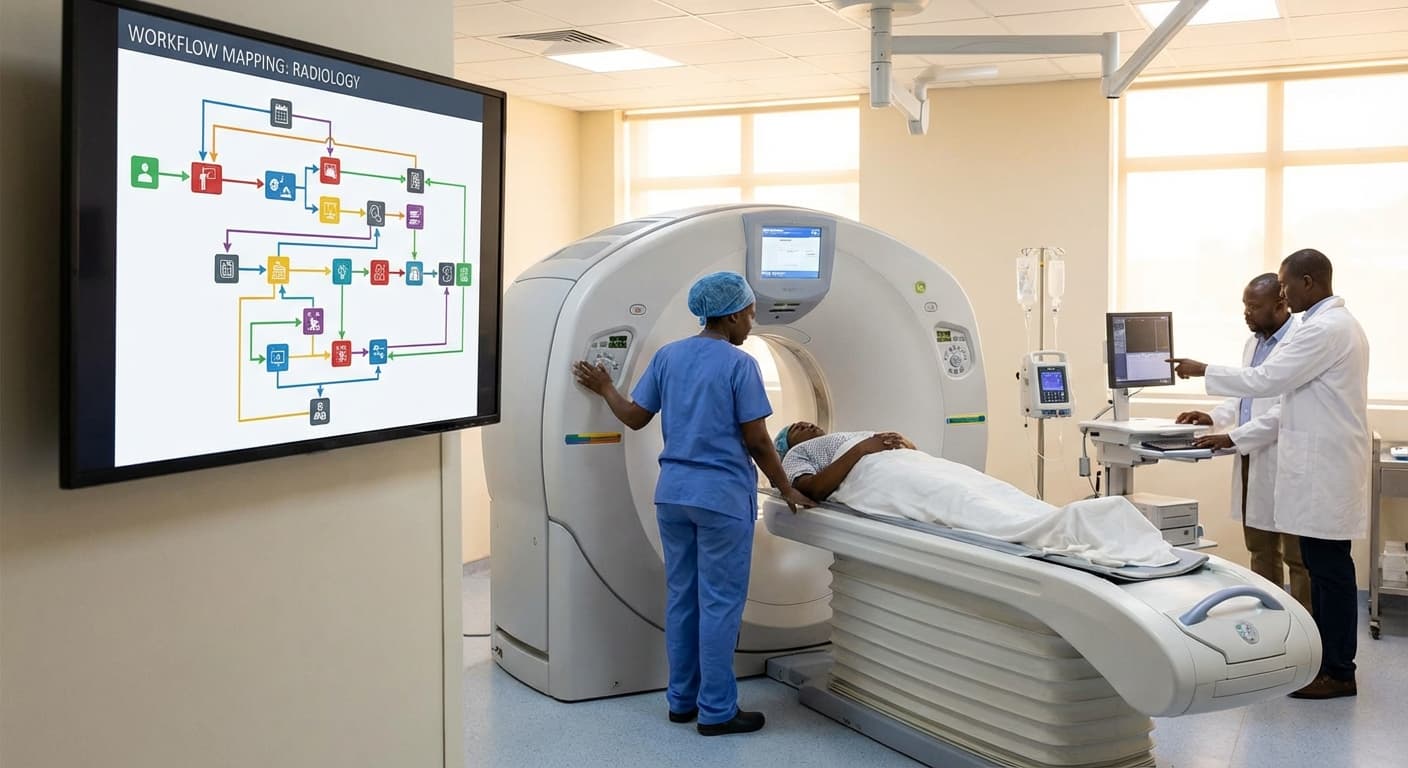
Visualizing and optimizing patient journeys across Radiology, ICU, OT, Lab, and Dialysis in Brazzaville hospitals. This service identifies bottlenecks and redundancies in existing workflows, leading to reduced wait times, improved resource allocation, and enhanced patient care continuity.
Standardizing Diagnostic & Treatment Pathways
Developing clear, documented, and auditable workflow maps for critical departments like Radiology, ICU, OT, Lab, and Dialysis in Congo. This ensures consistent application of best practices, reduces variations in care, and facilitates training and onboarding of new medical personnel.
Enhancing Operational Efficiency and Resource Management
Analyzing and mapping the operational workflows of key hospital departments in Brazzaville to pinpoint areas for efficiency gains. This service helps in optimizing the utilization of specialized equipment (e.g., MRI, ventilators, lab analyzers), staffing levels, and consumable supplies, thereby lowering operational costs and improving service delivery.
What Is Department Workflow Mapping Service (Radiology/icu/ot/lab/dialysis) In Congo (Brazzaville)?
Department Workflow Mapping Service (Radiology/ICU/OT/Lab/Dialysis) in Congo (Brazzaville) refers to the systematic analysis, documentation, and optimization of the processes and procedures within specific hospital departments. This service aims to identify inefficiencies, bottlenecks, and areas for improvement in the flow of patients, information, materials, and resources. It involves a detailed examination of each step, from patient registration and arrival to diagnosis, treatment, and discharge, within the context of the identified departments (Radiology, Intensive Care Unit (ICU), Operating Theatre (OT), Laboratory, and Dialysis). The ultimate goal is to enhance operational efficiency, improve patient care quality, reduce turnaround times, and optimize resource utilization within these critical healthcare units.
| Who Needs Department Workflow Mapping Service? | Typical Use Cases |
|---|---|
| Hospitals and healthcare facilities in Congo (Brazzaville) seeking to improve operational performance within critical departments. | Radiology: Optimizing image acquisition, interpretation, reporting turnaround times, and patient scheduling. Identifying bottlenecks in PACS integration and radiologist workload distribution. |
| Department heads and managers responsible for the efficiency and quality of care within Radiology, ICU, OT, Laboratory, or Dialysis units. | ICU: Streamlining patient admission and transfer processes, improving communication between multidisciplinary teams, and optimizing resource allocation (e.g., ventilators, beds). |
| Healthcare administrators and policymakers focused on enhancing patient outcomes, reducing healthcare costs, and improving patient satisfaction. | OT: Minimizing operating room downtime, optimizing surgical scheduling, improving instrument and supply management, and reducing patient waiting lists. |
| Medical technologists, nurses, physicians, and support staff working within these specialized departments. | Laboratory: Accelerating sample processing, improving test turnaround times, enhancing quality control procedures, and optimizing specimen tracking. |
| Organizations involved in healthcare infrastructure development, management, or consulting in Congo (Brazzaville). | Dialysis: Enhancing patient scheduling, optimizing machine utilization, improving access to pre- and post-treatment care, and ensuring adherence to safety protocols. |
| Any entity aiming to standardize and improve the delivery of specialized medical services. | Cross-departmental: Identifying and mitigating handoff errors between departments, improving interdisciplinary communication, and standardizing patient pathways across multiple units. |
Key Components of Department Workflow Mapping Service:
- Process Identification and Documentation: Detailed charting of all activities, decision points, and interdependencies within a department's workflow.
- Data Collection and Analysis: Gathering quantitative and qualitative data on key performance indicators (KPIs) such as patient throughput, waiting times, resource availability, and error rates.
- Bottleneck and Inefficiency Identification: Pinpointing specific stages where delays, resource constraints, or suboptimal practices impede workflow.
- Stakeholder Consultation: Engaging with clinical staff, administrative personnel, and management to gather insights and ensure buy-in.
- Technology Integration Assessment: Evaluating the role and effectiveness of existing or potential technological solutions (e.g., HIS, LIS, PACS, EMRs) in supporting or hindering workflow.
- Recommendation Development: Formulating actionable strategies and proposed changes to streamline processes, improve efficiency, and enhance patient safety.
- Implementation Support and Monitoring: Assisting in the rollout of proposed changes and establishing metrics for ongoing performance evaluation.
Who Needs Department Workflow Mapping Service (Radiology/icu/ot/lab/dialysis) In Congo (Brazzaville)?
In Congo (Brazzaville), optimizing operational efficiency and patient care within critical healthcare departments is paramount. A Department Workflow Mapping Service offers a vital solution for understanding, analyzing, and improving the intricate processes within key areas of a hospital. This service is designed to identify bottlenecks, reduce errors, enhance resource utilization, and ultimately lead to better patient outcomes and a more streamlined healthcare delivery system.
| Target Customer | Department | Needs Addressed by Workflow Mapping |
|---|---|---|
| Public Hospitals | Radiology | Reducing patient turnaround time for imaging reports, optimizing equipment utilization, improving radiologist workflow. |
| Public Hospitals | ICU (Intensive Care Unit) | Ensuring timely and accurate administration of life-saving interventions, improving communication between medical staff, optimizing bed management. |
| Public Hospitals | OT (Operating Theatre) | Streamlining surgical scheduling, minimizing downtime between procedures, optimizing surgical team coordination, ensuring efficient sterilization and supply chain. |
| Public Hospitals | Laboratory | Accelerating sample processing and reporting, reducing errors in sample handling and analysis, optimizing staff allocation and instrument utilization. |
| Public Hospitals | Dialysis Unit | Improving patient scheduling and throughput, ensuring efficient machine maintenance and allocation, optimizing medication and supply management. |
| Private Hospitals | Radiology | Enhancing patient experience through faster results, optimizing imaging protocols for efficiency and accuracy, improving referral physician satisfaction. |
| Private Hospitals | ICU (Intensive Care Unit) | Implementing best practices for critical care delivery, optimizing staffing ratios based on patient acuity, ensuring adherence to international standards. |
| Private Hospitals | OT (Operating Theatre) | Maximizing operating room utilization for revenue generation, implementing advanced surgical techniques with efficient workflows, improving patient safety through clear procedural steps. |
| Private Hospitals | Laboratory | Offering rapid diagnostic services, ensuring high-throughput testing capabilities, implementing quality control measures to meet international benchmarks. |
| Private Hospitals | Dialysis Unit | Providing personalized patient care with efficient scheduling, investing in advanced dialysis technologies with optimized operational workflows, ensuring patient comfort and safety. |
| Specialized Clinics | Radiology | Focusing on specific imaging modalities and optimizing their workflow for specialized diagnostics. |
| Specialized Clinics | Laboratory | Streamlining specialized testing procedures and ensuring rapid turnaround for specific medical conditions. |
| Healthcare Consortia/Networks | All Listed Departments | Standardizing workflows across multiple facilities for consistent quality of care and efficient resource sharing. |
Who Needs Department Workflow Mapping Service in Congo (Brazzaville)?
- Hospitals seeking to improve patient flow and reduce wait times.
- Healthcare facilities aiming to enhance the accuracy and speed of diagnostic and treatment procedures.
- Organizations focused on cost reduction and resource optimization.
- Institutions undergoing digital transformation or implementing new technologies.
- Departments struggling with staff burnout due to inefficient processes.
- Hospitals preparing for accreditation or quality assurance reviews.
Department Workflow Mapping Service (Radiology/icu/ot/lab/dialysis) Process In Congo (Brazzaville)
This document outlines the Department Workflow Mapping Service for various critical hospital departments in Congo (Brazzaville), specifically Radiology, Intensive Care Unit (ICU), Operating Theatre (OT), Laboratory, and Dialysis. The service aims to analyze, document, and optimize existing departmental processes to improve efficiency, reduce errors, and enhance patient care. The workflow begins with an initial inquiry from a healthcare institution and culminates in the delivery of a comprehensive workflow map and recommendations for improvement.
| Stage | Description | Key Activities | Deliverables/Outcomes | Responsible Party |
|---|---|---|---|---|
| The process begins when a hospital or department expresses interest in the workflow mapping service. This stage involves understanding their general needs and objectives. | Initial contact, preliminary discussion of needs, brief overview of services, scheduling follow-up. | Understanding of client's general interest, agreement to proceed to next stage. | Client (Hospital/Department), Service Provider |
| A deeper dive into the specific department(s) requiring mapping, identifying the exact processes to be analyzed, and defining the project's boundaries. | On-site or virtual meetings with key stakeholders (department heads, senior staff), defining specific departments (e.g., Radiology, ICU, OT, Lab, Dialysis), identifying key processes within each department, establishing project scope and objectives, setting timelines. | Detailed understanding of client's requirements, formally defined project scope document, agreed-upon objectives and timeline. | Service Provider, Client (Key Stakeholders) |
| Gathering comprehensive information about the current state of the department's workflows, including procedures, roles, resources, and existing challenges. | Observation of daily operations, interviews with staff at all levels, review of existing documentation (SOPs, protocols, forms), data gathering on patient flow, turnaround times, resource utilization, identification of bottlenecks and pain points. | Detailed understanding of current operational procedures, identification of key performance indicators (KPIs), preliminary identification of areas for improvement. | Service Provider (Analysts, Consultants), Client (Staff Cooperation) |
| Translating the collected data into visual representations of the current state workflows for each targeted department. | Creation of process flowcharts (using standard notations like BPMN), development of process narratives, documentation of roles and responsibilities, mapping of decision points and handoffs, detailing information flow. | Comprehensive visual workflow maps for each department, documented process descriptions. | Service Provider (Workflow Analysts) |
| Analyzing the mapped workflows to identify inefficiencies, redundancies, potential risks, and areas for optimization. Developing actionable recommendations. | Comparing current state maps to best practices and desired outcomes, identifying deviations and inefficiencies, brainstorming solutions, prioritizing recommendations based on impact and feasibility, considering local context and resource constraints. | List of identified gaps and inefficiencies, a set of prioritized recommendations for process improvement, potential for cost savings, efficiency gains, and improved patient outcomes. | Service Provider (Consultants, Subject Matter Experts) |
| Presenting the findings, workflow maps, and recommendations to the client for review and feedback, ensuring accuracy and buy-in. | Formal presentation of workflow maps and recommendations to department leadership and key stakeholders, discussion of findings, addressing questions and concerns, incorporating client feedback. | Validated workflow maps, agreed-upon recommendations, increased understanding and buy-in from client. | Service Provider, Client (Leadership and Staff) |
| Compiling all findings, maps, and recommendations into a comprehensive final report. | Finalization of workflow maps, compilation of the detailed report including executive summary, current state analysis, gap analysis, recommendations, and proposed future state workflows (if applicable). | Final comprehensive workflow mapping report, digital copies of workflow maps, executive summary. | Service Provider |
| Providing ongoing assistance to the client in implementing the recommendations and monitoring progress. | Post-implementation support, monitoring of implemented changes, further optimization, training sessions. | Successful implementation of recommendations, sustained process improvements, ongoing client satisfaction. | Service Provider (Optional Service) |
Service Workflow Stages
- Inquiry and Initial Consultation
- Needs Assessment and Scope Definition
- Data Collection and Analysis
- Workflow Mapping and Documentation
- Gap Identification and Recommendation Development
- Presentation and Validation
- Final Report and Deliverables
- Follow-up and Support (Optional)
Department Workflow Mapping Service (Radiology/icu/ot/lab/dialysis) Cost In Congo (Brazzaville)
The cost of departmental workflow mapping services for specialized areas like Radiology, ICU, OT, Lab, and Dialysis in Congo (Brazzaville) can vary significantly. These services are crucial for optimizing efficiency, patient flow, resource allocation, and overall quality of care within these complex departments. Several factors influence the pricing, making it difficult to provide a single definitive cost. However, we can outline the typical pricing factors and offer estimated ranges in the local currency, the Congolese Franc (XAF).
| Service Type | Estimated Price Range (XAF) | Notes |
|---|---|---|
| Radiology Workflow Mapping (Basic Assessment) | 800,000 - 1,500,000 | Covers initial process overview, bottleneck identification, and basic recommendations. |
| Radiology Workflow Mapping (In-depth Analysis & Redesign) | 1,500,000 - 3,500,000 | Includes detailed process mapping, simulation, advanced recommendations, and potential redesign proposals. |
| ICU Workflow Mapping (Basic Assessment) | 1,000,000 - 2,000,000 | Focuses on patient flow, staff allocation, and critical care process assessment. |
| ICU Workflow Mapping (In-depth Analysis & Optimization) | 2,000,000 - 5,000,000+ | Comprehensive mapping of all critical care processes, equipment utilization, and interdisciplinary communication with optimization strategies. |
| OT Workflow Mapping (Basic Assessment) | 900,000 - 1,800,000 | Assessment of surgical scheduling, patient preparation, and post-operative flow. |
| OT Workflow Mapping (In-depth Analysis & Efficiency Improvement) | 1,800,000 - 4,500,000 | Detailed mapping of the entire surgical process, from patient admission to discharge, with a focus on reducing turnaround times and improving resource utilization. |
| Lab Workflow Mapping (Basic Assessment) | 700,000 - 1,300,000 | Focus on sample handling, processing, and reporting for general lab services. |
| Lab Workflow Mapping (In-depth Analysis & Automation Potential) | 1,300,000 - 3,000,000 | Detailed analysis of all lab processes, including specialized testing, quality control, and identification of automation opportunities. |
| Dialysis Workflow Mapping (Basic Assessment) | 850,000 - 1,600,000 | Overview of patient scheduling, treatment procedures, and staff coordination. |
| Dialysis Workflow Mapping (In-depth Analysis & Patient Safety) | 1,600,000 - 4,000,000 | Comprehensive mapping focusing on patient comfort, safety protocols, equipment maintenance, and efficient patient throughput. |
| Multi-Departmental Workflow Mapping (Customized) | Customized Quote - Starting from 2,500,000+ | Pricing will depend on the specific departments, scope, and complexity of the integrated workflows. |
Key Factors Influencing Workflow Mapping Costs:
- Scope of the Project: The number of departments to be mapped, the depth of analysis required (e.g., initial assessment vs. detailed process redesign), and the complexity of existing workflows all play a major role. Mapping a single small lab will be less expensive than mapping an entire ICU and its adjacent surgical theaters.
- Consultant Expertise and Experience: Highly specialized consultants with proven track records in healthcare workflow optimization, particularly within the specific departments being mapped, will command higher fees.
- Duration of the Engagement: The time required for on-site observation, data collection, analysis, report generation, and stakeholder consultations will directly impact the overall cost.
- Deliverables Required: The type of output expected, such as initial diagnostic reports, detailed process maps, recommended improvements, implementation plans, or training materials, will affect the pricing.
- Complexity of the Departmental Workflows: Departments like the ICU and OT have highly intricate and time-sensitive workflows involving multiple interdependencies. Mapping these requires a higher level of expertise and time.
- Size and Infrastructure of the Healthcare Facility: Larger hospitals or facilities with more extensive infrastructure may require more time and resources for mapping.
- Level of Stakeholder Engagement: The extent to which key personnel (doctors, nurses, technicians, administrators) need to be involved in interviews and workshops will influence the project timeline and cost.
- Technology and Tools Used: Some consultants may utilize advanced software for process modeling and simulation, which can add to the overall cost.
- Location within Congo (Brazzaville): While less impactful than other factors, travel and logistical costs within the country can sometimes be a minor consideration.
Affordable Department Workflow Mapping Service (Radiology/icu/ot/lab/dialysis) Options
Our Affordable Department Workflow Mapping Service is designed to optimize operations across critical hospital departments including Radiology, Intensive Care Unit (ICU), Operating Theater (OT), Laboratory, and Dialysis. By meticulously mapping existing workflows, we identify bottlenecks, inefficiencies, and areas for improvement, leading to enhanced patient care, reduced wait times, and significant cost savings. We offer flexible value bundles and implement strategic cost-saving initiatives tailored to your department's unique needs.
| Value Bundle | Departments Covered | Key Features | Estimated Price Range (USD) | Cost-Saving Potential |
|---|---|---|---|---|
| Essentials Bundle | Radiology, Lab, or Dialysis (Choose 1) | Core Workflow Mapping, Bottleneck Identification, Basic Optimization Recommendations | $3,000 - $7,000 | 5-10% (Reduced waste, improved throughput) |
| Standard Bundle | ICU or OT (Choose 1) OR any 2 from Essentials | Essentials Features + Redesign Recommendations, Technology Assessment | $7,000 - $15,000 | 7-15% (Optimized resource allocation, reduced error rates) |
| Comprehensive Bundle | Any 3+ Departments OR All Departments | Standard Features + Staff Training, KPI Development, Ongoing Support (3 months) | $15,000 - $30,000+ | 10-20%+ (Significant efficiency gains, improved patient outcomes, reduced operational costs) |
| Custom Bundle | Tailored to Specific Needs | Any combination of features, flexible scope | Varies (Based on scope) | Variable (Optimized for unique challenges) |
Value Bundles & Key Offerings
- Core Workflow Mapping: Detailed analysis and documentation of current processes.
- Bottleneck Identification & Analysis: Pinpointing critical points of delay and inefficiency.
- Redesign & Optimization Recommendations: Proposing actionable strategies for streamlined workflows.
- Technology Integration Assessment: Evaluating opportunities for leveraging existing or new technologies.
- Staff Training & Change Management Support: Facilitating smooth implementation of new processes.
- Performance Metrics & KPI Development: Establishing benchmarks for ongoing performance monitoring.
Verified Providers In Congo (Brazzaville)
In the Democratic Republic of Congo (Brazzaville), identifying reliable and credentialed healthcare providers is paramount for ensuring quality patient care and peace of mind. Among the various entities, Franance Health stands out as a leading organization, offering a robust network of verified professionals. This document outlines the credentials of Franance Health and explains why their network represents the best choice for healthcare in Congo (Brazzaville).
| Credential Type | Verification Process | Significance for Patients |
|---|---|---|
| Medical Licenses & Certifications | Franance Health confirms the validity and current standing of all medical licenses and specialized certifications with relevant national and international medical boards. | Ensures providers have the legal authorization and foundational qualifications to practice medicine. |
| Educational Background | Verification of degrees and diplomas from accredited medical schools and institutions. | Confirms that providers have received comprehensive and high-quality medical education. |
| Clinical Experience | Thorough review of past employment history, references, and documented years of practice in relevant fields. | Guarantees that providers possess practical expertise and have a track record of successful patient outcomes. |
| Specialization & Expertise | Assessment of specific training, fellowships, and certifications in areas of medical specialization. | Allows patients to be matched with doctors who have the most relevant expertise for their specific health needs. |
| Ethical Conduct & Professionalism | Background checks and reference checks focusing on professional conduct and adherence to medical ethics. | Provides assurance of trustworthy and compassionate care, free from malpractice or ethical violations. |
| Adherence to Standards | Confirmation that providers follow established clinical guidelines, best practices, and international healthcare standards. | Ensures patients receive care that is up-to-date, evidence-based, and of the highest quality. |
Franance Health's Commitment to Verification and Quality
- Rigorous vetting process for all affiliated healthcare professionals.
- Verification of medical licenses and certifications from recognized authorities.
- Background checks to ensure a history of ethical practice.
- Assessment of clinical experience and specialization.
- Commitment to ongoing professional development and adherence to international standards.
- Patient feedback mechanisms to ensure continuous improvement.
- Partnerships with reputable healthcare institutions and regulatory bodies within Congo (Brazzaville) and internationally.
Scope Of Work For Department Workflow Mapping Service (Radiology/icu/ot/lab/dialysis)
This Scope of Work (SOW) outlines the services to be provided for a comprehensive workflow mapping initiative across key hospital departments. The primary objective is to document, analyze, and visualize existing operational processes within Radiology, Intensive Care Unit (ICU), Operating Theatre (OT), Laboratory Services, and Dialysis Units. The service provider will deliver detailed workflow maps, identify bottlenecks, suggest areas for optimization, and provide a set of standard specifications for future process design. This will enable the organization to achieve greater efficiency, reduce errors, improve patient care, and streamline resource utilization.
| Phase | Activities | Deliverables | Timeline (Indicative) |
|---|---|---|---|
| Phase 1: Discovery & Information Gathering | Kick-off meeting with stakeholders. On-site observation and data collection. Interviews with key personnel (doctors, nurses, technicians, administrators). Review of existing documentation (SOPs, guidelines). | Project plan and communication strategy. Initial stakeholder register. Raw data repository (interview notes, observation logs). | 2-3 Weeks |
| Phase 2: Workflow Analysis & Mapping | Development of detailed 'as-is' process maps using a standardized notation (e.g., BPMN 2.0). Identification of decision points, roles, systems, and data flows. Analysis of process steps for bottlenecks, delays, and errors. Preliminary identification of improvement areas. | 'As-Is' Workflow Maps (per department). List of identified bottlenecks and pain points. Gap analysis report. | 4-6 Weeks |
| Phase 3: Optimization & 'To-Be' Design | Facilitation of workshops with stakeholders to brainstorm and design optimized 'to-be' workflows. Incorporating best practices, automation opportunities, and technology solutions. Defining new roles, responsibilities, and system interactions. Risk assessment for proposed changes. | 'To-Be' Workflow Maps (per department). Prioritized list of recommended improvements. Proposed future state process descriptions. Risk mitigation strategies. | 3-4 Weeks |
| Phase 4: Documentation & Standardization | Development of a comprehensive workflow documentation standard/template. Creation of a 'Technical Deliverables Specification' document. Finalization of all workflow maps and reports. Presentation of findings and recommendations to management. | Final 'As-Is' and 'To-Be' Workflow Maps (digital format). Comprehensive Project Report (including findings, recommendations, and ROI analysis where applicable). 'Technical Deliverables Specification' document. Workflow Documentation Standard/Template. | 2-3 Weeks |
Key Objectives
- To accurately document current 'as-is' workflows for all specified departments.
- To identify inefficiencies, redundancies, and potential risks within existing processes.
- To propose 'to-be' optimized workflows based on best practices and identified opportunities.
- To establish standardized templates and specifications for future workflow documentation and development.
- To provide actionable recommendations for process improvement and technology integration.
Service Level Agreement For Department Workflow Mapping Service (Radiology/icu/ot/lab/dialysis)
This Service Level Agreement (SLA) outlines the guaranteed response times and uptime for the Department Workflow Mapping Service. This service aims to provide accurate, up-to-date, and accessible workflow maps for various hospital departments, including Radiology, Intensive Care Unit (ICU), Operating Theatre (OT), Laboratory (Lab), and Dialysis. The primary goal is to improve operational efficiency, reduce errors, and enhance training within these critical areas.
| Service Component | Response Time Guarantee (Business Hours) | Uptime Guarantee | Escalation Point |
|---|---|---|---|
| Initial Workflow Map Creation (New Department/Major Overhaul) | 10 Business Days | N/A (Project-based) | Workflow Mapping Service Lead |
| Minor Workflow Map Updates (e.g., personnel changes, minor process tweaks) | 2 Business Days | N/A (Project-based) | Workflow Mapping Service Lead |
| Major Workflow Map Updates (e.g., new equipment integration, significant process redesign) | 5 Business Days | N/A (Project-based) | Workflow Mapping Service Lead |
| Request for Clarification/Support on Existing Workflow Maps | 4 Business Hours | 99.5% | Workflow Mapping Support Team |
| Website/Portal Availability for Workflow Map Access | N/A | 99.8% | IT Infrastructure Support |
| Urgent Workflow Map Correction (Critical Error impacting patient care/safety) | 1 Business Hour | N/A | Workflow Mapping Service Director |
Scope of Service
- Development and maintenance of digital workflow maps.
- Regular updates based on departmental feedback and process changes.
- Accessibility of workflow maps through a designated online portal.
- Provision of support for understanding and utilizing the workflow maps.
Frequently Asked Questions

Ready when you are
Let's scope your Department Workflow Mapping Service (Radiology/ICU/OT/Lab/Dialysis) in Congo (Brazzaville) project in Congo (Brazzaville).

Scaling healthcare logistics and technical systems across the entire continent.