
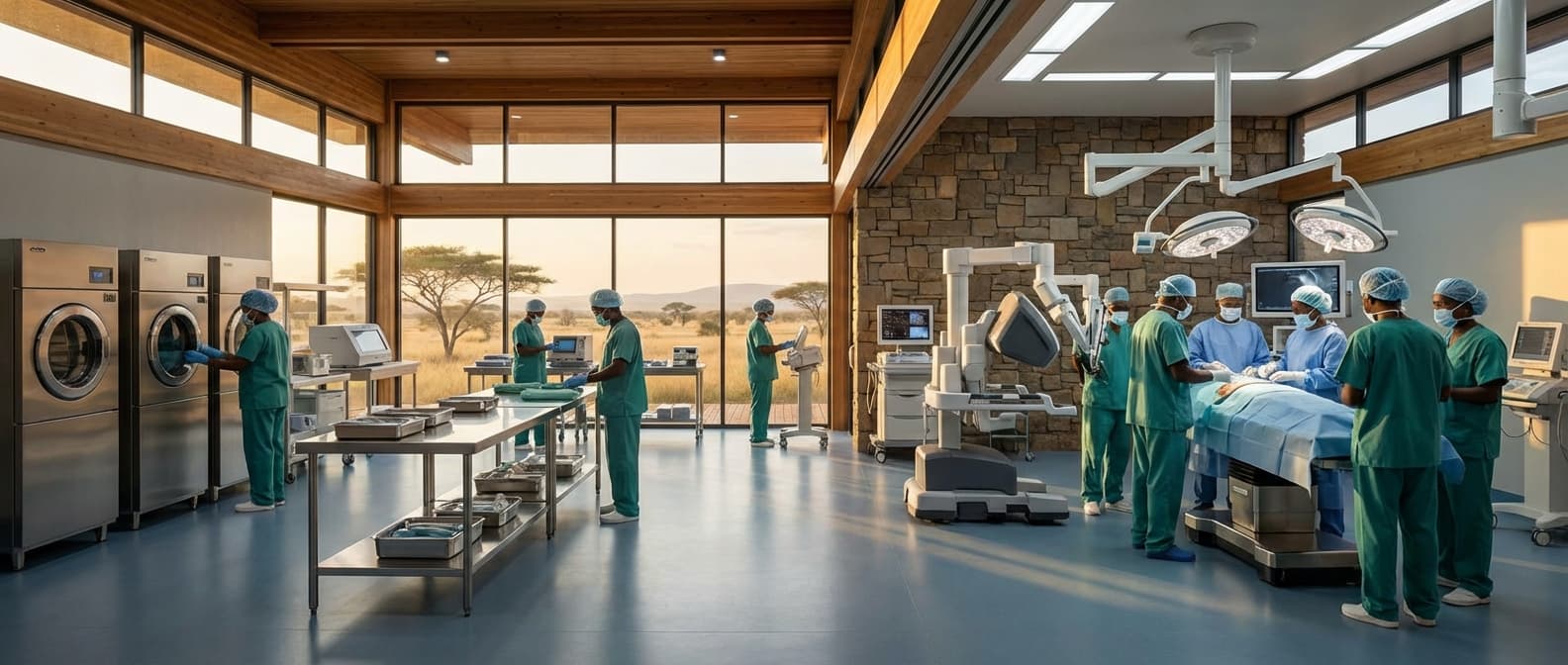
Operating Theatre Turnkey Build in Congo (Brazzaville)
Engineering Excellence & Technical Support
Complete OR design, equipment integration and commissioning High-standard technical execution following OEM protocols and local regulatory frameworks.
Advanced Surgical Suite Integration
Engineered a fully integrated turnkey operating theatre in Brazzaville, featuring state-of-the-art laminar flow systems, advanced surgical lighting, and medical gas pipelines compliant with international standards, ensuring optimal sterility and operational efficiency for complex procedures.
Robust Infection Control & Safety Protocols
Implemented comprehensive infection control measures through negative pressure rooms, HEPA filtration, and antimicrobial surface finishes, guaranteeing a safe environment for both patients and medical staff while minimizing the risk of healthcare-associated infections in the Congo basin.
Localized Infrastructure Adaptation & Resilience
Successfully adapted the turnkey build to the local infrastructure of Brazzaville, incorporating robust power backup solutions (generators & UPS) and climate control systems resilient to regional environmental challenges, ensuring continuous and reliable operation of critical medical equipment.
What Is Operating Theatre Turnkey Build In Congo (Brazzaville)?
An Operating Theatre Turnkey Build in Congo (Brazzaville) refers to a comprehensive service where a specialized contractor assumes full responsibility for the design, construction, equipping, and commissioning of a fully functional operating theatre. This "turnkey" approach ensures that the client receives a ready-to-operate facility with all necessary infrastructure, specialized medical equipment, and regulatory compliance addressed. The service encompasses the entire project lifecycle, from initial conceptualization and site assessment through to final handover and operational readiness testing. It is particularly relevant in regions like Congo (Brazzaville) where established infrastructure for advanced medical facilities may be underdeveloped, or where local expertise for such complex projects is limited. The objective is to provide a seamless, end-to-end solution, minimizing client involvement and ensuring a high-quality, compliant, and efficient surgical environment.
| Who Needs It? | Typical Use Cases | ||||||
|---|---|---|---|---|---|---|---|
| Hospitals & Healthcare Institutions (Public & Private): Seeking to upgrade existing facilities or establish new surgical capacity. | Establishment of new hospitals: Particularly in regions with nascent healthcare infrastructure. | Expansion or modernization of existing surgical departments: To incorporate advanced technologies or increase capacity. | Specialty surgical centers: Focusing on specific medical disciplines (e.g., cardiology, neurosurgery, orthopedics). | Government health ministries or public health organizations: Undertaking national healthcare infrastructure development projects. | Non-governmental organizations (NGOs) or humanitarian organizations: Establishing medical facilities in underserved areas or during crisis response. | Private investors in healthcare: Developing for-profit medical facilities. | Remote or resource-limited areas: Where direct access to specialized expertise and high-quality construction is challenging. |
| General Surgery & Emergency Procedures: Standard operating rooms for a wide range of surgical interventions. | Specialized Surgical Suites: Dedicated operating rooms for complex procedures requiring specific equipment and environmental controls (e.g., hybrid operating rooms integrating imaging, cardiac catheterization labs with surgical capabilities). | Trauma Centers: Facilitating rapid response and treatment of critical injuries. | Maternity and Obstetrics: For Cesarean sections and other gynecological surgical procedures. | Outpatient Surgery Centers: For less invasive procedures requiring shorter recovery times. | Research and Training Facilities: Integrated operating theatres designed for educational purposes and clinical research. |
Key Components of an Operating Theatre Turnkey Build:
- Architectural & Structural Design: Development of detailed plans for the operating room suite, including layout, flow, size, and structural integrity, adhering to international healthcare design standards and local building codes.
- Civil Works & Construction: Execution of all necessary construction activities, including foundation, walls, ceilings, flooring, and partitioning, with a focus on hygienic materials and infection control.
- Medical Gas Systems: Installation and integration of essential medical gas pipelines (e.g., oxygen, medical air, vacuum, nitrous oxide) with appropriate outlets, alarms, and backup systems.
- HVAC & Air Filtration: Design and implementation of a specialized HVAC system to maintain precise temperature, humidity, and positive/negative pressure differentials, coupled with high-efficiency particulate air (HEPA) filtration for sterile air quality.
- Electrical & Lighting Systems: Installation of robust electrical infrastructure, including backup power (generators, UPS), specialized operating room lighting (e.g., surgical LED lights with shadowless capabilities, ambient lighting), and integrated power outlets.
- Low Voltage Systems: Integration of communication systems (intercom, nurse call), data networks, audiovisual equipment, and security systems.
- Medical Equipment Procurement & Installation: Sourcing, delivery, installation, and calibration of all required surgical equipment, including operating tables, anesthesia machines, surgical lights, patient monitors, electrosurgical units, sterilization equipment, and imaging modalities.
- Sterilization & Waste Management: Design and implementation of sterile processing areas and compliant medical waste disposal systems.
- Finishing & Outfitting: Application of specialized hygienic finishes (e.g., seamless epoxy flooring, anti-microbial wall coatings), installation of cabinetry, doors, and other interior fittings.
- Commissioning & Validation: Rigorous testing and validation of all installed systems and equipment to ensure operational performance, safety, and compliance with regulatory standards and manufacturer specifications.
- Training & Handover: Provision of comprehensive training to clinical and technical staff on the operation and maintenance of the facility and its equipment, followed by a formal handover.
Who Needs Operating Theatre Turnkey Build In Congo (Brazzaville)?
Operating theatre turnkey builds in Congo (Brazzaville) are crucial for establishing advanced medical facilities. These comprehensive solutions provide everything needed for a fully functional operating suite, from initial design and construction to equipment installation and commissioning. This significantly accelerates the delivery of modern surgical care, addresses critical infrastructure gaps, and enhances the capacity for complex medical procedures within the country.
| Target Customer Segment | Key Needs & Motivations | Relevant Departments |
|---|---|---|
| Public Hospitals | Modernization, increased capacity for general and specialized surgeries, improved patient outcomes, compliance with international standards. | General Surgery, Orthopedics, Obstetrics & Gynecology, Urology, Emergency Surgery, Anesthesiology, Intensive Care Unit (ICU). |
| Private Hospitals & Clinics | Competitive advantage, attracting top surgeons, offering cutting-edge procedures, catering to higher-income demographics, revenue generation. | Cardiology, Neurosurgery, Ophthalmology, Plastic Surgery, Oncology Surgery, Laparoscopic Surgery, Pain Management. |
| NGOs & Humanitarian Organizations | Rapid deployment of essential surgical services, responding to emergencies, providing critical care in remote or disaster-stricken areas, cost-effectiveness for project completion. | Trauma Surgery, Emergency Medicine, General Surgery, Field Hospitals, Surgical Camps. |
| Research & Training Institutions | High-fidelity simulation, advanced surgical techniques demonstration, hands-on training, supporting academic research, attracting medical talent. | Surgical Simulation Labs, Anatomy & Surgical Skills Centers, Postgraduate Surgical Training Programs. |
| Corporations (Mining, Oil & Gas) | Employee health and safety, immediate medical response, reducing patient evacuation costs, providing comprehensive occupational health services. | Occupational Health Clinics, Emergency Medical Services, Trauma & Surgical Response Teams. |
Target Customers for Operating Theatre Turnkey Builds in Congo (Brazzaville)
- Public Hospitals and Healthcare Institutions: Government-funded hospitals seeking to upgrade their surgical capabilities and expand access to specialized procedures.
- Private Hospitals and Clinics: For-profit healthcare providers aiming to offer premium surgical services and attract patients seeking advanced medical treatment.
- International NGOs and Humanitarian Organizations: Groups involved in providing healthcare in underserved areas or during medical crises, requiring rapid deployment of functional surgical facilities.
- Research and Training Institutions: Medical universities or research centers that require state-of-the-art operating theatres for teaching, training, and conducting surgical research.
- Mining and Oil & Gas Companies: Large corporations with remote operations may invest in on-site medical facilities, including operating theatres, to ensure the health and safety of their workforce and surrounding communities.
Operating Theatre Turnkey Build Process In Congo (Brazzaville)
The construction of an operating theatre in Brazzaville, Congo, is a complex undertaking requiring meticulous planning and execution. A turnkey build process streamlines this by offering a single point of responsibility, managing all aspects from initial design to final handover. This workflow is crucial for ensuring compliance with international standards, local regulations, and the specific needs of a medical facility.
| Phase | Key Activities | Deliverables | Key Considerations (Congo) |
|---|---|---|---|
| Inquiry & Assessment | Client consultation, requirement gathering, initial budget discussion | Project brief, preliminary scope of work | Understanding local healthcare needs and existing infrastructure |
| Feasibility & Site Eval | Site surveys, geotechnical analysis, infrastructure assessment, risk analysis | Feasibility report, site suitability assessment | Logistical challenges, security, land ownership, utility availability |
| Conceptual Design | Space planning, workflow optimization, infection control integration, initial renderings | Conceptual drawings, floor plans, preliminary layouts | Adherence to international healthcare design guidelines |
| Detailed Design & Eng. | Architectural, structural, MEP design, medical gas systems, lighting, acoustics | Detailed architectural drawings, engineering specifications, equipment lists | Local building codes and standards, material availability |
| Approvals & Permitting | Submission to ministries (Health, Urban Planning), permit applications | Building permits, environmental permits, health clearances | Bureaucratic processes, need for local legal/consulting support |
| Procurement & Supply | Sourcing materials, equipment, specialized systems; logistics and customs | Procurement orders, shipping manifests, import documentation | Import duties, transportation infrastructure, potential for delays |
| Construction & Install. | Site preparation, foundation, structure, MEP installation, medical equipment | Completed building shell, installed systems, calibrated equipment | Skilled labor availability, quality control, remote site challenges |
| QA & Testing | System testing (HVAC, medical gases), equipment commissioning, validation | Test reports, commissioning certificates, validation documentation | Ensuring compliance with international standards |
| Training & Handover | Staff training on operations and maintenance, final inspection, documentation | Training manuals, as-built drawings, handover certificate, warranties | Language barriers, comprehensive user manuals |
| Post-Support | Warranty period, planned maintenance, emergency support | Maintenance schedules, service agreements, spare parts inventory | Establishing reliable local support networks |
Operating Theatre Turnkey Build Process in Congo (Brazzaville) - Workflow
- 1. Initial Inquiry & Needs Assessment: The process begins with a formal inquiry from the client (hospital, government agency, private investor) detailing their requirements for the operating theatre. This includes capacity, specialization (e.g., general surgery, cardiology), desired technology, budget, and timeline.
- 2. Feasibility Study & Site Evaluation: A comprehensive feasibility study is conducted. This involves assessing the proposed site's suitability, considering factors like access for construction, utilities (water, electricity, waste management), structural integrity, and potential environmental impacts. Site surveys and geological assessments may be necessary.
- 3. Conceptual Design & Space Planning: Based on the needs assessment, architects and medical planners develop conceptual designs. This phase focuses on efficient workflow, infection control principles, optimal equipment placement, and compliance with relevant healthcare building codes. Detailed space planning ensures adequate room for surgical teams, equipment, sterilization areas, and patient recovery.
- 4. Detailed Design & Engineering: Once the conceptual design is approved, detailed architectural, structural, mechanical, electrical, and plumbing (MEP) engineering plans are developed. This includes specifications for HVAC systems with HEPA filtration, specialized lighting, medical gas pipelines, and electrical systems for critical equipment. Infection control strategies are deeply integrated at this stage.
- 5. Regulatory Approvals & Permitting: Navigating the local regulatory landscape is critical. This involves submitting all design documents to relevant government bodies in Congo (Brazzaville) for review and approval. Obtaining building permits, environmental clearances, and health ministry certifications can be a lengthy process requiring local expertise.
- 6. Procurement & Supply Chain Management: The turnkey provider manages the procurement of all materials, equipment, and specialized medical technology. This includes sourcing from reputable international and local suppliers, managing logistics, customs clearance, and transportation to the site, which can be challenging in Congo.
- 7. Construction & Installation: This phase involves site preparation, foundation work, structural erection, and the installation of all building systems (MEP). Specialized construction techniques are employed for operating theatre walls (e.g., seamless, anti-microbial surfaces), flooring, and ceilings to ensure sterility and ease of cleaning. Medical equipment installation and calibration are integrated.
- 8. Quality Assurance & Testing: Throughout the construction and installation process, rigorous quality assurance checks are performed. This includes testing all building systems, medical gas pipelines, HVAC performance, and ensuring adherence to design specifications and international healthcare standards. Commissioning of all equipment is a crucial step.
- 9. Training & Handover: Once construction is complete and all systems are functional, comprehensive training is provided to the hospital's staff on the operation and maintenance of the new facilities and equipment. A formal handover ceremony signifies the completion of the project, including all necessary documentation, warranties, and certifications.
- 10. Post-Construction Support & Maintenance: The turnkey provider typically offers a period of post-construction support and ongoing maintenance services to ensure the continued optimal performance of the operating theatre and its systems. This can include preventative maintenance schedules and emergency repair services.
Operating Theatre Turnkey Build Cost In Congo (Brazzaville)
Constructing a turnkey operating theatre in Congo (Brazzaville) involves a complex interplay of factors influencing the overall cost. These factors range from the size and complexity of the theatre to the quality of materials, equipment, and the overall project management. Local currency, the Central African CFA franc (XAF), is the primary unit of exchange, and costs can vary significantly based on supplier, contractor, and prevailing market conditions. It's crucial to obtain detailed quotes from multiple reputable providers to establish an accurate budget. The 'turnkey' aspect implies that the contractor handles all aspects of the project, from initial design and construction to the installation of all necessary medical equipment and systems, ensuring the theatre is ready for immediate use. This comprehensive approach typically leads to higher initial costs compared to a phased or self-managed project but offers greater certainty and reduced risk for the client.
| Category | Estimated Price Range (XAF) | Notes |
|---|---|---|
| Basic Operating Theatre (Standard Size, Essential Equipment) | 100,000,000 - 250,000,000 XAF | Includes a single surgical room, essential surgical equipment, basic HVAC, and standard finishes. Focus on functionality over high-end features. |
| Intermediate Operating Theatre (Larger Size, Enhanced Equipment) | 250,000,000 - 500,000,000 XAF | May include multiple surgical rooms, more advanced imaging or anesthetic equipment, improved HVAC with better filtration, and higher quality finishes. Support areas like sterile processing might be more comprehensive. |
| Advanced/Specialized Operating Theatre (Large, High-Tech, Multiple Rooms) | 500,000,000 - 1,500,000,000+ XAF | Features state-of-the-art surgical equipment, integrated imaging systems, advanced robotics (if applicable), specialized ventilation for different surgical disciplines, high-level sterile processing, and premium finishes. Often includes extensive support infrastructure. |
| Turnkey Project Management & Design Fees | 5% - 15% of total build cost | This is typically integrated into the overall project cost but represents a significant component for comprehensive service delivery. |
| Medical Equipment (per operating theatre suite) | 30,000,000 - 200,000,000+ XAF | Highly variable depending on the specialization and brand of equipment. This figure is a general estimate and can be a significant portion of the total cost. |
| Specialized HVAC and Air Purification Systems | 15,000,000 - 75,000,000+ XAF | Crucial for infection control and patient safety. Costs escalate with advanced filtration (HEPA), pressure differentials, and redundancy. |
Key Pricing Factors for Turnkey Operating Theatre Builds in Congo (Brazzaville)
- Size and Scope of the Operating Theatre: The square footage of the theatre, the number of surgical rooms, and the inclusion of support spaces (e.g., pre-operative rooms, post-operative recovery areas, sterilization units, staff changing rooms, storage) directly impact material and labor costs.
- Complexity of Medical Systems and Technology: The level of technological integration, such as advanced imaging systems (e.g., C-arms, portable X-rays), specialized surgical lighting, integrated ventilation and air purification (HVAC systems with HEPA filtration), gas supply networks (oxygen, medical air, vacuum), and nurse call systems, significantly drives up costs.
- Quality of Medical Equipment: The brand, specifications, and quantity of essential surgical equipment (operating tables, anesthesia machines, surgical lights, electrosurgical units, patient monitors, surgical instruments) are major cost determinants. High-end, specialized equipment will be considerably more expensive.
- Construction Materials and Finishes: The choice of durable, sterile-friendly, and high-performance materials for walls, floors, and ceilings (e.g., epoxy flooring, anti-microbial wall coatings, lead shielding for X-ray protection) contributes to the overall budget. The quality of doors, windows, and other architectural elements also plays a role.
- Infrastructure and Utilities: The availability and integration of essential utilities like reliable electricity (often requiring backup generators and UPS systems), plumbing (including specialized waste disposal), and robust internet connectivity will influence the build cost.
- Architectural and Engineering Design: Professional design services, including detailed architectural plans, structural engineering, and MEP (Mechanical, Electrical, and Plumbing) design, are a necessary upfront investment that impacts the final build.
- Contractor's Fee and Project Management: The expertise, reputation, and overhead of the turnkey contractor will be factored into their pricing. Comprehensive project management, including site supervision, quality control, and coordination of all trades, is included in the turnkey cost.
- Logistics and Importation: Given Brazzaville's location, the cost of transporting materials and equipment from international suppliers, including customs duties and taxes, can be substantial. Local sourcing can mitigate some of these costs.
- Regulatory Compliance and Approvals: Obtaining necessary permits, adhering to local building codes, and meeting healthcare facility accreditation standards will require fees and expert consultation.
- Contingency Budget: It is always advisable to include a contingency fund (typically 10-20%) to account for unforeseen issues, design changes, or price fluctuations during the construction process.
Affordable Operating Theatre Turnkey Build Options
Establishing a new operating theatre is a significant undertaking, often perceived as prohibitively expensive. However, by exploring "Affordable Operating Theatre Turnkey Build Options," healthcare providers can achieve their goals without compromising essential quality and functionality. Turnkey solutions offer a comprehensive approach, managing the entire process from design and construction to fitting out and commissioning. This integrated model inherently lends itself to cost-efficiency through streamlined project management and the leveraging of economies of scale. Understanding value bundles and implementing smart cost-saving strategies are key to unlocking these affordable options.
| Cost-Saving Strategy | Description | Potential Savings Impact |
|---|---|---|
| Bulk Procurement | Negotiating lower prices by purchasing materials and equipment in large quantities through the turnkey provider. | Significant reduction in equipment and material costs. |
| Standardized Fit-Outs | Opting for pre-designed and commonly used interior finishes and fittings rather than highly customized options. | Reduced labor and material expenses, faster installation. |
| Pre-Fabrication & Modularization | Utilizing factory-built components that are assembled on-site, minimizing on-site construction time and labor. | Lower labor costs, reduced site management overhead, faster project completion. |
| Value Engineering | Collaboratively reviewing design and material choices to identify cost-effective alternatives without compromising essential function or safety. | Optimization of material usage and reduced overall construction costs. |
| Long-Term Operational Efficiency Focus | Investing in energy-efficient systems and durable, low-maintenance equipment to reduce ongoing utility and repair expenses. | Lower utility bills and reduced maintenance/replacement costs over the lifecycle of the theatre. |
| Experienced Project Management | Leveraging a turnkey provider's expertise to avoid costly delays, errors, and scope creep during the build process. | Minimizes rework, unexpected expenses, and extended project timelines. |
Key Components of Affordable Turnkey Operating Theatre Builds
- Modular Construction: Utilizes pre-fabricated modules for faster installation and reduced on-site disruption, often leading to lower labor costs and shorter project timelines.
- Standardized Design Packages: Offers pre-defined, yet customizable, layouts and specifications that cater to common surgical needs, reducing bespoke design fees and material waste.
- Integrated Technology Solutions: Bundles essential medical equipment, HVAC systems, lighting, and other critical infrastructure, often at a negotiated bulk discount.
- Phased Development: Allows for the build to be completed in stages, aligning with budget availability and operational needs, rather than requiring a single large capital outlay.
- Energy-Efficient Systems: Incorporates energy-saving technologies in lighting, HVAC, and equipment to reduce long-term operational costs and environmental impact.
- Optimized Workflow Design: Focuses on efficient space utilization and logical placement of equipment to improve surgical team efficiency, indirectly reducing costs associated with prolonged procedures.
Verified Providers In Congo (Brazzaville)
When seeking healthcare services in Congo (Brazzaville), it is paramount to identify verified providers who offer a high standard of care and possess recognized credentials. Franance Health stands out as a leading choice due to its rigorous verification processes and commitment to excellence. This document outlines why Franance Health credentials represent the best option for patients in Congo (Brazzaville), emphasizing trust, quality, and accessibility.
| Credential Aspect | Franance Health Verification Standard | Patient Benefit |
|---|---|---|
| Medical Licenses and Certifications | Mandatory verification of all relevant medical licenses, specialist certifications, and educational degrees from accredited institutions. | Ensures providers are legally qualified and possess the necessary formal education and expertise. |
| Professional Experience | Assessment of a provider's clinical experience, including years in practice, areas of specialization, and past performance evaluations. | Provides assurance of practical skill and a proven track record in delivering care. |
| Ethical Conduct and Professionalism | Review of ethical guidelines, professional conduct history, and adherence to medical ethics codes. | Guarantees a commitment to patient well-being, honesty, and respectful treatment. |
| Facility Standards (where applicable) | Evaluation of medical facilities for compliance with safety regulations, equipment standards, and hygiene protocols. | Ensures a safe and well-equipped environment for medical procedures and consultations. |
| Continuing Medical Education (CME) | Confirmation of participation in recognized CME programs to stay abreast of medical advancements. | Confirms providers are up-to-date with the latest diagnostic and treatment methods. |
| Reputation and Peer Review | Consideration of peer reviews and general professional reputation within the medical community. | Offers an additional layer of assurance regarding the quality and reliability of care. |
Key Benefits of Choosing Verified Franance Health Providers:
- Unwavering Commitment to Quality: Franance Health's verification process meticulously assesses medical professionals and facilities, ensuring they meet stringent international standards for patient care, safety, and ethical practice.
- Enhanced Patient Safety: Verified providers have demonstrated adherence to best practices in hygiene, infection control, and patient management, significantly reducing risks and ensuring a safer healthcare experience.
- Access to Specialized Expertise: Franance Health's network includes specialists across a wide range of medical disciplines. Their verification process confirms the qualifications and experience of these specialists, guaranteeing access to expert medical advice and treatment.
- Transparency and Trust: The credentialing process provides a transparent system for patients to identify reliable healthcare providers, fostering trust and confidence in the services received.
- Streamlined Access to Care: By partnering with verified providers, Franance Health aims to simplify the process of finding and accessing quality healthcare, reducing the burden on patients navigating the healthcare system.
- Continuous Professional Development: Franance Health encourages and often requires ongoing training and professional development for its affiliated providers, ensuring they remain up-to-date with the latest medical advancements and techniques.
- Patient-Centric Approach: Verified Franance Health providers are committed to a patient-centric approach, prioritizing patient needs, clear communication, and personalized treatment plans.
Scope Of Work For Operating Theatre Turnkey Build
This document outlines the Scope of Work (SOW) for a turnkey Operating Theatre (OT) build, detailing the technical deliverables and standard specifications required to complete the project from inception to handover. The SOW encompasses all phases of the construction and fit-out process, ensuring a fully functional, compliant, and state-of-the-art operating theatre environment.
| Technical Deliverable | Description | Standard Specification/Reference |
|---|---|---|
| Architectural Design Drawings | Detailed plans including layout, room dimensions, door/window schedules, finishes, and ceiling designs. | JCI/ISO Standards, Local Building Codes, Healthcare Facility Design Guidelines |
| Structural Engineering Drawings | Calculations and drawings for load-bearing elements, ensuring structural integrity. | Local Building Codes, ASCE Standards |
| MEP Design Drawings | Detailed schematics for HVAC, electrical power distribution, lighting, medical gas systems, plumbing, and communication systems. | ASHRAE Standards, NFPA Standards, HTM 02-01 (Medical Gases), Local Electrical Codes |
| HVAC System | Positive pressure environment, HEPA filtration (ISO Class 5/6 for OT core), precise temperature and humidity control, airflow patterns. | ASHRAE 170, ISO 14644-1, HTM 03-01 (Ventilation for Healthcare Premises) |
| Electrical Power System | Redundant power supply (UPS, generator backup), isolated power systems for surgical equipment, emergency lighting. | NFPA 99, IEC 60364-7-710, Local Electrical Codes |
| Medical Gas Systems | Piped medical gases (Oxygen, Medical Air, Vacuum, Nitrous Oxide) with alarms, outlets, and distribution network. | HTM 02-01, ISO 7396-1, NFPA 99 |
| Lighting Systems | Surgical task lighting (LED, shadowless), ambient lighting, emergency lighting, dimming controls. | IESNA Lighting Handbook, Local Building Codes |
| Plumbing Systems | Sterile water supply, waste drainage, eyewash stations, specialized sinks. | Local Plumbing Codes, ASSE Standards |
| Wall & Ceiling Finishes | Seamless, non-porous, anti-microbial, impact-resistant materials (e.g., PVC wall cladding, epoxy flooring, specialized paints). | ISO 22196 (Anti-microbial surfaces), Manufacturer's Specifications |
| Operating Theatre Doors | Hermetically sealed, automatic sliding or swing doors with break-out functionality, lead shielding (if applicable). | DIN 18650, Manufacturer's Specifications |
| Surgical Scrub Sinks | Hands-free operation, touchless faucets, integrated soap dispensers. | Manufacturer's Specifications |
| Waste Management Systems | Integrated waste chutes or designated disposal points. | Local Health Regulations |
| Communication Systems | Intercom systems, nurse call systems, data outlets. | Manufacturer's Specifications |
| Anesthesia Gas Scavenging System (AGSS) | Safe removal of waste anesthetic gases. | HTM 02-01, ISO 9170-2 |
| Shielding (Radiology/Gamma) | Lead lining for walls, floors, and ceilings as per radiological requirements. | Local Radiation Protection Regulations, NCRP Reports |
| Integration of Surgical Equipment | Mounting points, power, and data connections for surgical lights, monitors, endoscopes, etc. | Manufacturer's Specifications, Site-Specific Requirements |
| Airflow & Pressure Monitoring System | Real-time display of air pressure and HEPA filter status. | Manufacturer's Specifications |
| Validation & Commissioning Reports | Comprehensive reports confirming all systems operate according to design specifications and regulatory requirements. | HTM 00, ISO 17025 (for testing laboratories) |
| Operation & Maintenance Manuals | Detailed documentation for all installed equipment and systems. | Manufacturer's Specifications |
| As-Built Drawings | Final drawings reflecting the actual construction and installation. | Standard Engineering Practice |
Key Phases of Operating Theatre Turnkey Build
- Design & Planning
- Civil & Structural Works
- MEP (Mechanical, Electrical, and Plumbing) Systems Installation
- Specialized OT Equipment Installation & Integration
- Finishing Works
- Testing, Commissioning & Validation
- Training & Handover
Service Level Agreement For Operating Theatre Turnkey Build
This Service Level Agreement (SLA) outlines the response times and uptime guarantees for the Operating Theatre Turnkey Build project. This agreement is between [Client Name] (hereinafter referred to as 'Client') and [Provider Name] (hereinafter referred to as 'Provider'). This SLA aims to ensure the efficient and reliable delivery of the turnkey operating theatre build, minimizing disruption and maximizing operational readiness.
| Service Component | Response Time Target (During Build & Commissioning) | Uptime Guarantee (Post-Handover) | Remediation Plan |
|---|---|---|---|
| Critical System Failure (e.g., HVAC failure in sterile zone, critical electrical failure) | 1 Hour for initial diagnosis, 4 Hours for on-site attendance | 99.5% Uptime (averaged over a calendar month) | Provider to provide immediate on-site repair, prioritize parts procurement. Client may be eligible for service credits or extended warranty for prolonged downtime beyond 24 hours. |
| Major Equipment Malfunction (e.g., Surgical light failure, surgical table malfunction) | 2 Hours for initial diagnosis, 8 Hours for on-site attendance | 99.0% Uptime (averaged over a calendar month) | Provider to dispatch technicians for repair, facilitate loaner equipment if necessary. Client may be eligible for service credits for downtime exceeding 48 hours. |
| Minor Equipment Issue (e.g., Infusion pump alarm, minor display issue) | 4 Hours for initial diagnosis, 24 Hours for on-site attendance (if required) | N/A (addressed through standard maintenance contract) | Remote troubleshooting first, on-site visit if remote resolution is not feasible within 24 hours. |
| Non-Critical Infrastructure Issue (e.g., minor plumbing leak, cosmetic damage) | 8 Business Hours for initial assessment, 48 Business Hours for resolution | N/A | Scheduled repair within agreed timeframe. |
| Project Documentation/Information Request (Critical) | 4 Business Hours for initial acknowledgment, 24 Business Hours for provision of information | N/A | Escalate to project manager for immediate attention. |
Key Performance Indicators
- The Provider commits to delivering the Operating Theatre Turnkey Build according to the agreed-upon project schedule and specifications.
- This SLA specifically addresses response times for critical issues during the construction and commissioning phases, and uptime guarantees for the operational facility post-handover.
- Definitions of critical issues, response tiers, and escalation procedures are detailed below.
Frequently Asked Questions

Ready when you are
Let's scope your Operating Theatre Turnkey Build in Congo (Brazzaville) project in Congo (Brazzaville).

Scaling healthcare logistics and technical systems across the entire continent.