
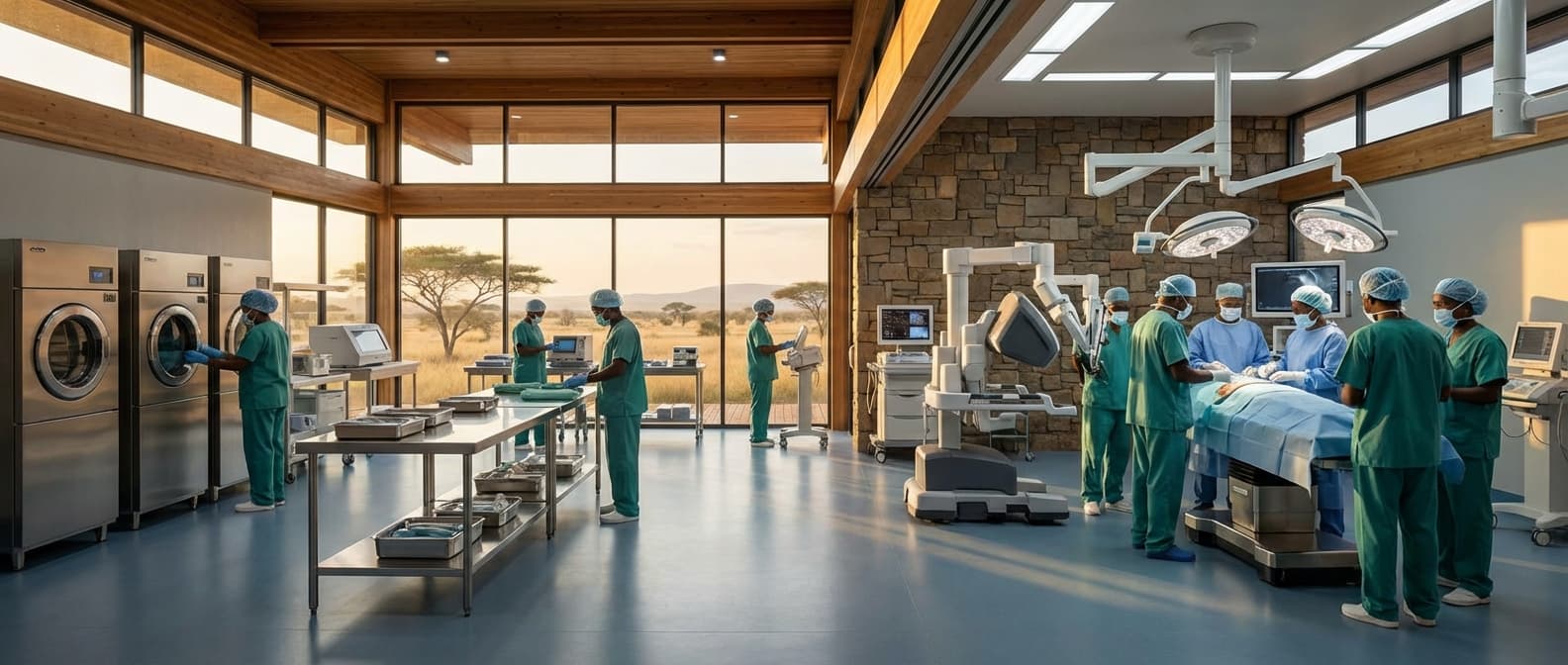
CSSD Design & Validation in Congo (Brazzaville)
Engineering Excellence & Technical Support
CSSD workflow design, validation and process development High-standard technical execution following OEM protocols and local regulatory frameworks.
Sterilization Equipment Integration & Validation
Successfully designed and validated the integration of new autoclaves and washer-disinfectors in the CSSD, ensuring compliance with ISO 13485 and local health regulations. This involved meticulous calibration, performance qualification (PQ), and operational qualification (OQ) to guarantee effective sterilization of medical instruments.
Workflow Optimization & Decontamination Protocols
Developed and implemented optimized workflow processes within the CSSD, focusing on efficient patient-to-sterile instrument turnaround times. This included the design and validation of critical decontamination protocols and staff training on best practices for biohazard handling and instrument processing to minimize infection risks.
Traceability System Implementation & Validation
Led the design and validation of a robust traceability system for all sterilized medical devices. This involved selecting and implementing barcode scanning technology and software solutions to track instruments from decontamination through to patient use, ensuring accountability and facilitating recall management if necessary.
What Is Cssd Design & Validation In Congo (Brazzaville)?
CSSD (Central Sterile Supply Department) design and validation in Brazzaville, Congo, refers to the comprehensive process of planning, constructing, equipping, and verifying the functionality and compliance of a sterile processing facility. This service is critical for healthcare institutions to ensure the safety and efficacy of medical devices and instruments through proper sterilization and supply chain management. It encompasses architectural layout, workflow optimization, selection and integration of sterilization equipment, validation of all processes, and adherence to international and national regulatory standards. The goal is to establish a robust, efficient, and contamination-controlled environment for reprocessing reusable medical items.
| Who Needs CSSD Design & Validation | Typical Use Cases | |||||
|---|---|---|---|---|---|---|
| Hospitals and Healthcare Facilities: All surgical centers, general hospitals, specialized clinics, and diagnostic laboratories that utilize reusable medical devices and instruments requiring sterilization. | New Facility Construction: Designing and validating a CSSD from the ground up for a new hospital or a major expansion project. | Renovation or Upgrade Projects: Redesigning and revalidating existing CSSD areas to improve efficiency, safety, or comply with updated regulations. | Introduction of New Technologies: Validating a CSSD when implementing new sterilization equipment or processes. | Addressing Compliance Gaps: Engaging CSSD design and validation experts to rectify issues identified during audits or inspections related to sterilization processes and facility standards. | Quality Assurance Improvement: Seeking to enhance the overall quality and reliability of sterile supply services through expert design and validation. | Establishing a Centralized Processing Hub: Designing a CSSD to serve multiple smaller healthcare facilities or clinics within a region. |
Key Aspects of CSSD Design & Validation
- Facility Design & Layout: Optimizing the physical space to support a unidirectional workflow, preventing cross-contamination between dirty, clean, and sterile areas. This includes considerations for ventilation, lighting, drainage, and material flow.
- Equipment Specification & Integration: Selecting appropriate sterilization technologies (e.g., steam autoclaves, low-temperature sterilizers, EtO sterilizers) and associated equipment (e.g., washer-disinfectors, ultrasonic cleaners, packaging systems) based on clinical needs and throughput requirements. Ensuring seamless integration and interoperability.
- Workflow Analysis & Optimization: Designing efficient operational processes for receiving, cleaning, disinfection, inspection, packaging, sterilization, storage, and distribution of sterile supplies. Minimizing manual handling and potential for errors.
- Regulatory Compliance: Ensuring adherence to relevant national and international standards and guidelines (e.g., ISO 13485, AAMI ST series, local health authority regulations) governing CSSD operations and sterile processing.
- Process Validation: Scientifically demonstrating that sterilization processes consistently achieve the intended level of microbial kill. This includes performance qualification (PQ) of equipment and routine monitoring.
- Environmental Monitoring: Establishing protocols for monitoring the sterile environment, including air quality, water quality, and surface contamination levels.
- Staff Training & Competency Assessment: Ensuring that all CSSD personnel are adequately trained in their respective roles, understand sterile processing principles, and are competent in operating equipment and following protocols.
- Quality Management System (QMS) Implementation: Developing and implementing a comprehensive QMS to govern all aspects of CSSD operations, including documentation, record-keeping, incident reporting, and continuous improvement.
Who Needs Cssd Design & Validation In Congo (Brazzaville)?
Designing and validating a Central Sterile Supply Department (CSSD) is crucial for ensuring patient safety and operational efficiency in healthcare facilities. In Congo (Brazzaville), as in any country, the need for robust CSSD practices is paramount. This includes ensuring that surgical instruments and medical devices are properly cleaned, disinfected, and sterilized to prevent healthcare-associated infections (HAIs). Proper CSSD design minimizes contamination risks, optimizes workflow, and ensures compliance with international standards.
| Customer Type | Key Departments Involved in CSSD | Specific Needs/Concerns |
|---|---|---|
| Public Hospitals | Operating Theaters, Intensive Care Units (ICUs), Emergency Rooms, Outpatient Clinics, Infection Control Department, Administration | High patient volume, limited budgets, need for reliable and cost-effective sterilization, strict adherence to national health guidelines, training for staff, ensuring equipment longevity. |
| Private Hospitals & Clinics | Operating Rooms, Maternity Wards, Endoscopy Units, Diagnostic Imaging (for sterile probes), Infection Prevention and Control, Quality Assurance | Emphasis on patient satisfaction and safety, advanced technology adoption, compliance with international accreditation standards, efficient turnaround times, space optimization, specialized sterilization needs. |
| Surgical Centers | Surgical Suites, Pre-operative Holding, Post-operative Recovery, Infection Control | Focus on outpatient surgical procedures, rapid instrument reprocessing, maintaining sterility for immediate reuse, workflow efficiency to maximize surgical slots. |
| Dental Clinics (with Sterilization) | Treatment Rooms, Sterilization Area | Reprocessing of dental instruments (handpieces, forceps, scalpels), ensuring patient safety during dental procedures, small-scale but critical sterilization needs. |
| Research Laboratories | Experimentation Areas, Sterilization Facilities | Sterilization of glassware, media, and specialized equipment for experiments, preventing contamination in research outcomes, adherence to specific lab protocols. |
Target Customers and Departments for CSSD Design & Validation in Congo (Brazzaville)
- Hospitals (Public and Private)
- Clinics and Medical Centers
- Surgical Centers
- Dental Clinics with Sterilization Needs
- Research Laboratories Requiring Sterile Equipment
Cssd Design & Validation Process In Congo (Brazzaville)
This document outlines the comprehensive workflow for the design and validation of a Central Sterile Supply Department (CSSD) in Congo (Brazzaville), from the initial inquiry to the final execution. The process emphasizes adherence to international standards and local regulations to ensure safe and efficient sterilization practices.
| Phase | Key Activities | Deliverables | Responsible Parties | Key Considerations (Congo Context) |
|---|---|---|---|---|
| 1: Inquiry & Initial Assessment | Receive inquiry from client (hospital/healthcare facility). Initial site visit to understand current infrastructure, operational capacity, and general needs. Discuss project scope, objectives, and preliminary budget. | Inquiry acknowledgement, preliminary site assessment report, project mandate. | Client, Consultant/Design Team. | Understanding of existing healthcare infrastructure challenges, potential for local partnerships, regulatory overview from Ministry of Health. |
| 2: Needs Assessment & Feasibility Study | Detailed analysis of current sterile processing workflow, patient population, surgical procedures, and anticipated future needs. Assessment of space availability, utilities (water, electricity, ventilation), and staff capacity. Conduct economic feasibility study. | Detailed needs assessment report, functional program, feasibility study report, preliminary budget. | Consultant/Design Team, Client (Clinical & Administrative Staff). | Availability and reliability of utilities, local availability of skilled labor for construction, import regulations for medical equipment, potential for specialized training programs. |
| 3: Conceptual Design & Planning | Develop preliminary layout and workflow diagrams based on functional program. Define spatial requirements for each CSSD zone (receiving, cleaning, disinfection, packing, sterilization, storage, dispatch). Identify key equipment types and their approximate locations. Develop preliminary project schedule and cost estimates. | Conceptual design drawings (floor plans, elevations), workflow diagrams, preliminary equipment list, refined budget, preliminary project schedule. | Consultant/Design Team, Architects, Engineers. | Adherence to international standards (e.g., ISO 13485, AAMI ST standards) adapted to local building codes and fire safety regulations. Consideration of disease control and infection prevention best practices. |
| 4: Detailed Design & Engineering | Produce detailed architectural, mechanical, electrical, and plumbing (MEP) drawings. Specify materials, finishes, lighting, HVAC systems, water treatment, and waste management. Prepare technical specifications for all equipment. Obtain necessary permits and approvals. | Detailed design drawings (architectural, MEP), technical specifications for equipment and materials, Bill of Quantities (BOQ), permit applications. | Consultant/Design Team, Architects, MEP Engineers, Structural Engineers. | Ensuring materials are durable and easy to clean/decontaminate. Specifying appropriate ventilation systems for negative/positive pressure zones. Sourcing reliable and maintainable utility connections. |
| 5: Procurement & Construction/Renovation | Tender process for construction/renovation services. Selection of qualified contractors. Construction or renovation of the CSSD facility according to approved detailed designs. Regular site supervision and quality control. | Construction contract, completed facility (shell and core), interim progress reports, quality control records. | Client (Procurement Department), Contractor, Consultant/Design Team (Supervision). | Engaging local contractors with experience in healthcare construction. Ensuring compliance with local labor laws and safety standards. Managing import logistics for specialized construction materials if needed. |
| 6: Equipment Installation & Commissioning | Procurement and delivery of CSSD equipment. Professional installation by manufacturers or authorized service providers. Pre-commissioning checks to ensure correct installation and functionality of individual equipment pieces. Integration testing of all systems. | Equipment delivery manifests, installation reports, pre-commissioning test results, integrated system test reports. | Equipment Suppliers/Manufacturers, Contractor, Consultant/Design Team. | Ensuring proper voltage and frequency compatibility for electrical equipment. Verifying water quality for autoclaves and washer-disinfectors. Establishing local service and maintenance agreements. |
| 7: Validation & Qualification | Performance Qualification (PQ) of all equipment and processes. This includes cycle validation for autoclaves, disinfection efficacy testing for washer-disinfectors, and environmental monitoring of storage areas. Development and implementation of Standard Operating Procedures (SOPs). | Validation protocols, test reports (IQ, OQ, PQ), validation certificates, approved SOPs, risk assessments. | Consultant/Validation Team, Client (CSSD Staff), Equipment Suppliers. | Ensuring validation protocols align with international standards and are practical for the local context. Training local staff to perform routine performance monitoring. Establishing a robust documentation system. |
| 8: Training & Handover | Comprehensive training program for CSSD staff on equipment operation, maintenance, infection control principles, and SOPs. Final handover of the facility and equipment to the client. Provision of as-built drawings and operation & maintenance manuals. | Training materials, training attendance records, certificates of completion, handover documentation, as-built drawings. | Consultant/Design Team, Equipment Suppliers, Client (CSSD Staff & Management). | Delivering training in French (or other appropriate local languages). Developing sustainable training programs for future staff. Ensuring easy access to spare parts and technical support. |
| 9: Post-Implementation Review & Optimization | Post-occupancy evaluation to assess operational efficiency, identify any bottlenecks, and gather user feedback. Implementation of corrective actions and optimization strategies to improve CSSD performance. Ongoing monitoring and quality assurance. | Post-implementation review report, optimization recommendations, updated SOPs, performance monitoring reports. | Client (CSSD Management & Staff), Consultant/Design Team (support). | Establishing a system for continuous quality improvement. Monitoring key performance indicators (KPIs) relevant to resource utilization and patient safety in the Congolese context. Facilitating ongoing professional development for CSSD personnel. |
CSSD Design & Validation Process Workflow
- Phase 1: Inquiry & Initial Assessment
- Phase 2: Needs Assessment & Feasibility Study
- Phase 3: Conceptual Design & Planning
- Phase 4: Detailed Design & Engineering
- Phase 5: Procurement & Construction/Renovation
- Phase 6: Equipment Installation & Commissioning
- Phase 7: Validation & Qualification
- Phase 8: Training & Handover
- Phase 9: Post-Implementation Review & Optimization
Cssd Design & Validation Cost In Congo (Brazzaville)
Designing and validating a Central Sterile Supply Department (CSSD) in Congo (Brazzaville) involves a complex interplay of factors influencing the overall cost. These costs can vary significantly based on the scale of the facility, the specific equipment chosen, the level of technological integration, and the expertise of the design and validation teams. It's crucial to understand that these are estimates, and obtaining detailed quotes from local and international suppliers and consultants is essential for accurate budgeting.
| Cost Component | Estimated Range (CFA Francs) | Notes |
|---|---|---|
| Architectural & Engineering Design | 5,000,000 - 25,000,000 | Dependent on project complexity and firm's reputation. |
| Basic Equipment (Washer-Disinfector, Autoclave, Packaging) | 30,000,000 - 100,000,000 | For smaller facilities or basic setups. Prices are per unit and can increase with capacity. |
| Advanced/Automated Equipment (e.g., ultrasonic cleaners, advanced sterilization systems) | 100,000,000 - 500,000,000+ | Significant variation based on brand, features, and automation level. |
| Validation Services (IQ, OQ, PQ, Process Validation) | 10,000,000 - 50,000,000 | Can be higher for complex systems or multiple validation phases. |
| Installation & Commissioning | 15,000,000 - 60,000,000 | Includes labor, materials, and basic testing. |
| Staff Training | 3,000,000 - 15,000,000 | Per training session or for a comprehensive program. |
| Infrastructure Modifications | 10,000,000 - 40,000,000 | Variable, depends on existing building condition. |
| Logistics, Import Duties & Taxes | 15,000,000 - 70,000,000+ | Highly dependent on the value and origin of imported goods. Can be a significant percentage. |
| Consulting & Regulatory Compliance | 5,000,000 - 20,000,000 | For specialized advice and ensuring adherence to standards. |
| Contingency (10-20%) | Calculated based on subtotal of other costs | Essential for unforeseen expenses. |
| Total Estimated Range (Small to Medium Facility) | 100,000,000 - 400,000,000 | This is a very broad estimate. A detailed assessment is required. |
| Total Estimated Range (Larger/Advanced Facility) | 400,000,000 - 1,500,000,000+ | Can easily exceed this for highly specialized or large-scale operations. |
Key Pricing Factors for CSSD Design & Validation in Congo (Brazzaville)
- Facility Size and Scope: The number of sterilization bays, the volume of instruments to be processed, and the overall square footage of the CSSD directly impact design complexity and material requirements.
- Equipment Selection: This is often the largest cost component. Prices vary greatly between basic manual equipment and advanced automated systems (e.g., washer-disinfectors, sterilizers, packaging machines). Brand reputation, features, and energy efficiency also play a role.
- Technology and Automation: The level of automation chosen for processes like tracking, data management, and material handling will influence upfront investment.
- Architectural and Engineering Design: Costs associated with specialized architects and engineers experienced in healthcare facility design, including space planning, workflow optimization, and compliance with relevant standards.
- Validation Services: This is a critical step ensuring the CSSD operates effectively and safely. Costs include qualification (IQ, OQ, PQ) of equipment, process validation, and documentation.
- Installation and Commissioning: Labor and material costs for installing and setting up all equipment and systems.
- Training: Providing comprehensive training to CSSD staff on equipment operation, safety protocols, and quality management.
- Regulatory Compliance and Consulting: Costs associated with ensuring the design and operation meet national and international healthcare standards and regulations. This may involve engaging specialized consultants.
- Infrastructure Requirements: Upgrades or modifications to existing building infrastructure (e.g., plumbing, electrical, ventilation) to support the CSSD's needs.
- Logistics and Import Duties: For imported equipment and materials, transportation costs and applicable import duties and taxes in Congo (Brazzaville) will be a significant factor.
- Local Labor and Expertise: Availability and cost of skilled local labor for construction, installation, and maintenance.
- Contingency: It is advisable to include a contingency fund (typically 10-20%) to cover unforeseen expenses.
Affordable Cssd Design & Validation Options
Designing and validating a Central Sterile Supply Department (CSSD) is a critical investment for any healthcare facility. While ensuring optimal functionality, safety, and compliance, it's essential to explore cost-effective solutions. This guide outlines affordable CSSD design and validation options, focusing on value bundles and smart cost-saving strategies to maximize your budget without compromising quality or regulatory adherence.
| Value Bundle Option | Description | Cost-Saving Strategy | Typical Benefits |
|---|---|---|---|
| Basic Design & Workflow Consultation | Initial consultation focusing on core CSSD layout, workflow optimization, and essential equipment selection. | Reduces the need for extensive architectural drawings and consultant fees. Focuses on practical, efficient design from the outset. | Optimized workflow, reduced processing times, improved staff efficiency, foundational for future expansion. |
| Essential Equipment Package (Washing & Sterilization) | Bundled pricing for fundamental washing disinfectors and steam sterilizers based on projected throughput. | Negotiated bulk discounts from manufacturers or distributors. Simplifies procurement process. | Reduced upfront equipment costs, faster installation, standardized maintenance requirements. |
| Core Validation & Documentation Bundle | Includes initial validation of critical equipment (sterilizers, washer-disinfectors) and essential documentation support for compliance. | Streamlined validation process, potentially by a single provider. Reduces administrative burden. | Ensured compliance with regulatory standards, reduced risk of non-compliance, faster operational readiness. |
| Modular Design & Phased Fit-Out | Design incorporating flexible, modular components allowing for future expansion and staged implementation of different CSSD zones. | Spreads capital expenditure over time. Avoids over-engineering early on. Adaptable to changing needs. | Lower initial investment, ability to scale as demand grows, minimizes disruption during fit-out. |
| Training & Competency Assessment Package | Includes initial training for CSSD staff on equipment operation, infection control protocols, and basic troubleshooting. | Empowers internal staff, reduces reliance on external trainers for routine operations. | Improved staff proficiency, enhanced safety culture, reduced operational errors. |
Key Considerations for Affordable CSSD Design & Validation
- Phased Implementation: Break down large projects into manageable phases to spread costs and allow for incremental improvements. This can include prioritizing essential areas like sterile processing first.
- Modular Design: Opt for modular CSSD layouts that can be adapted and expanded as needs change. This offers flexibility and avoids costly overhauls.
- Standardized Equipment: Select widely adopted and well-supported equipment models. This often leads to better pricing, readily available parts, and a larger pool of trained technicians for maintenance and repair.
- Prioritize Essential Validation: Focus validation efforts on critical processes and equipment directly impacting patient safety. Risk assessment can help identify these areas.
- Leverage Existing Infrastructure: Where possible, integrate new CSSD components with existing building utilities and spaces to minimize new construction costs.
- Consider Refurbished Equipment (with caution): High-quality, refurbished sterilization and washing equipment can offer significant savings. Ensure thorough inspection, testing, and warranty coverage.
- Outsourced Validation Services: Partner with specialized validation companies that offer competitive rates for comprehensive validation packages.
- Internal Training & Competency: Invest in training your internal staff for routine validation tasks and maintenance. This reduces reliance on external contractors for ongoing needs.
- Thorough Needs Assessment: Conduct a detailed analysis of your facility's current and future sterilization needs to avoid unnecessary equipment or space.
- Collaborative Purchasing: Explore opportunities for group purchasing or collaborations with other facilities to negotiate better prices on equipment and supplies.
Verified Providers In Congo (Brazzaville)
Finding reliable and trustworthy healthcare providers is paramount in any region. In Congo (Brazzaville), navigating the healthcare landscape can be challenging. This is where verified providers, particularly those with Franance Health credentials, emerge as the superior choice. Franance Health's rigorous vetting process ensures that its partner providers meet the highest standards of medical expertise, ethical practice, and patient care. Their credentialing signifies a commitment to quality that directly benefits patients seeking effective and safe medical services.
| Provider Characteristic | Franance Health Verified | Standard Provider (Unverified) |
|---|---|---|
| Medical Licensing and Qualifications | Thoroughly verified and current | May vary; difficult to independently confirm |
| Professional Experience | Verified and relevant to their specialty | Information may be anecdotal or unverified |
| Adherence to Ethical Standards | Confirmed through background checks and references | Difficult to ascertain without formal verification |
| Patient Care Standards | Meets or exceeds established benchmarks | Can be inconsistent |
| Reputation and References | Positive and verified feedback | May be based on informal opinions |
| Commitment to Continuous Improvement | Often a requirement for credential renewal | Not guaranteed |
Why Franance Health Credentials Matter:
- Rigorous Vetting: Franance Health employs a comprehensive evaluation process that scrutinizes medical licenses, qualifications, experience, and adherence to ethical guidelines.
- Quality Assurance: The credentialing process acts as an ongoing quality assurance mechanism, ensuring that providers maintain their high standards over time.
- Patient Safety: By partnering with Franance Health, patients gain access to providers who have demonstrated a commitment to patient safety and best practices.
- Trust and Transparency: Franance Health's verified network provides a level of trust and transparency that is often difficult to find independently.
- Access to Expertise: Their network includes a diverse range of specialists, ensuring patients can find the right expertise for their specific health needs.
- Improved Health Outcomes: Choosing a Franance Health-credentialed provider increases the likelihood of receiving accurate diagnoses, effective treatments, and ultimately, better health outcomes.
Scope Of Work For Cssd Design & Validation
This document outlines the Scope of Work (SOW) for the design and validation of a Central Sterile Supply Department (CSSD). It details the technical deliverables and standard specifications required for a successful project, ensuring compliance with international best practices and regulatory requirements. The SOW encompasses all phases from initial conceptualization and detailed design to equipment selection, installation, commissioning, and validation. The primary objective is to establish a CSSD that guarantees the safe and effective reprocessing of medical devices, thereby minimizing the risk of healthcare-associated infections.
| Parameter | Standard/Specification | Description |
|---|---|---|
| Room Layout & Zoning | ISO 13485:2016, AAMI ST79 | Segregation of clean and dirty areas, airflow control (positive/negative pressure), and traffic flow to prevent cross-contamination. |
| Airflow & Ventilation (HVAC) | ASHRAE 170, HTM 03-01 | Controlled air changes per hour (ACH), temperature, humidity, and HEPA filtration in critical areas. |
| Water Quality | AAMI TIR34, EN 285 | Purified water for cleaning and disinfection, with defined resistivity and microbial counts. |
| Lighting | Relevant national/international standards for healthcare facilities | Adequate illumination levels for detailed inspection and assembly. |
| Materials of Construction | FDA-approved, non-porous, and easily cleanable surfaces | Durable, corrosion-resistant materials for walls, floors, ceilings, and work surfaces. |
| Equipment Performance | Manufacturer's specifications, relevant EN/ISO standards (e.g., EN 15883 for washer-disinfectors, EN 285 for steam sterilizers) | Verification of specified performance parameters (e.g., temperature, pressure, cycle times, drying efficiency). |
| Sterilization Validation | ISO 11135 (Ethylene Oxide), ISO 17665 (Steam), ISO 11137 (Radiation) | Demonstration that sterilization processes consistently achieve the required Sterility Assurance Level (SAL). |
| Cleaning Validation | AAMI ST79, national guidelines | Verification of effective removal of soil, debris, and organic matter prior to sterilization. |
| Biological Indicators (BIs) | ISO 11138 series | Use of appropriate BIs for sterilization monitoring and validation. |
| Chemical Indicators (CIs) | ISO 11140 series | Use of appropriate CIs for process monitoring during sterilization. |
| Tracking & Traceability | Industry best practices, potential for integrated IT solutions | System for tracking instruments from point of use to sterile storage. |
| Waste Management | Local environmental regulations | Safe and compliant disposal of medical waste. |
Key Technical Deliverables
- Conceptual Design Report & Space Planning
- Detailed Architectural & Engineering Drawings (including HVAC, electrical, plumbing)
- Equipment Specifications & Selection Criteria
- Workflow & Process Flow Diagrams
- Validation Master Plan (VMP)
- Installation Qualification (IQ) Protocols & Reports
- Operational Qualification (OQ) Protocols & Reports
- Performance Qualification (PQ) Protocols & Reports
- Standard Operating Procedures (SOPs) for CSSD Operations
- Staff Training Manuals & Programs
- Risk Assessment Reports (e.g., FMEA for processes and equipment)
- Material & Equipment Procurement List
- Commissioning & Handover Documentation
Service Level Agreement For Cssd Design & Validation
This Service Level Agreement (SLA) outlines the expected response times and uptime guarantees for the CSSD (Central Sterile Supply Department) Design & Validation services. It is intended to ensure consistent and reliable performance, supporting the critical operations of sterile processing.
| Service Component | Severity Level | Response Time Target | Resolution Time Target | Uptime Guarantee |
|---|---|---|---|---|
| Design Consultation & Planning | Standard Inquiry | 2 Business Hours | 3 Business Days | 99.5% |
| Design Consultation & Planning | Urgent Requirement (e.g., critical project delay) | 1 Business Hour | 1 Business Day | 99.5% |
| Validation Protocol Development | Standard Request | 4 Business Hours | 5 Business Days | 99.5% |
| Validation Protocol Development | Expedited Request (e.g., regulatory audit imminent) | 2 Business Hours | 2 Business Days | 99.5% |
| Validation Execution Support | Live Validation Session Issue | 30 Minutes | 1 Business Hour | 99.8% |
| Validation Execution Support | Data Analysis & Reporting | 8 Business Hours | 3 Business Days | 99.5% |
| Documentation Review & Approval | Standard Submission | 24 Business Hours | 5 Business Days | 99.5% |
| Technical Support & Troubleshooting | Critical System Failure (impacting validation completion) | 1 Business Hour | 4 Business Hours | 99.8% |
| Technical Support & Troubleshooting | Non-Critical Issue (e.g., minor software bug) | 4 Business Hours | 2 Business Days | 99.5% |
Key Performance Indicators (KPIs)
- Response Time: The maximum time allowed for the service provider to acknowledge and begin addressing a reported issue or request.
- Resolution Time: The maximum time allowed to resolve a reported issue or fulfill a request, categorized by severity.
- Uptime Guarantee: The minimum percentage of time the CSSD Design & Validation services are expected to be operational and accessible.
- Availability: Refers to the accessibility and functionality of the CSSD Design & Validation services as defined in this SLA.
Frequently Asked Questions

Ready when you are
Let's scope your CSSD Design & Validation in Congo (Brazzaville) project in Congo (Brazzaville).

Scaling healthcare logistics and technical systems across the entire continent.