
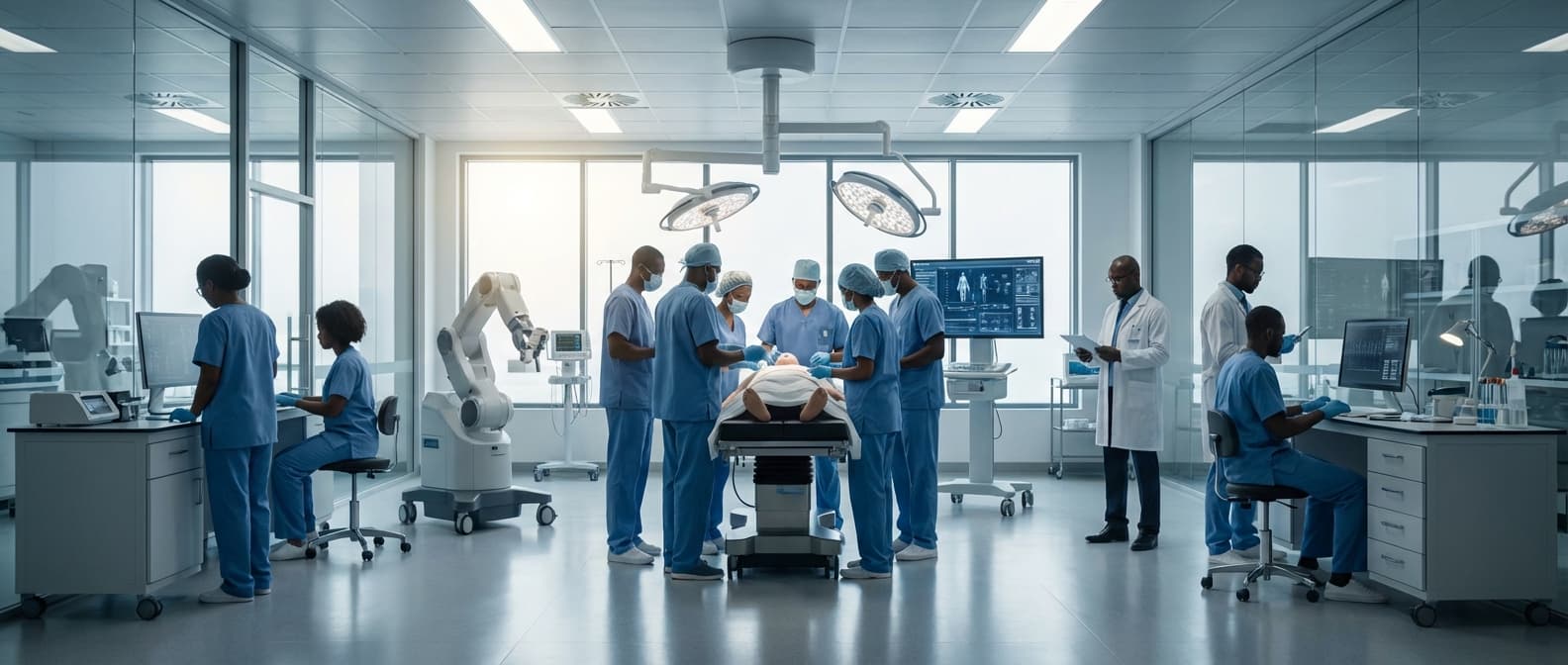
Managed Equipment Service (MES) in Congo (Brazzaville)
Engineering Excellence & Technical Support
Long‑term equipment provision with uptime SLAs and lifecycle management. High-standard technical execution following OEM protocols and local regulatory frameworks.
IoT-Enabled Predictive Maintenance for Critical Healthcare Equipment
Implemented a cutting-edge IoT sensor network and cloud-based analytics platform for real-time monitoring of vital medical equipment (e.g., ventilators, incubators) in Brazzaville's healthcare facilities. This allows for proactive identification of potential failures, reducing critical downtime and ensuring continuity of patient care even in remote areas.
Remote Diagnostics and Troubleshooting of Advanced Medical Imaging Systems
Deployed a secure remote access and diagnostic solution for complex medical imaging systems (e.g., CT scanners, MRI machines). Our MES technicians can now perform initial troubleshooting and software updates remotely, significantly reducing the need for on-site visits and accelerating repair times for essential diagnostic tools across Congo.
Optimized Spare Parts Management and Supply Chain Resilience for Medical Devices
Developed a robust and localized spare parts inventory and logistics system tailored for the unique challenges of Congo (Brazzaville). By leveraging predictive demand forecasting and strategic local warehousing, we ensure rapid availability of critical components for medical equipment, minimizing lead times and enhancing the overall resilience of healthcare service delivery.
What Is Managed Equipment Service (Mes) In Congo (Brazzaville)?
Managed Equipment Service (MES) in Congo (Brazzaville) refers to a comprehensive outsourcing model wherein a third-party provider assumes responsibility for the acquisition, installation, maintenance, and lifecycle management of critical medical equipment for healthcare facilities. This service aims to optimize equipment utilization, reduce operational costs, ensure technological relevance, and enhance overall service quality within the healthcare sector.
| Who Needs MES? | Typical Use Cases | ||||
|---|---|---|---|---|---|
| Public Hospitals and Clinics: Government-funded healthcare institutions often face budget constraints and require reliable, cost-effective access to advanced medical technology. | Private Healthcare Providers: Clinics and hospitals seeking to enhance their service offerings, ensure equipment reliability, and offload the complexities of equipment management. | Non-Governmental Organizations (NGOs) and Humanitarian Organizations: Entities operating in remote or challenging environments who need robust and well-maintained medical equipment for their programs. | Diagnostic Laboratories: Facilities requiring specialized equipment for accurate and efficient diagnostic testing. | Specialized Medical Centers: Institutions focusing on specific medical fields (e.g., cardiology, oncology) that need sophisticated and continuously updated equipment. | |
| Radiology Departments: Management of X-ray machines, CT scanners, MRI units, and ultrasound devices. | Surgical Suites: Provision and maintenance of surgical instruments, anesthesia machines, patient monitors, and operating room lights. | Intensive Care Units (ICUs): Ensuring the availability and functionality of ventilators, defibrillators, infusion pumps, and vital signs monitors. | Laboratories: Management of diagnostic analyzers, microscopes, and other laboratory instrumentation. | Emergency Medical Services (EMS): Equipping ambulances and emergency response units with reliable medical devices. | Primary Healthcare Facilities: Ensuring access to essential diagnostic and treatment equipment for basic medical services. |
MES in Congo (Brazzaville) Involves:
- Equipment Sourcing and Procurement: Identifying, selecting, and acquiring medical devices based on the specific needs and technological advancements relevant to the Congolese healthcare context.
- Installation and Commissioning: Expert setup and validation of equipment to ensure operational readiness and adherence to regulatory standards.
- Preventive and Corrective Maintenance: Proactive servicing to minimize downtime and reactive repairs to address equipment failures promptly.
- Calibration and Validation: Regular adjustments and testing to maintain accuracy and performance specifications.
- Training and Skill Development: Providing comprehensive training to local healthcare professionals on the operation and basic maintenance of the equipment.
- Asset Management and Tracking: Comprehensive inventory management, including tracking equipment location, utilization, and maintenance history.
- Technology Refresh and Upgrades: Planning and executing the replacement or upgrade of aging or obsolete equipment to ensure access to current medical technologies.
- Consumables Management: In some MES models, the provision and management of associated consumables can also be included.
- Performance Monitoring and Reporting: Continuous tracking of equipment performance, uptime, and cost-effectiveness, with regular reporting to the client.
Who Needs Managed Equipment Service (Mes) In Congo (Brazzaville)?
Managed Equipment Service (MES) in Congo (Brazzaville) offers a comprehensive solution for organizations relying on critical equipment. Instead of managing procurement, maintenance, and upgrades in-house, businesses can outsource these responsibilities to a specialized MES provider. This allows them to focus on their core operations, reduce capital expenditure, and ensure equipment reliability and technological advancement. The demand for MES is particularly high in sectors where equipment is central to service delivery, innovation, and operational efficiency. Key target customers include large enterprises with complex technological needs, organizations undergoing digital transformation, and those seeking to optimize their operational costs and gain access to cutting-edge technology without significant upfront investment.
| Target Customer Segment | Key Departments Benefiting from MES |
|---|---|
| Healthcare | Radiology, Pathology, Surgery, IT, Facilities Management |
| Industrial Manufacturing | Production, Maintenance, Engineering, IT, Supply Chain |
| Telecommunications | Network Operations, Data Center Management, IT Infrastructure, Field Services |
| Mining and Extractive Industries | Operations, Maintenance, Engineering, Health & Safety, IT |
| Energy and Utilities | Operations, Maintenance, Engineering, IT, Safety & Compliance |
| Large Commercial Enterprises | IT, Operations, Facilities Management, Procurement |
| Government and Public Sector | IT, Defense, Research & Development, Infrastructure Management, Procurement |
Target Customers and Departments for MES in Congo (Brazzaville)
- Healthcare Sector: Hospitals, clinics, and diagnostic centers that require advanced medical imaging equipment, laboratory instruments, and patient monitoring systems.
- Industrial Manufacturing: Factories and production facilities reliant on heavy machinery, specialized assembly lines, and sophisticated automation systems.
- Telecommunications: Companies operating extensive network infrastructure, data centers, and communication equipment requiring constant upgrades and maintenance.
- Mining and Extractive Industries: Operations that depend on heavy-duty vehicles, specialized drilling equipment, and sophisticated processing machinery.
- Energy and Utilities: Power generation plants, water treatment facilities, and oil and gas operations requiring reliable and high-performance equipment.
- Large Commercial Enterprises: Businesses with significant IT infrastructure, including servers, networking equipment, and end-user devices.
- Government and Public Sector: Agencies with needs for specialized equipment in areas like defense, research, and infrastructure management.
Managed Equipment Service (Mes) Process In Congo (Brazzaville)
The Managed Equipment Service (MES) process in Congo (Brazzaville) is a comprehensive workflow designed to provide healthcare facilities with advanced medical equipment and ongoing support. This process, often initiated by a government health ministry, a large hospital group, or a regional health authority, aims to improve healthcare delivery by ensuring access to reliable, state-of-the-art medical technology. The workflow typically begins with an initial inquiry and culminates in the full execution and ongoing management of the service.
| Stage | Key Activities | Responsible Parties | Key Deliverables |
|---|---|---|---|
| Inquiry & Needs Assessment | Initial request, site visits, requirement gathering, feasibility studies | Healthcare Facility/Ministry of Health, MES Provider | Needs assessment report, technical specifications |
| Proposal Development & Submission | Equipment selection, service model design, financial modeling, proposal writing | MES Provider | Comprehensive MES proposal |
| Tendering & Evaluation | RFP issuance, bid submission, technical & financial evaluation, due diligence | Healthcare Facility/Ministry of Health, Tender Committee, MES Provider (bidders) | Evaluation report, shortlisted providers |
| Contract Negotiation & Award | SLA finalization, pricing negotiation, legal review, contract signing | Healthcare Facility/Ministry of Health, MES Provider | Signed MES contract |
| Procurement & Logistics | Equipment ordering, manufacturing oversight, shipping, customs, inland transport | MES Provider, Manufacturers, Logistics Partners | Delivered and cleared equipment |
| Installation & Commissioning | Site preparation, equipment installation, calibration, testing, handover | MES Provider (Technicians), Healthcare Facility (support staff) | Fully functional and commissioned equipment |
| Training & Capacity Building | User training, maintenance training, refresher courses | MES Provider (Trainers), Healthcare Facility (Staff) | Trained personnel, training records |
| Ongoing Service & Maintenance | Preventive maintenance, corrective repairs, spare parts management, remote monitoring | MES Provider (Service Engineers), Healthcare Facility (reporting issues) | High equipment uptime, timely repairs, availability of parts |
| Performance Monitoring & Reporting | Data collection, performance analysis, report generation, review meetings | MES Provider, Healthcare Facility/Ministry of Health | Regular performance reports, compliance audits |
| Lifecycle Management & Upgrade | Equipment assessment, technology evaluation, upgrade/replacement planning | MES Provider, Healthcare Facility/Ministry of Health | Updated equipment inventory, lifecycle plans |
Key Stages of the MES Process in Congo (Brazzaville)
- Inquiry and Needs Assessment: The process commences with a formal expression of interest or request from a healthcare entity (e.g., Ministry of Health, hospital). This is followed by a detailed assessment to understand the specific medical needs, existing infrastructure, patient demographics, and budgetary constraints. Specialists conduct site visits and consultations to gather precise requirements.
- Proposal Development and Submission: Based on the needs assessment, MES providers develop tailored proposals. These proposals outline the recommended equipment, service levels, implementation plan, training programs, maintenance schedules, spare parts management, and financial models (e.g., payment structures, financing options). The proposal is then submitted for evaluation.
- Tendering and Evaluation: The MES proposal typically undergoes a rigorous tendering process. This may involve public tenders, requests for proposals (RFPs), or negotiated procurement depending on the institutional framework and procurement regulations in Congo. Evaluating committees, often composed of technical experts, financial analysts, and legal advisors, assess proposals based on technical merit, financial viability, and compliance with national regulations.
- Contract Negotiation and Award: Once a preferred provider is identified, extensive contract negotiations take place. This stage involves finalizing all terms and conditions, including service level agreements (SLAs), performance metrics, payment schedules, warranties, intellectual property rights, and exit clauses. Upon successful negotiation, the contract is awarded.
- Procurement and Logistics: Following contract signing, the MES provider initiates the procurement of the agreed-upon equipment from international manufacturers. This involves managing international shipping, customs clearance, and inland transportation to the designated healthcare facilities in Congo. Careful logistical planning is crucial to avoid delays and ensure secure delivery.
- Installation and Commissioning: Once the equipment arrives, skilled technicians perform the installation and rigorous commissioning. This ensures that all equipment functions according to manufacturer specifications and is ready for clinical use. Site preparation and integration with existing infrastructure are also critical components of this stage.
- Training and Capacity Building: A vital aspect of MES is empowering local healthcare professionals. Comprehensive training programs are delivered to doctors, nurses, technicians, and support staff on the operation, maintenance, and troubleshooting of the new equipment. This builds local capacity and ensures sustainable use.
- Ongoing Service and Maintenance: This is the core of the MES. The provider is responsible for all scheduled preventive maintenance, corrective repairs, and the supply of spare parts. This often includes remote monitoring of equipment performance and proactive interventions to minimize downtime. Service level agreements define response times and availability targets.
- Performance Monitoring and Reporting: Regular performance reports are generated, detailing equipment uptime, service response times, training delivered, and overall adherence to the SLA. These reports are shared with the healthcare facility and relevant government bodies to ensure accountability and continuous improvement.
- Equipment Lifecycle Management and Upgrade: MES contracts typically cover the entire lifecycle of the equipment. This may include periodic upgrades or replacements of older technology to ensure that healthcare facilities continue to benefit from the latest advancements. End-of-life disposal is also managed responsibly.
Managed Equipment Service (Mes) Cost In Congo (Brazzaville)
Managed Equipment Service (MES) for medical equipment in Congo (Brazzaville) is a complex service with pricing influenced by a multitude of factors. These services typically involve a third-party provider taking responsibility for the procurement, installation, maintenance, repair, and eventual replacement of medical equipment for a healthcare facility. The goal is to ensure optimal equipment uptime and performance while allowing the facility to focus on patient care. Pricing is usually structured as a recurring fee (monthly, quarterly, or annually) and is highly customized to the specific needs and scope of the agreement. Understanding these pricing factors is crucial for healthcare institutions seeking to budget and procure MES effectively.
| Equipment Category | Estimated Monthly MES Cost Range (XAF) | Notes |
|---|---|---|
| Basic Diagnostic Equipment (e.g., Digital X-ray, Ultrasound) | 500,000 - 2,000,000 | Covers routine maintenance, minor repairs, and parts. Volume dependent. |
| Intermediate Imaging Equipment (e.g., CT Scanner) | 2,000,000 - 8,000,000 | Includes comprehensive preventive maintenance, scheduled service, and critical component coverage. Higher uptime guarantees increase cost. |
| Advanced Imaging Equipment (e.g., MRI Scanner) | 5,000,000 - 20,000,000+ | Significant costs due to complex technology, specialized technicians, and high-value parts. Full lifecycle management with upgrade options. |
| Surgical & Anesthesia Equipment (e.g., Ventilators, Anesthesia Machines) | 800,000 - 4,000,000 | Focus on patient safety, requires regular calibration and testing. Service contracts can be bundled. |
| Laboratory Equipment (e.g., Analyzers, Microscopes) | 300,000 - 1,500,000 | Dependent on the complexity of the analyzers and the volume of tests. Reagent management might be included. |
| General Hospital Furniture & Non-Clinical Equipment | Negotiable (often per item or bundled) | Typically less complex, pricing focuses on repair and replacement rates. May not be standard MES. |
Key Pricing Factors for MES in Congo (Brazzaville)
- Type and Volume of Equipment: The sheer number and sophistication of the medical devices covered under the MES agreement are primary drivers of cost. More specialized and higher-value equipment (e.g., MRI machines, CT scanners) will naturally incur higher service fees than basic diagnostic tools.
- Service Level Agreements (SLAs): The guaranteed uptime, response times for repairs, and preventive maintenance schedules defined in the SLA directly impact pricing. More stringent SLAs with faster response times and higher uptime guarantees will command higher fees.
- Scope of Services: MES can encompass a wide range of services, from basic preventive maintenance and repairs to full lifecycle management, including training, calibration, consumables, and even equipment upgrades or replacements. A broader scope increases the overall cost.
- Age and Condition of Existing Equipment: If the MES provider is taking over existing equipment, its age and current condition will influence the initial assessment and the projected maintenance costs. Older or poorly maintained equipment might require more extensive and costly initial interventions.
- Provider's Overhead and Profit Margin: Local and international MES providers will factor in their operational costs, including staff salaries, logistics, administrative expenses, and their desired profit margin.
- Geographical Location and Accessibility: While Congo (Brazzaville) is the general location, the specific accessibility of the healthcare facility within the country can affect logistics costs for technicians and spare parts. Remote or challenging locations might lead to higher fees.
- Import Duties and Taxes: For any new equipment procured or spare parts imported by the MES provider, applicable import duties and taxes in Congo (Brazzaville) will be factored into the overall cost.
- Currency Exchange Rate Fluctuations: If contracts are denominated in foreign currency, fluctuations in the exchange rate between the local currency (CFA Franc) and the base currency can impact the cost in local terms.
- Training and Skill Development: The MES agreement might include training for local healthcare staff on operating and basic troubleshooting of the equipment, adding to the service cost.
- Technology Advancement and Obsolescence Management: MES providers often factor in the need to manage technological obsolescence, ensuring that equipment is upgraded or replaced before it becomes outdated and unsupported, which can influence long-term pricing strategies.
Affordable Managed Equipment Service (Mes) Options
Securing reliable and efficient managed equipment services (MES) doesn't have to break the bank. By understanding value bundles and implementing strategic cost-saving measures, organizations can significantly reduce their MES expenditure while maintaining high service levels. This guide explores these options, offering a clear path to affordable MES solutions.
| Strategy/Bundle Type | Description | Potential Cost-Saving Impact | Considerations |
|---|---|---|---|
| Comprehensive Value Bundle | All-inclusive package covering maintenance, repairs, and potentially software updates. | High (predictable costs, potential discounts) | Ensure all included services are genuinely needed; negotiate scope. |
| Basic Maintenance Bundle | Focuses on routine checks and scheduled preventative maintenance. | Medium (lower upfront cost than comprehensive) | May require separate arrangements for unexpected breakdowns. |
| Long-Term Contract Negotiation | Committing to MES services for multiple years. | High (discounted rates, price stability) | Requires careful contract review and assurance of service continuity. |
| Tiered Service Level Selection | Choosing a service level (e.g., response time, coverage) that matches actual needs. | High (tailored spending, avoids overpaying for unneeded services) | Accurate assessment of criticality and downtime impact is crucial. |
| Predictive Maintenance Integration | Using data analytics to anticipate and prevent equipment failures. | High (reduced emergency repairs, minimized downtime) | May require initial investment in sensors or software; assess ROI. |
Understanding Value Bundles and Cost-Saving Strategies
- Value Bundles: Instead of purchasing individual services, MES providers often offer bundled packages. These bundles typically combine essential services like routine maintenance, preventative care, emergency repairs, and sometimes even remote monitoring or software updates into a single, predictable fee. The advantage of bundles lies in economies of scale and often preferential pricing compared to à la carte services. Bundles can be tailored to specific equipment types, usage levels, or criticality, ensuring you only pay for what you truly need.
- Cost-Saving Strategies: Beyond choosing the right bundle, several strategies can further optimize MES costs:
- Negotiate Long-Term Contracts: Longer contract terms often come with discounted rates. Providers are more willing to offer concessions for guaranteed business over an extended period. Ensure the contract includes clear service level agreements (SLAs) to protect your interests.
- Tiered Service Levels: MES providers often offer different tiers of service (e.g., standard, premium, platinum). Carefully assess your actual needs. Do you require 24/7 on-site support for all equipment, or would a response time of 4-8 business hours suffice for less critical assets? Opting for a lower, but still adequate, service tier can lead to substantial savings.
- Predictive Maintenance Focus: While preventative maintenance is standard, embracing predictive maintenance (using sensors and data analytics to anticipate failures) can be more cost-effective in the long run. It minimizes unexpected downtime and costly emergency repairs, often included in higher-tier bundles or as an add-on that pays for itself.
- Leverage Remote Monitoring and Diagnostics: When available and applicable, remote capabilities can reduce the need for on-site technician visits, especially for routine checks and minor troubleshooting. This can be a significant cost-saver if integrated into your chosen MES plan.
- Consolidate Vendors: If you have multiple MES contracts with different providers for various equipment types, explore consolidating them with a single vendor. This can lead to volume discounts, simplified management, and stronger negotiating power.
- Performance-Based Contracts: Some advanced MES arrangements allow for payment structures tied to equipment uptime or performance metrics. While this can be complex, it directly aligns the provider's incentives with your operational success, potentially leading to cost efficiencies if they deliver exceptional service.
- Regular Performance Reviews: Don't just sign and forget. Schedule regular reviews with your MES provider to assess performance against SLAs, identify areas for improvement, and ensure the services are still meeting your evolving needs. This can uncover opportunities for renegotiation or adjustments to the service package.
- In-House Expertise for Simple Tasks: If your internal team has the capacity and expertise for basic maintenance or troubleshooting tasks, discuss with your MES provider if these can be excluded from the contract to reduce costs. This requires a careful balance to avoid impacting overall equipment reliability.
Verified Providers In Congo (Brazzaville)
In the Democratic Republic of Congo (Brazzaville), navigating the healthcare landscape can be challenging. Ensuring you have access to verified, high-quality medical services is paramount. Franance Health stands out as a premier choice for reliable and credentialed healthcare providers in the region. Their commitment to rigorous vetting processes guarantees that their network comprises experienced professionals adhering to international standards.
| Credential/Aspect | Franance Health's Commitment | Benefit to Patients |
|---|---|---|
| Medical Licenses & Certifications | Verified for all affiliated practitioners. | Ensures practitioners meet legal and professional requirements. |
| Professional Experience | Thorough review of past practice and areas of expertise. | Connects patients with experienced doctors for their specific needs. |
| Reputation & Patient Feedback | Monitored and considered during the vetting process. | Prioritizes providers with positive patient experiences and ethical conduct. |
| Adherence to Standards | Ensures providers follow recognized medical protocols and best practices. | Promotes safe and effective medical treatments. |
| Specialty Expertise | Maintains a network of specialists across various medical fields. | Provides access to specialized care without the need for extensive searching. |
Why Franance Health is Your Best Choice in Congo (Brazzaville)
- Extensive Network: Franance Health partners with a wide array of reputable doctors, specialists, and healthcare facilities across Congo (Brazzaville).
- Rigorous Vetting: Every provider within the Franance Health network undergoes a thorough credentialing process, verifying their qualifications, licenses, and experience.
- Quality Assurance: Franance Health is dedicated to maintaining the highest standards of medical care, ensuring patient safety and optimal outcomes.
- Accessibility: They facilitate easier access to specialized medical services, reducing the burden on patients seeking quality healthcare.
- Peace of Mind: By choosing Franance Health, you gain the assurance that you are receiving care from trusted and verified professionals.
Scope Of Work For Managed Equipment Service (Mes)
This document outlines the Scope of Work (SOW) for a Managed Equipment Service (MES) contract. It details the technical deliverables expected from the MES provider and establishes the standard specifications for their performance and the equipment under management.
| Category | Technical Deliverables | Standard Specifications |
|---|---|---|
| Equipment Inventory & Management | Comprehensive and accurate inventory of all managed equipment, including serial numbers, model numbers, purchase dates, warranty information, and location. | Real-time, auditable inventory system accessible to the client. Inventory accuracy to be maintained at 98% or higher. Regular (e.g., quarterly) reconciliation of inventory. |
| Preventive Maintenance (PM) | Execution of manufacturer-recommended and/or best-practice preventive maintenance schedules for all managed equipment. | PM completion rate of 100% within scheduled windows. All PMs to be documented in the service management system with detailed reports including tests performed, parts replaced, and technician findings. PM compliance metrics to be reported monthly. |
| Corrective Maintenance & Repair | Rapid response and resolution of equipment failures and malfunctions. | Defined response times based on equipment criticality (e.g., Tier 1: 2 hours, Tier 2: 4 hours, Tier 3: 8 hours for critical equipment). Repair completion within defined timeframes (e.g., 95% of critical repairs completed within 24 hours). Use of OEM or equivalent quality parts. Post-repair validation and functional testing. |
| Equipment Performance Monitoring | Proactive monitoring of equipment performance to identify potential issues before they lead to failure. | Implementation of remote monitoring tools where applicable. Regular performance analysis and reporting on key metrics (e.g., uptime, failure rates, Mean Time Between Failures - MTBF). Proactive alerts for critical deviations. |
| Calibration & Certification | Ensuring all applicable equipment is calibrated and certified according to relevant standards and regulations. | Calibration to be performed by certified technicians using traceable standards. Certification documentation to be provided for all calibrated equipment. Calibration due dates to be managed and communicated in advance. |
| Parts Management & Logistics | Procurement, stocking, and management of spare parts for managed equipment. | Maintenance of an adequate stock of critical spare parts to meet repair time SLAs. Just-in-time delivery for non-critical parts. Inventory of spare parts to be tracked and managed within the service management system. Parts quality to meet OEM specifications. |
| Service Management System (SMS) | Provision and management of a robust Service Management System for tracking all service activities, including PMs, repairs, inventory, and reporting. | System to be accessible to authorized client personnel. Comprehensive reporting capabilities for all aspects of the MES. Data security and privacy to be maintained according to industry best practices and relevant regulations (e.g., HIPAA). |
| Reporting & Analytics | Regular and ad-hoc reporting on equipment performance, service activities, costs, and trends. | Monthly and quarterly performance reports including KPIs such as uptime, PM compliance, repair turnaround time, and cost analysis. Annual strategic review and trend analysis reports. Reports to be clear, concise, and actionable. |
| Technology Lifecycle Management | Advisory services on equipment obsolescence, upgrades, and replacements. | Proactive identification of equipment nearing end-of-life. Recommendations for upgrades or replacements based on clinical needs, technological advancements, and cost-effectiveness. Support for decommissioning and disposal of obsolete equipment. |
| Staff Training & Competency | Training for client clinical staff on the proper use and basic troubleshooting of managed equipment. | Development and delivery of training programs tailored to specific equipment and user groups. Competency assessments to be conducted. Training records to be maintained. |
| Regulatory Compliance & Safety | Ensuring all managed equipment meets current regulatory requirements (e.g., FDA, local health authorities) and safety standards. | Adherence to all relevant medical device regulations. Regular safety inspections. Documentation of compliance activities. Immediate reporting of any safety concerns or incidents. |
| Asset Utilization Analysis | Analysis of equipment usage patterns to identify under- or over-utilized assets. | Regular reports on equipment utilization metrics. Recommendations for optimizing asset deployment and reducing unnecessary capital expenditure. |
Key Objectives of the MES:
- Ensure optimal performance and availability of all managed medical equipment.
- Minimize downtime and associated clinical impact.
- Control and reduce total cost of ownership for medical equipment.
- Provide a comprehensive and proactive maintenance strategy.
- Ensure regulatory compliance and adherence to safety standards.
- Facilitate technology lifecycle management and strategic planning.
Service Level Agreement For Managed Equipment Service (Mes)
This Service Level Agreement (SLA) outlines the agreed-upon service levels for the Managed Equipment Service (MES), focusing on response times for incidents and guaranteed uptime for the provided equipment. This document is intended to ensure the consistent and reliable operation of the MES, meeting the operational needs of the Client.
| Service Component | Severity Level | Response Time Target | Resolution Time Target (Best Effort) | Uptime Guarantee |
|---|---|---|---|---|
| Managed Equipment Service (MES) | Critical (System Failure, Complete Outage) | 1 Hour | 4 Business Hours | 99.9% |
| Managed Equipment Service (MES) | High (Significant performance degradation, partial outage affecting core functions) | 2 Business Hours | 8 Business Hours | 99.5% |
| Managed Equipment Service (MES) | Medium (Minor performance degradation, non-critical function impaired) | 4 Business Hours | 24 Business Hours | 99.0% |
| Managed Equipment Service (MES) | Low (Cosmetic issues, non-impactful functional errors) | 8 Business Hours | 48 Business Hours | 98.5% |
Key Definitions
- Client: The entity receiving the Managed Equipment Service.
- Provider: The entity providing the Managed Equipment Service.
- Equipment: The specific hardware and associated software covered under this MES.
- Incident: Any event that causes or may cause an interruption to the normal operation of the Equipment, or a degradation of its performance.
- Downtime: The cumulative period during which the Equipment is not available for use due to an Incident.
- Response Time: The maximum time allowed for the Provider to acknowledge an Incident and begin investigation.
- Resolution Time: The maximum time allowed for the Provider to resolve an Incident and restore normal operation of the Equipment.
- Uptime Guarantee: The minimum percentage of time the Equipment is expected to be operational and available for use.
Frequently Asked Questions

Ready when you are
Let's scope your Managed Equipment Service (MES) in Congo (Brazzaville) project in Congo (Brazzaville).

Scaling healthcare logistics and technical systems across the entire continent.