
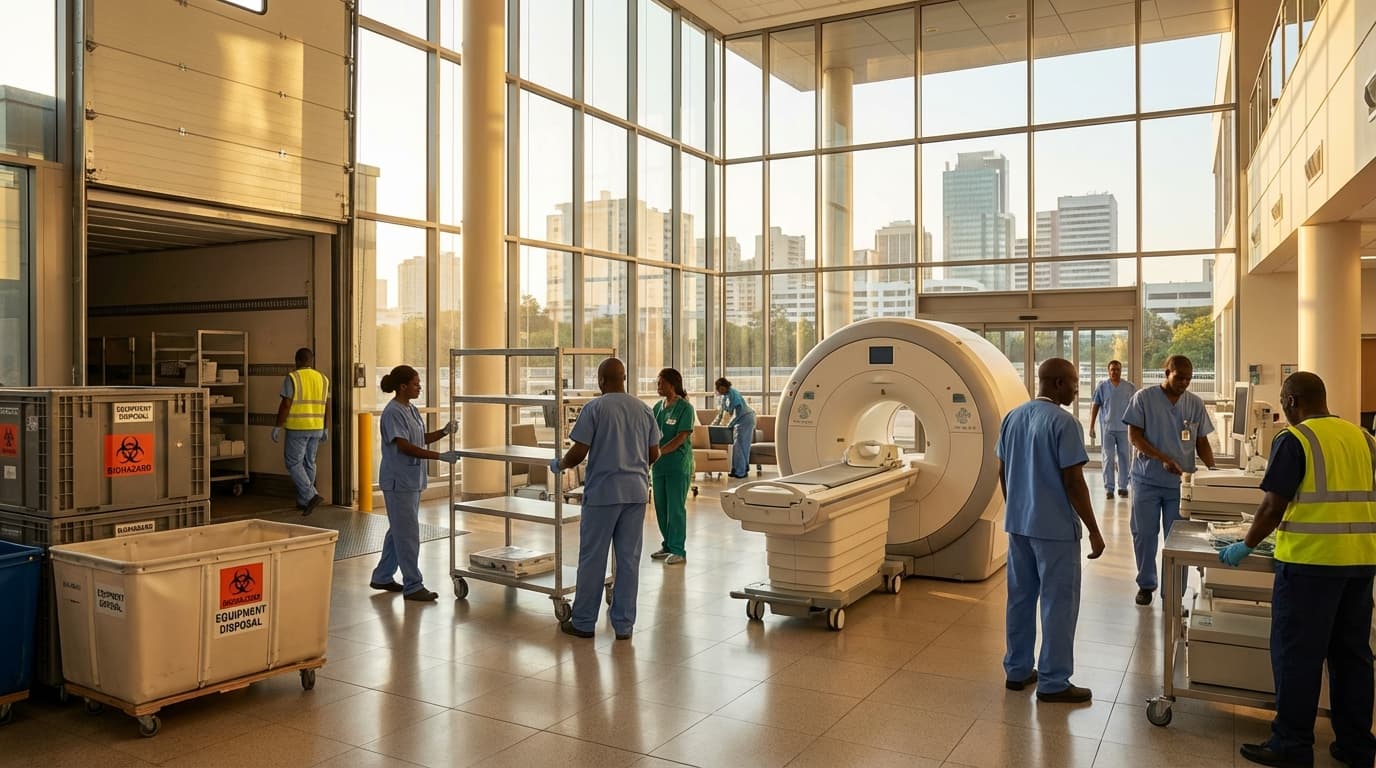
Medical Equipment Relocation Service (Move & Re-Install) in Comoros
Engineering Excellence & Technical Support
Medical Equipment Relocation Service (Move & Re-Install) High-standard technical execution following OEM protocols and local regulatory frameworks.
Specialized Medical Equipment Transport
Our fleet is equipped with climate-controlled and vibration-dampening systems, specifically designed to safeguard sensitive medical devices like MRI machines, CT scanners, and laboratory equipment during transit to and from Comorian islands. We ensure secure handling and proper bracing to prevent any damage.
Certified Re-Installation & Calibration
Our certified technicians possess extensive experience in re-installing a wide range of medical equipment, from diagnostic imaging systems to surgical units. We adhere to strict manufacturer guidelines and local regulations, performing comprehensive calibration and testing to guarantee optimal performance and patient safety in your new Comorian facility.
Comprehensive Decontamination & Packaging Solutions
We provide expert decontamination services to meet stringent hygiene standards before relocation. Our specialized packaging utilizes anti-static materials, shock-absorbent cushioning, and protective wraps to shield delicate components and sensitive electronics from the unique environmental challenges of Comoros, ensuring a pristine arrival.
What Is Medical Equipment Relocation Service (Move & Re-install) In Comoros?
Medical Equipment Relocation Service (Move & Re-Install) in Comoros refers to a specialized logistical and technical service focused on the safe, compliant, and efficient transfer and re-establishment of medical devices and associated infrastructure within or to Comoros. This encompasses planning, packing, transportation, unpacking, and the complete re-installation, testing, and calibration of medical equipment to operational status at a new location. The service prioritizes maintaining equipment integrity, functionality, and adherence to relevant regulatory standards throughout the entire relocation process. It is crucial for ensuring continuity of care and minimizing downtime for healthcare facilities.
| Who Needs It | Typical Use Cases | |||
|---|---|---|---|---|
| Hospitals and Clinics (Public & Private) | Facility upgrades or expansions requiring equipment transfer to new wings or floors. | Renovations or construction projects necessitating temporary or permanent equipment relocation. | Mergers or acquisitions of healthcare facilities. | Establishment of new medical facilities or satellite clinics. |
| Diagnostic Imaging Centers (Radiology, MRI, CT) | Relocation of heavy and sensitive imaging equipment to new or upgraded facilities. | Upgrade projects involving the replacement or addition of imaging modalities. | ||
| Laboratories (Pathology, Research, Clinical) | Transfer of sophisticated analytical instruments and biosafety cabinets. | Setting up new laboratory spaces or expanding existing ones. | ||
| Surgical Centers and Operating Rooms | Moving specialized surgical instruments, anesthesia machines, and operating tables. | Reconfiguration of operating room layouts. | ||
| Medical Equipment Manufacturers & Distributors | Delivery and installation of new equipment to healthcare providers in Comoros. | Relocation of demonstration units or showroom equipment. | ||
| Government Health Ministries & International Aid Organizations | Distribution and installation of donated or procured medical equipment to various healthcare sites. | Setting up temporary medical facilities for emergency response or public health campaigns. | ||
| Research Institutions | Relocation of laboratory equipment for research projects or facility changes. |
Key Components of Medical Equipment Relocation Service (Move & Re-Install) in Comoros
- Pre-move assessment and planning
- Disassembly and de-installation
- Specialized packing and crating
- Secure transportation (climate-controlled, vibration-dampened)
- Customs clearance and import/export documentation
- Unpacking and re-assembly
- Re-installation and system integration
- Performance testing and calibration
- Certifications and documentation verification
- Training for on-site personnel (if required)
- Post-installation support and troubleshooting
Who Needs Medical Equipment Relocation Service (Move & Re-install) In Comoros?
Specialized medical equipment relocation and re-installation services are crucial for a wide range of healthcare providers in Comoros. These services ensure that sensitive and expensive medical machinery is moved safely, maintaining its integrity and functionality, and is then correctly set up for immediate use at a new location. This is particularly important for facilities undergoing renovations, expanding their services, or consolidating operations. The meticulous handling and precise re-installation are vital to avoid damage, costly downtime, and to ensure patient safety and diagnostic accuracy.
| Customer Type | Key Equipment Types | Reasons for Relocation/Re-installation |
|---|---|---|
| Public Hospitals | MRI, CT Scanners, Ventilators, Anesthesia Machines | Renovations, Expansion, Equipment Upgrades, Consolidation |
| Private Clinics | Ultrasound Machines, X-ray Units, Surgical Monitors | Opening new branches, Interior redesign, Lease changes |
| Specialized Centers | Endoscopy Units, Dental X-ray, Therapy Equipment | Service expansion, Relocating to a more accessible location |
| Government Agencies | Various (depending on need) | Establishing new health centers, Redistributing resources |
| NGOs/Aid Organizations | Portable X-ray, Diagnostic kits, generators | Setting up emergency response units, Project-based deployment |
Target Customers and Departments in Comoros
- {"customer":"Public Hospitals","departments":["Radiology (MRI, CT Scanners, X-ray Machines)","Operating Theatres (Surgical Lights, Anesthesia Machines, Monitors)","Intensive Care Units (Ventilators, Infusion Pumps, Cardiac Monitors)","Laboratory (Analyzers, Microscopes)","Maternity and Neonatal Units (Incubators, Fetal Monitors)"]}
- {"customer":"Private Clinics and Hospitals","departments":["Diagnostic Imaging (Ultrasound, Mammography)","Cardiology (ECG Machines, Echocardiography)","Gastroenterology (Endoscopy equipment)","Surgical Suites","General Practice Examination Rooms"]}
- {"customer":"Specialized Medical Centers","departments":["Dental Clinics (X-ray units, sterilization equipment)","Ophthalmology Clinics (Slit lamps, optical coherence tomography)","Physiotherapy and Rehabilitation Centers (Therapy equipment, exercise machines)"]}
- {"customer":"Government Health Ministries/Agencies","departments":["Logistics and Procurement (relocating equipment between national facilities)","Public Health Initiatives (deploying equipment to new remote health posts)"]}
- {"customer":"Research and Training Institutions (if applicable)","departments":["Medical Laboratories","Simulation Centers"]}
- {"customer":"Non-Governmental Organizations (NGOs) & International Aid Organizations","departments":["Mobile Clinics","Temporary Medical Facilities","Donated equipment setup"]}
Medical Equipment Relocation Service (Move & Re-install) Process In Comoros
This document outlines the comprehensive workflow for Medical Equipment Relocation Services (Move & Re-Install) within Comoros, from initial inquiry to successful execution. This process ensures the safe, efficient, and compliant transfer and re-commissioning of sensitive medical devices.
| Stage | Description | Key Activities | Responsible Parties |
|---|---|---|---|
| The client contacts the relocation service provider with a request to move medical equipment. | Receive and log inquiry, understand the type and quantity of equipment, destination, required timelines, and any special handling needs. | Client, Relocation Service Provider (Sales/Inquiry Team) |
| A thorough assessment of both the origin and destination sites is conducted. | On-site inspection of equipment, access routes, power availability, environmental conditions, and potential logistical challenges at both locations. Develop a detailed relocation plan. | Relocation Service Provider (Project Manager, Technical Team), Client Representatives |
| Based on the site survey and planning, a detailed proposal is prepared and presented to the client. | Prepare a comprehensive quotation outlining services, costs, timelines, and terms. Formalize the agreement through a signed contract. | Relocation Service Provider (Sales/Contracts Team), Client |
| Necessary steps are taken to ensure the equipment is ready for safe movement. | Decontamination procedures (if required), necessary disconnections (electrical, water, etc.), securing loose parts, updating client on progress. | Relocation Service Provider (Technical Team), Client (for access and pre-approval) |
| The medical equipment is carefully dismantled (if necessary) and securely packed. | Professional dismantling of complex equipment, use of specialized protective materials (anti-static, shock-absorbent), meticulous labeling of all components and packaging. | Relocation Service Provider (Technical Team, Packing Specialists) |
| The packed equipment is transported from the origin to the destination site. | Utilizing specialized vehicles, adherence to safe driving practices, ensuring proper securing of loads, monitoring of environmental conditions during transit (if critical). | Relocation Service Provider (Logistics Team, Drivers) |
| The equipment is carefully unpacked and reassembled at the new location. | Safe removal of packing materials, precise re-assembly of components, positioning of equipment according to the approved layout. | Relocation Service Provider (Technical Team) |
| The re-installed equipment is thoroughly tested to ensure full functionality and accuracy. | Performing diagnostic tests, functional checks, calibration to manufacturer specifications, verification of all operational parameters. | Relocation Service Provider (Certified Technicians, Calibration Specialists), Client (for observation and approval) |
| Formal transfer of the re-installed equipment to the client. | Presenting test results and calibration certificates, providing user training (if part of the service), obtaining client sign-off, closing out the project. | Relocation Service Provider (Project Manager, Technical Team), Client |
Key Stages of the Medical Equipment Relocation Process
- Initial Inquiry & Needs Assessment
- Site Survey & Planning
- Quotation & Agreement
- Pre-Relocation Preparations
- Dismantling & Packing
- Transportation
- Unpacking & Re-Installation
- Testing & Calibration
- Handover & Documentation
Medical Equipment Relocation Service (Move & Re-install) Cost In Comoros
Relocating medical equipment in Comoros, whether it involves simple moves or complex re-installations requiring specialized technicians, presents unique logistical and cost considerations. The pricing for these services is influenced by several key factors, making it essential for healthcare providers to understand these elements to budget effectively. The local currency in Comoros is the Comorian Franc (KMF). It's important to note that while specific price lists are rarely published due to the bespoke nature of these services, we can outline the typical cost drivers and provide indicative ranges.
| Service Type / Equipment Category | Indicative Cost Range (KMF) |
|---|---|
| Basic Equipment Move (e.g., examination tables, small lab equipment) | 100,000 - 500,000 KMF |
| Mid-Range Equipment Move & Basic Re-installation (e.g., standard diagnostic machines, larger furniture) | 500,000 - 2,000,000 KMF |
| Complex Equipment Move & Full Re-installation (e.g., X-ray units, ultrasound, specialized surgical equipment) | 2,000,000 - 10,000,000+ KMF |
| Highly Specialized Equipment Move & Re-installation (e.g., MRI, CT Scanners - often involves manufacturer involvement) | 10,000,000 - 50,000,000+ KMF (highly variable) |
| On-site Calibration & Testing (per equipment type, by specialist) | 500,000 - 5,000,000 KMF (depending on complexity) |
Key Pricing Factors for Medical Equipment Relocation in Comoros:
- {"title":"Type and Size of Equipment","description":"Larger, heavier, or more delicate equipment (e.g., MRI machines, CT scanners, large X-ray units, surgical tables) will incur higher costs due to the specialized handling, lifting equipment, and expertise required. Smaller items like examination tables or basic laboratory equipment will be less expensive."}
- {"title":"Distance and Accessibility","description":"The distance between the origin and destination within Comoros, as well as the accessibility of both locations (e.g., presence of elevators, narrow corridors, challenging terrain, road conditions), will significantly impact transportation and labor costs."}
- {"title":"Re-installation Complexity","description":"Simple plug-and-play equipment has lower re-installation costs than complex machinery requiring calibration, testing, and integration with existing infrastructure (e.g., power, water, ventilation systems). This often necessitates specialized technicians."}
- {"title":"Dismantling and Re-assembly","description":"The need to dismantle equipment for transport and then re-assemble it at the new location adds to labor time and potentially the need for specialized tools and expertise."}
- {"title":"Specialized Personnel","description":"Engaging highly skilled technicians, engineers, or even manufacturers' representatives for calibration and testing will increase the overall service cost. This is particularly true for high-end or sensitive medical devices."}
- {"title":"Packing and Protection","description":"The level of protection required for the equipment during transit (e.g., custom crating, specialized padding, climate-controlled transport) will influence the cost."}
- {"title":"Insurance","description":"Adequate insurance coverage for the valuable medical equipment during the relocation process is crucial and will be factored into the overall price."}
- {"title":"Timeliness and Urgency","description":"Expedited services or relocation during off-peak hours may command higher fees."}
- {"title":"Permits and Approvals","description":"Depending on the nature of the equipment and the specific locations, certain permits or regulatory approvals might be required, adding to administrative costs."}
Affordable Medical Equipment Relocation Service (Move & Re-install) Options
Moving medical equipment requires specialized care, expertise, and often specific handling procedures. Our Affordable Medical Equipment Relocation Service understands the critical nature of your assets and offers seamless move and re-installation options designed to minimize disruption and maximize value. We provide transparent pricing and flexible solutions to meet your budgetary needs. Explore our value bundles and cost-saving strategies to ensure your medical equipment is transported safely and efficiently without breaking the bank.
| Value Bundle Name | Included Services | Ideal For | Estimated Price Range (Illustrative) | Cost-Saving Highlights |
|---|---|---|---|---|
| Essential Move & Connect | Equipment de-installation, secure transport, on-site re-installation, and basic functional testing. | Smaller clinics, individual practices, or single-unit relocations. | $X - $Y per unit | Streamlined process for quick setup. Focus on core relocation needs. |
| Comprehensive Re-Start | Includes 'Essential Move & Connect' plus advanced calibration, system integration testing, and minor configuration adjustments. | Hospitals, diagnostic centers, or multi-equipment facilities requiring full operational readiness. | $A - $B per unit | Bundled calibration and testing reduces the need for separate service calls. Comprehensive package prevents unforeseen costs. |
| Full Facility Transition | End-to-end relocation management including planning, packing, transport of all equipment, re-installation, calibration, and post-move support. | Major facility upgrades, practice mergers, or complete office overhauls. | Customized Quote (Based on scope) | Dedicated project manager ensures efficiency, minimizing downtime and potential delays. Bulk transport discounts often applied. |
Our Medical Equipment Relocation Service Advantages:
- Specialized handling for delicate and sensitive medical devices.
- Experienced and trained technicians for secure packing and unpacking.
- Customized crating and cushioning to prevent damage during transit.
- Careful dismantling and re-assembly of complex equipment.
- On-site testing and calibration post-relocation.
- Comprehensive insurance coverage for peace of mind.
- Flexible scheduling to accommodate your operational downtime.
- Experienced project management for smooth transitions.
- Adherence to all relevant safety and regulatory standards.
- 24/7 availability for urgent relocation needs.
Verified Providers In Comoros
When seeking healthcare services in Comoros, ensuring you are connected with verified providers is paramount for quality and trustworthy care. Franance Health stands out as a premier organization that rigorously vets and credentials its network of healthcare professionals. This commitment to verification means that patients can have confidence in the expertise, qualifications, and ethical standards of the providers they access through Franance Health. Their stringent credentialing process not only confirms medical licensing and board certifications but also includes checks on professional history and ongoing competency, offering a crucial layer of assurance.
| Franance Health Verification Component | Description | Benefit to Patients |
|---|---|---|
| Medical Licensing and Board Certification | Confirmation that providers hold valid and current licenses to practice medicine and possess relevant board certifications. | Ensures providers have met recognized educational and training standards. |
| Professional History Review | Thorough examination of a provider's past professional engagements, including any disciplinary actions or malpractice claims. | Identifies and mitigates risks associated with unqualified or problematic practitioners. |
| Ongoing Competency Assessment | Mechanisms to monitor and ensure providers continue to meet evolving medical standards and maintain their skills. | Guarantees that patients receive care based on current best practices. |
| Background Checks | Verification of identity and absence of criminal records relevant to professional practice. | Enhances patient safety and security. |
| Ethical Practice Standards | Confirmation of adherence to a code of medical ethics and professional conduct. | Promotes a patient-centered and trustworthy healthcare experience. |
Why Franance Health Represents the Best Choice for Verified Providers in Comoros:
- Rigorous Verification Process: Franance Health implements a multi-faceted credentialing system that goes beyond basic licensing.
- Focus on Quality and Competency: They ensure providers maintain high standards of medical practice and continuous professional development.
- Patient Safety and Trust: The verification process prioritizes patient well-being and fosters confidence in the healthcare system.
- Comprehensive Network: Access a broad range of specialists and general practitioners, all confirmed to meet stringent criteria.
- Ethical Standards: Providers are screened for adherence to ethical guidelines and professional conduct.
- Streamlined Access to Care: Franance Health simplifies the process of finding reliable healthcare professionals.
- Reputation and Reliability: Their established track record underscores their commitment to excellence in healthcare provision.
Scope Of Work For Medical Equipment Relocation Service (Move & Re-install)
This Scope of Work (SOW) outlines the requirements for the relocation and re-installation of medical equipment at [Client Name/Facility Name]. The service provider will be responsible for the safe and efficient transportation of specified medical equipment from its current location to the new designated site, followed by professional re-installation and functional testing to ensure operational readiness.
| Phase | Activity | Description | Technical Deliverables | Standard Specifications |
|---|---|---|---|---|
| Phase 1: Planning & Preparation | Site Survey & Assessment | On-site evaluation of both origin and destination locations, including access routes, power, data, and environmental requirements for each piece of equipment. | Detailed site survey report, including floor plans, equipment inventory, and risk assessment. | Compliance with building codes, accessibility standards, and environmental control requirements (temperature, humidity). |
| Phase 1: Planning & Preparation | Equipment De-installation Plan | Development of a detailed plan for the safe and systematic de-installation of each piece of equipment, including any necessary disconnections, disassembly, and labeling. | De-installation protocols for each equipment type, including diagrams and checklists. | Adherence to manufacturer's de-installation guidelines; use of certified technicians for specialized equipment. |
| Phase 1: Planning & Preparation | Transportation & Logistics Plan | Development of a comprehensive plan for the transportation of equipment, including vehicle selection, packing materials, route planning, and scheduling. | Logistics plan detailing transportation routes, schedules, and emergency contact information. | Use of climate-controlled, air-ride suspension vehicles; appropriate packing materials to prevent shock and vibration damage. |
| Phase 2: De-installation & Packing | Equipment De-installation | Execution of the approved de-installation plan, ensuring all connections are safely disconnected and documented. | Labeled and secured equipment components; photographic documentation of the de-installation process. | Follow manufacturer's de-installation procedures; use of ESD-safe practices for sensitive electronics. |
| Phase 2: De-installation & Packing | Equipment Packing & Protection | Careful packing of all equipment using appropriate materials to ensure protection during transit. | Custom-crated or specially padded equipment; clear labeling with origin, destination, and handling instructions. | Use of anti-static packaging for electronic components; shock-absorbent materials; protection against moisture and dust. |
| Phase 3: Transportation | Equipment Transit | Safe and secure transportation of packed equipment from the origin to the destination site. | Secure loading and unloading procedures; real-time tracking (if applicable). | Compliance with all local, state, and federal transportation regulations. |
| Phase 3: Transportation | Damage Assessment (During Transit) | Immediate reporting and documentation of any damage incurred during transit. | Damage report with photographic evidence; immediate notification to client. | As per agreed-upon insurance and damage claims procedures. |
| Phase 4: Re-installation & Setup | Equipment Re-installation | Professional re-installation of all equipment at the designated new location according to manufacturer specifications and client requirements. | Re-installed equipment ready for connection; documented connection points (power, data, medical gases). | Adherence to manufacturer's installation manuals; compliance with facility's electrical, data, and medical gas infrastructure. |
| Phase 4: Re-installation & Setup | Connection & Calibration | Connection of all necessary utilities (power, data, medical gases) and recalibration of equipment as required. | Fully connected and calibrated equipment; calibration certificates (if applicable). | Use of certified technicians for calibration; adherence to manufacturer's calibration protocols. |
| Phase 4: Re-installation & Setup | Functional Testing | Thorough testing of all equipment functions to ensure optimal performance and accuracy. | Functional test reports for each equipment item, detailing test parameters and results. | Testing to simulate actual clinical usage; verification of all safety features. |
| Phase 5: Post-Relocation | Client Acceptance & Handover | Formal handover of re-installed and tested equipment to the client. | Signed acceptance form; final project report. | Client sign-off confirming satisfactory completion of all relocation and re-installation activities. |
| Phase 5: Post-Relocation | Documentation & Reporting | Provision of all relevant documentation, including site surveys, de-installation/re-installation logs, test results, and any warranty information. | Comprehensive project completion report; all original equipment documentation. | As per industry best practices and client's record-keeping requirements. |
Key Objectives
- Safe and secure transportation of all identified medical equipment.
- Minimizing downtime of critical medical services during the relocation process.
- Ensuring all equipment is re-installed to manufacturer specifications and operational standards.
- Providing clear documentation of the relocation and re-installation process.
- Adherence to all relevant safety regulations and infection control protocols.
Service Level Agreement For Medical Equipment Relocation Service (Move & Re-install)
This Service Level Agreement (SLA) outlines the response times and uptime guarantees for the Medical Equipment Relocation Service (Move & Re-Install), provided by [Your Company Name] to [Client Name]. This SLA is an integral part of the overall service contract and is effective as of [Effective Date].
| Service Component | Response Time (during business hours: Mon-Fri, 9 AM - 5 PM local time) | Uptime Guarantee (post-reinstallation) | Notes |
|---|---|---|---|
| Initial Contact / Scheduling Confirmation | Within 4 business hours of request submission. | N/A | Applies to scheduling the relocation event. Not applicable to emergency relocation requests. |
| On-site Technician Arrival (Scheduled Relocation) | Within 30 minutes of the scheduled arrival time. | N/A | Assumes pre-arranged access and site readiness. |
| On-site Technician Arrival (Emergency Relocation Request - if applicable) | Within 4 business hours (if emergency service is part of the contract). | N/A | Emergency relocation must be pre-defined and approved in the contract. |
| Equipment Functionality Post-Reinstallation | N/A | 99.5% within the first 72 hours post-reinstallation. | Guaranteed functionality for core operations as per manufacturer specifications. Excludes software issues not directly related to reinstallation or physical damage. |
| Remote Technical Support (Post-Reinstallation) | Within 2 business hours for critical issues; 4 business hours for non-critical issues. | N/A | Covers issues directly attributable to the relocation and reinstallation process. |
| On-site Technical Support (Post-Reinstallation - if required) | Within 8 business hours for critical issues; 24 business hours for non-critical issues. | N/A | Subject to technician availability and geographical proximity. Critical issues are defined as complete equipment failure preventing essential patient care. |
Scope of Service
- Relocation of specified medical equipment from the originating site to the designated destination site.
- Deinstallation of equipment at the originating site.
- Safe transportation of equipment between sites.
- Reinstallation and initial configuration of equipment at the destination site.
- Basic functional testing post-reinstallation.
- On-site support during the scheduled relocation window.
Frequently Asked Questions

Ready when you are
Let's scope your Medical Equipment Relocation Service (Move & Re-Install) in Comoros project in Comoros.

Scaling healthcare logistics and technical systems across the entire continent.