
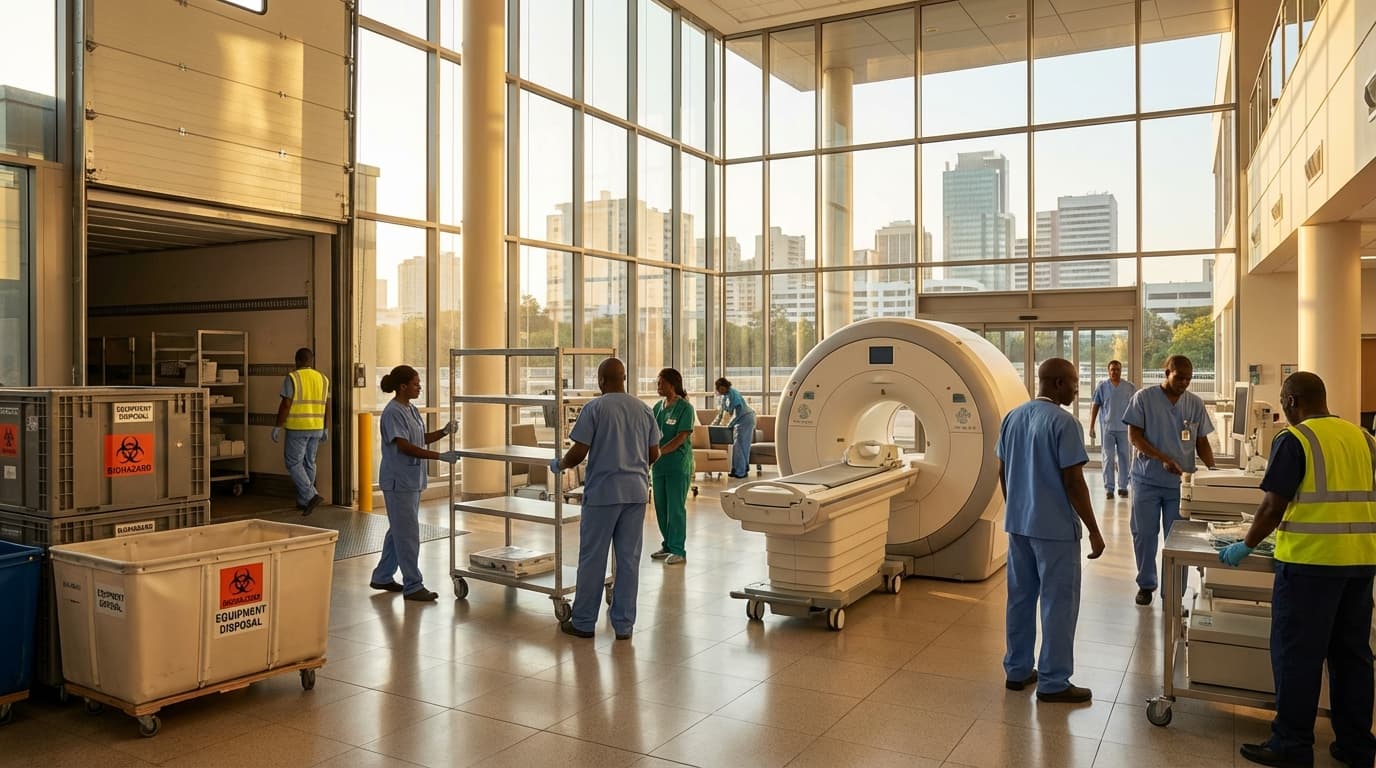
Heavy Medical Equipment De-Installation Service (MRI/CT/Cath Lab) in Comoros
Engineering Excellence & Technical Support
Heavy Medical Equipment De-Installation Service (MRI/CT/Cath Lab) High-standard technical execution following OEM protocols and local regulatory frameworks.
Expert De-Installation of Advanced Imaging Modalities
Our specialized team possesses deep technical expertise in the intricate de-installation of high-value medical equipment such as MRI, CT, and Cath Labs. We meticulously disconnect sensitive components, secure delicate systems, and ensure compliance with all manufacturer specifications, minimizing risk to the equipment's integrity.
Specialized Logistics & Secure Transportation
We provide comprehensive logistics solutions tailored for heavy medical equipment in Comoros. Our services include safe dismantling, specialized packaging for transit, and coordinated transportation, ensuring your valuable MRI, CT, or Cath Lab systems reach their destination securely and efficiently, regardless of remote locations.
Regulatory Compliance & Safety Protocols
Adhering strictly to international safety standards and local regulations in Comoros, our de-installation process prioritizes the safety of personnel and the preservation of equipment. We implement rigorous risk assessments and employ certified technicians trained in handling high-voltage, cryogenically-cooled, and radiation-emitting medical machinery.
What Is Heavy Medical Equipment De-installation Service (Mri/ct/cath Lab) In Comoros?
Heavy Medical Equipment De-Installation Service (MRI/CT/Cath Lab) in Comoros refers to the specialized process of safely and systematically dismantling, preparing for transport, and documenting large, complex medical imaging and interventional systems such as Magnetic Resonance Imaging (MRI) scanners, Computed Tomography (CT) scanners, and Cardiac Catheterization (Cath) Laboratories. This service is crucial for healthcare facilities undergoing renovations, relocations, upgrades, or when equipment reaches its end-of-life and requires disposal or transfer. The process necessitates a deep understanding of the equipment's intricate engineering, radiation safety protocols, electrical and cooling system requirements, and the logistical challenges of moving exceptionally heavy and sensitive components.
| Who Needs This Service? | Typical Use Cases | |||||
|---|---|---|---|---|---|---|
| Hospitals and Clinics in Comoros: Healthcare institutions operating or planning to operate MRI, CT, or Cath Lab facilities. | Renovations and Upgrades: When existing imaging suites require modernization or expansion, necessitating the removal of older equipment. | Relocations: Moving a healthcare facility or a specific department within a facility. | Equipment Replacement: When current systems are outdated, inefficient, or require replacement with newer models. | End-of-Life Equipment Disposal: For systems that are no longer operational or economically viable to repair. | Asset Redeployment: Transferring functional equipment to another facility within Comoros or for export. | New Facility Construction: Preparing space for the installation of new heavy medical equipment by removing any pre-existing or temporary structures. |
Key Aspects of Heavy Medical Equipment De-Installation Service:
- Systematic Disassembly: Involves methodical disconnection of all subsystems, including superconducting magnets (MRI), X-ray tubes and detectors (CT), and high-resolution imaging systems (Cath Lab), following manufacturer-specific procedures.
- Component Isolation and Containment: Techniques for safely handling and securing hazardous components such as cryogens (liquid helium for MRI), high-voltage electrical systems, and radiation-emitting parts.
- Structural Deconstruction: Removal of supporting structures, shielding, and integrated room modifications necessary for the equipment's operation.
- Logistical Planning and Execution: Coordination of specialized transportation, including heavy-lift cranes, reinforced transport vehicles, and secure packaging to prevent damage during transit.
- Documentation and Compliance: Meticulous record-keeping of the de-installation process, including photographic evidence, asset tagging, and compliance with local and international safety and environmental regulations.
- Site Restoration: Preparation of the original installation site for subsequent use, which may involve removal of specialized flooring, cooling systems, and electrical infrastructure.
- Certification and Verification: Post-de-installation checks and documentation to confirm completeness and adherence to safety standards.
Who Needs Heavy Medical Equipment De-installation Service (Mri/ct/cath Lab) In Comoros?
Heavy medical equipment like MRI, CT scanners, and Cath Labs are complex, high-value assets. Their de-installation, whether for relocation, replacement, or disposal, requires specialized expertise, stringent safety protocols, and a deep understanding of intricate systems. This specialized service is crucial for a range of healthcare providers and institutions that possess or intend to manage such sophisticated medical technology. In Comoros, as healthcare infrastructure develops and facilities upgrade their imaging and interventional capabilities, the need for reliable de-installation services becomes increasingly apparent.
| Department | Specific Needs for De-Installation | Reasons for Requiring Service |
|---|---|---|
| Radiology/Medical Imaging Department | De-installation of MRI, CT scanners (including associated infrastructure like RF shielding, cooling systems, etc.) | Equipment upgrades, replacement of older models, relocation to new imaging suites, end-of-life disposal. |
| Cardiology/Interventional Radiology Department | De-installation of Cath Labs (including imaging systems, tables, injectors, monitoring equipment, etc.) | Facility renovations, technology upgrades to newer systems, relocation to more advanced labs, decommissioning of outdated equipment. |
| Hospital Administration/Procurement | Coordination of de-installation as part of capital expenditure projects or facility planning | Ensuring smooth transitions, minimizing downtime, managing vendor contracts, and overseeing asset lifecycle. |
| Biomedical Engineering Department | On-site supervision and coordination with de-installation specialists | Ensuring adherence to technical specifications, safety protocols, and documentation for future re-installation or maintenance. |
| Facilities Management | Ensuring safe removal of equipment without damaging building infrastructure | Coordinating access, managing electrical and HVAC disconnections, and ensuring structural integrity during removal. |
Target Customers for Heavy Medical Equipment De-Installation Service in Comoros:
- Public Hospitals (e.g., Moroni General Hospital, Fomboni Regional Hospital)
- Private Hospitals and Clinics
- Medical Imaging Centers
- Research Institutions (if any exist or are planned)
- Government Health Ministries (for asset management and disposal)
- Equipment Manufacturers and Resellers (for logistical support during installation/de-installation phases of new projects)
- Third-Party Service Providers specializing in medical equipment maintenance and relocation
Heavy Medical Equipment De-installation Service (Mri/ct/cath Lab) Process In Comoros
This document outlines the comprehensive workflow for heavy medical equipment de-installation services, specifically focusing on MRI, CT, and Cath Lab systems, within the Comoros. The process is designed to be efficient, safe, and compliant with all relevant regulations and best practices, ensuring minimal disruption and secure handling of highly sensitive and valuable equipment.
| Stage | Key Activities | Responsible Party | Timeline (Indicative) | Deliverables/Outcomes | Comoros Specific Considerations |
|---|---|---|---|---|---|
| Receive and review client request for de-installation.<br>Discuss equipment type, location, desired timeline, and specific requirements.<br>Gather preliminary information about the installation environment. | Client, Service Provider (De-Installation Team) | 1-3 Business Days | Understanding of project scope and client needs. | Language barriers (French/Comorian), time zone differences, communication channels (internet availability). |
| On-site inspection of the equipment and surrounding area.<br>Assess access routes, power supply, structural integrity, and potential obstructions.<br>Develop a detailed de-installation plan, including safety protocols and resource allocation.<br>Identify any specialized tools or equipment required. | Service Provider (Technical Lead, Rigging Specialists) | 3-7 Business Days (depending on site complexity and travel) | Detailed de-installation plan, risk assessment report, Bill of Materials for specialized equipment. | Infrastructure quality (roads, building access), availability of local support for site surveys, local permits or access permissions. |
| Prepare a comprehensive quotation based on the site assessment and de-installation plan.<br>Include costs for labor, equipment, specialized transport, insurance, and potential disposal/disassembly.<br>Negotiate terms and finalize the service contract. | Service Provider, Client | 2-5 Business Days | Signed service contract, agreed-upon quotation. | Currency fluctuations, payment processing complexities, legal framework for contracts in Comoros. |
| Secure all necessary permits and authorizations from local authorities.<br>Schedule and confirm logistics for specialized equipment and personnel.<br>Coordinate with the client regarding power shutdown and facility access.<br>Conduct pre-de-installation safety briefings for the team. | Service Provider, Client, Local Authorities | 5-14 Business Days (depending on permit acquisition) | All permits obtained, logistical arrangements confirmed, client informed and prepared. | Bureaucratic processes for permits, reliance on local contacts for facilitation, potential delays due to unforeseen administrative issues. |
| Systematic disassembly of the medical equipment by certified technicians.<br>Careful disconnection of all components, including power, data, and cooling systems.<br>Segregation and labeling of all parts for reassembly or transport.<br>Adherence to strict safety procedures throughout the process. | Service Provider (Certified Technicians, Engineers) | 1-5 Days (depending on equipment complexity) | De-installed and disassembled equipment, components organized and labeled. | Availability of specialized tools and parts if unforeseen issues arise, humidity and temperature control for sensitive components during disassembly. |
| Careful lifting, maneuvering, and packing of heavy equipment components.<br>Utilize specialized rigging equipment and trained personnel.<br>Securely load equipment onto appropriate transport vehicles.<br>Ensure compliance with local transportation regulations. | Service Provider (Rigging Specialists, Logistics Team) | 1-3 Days | Equipment safely packed and loaded onto transport. | Road conditions and suitability for heavy transport, availability of appropriate cranes or lifting equipment, customs procedures for international transport if applicable. |
| Comprehensive documentation of the de-installation process, including photos and progress reports.<br>Provide a detailed inventory of all removed components.<br>Formal handover of equipment to the client or designated logistics partner.<br>Sign-off on completion of services. | Service Provider, Client | 1-2 Business Days | De-installation report, component inventory, signed handover certificate. | Language of documentation (French/English), clarity of handover procedures. |
| Address any client queries or concerns.<br>Provide technical support as per the contract.<br>Facilitate logistics for onward shipping or storage if required. | Service Provider, Client | Ongoing (as per contract) | Client satisfaction, resolution of any outstanding issues. | Remote support capabilities, post-service communication channels. |
De-Installation Workflow for Heavy Medical Equipment in Comoros
- Inquiry & Initial Consultation
- Site Assessment & Planning
- Quotation & Contract Finalization
- Pre-De-Installation Preparations
- Equipment De-Installation
- Rigging & Specialized Transport
- Documentation & Handover
- Post-De-Installation Support
Heavy Medical Equipment De-installation Service (Mri/ct/cath Lab) Cost In Comoros
The cost of de-installing heavy medical equipment such as MRI, CT scanners, and Cath Labs in Comoros is highly variable and depends on a multitude of factors. Due to the specialized nature of this work and the logistical challenges inherent in an island nation, professional de-installation services are often contracted from international or regional providers who then bring their expertise and equipment to Comoros. Local availability of highly skilled technicians with experience in these specific modalities is scarce, leading to reliance on external resources.
The de-installation process itself involves meticulous disassembling of complex machinery, careful handling of sensitive components (like superconducting magnets in MRI machines), safe disconnection of power and cooling systems, and packaging for transport. The sheer weight and size of these units necessitate specialized lifting and rigging equipment, which may need to be transported to the site or even imported.
Key Pricing Factors:
- Equipment Type and Size: An MRI scanner, with its large superconducting magnet, will inherently be more complex and costly to de-install than a smaller CT scanner or a more modular Cath Lab system. The specific model and its dimensions play a significant role.
- Site Accessibility and Logistics: The ease of access to the installation room and the building's infrastructure (e.g., elevator availability, width of corridors, proximity to loading docks) significantly impact the time and resources required. If the equipment needs to be moved through challenging terrain or multiple levels, costs will increase.
- Dismantling Complexity and Time: The amount of disassembly required and the time it takes to safely break down the equipment are direct cost drivers. Older or custom-built systems might present unique challenges.
- Specialized Tools and Equipment: The need for specialized tools, lifting equipment (cranes, specialized dollies), and potentially containment for hazardous materials (e.g., refrigerants in older CT scanners) will add to the overall expense.
- Labor Costs: This is a major factor. If services are provided by an international team, their travel, accommodation, per diem, and professional fees will be a significant portion of the cost. Even if local labor is involved, their specialized training and expertise will command higher rates.
- Packaging and Crating: Proper packaging for sensitive medical equipment is crucial to prevent damage during transit. Custom crating can be a substantial cost, especially for large components.
- Permits and Approvals: While less common for de-installation alone, there might be local regulations or permits required, especially if the equipment is being removed from a hospital that is undergoing renovation or closure. These can incur administrative fees.
- Urgency of Service: Expedited de-installation services will typically come at a premium.
- Contractor's Overhead and Profit: As with any service, the contractor will factor in their operational costs, insurance, and desired profit margin.
Cost Ranges in Comorian Franc (KMF):
Due to the limited local market for these highly specialized services, it is challenging to provide precise local currency ranges without a specific project scope. However, given the factors above, the cost of de-installing a single heavy medical imaging or interventional radiology system in Comoros can range from KMF 20,000,000 to KMF 150,000,000 (approximately USD 44,000 to USD 330,000) or even higher. This range is a broad estimate and is heavily influenced by whether international specialized teams are contracted, requiring international travel and logistics for both personnel and equipment.
Breakdown of Estimated Costs (Illustrative, not exhaustive):
- International Specialized Team Mobilization: This would be the largest component, covering flights, accommodation, visas, per diems, and daily rates for highly skilled engineers and technicians. This could easily be KMF 15,000,000 - KMF 80,000,000+.
- Specialized De-installation Equipment Rental/Transport: If specific heavy lifting or rigging equipment needs to be brought in, this cost can be substantial, from KMF 5,000,000 - KMF 30,000,000+.
- Local Labor (if available and supervised): While less skilled local labor might assist, the core expertise will likely be external. If local engineers with some relevant experience are involved, their costs might be in the range of KMF 500,000 - KMF 2,000,000 per person for the project duration.
- Packaging and Crating Materials: From KMF 2,000,000 - KMF 10,000,000+ depending on the equipment's size and fragility.
- Site Assessment and Project Management: KMF 1,000,000 - KMF 5,000,000+.
- Contingency: It is always advisable to include a contingency of 10-20% for unforeseen issues.
It is crucial for any institution in Comoros requiring such services to obtain detailed quotes from multiple specialized providers. These quotes should clearly outline all included services, responsibilities, and associated costs. Negotiation will also be a key part of securing a reasonable price, considering the unique market dynamics.
| Service Component (Illustrative) | Estimated Cost Range (KMF) |
|---|---|
| International Specialized Team Mobilization (Travel, Accommodation, Fees) | 20,000,000 - 80,000,000+ |
| Specialized De-installation Equipment Rental/Transport | 5,000,000 - 30,000,000+ |
| Local Labor (Supervised Assistance) | 500,000 - 2,000,000 (per person) |
| Packaging and Crating Materials | 2,000,000 - 10,000,000+ |
| Site Assessment and Project Management | 1,000,000 - 5,000,000+ |
| Overall Estimated Project Cost Range (MRI/CT/Cath Lab) | 20,000,000 - 150,000,000+ |
Key Factors Influencing Heavy Medical Equipment De-Installation Costs in Comoros
- Equipment Type and Size (e.g., MRI, CT, Cath Lab)
- Site Accessibility and Logistical Challenges
- Complexity and Time Required for Dismantling
- Need for Specialized Tools and Lifting Equipment
- Labor Costs (especially for international specialists)
- Packaging and Crating Requirements
- Potential for Permits and Administrative Fees
- Urgency of the Service
- Contractor's Overhead and Profit Margin
Affordable Heavy Medical Equipment De-installation Service (Mri/ct/cath Lab) Options
De-installing large medical equipment like MRI, CT scanners, and Cath Labs is a complex and costly undertaking. This service involves highly skilled technicians, specialized tools, and meticulous logistical planning. Finding affordable options requires understanding service structures, identifying cost-saving strategies, and recognizing the value offered by different service bundles.
| Value Bundle/Strategy | Description | Cost-Saving Benefit |
|---|---|---|
| Standard De-installation | Basic service including dismantling, packaging, and site cleanup. Does not include transportation or warehousing. | Lower upfront cost compared to comprehensive packages. Suitable if you have your own logistics or relocation plans. |
| De-installation & Relocation Package | Includes dismantling, professional packaging, and transportation to a specified new location. May include basic re-installation at the destination. | Bundling services can offer a discount compared to booking each service separately. Streamlines the process and reduces coordination effort. |
| De-installation & Disposal Service | Covers dismantling, safe removal, and environmentally responsible disposal of the equipment. May include documentation for compliance. | Efficiently handles the entire lifecycle of obsolete equipment, avoiding separate vendor management and potential disposal fees. |
| Off-Peak Scheduling | Scheduling de-installation during less busy periods (e.g., weekends, late evenings, or off-season) can sometimes lead to lower labor rates. | Potential for reduced labor costs and improved availability of preferred service providers. |
| Pre-De-installation Site Assessment | A thorough assessment of the site and equipment before de-installation begins. This allows for accurate quoting and identification of potential challenges. | Prevents unexpected charges due to unforeseen site issues or equipment complexities. Ensures a more efficient and predictable de-installation process. |
| Multi-Equipment Discount | If you have multiple pieces of large medical equipment to de-install within a specific timeframe or at the same facility, negotiate a bulk discount. | Significant savings when consolidating de-installation projects with a single provider. |
| Partnerships with De-installation Providers | Building long-term relationships with a few reputable de-installation companies can lead to preferred pricing and priority service. | Consistent, reliable service at potentially negotiated, favorable rates for ongoing needs. |
| DIY Preparations (with caution) | While de-installation itself requires professionals, some pre-planning like clearing access routes or disconnecting non-critical power if advised by the provider can save minor time. | Marginal cost savings. Caution: Incorrect DIY can lead to damage or safety hazards, negating savings. Always consult the professional de-installation team. |
Factors Influencing De-installation Costs:
- Equipment Type and Size: Larger, more complex machines (e.g., high-field MRIs) are more expensive to de-install than smaller ones.
- Dismantling Complexity: Some equipment requires extensive disassembly, including superconducting magnets, cryogen handling, and intricate wiring.
- Site Accessibility: Difficult access (tight corridors, multiple floors, no direct loading dock) can increase labor and time costs.
- Geographic Location: Labor rates and travel expenses vary significantly by region.
- Required Tools and Equipment: Specialized lifting equipment, cranes, and safety gear add to the overall expense.
- Timeline and Urgency: Rush jobs often incur premium pricing.
- Disposal or Relocation Needs: If the equipment needs to be moved to a new site or disposed of, this adds further logistical considerations and costs.
- Regulatory Compliance: Adherence to safety and environmental regulations during de-installation can impact procedures and costs.
Verified Providers In Comoros
When seeking healthcare in Comoros, it's paramount to choose providers who offer a guarantee of quality, safety, and ethical practice. Franance Health stands out as a premier credentialing body, meticulously vetting healthcare professionals and facilities to ensure they meet the highest international standards. This rigorous verification process provides patients with invaluable peace of mind, knowing they are receiving care from trusted and competent hands. Franance Health's commitment extends beyond basic qualifications; they assess critical aspects such as clinical expertise, adherence to best practices, patient safety protocols, and ethical conduct. By choosing a provider accredited by Franance Health, individuals in Comoros are making a definitive choice for superior healthcare outcomes and a secure patient experience.
| Credentialing Aspect | Franance Health Verification | Benefit to Patients |
|---|---|---|
| Professional Qualifications | Verification of degrees, licenses, and specializations. | Assurance of a provider's legitimate and advanced medical training. |
| Clinical Competence | Assessment of practical skills and experience in various medical fields. | Confidence in the provider's ability to accurately diagnose and treat. |
| Patient Safety | Evaluation of infection control, emergency preparedness, and risk management. | Reduced risk of medical errors and enhanced safety during treatment. |
| Ethical Standards | Review of professional conduct, patient rights, and data privacy. | Trustworthy and respectful healthcare interactions. |
| Facility Standards | Inspection of infrastructure, equipment, and hygiene for accredited facilities. | Access to well-equipped and safe medical environments. |
Why Franance Health Credentials Matter
- Ensures adherence to international healthcare standards.
- Verifies the clinical expertise and qualifications of providers.
- Confirms robust patient safety protocols are in place.
- Guarantees ethical practice and patient-centered care.
- Provides peace of mind and confidence in healthcare choices.
Scope Of Work For Heavy Medical Equipment De-installation Service (Mri/ct/cath Lab)
This Scope of Work (SOW) outlines the requirements for the professional de-installation of heavy medical imaging equipment, specifically Magnetic Resonance Imaging (MRI) scanners, Computed Tomography (CT) scanners, and Cardiac Catheterization (Cath Lab) systems. The objective is to ensure the safe, efficient, and compliant removal of these complex systems from their current locations, preparing them for transport or relocation. This SOW details the technical deliverables and standard specifications expected from the service provider.
| Category | Technical Deliverable | Standard Specification / Requirement |
|---|---|---|
| Pre-De-Installation | Site Survey Report | Detailed assessment of site access, power requirements, existing infrastructure, and potential obstructions. Includes photographic evidence and preliminary de-installation plan. |
| Pre-De-Installation | De-Installation Plan | Comprehensive plan outlining sequence of operations, personnel required, specialized tools, safety protocols, and estimated timeline. Must be approved by the client. |
| De-Energization & Safety | Confirmation of Power Disconnection | Verification and documentation of complete power isolation to all components of the equipment. Adherence to lockout/tagout procedures. |
| De-Energization & Safety | Cryogen Venting (MRI) | Safe and controlled venting of cryogens (e.g., Helium) in accordance with manufacturer guidelines and environmental regulations. Includes monitoring and documentation of pressure and temperature. |
| De-Energization & Safety | Radiation Safety Protocols (CT/Cath Lab) | Adherence to all applicable radiation safety regulations during de-installation. Removal of any radioactive sources (if applicable and per client instruction). |
| Disassembly | Component Disassembly | Systematic disassembly of all major and minor components by trained technicians, following manufacturer specifications or best practice. Minimizing stress on components. |
| Disassembly | Component Labeling and Inventory | Each removed component shall be clearly labeled with identification codes, location of origin, and a unique serial number. A detailed inventory list shall be provided. |
| Disassembly | Coil and Magnet Handling (MRI) | Specialized handling procedures for MRI coils and superconducting magnets, ensuring no damage to sensitive components and maintaining magnetic field integrity. |
| Disassembly | Gantry Disassembly (CT) | Safe and controlled disassembly of the CT scanner gantry, including collimators, filters, and detector assemblies. |
| Disassembly | C-Arm and Table Separation (Cath Lab) | Careful separation of the C-arm, patient table, and associated imaging components in the Cath Lab system. |
| Cabling Management | Cable Segregation and Labeling | All internal and external cables shall be meticulously segregated, labeled, and coiled in a manner that prevents damage and facilitates re-installation. |
| Cabling Management | Fiber Optic Cable Handling | Specialized care and handling procedures for fiber optic cables to prevent bending, kinking, or damage to connectors. |
| Containment & Protection | Protective Wrapping and Packaging | All disassembled components shall be individually wrapped in protective material (e.g., bubble wrap, anti-static bags) and securely packaged for transport. |
| Containment & Protection | Skidding and Crating | Major components shall be secured to custom-built skids or crated as necessary to ensure stability and prevent movement during transit. |
| Containment & Protection | Environmental Considerations | Protection against moisture, dust, and extreme temperatures during the de-installation and packaging process. |
| Site Restoration | Removal of Ancillary Equipment | De-installation and removal of all associated ancillary equipment not part of the main imaging system (e.g., power conditioners, cooling units, workstations). |
| Site Restoration | Basic Site Cleaning | Removal of debris, dust, and packaging materials from the immediate work area. Floors swept and surfaces wiped down. |
| Site Restoration | Minor Wall/Floor Repair (as agreed) | Repair of minor cosmetic damage to walls, floors, or ceilings caused by the de-installation process, if explicitly included in the agreement. |
| Documentation | De-Installation Completion Report | A comprehensive report detailing the de-installation process, including dates, personnel involved, any deviations from the plan, and photographic evidence of the de-installed state. |
| Documentation | Component Inventory List | Finalized, detailed list of all de-installed components with their labels and condition. |
| Documentation | Waste Disposal Records | Documentation of proper disposal of any non-reusable materials or hazardous waste in accordance with regulations. |
Key Stages of De-Installation Service
- Pre-De-Installation Survey and Planning
- Equipment De-Energization and Safety Procedures
- Component Disassembly and Labeling
- Cabling Management and Removal
- System Containment and Protection
- Site Restoration and Cleanup
- Documentation and Handover
Service Level Agreement For Heavy Medical Equipment De-installation Service (Mri/ct/cath Lab)
This Service Level Agreement (SLA) outlines the response times and uptime guarantees for the de-installation of heavy medical equipment, specifically MRI, CT, and Cath Lab systems. It defines the expected performance standards for the service provider and the remedies available to the client in case of non-compliance.
1. Scope of Service:
This SLA covers the safe and efficient de-installation of MRI, CT, and Cath Lab equipment at the client's designated facility. This includes:
- Disconnection of all power, data, and cooling lines.
- Dismantling of major components as per manufacturer specifications and safety protocols.
- Preparation for transport (crating/palletizing where applicable).
- Waste disposal and site clean-up (as specified in the Master Service Agreement).
2. Service Availability:
Service availability refers to the period during which the service provider is contractually obligated to be available to respond to service requests related to de-installation. Standard service availability hours are Monday to Friday, 8:00 AM to 5:00 PM local time, excluding public holidays.
3. Response Times:
Response times are measured from the moment a service request is formally logged and acknowledged by the service provider's support system to the time a qualified technician is dispatched and actively working on-site to address the issue. For de-installation services, a 'Critical Issue' is defined as a situation preventing the commencement or safe continuation of the de-installation process due to unforeseen circumstances or equipment malfunction encountered during the de-installation. A 'Non-Critical Issue' is any other issue that does not immediately halt the de-installation process.
| Service Type | Issue Classification | Response Time (Target) | Uptime Guarantee (for scheduled window) |
|---|---|---|---|
| MRI/CT/Cath Lab De-Installation | Critical Issue | 4 Business Hours | N/A (Focus on response time) |
| MRI/CT/Cath Lab De-Installation | Non-Critical Issue | 8 Business Hours | N/A (Focus on response time) |
| MRI/CT/Cath Lab De-Installation | Scheduled De-installation Commencement | N/A | Commencement within agreed window (Delay > 2 business hours due to provider's fault is a breach) |
Service Level Objectives for De-Installation
- Response Time to Critical Issues: The service provider guarantees to dispatch a qualified technician to the client's site within 4 business hours of acknowledging a critical issue.
- Response Time to Non-Critical Issues: The service provider guarantees to dispatch a qualified technician to the client's site within 8 business hours of acknowledging a non-critical issue.
- Resolution Time (Target): While a guaranteed resolution time is difficult to define due to the complex nature of de-installation, the service provider will make reasonable efforts to resolve critical issues within 24 business hours and non-critical issues within 48 business hours.
- Uptime Guarantee (for pre-scheduled de-installation window): The service provider guarantees that the necessary resources and personnel will be available and ready to commence the de-installation within the agreed-upon scheduled window. This guarantee ensures the de-installation will not be delayed due to the service provider's lack of preparedness. A delay exceeding 2 business hours from the scheduled start time due to the service provider's failure to provide resources or personnel will be considered a breach of this guarantee.
- Technician Qualifications: All technicians dispatched for de-installation services will possess relevant certifications and experience specific to MRI, CT, and Cath Lab equipment, as well as appropriate safety training.
Frequently Asked Questions

Ready when you are
Let's scope your Heavy Medical Equipment De-Installation Service (MRI/CT/Cath Lab) in Comoros project in Comoros.

Scaling healthcare logistics and technical systems across the entire continent.