
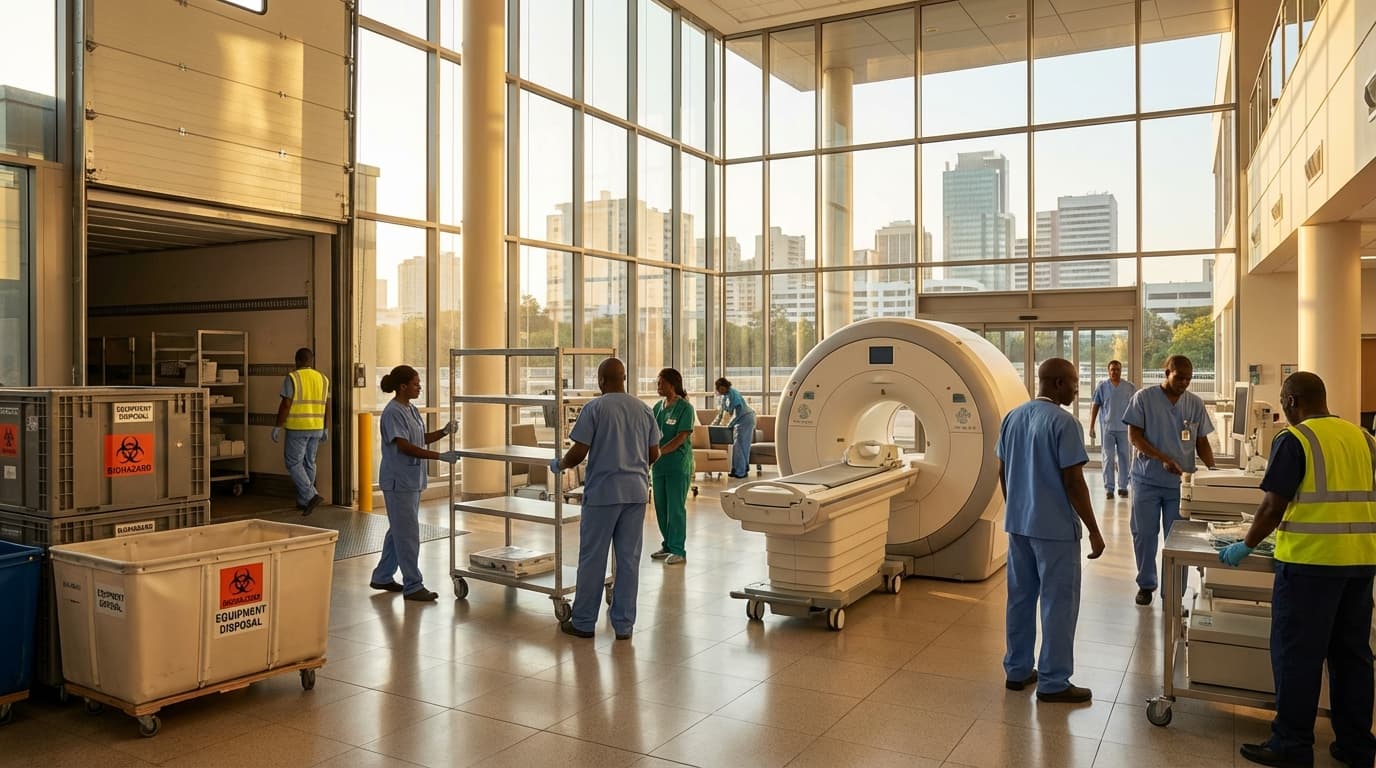
Decommissioning Service for Medical Devices in Comoros
Engineering Excellence & Technical Support
Decommissioning Service for Medical Devices High-standard technical execution following OEM protocols and local regulatory frameworks.
Regulatory Compliance Assurance
Our decommissioning services ensure strict adherence to Comorian healthcare regulations and international best practices for medical device disposal, safeguarding against environmental and legal liabilities.
Environmentally Responsible Disposal
We prioritize eco-friendly disposal methods, including secure data destruction and proper material segregation for recycling, minimizing the environmental impact of retired medical equipment in Comoros.
Secure Data Eradication
Comprehensive data sanitization protocols are implemented for all devices with storage capabilities, guaranteeing the complete and irreversible erasure of sensitive patient and operational information.
What Is Decommissioning Service For Medical Devices In Comoros?
Decommissioning service for medical devices in Comoros refers to the systematic and safe process of retiring medical equipment from service. This involves the secure disposal, recycling, or environmentally responsible destruction of these devices, ensuring compliance with local regulations and international best practices. The service is critical for healthcare facilities to manage their inventory of medical technology, mitigate risks associated with outdated or non-functional equipment, and maintain a secure and compliant operational environment.
| Who Needs Decommissioning Service? | Typical Use Cases |
|---|---|
| Hospitals and Clinics: | End-of-life equipment (e.g., expired MRI machines, CT scanners, X-ray units). |
| Diagnostic Laboratories: | Outdated analytical instruments and diagnostic equipment. |
| Research Institutions: | Obsolete or non-functional specialized medical research equipment. |
| Government Health Agencies: | Equipment removed from public health facilities or during program closures. |
| Private Medical Practices: | Any medical device no longer in use or requiring replacement. |
Key Components of Medical Device Decommissioning Service:
- Inventory Management and Asset Tracking: Documenting all decommissioned devices, including serial numbers, acquisition dates, and maintenance history.
- Data Sanitization and Destruction: Securely erasing all patient data and sensitive information stored on the device to prevent breaches.
- Environmental Assessment and Disposal Planning: Evaluating the device's materials for potential hazards (e.g., hazardous substances) and determining the most appropriate disposal method (e.g., recycling, incineration, landfill).
- Regulatory Compliance Verification: Ensuring adherence to Comorian environmental protection laws, waste management regulations, and any specific guidelines for medical waste disposal.
- Safe Removal and Transportation: Physically disconnecting, dismantling (if necessary), and safely transporting the device to the designated disposal or recycling facility.
- Certification of Disposal: Providing documentation verifying that the device has been decommissioned and disposed of in accordance with established protocols and regulations.
Who Needs Decommissioning Service For Medical Devices In Comoros?
Decommissioning service for medical devices in Comoros is crucial for ensuring patient safety, environmental protection, and regulatory compliance. This service is essential for healthcare facilities that need to retire, replace, or dispose of old, damaged, or obsolete medical equipment in a responsible and secure manner. The process typically involves data sanitization, physical destruction, and proper waste management to prevent unauthorized access to sensitive patient information and to minimize environmental hazards.
| Target Customer Group | Key Departments Requiring Decommissioning | Reasons for Decommissioning |
|---|---|---|
| Hospitals (Public and Private) | IT Department (for devices with data storage), Biomedical Engineering/Biomedical Equipment Maintenance, Radiology, Pathology, Surgery, Central Sterilization Supply Department (CSSD), Procurement/Materials Management | Equipment upgrade, end-of-life, malfunction, redundancy, space optimization, data security breaches, compliance with disposal regulations. |
| Clinics and Health Centers | Administration, Clinical Staff (Physicians, Nurses), Equipment Technicians (if applicable) | Obsolescence, frequent breakdowns, limited budget for repairs, adoption of new technologies. |
| Diagnostic Laboratories | Laboratory Management, Technical Staff, IT Department | Outdated diagnostic equipment, calibration failures, need for advanced testing capabilities, data privacy concerns. |
| Research Institutions (if any) | Research Department Heads, Laboratory Managers, IT/Data Management | Equipment no longer suited for research protocols, data archival requirements, advancements in research technology. |
| Government Health Agencies | Health Ministry Departments (e.g., Public Health, Medical Supplies), Regulatory Compliance Officers | Stock clearance, standardization of medical equipment, compliance oversight, public health initiatives for safe disposal. |
Target Customers and Departments for Medical Device Decommissioning Services in Comoros
- Hospitals (Public and Private)
- Clinics and Health Centers
- Diagnostic Laboratories
- Research Institutions (if any)
- Government Health Agencies
Decommissioning Service For Medical Devices Process In Comoros
This document outlines the standardized workflow for decommissioning medical devices in the Comoros, from the initial inquiry to the final execution of the service. The process aims to ensure safe, environmentally responsible, and compliant disposal or repurposing of medical equipment.
| Step | Activity | Responsible Party | Key Deliverables/Outcomes | Regulatory Compliance Considerations |
|---|---|---|---|---|
| 1.1 | Initial Inquiry | Healthcare Facility/Client | Service request submission | None |
| 1.2 | Service Provider Confirmation | Decommissioning Service Provider | Acknowledgement of inquiry, initial scope understanding | None |
| 2.1 | Device Inventory and Information Collection | Healthcare Facility/Client & Service Provider | Detailed list of devices (make, model, serial number, condition) | HIPAA/Data privacy compliance (for devices with patient data storage) |
| 2.2 | Site Visit and Risk Assessment | Service Provider | Assessment of access, safety hazards, workspace requirements | Occupational safety regulations (e.g., handling hazardous materials) |
| 3.1 | Proposal Generation | Service Provider | Detailed proposal (scope, methodology, timeline, cost, disposal plan) | None |
| 3.2 | Proposal Review and Negotiation | Healthcare Facility/Client & Service Provider | Agreement on terms and conditions | None |
| 3.3 | Contract Signing | Healthcare Facility/Client & Service Provider | Formal service agreement | Contract law |
| 4.1 | Detailed Execution Plan | Service Provider | Operational plan for on-site work, transportation, disposal | None |
| 4.2 | Permit and Authorization Acquisition | Service Provider | Necessary permits for transport, disposal, and potential hazardous material handling | National and local environmental regulations, Ministry of Health guidelines |
| 5.1 | On-Site Decommissioning Activities | Service Provider | Disassembly, cleaning, data sanitization (if applicable), secure packaging | Occupational safety and health standards, environmental protection regulations |
| 5.2 | Decontamination (if required) | Service Provider | Disinfection and sterilization procedures | Infection control guidelines |
| 6.1 | Secure Transportation | Service Provider | Safe transit of devices to designated facility | Transportation regulations, handling of potentially hazardous materials |
| 6.2 | Disposal/Recycling/Repurposing | Service Provider | Environmentally sound disposal, material recycling, or donation/resale | National waste management regulations, hazardous waste disposal guidelines, ethical considerations for repurposing |
| 7.1 | Documentation and Record Keeping | Service Provider | Detailed records of all activities, chain of custody | Audit trails, traceability requirements |
| 7.2 | Issuance of Certificate of Decommissioning | Service Provider | Formal document certifying completion of service | Client requirement, evidence for regulatory bodies |
| 8.1 | Client Feedback and Review | Healthcare Facility/Client & Service Provider | Confirmation of service completion and satisfaction | None |
| 8.2 | Final Reporting | Service Provider | Summary report of the decommissioning process | Compliance reporting |
Decommissioning Service for Medical Devices Process in Comoros: Workflow
- {"title":"Phase 1: Inquiry and Initial Assessment","description":"The process begins with a healthcare facility or authorized entity initiating an inquiry for medical device decommissioning services."}
- {"title":"Phase 2: Information Gathering and Site Visit","description":"Detailed information about the devices to be decommissioned is collected, followed by a physical site visit to assess the scope of work."}
- {"title":"Phase 3: Proposal and Agreement","description":"A comprehensive proposal is submitted, outlining the scope, methodology, timeline, and costs. Upon agreement, a formal contract is signed."}
- {"title":"Phase 4: Planning and Logistics","description":"Detailed plans for transportation, disassembly, storage, and disposal are developed. Necessary permits and authorizations are obtained."}
- {"title":"Phase 5: On-Site Execution","description":"The decommissioning team arrives at the facility and performs the agreed-upon services, including disassembly, cleaning, and data sanitization."}
- {"title":"Phase 6: Transportation and Disposal/Repurposing","description":"Devices are securely transported to a designated facility for environmentally sound disposal, recycling, or potential repurposing."}
- {"title":"Phase 7: Documentation and Certification","description":"All decommissioning activities are meticulously documented, and a certificate of decommissioning is issued to the client."}
- {"title":"Phase 8: Post-Decommissioning Review","description":"A final review is conducted to ensure client satisfaction and adherence to all regulatory requirements."}
Decommissioning Service For Medical Devices Cost In Comoros
Decommissioning medical devices in Comoros involves a series of steps, from secure data erasure to environmentally sound disposal. The cost of these services is influenced by several key factors, making a precise price range dependent on the specifics of each project. Understanding these factors is crucial for healthcare facilities planning for the end-of-life management of their medical equipment. The local currency, the Comorian Franc (KMF), is used for all pricing. It's important to note that this is a developing market, and availability of specialized decommissioning services might be limited, potentially impacting costs.
| Device Category | Estimated Cost Range (KMF) | Typical Decommissioning Scope |
|---|---|---|
Key Pricing Factors for Medical Device Decommissioning in Comoros:
- {"title":"Device Type and Complexity","description":"Larger, more complex, or highly specialized medical devices (e.g., MRI machines, CT scanners, sophisticated laboratory equipment) require more intricate decommissioning processes. This includes more extensive disassembly, specialized handling, and potentially the need for expert technicians. Simpler devices like basic diagnostic tools or furniture will be less expensive."}
- {"title":"Data Security and Erasure Requirements","description":"Medical devices often store sensitive patient data. The level of data sanitization required can significantly impact cost. Secure data erasure (e.g., multi-pass wiping, physical destruction of storage media) is more time-consuming and resource-intensive than basic data deletion. Compliance with any local or international data privacy regulations will dictate the required methods."}
- {"title":"Quantity of Devices","description":"As with most services, there can be economies of scale. Decommissioning a large volume of devices in a single project might result in a lower per-unit cost compared to decommissioning individual items sporadically. Bulk discounts are often negotiable."}
- {"title":"Transportation and Logistics","description":"The cost of transporting devices from the healthcare facility to the decommissioning site is a significant factor. This includes fuel, vehicle wear and tear, and labor. The remoteness of the facility within Comoros and the accessibility of the decommissioning facility will influence these costs. Specialized transport for large or hazardous equipment will be more expensive."}
- {"title":"Environmental Disposal Methods","description":"The method of disposal is critical. Environmentally sound practices, such as recycling of valuable components, proper handling of hazardous materials (e.g., refrigerants, mercury), and responsible landfilling or incineration, come with associated costs. Lack of advanced recycling infrastructure in Comoros might lead to higher disposal costs for certain materials."}
- {"title":"Service Provider Expertise and Reputation","description":"Experienced and reputable decommissioning service providers may command higher prices due to their proven track record, certified personnel, and adherence to best practices. Newer or less established providers might offer lower prices but with potentially higher risks."}
- {"title":"Regulatory Compliance and Certification","description":"If specific regulatory approvals or certifications are required for the decommissioning process or for the disposal of certain components, this can add to the overall cost. This may involve documentation, inspections, and specialized permits."}
- {"title":"Dismantling and Deconstruction","description":"The level of dismantling required before disposal will affect labor costs. Some devices may need to be fully disassembled to separate materials for recycling or to safely remove hazardous components."}
Affordable Decommissioning Service For Medical Devices Options
Decommissioning medical devices responsibly is crucial for data security, regulatory compliance, and environmental sustainability. Finding affordable options requires a strategic approach, focusing on value bundles and implementing cost-saving strategies. This guide outlines how to achieve cost-effective medical device decommissioning.
| Cost-Saving Strategy | Description | Impact on Affordability |
|---|---|---|
| Negotiate Volume Discounts | For organizations with a large number of devices to decommission, negotiating discounts based on the total volume of services can lead to substantial savings. | Directly reduces per-device cost. |
| Long-Term Contracts | Committing to a service provider for an extended period can often secure more favorable pricing and preferential service. | Secures lower rates and potential for additional benefits. |
| Prioritize Data Wiping Over Physical Destruction | For devices where data wiping meets regulatory requirements, it can be less expensive than complete physical destruction, especially for high-value reusable components. | Reduces material and processing costs. |
| Explore Certified Recyclers | Partnering with certified e-waste recyclers who specialize in medical equipment can ensure responsible disposal and potentially recoup value from certain components. | Minimizes disposal fees and can generate revenue. |
| Phased Decommissioning | Instead of a single large decommissioning project, breaking it down into smaller, phased approaches can help manage costs and workflow more effectively. | Spreads costs over time, aids budget management. |
| Internal Training and Standardization | Training in-house staff on basic decommissioning procedures (where appropriate and compliant) can reduce reliance on external services for less critical tasks. | Reduces external service fees for simpler tasks. |
| Request Detailed Quotes and Compare Providers | Obtain comprehensive quotes from multiple reputable decommissioning service providers, clearly outlining all included services and any potential add-ons. | Ensures competitive pricing and identification of hidden costs. |
Understanding Value Bundles
- {"title":"What are Value Bundles?","description":"Value bundles are service packages that combine multiple decommissioning tasks into a single offering at a reduced price compared to individual service costs. They are designed to provide comprehensive solutions and predictable budgeting."}
- {"title":"Common Components of Medical Device Decommissioning Bundles","description":"These bundles often include services such as secure data wiping, physical destruction of storage media, asset inventory and tracking, environmental disposal/recycling, and certification of services rendered."}
- {"title":"Benefits of Bundled Services","description":"Opting for bundles can streamline the decommissioning process, reduce administrative overhead, ensure all necessary steps are covered, and often result in significant cost savings through economies of scale."}
- {"title":"Choosing the Right Bundle","description":"Evaluate your specific needs, the volume and types of devices, and the required level of data destruction and regulatory compliance to select a bundle that offers the best value for your organization."}
Verified Providers In Comoros
In Comoros, navigating the healthcare landscape and finding trustworthy medical professionals is paramount for residents and visitors alike. Verified providers offer a crucial layer of assurance, ensuring that individuals receive care from qualified and credentialed practitioners. Franance Health stands out as a premier organization dedicated to identifying and endorsing these verified providers. Their rigorous credentialing process is designed to uphold the highest standards of medical expertise, ethical practice, and patient safety, making them a critical partner in delivering quality healthcare.
| Franance Health Credentialing Aspect | Why it Matters for Patients in Comoros | What it Demonstrates |
|---|---|---|
| Medical Licensure and Board Certification Verification | Ensures providers are legally permitted to practice and have met recognized levels of expertise. | Legal authorization and specialized competency. |
| Educational Background and Training Assessment | Confirms that practitioners have completed accredited medical programs and specialized training. | Academic rigor and practical preparedness. |
| Peer Review and Professional References | Validates a provider's performance and reputation within the medical community. | Clinical efficacy and professional standing. |
| Continuous Professional Development (CPD) Monitoring | Guarantees that providers remain current with the latest medical advancements and best practices. | Commitment to ongoing learning and modern medicine. |
| Adherence to Ethical Codes and Standards of Conduct | Ensures that providers prioritize patient well-being, confidentiality, and respect. | Integrity and patient advocacy. |
Key Benefits of Choosing Verified Providers in Comoros:
- Enhanced Patient Safety: Verified providers have undergone thorough background checks and have demonstrated adherence to professional standards, minimizing risks.
- Access to Competent Professionals: Credentials confirm that practitioners possess the necessary education, training, and experience for their specialized fields.
- Increased Trust and Confidence: Knowing a provider is verified by a reputable organization like Franance Health builds confidence in the quality of care received.
- Streamlined Healthcare Decisions: Verification simplifies the process of selecting a healthcare provider, saving time and reducing uncertainty.
- Upholding Ethical Standards: Verified providers are committed to ethical medical practices and patient-centered care.
Scope Of Work For Decommissioning Service For Medical Devices
This Scope of Work (SOW) outlines the requirements for the decommissioning of medical devices. It details the technical deliverables and standard specifications necessary to ensure safe, compliant, and environmentally responsible removal and disposal of these assets. The decommissioning process will cover the entire lifecycle of a medical device from its removal from service to its final disposition, including data sanitization, physical dismantling, and waste management.
| Technical Deliverable | Description | Standard Specification / Requirement | Verification Method |
|---|---|---|---|
| Decommissioning Plan | A detailed plan outlining the methodology, schedule, resources, safety procedures, and environmental considerations for the decommissioning project. | Must include risk assessment, waste management strategy, compliance with local/national regulations (e.g., HIPAA, EPA, FDA). | Review and approval by the Client's Project Manager. |
| Asset Inventory Report | A comprehensive list of all medical devices to be decommissioned, including manufacturer, model, serial number, location, and current status. | Must be accurate, verified on-site, and include asset tag information where applicable. | Physical verification against initial inventory during the decommissioning process. |
| Data Sanitization Certificate | Confirmation that all sensitive data stored on the medical device has been securely erased or destroyed. | Compliance with industry standards for data sanitization (e.g., NIST SP 800-88, DoD 5220.22-M). | Certificate of Destruction/Sanitization provided by the service provider, detailing the method used and the specific devices sanitized. |
| Device Dismantling Report | Details of the physical dismantling process, including any components that require special handling or disposal. | Adherence to manufacturer's guidelines where available, and safe dismantling practices. | Visual inspection of dismantled components; photographic evidence for complex dismantling. |
| Waste Manifests / Certificates of Disposal | Documentation for the proper disposal of all waste materials generated, including hazardous waste. | Compliance with all relevant environmental regulations for waste disposal. Use of licensed and certified disposal facilities. | Signed manifests from licensed waste haulers and disposal facilities. Certificates of Recycling/Disposal for specific materials. |
| Final Decommissioning Report | A comprehensive summary of the entire decommissioning process, including all deliverables, a record of any deviations from the plan, and confirmation of project completion. | Includes all supporting documentation (inventory, certificates, manifests). | Review and acceptance by the Client's Project Manager. |
| Environmental Compliance Report | Documentation confirming adherence to all environmental regulations throughout the decommissioning process. | Includes records of emissions, waste handling, and disposal practices. | Audit by an independent environmental consultant or regulatory body, or client review. |
| Safety Compliance Report | Documentation confirming adherence to all occupational health and safety regulations. | Includes records of safety training, incident reports, and use of personal protective equipment (PPE). | Audit by a safety officer or regulatory body, or client review. |
Key Stages of Decommissioning
- Site Assessment and Planning
- Asset Inventory and Verification
- Data Sanitization and Destruction
- Physical Dismantling and Removal
- Waste Segregation and Disposal
- Documentation and Certification
Service Level Agreement For Decommissioning Service For Medical Devices
This Service Level Agreement (SLA) outlines the performance standards for decommissioning services provided for medical devices. It specifies response times for incident reporting and critical issue resolution, as well as uptime guarantees for any supporting systems or personnel directly involved in the decommissioning process.
| Service Element | Service Level Objective (SLO) | Measurement Method | Reporting Frequency |
|---|---|---|---|
| Initial Response to Incident Report (Critical) | Within 2 business hours | Timestamp of incident report acknowledgement | Upon occurrence |
| Initial Response to Incident Report (High) | Within 4 business hours | Timestamp of incident report acknowledgement | Upon occurrence |
| Initial Response to Incident Report (Medium) | Within 8 business hours | Timestamp of incident report acknowledgement | Upon occurrence |
| Resolution of Critical Incidents | Within 24 business hours | Timestamp of incident resolution confirmation | Upon occurrence |
| Resolution of High Incidents | Within 72 business hours | Timestamp of incident resolution confirmation | Upon occurrence |
| Resolution of Medium Incidents | Within 5 business days | Timestamp of incident resolution confirmation | Upon occurrence |
| Availability of Decommissioning Project Manager | 99.5% during business hours (Monday-Friday, 9 AM - 5 PM Local Time) | Monitoring of calendar availability and response to communication | Monthly |
| Availability of Technical Support for Decommissioning Systems (if applicable) | 99.0% uptime | System monitoring logs | Monthly |
Key Service Level Objectives
- Response Times for Incident Reporting and Resolution
- Uptime Guarantees for Support Systems/Personnel
Frequently Asked Questions

Ready when you are
Let's scope your Decommissioning Service for Medical Devices in Comoros project in Comoros.

Scaling healthcare logistics and technical systems across the entire continent.