
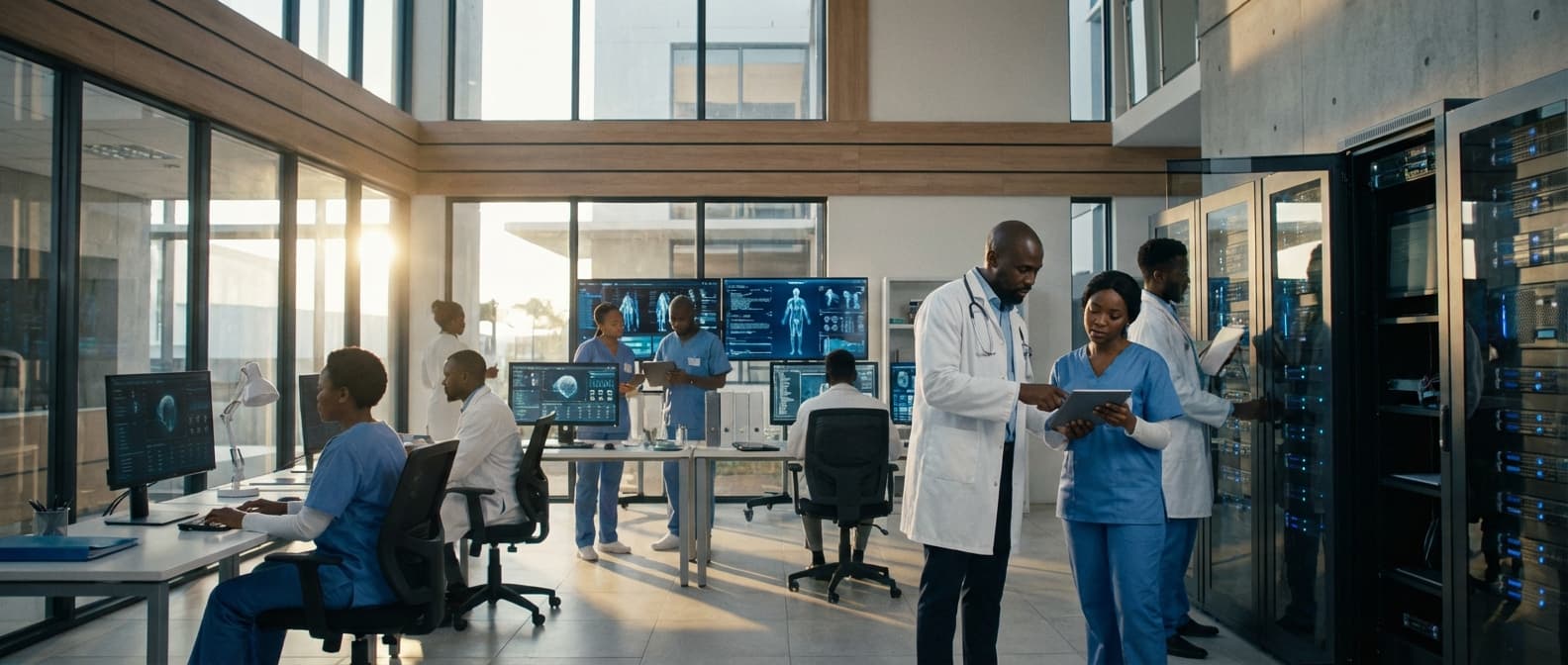
Medical IT Consultation in Comoros
Engineering Excellence & Technical Support
Strategic technology consulting to optimize healthcare operations, streamline workflows, and integrate cutting-edge medical information systems. High-standard technical execution following OEM protocols and local regulatory frameworks.
Cloud-Based EHR Implementation
Successfully deployed a scalable, cloud-based Electronic Health Records (EHR) system across multiple healthcare facilities in Comoros, enhancing data accessibility, security, and patient care coordination.
Secure Network Infrastructure
Designed and implemented robust, secure network infrastructure, including VPNs and firewalls, ensuring the protection of sensitive patient data and compliance with evolving data privacy regulations in the region.
Telemedicine Platform Rollout
Led the successful rollout of a telemedicine platform, enabling remote consultations and specialist access for underserved populations in Comoros, significantly improving healthcare accessibility and reducing patient travel burdens.
What Is Medical It Consultation In Comoros?
Medical IT Consultation in Comoros refers to the specialized advisory services provided to healthcare organizations and professionals in the Comorian archipelago concerning the strategic planning, implementation, optimization, and management of information technology (IT) systems within a medical context. This service aims to enhance clinical workflows, improve patient care delivery, ensure data security and compliance, and leverage technology for operational efficiency and research. It encompasses a broad spectrum of IT-related needs tailored to the unique healthcare landscape and infrastructure constraints prevalent in Comoros, including but not limited to electronic health records (EHRs), telemedicine, medical imaging systems (PACS), laboratory information systems (LIS), hospital information systems (HIS), data analytics, cybersecurity, and IT infrastructure development.
| Who Needs Medical IT Consultation in Comoros? | Typical Use Cases | ||
|---|---|---|---|
| Hospitals (Public and Private): Seeking to modernize patient record management, improve administrative efficiency, and enhance clinical decision-making. | Implementation of an Electronic Health Record (EHR) system to replace paper-based records. | Establishing a secure network infrastructure for data transmission. | Deploying a Picture Archiving and Communication System (PACS) for medical imaging. |
| Clinics and Health Centers (Urban and Rural): Aiming to improve patient registration, appointment scheduling, and basic health data collection. | Adopting a simplified clinic management system. | Setting up a patient portal for appointment booking and basic health information access. | Exploring basic telemedicine capabilities for remote consultations. |
| Government Health Ministries and Agencies: Requiring oversight of national health IT strategy, data standardization, and public health surveillance. | Developing a national health information exchange (HIE) strategy. | Implementing a disease surveillance system. | Establishing data standards for health reporting. |
| Medical Research Institutions: Needing robust data management and analysis tools for clinical research. | Setting up secure databases for research data. | Implementing data anonymization techniques. | Utilizing statistical software for analysis. |
| Pharmaceutical Companies and Medical Device Vendors: Requiring IT support for regulatory compliance and data management related to their products and services. | Ensuring compliance of IT systems with medical device regulations. | Managing data from clinical trials or post-market surveillance. | |
| Non-Governmental Organizations (NGOs) involved in healthcare: Needing efficient IT solutions for program delivery and data collection in underserved areas. | Implementing mobile health (mHealth) solutions for data collection in the field. | Setting up a basic IT infrastructure for remote health posts. | |
| Start-ups in the Healthtech sector: Developing innovative health IT solutions for the Comorian market. | Seeking guidance on regulatory requirements and market entry strategies. | Designing scalable and secure IT architectures. |
Key Components of Medical IT Consultation in Comoros
- Needs Assessment and Strategic Planning: Analyzing existing IT infrastructure, identifying gaps, and developing a roadmap for technology adoption aligned with organizational goals and healthcare priorities.
- System Selection and Procurement: Guiding healthcare entities in choosing appropriate EHR/EMR systems, LIS, PACS, HIS, and other medical software and hardware solutions that meet functional requirements and budget constraints.
- Implementation and Integration: Overseeing the installation, configuration, and integration of new IT systems with existing infrastructure, ensuring seamless data flow and interoperability.
- Data Management and Security: Developing and implementing policies and procedures for data governance, privacy (e.g., adherence to relevant data protection regulations), and robust cybersecurity measures to protect sensitive patient information.
- Telemedicine and Remote Healthcare Solutions: Advising on the deployment and utilization of telemedicine platforms to extend healthcare access to remote areas and facilitate remote consultations.
- Infrastructure Assessment and Upgrade: Evaluating current network, hardware, and software infrastructure and recommending upgrades or replacements to support advanced medical IT solutions.
- Training and Support: Providing training to healthcare professionals and IT staff on new systems and offering ongoing technical support and troubleshooting.
- Regulatory Compliance: Ensuring IT systems and practices comply with national health regulations and international best practices for healthcare IT.
- IT Governance and Policy Development: Establishing IT governance frameworks, policies, and procedures for effective IT management and decision-making.
- Cost Optimization and ROI Analysis: Identifying opportunities to reduce IT expenditures and demonstrating the return on investment (ROI) for technology initiatives.
Who Needs Medical It Consultation In Comoros?
Medical IT consultation in Comoros is essential for a range of healthcare organizations aiming to leverage technology for improved patient care, operational efficiency, and data security. The unique challenges and evolving healthcare landscape in Comoros necessitate expert guidance in implementing and managing IT solutions. This consultation can address everything from basic infrastructure setup and cybersecurity to advanced data analytics and telehealth integration.
| Customer Type | Key Departments Involved | Primary IT Needs | Example Consultation Areas |
|---|---|---|---|
| Public Hospitals | Administration, IT Department, Medical Records, Pharmacy, Outpatient/Inpatient Wards | EHR implementation, Network infrastructure, Data security, Patient portal development, Telehealth readiness | Optimizing EHR workflows, Cybersecurity audits, Training staff on new systems, Setting up remote patient monitoring capabilities |
| Private Clinics | Practice Management, Front Desk, Billing, IT Support (if any), Clinical Staff | Practice Management Software (PMS), Patient scheduling, Secure data storage, Basic network security, Digital marketing integration | Selecting and implementing a PMS, Enhancing appointment booking efficiency, Protecting patient PII, Establishing a secure Wi-Fi network for patients |
| Specialty Centers | Radiology, Laboratory, Cardiology, IT Department, Administration | PACS integration, LIS implementation, Medical imaging software, Data analytics for research, Interoperability with EHRs | Integrating new diagnostic equipment with existing IT, Developing reporting dashboards for lab results, Ensuring seamless data flow between systems |
| NGOs/International Health Orgs | Project Management, Data Management, M&E, Field Operations, IT Coordination | Data collection tools, Secure data sharing platforms, Mobile health solutions, Project management software, Communication infrastructure | Developing mobile data entry solutions for field surveys, Setting up encrypted communication channels, Implementing project tracking software |
| Ministry of Health | Health Information Systems, Public Health Surveillance, Policy & Planning, IT Division | National Health Information Exchange (HIE), Epidemiological surveillance systems, Health data analytics, Digital health strategy development, E-government integration | Designing a national EHR framework, Implementing real-time disease outbreak monitoring, Developing policy for data privacy and security in healthcare |
Target Customers and Departments for Medical IT Consultation in Comoros
- {"title":"Public Hospitals and Health Centers","description":"Government-run facilities across the islands that often face budget constraints but are critical for public health. IT consultation can help them optimize existing systems, implement Electronic Health Records (EHRs), and enhance data management for better public health reporting and resource allocation."}
- {"title":"Private Clinics and Medical Practices","description":"Smaller to medium-sized private healthcare providers seeking to modernize their operations. Consultation can assist with setting up practice management software, securing patient data, implementing appointment scheduling systems, and exploring options for digital patient engagement."}
- {"title":"Specialty Hospitals and Diagnostic Centers","description":"Facilities focusing on specific medical areas (e.g., cardiology, radiology) or offering advanced diagnostic services. IT consultation can guide them in acquiring and integrating specialized medical imaging software (PACS), laboratory information systems (LIS), and other domain-specific technologies."}
- {"title":"Non-Governmental Organizations (NGOs) and International Health Organizations","description":"Entities working on health initiatives in Comoros. IT consultation can help them establish robust IT infrastructures for their projects, ensure data privacy and compliance, and facilitate communication and data sharing with local partners."}
- {"title":"Ministry of Health and Public Health Agencies","description":"Government bodies responsible for national health policy, planning, and oversight. IT consultation can support the development of national health information systems, data analytics for epidemiological surveillance, and the implementation of digital health strategies."}
- {"title":"Pharmaceutical Companies and Medical Device Suppliers","description":"Businesses operating in the healthcare supply chain. While not direct healthcare providers, they may require IT expertise for supply chain management, data integration with healthcare facilities, and ensuring compliance with data regulations related to their products."}
Medical It Consultation Process In Comoros
The Medical IT Consultation Process in Comoros outlines the systematic approach taken by IT service providers to address the unique technological needs of healthcare facilities in the Comoros. This process ensures that inquiries are handled efficiently, solutions are tailored to the specific context, and implementations are carried out effectively, ultimately aiming to improve healthcare delivery through appropriate IT integration. The workflow begins with an initial inquiry from a healthcare facility and progresses through a series of defined stages, including needs assessment, proposal development, agreement, implementation, and ongoing support. Each stage is crucial for understanding the client's requirements, developing suitable IT strategies, and ensuring successful adoption and long-term functionality.
| Stage | Description | Key Activities | Deliverables | Key Stakeholders |
|---|---|---|---|---|
| Initial Inquiry and Contact | The process begins when a healthcare facility (hospital, clinic, health center) in Comoros contacts a Medical IT consulting firm with a request for IT services or to address a specific IT challenge. | Receiving inquiry (email, phone, referral), initial screening, scheduling a preliminary meeting. | Acknowledgement of inquiry, confirmation of meeting. | Healthcare Facility Representative, IT Consulting Firm Representative |
| Needs Assessment and Requirements Gathering | A thorough understanding of the healthcare facility's current IT infrastructure, operational workflows, pain points, and future goals is established. | On-site visits, interviews with staff, system audits, data analysis, understanding regulatory compliance needs. | Needs assessment report, documented requirements, list of potential challenges. | Healthcare Facility IT Staff, Clinical Staff, Management, IT Consultants |
| Solution Design and Proposal Development | Based on the gathered requirements, the IT consulting firm designs a tailored IT solution that addresses the identified needs and aligns with the facility's budget and objectives. | Architecting IT systems (EHR, HIS, PACS, network), selecting appropriate hardware/software, estimating costs, developing project timelines. | Detailed proposal, technical specifications, cost breakdown, project timeline, proposed solution architecture. | IT Consultants, Technical Specialists, Healthcare Facility Management |
| Proposal Review and Negotiation | The healthcare facility reviews the proposed solution and cost, and negotiations take place to finalize the scope of work, deliverables, and terms. | Presentation of proposal, Q&A sessions, discussions on modifications, budget adjustments. | Agreed-upon scope of work, revised proposal (if necessary). | Healthcare Facility Management, IT Consultants |
| Contract Agreement | A formal contract is drafted and signed, outlining the rights and responsibilities of both parties, the scope of services, payment terms, and service level agreements (SLAs). | Legal review, contract drafting, signature by authorized representatives. | Signed contract/agreement. | Healthcare Facility Legal Counsel, IT Consulting Firm Legal Counsel, Management |
| Project Planning and Scoping | A detailed project plan is developed, breaking down the implementation into manageable phases, defining roles and responsibilities, and establishing communication protocols. | Detailed project plan creation, resource allocation, risk management planning, communication strategy development. | Detailed project plan, work breakdown structure (WBS), communication plan. | Project Manager, IT Consultants, Healthcare Facility IT Team |
| Implementation and Deployment | The designed IT solutions are installed, configured, and tested in the healthcare facility's environment. | Hardware installation, software deployment, network setup, data migration, system integration, user acceptance testing (UAT). | Operational IT systems, integrated platforms. | IT Consultants, Technical Specialists, Healthcare Facility IT Staff |
| Training and Handover | End-users and IT staff are trained on how to effectively use and manage the new IT systems. The systems are formally handed over to the facility. | Conducting training sessions, creating user manuals, providing support during handover. | Trained staff, user manuals, handover documentation. | IT Consultants, Healthcare Facility Staff (Users and IT) |
| Post-Implementation Support and Maintenance | Ongoing technical support, troubleshooting, system updates, and regular maintenance are provided to ensure the continued smooth operation of the IT systems. | Helpdesk support, remote/on-site troubleshooting, software/hardware maintenance, security monitoring. | Resolved issues, system updates, performance reports. | IT Support Team, Healthcare Facility IT Staff |
| Performance Review and Optimization | Regular reviews are conducted to assess the performance of the implemented IT solutions and identify areas for improvement or further optimization. | Performance monitoring, user feedback collection, system audits, recommending upgrades or new solutions. | Performance review reports, optimization recommendations, future IT strategy input. | IT Consultants, Healthcare Facility Management, IT Staff |
Medical IT Consultation Workflow Stages in Comoros
- Initial Inquiry and Contact
- Needs Assessment and Requirements Gathering
- Solution Design and Proposal Development
- Proposal Review and Negotiation
- Contract Agreement
- Project Planning and Scoping
- Implementation and Deployment
- Training and Handover
- Post-Implementation Support and Maintenance
- Performance Review and Optimization
Medical It Consultation Cost In Comoros
Consulting on Medical IT in Comoros involves a nuanced pricing structure influenced by several factors. The complexity of the project, the specific services required, the experience and reputation of the IT consultant or firm, and the duration of the engagement all play a significant role. For smaller, more straightforward tasks like basic network setup or initial software recommendations, costs might be on the lower end. Conversely, implementing comprehensive Electronic Health Record (EHR) systems, cybersecurity audits, or custom software development will naturally command higher fees. The expertise of the consultant is also a crucial differentiator; highly specialized knowledge in healthcare IT, data privacy regulations (even within a local context), and integration of medical devices can lead to higher hourly or project rates. The competitive landscape of IT service providers in Comoros, while potentially less saturated than larger economies, still impacts pricing, with established firms or those with a proven track record in the medical sector often charging a premium for their reliability and expertise. Travel and accommodation expenses, if the consultant is not locally based, will also be factored into the overall cost.
| Service Type | Estimated Range (Comorian Franc - KMF) | Notes |
|---|---|---|
| Initial IT Assessment & Recommendation | 50,000 - 150,000 KMF | Basic review of current IT infrastructure, identifying immediate needs and suggesting solutions. |
| Network Setup & Configuration | 75,000 - 250,000 KMF | Includes planning, installation, and basic configuration of wired and wireless networks for a clinic or small hospital. |
| Software Selection & Procurement Advice | 40,000 - 100,000 KMF | Guidance on choosing appropriate medical software (practice management, basic EHR) based on budget and needs. |
| Basic EHR/EMR System Implementation Support | 200,000 - 800,000 KMF+ | Assistance with selecting, installing, configuring, and initial user training for a moderately complex EHR system. Can vary significantly based on system chosen. |
| Cybersecurity Consultation (Audit & Recommendations) | 100,000 - 300,000 KMF | Assessment of current security measures, identification of vulnerabilities, and recommendations for improvement to protect patient data. |
| IT Infrastructure Upgrade Planning | 75,000 - 200,000 KMF | Developing a roadmap for upgrading hardware, servers, and network components. |
| Custom Software Development (Small Scale) | 500,000 KMF+ | Development of small, specific applications or integrations. Costs escalate rapidly with complexity and features. |
| Hourly Consulting Rate | 15,000 - 40,000 KMF per hour | For ad-hoc support, troubleshooting, or ongoing project guidance. Rates depend on the consultant's expertise. |
Key Pricing Factors for Medical IT Consultation in Comoros:
- Project Complexity and Scope: Simple installations vs. comprehensive system deployments.
- Required Services: Network setup, software implementation, cybersecurity, data management, custom development, training.
- Consultant Experience and Reputation: Years in the field, successful healthcare IT projects, certifications.
- Duration of Engagement: Short-term advisory vs. long-term project management.
- Specialized Expertise: EHR/EMR systems, medical device integration, data analytics, compliance.
- Market Competition: Local availability and pricing of IT service providers.
- Travel and Accommodation: Applicable for non-local consultants.
Affordable Medical It Consultation Options
Navigating the complex landscape of medical IT can be daunting, especially for practices focused on patient care and budget. Fortunately, there are affordable medical IT consultation options available. These solutions often come in the form of value bundles, offering a comprehensive suite of services at a more predictable and cost-effective price point. By understanding these bundles and implementing cost-saving strategies, medical practices can leverage expert IT guidance without breaking the bank.
| Cost-Saving Strategies | Description | Example for Medical Practices |
|---|---|---|
| Opt for Managed IT Services (Value Bundles) | Instead of hiring in-house IT staff or paying for ad-hoc consulting, managed service providers (MSPs) offer comprehensive IT support through subscription-based bundles. This distributes costs evenly and provides access to a wider range of expertise. | A small clinic subscribes to a bundle that includes cybersecurity monitoring, EMR support, and remote help desk for a fixed monthly fee, saving on the cost of a full-time IT technician. |
| Leverage Cloud-Based Solutions | Cloud services (e.g., for EHR, practice management, data storage) reduce the need for expensive on-premise hardware, maintenance, and IT infrastructure management. | Migrating patient records and scheduling to a HIPAA-compliant cloud EHR system eliminates the need for server hardware and dedicated IT staff to manage it. |
| Prioritize Essential Services | Focus on the IT services that have the most direct impact on your practice's operations, compliance, and patient care. Avoid unnecessary or overly complex solutions. | A practice might prioritize robust cybersecurity and reliable EMR uptime over advanced analytics dashboards if their budget is limited. |
| Negotiate Contracts | Don't be afraid to negotiate terms and pricing with IT consultation providers. Compare quotes from multiple vendors and look for long-term contract discounts. | Requesting a multi-year contract for managed IT services could result in a lower monthly rate. |
| Standardize Hardware and Software | Using standardized equipment and software across your practice simplifies support, reduces troubleshooting time, and can lead to bulk purchasing discounts. | Implementing a single brand of computers and a unified operating system makes remote support more efficient and potentially lowers hardware acquisition costs. |
| Invest in User Training | Well-trained staff can prevent many common IT issues (e.g., phishing scams, improper software usage), reducing the burden on your IT support. | Regular training sessions on identifying phishing emails and secure data handling practices can prevent costly security breaches. |
Understanding Medical IT Consultation Value Bundles
- {"title":"What are Value Bundles?","description":"Value bundles are pre-packaged IT services designed to address common needs of medical practices. Instead of paying for individual services à la carte, you get a curated selection at a discounted rate, often with a recurring subscription model. This provides predictable costs and ensures you have essential IT support covered."}
- {"title":"Common Bundle Components","description":"These bundles typically include a mix of proactive and reactive IT services, such as:"}
- {"title":"Proactive Services","description":"Focus on preventing issues before they arise. This can include network monitoring, security patching, regular backups, system health checks, and user training."}
- {"title":"Reactive Services","description":"Address problems as they occur. This typically involves help desk support, remote troubleshooting, on-site emergency response (if applicable), and hardware/software repair or replacement coordination."}
- {"title":"Specialized Medical IT Services","description":"Many bundles also incorporate services crucial for healthcare, like HIPAA compliance assistance, EHR/EMR system support, cybersecurity for patient data, and cloud migration for medical applications."}
- {"title":"Benefits of Value Bundles","description":"Predictable monthly costs, reduced risk of unexpected IT expenses, access to a team of experts, improved system uptime and security, and the ability to focus on patient care rather than IT management."}
Verified Providers In Comoros
In Comoros, ensuring access to quality healthcare is paramount. Franance Health stands out as a leading entity in the region, committed to connecting individuals with verified healthcare providers. Understanding the importance of trust and reliability in medical services, Franance Health meticulously vets its network to guarantee that every provider meets stringent standards for expertise, professionalism, and patient care. This dedication to verification ensures that when you engage with a provider through Franance Health, you are choosing a healthcare professional who is not only qualified but also adheres to the highest ethical practices. Their robust credentialing process minimizes risks and maximizes the likelihood of a positive and effective healthcare experience.
| Provider Type | Key Verification Criteria | Franance Health Advantage |
|---|---|---|
| General Practitioners | Medical Degree, License to Practice, Professional References, Clean Disciplinary Record | Ensures access to primary care physicians with up-to-date knowledge and a commitment to patient well-being. |
| Specialists (e.g., Cardiologists, Pediatricians, Surgeons) | Board Certification in Specialty, Extensive Clinical Experience, Hospital Affiliations, Peer Reviews | Connects patients with highly skilled specialists equipped to handle complex medical conditions, backed by credible experience. |
| Dentists | Dental Degree, License to Practice, Continuing Education, Patient Feedback | Provides access to reliable dental care professionals focused on oral health, with a transparent record of patient satisfaction. |
| Pharmacists | Pharmacy Degree, License to Practice, Knowledge of Drug Interactions, Dispensing Accuracy | Guarantees that medication is dispensed by competent professionals prioritizing patient safety and accurate prescription fulfillment. |
Why Franance Health Represents the Best Choice for Verified Providers in Comoros:
- Rigorous Vetting Process: Franance Health employs a comprehensive screening protocol for all its healthcare professionals, ensuring they possess the necessary licenses, certifications, and a proven track record of competent practice.
- Commitment to Patient Safety: The primary focus of Franance Health's verification is to safeguard patient well-being, partnering only with providers who demonstrate a strong commitment to ethical conduct and patient-centered care.
- Access to Expertise: By partnering with Franance Health, individuals gain access to a curated network of specialists and general practitioners, offering a wide range of medical services tailored to the needs of the Comorian population.
- Enhanced Trust and Transparency: Franance Health provides a transparent platform where patients can feel confident in the qualifications and credibility of the healthcare providers they choose, fostering a relationship built on trust.
- Streamlined Healthcare Navigation: Navigating the healthcare landscape can be challenging. Franance Health simplifies this process by offering a reliable directory of verified providers, saving patients time and reducing uncertainty.
Scope Of Work For Medical It Consultation
This Scope of Work (SOW) outlines the consulting services to be provided by [Consulting Firm Name] (hereinafter referred to as "Consultant") to [Client Organization Name] (hereinafter referred to as "Client") for a comprehensive medical IT consultation. The objective is to assess, recommend, and guide the implementation of solutions to improve the Client's IT infrastructure, data security, patient care delivery systems, and operational efficiency within the healthcare environment.
| Phase | Key Activities | Deliverables | Estimated Timeline |
|---|---|---|---|
| Phase 1: Assessment & Analysis | On-site/remote interviews with stakeholders (IT staff, clinicians, administrators). Network and system audits. Review of current IT policies and procedures. Security vulnerability assessment. Current EHR/EMR system evaluation. | Current State Assessment Report. Gap Analysis Report. Preliminary Risk Assessment Report. | Weeks 1-4 |
| Phase 2: Strategy & Recommendation | Develop strategic IT roadmap. Research and evaluate potential solutions. Vendor assessment and selection support. Cost-benefit analysis of recommended solutions. Develop high-level architecture diagrams. | IT Strategy & Roadmap Document. Technology Recommendation Report. Vendor Evaluation Matrix. Proposed Budgetary Estimates. | Weeks 5-8 |
| Phase 3: Implementation Planning | Detailed project planning. Develop implementation schedules. Define resource requirements. Create training plans. Develop change management strategy. Finalize cybersecurity and DR/BCP plans. | Detailed Implementation Plan. Project Schedule. Resource Allocation Plan. Training Strategy Document. Cybersecurity & DR/BCP Enhancement Plan. | Weeks 9-12 |
| Phase 4: Oversight & Support (Optional) | Provide project management oversight during implementation. Offer technical guidance and troubleshooting. Conduct post-implementation review and optimization. Knowledge transfer to Client's IT staff. | Project Status Reports. Post-Implementation Review Report. Knowledge Transfer Sessions. Final Project Summary. | As per negotiated agreement (e.g., Weeks 13-24 or ongoing) |
Objectives
- Assess the current state of the Client's IT infrastructure, including hardware, software, networks, and cybersecurity measures.
- Evaluate existing electronic health record (EHR) systems, practice management software, and other clinical applications for functionality, interoperability, and user satisfaction.
- Identify key pain points and areas for improvement in IT operations, data management, and patient data security.
- Recommend strategic IT solutions and technologies aligned with the Client's short-term and long-term goals, including but not limited to cloud migration, telehealth solutions, data analytics, and AI applications.
- Develop a phased implementation roadmap with clear timelines, resource allocation, and budget considerations.
- Provide guidance on compliance with relevant healthcare regulations (e.g., HIPAA, HITECH, GDPR if applicable).
- Enhance cybersecurity posture and disaster recovery/business continuity plans.
- Improve IT support and helpdesk efficiency.
Service Level Agreement For Medical It Consultation
This Service Level Agreement (SLA) outlines the expected response times and uptime guarantees for Medical IT Consultation services provided by [Your Company Name] to [Client Name]. This agreement aims to ensure the consistent availability and timely support of critical IT systems within the healthcare environment.
| Severity Level | Description | Response Time Target | Resolution Time Target (Best Effort) | Uptime Guarantee (for affected systems) |
|---|---|---|---|---|
| Critical (Severity 1) | Complete system outage or major failure impacting patient care or critical operations (e.g., EHR down, inability to access patient records). | 15 minutes | 4 hours | 99.9% |
| High (Severity 2) | Significant degradation of service impacting a large number of users or a key function, but a workaround exists (e.g., slow network performance, intermittent access to a non-critical module). | 1 hour | 8 business hours | 99.5% |
| Medium (Severity 3) | Minor disruption to service affecting a limited number of users or a non-critical function (e.g., printer issue, specific software feature not working). | 4 business hours | 3 business days | 99.0% |
| Low (Severity 4) | General inquiry, feature request, or minor cosmetic issue with no immediate impact on operations (e.g., password reset, minor configuration request). | 8 business hours | 5 business days | N/A (not impacting operational uptime) |
Key Service Metrics
- Response Time: The maximum time within which [Your Company Name] will acknowledge and begin working on a reported incident or request.
- Resolution Time: The target time within which a resolved issue will be addressed, acknowledging that complex issues may require extended troubleshooting.
- Uptime Guarantee: The percentage of time critical IT systems, as defined in the scope of services, are expected to be operational and accessible.
- Severity Levels: A classification system to prioritize incidents based on their impact on critical healthcare operations.
Frequently Asked Questions

Ready when you are
Let's scope your Medical IT Consultation in Comoros project in Comoros.

Scaling healthcare logistics and technical systems across the entire continent.