
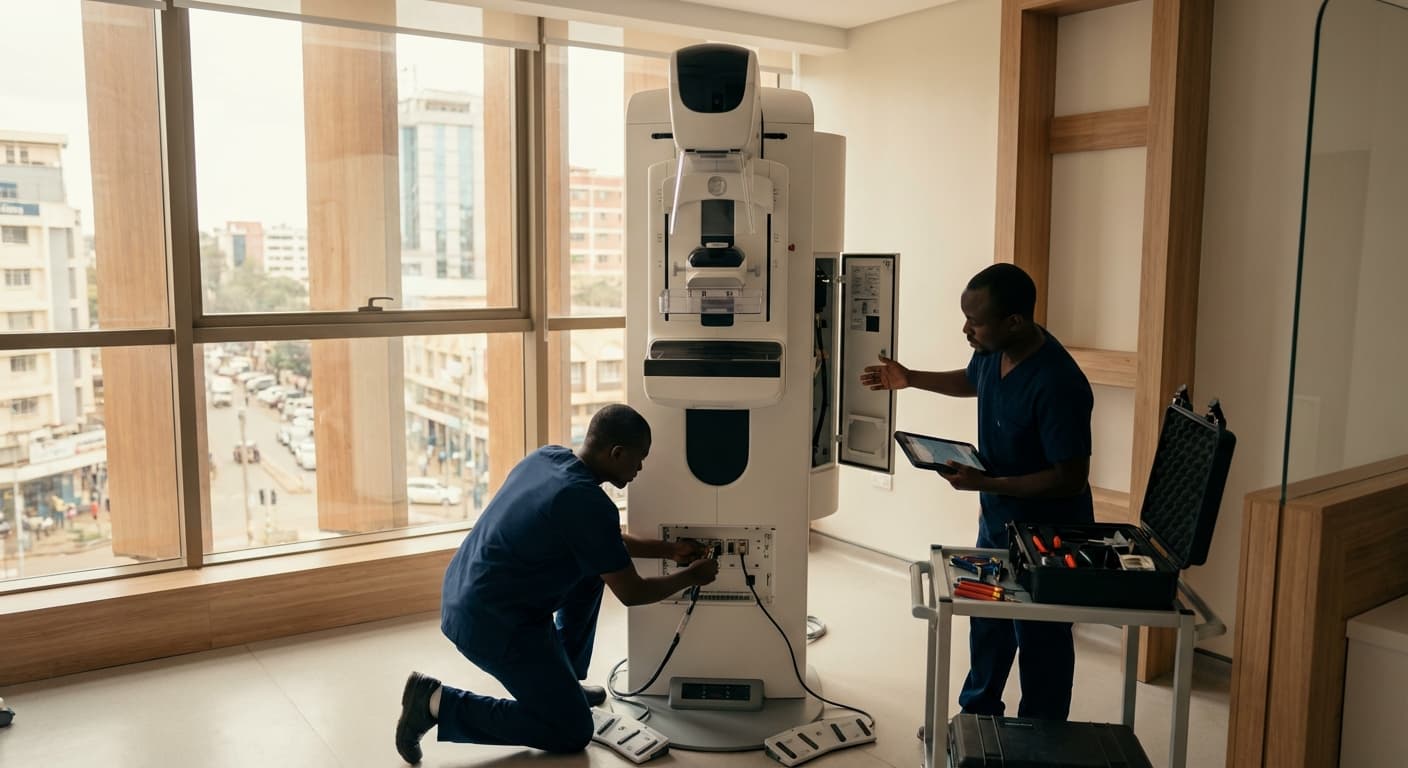
Mammography Installation Service in Comoros
Engineering Excellence & Technical Support
Mammography Installation Service High-standard technical execution following OEM protocols and local regulatory frameworks.
Certified & Compliant Installations
We ensure all mammography equipment is installed by certified technicians adhering to Comorian health regulations and international safety standards, guaranteeing optimal performance and patient safety.
Precision Calibration & Imaging Quality
Our meticulous calibration process guarantees image accuracy and diagnostic reliability. We optimize equipment settings for superior contrast and resolution, crucial for early breast cancer detection in Comoros.
Integrated Workflow Solutions
We provide seamless integration of mammography systems with existing Picture Archiving and Communication Systems (PACS) and Hospital Information Systems (HIS), streamlining radiologist workflow and improving reporting efficiency.
What Is Mammography Installation Service In Comoros?
Mammography Installation Service in Comoros refers to the comprehensive process of setting up, configuring, and commissioning mammography equipment within healthcare facilities in the Union of the Comoros. This service ensures that the medical imaging devices are operational, calibrated, and integrated into the existing clinical workflow to facilitate diagnostic mammography procedures. The service typically encompasses site preparation, equipment delivery and assembly, power and data connectivity, quality assurance testing, and staff training. It is crucial for establishing or upgrading breast imaging capabilities, thereby supporting early detection and diagnosis of breast cancer.
| Who Needs Mammography Installation Service? | Typical Use Cases | ||
|---|---|---|---|
| Public and Private Hospitals: Healthcare institutions requiring new or upgraded breast imaging facilities. | Establishment of new radiology departments or expansion of existing imaging services. | Replacement of outdated or malfunctioning mammography equipment. | Implementation of screening mammography programs. |
| Specialized Diagnostic Centers: Clinics focusing on women's health or comprehensive diagnostic imaging. | Setting up dedicated breast imaging centers. | Adding mammography to a multi-modality imaging practice. | |
| Government Health Initiatives: Ministry of Health or public health organizations procuring equipment for public healthcare facilities. | National breast cancer screening programs. | Improving access to diagnostic imaging in underserved regions. | |
| Non-Governmental Organizations (NGOs): Organizations involved in healthcare provision and medical aid in Comoros. | Donation and deployment of mammography equipment as part of medical aid projects. | Capacity building in local healthcare infrastructure. |
Key Components of Mammography Installation Service
- Site Assessment and Preparation: Evaluating the designated installation area for structural integrity, environmental conditions (temperature, humidity, radiation shielding requirements), and utility availability (power, ventilation, networking).
- Equipment Delivery and Unpacking: Safe transportation of the mammography unit, associated accessories, and peripherals to the installation site and careful unpacking.
- Physical Assembly and Mounting: Precise assembly of the mammography system components, including the X-ray tube, detector, compression paddle, and control console, and secure mounting as per manufacturer specifications.
- Utility Connections: Establishing robust electrical connections to meet power requirements and ensuring proper grounding. Data connectivity for PACS (Picture Archiving and Communication System) integration is also established.
- System Configuration and Calibration: Initial setup of system parameters, software installation, and meticulous calibration of radiation output, image receptor, and compression mechanisms to ensure diagnostic image quality and patient safety.
- Quality Assurance (QA) Testing: Performing a series of standardized tests (e.g., AEC calibration, artifact evaluation, resolution checks) to verify system performance against established benchmarks and regulatory requirements.
- Integration with Existing Infrastructure: Connecting the mammography unit to Picture Archiving and Communication Systems (PACS), Electronic Health Records (EHR), and other relevant hospital IT systems for seamless image management and reporting.
- User Training: Comprehensive training for radiographers, technologists, and potentially radiologists on the operation, basic maintenance, and troubleshooting of the newly installed mammography equipment.
- Handover and Documentation: Formal handover of the operational system to the client, along with comprehensive documentation including user manuals, warranty information, and QA reports.
Who Needs Mammography Installation Service In Comoros?
Mammography installation services are crucial for healthcare facilities in Comoros aiming to provide advanced breast cancer screening and diagnostic capabilities. These services ensure that the complex imaging equipment is set up correctly, calibrated, and ready for clinical use, meeting all safety and regulatory standards. This is particularly important for establishing or upgrading mammography departments within hospitals and specialized diagnostic centers.
| Target Customer Type | Relevant Departments |
|---|---|
| Public Hospitals | Radiology Department, Diagnostic Imaging Department, Oncology Department, Women's Health Unit |
| Private Hospitals and Clinics | Radiology Department, Diagnostic Imaging Unit, Breast Health Center, Surgical Oncology Department |
| Diagnostic Imaging Centers | Radiology Department, Mammography Suite |
| Women's Health Clinics | Diagnostic Imaging Unit, Screening Department |
| Ministry of Health / Public Health Authorities | Procurement Department, Health Infrastructure Development Unit |
| New Healthcare Facility Developments | Radiology Department (planned), Imaging Services (planned) |
| Research and Academic Institutions | Radiology Department, Medical Imaging Research Lab, Oncology Research Center |
Target Customers and Departments for Mammography Installation Service in Comoros:
- Public Hospitals: Government-funded hospitals, especially those serving as regional or national referral centers, are key clients. They often seek to equip or expand their radiology and diagnostic imaging departments.
- Private Hospitals and Clinics: Higher-end private healthcare providers that aim to offer comprehensive services, including specialized cancer screening, will require professional installation.
- Diagnostic Imaging Centers: Standalone centers focused on providing various diagnostic imaging services, including mammography, will be primary customers.
- Women's Health Clinics: Clinics specializing in women's health may invest in mammography units to offer integrated screening and diagnostic services on-site.
- Ministry of Health / Public Health Authorities: Government bodies responsible for public health infrastructure and the procurement of medical equipment for state-run facilities.
- New Healthcare Facility Developments: Any newly constructed or significantly renovated healthcare facility planning to offer mammography services.
- Research and Academic Institutions: If any medical universities or research centers in Comoros have a focus on radiology or oncology and plan to acquire mammography equipment for training or research purposes.
Mammography Installation Service Process In Comoros
This document outlines the typical workflow for mammography installation services in Comoros, from the initial inquiry to the final execution. The process emphasizes clear communication, adherence to regulations, and efficient project management to ensure a successful and timely installation.
| Phase | Key Activities | Responsible Party |
|---|---|---|
| Initial Contact | Inquiry, Needs Assessment, Initial Consultation | Client & Service Provider |
| Planning & Preparation | Site Survey, System Selection, Quotation, Contract Negotiation, Regulatory Approvals | Service Provider & Client |
| Logistics & Delivery | Equipment Procurement, Transportation, Customs Clearance, Delivery | Service Provider |
| Installation | Pre-Installation Site Preparation, Equipment Unpacking, Installation & Assembly, System Testing & Calibration, Radiation Safety Checks | Service Provider |
| Commissioning & Support | User Training, Acceptance Testing, Handover, Post-Installation Support, Maintenance | Service Provider & Client |
Mammography Installation Service Process in Comoros
- Inquiry & Initial Consultation: The process begins when a healthcare facility in Comoros expresses interest in acquiring and installing a mammography unit. This is followed by an initial consultation to understand their specific needs, existing infrastructure, and budget.
- Site Survey & Assessment: A crucial step involving a thorough inspection of the proposed installation site. This includes evaluating space requirements, power supply, radiation shielding, environmental conditions, and accessibility for equipment delivery and installation.
- System Selection & Quotation: Based on the site survey and client requirements, a suitable mammography system is recommended. A detailed quotation is then provided, outlining the equipment cost, installation fees, training, and any associated services.
- Contractual Agreement: Upon acceptance of the quotation, a formal contract is established. This document details the scope of work, payment schedule, delivery timelines, warranty information, and responsibilities of both the service provider and the client.
- Regulatory Approvals & Permitting: Navigating the regulatory landscape in Comoros is essential. This involves obtaining necessary permits and approvals from relevant health and safety authorities for the installation and operation of medical imaging equipment.
- Equipment Procurement & Logistics: Once approvals are in place, the mammography unit is procured from the manufacturer. Logistics for transportation, customs clearance, and delivery to the Comorian facility are managed.
- Pre-Installation Preparation: The client's facility is prepared according to the site survey findings. This may include necessary modifications to the room, electrical work, or installation of specialized shielding.
- Equipment Delivery & Unpacking: The mammography unit is carefully transported to the installation site and unpacked. All components are inspected for any damage incurred during transit.
- Installation & Assembly: Trained technicians meticulously install and assemble the mammography system according to manufacturer specifications and safety standards.
- System Testing & Calibration: Comprehensive testing is performed to ensure all components function correctly. The system is calibrated to achieve optimal imaging performance and accuracy.
- Radiation Safety Checks: Rigorous radiation safety checks are conducted by qualified personnel to ensure compliance with national safety regulations and to protect patients and staff.
- User Training: Healthcare professionals (radiologists, technicians) receive comprehensive training on the operation, maintenance, and troubleshooting of the newly installed mammography unit.
- Acceptance Testing & Handover: The client conducts acceptance testing to verify that the system meets all specified requirements. Upon successful testing, the system is formally handed over to the facility.
- Post-Installation Support & Maintenance: Ongoing support is provided, including technical assistance, scheduled maintenance, and access to spare parts to ensure the long-term functionality and reliability of the mammography unit.
- Documentation & Record Keeping: All aspects of the installation process, including site surveys, approvals, testing results, and training records, are meticulously documented and provided to the client.
Mammography Installation Service Cost In Comoros
The cost of mammography installation services in Comoros can vary significantly based on several key factors. These factors influence the overall project scope, the complexity of the installation, and the resources required. It's essential for healthcare facilities to understand these elements to budget effectively for new mammography equipment. While specific price lists are not readily available publicly due to the specialized nature of these services, we can discuss the typical pricing considerations and provide estimated ranges in the local currency, the Comorian Franc (KMF).
| Cost Component | Estimated Range (KMF) | Notes |
|---|---|---|
| Equipment Purchase (New Digital/3D Mammography Unit) | 25,000,000 - 70,000,000+ | This is the largest single cost. Prices vary widely by brand and model. |
| Site Preparation (Lead Shielding, Electrical, HVAC) | 2,000,000 - 10,000,000 | Depends heavily on the existing facility's condition and required upgrades. |
| Installation Labor and Technical Services | 1,000,000 - 5,000,000 | Includes engineers, technicians, and project management. |
| Software Installation and Integration | 500,000 - 2,000,000 | For Picture Archiving and Communication Systems (PACS) and other medical imaging software. |
| Training for Radiologists and Technicians | 300,000 - 1,500,000 | Essential for proper operation and interpretation. |
| Permits and Regulatory Approvals | 100,000 - 500,000 | Costs associated with local health and safety regulations. |
| Contingency (10-15%) | Variable | Recommended for unforeseen expenses. |
Key Pricing Factors for Mammography Installation in Comoros
- {"title":"Type and Model of Mammography Equipment","description":"The most significant driver of cost. Advanced digital mammography systems (FFDM) or 3D mammography (tomosynthesis) are generally more expensive to install than older analog systems. This includes the cost of the unit itself, as well as any associated software and networking requirements."}
- {"title":"Site Preparation and Infrastructure","description":"This involves assessing the existing facility. Requirements might include lead shielding for radiation protection, adequate electrical power supply, ventilation, temperature and humidity control, and potentially structural modifications to the room where the mammography unit will be housed. Upgrading existing infrastructure to meet the specific needs of the new equipment can add substantial costs."}
- Installation Complexity and Technical Expertise
- Service Provider and Location
- Ancillary Equipment and Software
- Training and Support
- Logistics and Transportation
Affordable Mammography Installation Service Options
Securing affordable mammography installation is crucial for healthcare providers aiming to expand diagnostic capabilities without breaking the bank. This involves understanding various service options, recognizing the value of bundled packages, and implementing effective cost-saving strategies. These approaches can significantly reduce the initial investment and ongoing operational expenses associated with mammography equipment.
| Value Bundle Component | Potential Cost Savings Strategy | Benefits |
|---|---|---|
| Equipment Purchase & Installation | Bundled package deals with manufacturer or authorized dealer | Reduced overall upfront cost, streamlined procurement process, single point of contact. |
| Site Preparation (Electrical, HVAC, Shielding) | Early and comprehensive site assessment by the installer | Minimizes rework, avoids unexpected delays and costs, ensures compliance. |
| IT Integration & Networking | Inclusion in the installation package or negotiation with IT vendors | Seamless data flow, reduced interoperability issues, potential for volume discounts. |
| Calibration & Quality Assurance | Bundled with initial setup and training | Ensures optimal image quality from day one, meets regulatory requirements, avoids costly recalibrations later. |
| Staff Training | Integrated into the installation service package | Reduces the need for separate training programs, ensures staff proficiency with new equipment, improves operational efficiency. |
| Extended Warranty & Maintenance | Negotiated as part of the initial purchase agreement | Predictable long-term costs, minimizes downtime due to equipment failure, often cheaper than purchasing separately later. |
Key Considerations for Affordable Mammography Installation
- Understanding Installation Costs: Factors influencing installation costs include equipment type, site preparation requirements (power, cooling, shielding), IT integration, and specialized personnel needs.
- New vs. Refurbished Equipment: While new equipment offers the latest technology, refurbished units can provide substantial savings, often with warranties and a renewed lifespan.
- Service Provider Selection: Choosing reputable and experienced installation service providers is vital. Compare quotes and inquire about their track record, certifications, and insurance.
- Phased Installation: For larger facilities or those with budget constraints, a phased installation approach, where equipment is acquired and installed over time, can be beneficial.
- Bundled Service Packages: Many vendors offer comprehensive installation packages that combine equipment purchase, delivery, setup, calibration, and initial training. These bundles often come at a reduced price compared to purchasing services individually.
- Maintenance Contracts: Negotiating long-term maintenance contracts as part of the installation package can lock in predictable costs and ensure timely service.
- Financing Options: Explore financing and leasing options specifically designed for medical equipment, which can spread the cost over time and improve cash flow.
- Site Preparation Planning: Thorough pre-installation site assessment and preparation are essential to avoid costly last-minute modifications. This includes ensuring adequate space, electrical capacity, and radiation shielding if necessary.
- Remote Support and Diagnostics: Consider providers who offer robust remote support and diagnostic capabilities, which can reduce the need for on-site technician visits for minor issues.
Verified Providers In Comoros
Ensuring access to quality healthcare is paramount, and in Comoros, identifying verified providers is crucial for individuals seeking reliable medical services. Franance Health stands out as a leading entity, offering a robust credentialing process that ensures their network comprises highly qualified and ethical healthcare professionals. This meticulous vetting system is the cornerstone of their commitment to patient well-being, providing a trusted pathway to effective medical care within Comoros.
| Aspect of Credentialing | Franance Health's Standard | Benefit for Comoros Patients |
|---|---|---|
| Medical Licenses & Certifications | Verified to be current, valid, and from recognized institutions. | Guarantees providers possess the fundamental legal and educational qualifications. |
| Professional Experience & Training | Thorough review of educational background, residency, fellowships, and specialized training. | Ensures providers have the necessary practical skills and knowledge for effective treatment. |
| Reputation & Disciplinary History | Background checks and review of any past disciplinary actions or malpractice claims. | Protects patients from potentially problematic or unethical practitioners. |
| Clinical Competence Assessment | May involve peer reviews and ongoing performance monitoring (where applicable). | Indicates a commitment to maintaining high standards of medical practice. |
| Adherence to Standards of Care | Ensures providers follow established best practices and treatment protocols. | Promotes consistent and high-quality patient outcomes. |
Why Franance Health Credentials Matter for Comoros Patients:
- Rigorous Professional Verification: Franance Health meticulously examines the qualifications, licenses, and certifications of all affiliated healthcare providers, ensuring they meet stringent international and local standards.
- Commitment to Ethical Practices: Beyond technical expertise, Franance Health assesses providers for their adherence to ethical medical conduct, promoting patient-centered care and transparency.
- Enhanced Patient Safety: By partnering only with credentialed professionals, Franance Health significantly minimizes risks associated with unqualified practitioners, prioritizing the safety and health of its members.
- Access to Specialized Care: Their network is designed to include a diverse range of specialists, meaning patients can be confident they will find the right expertise for their specific medical needs.
- Streamlined Healthcare Navigation: Franance Health's verified provider list simplifies the process of finding trusted doctors and facilities, reducing the burden and uncertainty for patients.
Scope Of Work For Mammography Installation Service
This Scope of Work (SOW) outlines the requirements for the installation of a new mammography system. It details the technical deliverables, standard specifications, and activities required to ensure a successful and compliant installation. The primary objective is to integrate the new mammography equipment seamlessly into the existing medical imaging infrastructure, ensuring optimal performance, safety, and adherence to all relevant regulatory standards.
| Category | Description | Standard Specifications / Deliverables | |
|---|---|---|---|
| Site Preparation | Ensuring the installation location meets the physical and environmental requirements for the mammography system. |
| |
| Equipment Delivery and Unpacking | Safe and secure transportation and unpacking of the mammography system components. |
| |
| System Installation | Physical installation and assembly of the mammography system. |
| |
| System Integration | Connecting the mammography system to the facility's IT infrastructure. |
| |
| System Power-Up and Initial Configuration | Bringing the system online and performing initial software setup. |
| |
| Calibration and Quality Control (QC) | Ensuring the system is calibrated for optimal image quality and diagnostic accuracy. |
| |
| Testing and Verification | Comprehensive testing of all system functionalities and performance. |
|
|
| User and Technical Training | Providing comprehensive training to relevant personnel. |
| |
| Documentation and Handover | Providing all necessary documentation and formally handing over the system. |
| |
| Regulatory Compliance | Ensuring the installation meets all applicable regulations and standards. |
|
Key Objectives of Mammography Installation Service
- To successfully install and commission the specified mammography system.
- To integrate the mammography system with existing PACS/RIS and IT infrastructure.
- To ensure the system meets all manufacturer specifications and clinical performance requirements.
- To conduct comprehensive testing and calibration to guarantee diagnostic image quality and patient safety.
- To provide thorough training to clinical and technical staff on system operation and maintenance.
- To ensure compliance with all relevant medical device regulations and accreditation standards (e.g., FDA, MQSA, ACR).
Service Level Agreement For Mammography Installation Service
This Service Level Agreement (SLA) outlines the response times and uptime guarantees for the Mammography Installation Service provided by [Your Company Name]. This SLA is designed to ensure timely and reliable service delivery to our clients.
| Service Component | Response Time Guarantee | Uptime Guarantee (Post-Installation) |
|---|---|---|
| Initial Installation Scheduling | Within 2 business days of contract signing. | N/A |
| On-site Installation Commencement | As per agreed-upon installation schedule. | N/A |
| Troubleshooting & Remote Support (during warranty period) | Within 4 business hours of service request submission. | N/A |
| Emergency On-site Support (during warranty period, critical failure) | Within 24 business hours of critical failure report. | N/A |
| Standard Uptime (for successfully installed equipment) | N/A | 98% availability during standard operating hours (defined as Monday-Friday, 8 AM - 6 PM local time, excluding public holidays). |
| Uptime Guarantee (with optional Preventative Maintenance add-on) | N/A | 99% availability during standard operating hours (defined as Monday-Friday, 8 AM - 6 PM local time, excluding public holidays). |
Key Service Components
- Installation Service: Professional installation of new mammography equipment at client facilities.
- Troubleshooting and Support: Timely assistance for any issues arising during or after the installation process.
- Preventative Maintenance (Optional Add-on): Scheduled maintenance to ensure optimal equipment performance.
- Emergency Repair (Optional Add-on): Rapid response to critical equipment failures.
Frequently Asked Questions

Ready when you are
Let's scope your Mammography Installation Service in Comoros project in Comoros.

Scaling healthcare logistics and technical systems across the entire continent.