
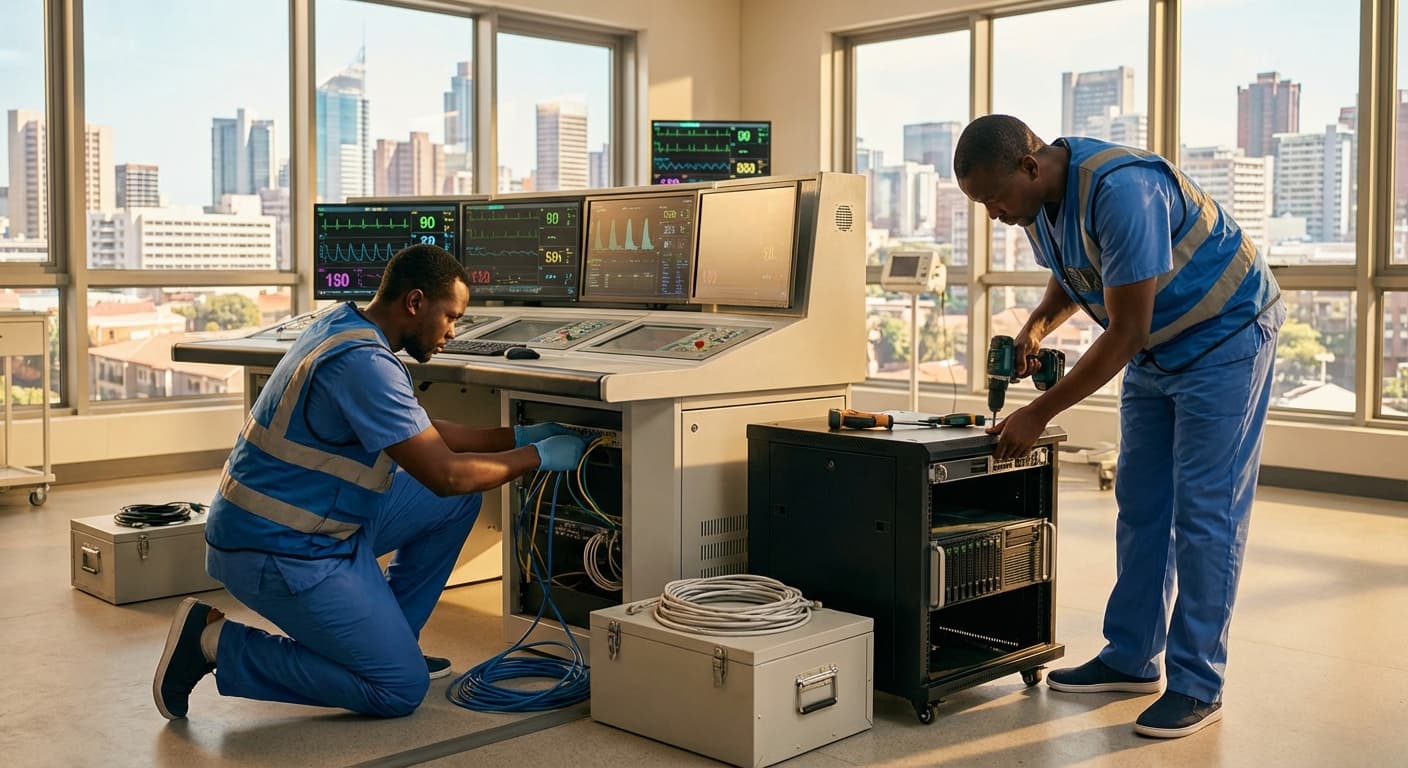
ICU Central Monitoring Station Installation Service in Comoros
Engineering Excellence & Technical Support
ICU Central Monitoring Station Installation Service High-standard technical execution following OEM protocols and local regulatory frameworks.
Robust Network Infrastructure
We design and deploy resilient, high-bandwidth networks engineered to guarantee the seamless, real-time transmission of critical patient data from bedside monitors to the ICU Central Monitoring Station, ensuring zero latency and uninterrupted surveillance even during peak demand.
Advanced Data Security & Compliance
Our installation prioritizes the strictest data privacy and security protocols, adhering to international healthcare standards to safeguard sensitive patient information against cyber threats and ensure full compliance with Comoros' evolving data protection regulations.
Customizable & Scalable Display Solutions
We configure state-of-the-art, high-resolution display walls tailored to your ICU's specific layout and workflow, providing clear, at-a-glance visibility of all patient vital signs and enabling intuitive navigation for rapid response and efficient clinical decision-making.
What Is Icu Central Monitoring Station Installation Service In Comoros?
ICU Central Monitoring Station Installation Service in Comoros refers to the comprehensive process of setting up and configuring a centralized monitoring system for Intensive Care Units (ICUs) within healthcare facilities in the Comoros archipelago. This service encompasses the physical installation of hardware, network integration, software deployment, system calibration, and initial testing to ensure a fully operational and reliable monitoring infrastructure. The objective is to provide real-time, aggregated patient vital signs and critical care data to a central console, enabling a unified overview of multiple ICU patients for continuous surveillance and immediate intervention by medical personnel. This service is crucial for enhancing patient safety, optimizing resource allocation, and improving the overall quality of critical care delivery.
| Who Needs This Service? | Typical Use Cases in Comoros | |||||
|---|---|---|---|---|---|---|
| Hospitals and Healthcare Facilities in Comoros: Particularly those with existing or planned Intensive Care Units (ICUs) or high-dependency units. | Centralized Surveillance of Multiple ICU Beds: Enabling clinicians to monitor vital signs (e.g., ECG, SpO2, NIBP, respiration) of several critically ill patients simultaneously from a single console. | Emergency Response and Triage: Facilitating rapid assessment and prioritization of patient needs in a critical care environment. | Early Detection of Patient Deterioration: Real-time alarm systems alert staff to significant changes in patient status, allowing for prompt intervention and potentially preventing adverse outcomes. | Data Management and Record Keeping: Automating the collection and storage of patient monitoring data for trend analysis, clinical review, and medical record documentation. | Resource Optimization: Allowing for efficient allocation of nursing staff and medical resources by providing a consolidated view of patient status. | Research and Quality Improvement: Utilizing aggregated data to identify trends, evaluate treatment protocols, and drive improvements in critical care practices. |
| Government Health Ministries and Agencies: For oversight and implementation of national healthcare standards in critical care. | Non-Governmental Organizations (NGOs) and International Aid Organizations: Involved in healthcare infrastructure development and support in Comoros. | Medical Equipment Suppliers and Installers: Providing specialized installation and integration services for critical care technology. |
Components of ICU Central Monitoring Station Installation Service:
- Site Assessment and Planning: Evaluating existing infrastructure, network capabilities, power supply, and physical space to design an optimal system layout.
- Hardware Installation: Physically installing central monitoring consoles, bedside patient monitors, network switches, servers, and associated cabling.
- Network Integration: Configuring network infrastructure (wired or wireless) to ensure secure and reliable data transmission between bedside monitors and the central station.
- Software Deployment and Configuration: Installing and configuring the central monitoring software, including user interface customization, alarm parameter setting, and data logging protocols.
- System Calibration and Testing: Performing rigorous testing to verify data accuracy, alarm functionality, and system responsiveness under various simulated patient conditions.
- User Training and Handover: Providing comprehensive training to clinical staff on operating the central monitoring system, interpreting data, and responding to alarms.
- Post-Installation Support and Maintenance: Offering initial technical support, troubleshooting, and outlining ongoing maintenance requirements.
Who Needs Icu Central Monitoring Station Installation Service In Comoros?
The installation of an ICU Central Monitoring Station (CMS) is a critical investment for healthcare facilities aiming to provide advanced and continuous patient care. In Comoros, where healthcare infrastructure is developing, a CMS becomes indispensable for hospitals seeking to elevate their critical care capabilities. This service is designed for facilities that understand the profound impact of real-time, comprehensive patient data on patient outcomes, allowing for proactive interventions and optimized resource management.
| Target Customer Segment | Relevant Departments | Key Needs Addressed by CMS Installation |
|---|---|---|
| Large Public Hospitals | Intensive Care Unit (ICU), Coronary Care Unit (CCU), Emergency Department (ED) | Centralized patient data aggregation, improved staff efficiency, early detection of patient deterioration, enhanced patient safety, better resource allocation. |
| Established Private Hospitals | Intensive Care Unit (ICU), Surgical Intensive Care Unit (SICU), Medical Intensive Care Unit (MICU), Cardiac Care Unit (CCU) | Competitive advantage through advanced technology, enhanced reputation, specialized treatment capabilities, reduced medical errors, data-driven decision-making. |
| New Healthcare Facilities | Intensive Care Unit (ICU), High Dependency Unit (HDU), Post-Anesthesia Care Unit (PACU) | Foundation for a modern critical care department, compliance with international healthcare standards, attracting skilled medical professionals, ensuring optimal patient outcomes from inception. |
| Government & Health Organizations | National health ministries, regional health authorities, medical training institutions | Standardization of critical care across the nation, training and education for healthcare professionals, data collection for public health research and policy development, improving overall healthcare quality. |
| Specialized Medical Centers | Neuro-ICU, Trauma ICU, Pediatric ICU | Tailored monitoring solutions for specific patient populations, integration with specialized diagnostic equipment, facilitating complex treatment protocols, ensuring the highest level of care for critical patients. |
Target Customers and Departments for ICU Central Monitoring Station Installation in Comoros:
- Public Hospitals undertaking upgrades to their critical care units.
- Private Hospitals seeking to offer specialized and high-level medical services.
- Newly established hospitals planning to equip their ICU with state-of-the-art technology.
- Government health initiatives focused on improving national healthcare standards.
- Hospitals with a high patient load requiring efficient monitoring and management.
Icu Central Monitoring Station Installation Service Process In Comoros
This document outlines the standard workflow for the ICU Central Monitoring Station Installation Service Process in Comoros. It covers the entire service lifecycle, from initial customer inquiry to the successful execution and handover of the installed system.
| Phase | Key Activities | Responsible Party | Deliverables | Timeline (Estimated) |
|---|---|---|---|---|
| Phase 1: Inquiry & Initial Consultation | Customer expresses interest. Initial discussion of needs, scope, and objectives. Provide preliminary information about the service. | Customer, Service Provider Sales/Consultant | Initial understanding of requirements. Contact information exchanged. | 1-3 Business Days |
| Phase 2: Site Assessment & Requirements Gathering | On-site visit to assess existing infrastructure (power, network, space). Detailed discussion with clinical staff and IT team. Identify specific monitoring needs and integration requirements. | Service Provider Technical Team, Customer Representatives | Detailed site survey report. Formalized technical requirements document. Equipment list with specifications. | 3-7 Business Days |
| Phase 3: Proposal & Quotation | Develop a comprehensive technical proposal outlining the solution. Generate a detailed quotation including hardware, software, installation, and support costs. | Service Provider Technical & Sales Team | Formal Proposal. Itemized Quotation. Project timeline overview. | 5-10 Business Days |
| Phase 4: Contract & Agreement | Review and negotiation of terms and conditions. Finalization and signing of the service contract. Payment of initial deposit (if applicable). | Customer, Service Provider Management | Signed Service Contract. Purchase Order (PO). | 3-5 Business Days |
| Phase 5: System Design & Planning | Detailed system architecture design. Network topology planning. Integration plan with existing hospital systems (if any). Installation schedule and resource allocation. | Service Provider Engineering Team | Final System Design Document. Detailed Installation Plan. Resource Allocation Plan. | 5-15 Business Days |
| Phase 6: Procurement & Logistics | Order necessary hardware and software components. Arrange for shipping and customs clearance to Comoros. Coordinate delivery to the hospital site. | Service Provider Procurement & Logistics Team | Procurement Orders. Shipping Manifests. Delivery Confirmations. | Varies based on lead times and shipping (can be weeks/months) |
| Phase 7: Installation & Configuration | Unpacking and physical installation of central monitoring station hardware. Installation and configuration of monitoring software. Network cable installation and connection. Integration with patient monitors and other devices. | Service Provider Installation Technicians | Installed Hardware. Configured Software. Network Connectivity. | 7-21 Business Days (depending on complexity) |
| Phase 8: Testing & Commissioning | Unit testing of all components. System integration testing. Functional testing of all monitoring features. Performance and load testing. User Acceptance Testing (UAT) with hospital staff. | Service Provider Technical Team, Customer Representatives | Test Reports. Commissioning Certificate. UAT Sign-off. | 5-10 Business Days |
| Phase 9: Training & Handover | Comprehensive training for clinical and IT staff on system operation and maintenance. Provide user manuals and technical documentation. Formal handover of the installed system. | Service Provider Training Specialist, Customer Staff | Trained Personnel. User Manuals & Documentation. Handover Protocol. | 2-5 Business Days |
| Phase 10: Post-Installation Support & Maintenance | Initial period of on-site or remote support. Implementation of ongoing maintenance and support contract (if applicable). Regular system health checks and updates. | Service Provider Support Team | Resolved Issues. System Performance Reports. Maintenance Schedule. | Ongoing (as per contract) |
ICU Central Monitoring Station Installation Service Process in Comoros
- Phase 1: Inquiry & Initial Consultation
- Phase 2: Site Assessment & Requirements Gathering
- Phase 3: Proposal & Quotation
- Phase 4: Contract & Agreement
- Phase 5: System Design & Planning
- Phase 6: Procurement & Logistics
- Phase 7: Installation & Configuration
- Phase 8: Testing & Commissioning
- Phase 9: Training & Handover
- Phase 10: Post-Installation Support & Maintenance
Icu Central Monitoring Station Installation Service Cost In Comoros
Installing an ICU Central Monitoring Station (CMS) in Comoros is a critical undertaking that requires specialized equipment and expertise. The cost of this service can vary significantly due to several factors. These factors range from the complexity and scale of the installation to the specific brand and features of the monitoring equipment chosen. Furthermore, the location within Comoros and the availability of skilled technicians can also influence the overall price. Understanding these elements is crucial for healthcare facilities planning such an investment.
| Cost Component | Estimated Range (Comorian Franc - KMF) | Notes |
|---|---|---|
| Basic ICU CMS Installation (e.g., 4-6 beds) | 15,000,000 - 30,000,000 KMF | Includes essential patient monitors and central unit, basic setup. |
| Mid-Range ICU CMS Installation (e.g., 8-12 beds) | 30,000,000 - 60,000,000 KMF | More advanced features, higher bed count, comprehensive training. |
| High-End/Comprehensive ICU CMS Installation (e.g., 16+ beds) | 60,000,000 - 150,000,000+ KMF | State-of-the-art technology, integration with EMR, extensive support. |
| Equipment (per patient monitor) | 1,000,000 - 5,000,000 KMF | Varies greatly by brand, features (e.g., advanced hemodynamic monitoring). |
| Central Monitoring Unit | 3,000,000 - 10,000,000 KMF | Depends on capacity and display capabilities. |
| Installation Labor (per technician, per day) | 50,000 - 150,000 KMF | Dependent on skill level and complexity. |
| Software Licensing (annual) | 500,000 - 3,000,000 KMF | Can be a recurring cost. |
Key Pricing Factors for ICU Central Monitoring Station Installation in Comoros:
- Equipment Cost: This is often the largest component. It includes the central monitoring unit, patient monitors (for ECG, SpO2, NIBP, etc.), sensors, cables, and any necessary networking hardware. The sophistication and brand reputation of the equipment will directly impact the price.
- Installation Labor: This covers the cost of skilled technicians to set up the hardware, connect the patient monitors to the central station, configure the software, and ensure proper data flow. The number of ICU beds to be monitored will also influence labor hours.
- Site Preparation: Depending on the existing infrastructure, there might be costs associated with preparing the ICU room. This could include electrical work, network cabling installation, and ensuring adequate ventilation and space for the equipment.
- Software and Licensing: The central monitoring system often comes with specialized software for data analysis, alarm management, and patient record integration. Licensing fees for this software can add to the overall cost.
- Training: Providing training to medical staff on how to operate and maintain the CMS is essential. This cost can vary depending on the duration and comprehensiveness of the training program.
- Warranty and Maintenance: Post-installation warranty periods and ongoing maintenance contracts contribute to the long-term cost of the system.
- Logistics and Transportation: For remote locations in Comoros, the cost of transporting equipment and personnel can be a significant factor.
- Import Duties and Taxes: If the equipment is imported, applicable customs duties and taxes in Comoros will need to be factored in.
Affordable Icu Central Monitoring Station Installation Service Options
Implementing a reliable and efficient ICU central monitoring station is crucial for patient safety and effective care. This service focuses on providing cost-effective solutions for installation, ensuring your hospital can access critical patient data without breaking the budget. We offer various value bundles and cost-saving strategies to meet diverse needs and financial constraints.
| Value Bundle Tier | Description | Included Services/Hardware | Estimated Cost Range (USD) | Cost-Saving Strategies |
|---|---|---|---|---|
| Essential Care Bundle | Basic, functional setup for essential monitoring needs. | Core server/workstation, essential software licenses, basic network setup, 2-3 bedside monitors, standard installation, basic training. | $20,000 - $50,000 | Utilize refurbished, certified equipment. Opt for open-source monitoring software where feasible. Phased installation to spread costs. |
| Advanced Care Bundle | Enhanced features and increased scalability for a robust monitoring solution. | Higher capacity server, advanced software with EMR integration, comprehensive network setup, 5-7 bedside monitors, extended installation support, advanced training. | $50,000 - $100,000 | Negotiate bulk hardware discounts. Leverage cloud-based storage solutions. Prioritize essential software features, deferring non-critical modules. |
| Comprehensive Care Bundle | Full-featured, highly scalable solution with premium support and integration. | High-performance server, comprehensive software suite with deep EMR integration, advanced network security, 8+ bedside monitors, dedicated project management, on-site support, specialized training. | $100,000+ | Explore leasing options for hardware. Partner with us for ongoing managed services to reduce long-term IT burden. Utilize existing network infrastructure where possible. |
Key Components of an ICU Central Monitoring Station Installation
- Central server and workstation hardware
- Network infrastructure (cabling, switches, routers)
- Monitoring software licenses and integration
- Patient bedside monitor acquisition and setup
- Installation, configuration, and testing
- Training for clinical and IT staff
- Ongoing technical support and maintenance
Verified Providers In Comoros
In the Comoros, ensuring access to reliable healthcare is paramount. This is where the importance of verified providers comes into play, and Franance Health stands out as a leading example. By adhering to stringent credentialing processes, Franance Health guarantees that its network of healthcare professionals meets the highest standards of expertise, ethics, and patient care. This verification process instills confidence in individuals seeking medical services, knowing they are receiving treatment from qualified and trustworthy practitioners. Choosing Franance Health means opting for a healthcare experience that prioritizes safety, efficacy, and patient well-being.
| Provider Type | Franance Health Verification | Benefit to Patients |
|---|---|---|
| Doctors | Medical license, board certification, peer review. | Access to highly skilled and specialized medical expertise. |
| Nurses | Nursing license, relevant certifications, background checks. | Reliable and compassionate nursing care. |
| Specialists | Advanced degrees, sub-specialty certifications, proven track record. | Expert diagnosis and treatment for complex conditions. |
| Clinics/Hospitals | Facility accreditation, adherence to health regulations, quality assurance protocols. | Safe and well-equipped healthcare facilities. |
Why Franance Health is the Best Choice for Verified Providers in Comoros:
- Rigorous credentialing and verification of all healthcare professionals.
- Commitment to maintaining the highest ethical and professional standards.
- Ensuring practitioners possess the necessary qualifications and experience.
- Prioritizing patient safety and quality of care.
- Providing access to a trusted network of medical experts.
Scope Of Work For Icu Central Monitoring Station Installation Service
This Scope of Work (SOW) outlines the requirements for the installation services of an Intensive Care Unit (ICU) Central Monitoring Station (CMS). The service includes the complete setup, configuration, testing, and commissioning of the CMS, ensuring seamless integration with existing and future ICU monitoring devices. The successful vendor will be responsible for delivering a fully functional CMS that meets all specified technical deliverables and adheres to established standard specifications.
| Category | Specification/Standard | Description | Compliance Requirement |
|---|---|---|---|
| Hardware | Industry Standard Server & Workstation Specifications | High-performance, reliable hardware meeting clinical demands. Examples: Intel Xeon processors, ECC RAM, enterprise-grade SSDs. | Must comply with current industry standards for medical device integration and data processing. |
| Hardware | High-Resolution Medical Grade Displays | Displays with appropriate resolution, contrast, and viewing angles for critical patient data visualization. Minimum resolution of 1920x1080 (Full HD). | Must meet DICOM part 14 standards for grayscale display function for any image display. |
| Software | Operating System | Stable, secure, and supported operating system. Examples: Windows Server, Linux. | Must be a version supported by the CMS application vendor and approved by hospital IT. |
| Software | CMS Application Software | Proprietary or open-source CMS software designed for real-time patient monitoring. | Must be version-controlled, with documented update and patch management procedures. |
| Software | Database | Robust and scalable database system for storing patient data and events. Examples: SQL Server, PostgreSQL. | Must comply with hospital data retention policies and security standards. |
| Networking | Ethernet Standards (IEEE 802.3) | Gigabit Ethernet (1000BASE-T) or higher for data transmission. | Must adhere to hospital network infrastructure standards and security protocols. |
| Networking | Network Protocol Standards | TCP/IP suite for reliable data communication. | Must align with hospital's IP addressing scheme and subnetting. |
| Networking | Wireless Standards (IEEE 802.11) | If wireless integration is required, must use secure and robust standards (e.g., WPA2/WPA3 Enterprise). | Must comply with hospital's wireless security policy and RF planning. |
| Integration | HL7 Standards (v2.x, FHIR) | For interoperability with other hospital information systems (HIS, EMR). | Must implement specified HL7 message types and segments as per hospital requirements. |
| Integration | DICOM Standards (for imaging if applicable) | For integration of medical imaging data. | Must implement relevant DICOM profiles for image storage and retrieval. |
| Integration | Device-Specific Protocols | Support for various medical device communication protocols (e.g., proprietary, TCP/IP, serial). | Must be documented and validated for each integrated device. |
| Security | HIPAA Compliance (or local equivalent) | Measures to protect Protected Health Information (PHI). | Must demonstrate adherence to all relevant privacy and security regulations. |
| Security | Role-Based Access Control (RBAC) | Granular control over user access to system functions and data. | Must be configurable and auditable. |
| Security | Data Encryption | Encryption of data at rest and in transit. | Must meet hospital's encryption policy and industry best practices. |
| Power & UPS | Standard Electrical Safety Standards (e.g., IEC 60601-1) | Ensuring safe and reliable power supply for all components. | All installed components must meet relevant safety certifications. |
| Power & UPS | Uninterruptible Power Supply (UPS) Sizing | Sufficient runtime to ensure continuous operation during power outages, based on load calculations. | UPS runtime must be documented and validated. |
| Performance | Real-time Data Latency | Minimal delay in data acquisition, processing, and display. Target latency for critical parameters: < 5 seconds. | Must be verifiable through system testing. |
| Performance | System Uptime | High availability with minimal unplanned downtime. Target: 99.9% uptime. | Must be monitored and reported post-installation. |
| Documentation | Technical Documentation Standards | Clear, concise, and comprehensive documentation in English. | Must adhere to industry standard documentation practices. |
| Testing | Test Plan & Protocol | Detailed test plans covering all aspects of the system functionality and performance. | Must be reviewed and approved by hospital stakeholders prior to execution. |
Key Technical Deliverables
- Detailed system design and architecture documentation.
- Installation and configuration of all CMS hardware (servers, workstations, displays, network equipment).
- Installation and configuration of all CMS software (operating systems, monitoring applications, database).
- Integration of all ICU bedside monitors and other relevant medical devices with the CMS.
- Network infrastructure setup and configuration (cabling, switches, routers, firewalls) to support CMS operation.
- Power and UPS system installation and configuration for CMS components.
- User interface (UI) and user experience (UX) customization according to hospital requirements.
- Development and implementation of alarm management system and protocols.
- Data archiving and retrieval system setup.
- Comprehensive system testing (unit, integration, system, and user acceptance testing).
- User training documentation and delivery of training sessions for clinical and IT staff.
- As-built documentation, including network diagrams, device locations, and configuration details.
- Post-installation support and warranty services.
- Commissioning report, certifying the system's readiness for operation.
Service Level Agreement For Icu Central Monitoring Station Installation Service
This Service Level Agreement (SLA) outlines the response times and uptime guarantees for the installation of an ICU Central Monitoring Station. This SLA is an addendum to the Master Service Agreement (MSA) between [Your Company Name] ('Provider') and [Client Company Name] ('Client').
| Service Component | Response Time (during Service Hours) | Response Time (outside Service Hours - Emergency Only) | Resolution Target (Emergency) | Resolution Target (Non-Emergency) |
|---|---|---|---|---|
| Critical System Failure (Emergency) | 1 hour | 2 hours | 8 business hours | N/A |
| Major System Malfunction (impacting significant functionality) | 2 hours | 4 hours | 16 business hours | 2 business days |
| Minor System Malfunction (cosmetic or non-critical feature) | 4 hours | N/A (logged for next business day) | N/A | 5 business days |
| Configuration/Setup Assistance (non-critical) | 8 business hours | N/A (logged for next business day) | N/A | 7 business days |
Key Definitions
- Installation Service: The complete process of setting up and configuring the ICU Central Monitoring Station hardware and software as specified in the Statement of Work (SOW).
- Service Hours: Standard business hours are Monday to Friday, 8:00 AM to 5:00 PM local time, excluding national holidays.
- Emergency: A critical system failure that prevents the ICU Central Monitoring Station from functioning or significantly impairs its ability to monitor patient vital signs, impacting patient care.
- Non-Emergency: Any issue that does not constitute an Emergency but requires attention to ensure optimal system performance or address minor malfunctions.
- Uptime: The percentage of time the ICU Central Monitoring Station is operational and performing its intended functions as per the SOW.
Frequently Asked Questions

Ready when you are
Let's scope your ICU Central Monitoring Station Installation Service in Comoros project in Comoros.

Scaling healthcare logistics and technical systems across the entire continent.