
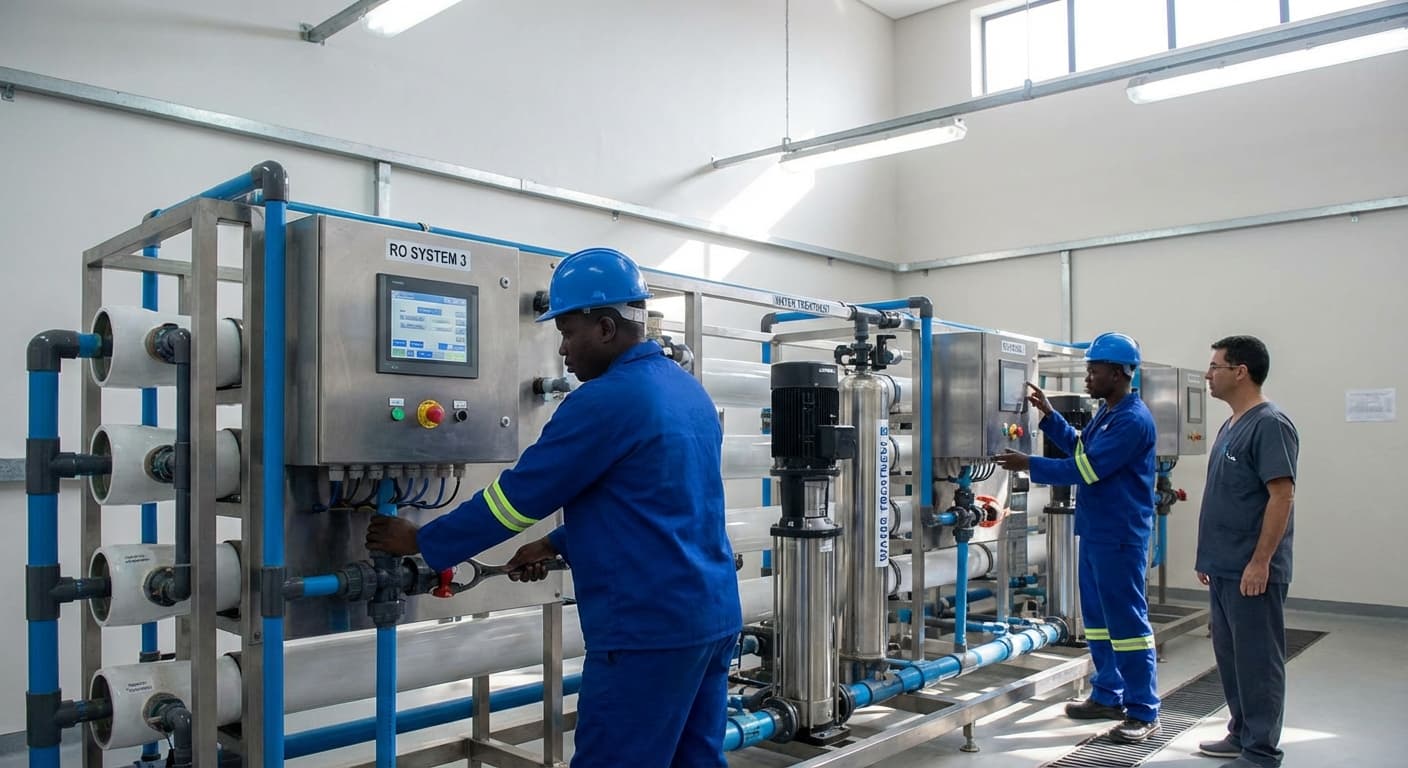
Dialysis RO/Water Treatment Plant Installation Service in Comoros
Engineering Excellence & Technical Support
Dialysis RO/Water Treatment Plant Installation Service High-standard technical execution following OEM protocols and local regulatory frameworks.
Expert RO System Integration
Leveraging advanced Reverse Osmosis (RO) technology, our Comorian installation service ensures the highest purity water for your dialysis center. We meticulously design and integrate RO systems tailored to local water quality, guaranteeing efficient, reliable, and compliant dialysis fluid production.
Precision Water Treatment Plant Assembly
Our skilled technicians provide end-to-end installation of state-of-the-art water treatment plants. From pretreatment filtration to final polishing, we guarantee precise assembly and calibration, minimizing operational risks and maximizing the lifespan of your critical infrastructure in the Comoros.
Regulatory Compliance & Quality Assurance
We are committed to exceeding international dialysis water quality standards. Our installation process in Comoros includes rigorous quality assurance checks and adherence to all relevant regulatory guidelines, ensuring the safety and well-being of your patients and the integrity of your dialysis operations.
What Is Dialysis Ro/water Treatment Plant Installation Service In Comoros?
Dialysis RO/Water Treatment Plant Installation Service in Comoros refers to the comprehensive process of designing, procuring, constructing, commissioning, and integrating Reverse Osmosis (RO) and associated water purification systems specifically for dialysis facilities within the Comoros archipelago. This service ensures the provision of high-purity, medically safe water, essential for hemodialysis procedures, by removing contaminants such as dissolved salts, minerals, microorganisms, endotoxins, and particulate matter to meet stringent international water quality standards (e.g., ISO, AAMI). The installation encompasses the entire water treatment train, from source water intake and pre-treatment (e.g., filtration, softening) to the RO membrane stage, post-treatment (e.g., UV sterilization, bacterial filters), and the distribution loop to dialysis machines.
| Service Component | Description | Importance for Dialysis |
|---|---|---|
| Pre-treatment Systems | Includes multi-media filters, activated carbon filters, and water softeners to remove larger particles, chlorine, and hardness. | Protects RO membranes from fouling and scaling, extending their lifespan and ensuring efficient operation. |
| Reverse Osmosis (RO) Unit | Utilizes semi-permeable membranes to remove dissolved solids, ions, and larger molecules. | The primary stage for achieving the high level of water purity required for dialysis, removing up to 99% of contaminants. |
| Post-treatment Systems | May include UV sterilization units and bacterial filters to eliminate any remaining microorganisms and endotoxins. | Ensures that the treated water is microbiologically sterile and free from pyrogenic substances, preventing patient infection and adverse reactions. |
| Distribution Loop and Storage | Includes piping, storage tanks, and recirculation pumps to maintain water quality throughout the distribution network. | Prevents recontamination and ensures a consistent supply of purified water to each dialysis station. |
| Monitoring and Control | Automated systems for real-time monitoring of water quality parameters (e.g., conductivity, pressure, flow rates) and alarm functions. | Guarantees continuous compliance with water quality standards and enables prompt identification and resolution of system deviations. |
Key Components and Processes Involved:
- Source Water Assessment and Analysis
- System Design and Engineering (based on patient load, source water quality, and regulatory requirements)
- Equipment Procurement and Supply (RO membranes, pumps, filters, UV sterilizers, storage tanks, piping, control systems)
- Civil and Mechanical Works (skid fabrication, plant room construction, piping installation)
- Electrical and Instrumentation Works (power supply, control panel installation, sensor integration)
- System Commissioning and Validation (performance testing, water quality verification, microbial challenge tests)
- Operator Training and Handover
- Ongoing Maintenance and Support Planning
Who Needs Dialysis Ro/water Treatment Plant Installation Service In Comoros?
Dialysis centers and hospitals in Comoros that are experiencing or anticipating issues with their existing water treatment systems, or are in the process of establishing new dialysis facilities. This service is crucial for ensuring the purity and safety of the water used in hemodialysis, directly impacting patient health and treatment efficacy. The installation of a robust Reverse Osmosis (RO) and water treatment plant is essential for meeting international standards and providing reliable dialysis care.
| Customer Type | Specific Need/Scenario | Relevant Departments |
|---|---|---|
| New Dialysis Center | Establishing a complete water treatment system from scratch to meet regulatory requirements and patient safety standards. | Hospital Administration, Nephrology Department, Procurement, Facility Management |
| Existing Dialysis Center (Upgrade) | Current water treatment system is outdated, inefficient, or failing to meet current purity standards, leading to potential patient risks. | Nephrology Department, Facility Management, Biomedical Engineering |
| Existing Dialysis Center (Replacement) | Complete breakdown of the existing RO system, necessitating an immediate and reliable replacement to avoid service disruption. | Hospital Administration, Nephrology Department, Procurement, Facility Management |
| Hospital with Integrated Dialysis | Need to ensure a consistent and high-quality water supply for their dialysis unit as part of overall hospital infrastructure. | Chief Medical Officer, Nephrology Department, Facility Management, Biomedical Engineering |
| Government Healthcare Facility | Meeting national health guidelines and ensuring public access to safe and effective dialysis treatment through reliable water infrastructure. | Ministry of Health (represented by facility leadership), Facility Management, Procurement |
| Private Healthcare Provider | Maintaining a competitive edge and patient trust by offering state-of-the-art dialysis treatment with high-quality water. | Hospital Administration, Nephrology Department, Facility Management, Procurement |
Target Customers and Departments for Dialysis RO/Water Treatment Plant Installation Service in Comoros:
- {"items":["Newly establishing dialysis centers","Existing dialysis centers requiring upgrades or replacements","Hospitals with integrated dialysis units","Government healthcare facilities operating dialysis services","Private healthcare providers offering dialysis treatments"],"title":"Target Customers"}
- {"items":["Hospital Administration/Management","Department Heads of Nephrology/Dialysis","Chief Medical Officers (CMOs)","Facility Managers/Engineers","Procurement Departments","Biomedical Engineering Departments"],"title":"Key Departments/Personnel Involved in Decision Making"}
Dialysis Ro/water Treatment Plant Installation Service Process In Comoros
This document outlines the typical workflow for a Dialysis RO/Water Treatment Plant Installation Service in Comoros, from the initial client inquiry to the final execution and handover. The process is designed to ensure a comprehensive and successful installation, meeting the specific needs of healthcare facilities in the region.
| Phase | Key Activities | Deliverables | Typical Duration |
|---|---|---|---|
| Inquiry & Needs Assessment | Initial contact, information gathering, understanding requirements | Preliminary understanding of client needs, rough scope definition | 1-3 Days |
| Site Survey & Technical Consultation | On-site visit, detailed assessment, technical discussions | Detailed site report, refined technical requirements | 2-5 Days |
| System Design & Proposal | Custom system design, proposal preparation, cost estimation | Detailed technical proposal, quotation, project plan | 3-7 Days |
| Contract & Preparation | Contract signing, equipment procurement, logistics planning | Signed contract, order confirmations, shipping arrangements | 2-4 Weeks (depending on equipment lead time) |
| Installation & Commissioning | On-site assembly, connection, testing, water quality verification | Fully installed and operational RO/water treatment plant, commissiong report | 1-3 Weeks (depending on system complexity and site conditions) |
| Training & Handover | Staff training, documentation provision, formal handover | Trained staff, user manuals, handover certificate | 2-3 Days |
| Post-installation Support | Ongoing technical assistance, maintenance services | Resolved issues, scheduled maintenance reports | Ongoing (as per agreement) |
Dialysis RO/Water Treatment Plant Installation Service Process in Comoros
- 1. Initial Inquiry & Needs Assessment:
- Client (Hospital/Clinic) contacts the service provider with a requirement for a dialysis RO/water treatment plant.
- Provider gathers initial information: number of dialysis stations, existing water sources, power availability, space constraints, budget, and any specific water quality concerns.
- Discussion of regulatory requirements and standards applicable in Comoros for medical water treatment.
- 2. Site Survey & Technical Consultation:
- A dedicated technical team visits the client's facility in Comoros.
- Detailed assessment of the site, including: water source analysis (quality, flow rate, pressure), electrical infrastructure, plumbing layout, installation space, and accessibility.
- In-depth technical consultation with facility engineers and medical staff to refine system requirements and identify potential challenges.
- 3. System Design & Proposal Generation:
- Based on the site survey and needs assessment, a customized RO/water treatment system is designed.
- Selection of appropriate technologies (e.g., pre-filtration, reverse osmosis membranes, post-treatment, disinfection methods).
- Development of a detailed proposal including: system specifications, equipment list, installation plan, timeline, cost breakdown, warranty information, and maintenance recommendations.
- Submission of the proposal to the client for review and approval.
- 4. Contract Agreement & Pre-installation Preparation:
- Upon client approval, a formal contract is signed.
- Procurement of all necessary equipment and materials.
- Arrangement of logistics for shipping equipment to Comoros, including customs clearance procedures.
- Scheduling of the installation team and necessary permits (if any).
- Pre-installation site preparation by the client as advised by the provider (e.g., ensuring power and water access points).
- 5. On-site Installation & Commissioning:
- The installation team arrives at the site in Comoros.
- Unpacking and meticulous placement of all equipment.
- Installation of plumbing, electrical connections, and piping according to the design.
- System assembly and integration of all components.
- Commissioning: This phase involves rigorous testing of the system to ensure it operates as per design specifications. It includes:
- Flushing and sanitization of the system.- Initial startup and operational checks.- Water quality testing at various stages (pre-treatment, RO permeate, final output) to meet dialysis standards.- Performance monitoring and calibration.- 6. Training & Handover:
- Comprehensive training for the client's facility staff on the operation, maintenance, and troubleshooting of the new system.
- Provision of user manuals, technical documentation, and maintenance schedules.
- Formal handover of the fully functional and tested RO/water treatment plant to the client.
- Final site cleanup and removal of all installation-related debris.
- **7. Post-installation Support & Maintenance:
- Ongoing technical support and troubleshooting as needed.
- Scheduled preventative maintenance services (if contracted).
- Supply of spare parts and consumables.
Dialysis Ro/water Treatment Plant Installation Service Cost In Comoros
Installing a Reverse Osmosis (RO) and water treatment plant for dialysis in Comoros is a significant undertaking with costs influenced by several key factors. These factors determine the overall price, from the initial consultation and design to the final commissioning of the system. The complexity and scale of the plant are paramount, directly impacting the choice of equipment, the number of filtration stages, and the overall capacity required to meet the dialysis center's needs. The quality and brand of the RO membranes and other treatment components play a crucial role in the final cost, with higher-end, more durable, and efficient options generally commanding a premium. Furthermore, the scope of the installation service itself, including the extent of site preparation, plumbing, electrical work, and the level of technical expertise required for installation and calibration, will significantly affect the final price. Logistics and transportation of equipment to Comoros, considering its island nature, can also add a substantial portion to the overall cost. Finally, ongoing maintenance and support contracts, while not strictly installation costs, are often bundled or discussed during the initial service agreement, influencing the perceived total investment.
| Cost Component | Typical Price Range (Comorian Franc - KMF) | Notes |
|---|---|---|
| Initial Consultation & Design | 250,000 - 750,000 KMF | Covers site survey, needs assessment, and preliminary system design. |
| Equipment Purchase (RO Unit & Pre-treatment) | 3,000,000 - 15,000,000+ KMF | Highly variable based on capacity, brand, and number of filtration stages. |
| Ancillary Treatment Components (Sterilization, Monitoring) | 500,000 - 3,000,000 KMF | Includes UV sterilizers, carbon filters, softeners, and water quality monitors. |
| Installation Labor & Technical Expertise | 1,000,000 - 5,000,000 KMF | Depends on the complexity of the installation and the need for specialized technicians. |
| Plumbing & Electrical Work | 300,000 - 1,500,000 KMF | Cost of materials and labor for water distribution and power supply. |
| Logistics & Transportation | 500,000 - 3,000,000 KMF | Significant cost due to Comoros' island location; includes shipping, customs, and local delivery. |
| Commissioning & Testing | 200,000 - 800,000 KMF | Ensuring the system operates optimally and meets water quality standards. |
| Training & Initial Support | 200,000 - 750,000 KMF | Training local staff on operation and basic maintenance. |
| Contingency (10-15%) | Varies based on total estimated cost | To cover unforeseen expenses. |
| Total Estimated Installation Cost | 5,750,000 - 30,000,000+ KMF | This is a broad estimate; a detailed quote is essential. |
Key Pricing Factors for Dialysis RO/Water Treatment Plant Installation in Comoros
- Plant Capacity and Complexity: The volume of purified water required and the sophistication of the treatment process (e.g., single-pass RO vs. double-pass RO, specific contaminant removal needs).
- Equipment Quality and Brand: The choice of RO membranes, filters, pumps, sterilization systems, and monitoring equipment from reputable manufacturers.
- Scope of Installation Services: This includes site assessment, design and engineering, civil works (if any), plumbing, electrical connections, system integration, testing, and commissioning.
- Logistics and Transportation: Shipping costs for equipment to Comoros, including potential customs duties and local handling fees.
- Ancillary Services: Inclusion of training for local staff, initial maintenance packages, and extended warranty periods.
Affordable Dialysis Ro/water Treatment Plant Installation Service Options
Finding affordable dialysis RO/water treatment plant installation services is crucial for healthcare facilities to ensure patient safety and operational efficiency without breaking the budget. This involves understanding the value propositions offered by different service providers and implementing strategic cost-saving measures. This document outlines various installation service options, explains the concept of value bundles, and provides actionable cost-saving strategies.
| Cost-Saving Strategy | Description | Potential Savings | Considerations |
|---|---|---|---|
| Bundle Services: | Opt for packages that combine installation with maintenance, warranty extensions, or training. Providers often offer discounts when multiple services are purchased together. | 10-20% reduction in overall service cost. | Ensure the bundled services genuinely meet your facility's needs and aren't unnecessary add-ons. |
| Negotiate Contracts and Payment Terms: | Discuss upfront payment discounts, phased payment schedules, or longer warranty periods in exchange for a slightly higher upfront fee. Secure favorable payment terms to manage cash flow. | 5-15% reduction in upfront cost or improved cash flow. | Clearly define all contractual obligations and payment milestones. |
| Compare Multiple Quotes: | Obtain detailed proposals from at least three reputable service providers. Compare not only the price but also the scope of work, equipment quality, and after-sales support. | Can lead to significant price variations between providers. | Ensure apples-to-apples comparison by scrutinizing the details of each proposal. |
| Leverage Existing Infrastructure: | If possible, assess if existing plumbing, electrical, or space can be utilized to minimize new construction or modifications. Discuss this with the installation team. | Potentially thousands of dollars in construction and material costs. | Requires a thorough site assessment and potential modifications to ensure compliance and efficiency. |
| Phased Installation/Modular Systems: | Install the system in phases based on current needs and budget, with the ability to expand later. Modular systems allow for this flexibility. | Spreads capital expenditure over time, easing financial strain. | Requires careful planning to ensure future expansion is seamless and cost-effective. |
| Invest in Quality Equipment with Longer Lifespans: | While potentially higher upfront, investing in durable, high-quality RO membranes and components can reduce replacement costs and maintenance frequency over the long term. | Reduced long-term operational and replacement costs. | Requires thorough research into equipment brands and specifications. |
| Training for In-House Staff: | If your facility has qualified maintenance personnel, investing in their training to handle routine maintenance and minor troubleshooting can reduce reliance on external service calls. | Significant reduction in annual maintenance and repair costs. | Requires dedicated training investment and ongoing competency assessment. |
| Bulk Purchasing of Consumables: | Once the plant is installed, negotiate better pricing for consumables like filters and membranes by purchasing them in bulk or establishing long-term supply agreements. | 5-10% discount on recurring consumable costs. | Requires sufficient storage space and careful inventory management. |
Affordable Dialysis RO/Water Treatment Plant Installation Service Options
- Standard Installation Package: Typically includes site assessment, basic plumbing and electrical connections, equipment setup, and initial system testing. This is often the most budget-friendly option.
- Value-Added Installation Package: Extends the standard package with additional services like extended warranty, comprehensive training for facility staff, preventative maintenance plan integration, or customized system integration with existing facility infrastructure.
- Turnkey Installation Solutions: Offers a complete end-to-end service, from initial design and planning, equipment sourcing and procurement, installation, commissioning, and ongoing operational support. While often a higher upfront cost, it can lead to significant long-term savings and reduced operational burden.
- Modular/Scalable Installation: For facilities with evolving needs, opting for modular systems allows for phased installation and expansion, spreading costs over time and ensuring the plant scales with patient demand. This can be a cost-effective approach for growing clinics.
- DIY-Assisted Installation (with qualified professional oversight): Some providers may offer a hybrid approach where the facility's in-house maintenance team handles some aspects of the installation under the strict supervision and guidance of the service provider's certified technicians. This can reduce labor costs but requires skilled internal resources and carries inherent risks.
Verified Providers In Comoros
Navigating healthcare options in Comoros can be challenging. However, identifying verified providers is crucial for ensuring quality care. Franance Health stands out as a leading credentialing body, rigorously vetting healthcare professionals and facilities to guarantee adherence to international standards. Their comprehensive verification process examines qualifications, experience, ethical conduct, and adherence to regulatory guidelines, providing patients with the assurance that they are receiving care from competent and trustworthy practitioners. Choosing providers accredited by Franance Health means prioritizing safety, expertise, and a commitment to patient well-being.
| Credentialing Aspect | Franance Health's Focus | Benefit to Patients |
|---|---|---|
| Professional Qualifications | Verification of degrees, licenses, and specialized training. | Ensures practitioners possess the necessary knowledge and skills. |
| Clinical Experience | Assessment of years of practice and relevant case experience. | Indicates a level of practical competence and problem-solving ability. |
| Ethical Conduct | Review of professional history and adherence to ethical codes. | Protects patients from malpractice and unethical practices. |
| Facility Standards | Evaluation of infrastructure, equipment, and hygiene protocols (for facilities). | Guarantees a safe and well-equipped environment for treatment. |
| Continuing Education | Requirement for ongoing professional development and skill enhancement. | Ensures providers stay updated with the latest medical advancements. |
Why Franance Health Credentials Matter in Comoros:
- Rigorous Verification Process: Franance Health employs a multi-faceted approach to assess providers, ensuring they meet stringent quality benchmarks.
- International Standards Alignment: Credentials reflect adherence to globally recognized healthcare best practices.
- Enhanced Patient Safety: Verified providers have demonstrated a commitment to safe and effective medical practices.
- Trust and Reliability: Accreditation by Franance Health signifies a provider's integrity and professionalism.
- Access to Competent Professionals: Patients can confidently seek care from individuals with proven expertise and qualifications.
- Improved Healthcare Outcomes: Verified providers are more likely to deliver effective and satisfactory medical services.
- Transparency in Healthcare: The credentialing process brings clarity and accountability to the healthcare landscape.
Scope Of Work For Dialysis Ro/water Treatment Plant Installation Service
This Scope of Work (SOW) outlines the services required for the installation of a Dialysis Reverse Osmosis (RO) / Water Treatment Plant. The objective is to ensure the delivery of high-purity water suitable for hemodialysis treatments, meeting all relevant regulatory and quality standards. The contractor will be responsible for the complete installation, testing, commissioning, and handover of the RO/Water Treatment Plant system.
| Deliverable Item | Description | Standard/Specification Reference | Acceptance Criteria |
|---|---|---|---|
| RO/Water Treatment Plant System | Complete, fully functional Reverse Osmosis / Water Treatment Plant system capable of producing medical-grade water for dialysis. | Manufacturer's specifications, AAMI standards, ISO 13485 (if applicable for medical devices), local health regulations. | System operates at design capacity, water quality meets or exceeds specified parameters (e.g., conductivity, TOC, microbial limits) for 7 consecutive days. |
| Pre-treatment Modules | Sediment filters, carbon filters, water softeners, etc., as per system design. | Manufacturer's specifications, NSF/ANSI standards. | Properly installed, functioning, and backwashable (if applicable). |
| RO Membrane Housings & Membranes | High-efficiency RO membrane housings and latest generation low-fouling RO membranes. | Manufacturer's specifications, ISO 9001. | Leak-free installation, membranes correctly seated, initial salt rejection > 98% (or as specified). |
| Post-treatment Systems | UV sterilizers, post-filters (e.g., ultrafilters, bacteriostatic filters), remineralization (if required). | Manufacturer's specifications, relevant microbiological standards. | Effective reduction of TOC and microbial load, correct flow rates. |
| Piping & Fittings | All piping, valves, and fittings for water distribution, typically using food-grade/medical-grade materials like PEX, CPVC, or Stainless Steel. | ASTM standards, FDA approved materials, local plumbing codes. | Leak-free, properly supported, installed according to sanitary design principles, material compatibility verified. |
| Electrical Installation | All necessary electrical wiring, control panels, sensors, and power connections. | NEC (National Electrical Code), local electrical codes, manufacturer's wiring diagrams. | Safe and secure installation, all components functioning as per design, proper grounding. |
| Control System & Instrumentation | PLC-based control system, sensors for pressure, flow, conductivity, TOC, alarms, and data logging. | Manufacturer's specifications, relevant control standards. | Accurate readings, proper alarm activation, successful data logging, intuitive user interface. |
| Water Quality Testing Reports | Comprehensive reports detailing water quality parameters before, during, and after commissioning. | AAMI standards, ISO 13485 (if applicable), client-specific requirements. | All tested parameters meet or exceed the specified limits. Independent laboratory verification may be required. |
| As-Built Drawings | Detailed drawings showing the final installed configuration of the RO/Water Treatment Plant, including piping, electrical, and component placement. | Industry best practices for technical documentation. | Accurate representation of the installed system, clearly labeled components and connections. |
| Operation & Maintenance Manuals | Complete manuals covering system operation, daily/weekly/monthly maintenance procedures, troubleshooting guides, and parts lists. | Manufacturer's standard documentation, clear and concise language. | Comprehensive and easy to understand for facility staff. |
| Training Session Certificates | Documentation confirming training provided to facility personnel on system operation and basic maintenance. | N/A | Attendance records and confirmation of understanding of key concepts. |
| Warranty Documentation | Details of the warranty period, coverage, and claim procedure for the installed system and components. | Manufacturer's standard warranty terms. | Clearly defined warranty period and scope of coverage. |
Key Activities and Responsibilities
- Site assessment and preparation, including structural and utility checks.
- Procurement and delivery of all specified RO/Water Treatment Plant components and consumables.
- Installation of the RO/Water Treatment Plant system, including pre-treatment, RO modules, post-treatment, and distribution piping.
- Electrical and plumbing connections to the unit and existing building services.
- System testing and calibration to verify performance against specifications.
- Commissioning of the RO/Water Treatment Plant, including initial runs and water quality analysis.
- Training of facility personnel on the operation, maintenance, and troubleshooting of the system.
- Provision of all required documentation, including manuals, test reports, and as-built drawings.
- Post-installation support and warranty service.
Service Level Agreement For Dialysis Ro/water Treatment Plant Installation Service
This Service Level Agreement (SLA) outlines the guaranteed response times and uptime for the installation and initial commissioning of Dialysis Reverse Osmosis (RO) and Water Treatment Plant systems. It is agreed between [Client Name] (hereinafter referred to as 'Client') and [Service Provider Name] (hereinafter referred to as 'Provider') for the installation project located at [Installation Site Address]. This SLA is effective from the project commencement date until the final acceptance of the installed system.
| Service Level | Description | Response Time Guarantee | Resolution Time Guarantee (Target) | Uptime Guarantee (During Warranty/Service Period) |
|---|---|---|---|---|
| Installation Support (During Installation Period) | Assistance and troubleshooting during the physical setup and pre-commissioning phases. | 4 Business Hours for acknowledgment, 8 Business Hours for on-site presence (if required). | N/A (Focus on efficient installation) | N/A |
| Critical Issue Resolution (During Commissioning & Warranty) | System completely non-operational or producing non-compliant water. | 2 Business Hours (acknowledgment) | 8 Business Hours (remote troubleshooting) / 24 Business Hours (on-site technician) | 98% (during scheduled operational hours) |
| Major Issue Resolution (During Commissioning & Warranty) | Significant performance degradation, but system remains partially functional. | 4 Business Hours (acknowledgment) | 16 Business Hours (remote troubleshooting) / 48 Business Hours (on-site technician) | 99% (during scheduled operational hours) |
| Minor Issue Resolution (During Commissioning & Warranty) | Non-critical faults, system functional but requiring attention. | 8 Business Hours (acknowledgment) | 72 Business Hours (remote troubleshooting) / As per scheduled maintenance (on-site technician) | 99.5% (during scheduled operational hours) |
Key Definitions
- Installation Period: The agreed-upon timeframe for the physical installation and pre-commissioning of the RO/Water Treatment Plant system.
- Commissioning Period: The period following physical installation where the system is tested, calibrated, and validated to meet specified operational parameters.
- Downtime: Any period where the installed RO/Water Treatment Plant system is non-operational and unable to produce purified water meeting the defined quality standards due to a fault or failure attributed to the installation or its components.
- Response Time: The maximum time allowed for the Provider to acknowledge a reported issue and commence troubleshooting or dispatch of a technician.
- Resolution Time: The maximum time allowed for the Provider to rectify a reported issue and restore the system to full operational status.
- Uptime Guarantee: The minimum percentage of time the RO/Water Treatment Plant system is expected to be operational and producing compliant purified water during the defined operational periods.
- Critical Issue: A fault that renders the entire RO/Water Treatment Plant system non-operational or produces water that is not compliant with required dialysis standards, posing an immediate risk to patient safety or facility operations.
- Major Issue: A fault that significantly degrades the performance of the RO/Water Treatment Plant system, but does not completely halt operations or produce non-compliant water, requiring prompt attention.
- Minor Issue: A non-critical fault that does not impact the primary function or water quality of the RO/Water Treatment Plant system, but requires attention for optimal performance and longevity.
Frequently Asked Questions

Ready when you are
Let's scope your Dialysis RO/Water Treatment Plant Installation Service in Comoros project in Comoros.

Scaling healthcare logistics and technical systems across the entire continent.