
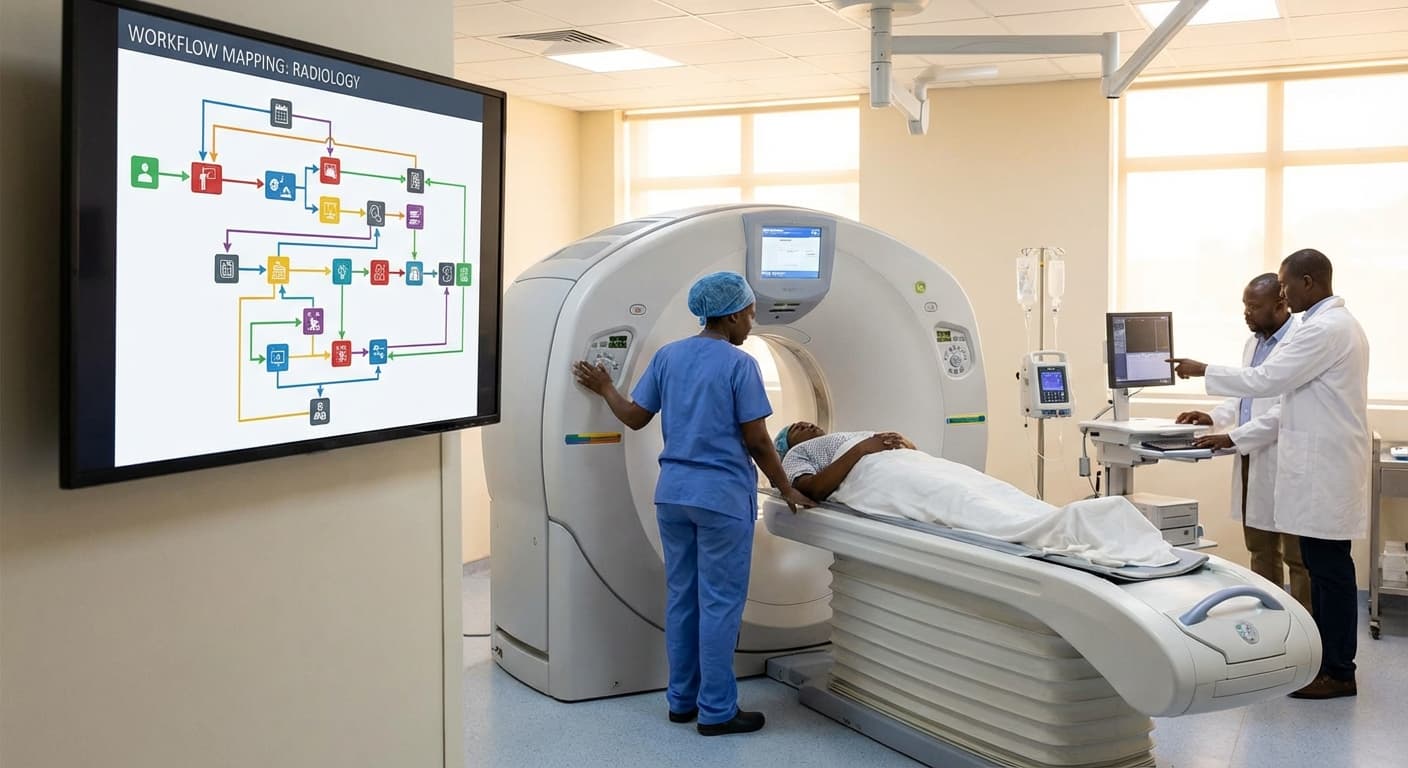
Department Workflow Mapping Service (Radiology/ICU/OT/Lab/Dialysis) in Comoros
Engineering Excellence & Technical Support
Department Workflow Mapping Service (Radiology/ICU/OT/Lab/Dialysis) High-standard technical execution following OEM protocols and local regulatory frameworks.
Streamlined Radiology Patient Flow
Visualize and optimize the entire patient journey from referral to imaging, report generation, and follow-up. Identify bottlenecks in scheduling, equipment utilization, and image interpretation to reduce wait times and improve diagnostic turnaround in Comorian radiology departments.
Enhanced ICU Patient Management Pathways
Map critical care patient pathways, from admission to discharge or transfer. Our service helps Comorian ICUs standardize treatment protocols, improve interdisciplinary communication, and ensure timely interventions, leading to better patient outcomes.
Optimized Operating Theatre Resource Allocation
Analyze and map surgical workflows, from pre-operative assessment to post-operative care. We help Comorian OT departments improve scheduling efficiency, optimize the use of surgical teams and equipment, and minimize cancellations, ensuring maximum theatre utilization and patient safety.
What Is Department Workflow Mapping Service (Radiology/icu/ot/lab/dialysis) In Comoros?
Department Workflow Mapping Service (Radiology/ICU/OT/Lab/Dialysis) in Comoros refers to the systematic analysis, documentation, and optimization of the operational processes within critical hospital departments. This service aims to create visual representations (maps) of how tasks, information, and resources flow through these departments to achieve specific patient care or diagnostic outcomes. The objective is to identify inefficiencies, bottlenecks, redundancies, and areas for improvement in order to enhance patient safety, throughput, resource utilization, and overall service quality. The methodology typically involves data collection through observation, interviews, process tracing, and system analysis, followed by the construction of detailed workflow diagrams using standardized notation (e.g., BPMN). The outputs are actionable insights and recommendations for process redesign and implementation.
| Department | Who Needs This Service | Typical Use Cases |
|---|---|---|
| Radiology | Radiology department managers, hospital administrators, IT departments responsible for PACS/RIS. | Optimizing patient scheduling and throughput for imaging procedures, reducing report turnaround times, improving radiologist workload distribution, enhancing image quality control pathways, streamlining contrast media management. |
| Intensive Care Unit (ICU) | ICU directors, nursing managers, critical care physicians, hospital quality improvement teams. | Improving patient admission and discharge processes, optimizing nurse-to-patient ratios and task allocation, streamlining medication administration and monitoring, enhancing communication protocols between multidisciplinary teams, reducing adverse events (e.g., VAP, CLABSI). |
| Operating Theatre (OT) | Surgical department heads, theatre managers, anesthesiologists, surgical nurses, sterilization technicians. | Optimizing surgical case scheduling and turnover times, improving instrument sterilization and availability, streamlining pre-operative patient preparation, enhancing post-operative recovery pathways, reducing surgical delays and cancellations, improving sterile supply chain management. |
| Laboratory | Laboratory directors, laboratory technicians, hospital quality managers, procurement departments. | Improving sample collection, transportation, and accessioning processes, optimizing test turnaround times, enhancing reagent and consumable inventory management, streamlining quality control procedures, improving result reporting and validation, optimizing laboratory automation integration. |
| Dialysis | Nephrology department heads, dialysis unit managers, dialysis nurses, biomedical engineers. | Optimizing patient scheduling and flow for dialysis treatments, improving machine utilization and maintenance, streamlining medication and fluid management, enhancing patient monitoring and safety protocols, improving access to vascular access and related care, optimizing supply chain for dialysis consumables. |
Key Components of Department Workflow Mapping Service
- Process Identification and Scope Definition
- Data Gathering (Interviews, Observations, Document Review)
- Workflow Diagramming and Visualization
- Bottleneck and Inefficiency Analysis
- Performance Metrics Identification and Baseline Establishment
- Root Cause Analysis of Process Deviations
- Recommendation Development for Optimization
- Implementation Planning and Support
- Continuous Monitoring and Refinement Strategy
Who Needs Department Workflow Mapping Service (Radiology/icu/ot/lab/dialysis) In Comoros?
In Comoros, healthcare facilities are increasingly recognizing the critical need for optimizing operational efficiency and patient care. Department workflow mapping services are essential for identifying bottlenecks, streamlining processes, and ultimately improving the quality and speed of service delivery. This is particularly true for high-demand, complex departments like Radiology, Intensive Care Units (ICU), Operating Theaters (OT), Laboratories, and Dialysis Units. By visually representing the step-by-step processes within these departments, healthcare providers can gain invaluable insights into their current state and identify areas for targeted improvement. This leads to reduced waiting times, minimized errors, better resource allocation, and enhanced patient satisfaction. The implementation of such services can be a significant step towards modernizing healthcare infrastructure in Comoros.
| Department | Why Workflow Mapping is Crucial | Target Customers within the Department |
|---|---|---|
| Radiology | Expedite patient throughput for imaging, reduce report turnaround time, optimize equipment utilization, manage contrast media inventory. | Radiologists, Radiographers, Department Managers, IT Support (for PACS/RIS integration) |
| Intensive Care Unit (ICU) | Improve patient monitoring and intervention protocols, ensure timely medication administration, streamline communication between staff and specialists, optimize bed management. | Intensivists, ICU Nurses, Respiratory Therapists, Charge Nurses, Department Heads |
| Operating Theater (OT) | Minimize surgical delays, optimize sterilization processes, ensure efficient instrument and supply management, improve patient flow pre and post-surgery. | Surgeons, Anesthesiologists, Operating Room Nurses, Scrub Nurses, Anesthesia Technicians, OR Managers |
| Laboratory | Speed up sample processing and analysis, reduce pre-analytical errors, optimize reagent and consumable inventory, ensure timely reporting of results. | Pathologists, Medical Technologists, Laboratory Technicians, Phlebotomists, Lab Managers |
| Dialysis Unit | Optimize patient scheduling and treatment slots, ensure efficient equipment maintenance and preparation, streamline medication and fluid management, improve patient comfort and safety. | Nephrologists, Dialysis Nurses, Renal Technicians, Unit Coordinators, Biomedical Engineers |
Who Needs Department Workflow Mapping Service in Comoros?
- Hospitals and larger healthcare facilities with specialized departments.
- Clinics facing increasing patient loads and complex procedures.
- Government health ministries seeking to improve national healthcare standards.
- Healthcare administrators and operational managers focused on efficiency and cost-effectiveness.
- Quality improvement teams aiming to reduce medical errors and enhance patient safety.
- Training and education departments looking to standardize departmental procedures.
Department Workflow Mapping Service (Radiology/icu/ot/lab/dialysis) Process In Comoros
This document outlines the standard workflow for requesting and executing Department Workflow Mapping services for various specialized units within healthcare facilities in Comoros. The service aims to analyze, document, and optimize operational processes to enhance efficiency, patient care, and resource utilization in departments such as Radiology, Intensive Care Units (ICU), Operating Theatres (OT), Laboratories, and Dialysis.
| Stage | Description | Key Activities | Responsible Parties | Deliverables |
|---|---|---|---|---|
| Initial contact from a healthcare facility to understand their need for workflow mapping services. | Facility contacts service provider. Discusses specific departmental challenges, goals, and scope of work. Preliminary assessment of needs and expectations. | Healthcare Facility (Department Head, Administrator), Service Provider (Business Development/Consultant) | Initial understanding of project scope, identified pain points, and potential benefits. |
| Formalization of the service offering based on the needs assessment. | Service provider develops a detailed proposal outlining methodology, timeline, deliverables, and costs. Facility reviews and negotiates the proposal. Contract/Agreement signing. | Service Provider (Consultant/Project Manager), Healthcare Facility (Procurement/Administration) | Signed Agreement, Detailed Project Proposal. |
| Deep dive into the current operational processes of the target department(s). | On-site observation of daily operations. Interviews with staff at all levels. Review of existing documentation (SOPs, protocols, reports). Data collection on patient flow, resource utilization, and turnaround times. | Service Provider (Analysts/Consultants), Healthcare Facility (Department Staff) | Raw data, interview notes, observed processes, initial process maps. |
| Visually representing the current state of departmental workflows. | Development of detailed process flowcharts (e.g., using BPMN or similar notation). Identification of all steps, decision points, roles, and systems involved. Documentation of communication pathways and handoffs. | Service Provider (Analysts/Process Engineers) | Current State Workflow Maps, Detailed Process Documentation. |
| Identifying areas for improvement and proposing solutions. | Analysis of mapped workflows to identify bottlenecks, redundancies, inefficiencies, and potential risks. Development of specific, actionable recommendations for process improvement. Proposal of optimized future state workflows. | Service Provider (Consultants/Subject Matter Experts) | Gap Analysis Report, Recommendations Document, Future State Workflow Maps (Proposed). |
| Assisting the facility in putting the recommendations into practice. | Training for staff on new processes. Development of revised SOPs. Support in piloting new workflows. Change management guidance. | Service Provider (Consultants/Trainers), Healthcare Facility (Department Staff/Management) | Revised SOPs, Training Materials, Pilot Study Reports. |
| Ensuring the accuracy and effectiveness of the mapped and recommended workflows. | Presentation of findings and recommendations to facility management and staff. Feedback gathering and incorporation. Final validation of workflow maps and recommendations. Project closure. | Service Provider (Project Manager/Consultant), Healthcare Facility (Department Head/Management) | Final Workflow Mapping Report, Validation Sign-off. |
Service Workflow Stages
- Inquiry and Needs Assessment
- Proposal and Agreement
- Information Gathering and Analysis
- Workflow Mapping and Documentation
- Recommendations and Optimization
- Implementation Support (Optional)
- Review and Validation
Department Workflow Mapping Service (Radiology/icu/ot/lab/dialysis) Cost In Comoros
Providing a comprehensive "Department Workflow Mapping Service" for specialized medical departments like Radiology, ICU, OT (Operating Theatre), Lab, and Dialysis in Comoros involves a nuanced approach to pricing. The cost is not a one-size-fits-all figure but rather depends on a multitude of factors that influence the time, expertise, and resources required for each engagement. These factors are critical for healthcare institutions in Comoros to budget effectively for such an essential service aimed at optimizing operational efficiency, patient safety, and resource utilization.
| Department Type | Estimated Minimum Cost (Comorian Franc - KMF) | Estimated Maximum Cost (Comorian Franc - KMF) | Typical Duration (Weeks) |
|---|---|---|---|
| Radiology | 750,000 | 1,500,000 | 4-8 |
| ICU (Intensive Care Unit) | 1,000,000 | 2,500,000 | 6-12 |
| OT (Operating Theatre) | 900,000 | 2,000,000 | 5-10 |
| Lab (Laboratory) | 500,000 | 1,200,000 | 3-6 |
| Dialysis Unit | 600,000 | 1,300,000 | 4-7 |
| Multiple Departments (package) | Negotiable (often with discount) | N/A | Varies based on total scope |
Key Pricing Factors for Department Workflow Mapping Services in Comoros
- Scope and Complexity of the Department: Mapping a large, multi-faceted department like an ICU with its intricate patient care pathways will naturally be more complex and time-consuming than mapping a smaller, more specialized lab. The number of sub-processes, patient flow stages, and interdependencies within the department directly impact the effort involved.
- Number of Departments Mapped: If an institution requires workflow mapping for multiple departments (e.g., Radiology and ICU simultaneously), the overall cost may involve economies of scale, but the cumulative effort and duration will increase.
- Current State Assessment Depth: The level of detail required for the 'as-is' workflow analysis is a major determinant. This can range from high-level process overviews to granular, step-by-step documentation, including every touchpoint, decision point, and information exchange.
- Future State Design & Optimization: Beyond just mapping the current state, the service often includes designing optimized future state workflows. This requires strategic thinking, understanding of best practices, and collaborative workshops, adding to the complexity and cost.
- Data Collection Methods: The methods employed for data collection (e.g., direct observation, interviews with staff, analysis of existing documentation, system log analysis) will influence the time and resources needed. More in-depth and varied methods generally lead to higher costs.
- Technology Integration Analysis: If the workflow mapping needs to consider the integration of existing or new technological systems (e.g., PACS in Radiology, LIMS in labs, EMR in ICU), this adds a layer of technical analysis and potentially vendor consultation.
- Stakeholder Engagement and Training: The number and seniority of stakeholders involved in interviews and workshops, as well as the need for training staff on new workflows, will impact the project timeline and cost.
- Deliverables and Reporting: The format and comprehensiveness of the final deliverables (e.g., detailed process maps, standard operating procedures (SOPs), gap analysis reports, recommendations, implementation roadmaps) will influence the effort in report generation and validation.
- Provider's Expertise and Reputation: The experience, specialization, and reputation of the consulting firm or individual providing the service will command different pricing. Highly specialized consultants with proven track records in healthcare workflow optimization may charge a premium.
- Project Timeline and Urgency: Expedited projects or those requiring intensive, on-site presence for extended periods may incur additional charges due to resource prioritization and potential overtime.
- Location-Specific Factors in Comoros: While not a direct service component, local operational costs for the service provider (e.g., travel, accommodation if applicable, administrative support) can subtly influence the overall pricing. However, the primary drivers remain the service scope and complexity.
Affordable Department Workflow Mapping Service (Radiology/icu/ot/lab/dialysis) Options
Our Affordable Department Workflow Mapping Service is designed to optimize operations within critical hospital departments like Radiology, ICU, OT (Operating Theatre), Lab, and Dialysis. We provide a comprehensive analysis of your existing workflows, identify bottlenecks, and propose actionable solutions to enhance efficiency, reduce costs, and improve patient care. Our service focuses on creating clear, documented processes that empower your teams and streamline operations.
| Service Component | Description | Cost-Saving Strategy | Typical Value |
|---|---|---|---|
| Workflow Visualization & Documentation | Creating clear visual maps and written procedures of departmental processes. | Reduces errors, minimizes rework, ensures consistency, and facilitates onboarding. | Enhanced clarity, improved compliance, faster training. |
| Bottleneck Identification & Analysis | Pinpointing areas where work is delayed or obstructed. | Streamlines patient flow, optimizes resource allocation, reduces waiting times. | Increased throughput, reduced patient wait times, better resource utilization. |
| Standard Operating Procedure (SOP) Development | Formalizing best practices and step-by-step instructions for key tasks. | Ensures consistent quality of care, reduces variability, and supports training. | Improved quality, reduced errors, easier staff training and retention. |
| Resource Optimization Recommendations | Analyzing staff, equipment, and supply utilization. | Minimizes waste, avoids over-allocation, and identifies opportunities for shared resources. | Reduced operational expenses, improved equipment lifespan, efficient staff deployment. |
| Technology Integration Opportunities | Identifying potential software or hardware solutions to automate or enhance processes. | Increases speed, accuracy, and data management capabilities, leading to long-term cost reductions. | Improved data accuracy, automation of tasks, potential for reduced administrative overhead. |
| Inter-Departmental Handoff Improvement | Mapping and optimizing the transitions of patients and information between departments. | Reduces communication errors, prevents delays, and ensures seamless patient care continuum. | Smoother patient transitions, reduced errors, improved patient satisfaction. |
Value Bundles for Department Workflow Mapping
- Basic Efficiency Audit: A foundational mapping of your current workflow, identifying key steps and potential areas for minor improvements. Ideal for departments seeking a quick overview and initial cost-saving insights.
- Standard Optimization Package: Includes detailed workflow mapping, bottleneck analysis, and the development of standardized operating procedures (SOPs) for critical processes. This bundle focuses on significant efficiency gains and initial cost reduction strategies.
- Premium Performance Enhancement: Encompasses comprehensive workflow mapping, advanced bottleneck identification, SOP development, staff training materials on new workflows, and recommendations for technology integration to maximize long-term cost savings and patient throughput. This is our most robust offering for departments aiming for transformative operational excellence.
- Customizable Departmental Solutions: Tailored packages designed to address the unique challenges and specific needs of individual departments. We can combine elements from our standard bundles or create entirely new solutions based on your requirements.
Verified Providers In Comoros
Ensuring access to quality healthcare is paramount, especially in regions where reliable medical services can be challenging to identify. In the Comoros, "Franance Health" is emerging as a leading name, synonymous with trust, professionalism, and a commitment to patient well-being. This document outlines the credentials of Franance Health and explains why they represent the best choice for healthcare needs in the Comoros.
| Key Service Areas | Franance Health's Commitment | Why it Matters for Comoros Residents |
|---|---|---|
| Primary Care | Accessible and comprehensive general medical services. | Provides first point of contact for common illnesses and routine check-ups, reducing reliance on distant or unverified sources. |
| Specialized Medical Care | Access to qualified specialists in various fields. | Reduces the need for costly and time-consuming overseas travel for specialized treatments and consultations. |
| Diagnostic Services | State-of-the-art laboratory and imaging facilities. | Enables accurate and timely diagnosis of conditions, leading to quicker and more effective treatment plans. |
| Preventative Health | Focus on health education and screening programs. | Empowers individuals to take proactive steps towards maintaining good health and preventing diseases. |
| Emergency Services | Preparedness for urgent medical situations (where applicable/available). | Offers vital support during medical emergencies, potentially saving lives. |
Franance Health Credentials and Advantages:
- Qualified Medical Professionals: Franance Health prides itself on employing a team of highly trained and experienced doctors, nurses, and specialists. Many of their practitioners have international qualifications and extensive experience in their respective fields, ensuring a high standard of medical care.
- Advanced Facilities and Equipment: The organization invests in modern medical equipment and facilities, enabling accurate diagnoses and effective treatments. This commitment to technological advancement allows for a wider range of medical services to be offered locally.
- Comprehensive Service Offerings: Franance Health provides a broad spectrum of medical services, encompassing general practice, specialized consultations (e.g., cardiology, pediatrics, dermatology), diagnostic imaging, laboratory services, and preventative care. This one-stop approach simplifies healthcare access for residents.
- Patient-Centric Approach: The core philosophy of Franance Health revolves around patient satisfaction and comfort. They emphasize clear communication, empathetic care, and personalized treatment plans tailored to individual needs.
- Adherence to International Standards: Franance Health aligns its practices with recognized international healthcare standards and protocols. This commitment to quality assurance provides patients with confidence in the safety and effectiveness of the care they receive.
- Accessibility and Outreach: Recognizing the geographical challenges in the Comoros, Franance Health strives to improve accessibility through strategically located clinics and, where possible, mobile health initiatives. This dedication to reaching underserved populations is a key differentiator.
- Trust and Reputation: Over time, Franance Health has built a strong reputation for reliability and ethical medical practice. Positive patient testimonials and growing community trust underscore their position as a dependable healthcare provider.
- Partnerships and Collaborations: Franance Health actively seeks partnerships with international health organizations and medical institutions. These collaborations facilitate knowledge exchange, access to specialized training, and the potential for advanced medical interventions.
Scope Of Work For Department Workflow Mapping Service (Radiology/icu/ot/lab/dialysis)
This Scope of Work (SOW) outlines the services to be provided for a comprehensive workflow mapping initiative across critical hospital departments: Radiology, Intensive Care Unit (ICU), Operating Theatre (OT), Laboratory (Lab), and Dialysis. The objective is to document, analyze, and optimize existing processes to improve efficiency, patient care, and resource utilization. The project will deliver detailed workflow maps, identify bottlenecks and inefficiencies, and propose actionable recommendations for improvement. All deliverables will adhere to established technical standards and specifications to ensure clarity, consistency, and usability.
| Deliverable | Description | Technical Specifications / Standards | Department Focus |
|---|---|---|---|
| Current State Workflow Maps | Detailed visual representations of all key processes within each department, from patient intake to discharge/completion. Includes roles, responsibilities, steps, decision points, and system interactions. | Utilize standard flowcharting notation (e.g., BPMN 2.0). Maps will be digital (e.g., Visio, Lucidchart, or similar) and printable. Color-coded for clarity. Annotated with key metrics (e.g., average time per step, frequency). | Radiology, ICU, OT, Lab, Dialysis |
| Process Narratives | Written descriptions accompanying each workflow map, providing detailed textual explanations of each step, rationale, and potential exceptions. | Clear, concise language. Consistent formatting. Cross-referenced with corresponding workflow map elements. | Radiology, ICU, OT, Lab, Dialysis |
| Stakeholder Interviews and Workshops Summary | Documentation of key insights, pain points, and suggestions gathered from subject matter experts and end-users during data collection phases. | Structured summary reports. Key themes and verbatim quotes captured where appropriate. Categorized by department and process. | Radiology, ICU, OT, Lab, Dialysis |
| Bottleneck and Inefficiency Analysis Report | Identification and detailed analysis of critical bottlenecks, redundant activities, and areas of significant inefficiency within the documented workflows. | Quantitative and qualitative assessment. Prioritization of identified issues based on impact (e.g., patient safety, cost, time). Data-backed evidence where available. | Radiology, ICU, OT, Lab, Dialysis |
| Recommendations for Process Improvement | Actionable and prioritized recommendations for optimizing workflows, addressing identified inefficiencies, and enhancing overall departmental performance. | SMART (Specific, Measurable, Achievable, Relevant, Time-bound) recommendations. Potential impact assessment for each recommendation. Phased implementation plan outline. | Radiology, ICU, OT, Lab, Dialysis |
| Final Project Report | A comprehensive report summarizing the entire project, including objectives, methodology, findings, analyses, and recommendations. | Executive summary. Detailed sections for each department. Appendices with raw data, interview notes, and supporting documentation. Professional formatting. | Radiology, ICU, OT, Lab, Dialysis |
| Data Dictionary (Optional, based on complexity) | Definitions of key terms, metrics, and data points used within the workflow maps and reports. | Alphabetical listing. Clear and unambiguous definitions. Consistent terminology. | Radiology, ICU, OT, Lab, Dialysis |
Project Objectives
- To meticulously document current state workflows for each specified department.
- To identify inefficiencies, bottlenecks, redundant steps, and potential risks within existing processes.
- To facilitate a shared understanding of departmental operations among stakeholders.
- To provide data-driven insights for process optimization and improvement initiatives.
- To establish a baseline for future performance measurement and comparison.
- To ensure alignment of workflows with best practices, regulatory requirements, and institutional goals.
Service Level Agreement For Department Workflow Mapping Service (Radiology/icu/ot/lab/dialysis)
This Service Level Agreement (SLA) outlines the performance standards and guarantees for the Department Workflow Mapping Service provided to the Radiology, Intensive Care Unit (ICU), Operating Theatre (OT), Laboratory, and Dialysis departments. The service aims to document, analyze, and optimize departmental workflows to improve efficiency, reduce errors, and enhance patient care.
| Service Component | Response Time Guarantee (Business Hours) | Uptime Guarantee (Monthly) |
|---|---|---|
| Initial Consultation/Request Acknowledgement | Within 4 business hours | N/A (not a continuously running service) |
| Delivery of Preliminary Workflow Maps (per department scope) | Within 5 business days (for standard department scope) | N/A |
| Incorporation of Feedback and Revisions | Within 2 business days per revision cycle | N/A |
| Availability of Workflow Mapping System/Tools (if applicable) | N/A | 99.5% |
| Support for Urgent Workflow Clarification/Issues | Within 2 business hours | N/A |
Service Objectives
- To provide accurate and comprehensive workflow maps for designated departments.
- To identify bottlenecks and areas for improvement within existing workflows.
- To support the implementation of optimized workflows and standard operating procedures.
- To ensure the service is available and responsive to departmental needs.
Frequently Asked Questions

Ready when you are
Let's scope your Department Workflow Mapping Service (Radiology/ICU/OT/Lab/Dialysis) in Comoros project in Comoros.

Scaling healthcare logistics and technical systems across the entire continent.