
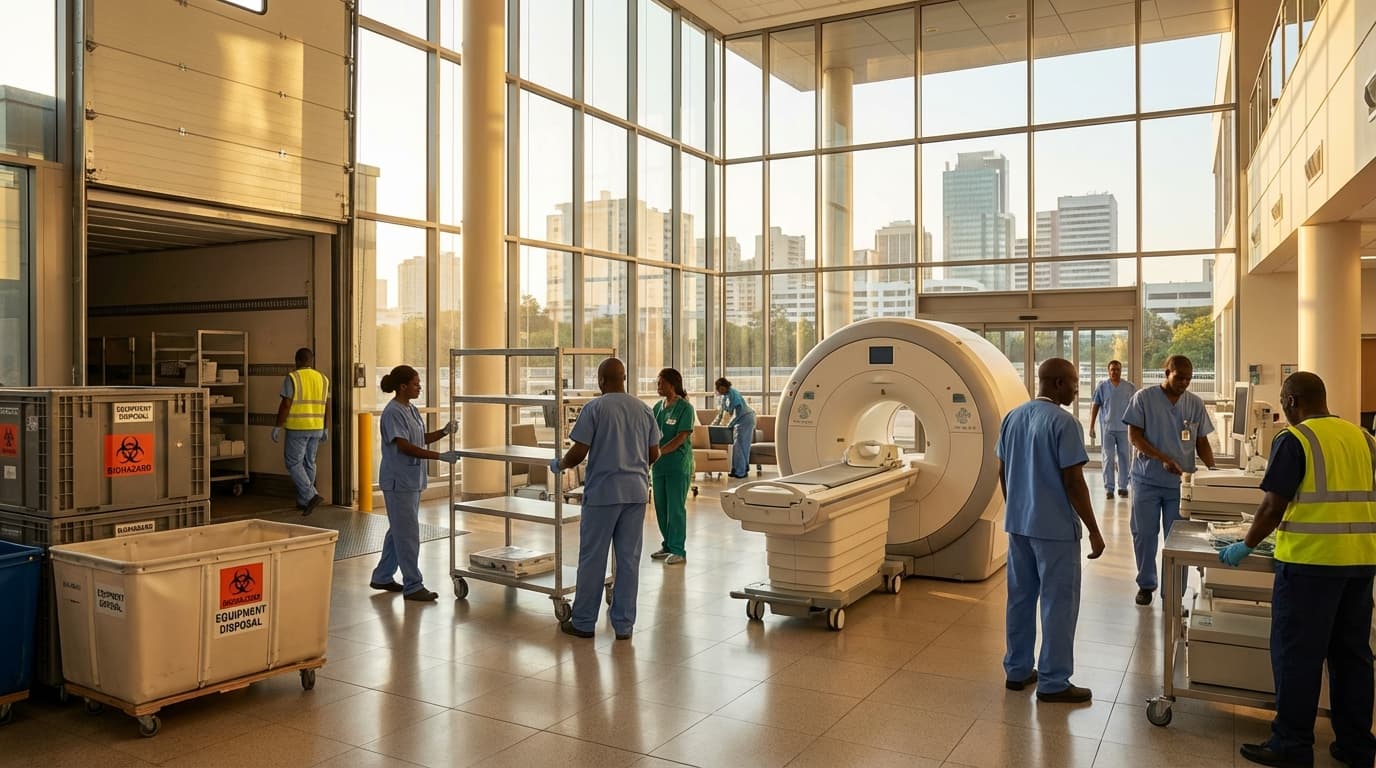
Heavy Medical Equipment De-Installation Service (MRI/CT/Cath Lab) in Chad
Engineering Excellence & Technical Support
Heavy Medical Equipment De-Installation Service (MRI/CT/Cath Lab) High-standard technical execution following OEM protocols and local regulatory frameworks.
Hazardous Material Containment & Compliance
Expert handling and containment of potentially hazardous materials (e.g., refrigerants, mercury in older CT components) according to international safety standards, ensuring absolute compliance with Chadian environmental regulations for safe removal and disposal.
Precision Component De-Manufacturing & Data Security
Meticulous de-installation of sensitive electronic components (e.g., superconducting magnets in MRIs, high-voltage X-ray tubes) with specialized tools and techniques to prevent damage, coupled with secure data sanitization protocols for all stored patient information.
Specialized Logistics & Site-Specific Infrastructure Adaptation
Leveraging robust, all-terrain logistics capabilities for transport of oversized and heavy equipment across Chad's infrastructure, including custom-designed lifting and rigging solutions adapted to unique on-site conditions and power grid limitations.
What Is Heavy Medical Equipment De-installation Service (Mri/ct/cath Lab) In Chad?
Heavy Medical Equipment De-Installation Service (MRI/CT/Cath Lab) in Chad refers to the specialized process of safely and systematically dismantling, packaging, and preparing large-scale, high-value medical imaging and interventional equipment for relocation, disposal, or long-term storage. This service is crucial for maintaining the integrity and functionality of complex systems like Magnetic Resonance Imaging (MRI) scanners, Computed Tomography (CT) scanners, and Cardiac Catheterization (Cath) laboratories. It requires a deep understanding of the intricate mechanical, electrical, and electronic components of these devices, as well as strict adherence to safety protocols and manufacturer-specific procedures. The process typically involves detailed planning, system diagnostics, disconnection of power and cooling systems, precise disassembly of major components (e.g., gantry, magnet, patient table, console), secure packaging using specialized materials, and coordination for transportation. The objective is to minimize risk of damage during the move and ensure the equipment can be successfully reinstalled or safely decommissioned.
| Typical Use Cases for Heavy Medical Equipment De-Installation Service (MRI/CT/Cath Lab) in Chad | Description |
|---|---|
| Equipment Upgrade/Replacement | De-installation of an older MRI, CT, or Cath Lab system to make space for a newer, more advanced model. This ensures the old system is removed without impacting ongoing operations and is prepared for responsible disposal or resale. |
| Facility Relocation | Moving an entire hospital or diagnostic imaging clinic to a new location. This involves the comprehensive de-installation of all heavy medical equipment, including imaging and interventional systems, for safe transit and subsequent re-installation at the new site. |
| Departmental Renovation/Expansion | When a specific medical department (e.g., Radiology, Cardiology) undergoes structural changes, requiring the temporary removal and subsequent re-installation of MRI, CT, or Cath Lab equipment to allow for construction or reconfiguration. |
| Lease Return/End-of-Contract | At the conclusion of a lease agreement for specialized medical equipment, a de-installation service is required to properly dismantle and prepare the equipment for return to the leasing company. |
| Site Decommissioning | When a healthcare facility or a specific unit is permanently closed, requiring the safe and systematic de-installation and disposal or transfer of all heavy medical equipment. |
| Inter-facility Transfer | Moving MRI, CT, or Cath Lab equipment from one healthcare facility to another within a network or to a different owner. This necessitates expert de-installation to ensure the equipment's transportability and readiness for re-installation. |
| Consolidation of Services | When multiple facilities merge or services are consolidated, requiring the de-installation of equipment from one site to be relocated to a central, consolidated facility. |
Who Needs Heavy Medical Equipment De-Installation Service (MRI/CT/Cath Lab) in Chad?
- Hospitals and Diagnostic Imaging Centers: Requiring upgrades, renovations, relocation within the facility, or replacement of existing MRI, CT, or Cath Lab equipment.
- Healthcare Providers Undergoing Facility Expansion or Relocation: When entire departments or entire healthcare facilities are being moved to new premises.
- Equipment Leasing Companies: For the return of leased equipment at the end of a contract term.
- Manufacturers and Vendors: During the decommissioning of demonstration units, servicing, or as part of a trade-in program.
- Organizations Involved in Medical Equipment Donation or Refurbishment: To prepare functional equipment for transfer to other facilities or for resale.
- Insurance Companies: In cases of equipment damage requiring removal and assessment prior to repair or replacement.
- Government and Non-Governmental Organizations (NGOs): During the setup or decommissioning of temporary medical facilities or when relocating specialized medical assets.
Who Needs Heavy Medical Equipment De-installation Service (Mri/ct/cath Lab) In Chad?
Companies and organizations requiring specialized expertise to safely and efficiently dismantle, decommission, and prepare for relocation or disposal of large, complex, and sensitive medical imaging and diagnostic equipment like MRI scanners, CT scanners, and Cath Labs in Chad.
| Customer Type | Key Departments/Functions Involved | Primary Need for De-Installation |
|---|---|---|
| Hospitals & Medical Centers | Radiology Department, Cardiology Department, Information Technology (IT) Department, Facilities Management, Biomedical Engineering Department | Equipment upgrades, facility renovations, relocation to new wings/buildings, end-of-life disposal, major maintenance requiring system removal. |
| Diagnostic Imaging Centers | Operations Management, Technical Staff, Facilities Management | System replacement, facility upgrades, closure of a site, relocation. |
| Government Health Ministries/Agencies | Procurement Department, Infrastructure Planning, Public Health Services | National equipment replacement programs, consolidation of services, upgrading public healthcare facilities. |
| International Aid Organizations/NGOs | Program Management, Logistics, Medical Equipment Specialists | Setting up new facilities, upgrading existing mission hospitals, decommissioning equipment after project completion. |
| Private Healthcare Providers | Management, Clinical Directors, Operations Managers, Facilities | Expansion of services, investment in newer technology, competitive upgrades, facility modernization. |
| Equipment Manufacturers/Distributors | Sales, Service & Support, Project Management | Facilitating trade-ins, managing end-of-lease returns, preparing for new installations by removing old systems. |
| Liquidation/Asset Recovery Companies | Auctioneers, Asset Managers, Logistics Coordinators | Safely dismantling equipment for resale, preparing for transport of acquired assets. |
Target Customers & Departments:
- Hospitals & Medical Centers: The primary users of these high-value medical systems.
- Diagnostic Imaging Centers: Facilities solely dedicated to medical imaging services.
- Government Health Ministries/Agencies: Involved in national healthcare infrastructure, upgrades, or replacements.
- International Aid Organizations/NGOs: Deploying or upgrading medical facilities in developing regions.
- Private Healthcare Providers: Expanding or renovating their imaging capabilities.
- Research Institutions: Utilizing advanced imaging for medical research.
- Equipment Manufacturers/Distributors: Facilitating upgrades, trade-ins, or site decommissioning for their clients.
- Liquidation/Asset Recovery Companies: Handling the disposal and resale of surplus or outdated medical equipment.
- Relocation Specialists (Medical Equipment): Needing expert de-installation before transport.
- Construction & Renovation Companies: Working on medical facilities where existing equipment needs to be temporarily or permanently removed.
- Maintenance & Service Providers: Overseeing the planned obsolescence or replacement of installed equipment.
Heavy Medical Equipment De-installation Service (Mri/ct/cath Lab) Process In Chad
This document outlines the comprehensive workflow for the Heavy Medical Equipment De-Installation Service (MRI/CT/Cath Lab) in Chad, from initial inquiry to successful execution. Our service ensures meticulous planning, safe dismantling, and compliant removal of complex medical imaging and interventional equipment.
| Stage | Description | Key Activities | Deliverables/Outcomes | Responsible Party |
|---|---|---|---|---|
| Initial Inquiry & Consultation | The client contacts us to inquire about de-installation services for heavy medical equipment. | Receive and acknowledge inquiry. Discuss equipment type, location, and client's general requirements. Provide preliminary information about our capabilities and process. | Understanding of client's needs. Initial confirmation of service availability. | Client, Service Provider |
| Site Assessment & Planning | A detailed on-site assessment to evaluate the equipment, surrounding infrastructure, and access routes. | Conduct physical inspection of equipment. Assess power, cooling, and structural requirements for dismantling. Evaluate building access, doorways, and transportation routes. Identify potential risks and safety concerns. Develop a preliminary de-installation plan. | Detailed site report. Risk assessment. Draft de-installation plan. Identification of specialized tools and personnel required. | Service Provider (Engineers, Project Manager) |
| Quotation & Agreement | Based on the site assessment, a detailed quotation and service agreement are provided. | Prepare a comprehensive quotation including labor, specialized equipment, transportation, permits (if applicable), insurance, and timelines. Present quotation and service agreement to the client for review and approval. Negotiate terms and finalize the contract. | Approved quotation. Signed service agreement. Clear understanding of scope, cost, and timeline. | Service Provider, Client |
| Logistics & Preparation | Gathering necessary resources, tools, and obtaining any required permits before commencing de-installation. | Procure specialized tools and lifting equipment. Secure transport vehicles. Mobilize skilled technicians and engineers. Obtain necessary local permits or approvals (if required). Coordinate with the client for site access and any temporary facility modifications. | All required equipment and personnel on-site. Necessary permits secured. Site ready for de-installation. | Service Provider |
| De-Installation Execution | The core phase where the equipment is safely and systematically dismantled. | Safely disconnect power and auxiliary systems. Dismantle equipment components according to manufacturer specifications and best practices. Carefully package and label all parts. Implement strict safety protocols throughout the process. | Dismantled and safely packaged equipment components. Detailed progress reports. | Service Provider (Technicians, Engineers) |
| Final Handover & Documentation | Concluding the on-site work and formally handing over the dismantled equipment. | Final site clean-up. Provide a comprehensive de-installation report, including photos and a list of all removed components. Obtain client sign-off on the completed work. | Cleaned de-installation site. De-installation report. Client sign-off. | Service Provider, Client |
| Post-Execution Support | Addressing any outstanding matters and ensuring client satisfaction after the de-installation. | Address any client queries or concerns. Facilitate transportation of equipment to the designated location (if part of the service). Provide support for any subsequent re-installation planning. | Resolved client queries. Seamless transition of dismantled equipment. Continued client satisfaction. | Service Provider |
Key Stages of the De-Installation Process
- Initial Inquiry & Consultation
- Site Assessment & Planning
- Quotation & Agreement
- Logistics & Preparation
- De-Installation Execution
- Final Handover & Documentation
- Post-Execution Support
Heavy Medical Equipment De-installation Service (Mri/ct/cath Lab) Cost In Chad
The cost of de-installing heavy medical equipment such as MRI, CT scanners, and Cath Labs in Chad is a complex undertaking influenced by several critical factors. These services require specialized expertise, significant logistical planning, and adherence to strict safety protocols. Therefore, pricing is not standardized and can vary considerably. It's essential for healthcare facilities to obtain detailed quotes from experienced providers, factoring in the specific circumstances of each de-installation project.
| Equipment Type | Estimated Cost Range (XAF) | Notes |
|---|---|---|
| CT Scanner | 2,000,000 - 7,000,000 | Varies based on size, complexity, and required disassembly. Excludes potential site restoration. |
| MRI Scanner (excluding magnet) | 3,000,000 - 10,000,000 | De-installation of ancillary components. Magnet removal and specialized handling can significantly increase costs. |
| Cath Lab (Angiography System) | 2,500,000 - 8,000,000 | Depends on the system's configuration, number of detectors, and gantry complexity. Excludes specialized shielding removal if applicable. |
| Modular/Larger MRI Magnet De-installation | 5,000,000 - 15,000,000+ | This is a highly specialized process requiring specific expertise, heavy lifting equipment, and strict safety protocols. Costs are highly variable. |
Key Factors Influencing Heavy Medical Equipment De-Installation Costs in Chad
- Type and Model of Equipment: Different machines have varying sizes, weights, complexity, and specific de-installation requirements. MRI machines, for instance, often involve dismantling superconducting magnets, which requires specialized handling and disposal/transportation considerations.
- Location of Equipment: The accessibility of the equipment within the facility, the floor it's on, and the proximity to exit routes all impact labor and equipment needed for transport. De-installation in remote or hard-to-reach areas will incur higher costs.
- Dismantling Complexity: The extent to which the equipment needs to be broken down for transport is a major cost driver. Some components may be too large to move without significant disassembly, requiring specialized tools and more labor hours.
- Specialized Tools and Equipment: De-installing heavy medical equipment often necessitates the use of cranes, forklifts, specialized lifting equipment, and secure transportation vehicles. The rental or ownership costs of these are passed on to the client.
- Labor Costs and Expertise: Highly skilled technicians with experience in de-installing sensitive and heavy medical machinery are required. Their expertise, coupled with the duration of the project, directly affects the overall cost.
- Safety and Environmental Regulations: Compliance with local safety standards and environmental regulations for disposal or transport of certain materials (e.g., refrigerants, radioactive components if applicable) can add to the cost.
- Transportation and Logistics: Moving heavy and delicate equipment from the de-installation site to its destination (e.g., storage, another facility, or disposal) involves significant logistical planning, specialized transport, and insurance, all contributing to the price.
- Site Preparation and Restoration: Depending on the contract, the de-installation service might include preparing the site for new equipment or restoring the original space after removal, which adds to the labor and material costs.
- Time Constraints and Urgency: If the de-installation needs to be completed within a tight timeframe, it may incur overtime labor costs or require expedited logistics, increasing the overall price.
- Contingency Planning: Unforeseen challenges during de-installation can arise. Professional service providers will factor in a contingency for potential issues, which is reflected in their pricing.
- Geographic Location within Chad: While the country is large, costs can also vary between major cities like N'Djamena and more remote regions due to differences in labor availability, transport infrastructure, and local service provider rates.
Affordable Heavy Medical Equipment De-installation Service (Mri/ct/cath Lab) Options
When it comes to de-installing large, complex medical equipment like MRI, CT scanners, and Cath Labs, cost can be a significant concern. This guide explores affordable options, value bundles, and cost-saving strategies to help healthcare facilities manage these projects efficiently and economically.
| Service Component | Cost-Saving Opportunity/Strategy | Potential Impact |
|---|---|---|
| Site Assessment & Planning | Bundle with de-installation service; Conduct internal assessments beforehand | Reduces unexpected issues and potential delays, leading to lower overall labor costs. |
| Equipment Disconnection | Inquire about included electrical, plumbing, and HVAC disconnection; coordinate with facility engineers | Avoids separate contractor fees; ensures efficient integration with bundled service. |
| Specialized Rigging & Lifting | Compare quotes from specialized rigging companies; inquire about provider's in-house capabilities | Secures competitive pricing for critical, high-risk operations. |
| Transportation | Optimize routes; inquire about shared transport options if applicable; consider proximity of destination | Reduces fuel and logistical expenses. |
| Site Remediation/Restoration | Clarify scope in the bundle; plan for minor repairs in-house | Prevents additional charges for unforeseen site damage or unnecessary restoration work. |
| Project Management | Choose a provider offering comprehensive project management within the bundle | Minimizes administrative overhead and communication breakdowns. |
Understanding Value Bundles and Cost-Saving Strategies
- {"title":"What are Value Bundles?","description":"Value bundles package multiple services together at a reduced price compared to purchasing them individually. For medical equipment de-installation, this might include pre-de-installation site assessment, equipment disconnection, specialized rigging, transportation, and even site remediation. Bundling ensures a comprehensive service and can lead to predictable pricing."}
- {"title":"Benefits of Value Bundles","description":"Key benefits include: Cost savings through bulk pricing, streamlined project management with a single point of contact, reduced risk of hidden fees, and often a more efficient execution as the bundled provider understands the entire workflow."}
- {"title":"Cost-Saving Strategies for De-Installation","description":"Beyond bundles, several strategies can reduce costs: \n\n* Early Planning & Scheduling: Booking services well in advance can secure better rates and accommodate less urgent timeframes.\n* Phased De-installation: If possible, breaking down the de-installation into smaller, manageable phases can spread costs and allow for adjustments.\n* Negotiating with Multiple Providers: Obtain quotes from several reputable de-installation specialists to compare pricing and services.\n* Evaluating Service Scope: Clearly define what services are essential and what can be managed in-house or by a less specialized provider.\n* Considering Refurbishment/Resale: If the equipment is being replaced, inquire about de-installation providers who also offer refurbishment or resale services, potentially offsetting de-installation costs."}
- {"title":"Factors Influencing De-Installation Costs","description":"The overall cost is influenced by: equipment type and size, complexity of the installation (e.g., RF shielding for MRI), accessibility of the site, required permits and regulatory compliance, distance for transportation, and the specific services included (e.g., electrical disconnects, HVAC modifications)."}
Verified Providers In Chad
Navigating healthcare options in any country can be challenging, and Chad is no exception. Ensuring you are accessing quality care from reputable sources is paramount. This document highlights verified providers in Chad, focusing on the credentials of Franance Health and explaining why they stand out as an excellent choice for your healthcare needs.
| Feature | Franance Health | Why it Matters for Patients |
|---|---|---|
| Accreditation & Licensing | Franance Health holds current and verified accreditation from relevant Chadian health authorities and adheres to all Ministry of Health regulations. | Ensures adherence to national healthcare standards and legal requirements, guaranteeing a baseline of safety and quality. |
| Professional Qualifications | All medical practitioners at Franance Health are board-certified or possess equivalent recognized qualifications and undergo continuous professional development. | Patients are assured of receiving care from highly skilled and up-to-date professionals, minimizing risks and optimizing treatment effectiveness. |
| Patient Care & Outcomes | Franance Health demonstrates a consistent history of positive patient feedback, successful treatment plans, and a commitment to patient well-being. | Indicates a provider that prioritizes patient experience, effective treatment, and long-term health improvements. |
| Service Comprehensiveness | Offers a wide spectrum of medical services, from general practice to specialized care, equipped with modern diagnostic and treatment facilities. | Provides a one-stop solution for various health concerns, reducing the need for multiple referrals and ensuring continuity of care. |
| Ethical Practices & Transparency | Franance Health operates with utmost integrity, ensuring patient confidentiality and transparent communication regarding treatments and costs. | Builds trust and empowers patients to make informed decisions about their health and finances without hidden surprises. |
| Technology & Infrastructure | Invests in up-to-date medical technology and maintains a well-equipped facility, adhering to international standards for healthcare infrastructure. | Facilitates accurate diagnoses, advanced treatment options, and a comfortable, safe environment for recovery. |
Key Indicators of a Verified Healthcare Provider in Chad
- Accreditation from national or recognized international health bodies.
- Proper licensing and registration with Chad's Ministry of Health.
- A strong track record of positive patient outcomes and satisfaction.
- Qualified and experienced medical professionals with relevant certifications.
- Adherence to ethical medical practices and patient privacy standards.
- Availability of comprehensive services that meet diverse healthcare needs.
- Transparent pricing and billing practices.
Scope Of Work For Heavy Medical Equipment De-installation Service (Mri/ct/cath Lab)
This Scope of Work (SOW) outlines the requirements for the professional de-installation of heavy medical imaging equipment, specifically Magnetic Resonance Imaging (MRI) scanners, Computed Tomography (CT) scanners, and Cardiac Catheterization (Cath Lab) systems. The service encompasses all necessary technical procedures, safety protocols, and documentation to ensure the equipment is safely and efficiently disconnected, disassembled, and prepared for relocation or disposal, adhering to industry best practices and manufacturer specifications.
| Task ID | Description | Technical Deliverables | Standard Specifications / Notes |
|---|---|---|---|
| 1.0 | Project Mobilization and Site Assessment | Site survey report, Risk assessment and method statement (RAMS), Pre-mobilization checklist | Includes verification of access routes, structural integrity, power requirements, cooling systems, and any site-specific constraints. RAMS must detail potential hazards and mitigation strategies. |
| 2.0 | System Shutdown and Power Down | Confirmed system shutdown procedures documented, Power isolation confirmation | Adherence to manufacturer-specific shutdown sequences. Verification of complete power isolation to all components, including emergency power supplies. |
| 3.0 | Cooling System Decommissioning (MRI/CT) | Cooling system drainage and flushing records, Coolant containment and disposal plan | For MRI, safe evacuation and containment of helium or other cryogens as per manufacturer and environmental regulations. For CT, safe drainage of cooling fluids. All coolant disposal must comply with local environmental laws. |
| 4.0 | Component Disassembly and Removal | Detailed breakdown of components with photographic evidence, Labeling and inventory of all removed parts | Systematic disassembly following manufacturer's service manuals. Delicate handling of sensitive components (e.g., X-ray tubes, detector arrays, superconducting magnets). Each component to be clearly labeled with its system origin and part number. |
| 5.0 | Cable and Conduit Management | Cable identification and segregation, Removal of associated cabling and conduits | Careful disconnection and labeling of all electrical, data, and RF cables. Safe removal of cable trays and conduits, ensuring minimal damage to building infrastructure. |
| 6.0 | Structural Component Removal (if applicable) | Documentation of structural interface points, Removal of any site-specific support structures | As required for specific installations (e.g., gantry support, magnet shielding removal). Ensure structural integrity of the building is maintained. |
| 7.0 | Preparation for Transit/Storage | Packaging specifications, Protective wrapping and crating of components, Securing of heavy items | Use of appropriate protective materials (e.g., anti-static bags, foam padding, specialized crates). Heavy components to be secured on appropriate transport pallets or skids as per manufacturer recommendations. |
| 8.0 | Site Remediation and Waste Disposal | Site cleanliness report, Waste disposal certificates | Thorough cleaning of the de-installation area. All waste materials, including packaging, fluids, and dismantled parts, to be disposed of in accordance with environmental regulations. |
| 9.0 | Documentation and Handover | Final de-installation report, Certificate of De-Installation, As-built documentation (if modified) | Comprehensive report detailing all steps performed, including dates, times, personnel involved, and any deviations from the plan. Certificate of De-Installation to confirm safe and complete removal. Include photographic evidence of the final state of the equipment and the site. |
Key Objectives and Deliverables
- Safe and complete de-installation of specified medical imaging equipment.
- Detailed technical documentation of the de-installation process.
- Proper packaging and preparation of components for transit.
- Adherence to all relevant safety regulations and manufacturer guidelines.
- Minimization of downtime for surrounding hospital operations.
- Provision of a Certificate of De-Installation.
- Removal of all waste and debris generated during the de-installation.
Service Level Agreement For Heavy Medical Equipment De-installation Service (Mri/ct/cath Lab)
This Service Level Agreement (SLA) outlines the response times and uptime guarantees for the de-installation of heavy medical equipment, specifically MRI, CT, and Cath Lab systems, by [Service Provider Name] for [Client Name]. This agreement ensures minimal disruption and timely service for critical medical infrastructure.
| Service Type | Response Time (Business Hours) | Response Time (24/7 - Emergency) | Uptime Guarantee |
|---|---|---|---|
| MRI De-installation | 4 Business Hours | 2 Business Hours | 99.5% (during scheduled service windows) |
| CT Scanner De-installation | 4 Business Hours | 2 Business Hours | 99.5% (during scheduled service windows) |
| Cath Lab De-installation | 4 Business Hours | 2 Business Hours | 99.5% (during scheduled service windows) |
Key Definitions
- Service Request: A formal notification from the Client to the Service Provider requesting de-installation services.
- Downtime: The period during which the de-installation service is unavailable or cannot be performed due to reasons within the Service Provider's control.
- Response Time: The maximum time allowed from the acknowledgment of a Service Request to the initiation of service work on-site by the Service Provider.
- Uptime Guarantee: The percentage of scheduled service availability.
- Scheduled Maintenance/De-installation: De-installation services scheduled in advance and agreed upon by both parties.
- Emergency Service Request: A Service Request for immediate de-installation due to unforeseen circumstances, such as facility closure or equipment relocation urgency.
Frequently Asked Questions

Ready when you are
Let's scope your Heavy Medical Equipment De-Installation Service (MRI/CT/Cath Lab) in Chad project in Chad.

Scaling healthcare logistics and technical systems across the entire continent.