
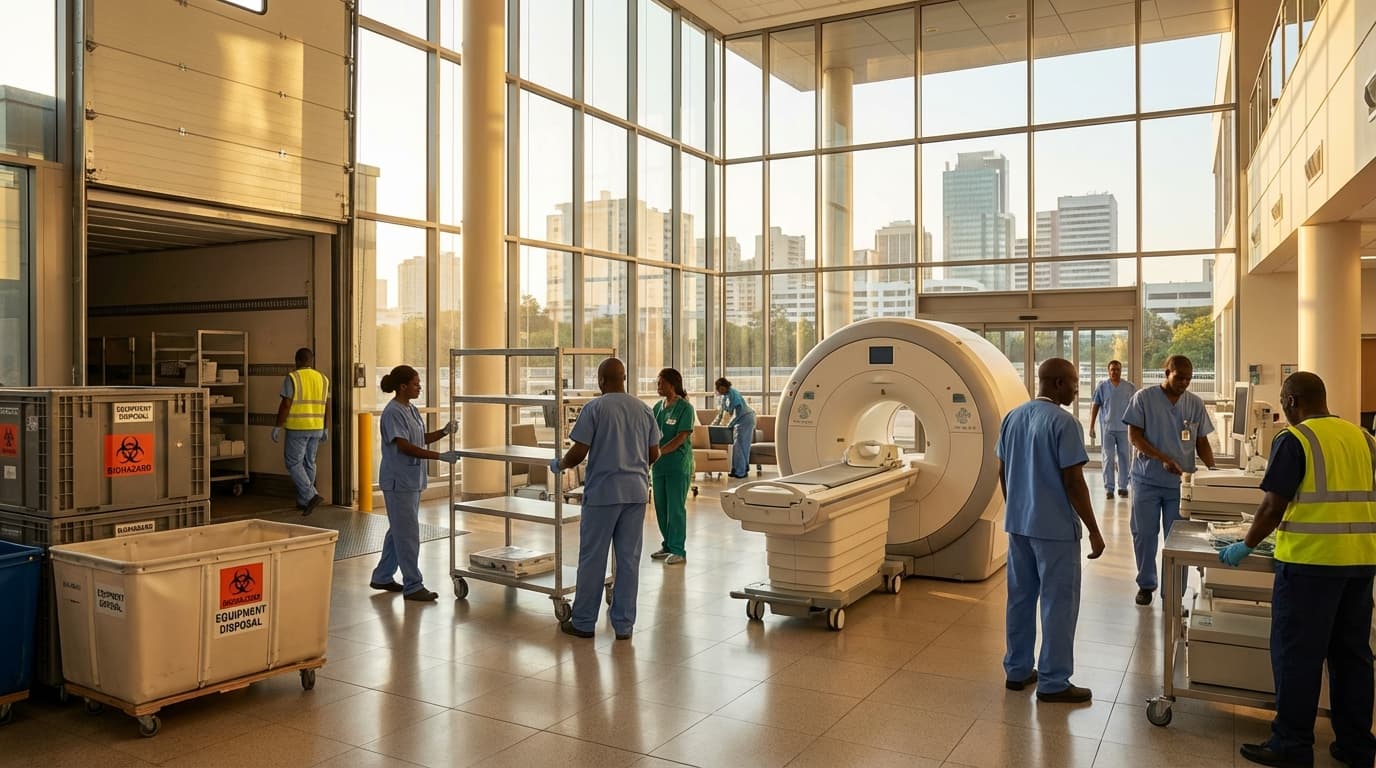
Decommissioning Service for Medical Devices in Chad
Engineering Excellence & Technical Support
Decommissioning Service for Medical Devices High-standard technical execution following OEM protocols and local regulatory frameworks.
Secure Data Sanitization & Destruction
Ensuring complete and irrefutable erasure of all sensitive patient data from medical devices prior to decommissioning, adhering to international privacy standards and Chad's specific data protection regulations.
Environmentally Responsible Disposal & Recycling
Implementing best practices for the environmentally sound dismantling, disposal, and recycling of medical devices, including hazardous materials management, to minimize ecological impact within Chad.
Regulatory Compliance & Certified Procedures
Providing comprehensive decommissioning services that meet all national and international regulatory requirements for medical device disposal, accompanied by certified documentation for chain of custody and compliance assurance in Chad.
What Is Decommissioning Service For Medical Devices In Chad?
Decommissioning service for medical devices in Chad refers to the organized and controlled process of retiring a medical device from active use. This involves a series of technical and administrative procedures to ensure the device is safely and responsibly removed from service, minimizing risks to patient safety, data privacy, and environmental integrity. The service encompasses several critical phases, including data sanitization, physical dismantling, proper disposal, and meticulous record-keeping.
| Who Needs Decommissioning Service | Typical Use Cases |
|---|---|
| Healthcare Facilities (Hospitals, Clinics, Diagnostic Centers): When medical devices reach the end of their operational lifespan, are upgraded, or are no longer needed. | End-of-life disposal of X-ray machines, MRI scanners, CT scanners, ultrasound devices, patient monitors, anesthesia machines, and laboratory equipment. |
| Medical Device Manufacturers and Distributors: For devices returned from field trials, trade-ins, or those designated for disposal before reaching end-users. | Disposal of demonstration units, obsolete inventory, or devices damaged during transit. |
| Research Institutions and Universities: When medical equipment used for research purposes is no longer required or needs to be retired. | Retirement of specialized diagnostic equipment used in clinical research or legacy laboratory instrumentation. |
| Government and Non-Governmental Organizations (NGOs): Involved in healthcare delivery, public health initiatives, or managing medical supplies. | Decommissioning of equipment from closed facilities or during the upgrade of national health infrastructure. |
| Third-Party Medical Equipment Service Providers: When managing equipment on behalf of clients or when performing major upgrades and replacements. | Systematic retirement of fleets of medical devices for clients undergoing facility modernization. |
Key Components of Medical Device Decommissioning Service
- Decommissioning Planning: Developing a comprehensive plan outlining the entire decommissioning process, including scope, timeline, responsibilities, and risk mitigation strategies.
- Asset Identification and Verification: Confirming the identity, location, and operational status of the medical device slated for decommissioning.
- Data Sanitization/Destruction: Implementing secure procedures to erase or physically destroy any Protected Health Information (PHI) or personally identifiable information (PII) stored on the device, adhering to relevant data privacy regulations.
- Functional Testing and Assessment: Evaluating the device's remaining functionality (if any) to determine the most appropriate decommissioning pathway (e.g., refurbishment for donation, parts harvesting, or recycling).
- Physical Dismantling and Component Segregation: Safely disassembling the device, segregating components for specialized disposal, recycling, or refurbishment.
- Hazardous Material Management: Identifying and safely managing any hazardous materials (e.g., mercury, lead, batteries) present in the device, in accordance with environmental regulations.
- Secure Transportation: Arranging for the safe and secure transport of the device or its components to the designated disposal or recycling facility.
- Environmentally Responsible Disposal/Recycling: Utilizing approved and certified facilities for the disposal or recycling of medical devices, ensuring compliance with environmental standards.
- Certification and Documentation: Providing comprehensive documentation, including certificates of data destruction, disposal certificates, and a final decommissioning report, for auditable records.
- Regulatory Compliance Review: Ensuring all decommissioning activities comply with local, national, and international regulations pertaining to medical device management, data privacy, and environmental protection.
Who Needs Decommissioning Service For Medical Devices In Chad?
In Chad, reliable and professional decommissioning services for medical devices are crucial for ensuring the safe and compliant disposal of outdated, damaged, or end-of-life equipment. This process not only mitigates environmental and health risks but also adheres to international and national regulations. Several entities within Chad's healthcare landscape require these specialized services.
| Customer Type | Typical Departments Requiring Decommissioning | Reasons for Decommissioning Needs |
|---|---|---|
| Public Hospitals and Healthcare Centers | Radiology, Pathology, Surgical Wards, Intensive Care Units (ICUs), Laboratories, Central Sterilization Supply Departments (CSSDs), Outpatient Departments | Equipment obsolescence, damage, upgrade to newer technology, infection control protocols, space optimization, compliance with disposal regulations. |
| Private Hospitals and Clinics | Similar to Public Hospitals but may have a greater focus on diagnostic imaging, specialized surgical equipment, and advanced laboratory testing. | Maintaining a modern facility, patient safety, competitive advantage, efficient resource allocation, adherence to licensing requirements. |
| Non-Governmental Organizations (NGOs) with Healthcare Programs | Mobile clinics, field hospitals, primary healthcare posts, specialized treatment centers (e.g., for HIV/AIDS, malaria). | Project closure, equipment donation expiry, transition to new initiatives, limited in-house technical capacity for disposal, ensuring responsible exit from programs. |
| Government Health Agencies and Ministries | National medical storage facilities, public health laboratories, procurement and logistics departments. | Managing national medical asset inventories, implementing national health policies on waste management, overseeing public health infrastructure. |
| Medical Research Institutions | Research laboratories, clinical trial facilities, universities with medical programs. | End of research projects, replacement of specialized research equipment, disposal of potentially hazardous research materials associated with devices, maintaining research integrity. |
| International Aid Organizations Operating in Chad | Hospitals and clinics supported by foreign aid, emergency response units, long-term development projects. | Fulfilling grant requirements for responsible disposal, aligning with international standards for medical waste management, ensuring sustainability of projects beyond immediate funding. |
Target Customers for Medical Device Decommissioning Services in Chad
- Public Hospitals and Healthcare Centers
- Private Hospitals and Clinics
- Non-Governmental Organizations (NGOs) with Healthcare Programs
- Government Health Agencies and Ministries
- Medical Research Institutions
- International Aid Organizations Operating in Chad
Decommissioning Service For Medical Devices Process In Chad
This document outlines the standard workflow for decommissioning medical devices within Chad, from initial inquiry to the final execution of the service. The process ensures that medical equipment is safely and responsibly retired, adhering to relevant regulations and environmental guidelines.
| Phase | Key Activities | Responsible Parties | Deliverables |
|---|---|---|---|
| Inquiry and Initial Assessment | Receive inquiry, conduct site assessment, gather device information. | Client, Service Provider | Initial assessment report, client requirements list. |
| Proposal and Agreement | Develop proposal, negotiate terms, sign contract. | Service Provider, Client | Decommissioning proposal, signed service agreement. |
| Planning and Preparation | Permit acquisition, safety planning, logistics coordination. | Service Provider, Relevant Authorities | Project plan, permits, safety protocols, transport arrangements. |
| Execution of Decommissioning | Dismantling, removal, transport, disposal/recycling. | Service Provider | Decommissioned devices at appropriate facilities, waste manifests. |
| Documentation and Certification | Generate reports, issue certificates. | Service Provider | Decommissioning report, certificates of destruction/recycling, final invoice. |
| Post-Decommissioning Review | Client follow-up, feedback collection, archiving. | Service Provider, Client | Client feedback summary, archived project files. |
Decommissioning Service for Medical Devices Process in Chad
- {"steps":["Facility initiates inquiry (phone, email, official letter).","Service provider acknowledges inquiry and schedules initial consultation.","On-site or remote assessment of devices to be decommissioned (type, quantity, condition, location).","Gathering of relevant documentation (e.g., device serial numbers, purchase dates, maintenance records if available).","Preliminary identification of potential hazards (e.g., hazardous materials, radiation sources).","Discussion of client's specific requirements and expectations."],"title":"Phase 1: Inquiry and Initial Assessment","description":"The process begins when a healthcare facility or organization expresses the need to decommission one or more medical devices. This involves an initial contact and a preliminary evaluation of the request."}
- {"steps":["Service provider develops a detailed decommissioning proposal.","Proposal includes scope of services (transport, dismantling, disposal methods, recycling, destruction).","Proposal details cost breakdown (labor, transport, disposal fees, certifications).","Proposal outlines estimated timeline for execution.","Client reviews the proposal and provides feedback.","Negotiation and finalization of terms and conditions.","Formal agreement/contract signed by both parties."],"title":"Phase 2: Proposal and Agreement","description":"Based on the initial assessment, a detailed proposal is developed, outlining the scope of work, costs, timeline, and terms. Upon acceptance, a formal agreement is established."}
- {"steps":["Develop a detailed project plan with specific tasks and responsibilities.","Obtain any necessary permits or authorizations from local authorities (e.g., Ministry of Health, environmental agencies).","Secure appropriate personnel and equipment for the decommissioning work.","Implement safety protocols and risk assessments for hazardous materials or procedures.","Coordinate logistics for transportation of devices.","Inform relevant internal stakeholders within the facility (e.g., IT, facilities management) about the decommissioning schedule."],"title":"Phase 3: Planning and Preparation","description":"Before execution, thorough planning and preparation are undertaken to ensure a smooth and compliant decommissioning process."}
- {"steps":["Secure the decommissioning site.","Safely disconnect and dismantle medical devices according to manufacturer guidelines and safety procedures.","Handle and segregate any hazardous components (e.g., mercury, batteries, radioactive materials).","If applicable, data sanitization or physical destruction of storage media to ensure data privacy.","Properly package and label devices for transport.","Transport devices to designated recycling, treatment, or disposal facilities.","Execute environmentally sound disposal or recycling methods as per national and international standards.","If required, perform secure destruction of sensitive or non-recyclable components."],"title":"Phase 4: Execution of Decommissioning","description":"This is the core phase where the actual dismantling, removal, and disposal/recycling of the medical devices occur."}
- {"steps":["Generate a detailed decommissioning report.","Report includes list of decommissioned devices, date of service, and methods used.","Provide certificates of destruction or recycling from certified facilities.","Include documentation of hazardous waste disposal (if applicable).","Confirm data sanitization or destruction with a certificate.","Submit any required reports to regulatory bodies.","Provide final invoice and confirmation of service completion to the client."],"title":"Phase 5: Documentation and Certification","description":"Upon completion of the decommissioning, comprehensive documentation and certifications are provided to the client, verifying the responsible retirement of the devices."}
- {"steps":["Follow up with the client to confirm satisfaction with the service.","Gather feedback on the process and any suggestions for improvement.","Archive all project-related documentation."],"title":"Phase 6: Post-Decommissioning Review","description":"A brief review is conducted to ensure client satisfaction and to identify any areas for improvement in future services."}
Decommissioning Service For Medical Devices Cost In Chad
Decommissioning medical devices in Chad involves a specialized service that ensures proper disposal, often due to obsolescence, malfunction, or upgrading of equipment. The cost of these services is influenced by several factors, leading to a range of pricing. These factors include the type and complexity of the medical device, the volume of devices requiring decommissioning, the required disposal methods (e.g., sterilization, shredding, hazardous waste management), the logistical challenges in reaching the location of the devices, and the expertise of the decommissioning service provider. Pricing is typically quoted in local currency, the Chadian Franc (XAF).
| Device Category (Example) | Estimated Cost Range (XAF) | Notes |
|---|---|---|
| Small Devices (e.g., Blood Pressure Monitors, Thermometers) | 15,000 - 50,000 XAF | Generally straightforward; minimal specialized handling. |
| Medium Devices (e.g., Patient Monitors, ECG Machines, Basic Ultrasound) | 50,000 - 250,000 XAF | May require some dismantling and specialized waste consideration. |
| Large/Complex Devices (e.g., X-ray Machines, CT Scanners, Larger Lab Equipment) | 250,000 - 1,500,000+ XAF | Significant dismantling, specialized transportation, hazardous waste protocols, and expert handling are typically required. Costs can escalate rapidly based on specific components and disposal needs. |
| Bulk Decommissioning (e.g., entire hospital ward, multiple facilities) | Negotiable per project | Volume discounts and tailored packages are common. A comprehensive site assessment is usually required for accurate quoting. |
Key Pricing Factors for Medical Device Decommissioning in Chad
- Device Type and Complexity: Larger, more complex, or specialized equipment (e.g., MRI machines, X-ray units, sophisticated laboratory analyzers) will generally incur higher decommissioning costs than simpler devices (e.g., basic patient monitors, examination tables).
- Volume of Devices: A higher number of devices to be decommissioned may lead to a lower per-unit cost due to economies of scale in labor and logistics.
- Disposal Method Requirements: Devices containing hazardous materials (e.g., radioactive isotopes, mercury) or requiring specific sterilization processes before disposal will have increased costs associated with specialized handling and waste management.
- Logistical Challenges: The geographical location of the medical facility can significantly impact costs. Decommissioning in remote or difficult-to-access areas will involve higher transportation and labor expenses.
- Service Provider Expertise and Certifications: Reputable service providers with specialized training, certifications, and a proven track record in medical device decommissioning may command higher prices.
- Environmental Regulations and Compliance: Adhering to Chadian environmental laws and regulations for waste disposal is a mandatory cost factor.
- Dismantling and Transportation: The labor involved in carefully dismantling devices and the cost of transportation to the disposal facility are key components of the overall price.
Affordable Decommissioning Service For Medical Devices Options
Decommissioning medical devices is a critical yet often overlooked aspect of healthcare facility management. It ensures data security, environmental compliance, and proper asset lifecycle management. Finding affordable services is essential, especially for smaller practices or those with budget constraints. This guide explores cost-effective options, focusing on value bundles and smart cost-saving strategies.
| Cost-Saving Strategy | Description | Potential Savings |
|---|---|---|
| Negotiate Tiered Pricing | Discuss volume discounts or tiered pricing based on the number of devices or service level required. This is particularly effective for larger decommissioning projects. | 5-15% on bulk services |
| Explore Off-Peak Scheduling | If possible, schedule decommissioning during off-peak hours or seasons when providers may have more availability and offer lower rates. | 3-10% on service fees |
| DIY Data Wiping (with caution) | For non-networked, less sensitive devices, consider in-house secure data wiping using certified software. Ensure strict adherence to data security protocols. | Significant savings on data destruction fees (but requires internal resources and expertise) |
| Partner with Specialized Recyclers | Instead of full-service providers, consider partnering directly with certified medical device recyclers. This can be more cost-effective if data destruction is handled separately or is not a primary concern for older, non-networked devices. | 10-25% on recycling and disposal |
| Bundle with Other Facility Services | Inquire if your current facility management or IT service providers offer decommissioning as part of a larger contract. This can lead to integrated discounts. | Varies based on contract |
| Phased Decommissioning | Break down large decommissioning projects into smaller, phased approaches. This can help manage cash flow and potentially secure better rates for each phase. | Improved cash flow management; potential for better per-phase negotiation |
| Seek Multiple Quotes | Always obtain at least three quotes from different reputable decommissioning service providers. Compare not only price but also the scope of services included and their certifications. | Up to 30% difference in pricing |
| Prioritize Device Value | For functional or valuable devices, explore options for resale or donation rather than immediate decommissioning. This can offset decommissioning costs. | Potential to recover costs or even generate revenue |
Understanding Value Bundles
- {"title":"What are Value Bundles?","description":"Value bundles in medical device decommissioning are packages of services offered at a reduced combined price compared to purchasing each service individually. They are designed to streamline the process and provide comprehensive solutions for a set fee."}
- {"title":"Common Components of Decommissioning Value Bundles:","sublist":["Secure data wiping and destruction (HIPAA compliance)","Physical dismantling and recycling of components","Environmental disposal of hazardous materials","Asset tracking and inventory management","Certification of destruction and recycling","Logistics and transportation of devices"],"description":"These bundles typically include a combination of the following services, tailored to the client's needs:"}
- {"title":"Benefits of Opting for Value Bundles:","sublist":["Predictable budgeting","Simplified vendor management","Potential for significant cost savings","Ensured comprehensive service coverage","Reduced administrative overhead"],"description":"Bundles offer several advantages for cost-conscious organizations:"}
Verified Providers In Chad
In the realm of healthcare access in Chad, identifying verified providers is paramount for ensuring quality care and patient safety. Franance Health stands out as a premier choice due to its rigorous credentialing process and unwavering commitment to excellence. This commitment translates into a network of healthcare professionals and facilities that consistently meet and exceed established standards.
| Benefit of Franance Health Credentials | Impact on Patient Care in Chad |
|---|---|
| Guaranteed Competence and Expertise | Patients can be confident in receiving care from well-trained and experienced medical professionals, reducing the risk of misdiagnosis or ineffective treatment. |
| Enhanced Patient Safety | Rigorous vetting minimizes the risk of fraudulent practitioners or those with questionable ethical standards, leading to a safer healthcare experience. |
| Access to Quality Facilities | Franance Health's network includes accredited and well-equipped healthcare facilities, ensuring patients have access to necessary resources and technology for their treatment. |
| Improved Health Outcomes | By ensuring providers adhere to best practices and continuously monitor their performance, Franance Health contributes to better and more consistent patient recovery and long-term health. |
| Increased Patient Confidence and Empowerment | Knowing that their chosen provider is verified by a reputable organization like Franance Health empowers patients to actively participate in their healthcare journey. |
Why Franance Health Credentials Represent the Best Choice:
- Rigorous Vetting Process: Franance Health employs a multi-layered verification system for all its providers. This includes thorough background checks, verification of medical licenses and certifications, and an in-depth assessment of clinical experience and expertise. This ensures that only highly qualified and ethical practitioners are part of their network.
- Adherence to International Standards: Franance Health aligns its credentialing protocols with recognized international healthcare benchmarks. This commitment to global best practices guarantees that patients receive care that is not only locally relevant but also globally competitive.
- Continuous Monitoring and Evaluation: The credentialing process doesn't end with initial approval. Franance Health actively monitors the performance and compliance of its providers through ongoing quality reviews, patient feedback mechanisms, and regular re-credentialing. This proactive approach maintains a consistently high level of care.
- Focus on Patient Safety and Outcomes: At the core of Franance Health's philosophy is the well-being of the patient. Their credentialing criteria are designed to prioritize patient safety, effective treatment protocols, and positive health outcomes. This focus assures patients that they are in capable hands.
- Transparency and Trust: Franance Health believes in fostering trust through transparency. Their credentialing information is readily accessible, empowering patients to make informed decisions about their healthcare providers. This open approach builds confidence and strengthens the patient-provider relationship.
- Access to Specialized Expertise: Through their meticulous selection process, Franance Health ensures access to a diverse range of medical specialists. This means patients can find the specific expertise they need, from general practitioners to highly specialized surgeons and diagnosticians.
Scope Of Work For Decommissioning Service For Medical Devices
This Scope of Work (SOW) outlines the decommissioning services required for a defined set of medical devices. The objective is to ensure that all medical devices are safely and securely decommissioned, data is securely erased, and all relevant environmental regulations are adhered to. The services include but are not limited to: site assessment, planning, physical removal, data sanitization, disposal, and documentation.
| Phase/Activity | Description | Technical Deliverables | Standard Specifications/Requirements | Acceptance Criteria |
|---|---|---|---|---|
| Site Assessment and Planning | On-site evaluation of the devices to be decommissioned, including their location, condition, connectivity, and any site-specific constraints. Development of a detailed decommissioning plan. | Decommissioning Plan (including timeline, resource allocation, safety protocols, waste management strategy). | Compliance with relevant health and safety regulations. Assessment of potential hazards (electrical, chemical, biological). Identification of disposal routes. | Approved Decommissioning Plan by the Client. |
| Physical Decommissioning and Removal | Safe disconnection, disassembly, and removal of medical devices from their installed locations. | Inventory of removed devices. Proof of physical removal (e.g., photos, signed checklists). | Adherence to manufacturer guidelines for disconnection. Use of appropriate tools and equipment. Minimal disruption to ongoing operations. Secure transportation from site. | Confirmation of complete and safe removal of all specified devices. |
| Data Sanitization and Destruction | Secure erasure or physical destruction of all sensitive data stored on the medical devices. | Data Sanitization Report (certifying data erasure to a specific standard). Certificate of Data Destruction (if physical destruction is performed). | Compliance with HIPAA, GDPR, or other relevant data privacy regulations. Use of certified data erasure software/hardware (e.g., NIST 800-88 Rev. 1 guidelines). Secure chain of custody for devices undergoing data destruction. | Client verification of data sanitization reports. No recoverable sensitive data from decommissioned devices. |
| Environmental Disposal and Recycling | Responsible disposal or recycling of decommissioned medical devices and their components in accordance with environmental regulations. | Waste Manifests/Certificates of Disposal. Recycling Certificates. | Adherence to local, state, and federal environmental regulations. Partnering with certified e-waste recyclers. Minimization of landfill waste through recycling. | Confirmation of proper and compliant disposal/recycling of all device components. |
| Documentation and Certification | Provision of all necessary documentation to confirm the completion of the decommissioning process. | Final Decommissioning Report (summarizing all activities, deliverables, and certifications). Signed acceptance forms. | Comprehensive and accurate documentation. Traceability of all activities. Clear communication of findings. | Client acceptance of the Final Decommissioning Report. |
Key Activities and Deliverables
- Site Assessment and Planning
- Physical Decommissioning and Removal
- Data Sanitization and Destruction
- Environmental Disposal and Recycling
- Documentation and Certification
Service Level Agreement For Decommissioning Service For Medical Devices
This Service Level Agreement (SLA) outlines the agreed-upon response times and uptime guarantees for the Decommissioning Service for Medical Devices provided by [Your Company Name] (hereinafter referred to as "Provider") to [Client Company Name] (hereinafter referred to as "Client"). This SLA is an appendix to the Master Service Agreement (MSA) between the parties.
| Service Category | Response Time (Acknowledgement/Start) | Resolution Time (Completion) | Uptime Guarantee |
|---|---|---|---|
Definitions
- {"term":"Decommissioning Service","definition":"The process of safely and securely removing medical devices from service, including data sanitization, physical destruction (if required), and environmental disposal, in accordance with all applicable regulations and manufacturer recommendations."}
- {"term":"Critical Device","definition":"A medical device whose failure or unavailability directly impacts patient safety or critical clinical workflows. This will be pre-defined and agreed upon by both parties."}
- {"term":"Standard Device","definition":"A medical device that is not classified as a Critical Device."}
- {"term":"Response Time","definition":"The maximum time allowed for the Provider to acknowledge a Service Request and commence initial troubleshooting or planning activities."}
- {"term":"Resolution Time","definition":"The maximum time allowed for the Provider to successfully complete the Decommissioning Service, from the initial Service Request until confirmation of completion."}
- {"term":"Uptime","definition":"For the purpose of this SLA, 'uptime' refers to the availability of the Provider's personnel and necessary resources to initiate and execute the Decommissioning Service upon request. This does not imply continuous operation of the medical devices themselves, as the service is for decommissioning."}
- {"term":"Service Request","definition":"A formal request submitted by the Client to the Provider for the Decommissioning Service, initiated via [Specify Method: e.g., client portal, email, phone]."}
- {"term":"Business Hours","definition":"Monday to Friday, 9:00 AM to 5:00 PM [Client's Time Zone], excluding national holidays."}
- {"term":"24/7 Support","definition":"Availability of the Decommissioning Service and support personnel outside of Business Hours, including weekends and holidays."}
Frequently Asked Questions

Ready when you are
Let's scope your Decommissioning Service for Medical Devices in Chad project in Chad.

Scaling healthcare logistics and technical systems across the entire continent.