
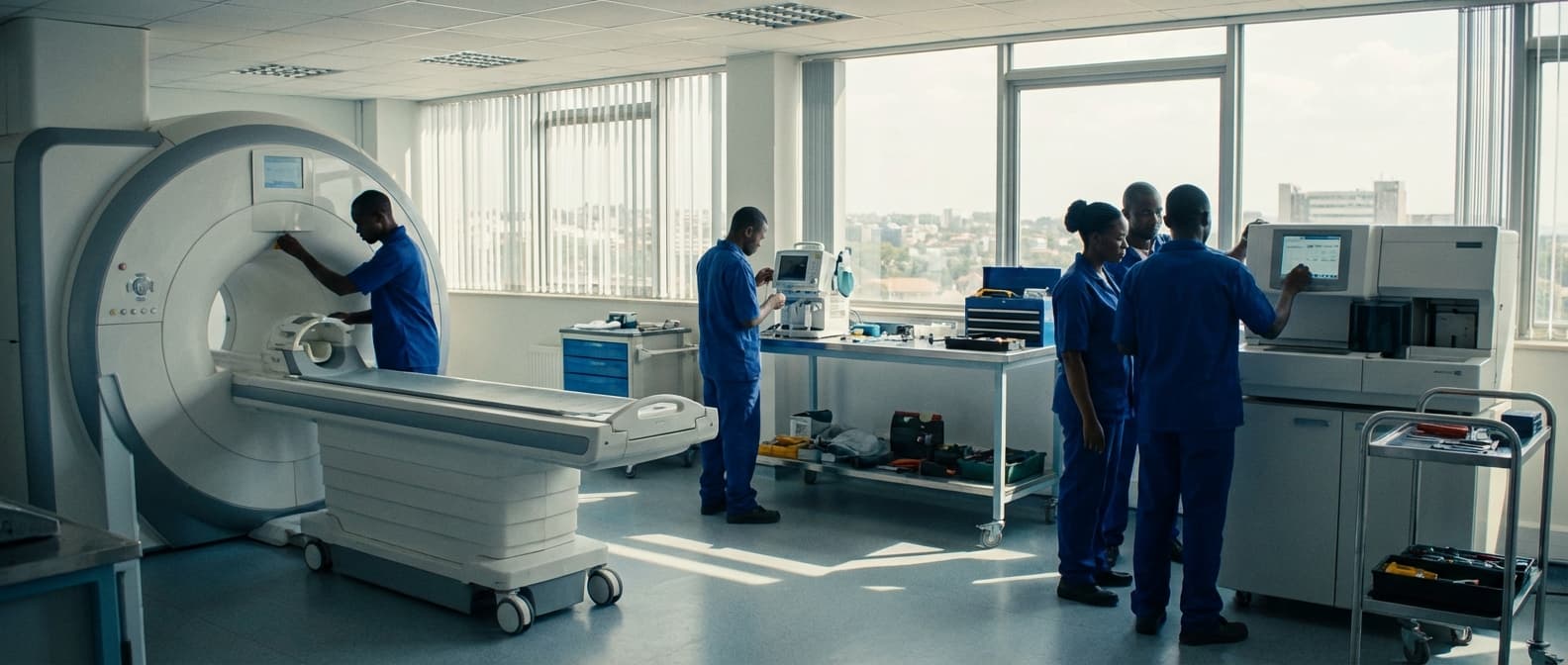
Uptime, Downtime & Root-Cause Analysis Reporting Service in Chad
Engineering Excellence & Technical Support
Uptime, Downtime & Root-Cause Analysis Reporting Service High-standard technical execution following OEM protocols and local regulatory frameworks.
Real-time Uptime Monitoring & Alerting
Proactive, 24/7 monitoring of critical IT infrastructure across Chad, with instant alerts for any service interruptions. Our platform ensures immediate notification of downtime events, minimizing impact on your business operations.
Automated Downtime Diagnostics
Advanced automated tools rapidly identify the scope and potential causes of any downtime. We provide granular logs and performance metrics to pinpoint the exact issue, reducing manual troubleshooting time significantly.
Comprehensive Root-Cause Analysis & Reporting
Detailed, actionable reports on every downtime incident, outlining the definitive root cause. Empower your IT teams with the insights needed to implement preventative measures and enhance system resilience throughout Chad.
What Is Uptime, Downtime & Root-cause Analysis Reporting Service In Chad?
Uptime, Downtime & Root-Cause Analysis Reporting Service in Chad refers to a specialized offering focused on monitoring the operational availability of IT infrastructure and services, identifying instances of unavailability (downtime), and performing in-depth investigations to determine the underlying causes. This service is crucial for organizations reliant on digital systems for their operations, ensuring business continuity, identifying performance bottlenecks, and preventing future disruptions. The core components include real-time monitoring, alert generation, incident logging, historical data analysis, and detailed reporting of downtime events and their root causes.
| Who Needs It? | Typical Use Cases in Chad | |||||||
|---|---|---|---|---|---|---|---|---|
| Businesses reliant on IT infrastructure: Any organization, regardless of size, whose operations depend on the availability of servers, networks, applications, cloud services, or communication systems. | Telecommunications Providers: Monitoring network uptime, cellular service availability, and internet connectivity to ensure uninterrupted customer service. | Financial Institutions (Banks, Microfinance): Ensuring the availability of ATMs, online banking platforms, transaction processing systems, and core banking applications. | Government Agencies: Maintaining the operational readiness of public services, e-government portals, citizen databases, and critical infrastructure management systems. | E-commerce and Online Service Providers: Guaranteeing website accessibility, order processing functionality, and payment gateway availability for customers. | Healthcare Providers: Ensuring the uptime of electronic health records (EHR) systems, diagnostic equipment interfaces, and communication platforms for patient care. | Cloud Service Providers & Managed Service Providers (MSPs): Offering Service Level Agreements (SLAs) to their clients, requiring robust monitoring and reporting of hosted services. | Logistics and Transportation Companies: Monitoring dispatch systems, tracking platforms, and communication tools for efficient supply chain operations. | Energy and Utilities: Ensuring the reliability of SCADA systems, grid management software, and customer billing platforms. |
Key Components of Uptime, Downtime & Root-Cause Analysis Reporting Service
- Uptime Monitoring: Continuous, real-time observation of system and service availability using synthetic transactions, active checks, and passive monitoring techniques. This establishes a baseline of performance and availability.
- Downtime Detection & Alerting: Automated identification of service interruptions or performance degradation that falls outside defined thresholds. This triggers immediate notifications to designated personnel via various channels (email, SMS, APIs).
- Incident Logging & Management: Comprehensive recording of all downtime events, including timestamps, affected services, duration, severity, and initial diagnostic information. This forms the basis for incident response and tracking.
- Root-Cause Analysis (RCA): A systematic process of investigating the fundamental reasons for downtime. This typically involves collecting logs, performance metrics, configuration changes, and user reports to pinpoint the originating issue (e.g., hardware failure, software bug, network anomaly, human error, security incident).
- Reporting & Dashboards: Generation of detailed reports summarizing uptime percentages, downtime durations, incident frequency, RCA findings, and recommended corrective actions. Interactive dashboards provide real-time visibility into system health.
Who Needs Uptime, Downtime & Root-cause Analysis Reporting Service In Chad?
In Chad, businesses and organizations increasingly rely on stable IT infrastructure for their operations. Downtime can lead to significant financial losses, reputational damage, and operational disruptions. Uptime, Downtime, and Root-Cause Analysis (RCA) Reporting Services are crucial for identifying the sources of these disruptions, preventing future occurrences, and optimizing system performance. These services help organizations maintain high availability, improve reliability, and make informed decisions regarding their IT investments and maintenance strategies.
| Customer Segment | Specific Industries/Organizations | Key Departments Involved | Primary Needs Addressed | ||||||||||||||||||||||||
|---|---|---|---|---|---|---|---|---|---|---|---|---|---|---|---|---|---|---|---|---|---|---|---|---|---|---|---|
| Telecommunications Companies | Mobile network operators (e.g., Airtel, MTN), Internet Service Providers (ISPs) | Network Operations Center (NOC), Engineering, IT Operations, Customer Support | Ensuring consistent network availability, identifying causes of service interruptions, minimizing subscriber churn due to outages, performance optimization. | Financial Services | Banks (e.g., Ecobank, UBA, BNI), Microfinance institutions, Insurance companies | IT Operations, Risk Management, Compliance, Operations, Fraud Prevention | Maintaining secure and uninterrupted financial transactions, compliance with regulatory reporting, preventing financial losses due to system failures. | Government Agencies | Ministries (e.g., Communication, Finance, Energy), Public utilities, Administrative bodies | IT Department, Infrastructure Management, Service Delivery | Ensuring continuous delivery of public services, safeguarding critical infrastructure, citizen satisfaction, efficient resource allocation. | Oil and Gas Sector | Exploration and production companies, Refineries, Service providers | IT Infrastructure, Operations Technology (OT), Plant Management, Safety & Security | Preventing downtime in critical operational systems, ensuring safety through reliable communication and control systems, optimizing production processes. | Logistics and Transportation | Shipping companies, Freight forwarders, Airlines, Road transport operators | IT Department, Operations, Supply Chain Management | Tracking and managing shipments, ensuring timely delivery, optimizing routes, preventing disruptions in supply chain visibility. | Large Enterprises (Cross-Industry) | Companies with significant IT footprints in retail, manufacturing, hospitality, healthcare | IT Operations, Business Continuity Planning, System Administration, Departmental Managers | Minimizing business interruptions, ensuring employee productivity, protecting revenue streams, improving IT resource management. | IT Service Providers & Managed Service Providers (MSPs) | Companies offering IT support, cloud services, network management to other businesses | Technical Support, Service Delivery, Account Management | Fulfilling Service Level Agreements (SLAs), demonstrating value to clients, proactively managing client infrastructure, identifying recurring issues for improvement. |
Target Customers and Departments for Uptime, Downtime & Root-Cause Analysis Reporting Service in Chad
- Businesses and organizations across various sectors in Chad.
- IT Departments and their leadership.
- Operations Management.
- Senior Management and C-suite executives.
- Risk Management and Compliance Officers.
- External service providers and their clients.
Uptime, Downtime & Root-cause Analysis Reporting Service Process In Chad
This document outlines the workflow for the Uptime, Downtime & Root-Cause Analysis (RCA) Reporting Service offered in Chad. This service aims to provide clients with detailed insights into their system availability, identify causes of disruptions, and recommend corrective actions to prevent recurrence. The process is designed to be transparent, efficient, and customer-centric, ensuring timely and accurate reporting.
| Stage | Description | Key Activities | Deliverables | Key Stakeholders | Duration (Typical) |
|---|---|---|---|---|---|
| The client expresses interest in the Uptime, Downtime & RCA Reporting Service and initiates contact. | Initial contact (phone, email, web form), discussion of service benefits, preliminary needs assessment. | Service inquiry received, initial understanding of client requirements. | Prospective Client, Sales/Account Manager | 1-3 Business Days |
| Detailed understanding of the client's systems, infrastructure, and specific reporting needs. | On-site/remote meetings, review of existing documentation, identification of critical systems, definition of SLAs, agreement on reporting frequency and format. | Signed service agreement, clearly defined scope of work, agreed-upon SLAs. | Client IT Team, Service Delivery Manager, Technical Consultants | 3-7 Business Days |
| Implementation of monitoring tools and establishment of data collection mechanisms for uptime and downtime metrics. | Deployment of monitoring agents/software, configuration of monitoring parameters, network connectivity checks, access provisioning. | Monitoring infrastructure established, baseline performance data collected. | Technical Team, Client IT Infrastructure Team | 5-15 Business Days (depending on complexity) |
| Continuous monitoring of systems and immediate notification upon detection of any performance degradation or outage. | Real-time system health checks, automated alert generation based on predefined thresholds, notification routing (email, SMS, ticketing system). | Alerts triggered for incidents, incident ticket created. | Monitoring System, Operations Team, Client IT Operations | Continuous |
| Swift assessment and initial troubleshooting of detected incidents to determine the nature and impact of the downtime. | Triage of alerts, immediate investigation, gathering preliminary information, communication with the client about the incident. | Incident assessment complete, initial diagnosis of the problem. | Operations Team, Technical Support Specialists, Client IT Support | Minutes to Hours (depending on incident severity) |
| In-depth investigation to identify the underlying cause(s) of the downtime incident. | Data analysis (logs, performance metrics, configuration changes), interviews with relevant personnel, use of RCA methodologies (e.g., 5 Whys, Fishbone diagram), identification of contributing factors. | Identified root cause(s) of the downtime. | RCA Specialists, Technical Experts, Client Subject Matter Experts | Hours to Days (depending on complexity and data availability) |
| Compilation of all collected data, analysis findings, and RCA into a comprehensive report. | Data aggregation, documentation of incident timeline, explanation of RCA findings, formulation of recommendations, formatting of the report. | Draft Uptime/Downtime report with RCA findings and recommendations. | Reporting Team, Technical Writers, Service Delivery Manager | 1-3 Business Days |
| Formal delivery of the report to the client, including a presentation and discussion of the findings. | Report distribution (email, secure portal), scheduled presentation meeting, Q&A session, clarification of report details. | Final Uptime/Downtime & RCA Report delivered, client understanding of findings. | Service Delivery Manager, Account Manager, Client Management | 1-2 Business Days |
| Gathering client feedback on the service and conducting a review to identify areas for improvement. | Client satisfaction survey, post-service review meeting, discussion of service effectiveness, identification of lessons learned. | Client feedback documented, service improvement plan initiated. | Client Management, Service Delivery Manager, Quality Assurance | Ongoing (after service completion) |
Uptime, Downtime & Root-Cause Analysis Reporting Service Workflow in Chad
- Inquiry & Service Request
- Information Gathering & Scope Definition
- Data Collection & Monitoring Setup
- Downtime Incident Detection & Alerting
- Initial Incident Response & Diagnosis
- Root-Cause Analysis (RCA)
- Report Generation
- Report Delivery & Presentation
- Client Feedback & Service Review
Uptime, Downtime & Root-cause Analysis Reporting Service Cost In Chad
Providing a reliable Uptime, Downtime, and Root-Cause Analysis (RCA) Reporting Service in Chad involves a complex pricing structure influenced by several critical factors. The cost is not uniform and depends heavily on the scope of services, the complexity of the IT infrastructure being monitored, the level of detail and customization required in the reports, and the expertise of the service provider. Service providers often need to account for local operational challenges, including infrastructure availability, skilled personnel, and logistical considerations within Chad.
| Service Component/Complexity | Estimated Cost Range (XAF per month) |
|---|---|
| Basic Uptime/Downtime Monitoring (Limited Scope, Standard Reports) | 50,000 - 150,000 |
| Intermediate Uptime/Downtime Monitoring & Basic RCA (Moderate Scope, Standard Reports) | 150,000 - 400,000 |
| Advanced Uptime/Downtime Monitoring & Comprehensive RCA (Extensive Scope, Customized Reports, Proactive Analysis) | 400,000 - 1,000,000+ |
| Specialized/On-Demand RCA Investigations (Per Incident/Project) | 100,000 - 750,000+ |
| Setup and Integration Fees (One-time) | 75,000 - 300,000+ |
Key Pricing Factors for Uptime, Downtime & RCA Reporting Services in Chad
- Scope of Monitoring: The number of devices, applications, and network segments to be monitored directly impacts cost. Larger and more complex IT environments require more resources.
- Service Level Agreements (SLAs): The agreed-upon uptime guarantees and response times for incidents will influence pricing. Higher SLAs generally come with higher costs.
- Reporting Frequency and Detail: The regularity of reports (daily, weekly, monthly) and the depth of analysis (basic alerts vs. in-depth RCA with recommendations) are key determinants.
- Customization Requirements: Tailoring reports to specific business needs, integrating with existing systems, or developing unique alert mechanisms will add to the price.
- Technology Stack: The types of technologies and platforms being monitored (e.g., cloud-based, on-premises, specific software applications) can affect the complexity and therefore the cost of monitoring and analysis.
- Data Retention Period: The duration for which historical performance data needs to be stored and accessible for analysis impacts storage and processing costs.
- Provider Expertise and Reputation: Established providers with a proven track record and specialized RCA expertise may command higher fees.
- On-site vs. Remote Services: While most reporting services are remote, any requirement for on-site presence for initial setup, audits, or specific investigations will incur additional travel and logistical costs.
- Local Infrastructure and Connectivity: The reliability of internet connectivity and power infrastructure in the client's location can influence the cost of ensuring consistent monitoring and data transmission.
- Language Support: While French and local languages are common, the need for specific language support in reports and communication might influence pricing if specialized translation is required.
Affordable Uptime, Downtime & Root-cause Analysis Reporting Service Options
This service offers robust uptime, downtime, and root-cause analysis reporting designed to be both comprehensive and budget-friendly. We understand that maintaining system reliability is crucial for your business operations, but also that cost is a significant factor. Our tiered value bundles and strategic cost-saving options ensure you receive the insights you need without overspending.
| Strategy | Description | Benefit | Applicability |
|---|---|---|---|
| Annual Subscriptions | Commit to a 12-month service agreement. | Up to 15% discount on monthly service fees. | All bundle levels. |
| Volume Licensing | Scale user licenses based on your organization's size and needs. | Tiered discounts for exceeding certain user thresholds. | Pro and Enterprise bundles. |
| Self-Service Tier | Utilize automated tools and reports with minimal direct support intervention. | Reduced operational overhead, leading to lower costs. | Essential and Pro bundles. |
| Bundled Add-ons | Combine reporting with other essential IT services (e.g., performance monitoring, security audits). | Package discounts for multi-service subscriptions. | All bundle levels, subject to available add-ons. |
| Data Retention Options | Choose data retention periods that meet your compliance needs without storing unnecessary historical data. | Reduced storage costs passed on as savings. | Pro and Enterprise bundles. |
Value Bundles
- {"title":"Essential Uptime Monitoring","features":["Real-time uptime tracking (99.9% SLA)","Automated outage alerts (email/SMS)","Basic incident log reporting","Single user access"],"description":"Ideal for startups and small businesses. Focuses on core uptime metrics and basic incident logging. Includes automated alerts for outages.","price_point":"Low"}
- {"title":"Pro Downtime & Analysis","features":["All 'Essential' features","Downtime duration & impact tracking","Automated root-cause suggestion engine","Historical incident trend reports","Up to 5 user licenses"],"description":"For growing businesses requiring deeper insights. Adds downtime impact analysis and initial root-cause identification. Suitable for teams needing to understand incident patterns.","price_point":"Medium"}
- {"title":"Enterprise Root-Cause Mastery","features":["All 'Pro' features","Advanced root-cause diagnostic tools","Customizable report templates","Integration with existing ticketing systems","Dedicated account manager","Unlimited user licenses"],"description":"Comprehensive solution for larger organizations with complex infrastructures. Offers advanced root-cause analysis, customizable reporting, and dedicated support. Designed for IT operations and SRE teams.","price_point":"High (with significant ROI potential)"}
Verified Providers In Chad
In Chad's evolving healthcare landscape, identifying trustworthy and competent medical services is paramount. Verified providers, especially those with strong credentials like Franance Health, offer a crucial layer of assurance for patients seeking quality care. Franance Health stands out due to its rigorous accreditation processes, commitment to international standards, and a team of highly qualified medical professionals. Their dedication to continuous improvement and patient-centric approaches makes them a leading choice for healthcare in Chad.
| Credential/Attribute | Franance Health's Standing | Patient Benefit |
|---|---|---|
| Accreditation Status | Fully Verified and Accredited by recognized health bodies | Guaranteed adherence to quality and safety protocols |
| Medical Staff Qualifications | Board-certified specialists with extensive experience | Access to expert diagnosis and treatment |
| Adherence to Standards | Meets or exceeds international healthcare benchmarks | Reliable and high-quality care comparable to global standards |
| Patient Feedback & Satisfaction | Consistently high ratings for care and professionalism | Positive patient experiences and trusted relationships |
| Ethical Practices | Upholds strict ethical guidelines and patient confidentiality | Trustworthy and respectful medical environment |
| Continuing Education | Mandatory ongoing training for all medical personnel | Ensures patients receive the latest and most effective treatments |
Why Franance Health is the Best Choice for Verified Healthcare in Chad:
- Rigorous Accreditation & Verification: Franance Health undergoes stringent verification processes, ensuring all their facilities and practitioners meet or exceed national and international healthcare standards. This eliminates the guesswork for patients.
- Highly Qualified Medical Professionals: Their network comprises experienced and board-certified doctors, nurses, and specialists across a wide range of disciplines. Continuous professional development is a core tenet.
- Commitment to International Standards: Franance Health adheres to global best practices in patient care, safety, and ethical conduct, offering a level of service comparable to leading international healthcare institutions.
- Patient-Centric Approach: Beyond clinical expertise, Franance Health prioritizes patient comfort, clear communication, and personalized treatment plans. Their focus is on delivering compassionate and effective care.
- Comprehensive Service Offering: From primary care to specialized treatments, Franance Health provides a broad spectrum of medical services, making them a convenient and reliable one-stop solution for diverse healthcare needs.
- Advanced Technology & Facilities: They invest in modern medical equipment and maintain up-to-date facilities, ensuring accurate diagnoses and effective treatments.
- Transparency and Accountability: Verified providers like Franance Health operate with a high degree of transparency regarding their services, fees, and qualifications, fostering trust and accountability.
Scope Of Work For Uptime, Downtime & Root-cause Analysis Reporting Service
This Scope of Work (SoW) outlines the services to be provided for Uptime, Downtime, and Root-Cause Analysis (RCA) Reporting. The objective is to establish a clear understanding of the deliverables, standard specifications, and the reporting framework for assessing and improving system reliability.
| Service Component | Description | Technical Deliverables | Standard Specifications | Frequency/Triggers |
|---|---|---|---|---|
| Uptime Monitoring & Reporting | Continuous monitoring of critical system components to measure availability. | Daily/Weekly/Monthly Uptime Reports (percentage, duration). | Uptime reported as a percentage of scheduled operational hours. Minimum acceptable uptime target (e.g., 99.9%). | Daily (for real-time monitoring), Weekly/Monthly (for summary reports). |
| Downtime Tracking & Reporting | Identification and logging of all unscheduled service interruptions. | Incident Log (Timestamp, duration, affected services, impact level). | Downtime events categorized by severity (e.g., Sev 1, Sev 2, Sev 3). Standardized incident reporting template. | Upon occurrence of any unscheduled downtime. |
| Root-Cause Analysis (RCA) | Detailed investigation into the underlying causes of significant downtime events. | Root-Cause Analysis Report (including timeline, contributing factors, impact assessment, resolution steps, preventative measures). | RCA conducted for all Sev 1 and Sev 2 incidents. Standardized RCA methodology (e.g., 5 Whys, Fishbone Diagram). | Within 24-48 hours of a qualifying downtime event resolution. |
| Trend Analysis & Recommendations | Analysis of historical uptime/downtime data and RCA findings to identify recurring issues and patterns. | Quarterly Trend Analysis Report (identifying common causes, areas for improvement, recommended actions). | Analysis based on aggregated data over defined periods. Recommendations should be specific, measurable, achievable, relevant, and time-bound (SMART). | Quarterly, or as needed based on incident volume. |
| Reporting Dashboard | A centralized, visual representation of uptime, downtime, and key incident metrics. | Interactive Dashboard (displaying real-time/historical uptime, incident count, MTTR, MTBF, etc.). | Dashboard accessible via web browser. Customizable views based on user roles. Data refresh rate defined. | Real-time for operational view, daily/weekly for executive summary. |
Key Objectives
- To accurately track and report system uptime and downtime.
- To conduct thorough root-cause analysis for all significant downtime events.
- To provide actionable insights and recommendations for preventing future incidents.
- To maintain a historical record of incidents for trend analysis and continuous improvement.
Service Level Agreement For Uptime, Downtime & Root-cause Analysis Reporting Service
This Service Level Agreement (SLA) outlines the guaranteed uptime, acceptable downtime, and reporting procedures for the Root-Cause Analysis (RCA) Reporting Service provided by [Your Company Name] to [Client Company Name]. This SLA is an integral part of the Master Service Agreement (MSA) between both parties.
| Metric | Target Value | Description |
|---|---|---|
| Guaranteed Uptime | 99.9% | The RCA Reporting Service shall be available to [Client Company Name] at least 99.9% of the time over any rolling 30-day period, excluding Scheduled Maintenance. |
| Maximum Allowable Downtime (per month) | 43.2 minutes | Calculated as (100% - 99.9%) of 30 days, approximately 43.2 minutes of unplanned downtime per month. |
| Critical Incident Response Time | < 30 minutes | Time from initial notification of a Severity 1 (Critical) incident to the start of investigation by [Your Company Name]'s support team. |
| High Incident Response Time | < 1 hour | Time from initial notification of a Severity 2 (High) incident to the start of investigation by [Your Company Name]'s support team. |
| Medium Incident Response Time | < 4 hours | Time from initial notification of a Severity 3 (Medium) incident to the start of investigation by [Your Company Name]'s support team. |
| Low Incident Response Time | < 8 business hours | Time from initial notification of a Severity 4 (Low) incident to acknowledgment and initiation of investigation by [Your Company Name]'s support team. |
| Initial RCA Report Delivery | < 24 hours (for Critical Incidents) | Delivery of an initial RCA report after a Severity 1 (Critical) incident is resolved. This report will include preliminary findings and expected next steps. |
| Full RCA Report Delivery | < 72 hours (for Critical Incidents) | Delivery of a comprehensive RCA report, including detailed analysis and actionable recommendations, after a Severity 1 (Critical) incident is resolved. |
Definitions
- Uptime: The percentage of time the RCA Reporting Service is available and functioning as intended. Measured by a rolling 30-day period.
- Downtime: The percentage of time the RCA Reporting Service is unavailable or not functioning as intended, excluding Scheduled Maintenance.
- Scheduled Maintenance: Pre-announced periods when the RCA Reporting Service may be temporarily unavailable for system upgrades, patches, or maintenance. Notification will be provided at least [Number] ([e.g., 48]) hours in advance.
- Emergency Maintenance: Unscheduled maintenance required to address critical security vulnerabilities or system failures. While efforts will be made to provide advance notice, this may not always be possible.
- Root-Cause Analysis (RCA): A systematic process for identifying the fundamental causes of a problem or incident.
- RCA Report: A document detailing the findings of an RCA, including the incident description, timeline, impact, identified root cause(s), and recommended corrective actions.
- Severity Levels: A classification of incidents based on their impact on the RCA Reporting Service and client operations.
Frequently Asked Questions

Ready when you are
Let's scope your Uptime, Downtime & Root-Cause Analysis Reporting Service in Chad project in Chad.

Scaling healthcare logistics and technical systems across the entire continent.