
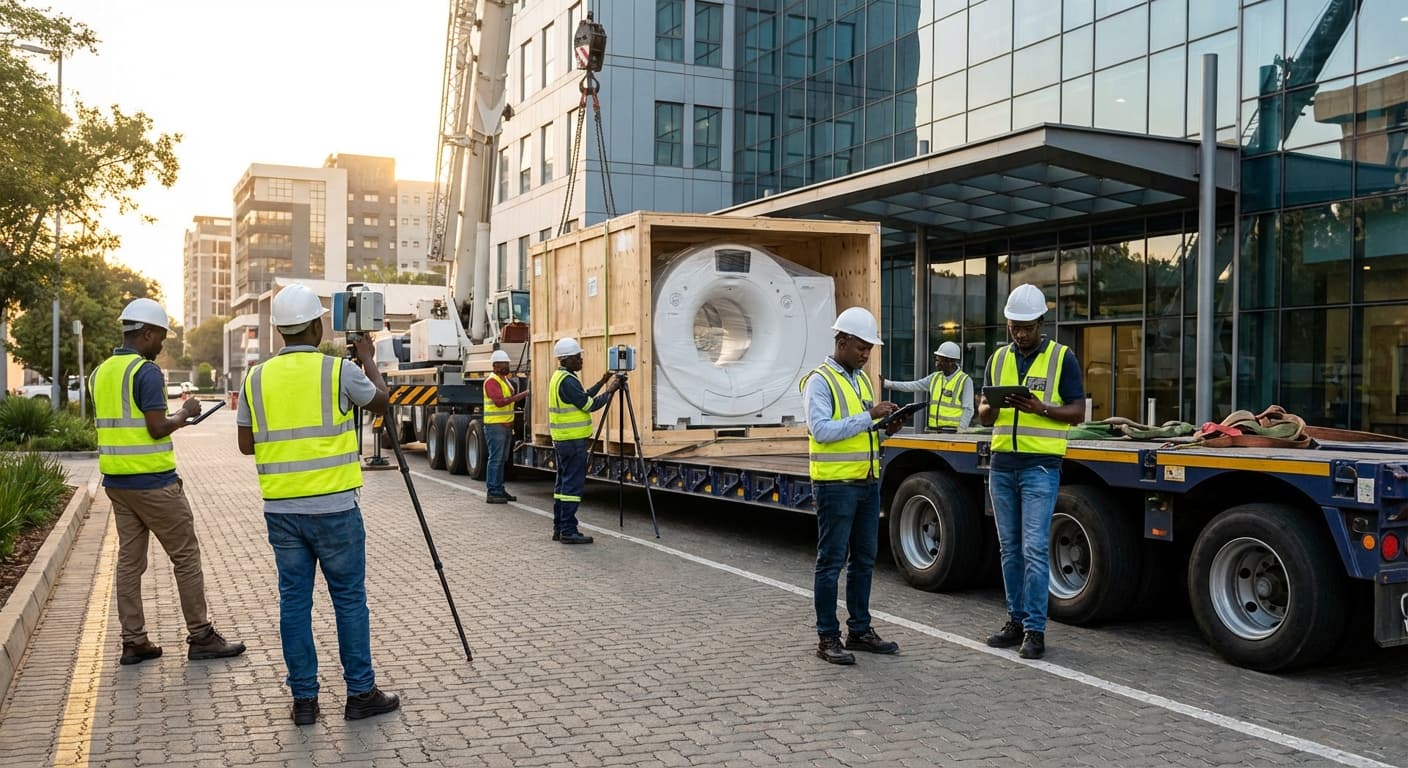
Route Survey & Rigging Plan Service for Heavy Medical Equipment in Chad
Engineering Excellence & Technical Support
Route Survey & Rigging Plan Service for Heavy Medical Equipment High-standard technical execution following OEM protocols and local regulatory frameworks.
Precise Route Survey & Obstacle Mitigation
Leveraging advanced GPS and laser scanning technologies to meticulously map proposed routes, identifying and quantifying all potential obstacles (e.g., power lines, existing infrastructure, terrain challenges) and developing proactive mitigation strategies to ensure safe and unimpeded transit of heavy medical equipment in Chad's diverse landscapes.
Customized Rigging & Lifting Solutions
Designing and implementing bespoke rigging plans utilizing specialized heavy-lift equipment, calculated load capacities, and expert knowledge of Chad's environmental conditions (e.g., dust, heat, potential seismic activity) to guarantee the secure and stable positioning of critical medical machinery within healthcare facilities.
Comprehensive Risk Assessment & Compliance
Conducting thorough risk assessments at every stage, from route selection to final equipment placement, ensuring full adherence to international safety standards and local Chadian regulations, thereby minimizing potential hazards and ensuring the integrity of sensitive medical equipment throughout its journey.
What Is Route Survey & Rigging Plan Service For Heavy Medical Equipment In Chad?
Route Survey & Rigging Plan Service for Heavy Medical Equipment in Chad refers to a specialized logistical and engineering process designed to ensure the safe, efficient, and compliant transportation and installation of oversized and overweight medical apparatus within Chad. This service is critical for facilitating access to advanced medical technologies in diverse and often challenging geographical and infrastructural environments. The process encompasses a comprehensive assessment of the proposed transit path, identifying and mitigating potential obstacles, and developing detailed engineering plans for the lifting, securing, and maneuvering of sensitive and high-value medical equipment. This includes but is not limited to MRI scanners, CT scanners, linear accelerators, and large-scale laboratory machinery.
| Stakeholder | Reason for Need | Typical Use Cases |
|---|---|---|
| Hospitals and Medical Centers (Public & Private) | Acquisition and installation of advanced diagnostic imaging equipment (MRI, CT), radiotherapy units, large-scale laboratory analyzers, and surgical suites. Ensures the equipment reaches operational status efficiently and safely, maximizing return on investment and patient care capabilities. | Installation of a new MRI scanner in a regional hospital; relocation of a CT scanner to an upgraded wing; commissioning of a linear accelerator for cancer treatment; deployment of a mobile diagnostic unit. |
| Government Health Ministries & Agencies | Facilitating the deployment of critical medical infrastructure to underserved areas or during public health emergencies. Ensuring the integrity and functionality of donated or procured medical equipment. Compliance with national health infrastructure development plans. | Distributing essential diagnostic equipment to remote clinics; establishing temporary field hospitals; upgrading existing healthcare facilities with advanced technology. |
| International Aid Organizations & NGOs | Logistical support for delivering and installing humanitarian medical aid, particularly in regions with underdeveloped infrastructure. Ensuring that donated equipment can be effectively utilized to improve health outcomes. | Setting up specialized medical units in refugee camps; providing advanced diagnostic capabilities to areas affected by natural disasters; deploying mobile surgical units. |
| Equipment Manufacturers & Suppliers | Ensuring their high-value, sensitive, and often proprietary medical equipment is transported and installed according to their specifications and warranty requirements. Mitigating the risk of damage during transit and installation. | Delivery and installation of newly purchased medical equipment to client sites; pre-installation site verification for complex systems; post-installation testing and commissioning. |
| Logistics & Transport Companies | Specialized service for handling oversized, overweight, and delicate cargo. Providing expert route planning and rigging solutions to ensure successful project execution for their clients. | Partnering with a logistics provider for a turnkey solution for medical equipment transport and installation; sub-contracting route survey and rigging services for specialized projects. |
Service Components
- Route Assessment and Reconnaissance: Detailed on-site surveys to evaluate road conditions, bridge load capacities, tunnel clearances, turning radii, overhead obstructions (power lines, trees, signage), and ground stability along the entire transit corridor from port of entry or origin to final destination.
- Obstacle Identification and Mitigation: Proactive identification of any potential impediments to transit, such as narrow streets, low bridges, sharp bends, or inadequate load-bearing surfaces. Development of strategies to overcome these obstacles, which may involve temporary infrastructure modifications, traffic management, or alternative routing.
- Load Bearing Capacity Analysis: Engineering calculations and verifications to determine the weight and dimensional limits of roads, bridges, and other transit infrastructure. Compliance with local and national transportation regulations is paramount.
- Rigging and Lifting Plan Development: Creation of detailed engineering schematics and procedural documents outlining the precise methods for lifting, securing, and transporting the heavy medical equipment. This includes specifications for cranes, lifting gear, transport vehicles (e.g., specialized trailers), and lashing configurations.
- Risk Assessment and Safety Protocols: Comprehensive identification of potential hazards associated with the entire operation, including weather conditions, site-specific risks, and equipment handling. Development and implementation of strict safety protocols and emergency contingency plans.
- Permitting and Regulatory Compliance: Management of all necessary permits and authorizations from relevant governmental and local authorities for road closures, special transport, and site access.
- On-site Supervision and Execution: Expert oversight of the rigging, loading, transit, unloading, and positioning phases to ensure strict adherence to the approved plan and safety standards.
Who Needs Route Survey & Rigging Plan Service For Heavy Medical Equipment In Chad?
Specialized route survey and rigging plan services are crucial for the successful transportation and installation of heavy medical equipment in Chad. These services ensure that delicate and oversized medical machinery, ranging from MRI scanners and CT scanners to large X-ray machines and specialized surgical units, can be moved safely and efficiently through often challenging logistical environments. This involves meticulous planning to navigate existing infrastructure, identify potential obstacles, and design secure rigging and lifting strategies. The goal is to prevent damage to the equipment, protect personnel, and minimize downtime, which is paramount in a healthcare setting.
| Customer Type | Key Needs Addressed by Service | Specific Equipment Examples | Potential Challenges in Chad |
|---|---|---|---|
| Public Hospitals | Ensuring safe delivery and installation of critical diagnostic and treatment equipment to improve patient care. | MRI Scanners, CT Scanners, X-ray Machines, Linear Accelerators | Limited road infrastructure, power supply reliability, security concerns, remote locations |
| Private Hospitals | Minimizing disruption to operations and maintaining high-quality patient services with advanced technology. | Digital X-ray Systems, Ultrasound Machines, Anesthesia Machines | Complex urban traffic, existing building constraints, specialized access requirements |
| NGOs/Aid Organizations | Facilitating the rapid deployment of essential medical equipment to underserved populations. | Mobile X-ray Units, Sterilization Equipment, Surgical Kits | Logistical complexities in remote or disaster-affected areas, limited skilled labor |
| Equipment Manufacturers/Suppliers | Protecting high-value assets during transit and ensuring successful on-site setup. | Sophisticated laboratory analyzers, ventilators, imaging modalities | Navigating customs and import regulations, ensuring timely delivery to avoid penalties |
| Ministries of Health | Overseeing national healthcare infrastructure development and equitable distribution of medical technology. | Hospital-wide imaging suites, specialized operating room equipment | Coordinating across multiple health facilities, ensuring compliance with national standards |
| Research Institutions | Enabling cutting-edge medical research through the installation of specialized scientific equipment. | Electron Microscopes, Flow Cytometers, Gene Sequencers | Integration with existing laboratory infrastructure, specialized environmental controls |
Target Customers and Departments Requiring Route Survey & Rigging Plan Services for Heavy Medical Equipment in Chad:
- {"customer":"Public Hospitals and Healthcare Facilities","departments":["Procurement Department","Engineering and Maintenance Department","Radiology Department","Surgical Department","Biomedical Engineering Department"]}
- {"customer":"Private Hospitals and Clinics","departments":["Administration","Operations Management","Facilities Management","IT Department (for integration of new equipment)"]}
- {"customer":"Non-Governmental Organizations (NGOs) and International Aid Organizations","departments":["Logistics and Supply Chain Management","Program Management","Medical Equipment Procurement"]}
- {"customer":"Medical Equipment Manufacturers and Suppliers","departments":["Logistics and Transportation","Installation and Commissioning Teams","Project Management"]}
- {"customer":"Government Ministries of Health","departments":["Planning and Development Division","Infrastructure Department","Equipment Procurement Unit"]}
- {"customer":"Research Institutions and Universities with Medical Programs","departments":["Facilities Management","Research Administration","Laboratory Management"]}
Route Survey & Rigging Plan Service For Heavy Medical Equipment Process In Chad
This document outlines the comprehensive workflow for our Route Survey & Rigging Plan Service, specifically tailored for the intricate process of transporting and installing heavy medical equipment in Chad. Our service ensures the safe, efficient, and compliant movement of vital healthcare technology from point of arrival to its final operational location. The process is designed to be transparent and collaborative, with clear stages from initial inquiry to successful execution and handover.
| Phase | Description | Key Activities | Deliverables/Outcomes | Client Involvement |
|---|---|---|---|---|
| 1: Inquiry & Initial Assessment | Understanding the client's requirements and the specific heavy medical equipment to be transported and installed. | Receive client inquiry; Discuss equipment specifications (dimensions, weight, fragility, power requirements); Understand delivery location and final installation site; Initial risk assessment; Provide preliminary service proposal. | Initial understanding of project scope; Preliminary service quotation; Confirmation of service feasibility. | Provide equipment specifications and project details; Ask clarifying questions. |
| 2: Detailed Site Survey & Data Collection | Conducting on-site investigations to gather all necessary data for planning. | Site visits to delivery point (port, airport) and final installation location; Identify access routes; Measure clearances (height, width, weight limits for bridges/roads); Assess terrain; Document potential obstacles (power lines, existing structures, traffic congestion); Photograph and video record key areas; Identify lifting points and structural capacities at installation site; Assess environmental conditions (seasonal variations, etc.). | Comprehensive site survey report; Detailed route maps with identified challenges; Photographic and video evidence; Preliminary obstacle identification report. | Grant site access; Provide site plans and contact persons; Identify key personnel at installation site. |
| 3: Route Planning & Optimization | Developing the safest, most efficient, and compliant transportation route. | Analyzing survey data; Identifying optimal transport route(s) considering road conditions, legal restrictions, and traffic patterns; Proposing required permits and escorts; Planning for potential diversions or temporary modifications; Estimating transit times and logistical requirements (e.g., specialized transport vehicles). | Detailed route plan document; Maps with proposed route highlighted; List of required permits and authorities; Estimated transit schedule; Recommendations for specialized transport equipment. | Review proposed route(s); Provide feedback on critical timings or site access constraints. |
| 4: Rigging Plan Development | Creating a detailed plan for the safe lifting, maneuvering, and placement of the medical equipment. | Analyzing equipment weight and center of gravity; Determining appropriate lifting equipment (cranes, forklifts, jacks); Calculating load capacities and safety margins; Designing lifting points and rigging configurations; Developing step-by-step lifting and placement procedures; Identifying potential hazards during rigging operations; Specifying required safety equipment and personnel expertise. | Comprehensive rigging plan document; Detailed lifting diagrams and schematics; Specification of required lifting equipment and accessories; Safety protocols and risk mitigation strategies; Personnel requirements for rigging operations. | Provide access to installation site for rigging assessment; Clarify any specific handling requirements or limitations. |
| 5: Client Review & Approval | Presenting the developed plans to the client for review and formal approval. | Presenting route survey findings and proposed route; Presenting the detailed rigging plan; Explaining all aspects of the plan and addressing any client queries or concerns; Incorporating client feedback into the plans. | Approved Route Survey Report; Approved Rigging Plan; Formal client sign-off. | Thoroughly review all documents; Provide feedback and request revisions; Grant formal approval. |
| 6: Pre-Execution Preparations | Undertaking all necessary logistical and administrative preparations before the physical execution. | Securing all required permits and authorizations; Arranging for specialized transport vehicles and equipment; Mobilizing skilled rigging and logistics personnel; Coordinating with local authorities and stakeholders (police, road management); Finalizing insurance and contingency plans; Conducting pre-job safety briefings. | All necessary permits obtained; Transport and rigging equipment secured; Personnel mobilized; Communication channels established with relevant parties. | Facilitate permit acquisition if required; Ensure availability of site access during preparation phase. |
| 7: Execution of Route Survey & Rigging | Implementing the approved route survey and rigging plan on-site. | On-site supervision of route survey confirmation; Execution of lifting and positioning operations according to the rigging plan; Real-time monitoring of safety and progress; Adapting to unforeseen circumstances with pre-approved contingency measures; Documenting the execution process (photos, videos, logs). | Successful and safe transportation and installation of equipment; On-site completion reports; Photographic and video documentation of execution. | Provide on-site access and necessary support; Maintain communication with the execution team. |
| 8: Post-Execution & Handover | Concluding the project and formally handing over the completed service to the client. | Site clean-up and restoration; Final equipment placement and verification; Debriefing with the client; Providing a final project report including all documentation; Archiving project data. | Final project report; As-built documentation; Formal handover of completed service; Client satisfaction confirmation. | Conduct final inspection and acceptance; Sign off on project completion. |
Workflow Stages: Inquiry to Execution
- Phase 1: Inquiry & Initial Assessment
- Phase 2: Detailed Site Survey & Data Collection
- Phase 3: Route Planning & Optimization
- Phase 4: Rigging Plan Development
- Phase 5: Client Review & Approval
- Phase 6: Pre-Execution Preparations
- Phase 7: Execution of Route Survey & Rigging
- Phase 8: Post-Execution & Handover
Route Survey & Rigging Plan Service For Heavy Medical Equipment Cost In Chad
Providing route survey and rigging plan services for heavy medical equipment in Chad involves a comprehensive process that is highly dependent on several key factors. The pricing structure is not a fixed rate but rather a tailored quote based on the specifics of each project. Understanding these influencing elements is crucial for budgeting and expecting accurate cost estimations.
| Service Component | Estimated Cost Range (XAF - Central African CFA Franc) | Notes |
|---|---|---|
| Initial Route Reconnaissance & Data Collection | 150,000 - 500,000 | Basic assessment of major roads and potential challenges. |
| Detailed Route Survey (including terrain, obstacles, and infrastructure) | 400,000 - 1,500,000+ | Depends on route length, complexity, and need for detailed mapping. |
| Rigging Plan Development (conceptual & detailed) | 300,000 - 1,200,000+ | Based on equipment weight, size, and lifting requirements. |
| Site Assessment (origin & destination) | 100,000 - 400,000 | Evaluation of lifting points, access, and space constraints. |
| Permit & Authorization Facilitation | 50,000 - 300,000+ | Variable depending on local bureaucracy and number of permits required. |
| On-site Supervision & Coordination (per day) | 75,000 - 250,000+ | For survey team and/or rigging supervisors. |
| Specialized Equipment Rental (if applicable) | Variable (e.g., crane hire, specialized transporters) | Quoted separately based on project needs. |
| Total Project Estimate (for a moderate complexity project) | 1,000,000 - 5,000,000+ XAF | This is a general estimate and can vary significantly. |
Key Pricing Factors for Route Survey & Rigging Plan Services in Chad
- Complexity of the Route: The length and terrain of the route significantly impact survey time and resource allocation. Difficult terrain (e.g., unpaved roads, significant elevation changes, narrow passages) will require more detailed surveys and potentially specialized equipment or personnel.
- Equipment Specifications: The size, weight, and fragility of the medical equipment are paramount. Larger and heavier items necessitate more robust rigging plans, specialized lifting gear, and potentially more personnel. The need for extreme precision or specialized handling (e.g., sterile environments) also adds to the cost.
- Distance and Accessibility: The distance from a major transportation hub to the final destination, as well as the accessibility of both locations, will influence logistics costs. Remote or hard-to-reach areas will incur higher transportation and on-site service fees.
- Infrastructure Assessment: Evaluating the condition of roads, bridges, and any potential obstacles along the route is a critical part of the survey. The need for temporary infrastructure improvements or permits for overweight/oversized loads will directly affect the budget.
- Site Conditions: The rigging plan is heavily influenced by the on-site conditions at both the origin and destination. This includes the availability of suitable lifting points, the space for maneuvering equipment, and the environmental conditions (e.g., weather, dust).
- Permits and Approvals: Obtaining necessary permits from local authorities for road closures, oversized transport, or any other regulatory requirements can add to the overall cost and lead time.
- Personnel and Expertise: The number of surveyors, riggers, engineers, and project managers required, along with their specialized skills and experience, directly influences labor costs. Projects requiring specialized medical equipment handling expertise will command higher rates.
- Equipment Rental: The cost of specialized rigging equipment, cranes, hydraulic jacks, or specialized transport vehicles will be factored into the service fee.
- Risk Assessment and Mitigation: A thorough risk assessment and the development of mitigation strategies for potential hazards are essential and contribute to the service cost.
- Time Sensitivity: Urgent projects requiring expedited surveys and planning may incur premium charges.
- Insurance: Adequate insurance coverage for the equipment, personnel, and the operation itself is a standard inclusion and impacts the final price.
Affordable Route Survey & Rigging Plan Service For Heavy Medical Equipment Options
Navigating the complexities of moving heavy medical equipment requires meticulous planning to ensure safety, efficiency, and cost-effectiveness. Our Affordable Route Survey & Rigging Plan Service is designed to provide comprehensive solutions tailored to your specific needs. We understand the unique challenges associated with transporting and installing delicate and oversized medical devices, from MRI machines and CT scanners to surgical robots and laboratory equipment. Our service eliminates the guesswork, mitigating risks of damage, delays, and unexpected expenses. We offer a tiered approach to our services, allowing you to select the most suitable package for your project's scope and budget. This ensures you only pay for what you need, maximizing your investment in a smooth and successful relocation or installation.
| Cost-Saving Strategy | Description | Benefit |
|---|---|---|
| Early Planning & Assessment | Engaging our service early in the project lifecycle allows for proactive identification of potential obstacles and the development of efficient solutions. | Reduces the likelihood of costly last-minute changes, delays, and emergency rerouting. |
| Bundle Selection | Choosing the right value bundle based on your equipment's complexity and project scope ensures you're not overpaying for unnecessary services. | Optimizes budget allocation and prevents expenditure on features not required for your specific move. |
| Consolidated Services | Bundling route surveying and rigging planning into a single service streamlines communication and project management. | Minimizes administrative overhead and potential misinterpretations between separate service providers. |
| Standardized Procedures & Templates | Leveraging our established methodologies and templates for route surveys and rigging plans ensures efficiency and reduces custom development time. | Faster turnaround times and predictable pricing due to our experience with similar projects. |
| Risk Mitigation | Thorough route surveys and detailed rigging plans identify and address potential hazards before they occur. | Avoids expensive damage to equipment, facility, or injury, saving on repair costs and potential litigation. |
| Optimized Equipment Utilization | Our rigging plans ensure the correct lifting and transport equipment is specified, preventing the use of oversized or under-specified gear. | Reduces rental costs and the risk of equipment failure, leading to smoother operations. |
Our Value Bundles
- {"title":"Essential Planning Bundle","description":"Ideal for straightforward moves of standard heavy medical equipment where a basic route assessment and rigging outline suffice. This bundle focuses on core safety checks and fundamental rigging requirements."}
- {"title":"Comprehensive Project Bundle","description":"Our most popular offering, this bundle includes an in-depth route survey, detailed rigging plan with equipment specifications, site-specific risk assessment, and preliminary load calculations. Suitable for most complex medical equipment installations and moves."}
- {"title":"Premium Custom Bundle","description":"For highly specialized or extremely sensitive equipment, or projects with unique logistical challenges. This bundle offers bespoke route optimization, advanced rigging design, detailed engineering reports, and on-site consultation during critical stages."}
Verified Providers In Chad
In Chad, ensuring access to reliable and trustworthy healthcare providers is paramount. Franance Health stands out as a leading organization that meticulously vets and verifies healthcare professionals, offering unparalleled peace of mind to individuals seeking medical services. Their rigorous credentialing process guarantees that all listed providers meet the highest standards of education, training, licensure, and ethical practice. This commitment to verification is crucial in a landscape where discerning quality care can be challenging.
| Credential Type | Franance Health Verification Focus | Patient Benefit |
|---|---|---|
| Medical Licenses | Confirms current and valid licensure with relevant Chadian medical boards. | Ensures providers are legally authorized to practice medicine. |
| Educational Degrees & Diplomas | Verifies authenticity and accreditation of medical institutions attended. | Guarantees foundational medical knowledge and training. |
| Specialty Certifications | Validates specific qualifications in various medical specialties. | Confirms expertise in particular areas of medicine. |
| Professional Memberships | Checks affiliation with reputable medical organizations. | Indicates engagement with the broader medical community and adherence to professional standards. |
| Continuing Medical Education (CME) | Confirms ongoing participation in educational programs to stay updated. | Ensures providers are current with the latest medical advancements and techniques. |
| Background Checks & Disciplinary Records | Investigates for any past misconduct or sanctions. | Protects patients by identifying and excluding providers with a history of unprofessional behavior. |
Why Franance Health Credentials Represent the Best Choice:
- Unwavering Commitment to Quality: Franance Health's primary focus is on patient safety and quality of care. They don't just accept providers at face value; they actively investigate and confirm qualifications.
- Comprehensive Vetting Process: Their verification goes beyond basic checks. It includes thorough scrutiny of educational backgrounds, specialized training, ongoing professional development, and any disciplinary actions.
- Trust and Transparency: By clearly displaying verified credentials, Franance Health builds trust and offers transparency to patients, allowing them to make informed decisions about their healthcare.
- Access to Competent Professionals: The organization ensures that only highly qualified and competent medical professionals are listed on their platform, minimizing the risk of encountering subpar or unqualified practitioners.
- Reduced Risk for Patients: Patients can be confident that when they choose a Franance Health-verified provider, they are selecting a professional who has met stringent criteria, leading to a safer and more effective healthcare experience.
- Promoting Excellence in Chadian Healthcare: Franance Health actively contributes to raising the standard of healthcare in Chad by promoting and highlighting practitioners who demonstrate excellence and adhere to best practices.
Scope Of Work For Route Survey & Rigging Plan Service For Heavy Medical Equipment
This document outlines the Scope of Work (SOW) for specialized Route Survey and Rigging Plan Services required for the safe and efficient transport and installation of heavy medical equipment. This service is critical for ensuring that the equipment can be moved from its point of origin to its final destination within the healthcare facility without damage, disruption, or risk to personnel and the building infrastructure. The SOW details the technical deliverables and standard specifications expected from the service provider.
| Section | Deliverable/Task | Description | Standard Specifications/Considerations |
|---|---|---|---|
| Site Visit and Reconnaissance | On-site inspection of all potential access routes, including external and internal pathways. | Minimum 2 on-site visits. Use of laser measuring devices, spirit levels, and photographic documentation. Assessment of floor load capacities. |
| Obstacle Identification and Measurement | Mapping and measurement of all potential obstacles along the route. | Doorways (width, height, clearance), corridors (width, turns, ceiling height), elevators (dimensions, load capacity, access), stairwells, ramps, and any permanent fixtures. Photographic evidence of all critical dimensions and clearances. |
| Structural Assessment (as required) | Evaluation of structural integrity of floors, walls, and ceilings if significant loads are anticipated or if modifications are considered. | Consultation with facility engineers if necessary. Review of building blueprints and structural drawings. Calculation of point loads and distributed loads. |
| Environmental Considerations | Assessment of environmental factors that could impact the move. | Temperature, humidity, dust control requirements, noise restrictions, vibration sensitivity, and any specific cleanroom requirements. |
| Equipment Specification | Detailed outline of all lifting and moving equipment to be used. | Cranes (capacity, reach), gantries, hydraulic jacks, pallet jacks, dollies, specialized skates, airbags, and slings. Manufacturer specifications for all equipment. |
| Lifting and Securing Methodology | Step-by-step procedure for safely lifting and securing the equipment. | Attachment points, lifting angles, load balancing calculations, load distribution, and protective padding. Compliance with relevant lifting standards (e.g., ASME, LOLER). |
| Movement Path Planning | Precise sequence of movements along the surveyed route. | Detailed diagrams and written instructions for each segment of the move, including turning radiuses and intermediate positioning. Use of CAD software for visualization. |
| Installation Considerations | Planning for the final placement and anchoring of the equipment. | Leveling requirements, seismic bracing, utility connections (electrical, water, gas), and final securing mechanisms. Integration with facility construction plans. |
| Hazard Identification | Systematic identification of all potential risks during the survey and rigging process. | Falling objects, equipment failure, structural damage, personnel injury, damage to building infrastructure, disruption to hospital operations, and environmental hazards. |
| Mitigation Strategies | Development of specific actions to prevent or minimize identified risks. | Exclusion zones, safety briefings, PPE requirements, emergency procedures, redundant safety systems, and backup equipment. |
| Skilled Personnel | Specification of the required expertise and certifications for the crew. | Certified riggers, crane operators, mechanical engineers, safety officers, and trained moving personnel. Minimum years of experience with heavy lift operations. |
| Insurance and Certification | Confirmation of adequate insurance coverage and equipment certifications. | Proof of liability insurance, worker's compensation, and current certifications for all equipment and personnel. Compliance with local and national regulations. |
| Route Survey Report | Comprehensive document detailing the findings of the route survey. | Photographs, scaled drawings, obstacle list with dimensions, floor load capacity analysis, and proposed route schematics. Date of survey and surveyor's name/company. |
| Rigging Plan Document | Detailed engineering plan for the rigging operation. | Load calculations, equipment schematics, step-by-step procedures, personnel assignments, safety protocols, and emergency contact information. Approved by a qualified engineer. |
| Pre-Move Checklist | A checklist to ensure all pre-move preparations are complete. | Verification of equipment readiness, personnel availability, site access, and safety measures. Signed by responsible parties. |
| Post-Move Report | A report documenting the successful completion of the move and any notable observations. | Confirmation of equipment placement, any incidents or near misses, and lessons learned. Signed by the project manager and client representative. |
Scope of Work Breakdown
- {"title":"1. Route Survey","description":"Comprehensive assessment of all potential transport routes from the delivery point (e.g., loading dock, main entrance) to the final installation location within the facility."}
- {"title":"2. Rigging Plan Development","description":"Detailed engineering plan outlining the precise method for lifting, moving, and positioning the heavy medical equipment."}
- {"title":"3. Risk Assessment and Mitigation","description":"Identification of potential hazards and the development of strategies to mitigate them throughout the transport and installation process."}
- {"title":"4. Equipment and Personnel Requirements","description":"Specification of all necessary rigging equipment, lifting devices, and skilled personnel required to execute the plan safely."}
- {"title":"5. Final Reporting and Documentation","description":"Comprehensive documentation of all survey findings, plan details, risk assessments, and execution reports."}
Service Level Agreement For Route Survey & Rigging Plan Service For Heavy Medical Equipment
This Service Level Agreement (SLA) outlines the response times and uptime guarantees for the Route Survey & Rigging Plan Service for Heavy Medical Equipment, provided by [Your Company Name] to [Client Name]. This agreement aims to ensure timely and reliable service delivery critical for the successful installation and operation of heavy medical equipment.
| Service Component | Response Time Objective | Uptime Guarantee | Notes |
|---|---|---|---|
| Initial Service Request Acknowledgement (Non-emergency) | Within 4 business hours of receipt | N/A | Requests received outside of business hours will be acknowledged at the start of the next business day. |
| Dispatch of Survey Team (Post-initial assessment/site visit scheduling) | Within 2 business days of site assessment completion and agreement on survey date | N/A | Depends on surveyor availability and client's site accessibility. |
| Provision of Draft Rigging Plan (Post-survey completion) | Within 5 business days of completion of on-site survey | N/A | May be extended for complex projects with mutual agreement. |
| Provision of Final Rigging Plan (Post-client review and approvals) | Within 2 business days of receiving client feedback/approvals | N/A | Assumes prompt client feedback. |
| Service Availability for Scheduling and Planning | N/A | 99% during standard business hours ([Client Business Hours, e.g., Monday-Friday, 9 AM - 5 PM Client Time Zone]) | Downtime may occur for scheduled maintenance or unforeseen circumstances, with reasonable prior notification where possible. |
Key Service Level Objectives
- Response Time: Refers to the time taken by [Your Company Name] to acknowledge a service request and initiate the necessary actions (e.g., dispatching a survey team, providing initial consultation).
- Uptime Guarantee: Applies to the availability of the service to initiate and conduct the route survey and rigging plan development process. It does not guarantee the physical uptime of the client's equipment, which is outside the scope of this SLA.
- Scheduled Survey Appointment: The confirmed date and time slot allocated for the on-site route survey.
- Rigging Plan Delivery: The date and time by which the completed rigging plan document is provided to the client.
Frequently Asked Questions

Ready when you are
Let's scope your Route Survey & Rigging Plan Service for Heavy Medical Equipment in Chad project in Chad.

Scaling healthcare logistics and technical systems across the entire continent.