
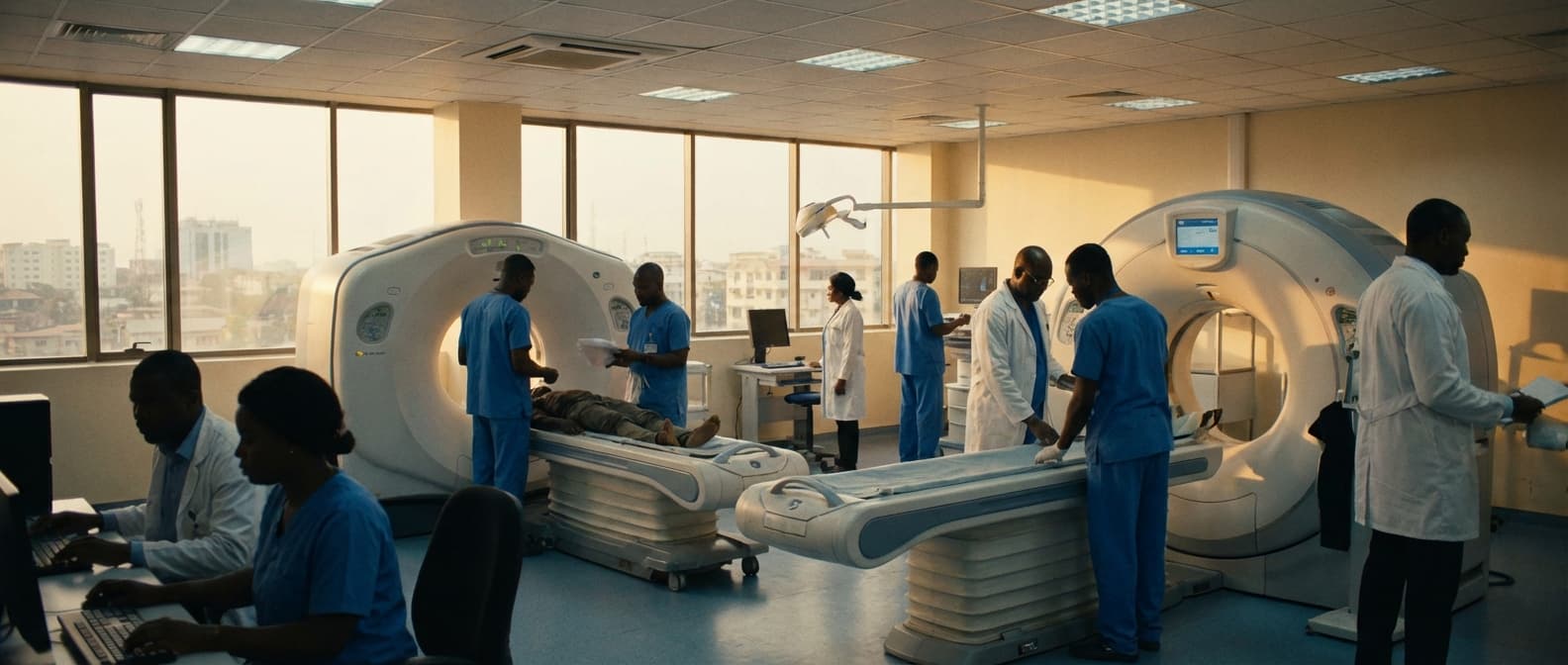
Imaging Acceptance Testing & QA in Chad
Engineering Excellence & Technical Support
Commissioning and periodic QA for CT/MRI/X‑ray/US/Mammo. High-standard technical execution following OEM protocols and local regulatory frameworks.
Comprehensive Imaging Protocol Validation
Ensures all imaging protocols on new or upgraded equipment in Chad adhere to international standards and specific clinical requirements, guaranteeing accurate diagnostic image quality and consistency across all modalities (CT, MRI, X-ray, Ultrasound).
Image Quality & Artifact Assessment
Systematic testing and analysis of image resolution, contrast, signal-to-noise ratio, and identification/mitigation of artifacts, crucial for reliable diagnoses in resource-limited settings in Chad, minimizing misinterpretations.
Workflow Integration & Data Integrity Checks
Verifies seamless integration of imaging systems with PACS/RIS, ensuring accurate metadata, image transfer, and data integrity, critical for efficient patient care and research continuity within healthcare facilities in Chad.
What Is Imaging Acceptance Testing & Qa In Chad?
Imaging Acceptance Testing & Quality Assurance (QA) in Chad refers to the systematic evaluation and validation of medical imaging systems, hardware, software, and associated workflows to ensure they meet predefined clinical, technical, and regulatory requirements before and during their operational deployment within healthcare facilities in Chad. This process is critical for guaranteeing the accuracy, reliability, and safety of diagnostic imaging services. It encompasses a broad spectrum of tests, from initial hardware calibration and software functionality checks to complex end-to-end clinical scenario simulations.
| Who Needs Imaging Acceptance Testing & QA in Chad? | Typical Use Cases | ||||
|---|---|---|---|---|---|
| Hospitals and Clinics: Public and private healthcare institutions acquiring new imaging equipment or upgrading existing systems. | Diagnostic Imaging Centers: Facilities specializing in radiology and other imaging modalities. | Government Health Ministries & Regulatory Bodies: Overseeing the deployment and quality of medical imaging services nationwide. | Medical Equipment Vendors & Distributors: Ensuring their products meet performance and safety standards before delivery and installation. | International Health Organizations & NGOs: Involved in healthcare infrastructure development and equipment provision in Chad. | |
| Procurement of New Imaging Equipment: Verifying that acquired systems meet technical specifications and are ready for clinical use. | System Upgrades & Replacements: Ensuring new software versions or hardware components integrate correctly and enhance existing capabilities. | Establishment of New Imaging Departments: Setting up a complete imaging suite, including all interconnected systems. | Response to Equipment Failures or Performance Degradation: Diagnosing issues and validating corrective actions. | Compliance Audits: Demonstrating adherence to national health regulations and international best practices. | Introduction of Advanced Imaging Techniques: Validating the performance of novel or complex imaging protocols. |
Key Components of Imaging Acceptance Testing & QA in Chad
- System Installation & Configuration Verification: Confirming that imaging equipment (e.g., X-ray, CT, MRI, Ultrasound, PACS) is installed correctly, calibrated according to manufacturer specifications and local standards, and configured to meet the specific needs of the healthcare facility.
- Hardware Performance Testing: Evaluating the physical performance of imaging hardware, including image quality parameters (resolution, contrast, signal-to-noise ratio), radiation output (for X-ray modalities), mechanical integrity, and environmental tolerance.
- Software Functionality & Integration Testing: Verifying that all software components, including acquisition software, image processing algorithms, Picture Archiving and Communication Systems (PACS), and reporting systems, function as intended and integrate seamlessly with each other and other hospital information systems (HIS/EMR).
- Image Quality Assessment (IQA): Objective and subjective evaluation of image quality using phantoms, standardized test protocols, and expert radiologist review to ensure diagnostic adequacy and minimize artifacts.
- Workflow Validation: Testing the entire imaging workflow, from patient scheduling and examination to image archiving, retrieval, and reporting, to identify and resolve bottlenecks or inefficiencies.
- Security & Data Integrity: Ensuring that patient data is protected through appropriate access controls, encryption, and backup mechanisms, and that data integrity is maintained throughout the imaging lifecycle.
- Regulatory Compliance: Verifying adherence to relevant national and international standards and regulations governing medical imaging equipment and radiation safety.
- User Training & Competency Assessment: Confirming that healthcare professionals are adequately trained to operate the equipment and utilize the software effectively and safely.
- Ongoing QA & Performance Monitoring: Establishing protocols for continuous quality improvement and routine performance checks to maintain system efficacy over time.
Who Needs Imaging Acceptance Testing & Qa In Chad?
Imaging Acceptance Testing & QA are crucial for ensuring the reliability, accuracy, and regulatory compliance of medical imaging systems in Chad. These processes are not a luxury but a necessity for healthcare providers seeking to offer high-quality diagnostic services and to avoid costly errors and potential patient harm. The adoption of robust testing and QA protocols safeguards investments in advanced imaging technology and fosters trust among patients and medical professionals.
| Customer/Department | Key Needs for Imaging Acceptance Testing & QA | Impact of Neglecting Testing & QA |
|---|---|---|
| Hospitals (Public & Private) | Ensuring diagnostic accuracy, patient safety, operational efficiency, compliance with international standards (if applicable). | Misdiagnosis, delayed treatment, increased healthcare costs due to repeat scans or incorrect interventions, reputational damage, potential legal liabilities. |
| Radiology Departments | Verification of image quality (resolution, contrast, noise), system performance (scan times, throughput), data integrity (DICOM compliance, PACS integration), artifact detection. | Suboptimal diagnostic images, increased radiologist workload, missed diagnoses, inefficient workflow, data loss or corruption. |
| Specialized Clinics | Validation of modality-specific image quality (e.g., cardiac function assessment, tumor characterization), accurate quantitative measurements. | Inaccurate assessments, incorrect treatment planning, compromised patient outcomes. |
| Medical Imaging Centers | Consistent high-quality service delivery, efficient patient throughput, meeting service level agreements with referring physicians. | Decreased patient satisfaction, loss of referring physicians, inability to compete in the market. |
| Government Health Agencies | Ensuring public health standards are met, responsible use of public funds for medical equipment, baseline for quality control. | Widespread substandard medical care, inefficient allocation of resources, failure to meet national health objectives. |
| Research Institutions | Reproducibility of research findings, data integrity for scientific publication, reliability of research-grade imaging. | Flawed research, inability to publish findings, wasted research effort and funding. |
| Vendors/Distributors | Client satisfaction, adherence to contractual obligations, early identification and resolution of installation issues, minimizing post-installation support costs. | Customer complaints, warranty claims, damage to brand reputation, lost future business. |
| Biomedical Engineering | Establishing baseline performance for future maintenance, troubleshooting efficiency, safe operation of equipment, regulatory compliance documentation. | Extended downtime, inefficient troubleshooting, safety hazards, difficulty in documenting compliance for audits. |
Target Customers & Departments for Imaging Acceptance Testing & QA in Chad:
- Hospitals (Public and Private): These are the primary consumers of advanced imaging equipment and thus require comprehensive testing to ensure their diagnostic capabilities are functioning optimally.
- Radiology Departments: The core users and beneficiaries of imaging systems, needing to verify image quality, system performance, and data integrity.
- Specialized Clinics (e.g., Cardiology, Neurology, Oncology): Clinics that rely heavily on specific imaging modalities for diagnosis and treatment planning.
- Medical Imaging Centers: Independent facilities providing imaging services to multiple healthcare providers.
- Government Health Agencies & Ministries of Health: Responsible for setting standards, ensuring quality of care, and potentially overseeing the procurement and deployment of medical equipment.
- Research Institutions & Universities (with medical programs): Requiring accurate and reliable imaging for research purposes and for training future medical professionals.
- Medical Equipment Vendors & Distributors: Responsible for delivering and installing equipment, and often involved in initial acceptance testing on behalf of their clients.
- Biomedical Engineering Departments: The internal technical teams responsible for the maintenance and troubleshooting of medical equipment, including imaging systems.
Imaging Acceptance Testing & Qa Process In Chad
This document outlines the Imaging Acceptance Testing and Quality Assurance (QA) process in Chad, detailing the workflow from initial inquiry through test execution and final acceptance. The process is designed to ensure that imaging systems and solutions meet the specified requirements, function correctly, and deliver reliable results within the operational context of Chad.
| Phase | Key Activities | Responsible Parties | Deliverables |
|---|---|---|---|
| Inquiry & Requirements Gathering | Understanding needs, defining specifications, identifying constraints. | Stakeholder, End-User. | Requirements Document, Use Cases. |
| Vendor/Solution Identification & Proposal | Market research, RFP issuance, proposal evaluation. | Stakeholder, Procurement Team. | Vendor Proposals, Solution Selection Report. |
| Solution Design & Review | Detailed architecture, installation plan, configuration. | Vendor, Technical Experts, Stakeholder. | Solution Design Document, Integration Plan. |
| Pre-Acceptance Testing (PAT) / FAT | Component and basic functionality verification. | Vendor, Third-Party QA. | PAT/FAT Report. |
| Site Preparation & Installation | Infrastructure readiness, system setup. | Vendor Technical Team, Site Staff. | Installation Report, Site Readiness Checklist. |
| Site Acceptance Testing (SAT) | Full functional, performance, integration, and clinical testing. | End-User, QA Team, Vendor Technical Support. | SAT Test Cases, Defect Log, SAT Report. |
| User Training | Hands-on system operation and maintenance training. | Vendor Trainers. | Training Materials, Trained Personnel. |
| Defect Management & Retesting | Issue identification, resolution, and re-verification. | Vendor, QA Team. | Updated Defect Log, Retesting Results. |
| Final Acceptance & Handover | Formal sign-off, system transfer. | Stakeholder, End-User, Vendor. | Acceptance Certificate, Handover Documentation. |
| Post-Acceptance Monitoring & Support | Ongoing maintenance, troubleshooting, performance checks. | Vendor Support Team, End-User IT. | Support Tickets, Performance Reports. |
Imaging Acceptance Testing & QA Process Workflow in Chad
- 1. Inquiry & Requirements Gathering: Initiated by a stakeholder (e.g., healthcare facility, government agency) expressing a need for an imaging solution or system. This phase involves detailed discussions to understand the specific requirements, including: * Technical specifications (hardware, software, resolution, compatibility). * Clinical needs and use cases. * Integration requirements with existing infrastructure (e.g., HIS, PACS). * Data security and privacy considerations. * Local operational constraints (power availability, network infrastructure, environmental factors). * Regulatory compliance specific to Chad. * Budgetary constraints.
- 2. Vendor/Solution Identification & Proposal: Based on the gathered requirements, potential vendors or imaging solutions are identified. Vendors submit proposals detailing their proposed solution, compliance with requirements, implementation plan, training strategy, and cost. This may involve a Request for Proposal (RFP) process.
- 3. Solution Design & Review: Upon selection of a vendor/solution, a detailed design document is created. This document outlines the technical architecture, installation plan, configuration settings, and integration points. This design is then rigorously reviewed by the requesting entity and subject matter experts to ensure it aligns with the initial requirements and is feasible for the Chadian context.
- 4. Pre-Acceptance Testing (PAT) / Factory Acceptance Testing (FAT): Conducted by the vendor or a third-party QA team, usually before the equipment is shipped to Chad. This testing verifies core functionality and specifications in a controlled environment. Key activities include: * Hardware component testing. * Software functionality verification. * Basic image quality checks. * Calibration procedures.
- 5. Site Preparation & Installation: Following successful PAT/FAT, the imaging system is shipped to Chad. Site preparation activities, including necessary infrastructure modifications (power, networking, environmental controls), are completed. The system is then installed by the vendor's technical team.
- 6. Site Acceptance Testing (SAT): This is a critical phase conducted once the system is installed at the user's site in Chad. It aims to verify that the system functions correctly in its intended operational environment and meets all agreed-upon requirements. SAT typically involves: * System Integration Testing: Verifying seamless integration with existing systems (HIS, PACS, EMR). * Functional Testing: Testing all intended functionalities, including image acquisition, processing, display, and storage. * Performance Testing: Assessing system speed, throughput, and responsiveness under expected load conditions. * Usability Testing: Evaluating the ease of use for clinical staff. * Data Integrity & Security Testing: Ensuring data is stored, transmitted, and accessed securely and without corruption. * Environmental Robustness Testing: Validating performance under local environmental conditions (temperature, humidity, power fluctuations). * Clinical Scenario Testing: Simulating real-world clinical scenarios to assess the system's effectiveness and accuracy in diagnosis.
- 7. User Training: Comprehensive training is provided to the end-users (radiologists, technicians, IT staff) by the vendor. Training covers system operation, maintenance, troubleshooting, and best practices for imaging within the Chadian context.
- 8. Defect Management & Retesting: Any issues or defects identified during SAT are documented in a defect tracking system. The vendor is responsible for rectifying these defects. Retesting of corrected functionalities is performed until all critical and major defects are resolved.
- 9. Final Acceptance & Handover: Once SAT is successfully completed, all defects are resolved, and the user is satisfied with the system's performance and training, formal acceptance is granted. The system is officially handed over to the end-user, along with comprehensive documentation (user manuals, maintenance guides, service agreements).
- 10. Post-Acceptance Monitoring & Support: The vendor provides ongoing technical support, maintenance, and potential software updates. Regular monitoring of system performance and user feedback are crucial for long-term success and continuous improvement.
Imaging Acceptance Testing & Qa Cost In Chad
Imaging Acceptance Testing (IAT) and Quality Assurance (QA) costs in Chad are influenced by several factors, making it challenging to provide a single definitive price. These costs are typically assessed on a project-by-project basis and depend heavily on the complexity of the imaging systems, the scope of testing required, the experience level of the QA personnel, and the geographical location within Chad. It's important to note that the local currency in Chad is the West African CFA franc (XOF).
| Service Category | Estimated Price Range (XOF) | Notes |
|---|---|---|
| Basic Imaging System Acceptance Testing (e.g., Standard X-ray) | 150,000 - 400,000 | Covers fundamental functional checks, basic image quality assessment, and essential safety parameters. |
| Intermediate Imaging System Acceptance Testing (e.g., Digital X-ray, Ultrasound) | 300,000 - 750,000 | Includes more detailed functional tests, performance benchmarks, and basic integration checks. |
| Advanced Imaging System Acceptance Testing (e.g., CT, MRI) | 600,000 - 1,500,000+ | Involves comprehensive testing of complex functionalities, advanced image processing, performance optimization, and potential integration with PACS/RIS. Costs can escalate significantly for highly specialized systems or extensive testing. |
| Routine Quality Assurance (Per Modality/Per Visit) | 100,000 - 300,000 | Regular checks to ensure ongoing performance, image quality, and safety. Frequency depends on modality and usage. |
| Specialized Performance Testing/Calibration | 200,000 - 600,000+ | Focuses on specific performance metrics or calibration requirements for high-precision imaging. May require specialized equipment and expertise. |
| Integration Testing (with PACS/RIS/EMR) | 250,000 - 800,000 | Testing the seamless transfer and interoperability of imaging data with other hospital information systems. Complexity is a major driver. |
| Hourly Rate for QA Engineer/Technician | 25,000 - 75,000 | Can apply for ad-hoc support, troubleshooting, or when project-based pricing is not suitable. Varies by experience. |
Key Pricing Factors for Imaging Acceptance Testing & QA in Chad:
- System Complexity: The more sophisticated the imaging equipment (e.g., advanced MRI, CT scanners, specialized digital radiography systems), the more in-depth and specialized the testing will be, leading to higher costs. Simple X-ray machines will generally be less expensive to test.
- Scope of Testing: This includes the number of imaging modalities being tested, the extent of functional testing (e.g., image acquisition, processing, storage, retrieval), performance testing (speed, accuracy), and integration testing with other hospital systems (e.g., PACS, RIS, EMR).
- Testing Environment: The accessibility and preparedness of the testing site (e.g., power supply stability, environmental controls for sensitive equipment) can impact efficiency and thus cost.
- Personnel Expertise and Experience: Highly skilled and experienced imaging engineers and QA specialists command higher rates. Their familiarity with specific imaging technologies and regulatory requirements is crucial.
- Duration of Testing: The length of time required for comprehensive testing directly influences labor costs.
- Travel and Logistics: For testing conducted in remote or less accessible areas of Chad, travel expenses for personnel and equipment, accommodation, and per diems will add to the overall cost.
- Third-Party Vendor Involvement: If specific vendor personnel are required for certain aspects of testing or troubleshooting, their associated fees will be factored in.
- Regulatory Compliance: Testing to meet specific national or international imaging standards and regulations will necessitate more rigorous procedures and documentation, potentially increasing costs.
- Reporting and Documentation: The level of detail and format required for acceptance and QA reports can influence the time spent on administrative tasks.
- Software and Calibration Tools: The need for specialized software licenses or calibration equipment for testing can also contribute to the overall expense.
Affordable Imaging Acceptance Testing & Qa Options
Ensuring the accuracy and reliability of medical imaging systems is paramount for patient care. Acceptance Testing (AT) and Quality Assurance (QA) are critical processes, but their associated costs can be a concern, especially for smaller facilities or those with budget constraints. This guide explores affordable imaging AT & QA options, focusing on value bundles and cost-saving strategies to maintain high standards without breaking the bank.
| Cost-Saving Strategy | Description | Benefits | Considerations |
|---|---|---|---|
| Value Bundles: | Comprehensive Packages: Vendors or third-party service providers offer bundled AT/QA services that include multiple tests, periodic reviews, and potentially remote monitoring at a reduced per-unit cost compared to standalone services. | Predictable Costs: Easier budgeting, potential discounts for volume or long-term contracts, access to expertise without hiring full-time staff. | Vendor Lock-in: Ensure the bundle meets all your specific needs and isn't just a generic offering. Compare bundled pricing against à la carte options. |
| Third-Party Service Providers: | Specialized Expertise: Engage independent companies that specialize in medical imaging AT/QA. They often have portable, calibrated equipment and experienced technicians. | Cost-Effectiveness: Often more affordable than relying solely on vendor services, particularly for facilities with multiple imaging modalities or locations. Can also be more flexible. | Accreditation & Reputation: Verify the provider's accreditation and track record. Ensure they are familiar with your specific equipment and regulatory requirements. |
| In-House QA Programs (with external AT): | Leveraging Existing Staff: Train internal staff (e.g., technologists, physicists) to perform routine QA checks using established protocols and phantom imaging. Outsource more complex AT and specialized QA tasks. | Reduced Routine Costs: Significant savings on daily/weekly QA by utilizing existing personnel. Faster identification of minor issues before they escalate. | Training Investment: Requires initial investment in training and potentially some basic QA equipment. Ensuring proper documentation and adherence to protocols is vital. |
| Remote Monitoring & Cloud-Based Solutions: | Automated Data Collection: Utilize software that can remotely collect performance data from imaging equipment, flagging deviations for investigation. | Proactive Issue Detection: Early identification of potential problems, reducing downtime and the need for costly emergency repairs. Streamlined data management. | Data Security & Integration: Ensure robust data security measures are in place and that the system integrates with your existing Picture Archiving and Communication System (PACS). |
| Phased Acceptance Testing: | Modular Approach: Break down AT into stages, focusing on critical functions first and deferring less essential tests to later phases or routine QA. This can be useful for new installations. | Faster Go-Live: Allows for earlier clinical use of essential imaging functions while more complex testing is completed. | Risk Management: Ensure thorough planning to avoid operational issues caused by incomplete testing. Requires clear definition of critical functions. |
| Standardized Protocols & Templates: | Efficiency & Consistency: Develop and use standardized testing protocols and reporting templates across all imaging modalities. This reduces variability and speeds up the process. | Reduced Training Time: Easier for new staff to learn and implement. Ensures consistent data collection for easier trend analysis. | Adaptability: Protocols need to be regularly reviewed and updated to reflect new equipment or evolving standards. |
| Shared Resources (Inter-facility): | Collaborative Approach: If part of a larger healthcare network or consortium, explore sharing specialized AT/QA equipment or personnel between facilities. | Economies of Scale: Reduces the need for each individual facility to own expensive, infrequently used equipment. Maximizes utilization of skilled personnel. | Logistical Coordination: Requires strong communication and coordination between facilities to schedule and execute testing effectively. |
Understanding Imaging Acceptance Testing & QA
- Acceptance Testing (AT): Performed on new imaging equipment before clinical use to verify it meets specifications and performance standards.
- Quality Assurance (QA): Ongoing, systematic monitoring of imaging equipment and processes to ensure consistent quality and safety.
- Key Components of AT & QA: Image quality assessment (resolution, contrast, noise), dose evaluation, equipment performance checks, artifact analysis, and documentation.
- Importance: Crucial for patient safety, accurate diagnosis, regulatory compliance, and efficient workflow.
- Challenges: Cost of specialized equipment, skilled personnel, time commitment, and vendor-specific procedures.
Verified Providers In Chad
In Chad's evolving healthcare landscape, identifying trusted and credentialed medical providers is paramount for ensuring quality care. Franance Health stands out as a leading organization that meticulously vets and verifies healthcare professionals, offering a crucial layer of assurance to patients. Their rigorous credentialing process is designed to uphold the highest standards of medical expertise, ethical practice, and patient safety. Choosing a Franance Health verified provider means opting for a healthcare professional who has undergone thorough background checks, academic and professional verification, and often peer reviews. This commitment to transparency and quality makes Franance Health verified providers the best choice for reliable and effective medical treatment in Chad.
| Provider Category | Franance Health Verification Standard | Why It Matters for Patients in Chad |
|---|---|---|
| General Practitioners | Verification of medical degree, licensing, and at least 2 years of practice experience. | Ensures a foundational understanding of common health issues and appropriate initial care. |
| Specialist Physicians (e.g., Cardiologists, Pediatricians) | Includes general practitioner verification plus proof of board certification and specialized training. | Guarantees expertise in complex medical conditions within their respective fields. |
| Surgeons | Verification of medical degree, licensing, board certification, and documented surgical residency and fellowship completion. | Confirms the highest level of training and skill for safe and effective surgical interventions. |
| Dentists | Verification of dental degree, licensing, and professional affiliations. | Ensures quality oral healthcare and adherence to dental hygiene and treatment protocols. |
| Nurses (RNs, NPs) | Verification of nursing degrees, licensing, and any specialized certifications. | Confirms qualified and competent nursing care, essential for patient recovery and well-being. |
| Pharmacists | Verification of pharmacy degree, licensing, and knowledge of drug interactions and safe dispensing practices. | Ensures access to accurate medication guidance and safe pharmaceutical services. |
Key Benefits of Choosing Franance Health Verified Providers in Chad
- Unwavering commitment to patient safety through stringent vetting processes.
- Ensured competency and expertise of medical professionals.
- Access to a network of ethically practicing healthcare providers.
- Peace of mind knowing your healthcare provider meets international standards.
- Streamlined access to quality medical care in Chad.
Scope Of Work For Imaging Acceptance Testing & Qa
This document outlines the Scope of Work (SoW) for Imaging Acceptance Testing and Quality Assurance (QA). It details the objectives, methodologies, and deliverables required to ensure that imaging systems meet predefined technical specifications and functional requirements. The focus is on validating image quality, performance, and integration with existing workflows.
| Phase | Activities | Technical Deliverables | Standard Specifications |
|---|---|---|---|
| Planning & Preparation | Define test cases and scenarios. Review system documentation. Prepare test environment. Develop test scripts. Identify key performance indicators (KPIs). | Test Plan Document. Test Case Matrix. Test Environment Configuration Report. Test Script Library. KPI Definition Document. | ISO 13485 (Quality Management Systems for Medical Devices). IEC 60601 (Medical Electrical Equipment - General Requirements for Basic Safety and Essential Performance). Manufacturer's Technical Specifications. DICOM (Digital Imaging and Communications in Medicine) Standards. |
| Functional Testing | Test image acquisition parameters. Verify image display and manipulation tools. Test image storage and retrieval. Validate user interface (UI) and user experience (UX). Test alarm and notification systems. | Functional Test Report. Defect Log. UI/UX Feedback Report. | DICOM Conformance Statements. HL7 (Health Level Seven) Standards for interoperability. Vendor-specific functional requirements. |
| Performance Testing | Measure image acquisition times. Assess system throughput. Evaluate image processing speeds. Test system stability under load. Measure network bandwidth utilization. | Performance Test Report. Throughput Analysis. Stability Report. | System performance benchmarks. Network infrastructure specifications. Image acquisition protocol parameters. |
| Image Quality Assessment | Evaluate image resolution and contrast. Assess signal-to-noise ratio (SNR). Test for artifacts and distortions. Verify geometric accuracy. Assess dose metrics (if applicable). | Image Quality Assessment Report. Artifact Analysis. Quantitative Image Metrics Report. | ACR (American College of Radiology) Appropriateness Criteria. AAPM (American Association of Physicists in Medicine) Task Group Reports. Manufacturer's image quality specifications. Relevant clinical imaging guidelines. |
| Integration Testing | Verify DICOM connectivity and communication. Test integration with PACS/RIS. Validate data exchange workflows. Test security protocols and access controls. | Integration Test Report. PACS/RIS Integration Verification. Data Exchange Log. | DICOM PS3 (Part 3) - Information Object Definitions. DICOM PS3 (Part 4) - Implementation Classifications. HL7 v2.x Messaging Standards. HIPAA (Health Insurance Portability and Accountability Act) Security Rule. |
| User Acceptance Testing (UAT) | Clinical users execute real-world scenarios. Provide feedback on usability and workflow. Validate clinical utility of images and features. | User Acceptance Test Report. Clinical Feedback Summary. Go/No-Go Recommendation. | Clinical workflow documentation. End-user requirements. Hospital IT policies. |
| Reporting & Closure | Document all test results. Compile final Acceptance Test Report. Obtain sign-off from stakeholders. Close out defect tickets. Archive test artifacts. | Final Acceptance Test Report. Sign-off Documentation. Defect Closure Report. Test Artifact Archive. | Project management methodologies. Stakeholder approval matrix. |
Key Objectives
- Validate that the imaging system meets all specified technical requirements and performance benchmarks.
- Ensure consistent and high-quality image acquisition across various imaging protocols and patient demographics.
- Verify the accuracy and reliability of image processing and analysis functionalities.
- Confirm seamless integration of the imaging system with PACS, RIS, and other relevant hospital information systems.
- Assess user-friendliness and operational efficiency for clinical staff.
- Identify and document any defects or deviations from specifications for remediation.
- Provide documented evidence of successful acceptance testing for release and operational use.
Service Level Agreement For Imaging Acceptance Testing & Qa
This Service Level Agreement (SLA) outlines the agreed-upon response times and uptime guarantees for Imaging Acceptance Testing and Quality Assurance (QA) services provided by [Your Company Name] to [Client Name]. This SLA is effective as of [Start Date] and will remain in effect until [End Date], unless terminated earlier by mutual written agreement.
| Service Component | Response Time Guarantee (Business Hours) | Uptime Guarantee |
|---|---|---|
| Critical Imaging System Issues (e.g., complete system failure impacting patient care) | Initial Acknowledgment: 15 minutes Diagnosis & Proposed Solution: 2 hours | 99.9% (Scheduled maintenance excluded) |
| High-Priority Imaging Acceptance Testing Failures (e.g., major functional defects preventing go-live) | Initial Acknowledgment: 1 hour Investigation & Root Cause Analysis: 4 hours | N/A (Testing is a project-based activity; uptime applies to production systems) |
| Medium-Priority QA Issues (e.g., data integrity anomalies, minor performance degradation) | Initial Acknowledgment: 2 business hours Investigation & Remediation Plan: 1 business day | N/A (QA issues addressed as part of ongoing support/projects) |
| Low-Priority QA Issues / Change Requests (e.g., minor data corrections, reporting adjustments) | Initial Acknowledgment: 4 business hours Resolution or Implementation Plan: 3 business days | N/A |
| Availability of QA Monitoring Tools/Dashboards | Initial Acknowledgment of Outage: 1 business hour Restoration: 4 business hours | 99.5% |
Key Service Components
- Imaging Acceptance Testing: The process of verifying that newly acquired or updated imaging systems and software meet specified functional, performance, and quality requirements before they are deployed into production.
- Quality Assurance (QA): The ongoing processes and activities to ensure that imaging data and associated metadata are accurate, consistent, and meet established standards throughout their lifecycle.
- Defined Scope: This SLA specifically covers the services related to acceptance testing of new imaging equipment/software and the ongoing QA of existing imaging data and processes as defined in the associated Statement of Work (SOW).
Frequently Asked Questions

Ready when you are
Let's scope your Imaging Acceptance Testing & QA in Chad project in Chad.

Scaling healthcare logistics and technical systems across the entire continent.