
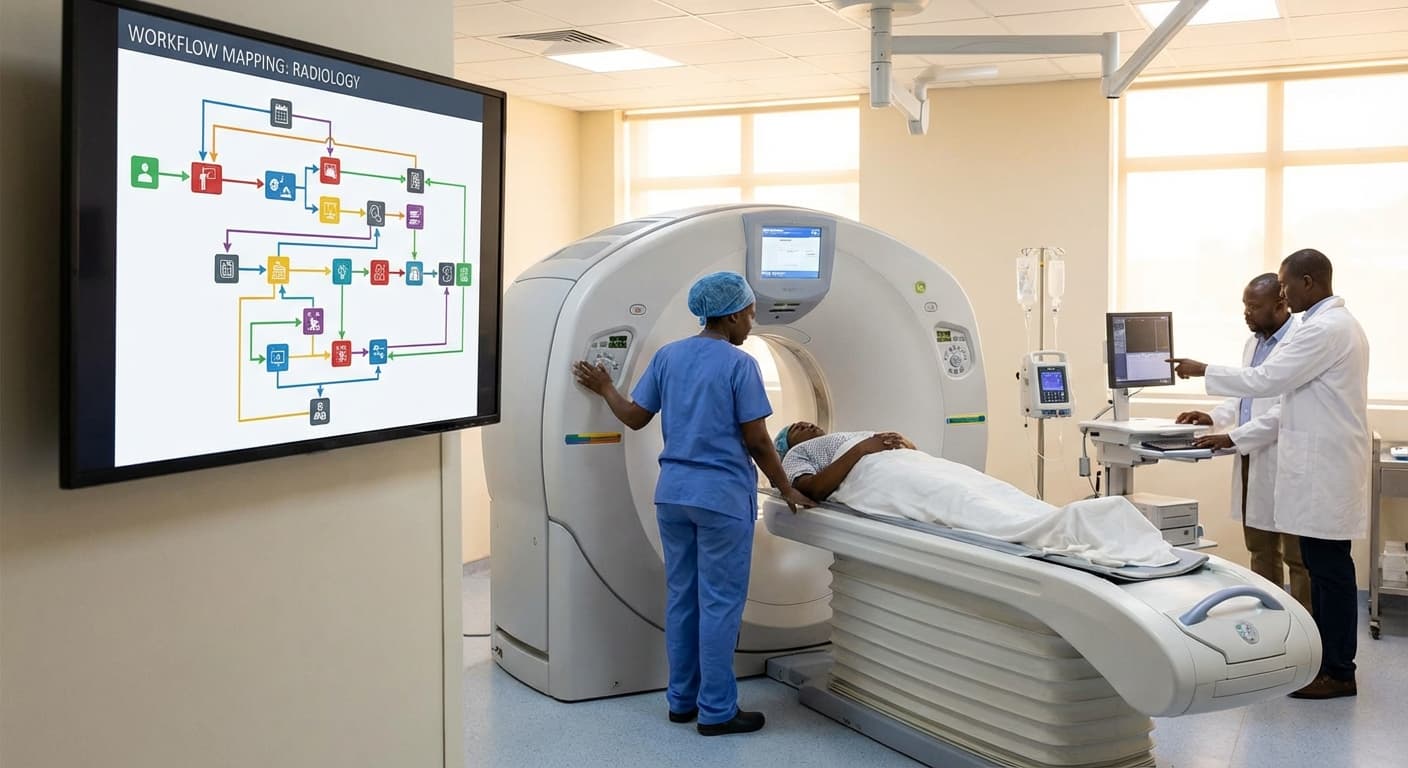
Department Workflow Mapping Service (Radiology/ICU/OT/Lab/Dialysis) in Chad
Engineering Excellence & Technical Support
Department Workflow Mapping Service (Radiology/ICU/OT/Lab/Dialysis) High-standard technical execution following OEM protocols and local regulatory frameworks.
Streamlined Patient Flow & Reduced Turnaround Times
Optimized workflows for Radiology, ICU, OT, Lab, and Dialysis departments in Chad, leading to significantly reduced patient wait times and faster diagnostic/treatment delivery. Achieved through precise mapping of patient journeys, identification of bottlenecks, and implementation of targeted process improvements.
Enhanced Resource Allocation & Utilization
Leveraged detailed workflow mapping to achieve optimal allocation of critical resources (equipment, staff, consumables) across key medical departments in Chad. This minimizes downtime, ensures availability during peak demand, and improves overall operational efficiency for Radiology, ICU, OT, Lab, and Dialysis.
Standardized Procedures & Improved Clinical Outcomes
Implemented standardized and documented operational procedures through comprehensive workflow mapping across Radiology, ICU, OT, Lab, and Dialysis in Chad. This reduces variation in care, enhances patient safety, and contributes to improved clinical outcomes and compliance with best practices.
What Is Department Workflow Mapping Service (Radiology/icu/ot/lab/dialysis) In Chad?
Department Workflow Mapping Service in Chad refers to the systematic analysis, documentation, and optimization of operational processes within specific high-acuity hospital departments, including Radiology, Intensive Care Units (ICU), Operating Theatres (OT), Laboratories, and Dialysis Units. This service aims to enhance efficiency, patient safety, resource utilization, and overall quality of care by providing a clear, visual, and actionable representation of existing workflows and identifying areas for improvement. It involves detailed observation, data collection, stakeholder interviews, and the application of process modeling techniques to understand the sequence of tasks, decision points, information flow, and resource allocation within these critical departments.
| Department | Who Needs It | Typical Use Cases |
|---|---|---|
| Radiology | Radiology departments (including imaging centers) seeking to improve patient throughput, reduce reporting turnaround times, optimize equipment utilization, and ensure accurate image acquisition and interpretation. | Mapping the patient journey from appointment scheduling and image acquisition to interpretation, reporting, and archiving. Optimizing radiologist workflow for report generation. Streamlining contrast media management. Improving PACS (Picture Archiving and Communication System) integration and data flow. |
| Intensive Care Unit (ICU) | ICUs aiming to enhance patient monitoring, streamline critical care interventions, improve communication among multidisciplinary teams, reduce adverse events, and optimize bed management. | Mapping patient admission, transfer, and discharge processes. Optimizing nurse-physician communication protocols. Streamlining medication administration and monitoring. Improving ventilator management workflows. Enhancing early warning scoring system implementation. |
| Operating Theatre (OT) | Surgical departments aiming to optimize operating room utilization, reduce surgical case delays, improve patient safety during surgical procedures, streamline sterilization processes, and enhance anesthesia management. | Mapping the pre-operative, intra-operative, and post-operative patient pathways. Optimizing surgical scheduling and room turnover. Streamlining instrument and supply management. Improving surgical checklist compliance. Enhancing anesthesia team coordination. |
| Laboratory | Clinical laboratories seeking to improve sample processing efficiency, reduce turnaround times for diagnostic tests, enhance quality control procedures, optimize reagent and equipment management, and ensure accurate result reporting. | Mapping the entire laboratory testing lifecycle from sample reception and accessioning to analysis, validation, and reporting. Optimizing specimen handling and transport. Streamlining quality assurance protocols. Improving laboratory information system (LIS) integration. Managing STAT (short turnaround time) sample workflows. |
| Dialysis Unit | Dialysis centers aiming to optimize patient scheduling, improve treatment delivery efficiency, enhance patient safety during dialysis sessions, manage equipment maintenance, and streamline fluid and electrolyte management. | Mapping the patient dialysis session from arrival, preparation, treatment, and discharge. Optimizing staff allocation and patient monitoring. Streamlining machine setup and cleaning protocols. Improving medication administration during dialysis. Enhancing vascular access management protocols. |
Key Components of Department Workflow Mapping Service
- As-Is Process Identification: Documenting the current state of workflows without alteration, capturing all steps, roles, systems, and data involved.
- Bottleneck Analysis: Identifying inefficiencies, delays, redundancies, and points of failure within the existing processes.
- Root Cause Analysis: Investigating the underlying reasons for identified inefficiencies and problems.
- To-Be Process Design: Developing optimized workflows that address identified issues, incorporating best practices and technological advancements.
- Gap Analysis: Comparing the 'As-Is' and 'To-Be' states to quantify improvements and identify implementation requirements.
- Performance Metrics Definition: Establishing key performance indicators (KPIs) to measure the effectiveness of the new workflows.
- Implementation Roadmap Development: Creating a plan for transitioning from the current to the optimized workflows.
- Training and Change Management Support: Facilitating the adoption of new processes by staff through training and communication.
Who Needs Department Workflow Mapping Service (Radiology/icu/ot/lab/dialysis) In Chad?
In Chad, optimizing operational efficiency is paramount for healthcare facilities. A Department Workflow Mapping Service is crucial for identifying bottlenecks, standardizing processes, and improving resource allocation within key departments. This service specifically targets the unique challenges faced by Radiology, Intensive Care Units (ICU), Operating Theaters (OT), Laboratories, and Dialysis centers.
| Department | Specific Needs Addressed by Workflow Mapping | Key Stakeholders within Department |
|---|---|---|
| Radiology | Streamlining patient imaging requests, report turnaround times, equipment utilization, and image archival processes. | Radiologists, Radiographers, Technicians, PACS Administrators, Department Managers |
| Intensive Care Unit (ICU) | Optimizing patient admission/discharge protocols, medication administration pathways, critical care team communication, and equipment management. | Intensivists, Critical Care Nurses, Respiratory Therapists, Physicians, Unit Managers |
| Operating Theater (OT) | Improving surgical scheduling, patient pre-operative preparation, instrument sterilization and management, and post-operative recovery flow. | Surgeons, Anesthesiologists, Scrub Nurses, Circulating Nurses, Theatre Technicians, Department Heads |
| Laboratory | Enhancing sample collection and transportation, test processing efficiency, result reporting, quality control procedures, and inventory management. | Pathologists, Laboratory Technicians, Phlebotomists, Lab Supervisors, Quality Assurance Officers |
| Dialysis | Optimizing patient scheduling, dialysis machine utilization, medication management, infection control protocols, and staff workflow during treatment sessions. | Nephrologists, Dialysis Nurses, Technicians, Patient Care Coordinators, Unit Managers |
Target Customers and Departments for Workflow Mapping in Chad
- Hospitals and Clinics: All public and private healthcare institutions operating these specialized departments.
- Ministry of Health (Chad): For national-level standardization and policy development.
- Non-Governmental Organizations (NGOs) involved in healthcare: Implementing projects and seeking to maximize their impact.
- International Aid Organizations: Funding and supporting healthcare infrastructure development.
Department Workflow Mapping Service (Radiology/icu/ot/lab/dialysis) Process In Chad
This document outlines the Department Workflow Mapping Service process for various specialized departments (Radiology, ICU, OT, Lab, Dialysis) within healthcare facilities in Chad, from initial inquiry to successful execution. The service aims to analyze, document, and optimize existing departmental workflows to improve efficiency, patient care, and resource utilization.
| Stage | Description | Key Activities | Deliverables/Outcomes |
|---|---|---|---|
| The process begins when a healthcare facility or department expresses interest in the workflow mapping service. | Contacting the service provider, initial discussion of needs and objectives, scope definition, and preliminary assessment of the department's current state. | Understanding of client needs, preliminary scope document, proposal outline. |
| Based on the initial consultation, a detailed proposal is developed and presented to the client. | Detailed service proposal submission, budget and timeline discussion, contract negotiation and signing. | Formal proposal, signed Service Level Agreement (SLA) or contract. |
| This stage involves in-depth understanding of the existing workflow. | Stakeholder interviews (doctors, nurses, technicians, administrators), observation of daily operations, review of existing documentation (SOPs, protocols), data collection on patient flow, resource allocation, and turnaround times. | Comprehensive understanding of current workflows, identification of bottlenecks and pain points, raw data on departmental processes. |
| The collected data is analyzed to create visual representations of the current workflows. | Developing process maps (e.g., flowcharts, swimlane diagrams), identifying critical paths, analyzing efficiency metrics, root cause analysis of identified issues. | Detailed current state workflow maps, identification of inefficiencies and areas for improvement. |
| Based on the analysis, proposed improvements and new workflows are designed. | Brainstorming sessions with stakeholders, developing 'to-be' workflow models, incorporating best practices and technological advancements, defining new Standard Operating Procedures (SOPs) and protocols. | Proposed future state workflow maps, revised SOPs and protocols, recommendations for technology integration. |
| The proposed optimized workflows are presented to the client for feedback and adjustments. | Presentation of proposed workflows to stakeholders, gathering feedback and suggestions, iterative refinement of workflow designs. | Validated and refined future state workflow maps, consensus on proposed changes. |
| A plan for implementing the new workflows is developed, and support is provided. | Development of an implementation roadmap, training plan for staff, change management strategies, pilot testing (if applicable), ongoing support during the transition. | Implementation plan, training materials, change management strategy, successful transition support. |
| After implementation, the new workflows are monitored to assess their effectiveness. | Data collection on key performance indicators (KPIs) of the new workflow, comparison with baseline data, post-implementation review meetings, identifying further optimization opportunities. | Performance reports, recommendations for continuous improvement, long-term workflow sustainability. |
Key Departments Covered
- Radiology
- Intensive Care Unit (ICU)
- Operating Theatre (OT)
- Laboratory
- Dialysis
Department Workflow Mapping Service (Radiology/icu/ot/lab/dialysis) Cost In Chad
The cost of Department Workflow Mapping Services for specialized healthcare departments like Radiology, ICU, OT (Operating Theatre), Lab, and Dialysis in Chad can vary significantly. These services are crucial for optimizing efficiency, patient flow, resource utilization, and ultimately, patient care within these high-demand areas. Several factors influence the pricing, making it difficult to provide a single definitive cost. However, we can outline the key pricing factors and provide estimated cost ranges in the local currency, the Chadian Franc (XAF).
| Department Type | Estimated Cost Range (XAF) |
|---|---|
| Radiology (Single Unit/Process) | 300,000 - 750,000 XAF |
| Radiology (Multi-Modality/Complex) | 750,000 - 1,500,000 XAF |
| ICU (Small/Medium Unit) | 800,000 - 2,000,000 XAF |
| ICU (Large/Specialized Unit) | 2,000,000 - 5,000,000 XAF |
| OT (Single Operating Room/Process) | 400,000 - 900,000 XAF |
| OT (Multiple ORs/Complex Scheduling) | 900,000 - 2,500,000 XAF |
| Laboratory (Basic/Routine) | 350,000 - 800,000 XAF |
| Laboratory (Specialized/High Volume) | 800,000 - 1,800,000 XAF |
| Dialysis (Small Unit) | 400,000 - 900,000 XAF |
| Dialysis (Large Unit/Multiple Shifts) | 900,000 - 2,000,000 XAF |
| Mapping Multiple Departments (Bundled) | Custom Quote Required - typically with a discount per department |
Key Pricing Factors for Department Workflow Mapping Services in Chad:
- Scope and Complexity of the Department: The size, complexity, and number of interconnected processes within a department will directly impact the time and resources required for mapping. For instance, a large, multi-specialty ICU with numerous patient pathways will be more complex than a smaller, focused radiology unit.
- Number of Workflows to Map: The total number of distinct workflows within the chosen department(s) will influence the project's duration and cost. Mapping all patient journeys from admission to discharge in an ICU is a more extensive undertaking than mapping a single diagnostic imaging process.
- Level of Detail Required: The depth of analysis and the granularity of the workflow map are critical. Do you need high-level overviews, or detailed step-by-step process maps including decision points, dependencies, and resource allocation?
- Data Collection Methods: The chosen methods for data collection, such as interviews, observation, time-and-motion studies, document analysis, and system audits, will affect the cost. More intensive methods like extensive direct observation can be more time-consuming.
- Technology and Tools Used: The software or platforms used for creating and visualizing the workflow maps can have associated licensing fees or subscription costs that might be passed on to the client.
- Consultant Expertise and Experience: The reputation, experience, and specialization of the consulting firm or individual providing the service are significant determinants of cost. Highly experienced consultants with a proven track record in healthcare workflow optimization will command higher fees.
- Project Timeline: A compressed or expedited timeline often incurs additional costs due to the need for more resources or overtime work.
- Location within Chad: While national pricing is generally considered, there might be minor logistical cost variations depending on the remoteness of the healthcare facility.
- Reporting and Deliverables: The format and comprehensiveness of the final reports, including recommendations, action plans, and training materials, will influence the overall cost.
- Post-Mapping Support and Training: Some service providers offer ongoing support, implementation assistance, or staff training, which would be additional costs.
Affordable Department Workflow Mapping Service (Radiology/icu/ot/lab/dialysis) Options
Our Affordable Department Workflow Mapping Service is designed to optimize efficiency and reduce costs across critical hospital departments including Radiology, ICU, Operating Theatre (OT), Laboratory, and Dialysis. By meticulously analyzing and visualizing your current workflows, we identify bottlenecks, redundancies, and areas for improvement. This leads to significant cost savings through reduced waste, improved resource allocation, enhanced staff productivity, and a streamlined patient journey.
| Cost-Saving Strategy | Description | Impacted Departments |
|---|---|---|
| Bottleneck Identification & Resolution | Pinpointing and addressing delays or inefficiencies in the patient or sample flow. Reduces patient wait times and improves throughput. | All Departments (Radiology, ICU, OT, Lab, Dialysis) |
| Redundancy Elimination | Identifying and removing duplicate steps or processes, saving staff time and resources. | All Departments |
| Improved Resource Allocation | Ensuring equipment, staff, and supplies are utilized optimally, reducing idle time and potential overstocking. | All Departments |
| Streamlined Patient Journey | Optimizing the patient's path through the department, leading to better patient satisfaction and reduced length of stay where applicable. | ICU, OT, Dialysis, Radiology (for imaging pathways) |
| Enhanced Staff Productivity | Simplifying tasks, reducing manual interventions, and clarifying roles to allow staff to focus on higher-value activities. | All Departments |
| Reduced Waste (Materials & Time) | Minimizing unnecessary use of consumables, energy, and staff time through process optimization. | All Departments |
| Standardized Procedures | Developing clear, consistent workflows that reduce errors and improve training efficiency. | All Departments |
| Predictive Maintenance Insights (for equipment-heavy departments) | Workflow mapping can highlight patterns that suggest potential equipment failures, enabling proactive maintenance and avoiding costly downtime. | Radiology, OT, Lab, Dialysis |
Value Bundles
- {"title":"Essential Efficiency Bundle","description":"Focuses on core workflow mapping for a single department. Ideal for organizations looking to tackle specific pain points and achieve immediate gains. Includes initial assessment, process mapping, bottleneck identification, and a high-level recommendations report."}
- {"title":"Integrated Department Bundle","description":"Expands on the Essential Bundle to include workflow mapping for two interconnected departments (e.g., ICU and OT, or Lab and Radiology). Identifies inter-departmental dependencies and potential handoff issues for a more holistic optimization. Includes detailed process maps, cross-departmental flow analysis, and collaborative recommendations."}
- {"title":"Comprehensive Hospital Optimization Bundle","description":"Our most extensive offering, covering workflow mapping for multiple key departments. Provides a complete picture of departmental interactions and opportunities for system-wide improvements. Ideal for larger institutions seeking broad operational enhancements. Includes all features of the Integrated Bundle plus advanced data analysis, simulation modeling (optional add-on), and a strategic roadmap for sustained efficiency."}
- {"title":"Custom Department Focus","description":"Tailored workflow mapping for a single department with specific, complex needs. Allows for in-depth analysis and customized solutions. Priced based on the scope and complexity of the department's processes."}
Verified Providers In Chad
In Chad's evolving healthcare landscape, identifying trustworthy and competent healthcare providers is paramount. Franance Health has established itself as a leading entity, synonymous with quality, integrity, and patient-centered care. This document outlines Franance Health's credentials and the compelling reasons why they represent the best choice for healthcare services in Chad.
| Aspect | Franance Health's Advantage | Why it Matters for Patients |
|---|---|---|
| Expertise & Specialization | Access to a wide range of medical specialists and sub-specialists. | Ensures patients receive care from professionals with the most relevant knowledge and experience for their specific condition. |
| Diagnostic Accuracy | Utilizes advanced diagnostic tools and techniques, including modern imaging and laboratory services. | Leads to faster and more accurate identification of illnesses, enabling timely and effective treatment plans. |
| Patient-Centered Care | Prioritizes individualized treatment plans, patient education, and compassionate communication. | Empowers patients, reduces anxiety, and fosters a collaborative approach to healthcare, leading to better outcomes. |
| Continuity of Care | Offers comprehensive services, from primary care to specialized treatments, facilitating seamless transitions and ongoing management. | Patients benefit from a consistent and integrated healthcare journey, minimizing the need to seek care from multiple uncoordinated sources. |
| Trust & Reliability | Demonstrated track record of successful patient outcomes and a strong reputation within the community. | Provides peace of mind and confidence in the quality and dependability of the healthcare services received. |
Franance Health's Differentiating Credentials
- Accreditation and Certifications: Franance Health adheres to stringent national and international healthcare standards, evidenced by its certifications in quality management systems and specialized medical services.
- Highly Qualified Medical Professionals: The organization boasts a team of experienced and board-certified physicians, nurses, and allied health professionals with diverse specializations.
- State-of-the-Art Facilities and Technology: Franance Health invests in modern medical equipment and infrastructure, ensuring accurate diagnoses and effective treatments.
- Commitment to Patient Safety and Ethics: A strong ethical framework and robust patient safety protocols are central to Franance Health's operational philosophy.
- Community Engagement and Outreach: Proactive involvement in public health initiatives and accessible healthcare programs demonstrate a deep commitment to the well-being of the Chadian population.
Scope Of Work For Department Workflow Mapping Service (Radiology/icu/ot/lab/dialysis)
This Scope of Work (SOW) outlines the services to be provided for a comprehensive workflow mapping initiative across key hospital departments. The primary objective is to document, analyze, and optimize existing operational processes within the Radiology, Intensive Care Unit (ICU), Operating Theatre (OT), Laboratory, and Dialysis departments. This service will identify bottlenecks, inefficiencies, and areas for improvement, leading to enhanced patient care, resource utilization, and operational efficiency. The project will culminate in the delivery of detailed workflow maps, process analyses, and actionable recommendations.
| Phase | Activities | Deliverables | Technical Specifications / Standards |
|---|---|---|---|
| Phase 1: Project Initiation & Planning | Kick-off meeting with stakeholders, project scope refinement, data collection strategy development, identification of key personnel for interviews and observation. | Project Charter, Detailed Project Plan, Stakeholder Register, Communication Plan. | Standard project management templates, adherence to ISO 9001 principles for quality management. |
| Phase 2: Current State Workflow Discovery | Conducting interviews with departmental staff, direct observation of processes, review of existing documentation (SOPs, manuals), shadowing key personnel, data gathering on process timings and resource utilization. | Raw Interview Transcripts, Observation Notes, Data Collection Forms, Initial Draft Workflow Diagrams (per department). | Data confidentiality agreements, ethical research protocols, adherence to hospital's IT security policies for data handling. |
| Phase 3: Workflow Analysis & Documentation | Analyzing collected data to identify process steps, decision points, inputs, outputs, roles, responsibilities, and potential pain points. Developing detailed 'As-Is' workflow maps using standardized notation. | Comprehensive 'As-Is' Workflow Maps (BPMN 2.0 standard recommended), Process Flowcharts, Gap Analysis Report (identifying deviations from best practices or desired outcomes). | Business Process Model and Notation (BPMN) 2.0 for all workflow diagrams. Use of standard flowcharting symbols. Data integrity checks on all documented processes. |
| Phase 4: Future State Design & Recommendations | Collaborative sessions with stakeholders to brainstorm and design 'To-Be' workflows, incorporating identified improvements, best practices, and potential technological solutions. Developing recommendations for process optimization. | 'To-Be' Workflow Maps, Recommendations Report (including proposed changes, implementation roadmap, potential ROI, and risk assessment). | Alignment with relevant healthcare industry standards (e.g., HL7 for data exchange where applicable), consideration of Lean/Six Sigma principles for efficiency, clear and actionable recommendations. |
| Phase 5: Finalization & Knowledge Transfer | Review and validation of all deliverables with stakeholders, incorporating feedback, finalizing all documentation, and conducting a knowledge transfer session to ensure understanding and sustainability of the new workflows. | Finalized 'As-Is' and 'To-Be' Workflow Maps (digital and printable formats), Final Recommendations Report, Training Materials (if applicable), Project Close-out Report. | Standardized deliverable formats (e.g., PDF, Visio, Lucidchart), adherence to version control for all documentation, clear and concise presentation of information. |
Key Objectives:
- To accurately document the current state of workflows within each specified department.
- To identify inefficiencies, redundancies, and potential bottlenecks in existing processes.
- To facilitate a deeper understanding of inter-departmental dependencies and communication flows.
- To provide data-driven insights for process improvement and optimization.
- To develop standardized, visual representations of workflows for training and reference.
- To recommend technological or procedural changes to enhance efficiency and patient outcomes.
Service Level Agreement For Department Workflow Mapping Service (Radiology/icu/ot/lab/dialysis)
This Service Level Agreement (SLA) outlines the agreed-upon response times and uptime guarantees for the Department Workflow Mapping Service. This service is critical for the efficient operation of the Radiology, Intensive Care Unit (ICU), Operating Theatre (OT), Laboratory, and Dialysis departments.
| Service Component | Response Time (Hours) | Uptime Guarantee (%) | Notes |
|---|---|---|---|
| New Workflow Mapping Request (Standard) | 24 | 99.5% | Requires initial submission and data validation. |
| Workflow Mapping Modification Request (Minor) | 12 | 99.5% | For small adjustments, text changes, or diagram tweaks. |
| Workflow Mapping Modification Request (Major) | 48 | 99.5% | For significant structural changes or addition of new processes. |
| Critical Issue Reporting (Service Outage) | 2 | 99.9% | Immediate acknowledgement and initiation of resolution efforts. Includes all departments. |
| General Inquiry / Support Request | 8 | 99.5% | For questions regarding existing mappings or service usage. |
| Scheduled Maintenance Window | N/A | 99.5% | Outage notification will be provided at least 48 hours in advance. Maintenance will be performed outside of peak operational hours. |
Service Objectives
- To provide accurate and timely mapping of departmental workflows.
- To ensure high availability of the workflow mapping service.
- To respond promptly to reported issues and requests for modification.
Frequently Asked Questions

Ready when you are
Let's scope your Department Workflow Mapping Service (Radiology/ICU/OT/Lab/Dialysis) in Chad project in Chad.

Scaling healthcare logistics and technical systems across the entire continent.