
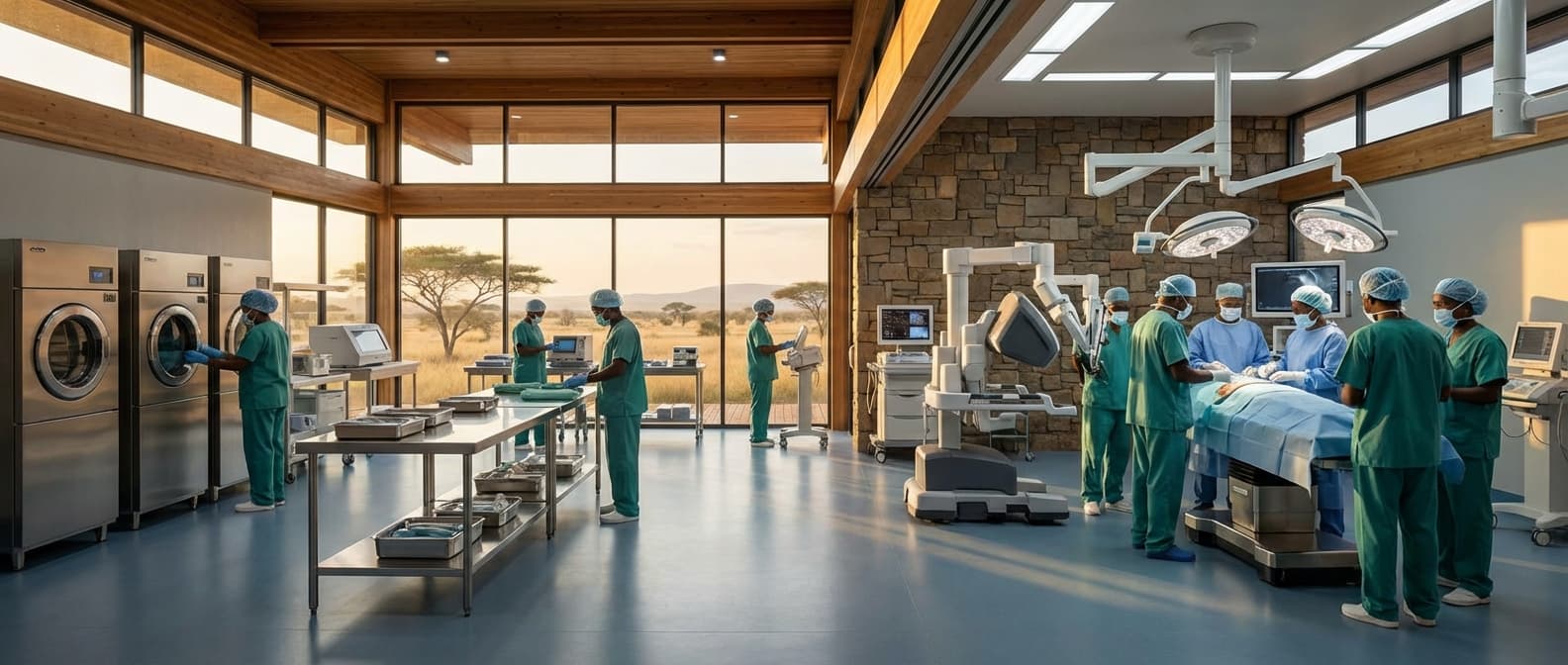
Operating Theatre Turnkey Build in Chad
Engineering Excellence & Technical Support
Complete OR design, equipment integration and commissioning High-standard technical execution following OEM protocols and local regulatory frameworks.
Expert Site Preparation & Foundation Laying
Leveraging specialized geotechnical analysis and advanced excavation techniques to ensure a stable and durable foundation for the operating theatre, crucial for the arid Chadian climate and varying soil conditions.
Modular Construction & Rapid Deployment
Implementing prefabricated, sterile-grade modular units designed for efficient transport and swift on-site assembly, significantly reducing construction time and minimizing disruption in remote Chadian locations.
Integrated HVAC & HEPA Filtration Systems
Designing and installing state-of-the-art climate control and high-efficiency particulate air (HEPA) filtration systems to maintain optimal sterile environments, essential for preventing surgical site infections in challenging regional air quality.
What Is Operating Theatre Turnkey Build In Chad?
An Operating Theatre Turnkey Build in Chad refers to a comprehensive, end-to-end service for the design, construction, equipping, and commissioning of a fully functional operating theatre suite. This approach consolidates all project management and execution responsibilities under a single provider, delivering a ready-to-operate facility upon completion. The service typically encompasses site assessment, architectural and engineering design adhering to international standards (e.g., ISO, WHO guidelines), structural construction, installation of specialized medical infrastructure (medical gases, electrical systems with UPS, HVAC with HEPA filtration), procurement and integration of surgical equipment, sterilization units, and ancillary services, as well as staff training and validation. The objective is to minimize project complexity and risk for the client by ensuring timely delivery of a compliant and advanced surgical environment.
| Stakeholder Group | Needs and Benefits | Typical Use Cases |
|---|---|---|
| Government Health Ministries/Agencies in Chad | To upgrade or establish new public healthcare facilities, expand surgical capacity, improve patient outcomes, and ensure compliance with national health standards. Turnkey solutions offer a streamlined procurement process and predictable project costs. | Construction of new district or regional hospital operating theatres; upgrading existing facilities to meet modern standards; establishing specialized surgical units (e.g., trauma, obstetrics). |
| Non-Governmental Organizations (NGOs) and International Aid Organizations | To rapidly deploy surgical capabilities in underserved or crisis-affected regions, requiring efficient and complete facility development. Turnkey models simplify project management for organizations with diverse operational mandates. | Establishing field hospitals or surgical centers in remote areas; responding to humanitarian crises with immediate surgical infrastructure; implementing targeted health improvement programs. |
| Private Healthcare Providers and Investors in Chad | To develop state-of-the-art surgical centers to attract medical tourism, offer advanced procedures, and meet the demand for private healthcare services. Turnkey builds ensure rapid market entry and minimize operational disruption during development. | Building private hospitals or specialized surgical clinics; expanding existing private healthcare facilities; offering specialized surgical procedures requiring advanced technology. |
| Military and Defense Healthcare Services | To establish robust and rapidly deployable surgical capabilities for military personnel or in operational zones. Turnkey solutions provide comprehensive and reliable medical infrastructure. | Developing forward operating base surgical facilities; equipping military hospitals; establishing specialized trauma care units. |
Key Components of an Operating Theatre Turnkey Build
- Site Assessment and Feasibility Studies: Evaluating existing infrastructure, site suitability, and resource availability.
- Design and Engineering: Developing detailed architectural, mechanical, electrical, and plumbing (MEP) designs incorporating infection control principles, ergonomics, and workflow optimization.
- Civil Construction and Fit-out: Executing the physical construction of the theatre space, including wall finishes, flooring, lighting, and door systems.
- Medical Gas Systems: Installation and integration of piped medical gases (oxygen, medical air, vacuum, nitrous oxide) with alarm systems.
- HVAC and Air Filtration: Designing and implementing specialized ventilation systems with HEPA filtration for maintaining sterile environments and controlling air pressure differentials.
- Electrical Systems: Ensuring robust power supply with uninterruptible power supply (UPS) and emergency generators, compliant with medical electrical safety standards.
- Equipment Procurement and Integration: Sourcing, installing, and commissioning a full suite of surgical instruments, operating tables, surgical lights, anesthesia machines, patient monitors, and sterilization equipment.
- Sterilization Facilities: Establishing integrated or dedicated sterilization units (autoclaves, sterile processing departments).
- Ancillary Services Integration: Connecting to IT networks, communication systems, and waste management facilities.
- Commissioning and Validation: Rigorous testing and certification of all systems and equipment to ensure compliance with regulatory requirements and operational readiness.
- Staff Training: Providing training on the operation and maintenance of installed equipment and theatre protocols.
Who Needs Operating Theatre Turnkey Build In Chad?
While a full operating theatre turnkey build might not be as common or extensively implemented in Chad as in highly developed nations, there are specific scenarios and entities that would significantly benefit from such an offering. These primarily revolve around improving access to advanced surgical care, enhancing existing healthcare infrastructure, and responding to specific public health needs. The demand is driven by the need for modern, safe, and efficient surgical environments to address a growing population and the prevalence of certain health conditions.
| Customer Type | Specific Departments/Needs Addressed | Rationale |
|---|---|---|
| Government Ministry of Health | Establishing new referral hospitals; upgrading existing provincial hospitals; creating specialized surgical centers (e.g., trauma, maternal health) | To standardize healthcare delivery across the nation, increase surgical capacity, and improve outcomes for a larger population. Turnkey solutions offer a rapid and predictable path to modernization. |
| Large Public Hospitals in Major Cities (e.g., N'Djamena) | Expansion of existing surgical suites; creation of specialized operating rooms (e.g., orthopedics, neurosurgery, cardiovascular) | To cope with increasing patient loads, introduce more complex surgical procedures, and improve infection control. Turnkey builds can integrate the latest technology and infrastructure. |
| Private Hospitals and Clinics (often in urban centers) | Development of state-of-the-art surgical facilities for elective and specialized procedures | To attract patients seeking higher quality care, offer competitive services, and cater to the growing middle class and expatriate community. Turnkey solutions can ensure compliance with international standards. |
| Non-Governmental Organizations (NGOs) with Healthcare Focus | Building or renovating surgical units in remote or underserved areas; establishing mobile surgical units | To address specific health crises (e.g., conflict-related injuries, maternal mortality) or provide essential surgical services where existing infrastructure is lacking. Turnkey can expedite project completion for critical needs. |
| International Aid Organizations | Supporting national health strategies through infrastructure development; disaster response surgical facilities | To facilitate large-scale health initiatives, respond to emergencies with rapidly deployable and functional surgical units, and ensure efficient use of donor funds through standardized and reliable builds. |
Target Customers and Departments for Operating Theatre Turnkey Build in Chad
- Government Ministry of Health
- Large Public Hospitals in Major Cities
- Private Hospitals and Clinics
- Non-Governmental Organizations (NGOs) with Healthcare Focus
- International Aid Organizations
Operating Theatre Turnkey Build Process In Chad
This document outlines the comprehensive workflow for a turnkey operating theatre (OT) build process in Chad, from initial inquiry to project execution. A turnkey solution signifies a complete, ready-to-use facility delivered by a single provider, minimizing the client's involvement in managing multiple contractors and suppliers.
| Stage | Description | Key Activities | Deliverables | Considerations for Chad |
|---|---|---|---|---|
| 1. Initial Inquiry & Requirements Gathering | The process begins with a prospective client expressing interest in a turnkey OT build. | Initial consultation, understanding client's needs (number of OTs, specialties, budget, timelines), site information exchange, preliminary scope definition. | Project inquiry document, preliminary needs assessment report. | Language barriers (French is official, many local dialects), understanding local healthcare infrastructure and needs, initial budget discussions often need to be flexible. |
| 2. Feasibility Study & Site Assessment | A detailed evaluation of the proposed site's suitability and project viability. | Site visits (if feasible, or virtual assessment), infrastructure analysis (power, water, waste management, internet), geotechnical surveys, logistical assessment for equipment transport, regulatory compliance review, detailed cost estimation. | Feasibility report, detailed site assessment findings, preliminary budget and timeline. | Access to remote areas, quality of existing infrastructure, availability of local skilled labor for initial assessment, import/customs duties and procedures for equipment. |
| 3. Design & Planning | Developing detailed architectural, mechanical, electrical, and medical gas designs tailored to the OT and local context. | Conceptual design, detailed architectural drawings, MEP (Mechanical, Electrical, Plumbing) design, medical gas pipeline design, infection control and HVAC system design, equipment selection and layout, regulatory approvals and permits. | Approved architectural and MEP drawings, equipment specifications, project execution plan, permit applications. | Adherence to international standards (e.g., HTM, ISO) while ensuring practical implementation in Chad. Need for robust HVAC for tropical climate, reliable power solutions (generators, UPS). Local building codes and approval processes. |
| 4. Procurement & Manufacturing | Sourcing and manufacturing of all required equipment, materials, and building components. | Supplier selection, equipment manufacturing/procurement, material sourcing, quality control checks, factory acceptance testing (FAT) for critical equipment. | Procured equipment and materials, manufacturing progress reports, FAT certificates. | Lead times for international shipping, customs clearance efficiency, potential for local sourcing of some materials or labor, currency fluctuations impacting costs. |
| 5. Site Preparation & Civil Works | Preparing the construction site and carrying out all necessary civil engineering and building works. | Site clearing, foundation work, structural construction, wall erection, roofing, flooring, painting, installation of basic utilities. | Completed building shell, prepared for interior fit-out. | Availability of skilled construction labor and supervisors, quality of local construction materials, logistical challenges for transporting heavy machinery and materials, environmental considerations (dust, heat). |
| 6. Installation & Integration | Installing all specialized OT equipment, MEP systems, and integrating them for seamless operation. | Installation of specialized OT equipment (lights, tables, anesthesia machines), MEP system installation and connection, medical gas pipeline installation, HVAC and air filtration system installation, IT and communication system setup. | Installed and interconnected OT systems and equipment. | Expertise of specialized technicians, safe handling and installation of sensitive medical equipment, coordination with local authorities for utility connections, ensuring robust power and water supply. |
| 7. Commissioning & Validation | Testing and verifying that all systems and equipment function as per specifications and safety standards. | System testing (electrical, HVAC, medical gas), equipment performance testing, infection control validation, environmental monitoring, site acceptance testing (SAT), regulatory inspections and certifications. | Commissioning reports, validation certificates, final operational OT facility. | Availability of specialized testing equipment and trained personnel, documentation requirements for local health authorities, rigorous testing protocols to ensure safety and efficacy in a challenging environment. |
| 8. Training & Handover | Training hospital staff on the operation and maintenance of the new OT, followed by official handover. | User training for medical and technical staff, operational manuals, maintenance schedules, spare parts provision, final project documentation, official project handover. | Trained staff, comprehensive documentation package, keys and access credentials. | Language of training materials (consider translations), cultural sensitivity during training, ensuring long-term understanding of complex systems. |
| 9. Post-Installation Support & Maintenance | Providing ongoing support and maintenance services as per the contract. | Warranty period support, scheduled preventive maintenance, emergency repair services, supply of spare parts, remote monitoring (if applicable). | Ongoing operational efficiency and reliability of the OT. | Establishing a reliable local service network or strong remote support capabilities, availability of spare parts logistics, training local technicians for basic maintenance. Long-term partnership considerations. |
Key Stages of the Turnkey Operating Theatre Build Process in Chad
- 1. Initial Inquiry & Requirements Gathering:
- 2. Feasibility Study & Site Assessment:
- 3. Design & Planning:
- 4. Procurement & Manufacturing:
- 5. Site Preparation & Civil Works:
- 6. Installation & Integration:
- 7. Commissioning & Validation:
- 8. Training & Handover:
- 9. Post-Installation Support & Maintenance:
Operating Theatre Turnkey Build Cost In Chad
Establishing a modern operating theatre in Chad involves a multifaceted cost structure, heavily influenced by factors such as location, scale, complexity, and the quality of materials and equipment chosen. Turnkey solutions, encompassing design, construction, and fit-out, offer a streamlined approach but require a clear understanding of the variables that impact the final price. These costs are generally denominated in the local currency, the Chadian Franc (XAF).
| Cost Component | Estimated Range (XAF per m² or unit) | Notes |
|---|---|---|
| Basic Construction (Shell & Core) | 500,000 - 1,200,000 XAF / m² | Includes structural work, walls, basic roofing, and foundation. Excludes internal fit-out and specialized systems. |
| Standard Operating Theatre Fit-out (Excluding Major Equipment) | 1,500,000 - 3,500,000 XAF / m² | Includes specialized flooring, wall cladding, integrated lighting, basic HVAC, medical gas outlets, standard plumbing, and electrical. Excludes high-end imaging or robotic systems. |
| High-End/Specialized Operating Theatre Fit-out (Excluding Major Equipment) | 3,000,000 - 7,000,000+ XAF / m² | Incorporates advanced HVAC with HEPA filtration, state-of-the-art medical gas systems, lead shielding (if required), advanced surgical lighting, and premium finishes. |
| Major Medical Equipment (per theatre) | 20,000,000 - 200,000,000+ XAF | Highly variable. Includes anesthesia machines, surgical lights, tables, imaging (e.g., C-arm), monitors, electro-surgical units, etc. Specific pricing depends on brands and specifications. |
| Ancillary Spaces (Sterilization, Scrub-up, Recovery - per m²) | 700,000 - 1,800,000 XAF / m² | Costs are for fit-out, similar to standard theatre fit-out but may vary based on functional requirements. |
| Turnkey Project Management & Design Fees | 5% - 15% of total project cost | Covers architectural design, engineering, project management, and oversight. |
| Contingency | 10% - 20% of total project cost | Essential for unforeseen circumstances and price fluctuations. |
Key Pricing Factors for Operating Theatre Turnkey Builds in Chad:
- Project Scope & Size: The overall square footage and the number of operating rooms significantly dictate material quantities and labor requirements.
- Location within Chad: Costs can vary between major cities like N'Djamena and more remote regions due to differences in logistics, labor availability, and local material pricing.
- Quality of Construction Materials: The grade of concrete, steel, finishing materials (tiles, paints, flooring), and specialized wall/ceiling systems will impact cost.
- Complexity of Design & Layout: Intricate designs requiring specialized structural elements or advanced ventilation systems will be more expensive.
- Specialized Medical Equipment: The type and brand of surgical lights, anesthesia machines, imaging equipment (e.g., C-arms), sterilization units, and patient monitors are major cost drivers.
- HVAC and Air Filtration Systems: Operating theatres require stringent air quality control, necessitating sophisticated and costly HVAC and HEPA filtration systems.
- Medical Gases Installation: The complexity and number of medical gas outlets (oxygen, medical air, vacuum) influence installation costs.
- Electrical & IT Infrastructure: Robust electrical systems, backup generators, UPS, and IT networking for medical equipment add to the expense.
- Plumbing & Drainage Systems: Specialized sanitaryware, sterile water systems, and waste management solutions are essential.
- Finishing & Fit-Out: Interior finishes, cabinetry, doors, windows, and access control systems contribute to the overall cost.
- Labor Costs: While generally lower than in Western countries, skilled labor for specialized construction and medical equipment installation can still be a significant factor, especially in remote areas.
- Logistics & Transportation: Importing specialized equipment and materials into Chad can incur substantial transportation and customs clearance costs.
- Regulatory Approvals & Inspections: Obtaining necessary permits and undergoing inspections by local health and building authorities may involve fees.
- Contingency & Project Management: It's crucial to include a contingency for unforeseen issues and project management fees for oversight and coordination.
- Turnkey Provider's Markup: The profit margin and overhead of the company providing the turnkey solution will be factored into the final price.
Affordable Operating Theatre Turnkey Build Options
Building or upgrading an operating theatre can be a significant investment. However, by exploring "Affordable Operating Theatre Turnkey Build Options," healthcare facilities can achieve high-quality, compliant spaces without breaking the bank. Turnkey solutions offer a comprehensive approach, handling everything from design and construction to equipment installation and commissioning. This section delves into the value bundles and cost-saving strategies available within these options.
| Cost-Saving Strategy | Description | Impact on Turnkey Builds |
|---|---|---|
| Standardization of Designs and Equipment | Utilizing pre-approved, modular designs and selecting standardized, readily available equipment reduces customisation costs and lead times. It also simplifies procurement and maintenance. | Enables faster project completion, lower material costs due to bulk purchasing, and predictable budgeting. Often integrated into 'Basic Compliance' and 'Standard Functionality' packages. |
| Phased Construction and Equipment Procurement | Breaking down the project into manageable phases allows for staggered spending and the ability to leverage cost savings as the project progresses. Equipment can be purchased as needed, potentially benefiting from future technological advancements or price reductions. | Spreads capital expenditure over time, making it more manageable. Allows for potential savings on later phases if early phases reveal cost efficiencies. Can be applied to any package type. |
| Modular Construction and Prefabrication | Utilizing prefabricated modules for walls, ceiling systems, and even entire OR rooms can significantly reduce on-site construction time, labor costs, and disruption. This also ensures higher quality control. | Shortens construction timelines, reduces on-site labor needs, and minimizes disruption to existing hospital operations. Often a key component in maximizing efficiency for all package types. |
| Negotiation and Bulk Purchasing | Leveraging the turnkey provider's established relationships with suppliers to negotiate bulk discounts on materials, fixtures, and medical equipment. | Directly reduces the overall cost of components and equipment, leading to a lower final project price. A core benefit of working with experienced turnkey providers. |
| Value Engineering and Alternative Materials | Working with the turnkey provider to identify opportunities to use equally effective but less expensive materials or construction methods without compromising safety or functionality. | Identifies cost efficiencies during the design and planning phases. Can be incorporated into any package to optimize budget without sacrificing performance. |
| Energy-Efficient Systems and Lighting | Specifying energy-efficient HVAC, lighting, and other systems can lead to long-term operational cost savings and often has a lower upfront cost for the systems themselves. | Reduces utility bills over the lifespan of the operating theatre. Can be a standard inclusion or an optional upgrade in 'Standard Functionality' and 'Advanced Integrated' packages. |
| Remote Monitoring and Predictive Maintenance Options | Incorporating systems that allow for remote monitoring of equipment performance and enable predictive maintenance can prevent costly downtime and emergency repairs. | Minimizes unexpected operational expenses and ensures higher uptime for the OR. Typically an add-on feature for 'Advanced Integrated' packages. |
Value Bundles in Turnkey Builds
- {"title":"Basic Compliance Package","description":"Includes essential elements for a functional and compliant operating theatre, focusing on core infrastructure, basic medical gas systems, and standard lighting. Suitable for facilities with limited budgets or for creating supplementary ORs."}
- {"title":"Standard Functionality Package","description":"Builds upon the basic package by incorporating more advanced features such as improved HVAC systems for better air quality control, enhanced lighting options (e.g., LED surgical lights), and a wider range of essential medical equipment."}
- {"title":"Advanced Integrated Package","description":"Offers a premium solution with state-of-the-art technology, including integrated audio-visual systems for training and remote consultation, advanced imaging integration, sophisticated environmental controls, and a broader selection of specialized surgical equipment. Often includes options for automation and smart OR features."}
- {"title":"Customizable Hybrid Packages","description":"Allows facilities to select specific components from different bundles or tailor a package to their unique surgical specialties, patient demographics, and technological needs. Offers flexibility and cost optimization by focusing on essential upgrades."}
Verified Providers In Chad
In Chad, navigating the healthcare landscape and finding trustworthy medical professionals can be a significant challenge. However, the emergence of verified providers, particularly those with Franance Health credentials, is revolutionizing access to quality care. Franance Health is a recognized body that rigorously assesses and certifies healthcare providers based on a stringent set of criteria, ensuring they meet high standards of competence, ethical practice, and patient safety. Choosing a Franance Health-credentialed provider in Chad offers a distinct advantage, providing patients with the assurance that they are receiving care from highly qualified and vetted individuals. This verification process often includes comprehensive background checks, verification of medical licenses and qualifications, peer reviews, and ongoing professional development monitoring. Therefore, when seeking medical services in Chad, prioritizing providers with Franance Health credentials signifies a commitment to your well-being and a choice that represents the best possible standard of care.
| Credential Type | Verification Process | Benefits for Patients |
|---|---|---|
| Franance Health Certified Physician | License verification, educational background check, peer review, continuing education tracking | Guaranteed competency, ethical practice, and up-to-date medical knowledge. |
| Franance Health Accredited Clinic/Hospital | Facility inspection, adherence to safety standards, quality management system review, staff credentialing | Safe environment, reliable equipment, organized patient care, and competent medical teams. |
| Franance Health Specialist (e.g., Surgeon, Cardiologist) | Advanced degree verification, specialized training validation, case review, experience assessment | Expertise in a specific medical field, complex case management capabilities, and advanced treatment options. |
Key Benefits of Choosing Franance Health Verified Providers in Chad:
- Enhanced Trust and Credibility: Franance Health's rigorous vetting process builds confidence in the provider's expertise and integrity.
- Assurance of Quality Care: Credentials signify adherence to established standards of medical practice and patient safety protocols.
- Reduced Risk of Substandard Services: Verification helps filter out unqualified or unethical practitioners.
- Access to Competent Professionals: Franance Health ensures providers possess the necessary qualifications and experience.
- Peace of Mind for Patients: Knowing your provider is verified offers a greater sense of security and reduces anxiety.
Scope Of Work For Operating Theatre Turnkey Build
This Scope of Work (SOW) outlines the requirements for the turnkey build of a state-of-the-art Operating Theatre (OT). It encompasses all phases from design and procurement to installation, commissioning, and handover. The objective is to deliver a fully functional, compliant, and efficient OT suite meeting the highest standards of healthcare facility design and operation. This document details the technical deliverables and standard specifications expected from the appointed contractor.
| Category | Technical Deliverable | Standard Specification / Requirement |
|---|---|---|
| Architectural Design | Detailed Architectural Drawings | Including layout, room dimensions, door/window schedules, finishes, and traffic flow plans. Adherence to local building codes and healthcare facility guidelines (e.g., JCI, local Ministry of Health standards). |
| Architectural Design | 3D Renderings and Walkthroughs | Visual representation of the final OT environment for client approval and stakeholder understanding. |
| Structural Design | Structural Integrity Reports | Ensuring the building structure can support all equipment loads and withstand operational requirements. |
| MEP - HVAC | HVAC System Design and Installation | Positive pressure differential with adjacent areas, HEPA filtration (ISO 14644-1 Class 7 or better within OT), 20-25 air changes per hour (ACPH), precise temperature and humidity control (typically 20-24°C, 40-60% RH), single-pass air, and integrated fume extraction. Integration with building management system (BMS). |
| MEP - Electrical | Medical Gas Pipeline System (MGPS) | Installation of medical gases (Oxygen, Air, Vacuum, Nitrous Oxide, etc.) compliant with ISO 7396-1/2 standards. Color-coded piping, emergency shut-off valves, gas outlets with specific connectors for each gas type, pressure monitoring, and alarms. Flow meters and regulators. |
| MEP - Electrical | Electrical Power Distribution System | Dedicated power supply for OT, with redundant power sources (e.g., UPS, generator backup). Isolation transformers for patient safety (e.g., Medical IT system). Grounding and bonding for electrical safety. Emergency lighting and exit signs. |
| MEP - Electrical | Specialized Electrical Outlets | Surge-protected outlets, dedicated outlets for critical equipment, and easily accessible power points. |
| MEP - Plumbing | Plumbing and Drainage System | Dedicated sterile water supply, floor drains with appropriate traps, and waste disposal systems designed to prevent backflow and contamination. |
| OT Interior | Wall and Ceiling Finishes | Seamless, non-porous, anti-bacterial, and easily cleanable materials (e.g., epoxy resin, specialized wall panels). Smooth finishes without sharp corners or crevices. Antimicrobial coatings where specified. |
| OT Interior | Flooring | Seamless, anti-static, anti-bacterial, slip-resistant, and coved flooring (e.g., linoleum, vinyl, epoxy). Seamless transition to walls. |
| OT Interior | Lighting System | High-quality, adjustable LED surgical lighting with minimal heat emission, excellent color rendering index (CRI >90), and shadow reduction. Ambient lighting for patient preparation and recovery. Emergency lighting. |
| OT Interior | Doors and Windows | Hermetically sealed doors with automated operation (swinging or sliding) for positive pressure maintenance. X-ray shielding for windows and doors as per requirements. Lead-lined walls where specified. |
| OT Interior | Anesthesia and Equipment Booms/Columns | Ceiling-mounted or floor-mounted booms providing integrated supply of medical gases, power, data, and suction. Articulated arms for ergonomic positioning and maneuverability. |
| OT Interior | Integrated Control Panels | Centralized control for lighting, HVAC, audio-visual systems, and potentially other OT functions. Touchscreen interface. |
| OT Interior | Surgical Observation Systems | Integrated HD/4K cameras, recording capabilities, and display monitors for training and remote consultation. Audio integration. |
| OT Interior | Waste Management System | Integrated and easily accessible waste disposal chutes or bins for different waste types, designed to minimize contamination. |
| Equipment | Surgical Table | Electrically operated, multi-positional surgical table with memory functions and compatible with imaging equipment. |
| Equipment | Anesthesia Machine | Advanced anesthesia workstation with integrated ventilation and monitoring capabilities. |
| Equipment | Electrosurgical Unit (ESU) | High-frequency electrosurgical unit with monopolar and bipolar capabilities. |
| Equipment | Patient Monitoring Systems | Comprehensive bedside monitors for vital signs (ECG, SpO2, NIBP, EtCO2, etc.). |
| Commissioning | HVAC System Validation | Performance testing to confirm air changes, pressure differentials, temperature, humidity, and HEPA filter efficiency. Smoke studies. |
| Commissioning | MEP System Testing | Functional testing of all electrical circuits, medical gas outlets, water supply, and drainage. |
| Commissioning | MGPS Alarm and Pressure Testing | Verification of alarm systems and gas pressures. |
| Commissioning | Lighting and AV System Testing | Verification of illumination levels, color temperature, and AV functionality. |
| Commissioning | Cleanliness and Sterility Validation | Microbiological swabbing and environmental monitoring to ensure sterility levels are met (ISO 14644-1 compliance). |
| Documentation | As-Built Drawings | Finalized drawings reflecting the exact installed configuration of all systems and components. |
| Documentation | Operation and Maintenance Manuals | Comprehensive manuals for all installed equipment and systems, including troubleshooting guides. |
| Documentation | Validation and Test Reports | All reports from commissioning and validation activities. |
| Training | User Training | Comprehensive training for hospital staff on the operation and maintenance of all installed equipment and systems. |
| Warranty | Defect Liability Period | A defined period (e.g., 12-24 months) for the contractor to rectify any defects arising from design, materials, or workmanship. |
Key Project Phases
- Design and Planning
- Procurement and Manufacturing
- Site Preparation and Civil Works
- MEP (Mechanical, Electrical, Plumbing) Installation
- Specialized OT Equipment Installation
- Finishing and Interior Fit-out
- Testing, Commissioning, and Validation
- Training and Handover
- Post-Handover Support and Warranty
Service Level Agreement For Operating Theatre Turnkey Build
This Service Level Agreement (SLA) outlines the response times and uptime guarantees for the Operating Theatre Turnkey Build project. This agreement is between [Client Name] (hereinafter referred to as 'Client') and [Service Provider Name] (hereinafter referred to as 'Provider').
| Service Component / System | Response Time Guarantee | Uptime Guarantee (Excluding Scheduled Maintenance) |
|---|---|---|
| Overall Operating Theatre Availability | 2 hours | 99.8% |
| Critical System - HVAC (Temperature & Humidity Control) | 1 hour | 99.9% |
| Critical System - Medical Gas Supply (O2, Air, Vacuum) | 30 minutes | 99.95% |
| Critical System - Uninterruptible Power Supply (UPS) | 15 minutes | 99.99% |
| Critical System - Lighting (Primary & Emergency) | 1 hour | 99.9% |
| Major Equipment Failure (e.g., Surgical Lights, Anesthesia Machine) | 4 hours | N/A (Resolution focused) |
| Non-Critical Systems (e.g., General IT, Communication) | 8 business hours | 99.5% |
Key Definitions
- Operating Theatre Turnkey Build: The complete design, procurement, construction, installation, commissioning, and handover of a fully functional operating theatre suite.
- Critical System: Any component or system essential for the immediate and safe operation of the operating theatre, including but not limited to HVAC, medical gas systems, power supply, lighting, and essential equipment.
- Service Incident: Any event that causes a disruption to the operation of the operating theatre or a significant deviation from agreed-upon performance metrics.
- Downtime: The period during which the operating theatre, or a critical system within it, is unavailable for use due to a Service Incident.
- Scheduled Maintenance: Planned maintenance activities that are communicated to the Client in advance and are conducted during agreed-upon low-usage periods.
- Response Time: The maximum time allowed for the Provider to acknowledge a Service Incident and initiate corrective actions.
- Resolution Time: The maximum time allowed for the Provider to restore a Critical System or the entire operating theatre to its operational state following a Service Incident.
Frequently Asked Questions

Ready when you are
Let's scope your Operating Theatre Turnkey Build in Chad project in Chad.

Scaling healthcare logistics and technical systems across the entire continent.