
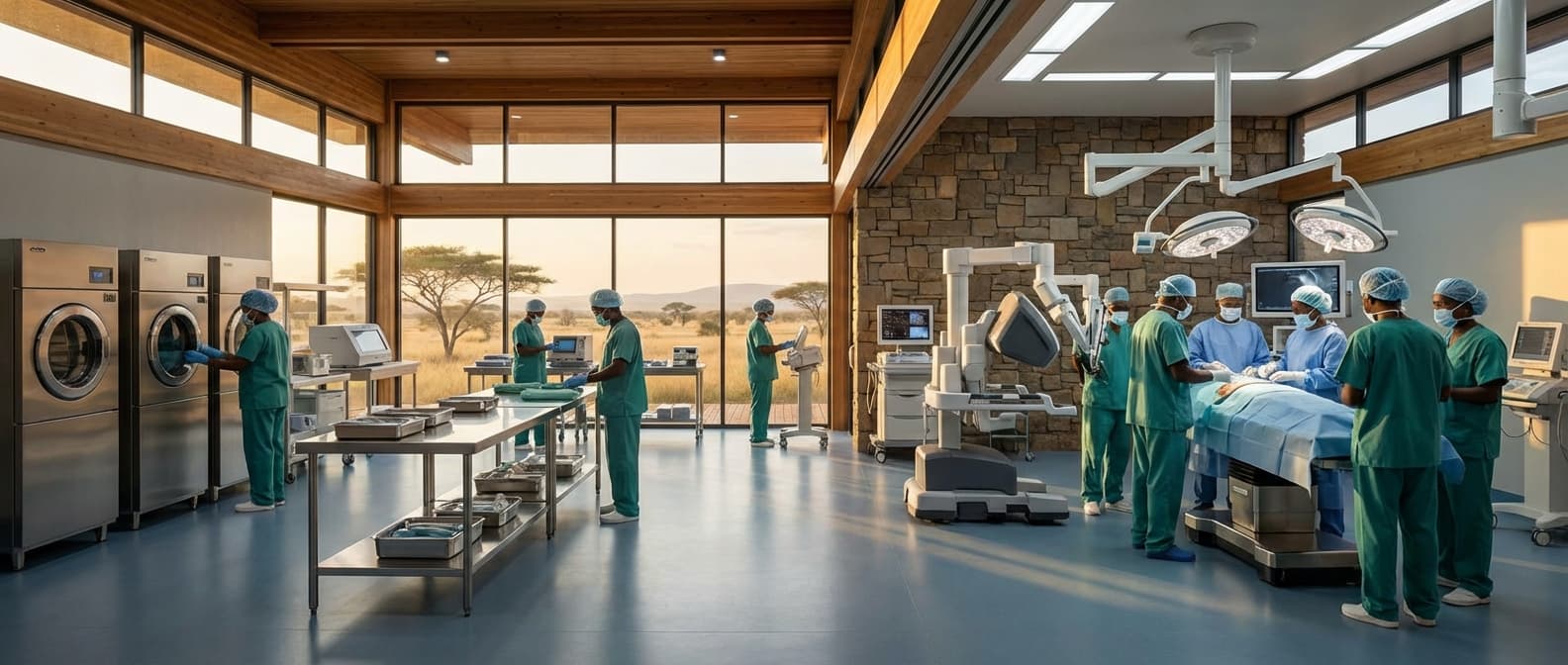
Medical Gas System Design & Installation in Chad
Engineering Excellence & Technical Support
Medical gas pipeline systems: O2, N2O, air, vacuum High-standard technical execution following OEM protocols and local regulatory frameworks.
Reliable Medical Gas Infrastructure
Designed and installed a robust medical gas system for a new hospital in N'Djamena, ensuring continuous and safe supply of oxygen, medical air, and vacuum, meeting international standards and critical healthcare needs.
Advanced Piped Gas Network Installation
Executed the installation of a state-of-the-art piped medical gas network across a regional health clinic, prioritizing leak detection, material compatibility, and pressure regulation for optimal patient safety and operational efficiency in challenging environments.
Sterile Gas Management & Safety Compliance
Implemented rigorous quality control and sterilization protocols during the installation of medical gas outlets and pipeline systems in multiple healthcare facilities, ensuring compliance with strict safety regulations and preventing cross-contamination.
What Is Medical Gas System Design & Installation In Chad?
Medical Gas System Design & Installation in Chad refers to the comprehensive process of planning, engineering, and physically implementing centralized gas supply networks within healthcare facilities. This service ensures the safe, reliable, and efficient delivery of essential medical gases like oxygen, medical air, nitrous oxide, and vacuum to patient care areas. It encompasses the selection and integration of all necessary components, adhering to international and national standards where applicable, to meet the specific demands of healthcare providers in Chad. The process involves detailed site surveys, flow calculations, pressure drop analyses, pipe sizing, material selection, manifold and control panel configuration, alarm system integration, and rigorous testing and validation to guarantee operational integrity and patient safety.
| Who Needs Medical Gas System Design & Installation in Chad? | Typical Use Cases & Applications | |||||||||
|---|---|---|---|---|---|---|---|---|---|---|
| Hospitals (public and private) | Operating Rooms (anesthesia, ventilation) | Intensive Care Units (ICUs) / Critical Care Units (CCUs) | Emergency Departments | Maternity Wards / Neonatal Intensive Care Units (NICUs) | Respiratory Therapy Departments | Outpatient Clinics with critical care capabilities | Rehabilitation Centers | Research Laboratories requiring medical-grade gases | Field Hospitals and Mobile Medical Units | Veterinary Hospitals (in some contexts, for similar needs) |
| Oxygen therapy for hypoxemia and respiratory distress | Ventilator support for patients with respiratory failure | Nitrous oxide for analgesia and anesthesia | Medical vacuum for suctioning of secretions, bodily fluids, and waste | Nitrogen for surgical power tools (though less common in basic setups) | Gas mixtures for specialized diagnostic procedures | Controlled environments for infant respiratory support |
Key Aspects of Medical Gas System Design & Installation:
- Needs Assessment & Demand Analysis: Evaluating current and future gas requirements based on facility size, specialty services, and patient load.
- System Architecture Design: Conceptualizing the overall layout, including source equipment (cylinders, bulk tanks, compressors, vacuum pumps), piping pathways, distribution manifolds, and terminal outlets.
- Component Specification & Selection: Identifying and specifying high-quality, medical-grade components such as pipes, fittings, valves, regulators, alarms, and patient outlets.
- Piping & Installation: Executing the physical installation of the gas distribution network using appropriate materials (e.g., copper tubing) and welding techniques, ensuring leak-free connections and compliance with safety codes.
- Control & Monitoring Systems: Integrating pressure regulators, flow meters, shut-off valves, and audible/visual alarm systems to ensure continuous supply and immediate notification of system anomalies.
- Purging & Testing: Implementing thorough flushing, pressure, and leak testing procedures to verify system integrity and remove contaminants prior to commissioning.
- Commissioning & Validation: Conducting performance testing, flow rate verification, and alarm functionality checks to ensure the system operates as designed and meets all regulatory requirements.
- Documentation & Training: Providing comprehensive system schematics, operating manuals, and training for facility maintenance personnel on system operation and emergency procedures.
Who Needs Medical Gas System Design & Installation In Chad?
Designing and installing a robust medical gas system is crucial for ensuring the delivery of safe, reliable, and high-quality patient care. In Chad, like many developing nations, the need for such specialized infrastructure is significant across various healthcare settings. These systems are not luxuries but essential components for modern medical facilities, supporting a wide range of life-saving and diagnostic procedures.
| Department | Critical Medical Gas Needs | Examples of Use |
|---|---|---|
| Anesthesia Department | Nitrous Oxide, Medical Air, Oxygen | Induction and maintenance of anesthesia during surgical procedures. |
| Intensive Care Unit (ICU) / Critical Care Unit (CCU) | Oxygen, Medical Air, Vacuum | Mechanical ventilation, respiratory support, suctioning of secretions. |
| Operating Rooms (OR) | Oxygen, Medical Air, Nitrous Oxide, Vacuum | Anesthesia delivery, patient ventilation, surgical suctioning, power for pneumatic surgical tools. |
| Emergency Department (ED) | Oxygen, Medical Air, Vacuum | Resuscitation, oxygen therapy, airway management, suctioning. |
| Respiratory Therapy Department | Oxygen, Medical Air | Nebulizer treatments, mechanical ventilation, non-invasive respiratory support. |
| Neonatal Intensive Care Unit (NICU) | Oxygen (high purity), Medical Air, Nitrous Oxide (sometimes) | Incubator oxygenation, mechanical ventilation for premature infants, pain management. |
| Maternity Ward | Oxygen, Medical Air | Oxygen therapy for mothers during labor or postpartum complications, resuscitation of newborns. |
| Pulmonology Clinics | Oxygen | Long-term oxygen therapy for patients with chronic respiratory diseases. |
| Laboratories (Pathology, Research) | Medical Air, Nitrogen, Carbon Dioxide (specialized) | Incubation, cell culture, microscopy, specialized analytical equipment. |
Target Customers and Departments for Medical Gas System Design & Installation in Chad
- Hospitals (Public and Private): The primary recipients of medical gas systems, ranging from large national hospitals to smaller district and private healthcare facilities.
- Specialized Clinics: Facilities focusing on specific medical fields that rely heavily on medical gases, such as critical care, surgery, and respiratory therapy.
- Maternity and Neonatal Centers: Essential for providing life support to premature infants and mothers during critical procedures.
- Emergency and Trauma Centers: Rapid response requires immediate access to medical gases for resuscitation and stabilization.
- Research and Educational Institutions: Medical schools and research facilities often require sophisticated gas systems for laboratories and teaching hospitals.
- Remote and Rural Healthcare Posts: While challenging to implement, establishing basic medical gas capabilities in these areas can significantly improve local healthcare outcomes.
Medical Gas System Design & Installation Process In Chad
Designing and installing a medical gas system in Chad involves a structured workflow to ensure compliance with national regulations, international standards, and the specific needs of healthcare facilities. This process typically begins with an initial inquiry and culminates in a fully functional and commissioned system. The workflow is iterative, involving planning, engineering, procurement, construction, and rigorous testing.
| Stage | Key Activities | Deliverables | Responsible Parties | Notes for Chad |
|---|---|---|---|---|
| Client (hospital, clinic, government body) contacts a qualified medical gas system designer/installer. Understanding the facility's current and future medical gas requirements (types of gases, flow rates, number of outlets, pressure requirements). | Initial proposal, scope of work outline, preliminary budget estimate. | Client, Potential Contractor. | Emphasis on understanding local healthcare infrastructure and growth plans. Engaging with local healthcare authorities early is crucial. |
| On-site assessment of the facility. Evaluating existing infrastructure (power, space for plant room, pipe routing possibilities), building structure, potential hazards. Identifying specific challenges and constraints of the location. | Site survey report, feasibility study report, risk assessment. | Contractor's Engineering Team, Client Representatives. | Considerations for climate, accessibility for equipment delivery, and availability of local skilled labor for future maintenance. |
| Developing a high-level design. Selecting appropriate medical gas types (Oxygen, Medical Air, Vacuum, Nitrous Oxide, etc.), determining system capacity, outlining central supply systems (cylinders, bulk tanks, air compressors, vacuum pumps), and defining distribution network layout. | Conceptual drawings, preliminary system layout, major equipment list, preliminary Bill of Quantities (BoQ). | Contractor's Design Engineers, Client. | Alignment with WHO guidelines and relevant national standards for medical gases. Prioritizing reliability and safety. |
| Producing comprehensive design documents. Including detailed piping layouts, pipe sizing, material specifications, valve schedules, outlet locations, alarm systems, gas manifold designs, and plant room layouts. Generating precise CAD drawings and schematics. | Detailed design drawings (P&IDs, isometrics), technical specifications for all components, refined BoQ, construction schedule. | Contractor's Design Engineers, Structural/Electrical Engineers (if needed). | Ensuring all materials and equipment meet international standards (e.g., ISO, NFPA) and are suitable for the Chadian environment. Proper documentation is key for future audits. |
| Submitting design documents to relevant Chadian authorities (Ministry of Health, building safety departments). Obtaining necessary permits and approvals before commencing installation. | Approved design drawings, construction permits. | Contractor's Project Manager, Local Agent/Consultant. | Understanding and navigating local bureaucratic processes. Engaging a local partner familiar with regulatory procedures is highly recommended. |
| Sourcing and purchasing all required components, including piping, fittings, valves, gas sources (compressors, vacuum pumps, tanks), alarms, outlets, and control panels. Ensuring quality and timely delivery. | Procurement plan, purchase orders, delivery schedules, material inspection reports. | Contractor's Procurement Department, Suppliers. | Logistics and customs clearance can be significant challenges. Pre-ordering and secure storage are vital. Preference for suppliers with proven track records in similar regions. |
| Executing the construction phase. Installing piping networks, central supply equipment, control panels, and patient outlets according to the approved design. Adhering to safety protocols and quality control measures throughout the installation. | Installed piping, central supply equipment, control systems, safety signage. | Contractor's Installation Team, Site Supervisors, Technicians. | Strict adherence to welding procedures for medical gas lines. Implementing rigorous quality checks at each installation stage. Ensuring proper training for local installation staff if involved. |
| Conducting comprehensive tests. Including pressure testing, leak testing, purity testing of gases, flow rate verification, and alarm system functionality checks. Validating that the system meets design specifications and operational requirements. | Test reports, commissioning certificates, validation reports, as-built drawings. | Contractor's Commissioning Engineers, Third-Party Inspector (optional but recommended). | This stage is critical for safety and efficacy. Independent verification is highly advisable. Ensuring gas purity meets medical standards. |
| Providing comprehensive training to facility staff (nurses, technicians, engineers) on the operation, maintenance, and emergency procedures for the medical gas system. Officially handing over the completed and commissioned system to the client. | Training materials, user manuals, O&M manuals, signed handover documentation. | Contractor's Training Specialist, Client's Facility Management Team. | Tailoring training to the skill levels of local personnel. Providing documentation in accessible formats. |
| Offering ongoing support, including routine maintenance, emergency repairs, and spare parts supply. Establishing a service contract to ensure the long-term reliability and safety of the system. | Maintenance schedules, service agreements, readily available spare parts. | Contractor's Service Department, Client's Maintenance Team. | Developing a sustainable maintenance plan. Identifying local partners for ongoing support if the contractor is not permanently based in Chad. |
Medical Gas System Design & Installation Process in Chad: Workflow Stages
- Inquiry & Needs Assessment
- Site Survey & Feasibility Study
- Conceptual Design & System Specification
- Detailed Engineering Design
- Regulatory Approvals & Permits
- Procurement of Materials & Equipment
- System Installation & Construction
- Testing, Commissioning & Validation
- Training & Handover
- Post-Installation Support & Maintenance
Medical Gas System Design & Installation Cost In Chad
Designing and installing a medical gas system in Chad involves a complex interplay of factors that influence the overall cost. These systems are critical for patient care, providing essential gases like oxygen, medical air, and vacuum to healthcare facilities. The pricing is highly variable, depending on the project's scope, the specific technologies employed, the materials used, and the labor involved. Understanding these pricing drivers is crucial for accurate budgeting and successful project implementation within the Chadian context.
| Item/Service | Estimated Cost Range (XAF - Chadian Franc) | Notes |
|---|---|---|
| Medical Gas Piping Installation (per meter) | 15,000 - 40,000 XAF | Varies based on gas type, material (copper vs. stainless steel), and complexity of routing. |
| Medical Gas Outlets (per unit) | 30,000 - 75,000 XAF | Includes outlet station, rough-in box, and connection. Prices vary by gas type and manufacturer. |
| Oxygen Generator (On-site, per facility) | 5,000,000 - 20,000,000+ XAF | Significant upfront investment. Capacity and technology are key drivers. For smaller clinics, simpler systems might be less. |
| Medical Air Compressor System | 3,000,000 - 10,000,000 XAF | Depends on capacity, redundancy, and purification levels. |
| Vacuum Pump System | 2,000,000 - 8,000,000 XAF | Capacity and reliability are critical factors. |
| Bulk Medical Gas Storage Tank (e.g., Oxygen) | 8,000,000 - 30,000,000+ XAF | Size, pressure rating, and supplier logistics influence cost. Includes installation. |
| Cylinder Manifold System (Automatic Changeover) | 1,500,000 - 5,000,000 XAF | For facilities using cylinders as primary or backup supply. |
| Alarm System (Pressure/Flow Monitoring) | 500,000 - 2,000,000 XAF | Depending on the number of zones and sophistication. |
| Design & Engineering Fees | 5% - 15% of Total Project Cost | Professional services for system layout, calculations, and specifications. |
| Installation Labor (Skilled Technician) | 25,000 - 60,000 XAF per day | Can fluctuate based on experience, demand, and location. |
| Testing & Commissioning | 500,000 - 2,500,000 XAF | Essential for ensuring system integrity and compliance. |
| Project Management | 3% - 10% of Total Project Cost | Oversight and coordination of all project phases. |
Key Pricing Factors for Medical Gas System Design & Installation in Chad
- Scope and Size of the Facility: The number of beds, operating rooms, ICU units, and other specialized areas directly impact the complexity and extent of the medical gas distribution network. Larger facilities require more piping, outlets, and ancillary equipment.
- Types of Gases Required: Different medical gases have varying storage and distribution requirements. The more gases needed (e.g., oxygen, medical air, nitrous oxide, vacuum, specialized gases), the more intricate the system and potentially higher the cost.
- Source of Medical Gases: Whether gases are sourced from cylinders, bulk liquid storage tanks, or on-site generation systems (e.g., oxygen concentrators) significantly affects initial investment and ongoing operational costs.
- System Design Complexity: Advanced features like dual-source systems for continuous supply, alarm systems for pressure and flow monitoring, and sophisticated control panels add to the complexity and cost.
- Material Quality and Specifications: The grade of materials used for piping (e.g., copper, stainless steel), fittings, valves, and outlets must meet stringent medical gas standards (e.g., NFPA 99, ISO 7396). Higher quality materials, while more expensive upfront, ensure safety and longevity.
- Installation Labor Costs: The availability of skilled technicians experienced in medical gas system installation in Chad, their wages, and the duration of the installation project are significant cost components.
- Equipment and Ancillary Components: This includes regulators, flowmeters, shut-off valves, alarm panels, manifolds, vacuum pumps, compressors, and purifiers. The number and specifications of these components will influence the overall price.
- Location and Accessibility: The remoteness of the healthcare facility within Chad can impact transportation costs for materials and personnel, as well as the logistics of the installation process.
- Regulatory Compliance and Certification: Ensuring the system meets all relevant national and international standards, and obtaining necessary certifications, may involve additional costs for inspections and testing.
- Project Management and Engineering Fees: The cost of designing the system, overseeing the installation, and managing the project contributes to the overall expense.
- Contingency and unforeseen circumstances: It's prudent to include a contingency for unexpected issues that may arise during design or installation.
Affordable Medical Gas System Design & Installation Options
Designing and installing a medical gas system is a critical undertaking for any healthcare facility. While ensuring compliance with stringent safety standards, healthcare providers also seek cost-effective solutions. This document explores affordable medical gas system design and installation options, focusing on value bundles and strategic cost-saving measures. By understanding these approaches, facilities can achieve both operational excellence and financial efficiency.
| Cost-Saving Strategy | Description | Potential Benefits |
|---|---|---|
| Value Bundles (Design & Install) | Engaging a single vendor for both the design and installation phases often leads to better coordination, reduced communication overhead, and potential for package discounts. | Streamlined project management, predictable costs, integrated responsibility, potential for bulk material discounts. |
| Standardized System Components | Utilizing standard, readily available components instead of highly specialized or custom-made parts can significantly reduce material and labor costs. | Lower procurement costs, faster availability of parts, simplified maintenance and repair. |
| Optimized Piping Layout | Careful planning of piping routes to minimize length, bends, and complexity can reduce material usage and installation time. | Reduced material costs (piping, supports), faster installation, improved gas flow efficiency, less material waste. |
| Modular or Prefabricated Systems | Where applicable, utilizing prefabricated medical gas outlets or manifold systems can speed up on-site installation and improve quality control. | Reduced on-site labor, faster project completion, consistent quality, potentially lower overall installation costs. |
| Energy-Efficient Equipment | Investing in energy-efficient medical air compressors and vacuum pumps can lead to significant long-term operational cost savings. | Lower energy bills, reduced environmental impact, potentially longer equipment lifespan. |
| Strategic Sourcing of Medical Gases | Negotiating favorable contracts with medical gas suppliers and exploring bulk purchasing options can reduce ongoing operational expenses. | Lower gas procurement costs, predictable supply, potential for volume discounts. |
| Preventive Maintenance Programs | Implementing a robust preventive maintenance schedule for the medical gas system can identify and address minor issues before they become major, costly repairs. | Reduced emergency repair costs, extended equipment lifespan, minimized system downtime, improved patient safety. |
Key Considerations for Affordable Medical Gas System Design & Installation
- Understanding Facility Needs: Accurately assessing the required medical gases (oxygen, medical air, vacuum, nitrous oxide, etc.) and their flow rates prevents over-specification and unnecessary costs.
- Scalability and Future-Proofing: Designing for future expansion or changes in service needs can prevent costly retrofits down the line.
- Material Selection: Balancing durability, performance, and cost of materials for piping, valves, and outlets is crucial.
- Regulatory Compliance: Prioritizing compliance from the outset avoids costly rework and penalties.
- Technology Integration: Exploring smart monitoring and control systems can optimize gas usage and identify potential issues early.
- Phased Installation: For larger projects or facilities with ongoing operations, a phased installation can spread costs and minimize disruption.
Verified Providers In Chad
Navigating healthcare in any country can be complex, and Chad is no exception. Ensuring you are accessing services from verified and reputable providers is paramount for your well-being. This is where Franance Health's rigorous credentialing process and commitment to quality assurance become invaluable. By understanding what makes Franance Health a trusted partner, you can make informed decisions about your healthcare journey in Chad.
| Franance Health Credentialing Components | Why it Represents the Best Choice |
|---|---|
| Rigorous Due Diligence | Franance Health conducts in-depth background checks on all healthcare entities and professionals, ensuring they meet stringent national and international standards. This minimizes the risk of encountering unqualified or fraudulent practitioners. |
| Quality Assurance Protocols | Our process includes verifying adherence to best practices in patient care, infection control, and medical ethics. This translates to safer and more effective treatments for patients. |
| Continuous Monitoring and Evaluation | Verification is not a one-time event. Franance Health maintains ongoing relationships with providers, conducting periodic reviews to ensure sustained quality and compliance. This provides long-term assurance. |
| Transparency and Accessibility | Franance Health makes it easier for you to find and access verified providers. Our platform offers clear information about their credentials and services, empowering you to make confident choices. |
| Focus on Patient Safety and Experience | Ultimately, our verification process is designed with your well-being as the top priority. By partnering with Franance Health, you are choosing a pathway to healthcare that prioritizes safety, competence, and a positive patient experience in Chad. |
What are Verified Providers in Chad?
- Verified providers in Chad are healthcare facilities and individual practitioners who have undergone a thorough vetting process to ensure they meet established standards of quality, safety, and ethical practice.
- This verification typically involves checks on licenses, accreditations, qualifications of medical staff, adherence to hygiene protocols, and the availability of essential medical equipment.
- Verified providers are committed to transparency and often undergo regular audits and evaluations to maintain their status.
- For individuals seeking healthcare, choosing a verified provider offers a significant degree of confidence in the services received, reducing risks and ensuring a higher standard of care.
Scope Of Work For Medical Gas System Design & Installation
This Scope of Work (SOW) outlines the requirements for the design and installation of a comprehensive medical gas system. The project encompasses all phases from conceptual design through final commissioning and handover. This document details the technical deliverables expected from the contractor and references standard specifications to ensure compliance with industry best practices and regulatory requirements. The medical gas system will serve [Specify Facility Type, e.g., Hospital, Clinic] and will include provisions for [List key gases, e.g., Oxygen, Medical Air, Vacuum, Nitrous Oxide, etc.].
| Deliverable | Description | Reference Standard/Specification |
|---|---|---|
| Design Basis Report (DBR) | Detailed documentation outlining design intent, system philosophy, performance criteria, and assumptions. | NFPA 99, Healthcare Facilities Code; Local Building Codes |
| Schematic Design Drawings | Preliminary drawings illustrating the overall layout, major components, and flow of medical gases. | NFPA 99, Healthcare Facilities Code |
| Detailed Design Drawings | Comprehensive construction-level drawings including piping layouts, equipment locations, shut-off valves, alarm systems, and outlets. | NFPA 99, Healthcare Facilities Code; ASSE Series Standards (e.g., ASSE 6000) |
| Equipment Submittals | Detailed specifications and data sheets for all major equipment, including compressors, vacuum pumps, manifolds, regulators, and alarms. | Manufacturer's Specifications; UL Standards; CSA Standards |
| Piping and Material Specifications | Detailed specifications for all piping materials, fittings, valves, and welding procedures. | NFPA 99, Healthcare Facilities Code; ASTM Standards (e.g., ASTM B88 for copper tubing) |
| Installation Manuals | Manufacturer-provided installation guidelines for all equipment. | Manufacturer's Instructions |
| Pressure Testing Reports | Documentation of all pressure testing performed on the medical gas piping system. | NFPA 99, Healthcare Facilities Code |
| Purity Testing Reports | Analysis of the purity of medical gases after installation and commissioning. | NFPA 99, Healthcare Facilities Code; USP (United States Pharmacopeia) Standards |
| Alarm System Calibration Reports | Certification of the proper functioning and calibration of all system alarms. | NFPA 99, Healthcare Facilities Code |
| As-Built Drawings | Updated drawings reflecting the exact installed configuration of the medical gas system. | NFPA 99, Healthcare Facilities Code |
| Operations and Maintenance (O&M) Manuals | Comprehensive manuals for the operation, maintenance, and troubleshooting of the entire medical gas system. | Manufacturer's Specifications; NFPA 99, Healthcare Facilities Code |
| Training Materials and Records | Documentation and records of training provided to facility staff on system operation and maintenance. | NFPA 99, Healthcare Facilities Code |
| Certificate of Completion | Formal documentation verifying that the system has been installed, tested, and commissioned according to the approved design and applicable standards. | NFPA 99, Healthcare Facilities Code; Local Regulatory Authority Approval |
Key Project Stages
- Design and Engineering
- Procurement of Materials and Equipment
- System Installation
- Testing and Commissioning
- Training and Documentation
- Post-Installation Support
Service Level Agreement For Medical Gas System Design & Installation
This Service Level Agreement (SLA) outlines the expected response times and uptime guarantees for the design and installation services of medical gas systems provided by [Your Company Name] (hereinafter referred to as 'Provider') to [Client Name] (hereinafter referred to as 'Client'). This SLA is an addendum to the Master Service Agreement between the parties, dated [Date].
| Service Component | Response Time Guarantee | Uptime Guarantee (Post-Installation) |
|---|---|---|
| Initial Design Consultation & Proposal Generation | Within 2 business days of receiving a formal request. | N/A |
| Submission of Preliminary Design Documents | Within 5 business days after the initial design consultation. | N/A |
| Response to Design Clarification Requests during Installation Phase | Within 4 business hours. | N/A |
| On-site Installation Team Availability (scheduled) | As per agreed project timeline. Provider will notify Client of any unavoidable delays within 24 hours. | N/A |
| Post-Installation System Uptime | N/A | 99.9% during operational hours (defined as [e.g., 24/7, Mon-Fri 8am-6pm]) under normal operating conditions and proper maintenance by the Client. |
| Emergency Support (critical system failure post-installation) | Within 2 business hours for remote diagnosis, 4 business hours for on-site dispatch if required. | Covered under the 99.9% uptime guarantee. |
Scope of Services Covered
- Medical gas system design, including but not limited to, pipeline design, manifold selection, and distribution network planning.
- Medical gas system installation, encompassing the physical setup of all components and infrastructure.
- System commissioning and testing.
- Documentation and handover of the completed medical gas system.
Frequently Asked Questions

Ready when you are
Let's scope your Medical Gas System Design & Installation in Chad project in Chad.

Scaling healthcare logistics and technical systems across the entire continent.