
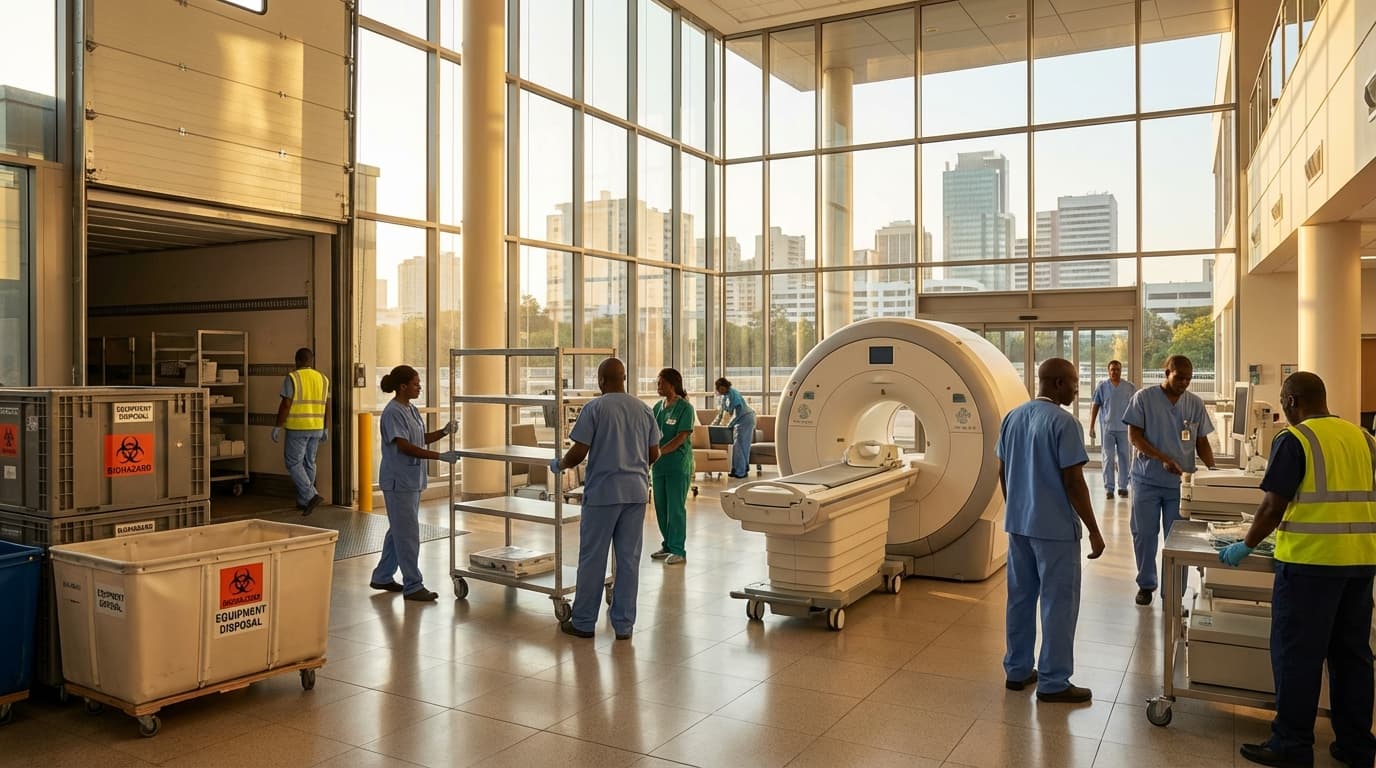
Decommissioning Service for Medical Devices in Central African Republic
Engineering Excellence & Technical Support
Decommissioning Service for Medical Devices High-standard technical execution following OEM protocols and local regulatory frameworks.
Compliance with International Standards
Ensures complete adherence to global medical device disposal regulations (e.g., WHO, IMDRF guidelines), safeguarding against environmental contamination and protecting public health in the Central African Republic.
Secure Data Destruction
Implements multi-layered, certified data sanitization protocols for medical devices containing sensitive patient information, preventing unauthorized access and upholding patient privacy in accordance with local and international data protection laws.
Environmentally Responsible Disposal
Utilizes advanced, eco-friendly decommissioning techniques that prioritize material recovery and safe disposal of hazardous components, minimizing environmental impact and promoting sustainable practices within the Central African Republic.
What Is Decommissioning Service For Medical Devices In Central African Republic?
Decommissioning Service for Medical Devices in the Central African Republic (CAR) refers to the systematic and documented process of safely and environmentally responsibly removing a medical device from active clinical use and disposal. This process ensures that the device's functionality is permanently rendered inoperable, its data is securely erased, and its physical components are managed according to relevant regulations to prevent unauthorized reuse, data breaches, or environmental contamination. The service is crucial for maintaining patient safety, data privacy, regulatory compliance, and responsible asset management within the healthcare infrastructure of the CAR.
| Who Needs Decommissioning Service? | Typical Use Cases | |||||
|---|---|---|---|---|---|---|
| Healthcare Facilities: Public and private hospitals, clinics, diagnostic centers, and laboratories operating in the CAR. | Medical Device Manufacturers/Distributors: When end-of-life products are returned or require recall and safe disposal. | Government Health Ministries/Agencies: For managing national medical device inventories and ensuring public health standards. | Non-Governmental Organizations (NGOs) and Humanitarian Organizations: Involved in healthcare provision and equipment management in the CAR. | Research Institutions: Decommissioning of specialized medical research equipment. | ||
| End-of-Life Equipment: Devices that have reached their operational lifespan and are no longer safe or effective for clinical use. | Obsolete Technology: Devices that have been superseded by newer, more advanced models and lack adequate support or spare parts. | Malfunctioning or Damaged Devices: Equipment that cannot be economically repaired or poses a safety risk. | Equipment Upgrades: When facilities replace existing devices with newer versions. | Regulatory Mandates: Compliance with evolving national or international regulations for medical device disposal. | Data Security Concerns: Devices containing sensitive patient data that must be securely erased before disposal. | Space Optimization: Freeing up valuable space in healthcare facilities by removing unused or outdated equipment. |
Key Components of Medical Device Decommissioning Service:
- Decommissioning Planning: Developing a comprehensive plan that outlines the steps, responsibilities, timelines, and disposal methods for specific medical devices.
- Data Sanitization/Destruction: Implementing secure methods to erase or physically destroy any patient identifiable information (PII) or electronic health records (EHR) stored on the device, adhering to data privacy standards.
- Functional Inactivation: Permanently disabling the device's operational capabilities to prevent its inadvertent or intentional reactivation and use, especially if it's outdated, malfunctioning, or replaced.
- Hazardous Material Management: Identifying and safely removing any hazardous materials (e.g., mercury, radioactive isotopes, biological contaminants) present in the device, in accordance with environmental regulations.
- Environmental Disposal: Ensuring that the device and its components are disposed of through approved channels, prioritizing recycling, refurbishment (where appropriate and ethical), or secure destruction to minimize environmental impact.
- Documentation and Record Keeping: Maintaining detailed records of the entire decommissioning process, including the device's serial number, decommissioning date, methods used, and final disposal location, for audit and compliance purposes.
- Regulatory Compliance: Adhering to national and international regulations governing medical device disposal, data privacy, and environmental protection applicable within the CAR.
Who Needs Decommissioning Service For Medical Devices In Central African Republic?
Decommissioning services for medical devices in the Central African Republic are essential for ensuring proper disposal, data security, and environmental compliance. These services are crucial for a range of organizations that utilize medical equipment throughout its lifecycle. The primary need arises when medical devices reach the end of their operational life, are replaced by newer technology, or are no longer needed due to changes in clinical practice or facility closures. This process involves not only the physical dismantling and disposal of the equipment but also the secure erasure of any sensitive patient data, adhering to national and international regulations to prevent data breaches and minimize environmental impact.
| Customer Type | Key Departments Requiring Service | Reasons for Decommissioning |
|---|---|---|
| Hospitals (Public and Private) | Biomedical Engineering/Biomedical Department, IT Department, Procurement Department, Administration, Infection Control | Equipment obsolescence, technological upgrades, relocation, facility closure, end-of-contract, irreparable damage, data security requirements. |
| Clinics and Health Centers | Clinical Staff, Facility Management, Administration | Similar to hospitals but often on a smaller scale; equipment replacement due to wear and tear or limited usage. |
| Diagnostic Laboratories | Laboratory Management, Biomedical Support, IT Department | Outdated testing equipment, replacement with automated systems, data storage compliance, hazardous material disposal. |
| Research Institutions | Research Leads, Lab Managers, IT Department, Facilities Management | End of research projects, equipment no longer suitable for new research, data integrity and security needs. |
| Government Health Agencies | Procurement, Planning and Statistics, Public Health Departments | Managing national medical equipment inventories, disposal of surplus or condemned equipment, public health initiatives. |
| Non-Governmental Organizations (NGOs) | Program Managers, Logistics, Healthcare Coordinators | Project completion, asset management for donated equipment, compliance with donor requirements for disposal. |
| Medical Equipment Suppliers and Manufacturers | After-Sales Service, Product Management, Environmental Compliance Department | Managing trade-in programs, responsible disposal of returned or end-of-life products, brand reputation management. |
| Military and Defense Medical Facilities | Medical Logistics, Biomedical Engineering, Information Assurance | Equipment upgrades, operational changes, classified data security, compliance with military regulations. |
Target Customers for Medical Device Decommissioning Services in the Central African Republic
- Hospitals (Public and Private)
- Clinics and Health Centers
- Diagnostic Laboratories
- Research Institutions
- Government Health Agencies
- Non-Governmental Organizations (NGOs) involved in healthcare delivery
- Medical Equipment Suppliers and Manufacturers (for end-of-life management programs)
- Military and Defense Medical Facilities
Decommissioning Service For Medical Devices Process In Central African Republic
This document outlines the decommissioning service process for medical devices in the Central African Republic (CAR), from initial inquiry to final execution. The process ensures that medical equipment is retired safely, responsibly, and in compliance with relevant regulations and environmental standards. Given the logistical and infrastructural challenges in the CAR, this process emphasizes clear communication, thorough documentation, and engagement with local stakeholders.
| Stage | Description | Key Activities | Responsible Parties | Potential Challenges in CAR | Mitigation Strategies | ||||||||||||||||||||||||||||||
|---|---|---|---|---|---|---|---|---|---|---|---|---|---|---|---|---|---|---|---|---|---|---|---|---|---|---|---|---|---|---|---|---|---|---|---|
| Inquiry & Initial Assessment | The process begins when a healthcare facility or organization expresses a need to decommission medical devices. An initial assessment determines the scope of work. | Receive inquiry, understand client needs, gather preliminary information on device types, quantities, and location. | Client (Healthcare Facility), Decommissioning Service Provider (DSP) | Limited internet access for initial communication, language barriers. | Utilize phone calls, in-person meetings where possible, employ local translators. | Service Agreement & Planning | Formalize the engagement with a service agreement and develop a detailed plan for the decommissioning project. | Draft and sign service agreement, define scope, timelines, costs, safety protocols, and waste management plan. | DSP, Client | Bureaucratic delays in contract finalization, unclear ownership of assets. | Proactive engagement with facility management, clear legal review of agreement, require proof of ownership. | Site Visit & Inventory Verification | A physical visit to the site is crucial to verify the inventory, assess the condition of devices, and identify any specific requirements. | Conduct site survey, physically inspect and catalog all devices to be decommissioned, confirm location and accessibility. | DSP, Client (Facility Manager/Biomedical Engineer) | Security concerns for site access, poor record-keeping by the facility, remote locations difficult to reach. | Coordinate with facility security, request pre-visit facility records, plan for secure transport and potentially multiple site visits. | Decommissioning Execution | The physical process of safely removing, dismantling, or rendering the medical devices inoperable. | Safe disconnection, dismantling, data sanitization (if applicable), removal of hazardous components. | DSP (Technicians), Client (for access and supervision) | Lack of specialized tools and equipment, risk of damage to surrounding infrastructure, power outages. | Ensure DSP is equipped, train local personnel on safe practices, contingency planning for power interruptions. | Waste Management & Disposal | Responsible handling and disposal of all components, adhering to environmental regulations. | Segregation of waste (hazardous, non-hazardous), transportation to approved disposal sites, proper documentation of disposal. | DSP, Local Waste Management Authority | Limited licensed hazardous waste disposal facilities, improper waste segregation practices, potential for illegal dumping. | Partner with accredited waste management companies, conduct audits of disposal sites, provide training on waste segregation. | Documentation & Certification | Provide comprehensive documentation confirming the successful and compliant decommissioning of the devices. | Issue certificates of decommissioning, provide waste disposal manifests, final project report. | DSP, Client, Regulatory Bodies (if applicable) | Lost or incomplete documentation, difficulty in obtaining official certifications from overwhelmed authorities. | Maintain meticulous records, use secure digital and physical archiving, understand and follow local certification requirements. |
Key Stages of Medical Device Decommissioning in CAR
- Inquiry & Initial Assessment
- Service Agreement & Planning
- Site Visit & Inventory Verification
- Decommissioning Execution
- Waste Management & Disposal
- Documentation & Certification
Decommissioning Service For Medical Devices Cost In Central African Republic
Decommissioning medical devices in the Central African Republic (CAR) involves a complex process that ensures safe and environmentally responsible disposal of obsolete or non-functional equipment. The cost of these services is influenced by several key factors, leading to a range of pricing in the local currency, the Central African CFA franc (XAF).
Key Pricing Factors:
- Device Type and Complexity: The nature of the medical device is a primary cost driver. Simple, non-electronic items will be significantly cheaper to decommission than complex imaging equipment (like X-ray machines or MRI scanners) containing hazardous materials (e.g., mercury, radioactive isotopes, refrigerants) and requiring specialized handling and disposal procedures. The volume and weight of the device also play a role.
- Hazardous Materials Assessment and Disposal: Devices containing hazardous materials require specialized containment, transportation, and disposal methods to comply with environmental regulations and prevent health risks. This significantly increases the cost due to the need for trained personnel, specialized equipment, and licensed disposal facilities.
- Transportation and Logistics: The geographical location of the facility requiring decommissioning within the CAR is crucial. Remoteness, poor road infrastructure, and the need for specialized transport vehicles (especially for larger or hazardous items) will inflate transportation costs.
- Data Destruction and Security: For devices storing patient data (e.g., computers, imaging systems), secure data destruction services are essential. This involves physical destruction or certified data wiping processes, which add to the overall cost.
- Regulatory Compliance and Permitting: Navigating local regulations and obtaining necessary permits for the decommissioning and disposal of medical equipment can incur administrative fees and require specialized expertise, thus impacting pricing.
- Service Provider Expertise and Certifications: Companies with proven track records, specialized certifications, and experienced personnel will generally charge more, reflecting their ability to handle complex decommissioning projects safely and efficiently.
- Volume of Decommissioning: Larger projects involving the decommissioning of multiple devices or an entire facility might benefit from economies of scale, potentially leading to a lower per-unit cost compared to smaller, ad-hoc services.
- Recycling and Resale Value (if applicable): While less common for heavily used or obsolete medical equipment, if certain components can be salvaged for recycling or if the device has any residual value, this might slightly offset the overall decommissioning cost. However, for most decommissioning, the focus is on safe disposal.
| Cost Factor | Impact on Pricing | Typical Range (XAF - Indicative) |
|---|---|---|
| Device Type & Complexity | Higher complexity, more components, and larger size increase costs. | 50,000 - 5,000,000+ (highly variable) |
| Hazardous Materials | Requires specialized handling, transport, and disposal, significantly increasing costs. | Adds 200,000 - 2,000,000+ on top of base cost |
| Transportation & Logistics | Distance, road conditions, and need for specialized vehicles increase costs. | 50,000 - 500,000+ (depending on distance and accessibility) |
| Data Destruction | Secure erasure or physical destruction of data-bearing devices adds to the service. | 50,000 - 250,000 per device |
| Regulatory & Permitting Fees | Administrative costs for compliance and permits. | 30,000 - 150,000 (can vary) |
| Service Provider Expertise | Certified and experienced providers may charge a premium for their capabilities. | Often reflected in the overall service package, not itemized separately. |
| Volume of Decommissioning | Larger projects may offer volume discounts. | Negotiable based on project size. |
Estimated Cost Ranges for Medical Device Decommissioning Services in the Central African Republic (XAF)
- Basic Non-Electronic Equipment (e.g., hospital beds, non-powered furniture): 50,000 - 200,000 XAF per item.
- Small Electronic Devices (e.g., basic diagnostic tools, monitors): 100,000 - 400,000 XAF per item.
- Medium-Sized Electronic Equipment (e.g., older lab equipment, basic patient monitoring systems): 300,000 - 800,000 XAF per item.
- Large or Complex Electronic Equipment (e.g., older imaging systems, large laboratory analyzers): 1,000,000 - 5,000,000+ XAF per item.
- Equipment with Hazardous Materials (e.g., older X-ray machines, CRT monitors containing lead, equipment with refrigerants): Costs can be significantly higher, potentially starting from 500,000 XAF and escalating based on the type and quantity of hazardous materials, often requiring a custom quote.
Affordable Decommissioning Service For Medical Devices Options
Decommissioning medical devices is a critical yet often overlooked aspect of healthcare operations. Ensuring proper data sanitization, environmental compliance, and asset disposition is essential. This document outlines affordable decommissioning service options, focusing on value bundles and cost-saving strategies to help healthcare facilities manage this process efficiently and economically.
| Service Offering | Description | Value Proposition | Cost-Saving Strategy |
|---|---|---|---|
Understanding Medical Device Decommissioning
- {"title":"Why Decommissioning Matters","description":"Proper decommissioning protects patient data privacy, adheres to environmental regulations, and optimizes asset lifecycle management. Improper decommissioning can lead to data breaches, legal penalties, and environmental hazards."}
- {"title":"Key Decommissioning Stages","description":"Includes secure data erasure, physical destruction of sensitive components, cleaning and decontamination, environmental disposal of hazardous materials, and asset tracking and reporting."}
- {"title":"Challenges in Decommissioning","description":"High costs, complexity of regulations, lack of internal expertise, and the need for specialized equipment are common hurdles."}
Verified Providers In Central African Republic
Ensuring access to quality healthcare is paramount, especially in regions like the Central African Republic where reliable medical services can be challenging to find. Franance Health has emerged as a leading provider, distinguished by its commitment to verified credentials and exceptional patient care. This document outlines why Franance Health stands out as the best choice for healthcare needs in the Central African Republic.
| Credential Type | Verification Standard | Franance Health's Approach | Why it Matters |
|---|---|---|---|
| Medical Licenses and Certifications | National and International Standards | Thorough background checks, verification against official registries, and ongoing monitoring of license status. | Ensures practitioners are legally qualified and meet recognized professional benchmarks, guaranteeing a baseline of competence. |
| Specialist Qualifications | Accreditation Boards and Professional Bodies | Independent verification of specialist training, fellowships, and board certifications through reputable institutions. | Confirms that specialists possess the advanced knowledge and skills required for complex medical cases. |
| Experience and Track Record | Reputational Reviews and Case Studies | Evaluation of past performance, peer reviews, and successful treatment outcomes through anonymized case study analysis. | Provides confidence in the provider's practical application of skills and ability to deliver effective care. |
| Ethical Conduct and Professionalism | Code of Conduct and Disciplinary Records | Strict adherence to a comprehensive code of ethics, including background checks for any disciplinary actions or malpractice claims. | Guarantees a safe and trustworthy healthcare environment, prioritizing patient well-being and confidentiality. |
Key Benefits of Choosing Franance Health:
- Rigorous Vetting Process for Medical Professionals
- Comprehensive Range of Medical Services
- State-of-the-Art Facilities and Equipment
- Patient-Centered Approach to Care
- Commitment to Ethical Practices and Transparency
Scope Of Work For Decommissioning Service For Medical Devices
This Scope of Work (SOW) outlines the requirements for the decommissioning of medical devices. The service encompasses the safe, secure, and compliant removal of specified medical equipment from the client's premises. This includes data sanitization, physical removal, and proper disposal or transfer of devices, adhering to all relevant regulations and standards.
| Technical Deliverable | Description | Standard Specification/Requirement | |
|---|---|---|---|
| Decommissioning Plan | A detailed document outlining the procedures, timelines, resources, and safety protocols for the decommissioning of each device. | Includes device inventory, risk assessment, disposal strategy, chain of custody, and compliance documentation. | |
| Data Sanitization Certificate | Proof that all sensitive data has been irretrievably removed from device storage. | Adherence to standards like NIST SP 800-88 Rev. 1 (Guidelines for Media Sanitization) or equivalent. | Certificates must specify the method used (e.g., overwriting, degaussing, physical destruction) and the specific devices affected. |
| Physical Removal Report | Documentation of the safe and efficient physical removal of devices from their installed locations. | Includes confirmation of device integrity (if applicable for transfer), identification of any damage to the client's infrastructure, and photographic evidence of removal. | |
| Waste Manifest/Disposal Certificate | Proof of proper and environmentally responsible disposal or transfer of devices and their components. | Compliance with local, national, and international regulations for medical waste and electronic waste (e-waste). | Certificates must specify the disposal facility, method of disposal, and date of disposal. |
| Chain of Custody Records | A continuous record of the location and handling of each device from initial decommissioning to final disposal or transfer. | Includes timestamps, personnel involved, and location tracking for all stages. | Ensures accountability and prevents unauthorized access or diversion. |
| Asbestos/Hazardous Material Survey Report (if applicable) | Identification and documentation of any hazardous materials within or attached to the medical devices. | Compliance with relevant occupational health and safety regulations for hazardous material handling and disposal. | |
| Final Project Report | A comprehensive summary of the entire decommissioning project, including all deliverables and compliance documentation. | Includes an executive summary, overview of work performed, exceptions, and confirmation of project completion. |
Key Stages of Decommissioning Service
- Site Survey and Assessment
- Planning and Scheduling
- Data Sanitization and Destruction
- Physical Disassembly and Removal
- Transportation and Logistics
- Waste Management and Disposal/Transfer
- Documentation and Reporting
Service Level Agreement For Decommissioning Service For Medical Devices
This Service Level Agreement (SLA) outlines the response times and uptime guarantees for the Decommissioning Service for Medical Devices. This service ensures that medical devices are securely and compliantly decommissioned, including data sanitization and physical destruction where applicable, to meet regulatory requirements and protect sensitive patient information. The provider commits to the following performance standards.
| Service Component | Response Time (Business Hours) | Resolution Time (Business Hours) | Uptime Guarantee |
|---|---|---|---|
| Initial Response to Critical Incident | 1 hour | N/A (Focus on initial response) | N/A |
| Resolution of Critical Incident | N/A | 4 business hours | N/A |
| Initial Response to Non-Critical Incident/Request | 4 business hours | N/A (Focus on initial response) | N/A |
| Resolution of Non-Critical Incident/Request | N/A | 1 business day | N/A |
| Scheduled Maintenance Notification | N/A | N/A | N/A |
| Decommissioning Scheduling and Confirmation | 1 business day | N/A (Process dependent) | N/A |
| Data Sanitization Verification | N/A | 1 business day (post-service completion) | N/A |
| Service Availability | N/A | N/A | 99.5% (excluding Scheduled Downtime) |
Key Definitions
- Decommissioning Service: The complete process of removing a medical device from service, including data erasure, physical destruction (if required), and documentation.
- Critical Incident: An event that renders the Decommissioning Service completely unavailable or significantly impairs its functionality, preventing scheduled decommissioning activities from proceeding.
- Scheduled Downtime: Planned periods for maintenance, upgrades, or other necessary service interruptions, communicated in advance to the client.
- Response Time: The maximum time allowed for the provider to acknowledge and begin addressing a reported incident or request.
- Resolution Time: The maximum time allowed to resolve a reported incident and restore the Decommissioning Service to normal operation.
- Uptime Guarantee: The percentage of time the Decommissioning Service is available and operational, excluding Scheduled Downtime.
Frequently Asked Questions

Ready when you are
Let's scope your Decommissioning Service for Medical Devices in Central African Republic project in Central African Republic.

Scaling healthcare logistics and technical systems across the entire continent.