
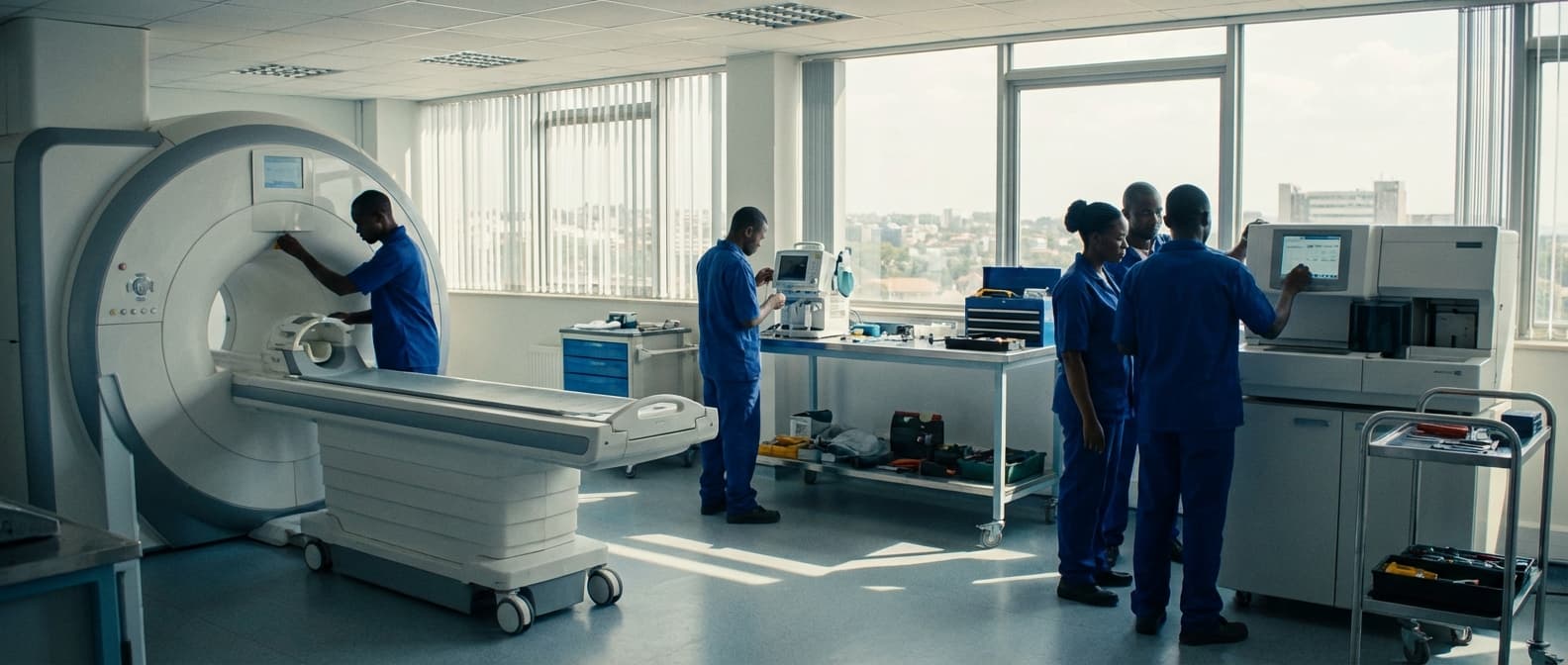
Uptime, Downtime & Root-Cause Analysis Reporting Service in Central African Republic
Engineering Excellence & Technical Support
Uptime, Downtime & Root-Cause Analysis Reporting Service High-standard technical execution following OEM protocols and local regulatory frameworks.
Proactive Uptime Monitoring
Leveraging advanced SNMP, ICMP, and API polling, our service continuously monitors critical infrastructure in the Central African Republic for real-time uptime status. Receive immediate alerts on any service degradation or outages, ensuring minimal disruption.
Rapid Downtime Detection & Notification
Our system is designed for sub-minute detection of network and application downtime across the CAR. Automated notifications are dispatched to designated personnel via SMS and email, facilitating swift response and mitigation efforts.
Comprehensive Root-Cause Analysis
Go beyond simply knowing there's an outage. Our reporting service provides in-depth root-cause analysis by correlating network traffic logs, system event data, and performance metrics, empowering your IT teams to resolve issues efficiently and prevent recurrence in the CAR.
What Is Uptime, Downtime & Root-cause Analysis Reporting Service In Central African Republic?
Uptime, Downtime, and Root-Cause Analysis (RCA) Reporting Service in the Central African Republic (CAR) refers to a specialized offering designed to monitor, document, and investigate the availability and performance of critical IT systems, infrastructure, and services within the CAR. This service aims to provide organizations with actionable insights into service disruptions, identifying the underlying causes to prevent recurrence and improve overall operational resilience. It encompasses the systematic tracking of periods when a system or service is operational (uptime) and when it is unavailable or malfunctioning (downtime), followed by a rigorous analysis to determine the originating factors of any failures.
Definition of the Service:
This service involves:
- Uptime Monitoring: Continuous or scheduled observation of IT assets (servers, networks, applications, cloud services, power infrastructure, etc.) to confirm their operational status and availability.
- Downtime Detection and Measurement: Proactive identification of service interruptions, accurate quantification of their duration (start and end times), and categorization based on severity and impact.
- Incident Logging and Documentation: Comprehensive recording of all detected downtime events, including timestamps, affected systems, error messages, and initial impact assessments.
- Root-Cause Analysis (RCA): A structured investigative process employing methodologies such as the '5 Whys', Ishikawa diagrams (fishbone diagrams), or fault tree analysis to pinpoint the fundamental reasons for downtime, moving beyond symptoms to identify systemic issues.
- Reporting and Recommendations: Generation of detailed reports summarizing uptime/downtime metrics, presenting RCA findings, and providing concrete recommendations for remediation, prevention, and process improvement.
Who Needs This Service:
Any entity operating in the Central African Republic that relies on stable and continuous IT operations and infrastructure requires this service. This includes, but is not limited to:
- Government Agencies: Ministries, public administration offices, and critical infrastructure operators (e.g., power, water, telecommunications).
- Telecommunications Providers: Mobile network operators, internet service providers, and satellite communication companies.
- Financial Institutions: Banks, microfinance institutions, and payment processors.
- Healthcare Providers: Hospitals, clinics, and public health organizations.
- International Organizations & NGOs: Aid agencies, humanitarian organizations, and development partners with significant operational footprints.
- Energy and Resource Companies: Mining, oil, and gas operations, as well as electricity generation and distribution companies.
- Logistics and Transportation Companies: Businesses managing supply chains and movement of goods.
- Any organization with mission-critical IT systems: Businesses that experience significant financial or operational losses due to IT downtime.
| Metric | Definition | Significance in CAR Context |
|---|---|---|
| Uptime | The percentage of time a system, service, or network is operational and accessible to users. | Crucial for maintaining continuity of essential services, economic activity, and public trust in infrastructure. Low uptime can lead to significant disruptions and financial losses. |
| Downtime | The period during which a system, service, or network is unavailable or not functioning as expected. | Directly impacts service delivery, productivity, and reputation. In CAR, where infrastructure can be fragile, understanding downtime patterns is vital for resilience planning. |
| Mean Time Between Failures (MTBF) | The average time a system operates between one failure and the next. | Indicates the reliability of components and systems. High MTBF suggests robust infrastructure, essential for critical services in a challenging environment. |
| Mean Time To Repair (MTTR) | The average time it takes to repair a system after a failure occurs. | Measures the efficiency of incident response and recovery. Low MTTR is critical for minimizing the impact of downtime in CAR, where logistical and technical resources may be limited. |
| Availability Percentage | Calculated as (Total Time - Downtime) / Total Time * 100. | A key performance indicator for IT services. Achieving high availability percentages is paramount for organizations in CAR to ensure service continuity and meet operational objectives. |
| Root Cause Analysis (RCA) | A systematic problem-solving method used to identify the fundamental causes of incidents or problems. | Essential for moving beyond superficial fixes to address underlying issues in CAR's infrastructure and operational processes, preventing recurrence and improving long-term stability. |
Typical Use Cases for Uptime, Downtime & Root-Cause Analysis Reporting Service in CAR
- Monitoring the availability of national internet backbone infrastructure.
- Ensuring continuous operation of financial transaction processing systems during peak hours.
- Analyzing recurring power outages affecting data center uptime.
- Investigating the cause of service disruptions for mobile phone networks and identifying the technical or logistical factors.
- Tracking the availability of healthcare IT systems for patient record management and telemedicine.
- Assessing the impact of network congestion on inter-branch communication for banking institutions.
- Diagnosing and rectifying intermittent failures in server infrastructure supporting government databases.
- Evaluating the performance and reliability of cloud-based services used by NGOs for field operations.
- Determining the root cause of application downtime for critical government services (e.g., tax collection, identity management).
- Establishing baseline uptime metrics for new infrastructure deployments and identifying early warning signs of potential issues.
Who Needs Uptime, Downtime & Root-cause Analysis Reporting Service In Central African Republic?
In the Central African Republic, where infrastructure development is a key priority and operational efficiency is crucial for economic growth and public service delivery, a robust Uptime, Downtime & Root-Cause Analysis Reporting Service is essential. This service provides critical insights into the performance and reliability of various systems, enabling organizations to proactively identify and resolve issues, minimize disruptions, and optimize resource allocation. Such a service is vital for ensuring the continuous availability of essential services and supporting the nation's development objectives.
| Target Customer Type | Key Departments/Functions Benefiting | Specific Needs Addressed |
|---|---|---|
| Government Ministries and Agencies | IT Departments, Infrastructure Management, Public Services Delivery, National Security | Ensuring uninterrupted access to e-government services, managing critical national infrastructure (e.g., communication networks, power grids), improving citizen services, and maintaining operational readiness of security apparatus. |
| Telecommunications Companies | Network Operations Center (NOC), Field Operations, Customer Service, Engineering | Minimizing service outages for mobile and fixed-line services, identifying and resolving network faults quickly, improving network performance and reliability, and reducing customer churn due to downtime. |
| Energy and Utility Providers | Operations Control Center, Maintenance Teams, Customer Service, Planning Department | Ensuring continuous power supply, identifying causes of blackouts and surges, optimizing grid performance, reducing maintenance costs through proactive identification of issues, and improving customer satisfaction. |
| Financial Institutions | IT Operations, Risk Management, Fraud Detection, Branch Operations | Maintaining the availability of banking systems, ATMs, and online transaction platforms, preventing financial losses due to system failures, ensuring regulatory compliance, and safeguarding customer data. |
| Healthcare Providers | IT Departments, Hospital Administration, Medical Equipment Management, Patient Care Services | Ensuring the uptime of critical medical equipment and IT systems (e.g., Electronic Health Records), minimizing disruptions to patient care, and guaranteeing the availability of diagnostic and treatment services. |
| Transportation and Logistics Companies | Operations Management, Fleet Management, IT Support, Supply Chain Management | Ensuring the reliability of transportation networks (e.g., air traffic control systems, port operations), optimizing logistics operations, minimizing delays in cargo movement, and enhancing safety. |
| Mining and Extractive Industries | Operations Management, Production Control, IT Infrastructure, Safety and Compliance | Maintaining the uptime of heavy machinery, processing plants, and communication systems in remote locations, ensuring operational continuity, minimizing production losses due to equipment failures, and prioritizing worker safety. |
| International Aid and Development Organizations | Program Management, IT Support, Logistics, Monitoring and Evaluation | Ensuring the reliable operation of their IT infrastructure and communication tools for project delivery, coordinating humanitarian efforts, and monitoring the impact of development programs without service interruptions. |
| Large-Scale Agricultural Enterprises | Farm Operations, Irrigation Systems Management, Processing Plant Operations, IT Departments | Ensuring the continuous operation of irrigation systems, processing equipment, and farm management software to maximize yields and minimize spoilage, especially in seasonal operations. |
| Internet Service Providers (ISPs) | Network Operations Center (NOC), Technical Support, Network Engineering | Maximizing internet service availability, quickly diagnosing and resolving network issues, improving customer experience, and ensuring the reliability of internet connectivity for businesses and individuals. |
Target Customers in the Central African Republic
- Government Ministries and Agencies
- Telecommunications Companies
- Energy and Utility Providers
- Financial Institutions
- Healthcare Providers
- Transportation and Logistics Companies
- Mining and Extractive Industries
- International Aid and Development Organizations
- Large-Scale Agricultural Enterprises
- Internet Service Providers (ISPs)
Uptime, Downtime & Root-cause Analysis Reporting Service Process In Central African Republic
This document outlines the standard operating procedure for the Uptime, Downtime, and Root-Cause Analysis Reporting Service within the Central African Republic. This service is critical for identifying, documenting, and resolving issues that impact system availability and performance. The workflow is designed to be clear, efficient, and to facilitate rapid problem resolution and continuous improvement.
| Phase | Step | Description | Key Stakeholders | Output/Deliverable | Timeline (Estimated) |
|---|---|---|---|---|---|
| Phase 1: Inquiry & Initial Triage | 1.1 Inquiry Received | An inquiry regarding an uptime or downtime event is received via designated channels (e.g., email, ticketing system, phone). | Reporting Unit, Service Desk | Incident Ticket/Report Logged | Immediate |
| 1.2 Initial Assessment & Prioritization | The inquiry is assessed for severity and impact. Based on pre-defined criteria, the incident is prioritized. | Service Desk, Operations Manager | Prioritized Incident Ticket | Within 15 minutes of inquiry | |
| 1.3 Incident Assignment | The incident is assigned to the appropriate technical team or individual for investigation. | Service Desk, Team Leads | Assigned Incident Ticket | Within 30 minutes of inquiry | |
| Phase 2: Data Collection & Analysis | 2.1 Information Gathering | Relevant data is collected from various sources, including system logs, monitoring tools, user reports, and configuration files. | Assigned Technical Team | Collected Raw Data | Variable (depends on complexity) |
| 2.2 Timeline Reconstruction | A precise timeline of events leading up to, during, and after the downtime/issue is constructed. | Assigned Technical Team | Event Timeline | Within 1 hour of assignment | |
| 2.3 Impact Assessment | The extent of the impact is quantified (e.g., number of users affected, business services disrupted, financial loss). | Assigned Technical Team, Business Stakeholders | Impact Report | Within 2 hours of assignment | |
| Phase 3: Root-Cause Identification | 3.1 Hypothesis Generation | Potential causes for the observed downtime or performance degradation are brainstormed. | Assigned Technical Team | List of Hypotheses | Within 3 hours of assignment |
| 3.2 Hypothesis Testing | Each hypothesis is rigorously tested through experiments, further data analysis, or rollback procedures. | Assigned Technical Team | Validated/Invalidated Hypotheses | Variable | |
| 3.3 Root Cause Confirmation | The definitive root cause of the incident is identified and confirmed. | Assigned Technical Team Lead, Subject Matter Experts | Confirmed Root Cause Statement | Within 24 hours of assignment (for critical incidents) | |
| Phase 4: Reporting & Recommendations | 4.1 Draft Report Creation | A comprehensive report is drafted, detailing the incident, impact, timeline, and the identified root cause. | Assigned Technical Team | Draft RCA Report | Within 24 hours of root cause confirmation |
| 4.2 Recommendation Development | Preventative and corrective actions are proposed to address the root cause and prevent recurrence. | Assigned Technical Team, relevant departments | List of Recommendations | Concurrent with report drafting | |
| 4.3 Report Review & Approval | The draft report and recommendations are reviewed and approved by relevant management and stakeholders. | Operations Manager, IT Director, Business Unit Heads | Approved RCA Report | Within 48 hours of draft submission | |
| Phase 5: Remediation & Verification | 5.1 Remediation Plan Execution | The approved recommendations are implemented as a remediation plan. | Assigned Technical Teams, Project Management Office (if applicable) | Completed Remediation Actions | Variable (based on complexity of recommendations) |
| 5.2 Verification of Fix | The effectiveness of the implemented remediation actions is tested and verified to ensure the issue is resolved and will not recur. | Assigned Technical Team, Quality Assurance | Verification Report | Within 7 days of remediation completion | |
| Phase 6: Closure & Knowledge Management | 6.1 Incident Closure | Once the issue is resolved and verified, the incident ticket is formally closed. | Service Desk, Operations Manager | Closed Incident Ticket | Upon successful verification |
| 6.2 Knowledge Base Update | Lessons learned from the incident and the RCA are documented and added to the organizational knowledge base. | Assigned Technical Team, Knowledge Management Team | Updated Knowledge Base Articles | Within 2 days of incident closure | |
| 6.3 Trend Analysis & Continuous Improvement | Regular analysis of RCA reports is conducted to identify recurring issues and drive broader process or system improvements. | Operations Management, IT Leadership | Improvement Initiatives | Ongoing |
Uptime, Downtime & Root-Cause Analysis Reporting Service Process
- Phase 1: Inquiry & Initial Triage
- Phase 2: Data Collection & Analysis
- Phase 3: Root-Cause Identification
- Phase 4: Reporting & Recommendations
- Phase 5: Remediation & Verification
- Phase 6: Closure & Knowledge Management
Uptime, Downtime & Root-cause Analysis Reporting Service Cost In Central African Republic
Providing a comprehensive Uptime, Downtime & Root-Cause Analysis (RCA) Reporting Service in the Central African Republic (CAR) involves a complex interplay of factors that influence cost. These services are crucial for businesses to understand the reliability of their IT infrastructure and identify underlying issues, ultimately minimizing operational disruptions and financial losses. The pricing in CAR is heavily influenced by the local economic landscape, infrastructure challenges, and the specialized nature of the expertise required. Factors such as the complexity of the systems being monitored, the frequency and depth of reporting, the level of customization needed, and the provider's operational overhead significantly impact the final service cost.
| Service Level / Scope | Estimated Monthly Cost (XAF) | Key Features Included |
|---|---|---|
Key Pricing Factors for Uptime, Downtime & RCA Reporting Services in CAR:
- {"title":"Scope and Complexity of Infrastructure:","description":"The number and types of systems (servers, networks, applications, cloud services) requiring monitoring and analysis directly affect the effort involved. Larger and more intricate infrastructures necessitate more sophisticated tools and deeper expertise."}
- {"title":"Data Volume and Granularity:","description":"The sheer volume of data generated by IT systems and the level of detail required in reports (e.g., real-time vs. daily summaries, specific error codes) influence processing and storage costs."}
- {"title":"Reporting Frequency and Customization:","description":"The demand for daily, weekly, monthly, or ad-hoc reports, along with the need for custom metrics, dashboards, and executive summaries, will alter pricing. Highly tailored reports require more analyst time."}
- {"title":"Root-Cause Analysis Depth and Expertise:","description":"The complexity of identifying root causes. Simple incidents might require basic log analysis, while complex, multi-layered issues demand highly skilled engineers with specialized knowledge, increasing service costs."}
- {"title":"Technology and Tools Used:","description":"The cost of sophisticated monitoring software, analytics platforms, and AI-driven RCA tools, if employed by the provider, will be factored into the service price. Licensing fees and maintenance are significant."}
- {"title":"Provider's Overhead and Operational Costs:","description":"This includes staff salaries (often higher for specialized IT roles), office space, utilities, internet connectivity (which can be expensive and unreliable in CAR), security, and administrative expenses."}
- {"title":"Service Level Agreements (SLAs):","description":"Guaranteed response times, resolution times, and uptime targets often come with premium pricing due to the commitment and resources required to meet them."}
- {"title":"Geographic Location and Logistics:","description":"While remote services are common, on-site support for initial setup, complex troubleshooting, or specialized training in CAR might incur additional travel and logistical costs."}
- {"title":"Market Demand and Competition:","description":"The availability of local providers and the overall demand for such services can influence pricing. In a market with limited specialized providers, costs may be higher."}
- {"title":"Currency Fluctuations:","description":"The Central African CFA franc (XAF) is pegged to the Euro. Fluctuations in the Euro can indirectly impact the cost of imported hardware, software licenses, and services priced in foreign currencies."}
Affordable Uptime, Downtime & Root-cause Analysis Reporting Service Options
This document outlines affordable service options for uptime, downtime, and root-cause analysis (RCA) reporting. We understand the critical need for reliable systems and efficient problem resolution. Our tiered service bundles are designed to offer maximum value, from essential monitoring to comprehensive RCA, while cost-saving strategies are integrated to ensure budget-friendliness. This ensures you can achieve operational stability and rapid issue resolution without breaking the bank.
| Service Bundle | Description | Key Features | Price (Monthly) | Cost-Saving Strategy |
|---|---|---|---|---|
| Basic Uptime Watch | Essential monitoring for critical services. | Uptime Monitoring, Downtime Detection, Basic Downtime Reporting. | $50 - $150 | Focuses on core monitoring needs, avoiding unnecessary advanced features. |
| Standard Uptime & RCA Lite | Includes foundational RCA for common issues. | All features of Basic Uptime Watch + Standard RCA (automated analysis, basic reports). | $150 - $350 | Bundles essential monitoring with simplified RCA for quicker resolution of frequent problems. |
| Premium Uptime & Full RCA | Comprehensive monitoring and in-depth root-cause analysis. | All features of Standard Uptime & RCA Lite + Comprehensive RCA Reporting, Historical Data Analysis. | $350 - $700+ | Offers the most complete solution for organizations requiring detailed insights and proactive problem-solving. |
| Custom Solutions | Tailored packages to meet specific organizational needs. | Flexible integration of any features from other bundles. | Custom Pricing | Pay only for the features you truly require, maximizing ROI. |
Key Features and Service Levels
- Uptime Monitoring: Continuous real-time tracking of service availability.
- Downtime Detection: Instant alerts upon service interruption.
- Basic Downtime Reporting: Timely notifications and summary of downtime events.
- Root-Cause Analysis (RCA): In-depth investigation to identify the origin of issues.
- Comprehensive RCA Reporting: Detailed reports with findings, contributing factors, and recommendations.
- Historical Data Analysis: Access to past performance and incident data for trend identification.
- Proactive Anomaly Detection: Identifying potential issues before they impact uptime.
Verified Providers In Central African Republic
In the Central African Republic (CAR), accessing reliable and qualified healthcare providers is paramount. Franance Health stands out as a leading credentialing body, ensuring that healthcare professionals meet rigorous standards. Their verification process scrutinizes academic qualifications, professional experience, and adherence to ethical guidelines, providing patients with the confidence that they are receiving care from the best available talent. This commitment to quality assurance makes Franance Health-verified providers the optimal choice for healthcare in the CAR.
| Credentialing Body | Key Verification Areas | Benefit to Patients | Why They Are the Best Choice |
|---|---|---|---|
| Franance Health | Academic degrees, licenses, board certifications, work history, criminal background checks, peer reviews, competency assessments. | Access to highly qualified, experienced, and ethical healthcare practitioners. Reduced risk of substandard care. | Comprehensive and transparent verification process that prioritizes patient safety and quality of care. Strong commitment to upholding the highest professional standards in the CAR. |
| Other Potential Bodies (Hypothetical/General) | May vary widely; some may focus solely on basic licensing or academic checks. | Potentially less assurance of overall competence and ethical practice. | May lack the rigorous depth and breadth of verification provided by Franance Health, leading to less confidence in provider quality. |
Why Franance Health Credentials Matter
- Ensures healthcare professionals meet stringent qualification benchmarks.
- Verifies extensive professional experience and practical skills.
- Confirms adherence to ethical medical practices and patient care standards.
- Builds trust and confidence for patients seeking quality healthcare.
- Contributes to raising the overall standard of healthcare delivery in the CAR.
Scope Of Work For Uptime, Downtime & Root-cause Analysis Reporting Service
This Scope of Work (SOW) outlines the requirements for a Uptime, Downtime, and Root-Cause Analysis (RCA) Reporting Service. The service aims to provide comprehensive reporting and analysis to understand system availability, identify causes of outages, and recommend corrective actions for continuous improvement.
| Category | Deliverable/Specification | Description | Standard Specifications/Metrics | Frequency |
|---|---|---|---|---|
| Uptime/Downtime Monitoring | System Availability Report | Report detailing the percentage of time systems are operational and unavailable. | Uptime: >= 99.9% (configurable per system/service). Downtime: Calculated as (Total Time - Uptime) * 100%. Alerts triggered for deviations. | Daily, Weekly, Monthly |
| Uptime/Downtime Monitoring | Downtime Event Log | Detailed record of each downtime incident, including start/end times, duration, and affected systems. | Timestamp accuracy: within 1 second. Duration: precise to the minute. Categorization of downtime (planned vs. unplanned). | Real-time logging, consolidated reports daily |
| Root-Cause Analysis (RCA) | RCA Report (Minor Incident) | Analysis of smaller downtime events to identify contributing factors and immediate fixes. | Includes: Incident summary, affected systems, timeline, identified root cause, immediate corrective actions taken. | Within 24 hours of incident resolution |
| Root-Cause Analysis (RCA) | RCA Report (Major Incident) | Comprehensive analysis of significant downtime events, including proactive and reactive measures. | Includes: Incident executive summary, detailed timeline, impact assessment, root cause(s) (5 Whys, Fishbone diagram, etc.), impact analysis, corrective/preventive actions, lessons learned, ownership and timelines for remediation. | Within 72 hours of incident resolution |
| Reporting & Dashboards | Performance Dashboard | Visual representation of key uptime, downtime, and RCA metrics. | Key metrics: Overall uptime %, Downtime hours per month, Number of critical incidents, RCA completion rate, Action item closure rate. Real-time updates where possible. | Real-time, with daily/weekly summaries |
| Reporting & Dashboards | Trend Analysis Report | Analysis of historical uptime/downtime data and RCA findings to identify recurring issues and trends. | Includes: Identification of recurring incidents, analysis of root cause trends, recommendations for architectural or process improvements. | Monthly |
| Data & Tools | Monitoring Tool Integration | Integration with existing or provision of new monitoring tools to collect accurate data. | Supports integration with (list specific tools if known) or provides API for data ingestion. Data retention: minimum 1 year. | Ongoing |
| Data & Tools | RCA Framework | Adherence to a defined RCA methodology. | Standard methodologies: 5 Whys, Fishbone Diagram, Fault Tree Analysis. Methodology to be agreed upon. | Defined in methodology documentation |
Objectives of the Service
- Accurately monitor and report on system uptime and downtime.
- Perform in-depth root-cause analysis for all significant downtime events.
- Provide actionable recommendations to prevent recurrence of identified issues.
- Establish clear reporting standards and metrics for performance evaluation.
- Enhance overall system reliability and availability.
Service Level Agreement For Uptime, Downtime & Root-cause Analysis Reporting Service
This Service Level Agreement (SLA) outlines the guaranteed uptime, acceptable downtime, and reporting procedures for the Root-Cause Analysis (RCA) service. It defines the responsibilities of both the service provider and the customer to ensure a clear understanding of service expectations and performance.
| Service Component | Uptime Guarantee | Maximum Monthly Downtime (Excluding Scheduled) | Response Time for Critical Incidents | RCA Report Delivery (Post-Incident) |
|---|---|---|---|---|
| RCA Platform Availability | 99.9% | ~43.8 minutes | < 15 minutes | Within 48 business hours |
| RCA Data Ingestion & Processing | 99.8% | ~87.6 minutes | < 30 minutes | Within 72 business hours |
| RCA Reporting & Dashboard Access | 99.9% | ~43.8 minutes | < 15 minutes | Within 24 business hours (for high priority incidents) |
Key Definitions
- Uptime: The percentage of time the RCA service is fully operational and accessible to the customer.
- Downtime: The percentage of time the RCA service is unavailable or significantly degraded, preventing the customer from utilizing its core functionalities.
- Scheduled Downtime: Pre-announced periods when the RCA service will be intentionally unavailable for maintenance, upgrades, or other planned activities. This is communicated to the customer in advance.
- Unscheduled Downtime: Periods when the RCA service becomes unavailable due to unforeseen issues, such as hardware failures, software bugs, or network disruptions.
- Root-Cause Analysis (RCA): The process of identifying the fundamental reasons for an incident or failure, enabling preventative measures to be taken.
- Incident: Any event that causes or may cause an interruption to or a reduction in the quality of the RCA service.
- Resolution: The act of restoring the RCA service to its normal operational state.
- Response Time: The time taken by the service provider to acknowledge and begin working on a reported incident.
- Service Credit: A monetary credit applied to the customer's account as compensation for failing to meet the defined uptime guarantees.
Frequently Asked Questions

Ready when you are
Let's scope your Uptime, Downtime & Root-Cause Analysis Reporting Service in Central African Republic project in Central African Republic.

Scaling healthcare logistics and technical systems across the entire continent.