
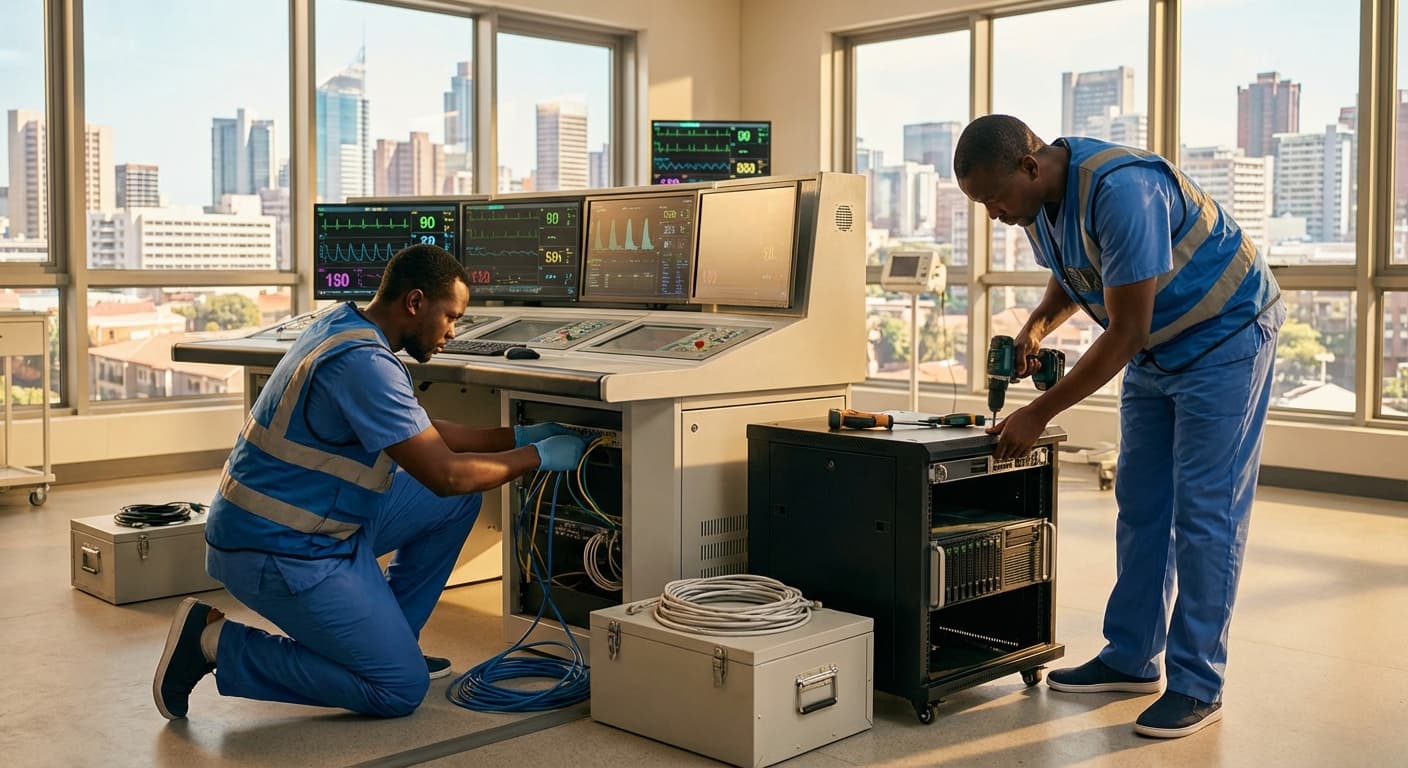
ICU Central Monitoring Station Installation Service in Central African Republic
Engineering Excellence & Technical Support
ICU Central Monitoring Station Installation Service High-standard technical execution following OEM protocols and local regulatory frameworks.
Robust Connectivity & Real-time Data Transmission
Implementing high-availability, low-latency network infrastructure tailored for the unique logistical challenges of the Central African Republic, ensuring seamless, real-time transmission of critical patient data from bedside monitors to the central station. Our solutions prioritize redundancy and local data buffering to mitigate potential network disruptions, guaranteeing continuous monitoring and immediate alert capabilities for ICU staff.
Scalable & Secure Centralized Server Architecture
Designing and deploying a resilient, centralized server architecture capable of handling the demands of a growing ICU patient load. Our installations prioritize robust data security protocols and local data storage options to comply with national healthcare regulations and ensure patient privacy, even in environments with limited and intermittent internet access.
Reliable Power Solutions & Environmental Resilience
Integrating redundant power supply systems, including UPS and potential solar integration, to ensure uninterrupted operation of the central monitoring station and connected devices. Our installations are engineered to withstand local environmental conditions, including temperature and humidity fluctuations, guaranteeing long-term system stability and operational uptime in remote or challenging settings within the Central African Republic.
What Is Icu Central Monitoring Station Installation Service In Central African Republic?
ICU Central Monitoring Station Installation Service in the Central African Republic refers to the specialized technical and logistical undertaking of establishing, configuring, and commissioning a centralized hub for real-time patient vital signs monitoring within Intensive Care Units (ICUs). This service ensures that critical patient data, typically collected from bedside monitors and ventilators, is aggregated, displayed, and managed from a central location, allowing for enhanced clinical oversight and rapid response to patient deterioration. The service encompasses the entire lifecycle from initial site assessment and network infrastructure design to hardware and software deployment, system integration, calibration, staff training, and ongoing maintenance support, all tailored to the specific requirements and operational constraints prevalent in the Central African Republic's healthcare landscape.
| Stakeholder Group | Need for Service | Typical Use Cases |
|---|---|---|
| Hospitals and Healthcare Facilities (Public & Private) | To improve patient outcomes in critical care settings through enhanced real-time surveillance and proactive intervention. | Monitoring multiple critically ill patients simultaneously from a single console; facilitating rapid response to physiological changes; reducing nursing workload by centralizing data review; enabling remote consultation and collaboration. |
| Government Health Ministries and Agencies | To standardize and elevate the quality of critical care services nationwide; to ensure equitable access to advanced medical monitoring technology. | Establishing national standards for ICU monitoring; allocating resources for critical care infrastructure development; supporting disaster preparedness and emergency response capabilities. |
| Non-Governmental Organizations (NGOs) and International Aid Organizations | To deploy and maintain critical medical infrastructure in resource-limited settings and post-conflict regions. | Setting up and equipping ICUs in areas with limited healthcare resources; providing essential monitoring technology to improve survival rates; training local healthcare professionals in advanced critical care practices. |
| Medical Equipment Suppliers and Installers | To offer comprehensive, end-to-end solutions that include the installation and integration of central monitoring systems as part of a larger medical equipment tender. | Providing turnkey solutions for ICU setup; ensuring proper integration of various medical devices; offering specialized technical expertise for complex installations. |
Key Components of ICU Central Monitoring Station Installation Service:
- Site Assessment and Design: Evaluating existing ICU infrastructure, power stability, network capabilities, and space allocation to design an optimal central monitoring station layout and data flow.
- Network Infrastructure Setup: Installation and configuration of reliable wired and wireless network connectivity to ensure seamless data transmission from bedside monitors to the central station.
- Hardware and Software Procurement and Installation: Sourcing, installing, and configuring central monitoring servers, display units, workstations, and specialized monitoring software.
- Integration with Bedside Devices: Connecting and synchronizing vital signs monitors, ventilators, and other critical care devices with the central monitoring system, ensuring data compatibility and accuracy.
- System Configuration and Calibration: Customizing display layouts, alarm parameters, data storage protocols, and ensuring all connected devices are accurately calibrated for optimal performance.
- Data Management and Security: Implementing robust data storage solutions, backup systems, and cybersecurity measures to protect sensitive patient information.
- Testing and Commissioning: Thoroughly testing all system functionalities, including data display, alarm triggers, and network stability, before handover.
- Clinical Staff Training: Providing comprehensive training to physicians, nurses, and technicians on the operation, interpretation of data, and troubleshooting of the central monitoring system.
- Documentation and Handover: Delivering detailed system documentation, operational manuals, and maintenance schedules.
- Post-Installation Support and Maintenance: Offering ongoing technical support, system updates, and preventative maintenance services.
Who Needs Icu Central Monitoring Station Installation Service In Central African Republic?
Installing and maintaining an ICU Central Monitoring Station (CMS) is a critical undertaking for any healthcare facility aiming to provide advanced patient care. In the Central African Republic, where healthcare infrastructure is continuously developing, the need for reliable and sophisticated monitoring systems is paramount. A CMS allows for the centralized observation of multiple ICU patients, enabling a coordinated and efficient response to critical changes in their condition. This service is essential for hospitals equipped to handle intensive care needs and for those looking to upgrade their existing capabilities.
| Customer Type | Specific Departments/Units | Key Needs Addressed by CMS |
|---|---|---|
| Public Hospitals | Intensive Care Unit (ICU), Coronary Care Unit (CCU), Neonatal Intensive Care Unit (NICU) | Centralized patient oversight, improved staff efficiency, early detection of patient deterioration, enhanced patient safety. |
| Private Hospitals/Clinics | Intensive Care Unit (ICU), Post-Anesthesia Care Unit (PACU), High Dependency Units (HDUs) | Elevated standard of care, competitive advantage, streamlined nursing workflow, data management for quality improvement. |
| Military/Government Facilities | Field Hospitals, Military Hospitals with ICU capabilities | Rapid assessment of multiple casualties, efficient resource allocation, remote monitoring capabilities (where applicable), disaster preparedness. |
| NGO Hospitals/Clinics | ICU, Emergency Departments with critical care capabilities | Maximizing limited resources, training and support for staff, ensuring continuity of care, delivering specialized medical services in underserved areas. |
| Referral/Teaching Hospitals | Specialized ICUs (e.g., Surgical ICU, Medical ICU, Trauma ICU), Research Units | Advanced clinical research, training of medical professionals, demonstration of best practices, integration with other hospital information systems. |
Target Customers for ICU Central Monitoring Station Installation Service in Central African Republic
- Public Hospitals with ICU Facilities
- Private Hospitals and Clinics with Intensive Care Units
- Military and Government Healthcare Facilities
- Non-Governmental Organization (NGO) Hospitals and Clinics
- Referral Hospitals and Teaching Hospitals
Icu Central Monitoring Station Installation Service Process In Central African Republic
This document outlines the comprehensive service process for installing an ICU Central Monitoring Station in the Central African Republic, from the initial client inquiry to the final execution and handover. The process is designed to ensure a smooth, efficient, and compliant installation, meeting the specific needs of healthcare facilities in this region.
| Phase | Key Activities | Deliverables | Responsible Party |
|---|---|---|---|
| Inquiry & Assessment | Initial contact, needs clarification, preliminary site info | Needs assessment report, preliminary consultation minutes | Client & Service Provider |
| Site Survey | On-site technical evaluation, user consultation | Detailed site survey report, user requirement document | Service Provider Technical Team |
| Proposal | Solution design, cost estimation, timeline creation | Formal proposal document, quotation | Service Provider |
| Contracting | Proposal review, negotiation, contract signing | Signed service contract | Client & Service Provider |
| Procurement & Logistics | Equipment ordering, shipping, customs clearance | Delivered equipment at site | Service Provider |
| Pre-Installation | Site preparation, utility checks | Ready installation environment | Client & Service Provider |
| Installation | System hardware/software setup, network integration | Installed and connected monitoring system | Service Provider Technical Team |
| Testing | System functionality verification, performance checks | Test reports, quality assurance sign-off | Service Provider Technical Team |
| Training | Operator and technician training | Trained personnel, user manuals | Service Provider Trainers |
| Handover | System commissioning, documentation delivery, client sign-off | Commissioned system, handover documentation | Service Provider & Client |
| Support | Warranty, maintenance, technical assistance | Ongoing system operability | Service Provider |
ICU Central Monitoring Station Installation Service Process
- 1. Initial Inquiry & Needs Assessment:
- Client (hospital, clinic, government health agency) contacts the service provider expressing interest in an ICU Central Monitoring Station.
- Initial discussions to understand the client's specific requirements, including the number of ICU beds to be monitored, existing infrastructure, budget, and desired features.
- Gathering preliminary information about the facility's location, accessibility, and any known logistical challenges in the Central African Republic.
- Scheduling a preliminary consultation (virtual or in-person, if feasible).
- 2. Site Survey & Detailed Consultation:
- A site visit by a qualified technical team to assess the physical space, power supply, network infrastructure, and potential installation sites for the central monitoring station and patient monitors.
- Detailed discussion with clinical staff (doctors, nurses, biomedical engineers) to confirm workflow integration and user needs.
- Identification of any environmental factors (e.g., humidity, temperature, dust) that may impact equipment selection or installation.
- Evaluation of local technical support capabilities and availability of spare parts.
- 3. Solution Design & Proposal Development:
- Based on the site survey and needs assessment, the service provider designs a tailored ICU Central Monitoring Station solution, including specific hardware (servers, workstations, networking equipment, patient monitors), software, and cabling.
- Development of a comprehensive proposal outlining the recommended system, detailed specifications, project timeline, cost breakdown, and payment terms.
- Inclusion of information on training, warranty, and after-sales support.
- Consideration of logistics for transportation of equipment to the Central African Republic, including customs clearance procedures.
- 4. Proposal Review & Contract Negotiation:
- The client reviews the proposal and may request clarifications or modifications.
- Negotiation of contract terms, including scope of work, deliverables, payment schedule, and responsibilities of each party.
- Finalization and signing of the service contract.
- 5. Procurement & Logistics:
- The service provider procures all necessary equipment and software as per the agreed specifications.
- Management of international shipping, customs clearance, and local transportation of equipment to the installation site in the Central African Republic.
- Close coordination with local authorities and logistics partners to ensure timely delivery.
- 6. Pre-Installation Preparation:
- Preparation of the installation site, including any necessary structural modifications, power outlet installation, and network cabling (if not already adequate).
- Ensuring availability of essential utilities (stable power, internet connectivity).
- Coordination of on-site team arrival and accommodation.
- 7. Installation & Configuration:
- On-site installation of the central monitoring station server(s), workstations, and all networking components.
- Installation and connection of patient monitors to the central station, ensuring proper network connectivity.
- Configuration of the monitoring software, including setting up patient profiles, alarms, and data storage.
- Integration with existing hospital IT systems, if applicable.
- 8. Testing & Quality Assurance:
- Rigorous testing of all installed components and the integrated system to ensure optimal performance and reliability.
- Verification of data accuracy, alarm functionality, and network stability.
- Performance of simulated patient monitoring scenarios.
- Addressing any identified issues or bugs.
- 9. User Training:
- Comprehensive training sessions for clinical staff and biomedical engineers on the operation, maintenance, and troubleshooting of the ICU Central Monitoring Station.
- Training can be delivered in-person or through a hybrid model, depending on feasibility.
- Provision of user manuals and training materials.
- 10. Commissioning & Handover:
- Final commissioning of the system after successful testing and training.
- Formal handover of the installed ICU Central Monitoring Station to the client.
- Provision of all relevant documentation, including as-built drawings, system configurations, and warranty information.
- Sign-off by the client confirming satisfaction with the installation.
- 11. Post-Installation Support & Maintenance:
- Commencement of the agreed-upon warranty period.
- Provision of ongoing technical support, remote troubleshooting, and on-site maintenance services as per the service agreement.
- Regular system health checks and performance monitoring.
- Availability of spare parts and timely repair services.
Icu Central Monitoring Station Installation Service Cost In Central African Republic
The installation of an ICU central monitoring station in the Central African Republic (CAR) is a critical infrastructure project that requires careful consideration of various cost factors. These factors significantly influence the overall price, making it challenging to provide a single, fixed cost. The CAR's economic landscape, infrastructure challenges, and the specific requirements of the healthcare facility all play a pivotal role in determining the final investment. It's important to note that all pricing is an estimate and subject to significant variation based on the specific project scope and supplier. For accurate quotations, direct engagement with specialized medical equipment suppliers and installation service providers operating in or able to service the CAR is essential.
| Cost Component | Estimated Range (XAF - Central African CFA Franc) | Notes |
|---|---|---|
| Basic ICU Central Monitoring System (per bed) | 5,000,000 - 15,000,000 | Includes one central unit and basic patient monitor per bed. Excludes extensive infrastructure. |
| Advanced ICU Central Monitoring System (per bed) | 15,000,000 - 40,000,000+ | Includes advanced patient monitors, specialized modules, and integrated software. Cost escalates with more advanced features and beds. |
| Installation Labor (per technician, per day) | 100,000 - 300,000 | Varies based on expertise, local availability, and whether expatriate specialists are required. |
| Site Preparation & Infrastructure (per ICU unit) | 2,000,000 - 10,000,000+ | Dependent on the existing state of the ICU, electrical upgrades, and network cabling needs. |
| Software Licensing & Integration | 1,000,000 - 5,000,000+ | Can be a recurring cost. Integration with existing HIS can be complex and costly. |
| Training (for staff) | 500,000 - 3,000,000 | Depends on the number of staff and the depth of training required. |
| Logistics & Import Costs | 1,000,000 - 5,000,000+ | Highly variable, influenced by shipping methods, duties, and taxes. |
| Total Estimated Project Cost (Small to Medium ICU) | 50,000,000 - 250,000,000+ | This is a broad estimate for a complete installation in a typical ICU setting. |
Key Pricing Factors for ICU Central Monitoring Station Installation in the Central African Republic
- Equipment Cost: This is the most significant component, encompassing the central monitoring unit, patient monitors (for ECG, SpO2, NIBP, etc.), invasive pressure modules, ventilators, and any other integrated devices. The brand, model, features, and quantity of equipment will heavily influence this cost.
- Installation Labor and Expertise: The complexity of the installation, the number of technicians required, their skill level, and the duration of the project all contribute to labor costs. Specialized knowledge in medical equipment integration and network setup is crucial.
- Infrastructure and Site Preparation: This includes the cost of electrical work (ensuring stable power supply, backup generators), network cabling (Ethernet, Wi-Fi), server room setup, and potential modifications to existing ICU rooms to accommodate the equipment and its connections.
- Software and Licensing: The central monitoring system often comes with proprietary software for data management, analysis, and reporting. Licensing fees for this software, and potential integration with existing hospital information systems (HIS), can add to the cost.
- Training: Comprehensive training for medical staff and IT personnel on operating and maintaining the new system is vital for its effective utilization. The cost of trainers, training materials, and the time employees spend in training must be factored in.
- Logistics and Transportation: Importing specialized medical equipment into the CAR can involve significant shipping costs, customs duties, taxes, and potential delays due to import regulations and the country's infrastructure.
- Warranty and Maintenance: The cost of initial warranty periods and ongoing maintenance contracts for the equipment and software should be considered for long-term operational budgeting.
- Consultation and Design: Professional consultation services for designing the optimal layout and integration of the central monitoring system within the ICU can incur fees.
- Currency Fluctuations and Exchange Rates: Given the reliance on imported equipment, the prevailing exchange rate of the Central African CFA franc (XAF) against major international currencies will impact the final cost.
- Local Regulations and Compliance: Adhering to any local health and safety regulations, as well as electrical and IT standards, might require specific certifications or adjustments, potentially adding to the overall expense.
Affordable Icu Central Monitoring Station Installation Service Options
Setting up an Intensive Care Unit (ICU) Central Monitoring Station (CMS) is a critical investment for any healthcare facility. It enables continuous patient observation, early detection of deteriorating conditions, and improved response times. This guide outlines affordable installation service options, focusing on value bundles and effective cost-saving strategies to ensure you get the most out of your budget without compromising patient care.
| Service Option | Description | Value Proposition | Cost-Saving Potential | Considerations |
|---|---|---|---|---|
| Basic Installation & Configuration | Focuses on essential hardware setup, network connectivity, and core software configuration. Primarily for facilities with existing compatible patient monitors and IT infrastructure. | Quick deployment of fundamental monitoring capabilities. | Lower upfront cost by leveraging existing resources. DIY elements can further reduce costs. | Requires in-house IT expertise for advanced troubleshooting and integration. May lack advanced features. |
| Standard Value Bundle | Includes installation, configuration, basic integration with a limited number of patient monitor models, and initial staff training on core functionalities. Often includes a basic warranty. | Comprehensive setup for immediate operational use with essential features. | Bundled pricing offers a slight discount compared to à la carte services. Standardized approach can be more efficient. | Integration may be limited to specific monitor brands/models. Advanced customization might incur extra charges. |
| Premium All-Inclusive Package | Encompasses end-to-end installation, comprehensive integration with all existing patient monitor types, advanced alarm management setup, data archiving integration, cybersecurity hardening, and extensive staff training. Often includes extended support and maintenance. | Maximizes system functionality, efficiency, and long-term reliability. Reduces the burden on internal staff. | While the highest upfront cost, it minimizes the risk of costly errors, unexpected integration issues, and future upgrade/support fees. Predictable budgeting. | Requires a larger initial investment. Ensure the included services align with your facility's specific needs and long-term goals. |
| Phased Implementation & Scalability | Breaks down the installation into manageable phases, allowing for a gradual rollout and budget allocation. Can be combined with any of the above bundles. | Distributes costs over time, making a sophisticated CMS more accessible. Allows for adjustments based on early phase feedback. | Spreads capital expenditure, easing budget strain. Can defer costs for less critical features until later phases. | Requires careful planning and project management to ensure seamless integration between phases. Potential for increased project management overhead. |
| Refurbished Hardware & Software with Service | Utilizes certified refurbished patient monitors, servers, and workstations, bundled with installation and support services. | Significant cost reduction on hardware while maintaining functionality and reliability. | Up to 30-50% cost savings on hardware. Often comes with warranties comparable to new equipment. | Requires due diligence in selecting reputable vendors for refurbished equipment. May have limited availability for specific models. |
Key Components of an ICU Central Monitoring Station
- Central monitoring server and software
- Workstations for nurses and physicians
- Network infrastructure (wired and/or wireless)
- Patient monitor integration hardware/software
- Alarm management systems
- Data storage and archiving solutions
- Backup power supply (UPS)
- Installation, configuration, and testing services
Verified Providers In Central African Republic
Finding reliable healthcare providers in the Central African Republic (CAR) can be a significant challenge. Trustworthy medical services are essential for the well-being of individuals and communities. Franance Health stands out as a leading organization dedicated to ensuring access to quality and verified healthcare. Their rigorous credentialing process and commitment to excellence make them a crucial partner in the CAR's healthcare landscape. This document outlines Franance Health's credentials and explains why they represent the best choice for verified healthcare providers.
| Key Benefits of Choosing Franance Health Verified Providers | Description |
|---|---|
| Trust and Reliability: | Patients can have confidence in the competence and ethical conduct of providers identified through Franance Health's vetting. |
| Improved Access to Quality Care: | Franance Health helps bridge the gap in accessing qualified healthcare professionals, particularly in underserved areas. |
| Enhanced Patient Safety: | The rigorous verification process significantly reduces the risk of encountering unqualified or unethical practitioners. |
| Standardized High-Quality Services: | Affiliated providers are committed to meeting established quality benchmarks, ensuring a consistent level of care. |
| Peace of Mind: | Knowing that a provider has been thoroughly vetted by a reputable organization offers crucial peace of mind to patients and their families. |
| Support for a Stronger Healthcare System: | By partnering with Franance Health, patients contribute to the development and strengthening of the healthcare infrastructure in the CAR. |
Franance Health's Credentials and Commitment to Excellence
- Rigorous Vetting Process: Franance Health employs a multi-faceted approach to vet healthcare providers, ensuring they meet stringent standards for qualifications, experience, and ethical practice.
- Verification of Medical Licenses and Certifications: All providers affiliated with Franance Health undergo thorough verification of their medical licenses and professional certifications from recognized national and international bodies.
- Background Checks and Criminal Record Screening: Comprehensive background checks are conducted to ensure the safety and integrity of the healthcare system.
- Peer Review and Performance Monitoring: Ongoing peer review and performance monitoring mechanisms are in place to maintain high standards of care and identify areas for continuous improvement.
- Compliance with International Healthcare Standards: Franance Health adheres to internationally recognized best practices and quality standards in healthcare delivery.
- Partnerships with Reputable Medical Institutions: Collaboration with established and reputable medical institutions within and outside the CAR strengthens their ability to provide comprehensive and specialized care.
- Focus on Patient Safety and Outcomes: The organization prioritizes patient safety and is committed to achieving positive health outcomes through evidence-based practices.
- Transparency and Accountability: Franance Health champions transparency in its operations and holds its affiliated providers accountable for the quality of care they deliver.
- Capacity Building and Training: They invest in the continuous professional development and training of healthcare professionals, enhancing their skills and knowledge.
Scope Of Work For Icu Central Monitoring Station Installation Service
This Scope of Work (SOW) outlines the requirements for the installation service of an Intensive Care Unit (ICU) Central Monitoring Station. The service includes the supply, installation, configuration, testing, and commissioning of the central monitoring system, ensuring seamless integration with existing or new patient monitoring devices within the ICU.
| Section | Description | Technical Deliverables | Standard Specifications |
|---|---|---|---|
| Initial assessment of the ICU environment, existing infrastructure, and specific monitoring needs. Development of a detailed installation plan. | Detailed Site Survey Report, Installation Plan, Network Assessment Report. | TIA-942 (Telecommunications Infrastructure Standard for Data Centers), relevant local building codes, HIPAA for data security (if applicable). |
| Procurement of all necessary central monitoring station hardware (servers, workstations, displays, network equipment) and software. Pre-configuration and testing of equipment. | Procured Equipment List, Staging & Configuration Report, Pre-installation Test Results. | Manufacturer's specifications for all hardware and software components, DICOM for medical imaging (if applicable), HL7 for health data interchange. |
| Physical installation of central monitoring station hardware, including workstations, servers, and displays. Installation and termination of network cabling for data transmission. | Installed Hardware, Completed Cabling Infrastructure, Cable Testing Report. | TIA-568 (Commercial Building Telecommunications Cabling Standard), IEEE 802.3 (Ethernet standards), specific hospital network standards. |
| Configuration of the central monitoring software, establishment of network connectivity, and integration with bedside patient monitors. Setup of alarm management and data archiving. | Configured Central Monitoring System, Integrated Patient Monitor Data Streams, Alarm Management Configuration Document, Data Archiving Configuration. | Manufacturer's software specifications, HL7 v2.x or FHIR for data interoperability, relevant cybersecurity standards (e.g., NIST SP 800-53). |
| Comprehensive testing of system functionality, data accuracy, alarm triggers, and network performance. Formal commissioning of the system. | System Test Plan, System Test Results, Commissioning Report, User Acceptance Testing (UAT) Sign-off. | ISO 9001 (Quality Management Systems), internal hospital QA protocols, system vendor's validation protocols. |
| Training sessions for ICU clinicians and IT support staff on the operation, maintenance, and troubleshooting of the central monitoring station. | Training Materials (manuals, presentations), Training Attendance Register, Competency Assessment Reports. | Adult learning principles, vendor-specific training modules. |
| Provision of all relevant documentation, including as-built drawings, user manuals, maintenance guides, and warranty information. Formal handover of the installed system. | As-Built Drawings, User Manuals, Maintenance Manuals, Warranty Certificates, Project Closeout Report. | Industry-standard documentation formats, manufacturer's warranty terms. |
Key Objectives
- To install a fully functional ICU Central Monitoring Station.
- To ensure reliable and accurate real-time monitoring of all connected ICU patients.
- To achieve seamless data integration and display.
- To provide comprehensive training to designated hospital staff.
- To ensure compliance with all relevant healthcare and technical standards.
Service Level Agreement For Icu Central Monitoring Station Installation Service
This Service Level Agreement (SLA) outlines the response times and uptime guarantees for the installation service of the ICU Central Monitoring Station. This SLA is effective from the date of service commencement until project completion and handover. All times are in 24-hour format and refer to business days (Monday-Friday) excluding public holidays.
| Service Component | Response Time (during business hours) | Uptime Guarantee (during installation phase) | Escalation Contact |
|---|---|---|---|
| Initial Consultation & Site Survey | Within 4 business hours of request | N/A (Pre-installation phase) | Project Manager |
| Technical Support (on-site) | Within 2 business hours of critical issue report | 99.5% during active installation work | Lead Technician |
| Remote Technical Support | Within 1 business hour of issue report | N/A (Applicable post-installation) | Technical Support Lead |
| Installation Schedule Adherence | Daily progress report within 2 hours of end of shift | N/A (Focus on timely completion) | Project Coordinator |
| System Testing & Validation | Immediate attention upon completion of installation | 99.9% during testing phase | Quality Assurance Lead |
| Post-Installation Support (initial 7 days) | Within 4 business hours of issue report | 99.0% (for system availability, excluding planned maintenance) | Support Manager |
Key Service Objectives
- To ensure timely and efficient installation of the ICU Central Monitoring Station.
- To minimize downtime and disruptions during the installation process.
- To provide clear and measurable service performance indicators.
Frequently Asked Questions

Ready when you are
Let's scope your ICU Central Monitoring Station Installation Service in Central African Republic project in Central African Republic.

Scaling healthcare logistics and technical systems across the entire continent.