
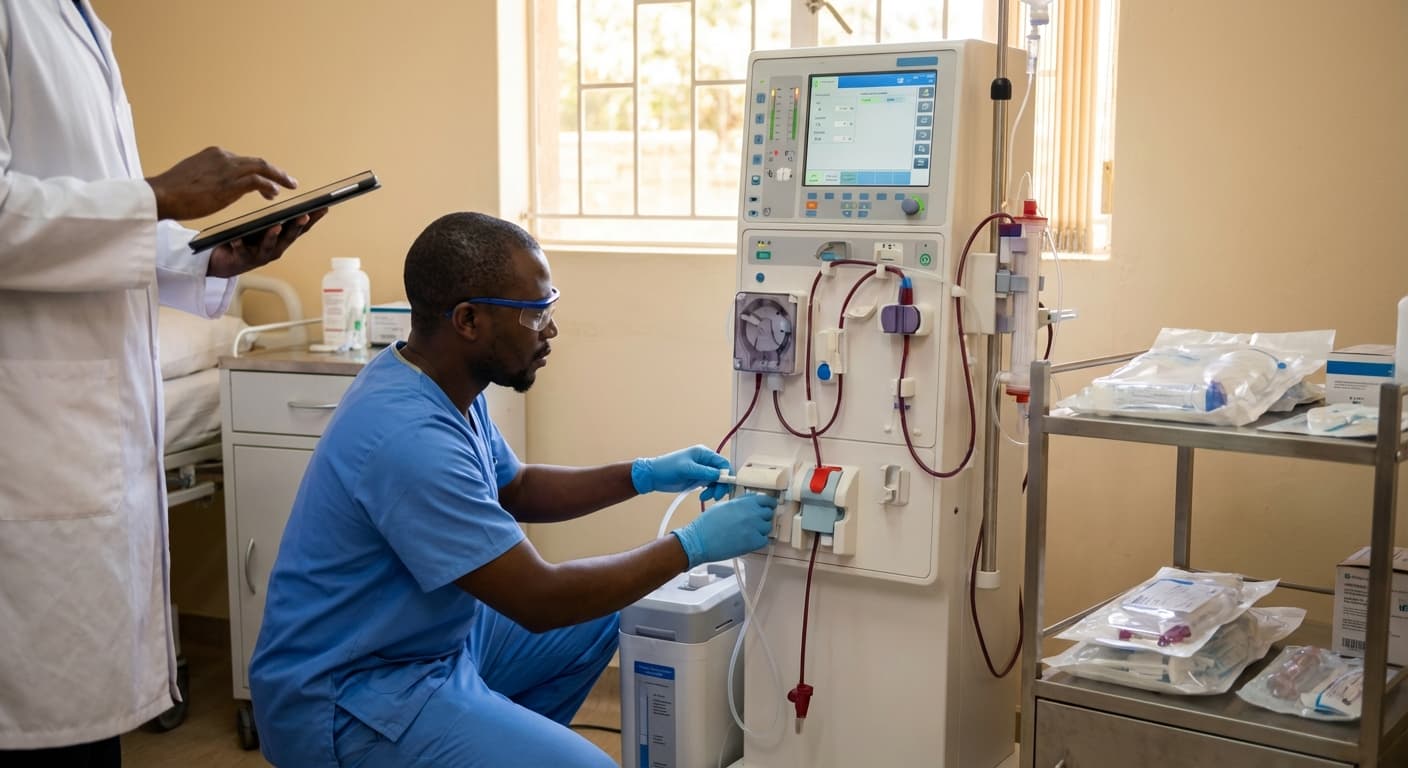
Hemodialysis Machine Installation Service in Central African Republic
Engineering Excellence & Technical Support
Hemodialysis Machine Installation Service High-standard technical execution following OEM protocols and local regulatory frameworks.
Certified Technicians & Global Standards
Our team comprises highly trained and certified biomedical technicians with extensive experience in installing advanced hemodialysis machines. We adhere to stringent international safety and operational standards, ensuring your facility is equipped for optimal patient care from day one.
Robust Infrastructure Assessment & Integration
We conduct thorough site assessments to evaluate existing infrastructure (power, water, waste management) and provide tailored recommendations for seamless integration. Our service ensures your hemodialysis machines operate reliably and efficiently within the local context of the Central African Republic.
Comprehensive Training & Local Capacity Building
Beyond installation, we provide comprehensive training for your medical and technical staff on machine operation, routine maintenance, and troubleshooting. This empowers your team and fosters local capacity, ensuring sustainable and independent management of your hemodialysis services.
What Is Hemodialysis Machine Installation Service In Central African Republic?
Hemodialysis machine installation service in the Central African Republic refers to the comprehensive process of setting up, calibrating, and commissioning hemodialysis equipment within healthcare facilities. This service ensures that the machines are operational, safe, and meet regulatory standards for treating patients with end-stage renal disease (ESRD) or acute kidney injury (AKI). The process typically includes site preparation, physical installation of the machines, connection to water purification systems (dialysis water treatment), power supply, and waste management, followed by rigorous testing, operator training, and handover. The objective is to establish functional hemodialysis units capable of delivering life-sustaining renal replacement therapy.
| Who Needs Hemodialysis Machine Installation Service? | Typical Use Cases in the Central African Republic | ||
|---|---|---|---|
| Public Hospitals and Tertiary Care Centers: Facilities managing a high volume of patients with renal conditions requiring advanced medical equipment. | Establishment of new hemodialysis units in existing hospitals to expand critical care services. | Replacement of outdated or non-functional hemodialysis machines in established renal centers. | Upgrading existing dialysis units with newer, more advanced technology. |
| Private Healthcare Providers and Clinics: Specialized medical facilities aiming to offer comprehensive nephrology services. | Setting up private dialysis centers to cater to a growing demand for renal replacement therapy. | Expansion of services in private hospitals to include dedicated hemodialysis capabilities. | |
| Non-Governmental Organizations (NGOs) and International Aid Agencies: Organizations involved in improving healthcare infrastructure and access to essential medical services in underserved regions. | Deployment of mobile or fixed hemodialysis units in remote or disaster-affected areas to address immediate health needs. | Provision of life-saving equipment as part of humanitarian medical missions. | |
| Government Health Ministries and Public Health Authorities: Entities responsible for national health planning, infrastructure development, and ensuring access to essential medical treatments. | Implementing national strategies for kidney disease management by equipping public healthcare facilities across the country. | Ensuring standardized quality of care by mandating and overseeing the installation of certified hemodialysis equipment. |
Key Components of Hemodialysis Machine Installation Service
- Site Assessment and Preparation: Evaluating the physical space, structural integrity, power infrastructure, and water supply to ensure compatibility with hemodialysis machine requirements.
- Equipment Delivery and Unpacking: Secure transportation and careful unpacking of hemodialysis machines and associated accessories.
- Physical Installation: Mounting, positioning, and securing the hemodialysis machines in their designated locations.
- System Integration: Connecting the machines to the critical infrastructure, including validated dialysis water treatment systems (e.g., reverse osmosis units), medical gas lines (if applicable), and electrical outlets.
- Plumbing and Drainage: Establishing proper connections for water inlet, dialysate flow, and effluent (waste) drainage, adhering to hygiene and safety protocols.
- Electrical and Grounding: Ensuring correct electrical connections, surge protection, and proper grounding of all equipment to prevent electrical hazards.
- Calibration and Configuration: Setting machine parameters according to manufacturer specifications and clinical protocols, including flow rates, temperature, and conductivity.
- Functional Testing and Validation: Performing comprehensive tests to verify machine performance, safety features, and adherence to international standards (e.g., ISO 13485).
- Water System Commissioning: Testing and validating the performance of the integrated dialysis water purification system to ensure it meets stringent water quality standards.
- Operator Training: Providing hands-on training to biomedical engineers, nephrologists, nurses, and technicians on the operation, maintenance, and troubleshooting of the installed hemodialysis machines.
- Documentation and Handover: Supplying all relevant technical documentation, user manuals, warranty information, and commissioning reports upon successful installation.
Who Needs Hemodialysis Machine Installation Service In Central African Republic?
The Central African Republic, with its developing healthcare infrastructure, faces a growing need for advanced medical equipment like hemodialysis machines. Ensuring these vital machines are properly installed, calibrated, and maintained is crucial for delivering effective kidney disease treatment. This service is particularly vital for facilities aiming to establish or expand their nephrology services, directly impacting patient care and health outcomes.
| Target Customer Segment | Key Departments Involved | Primary Needs & Considerations |
|---|---|---|
| Public Hospitals | Nephrology Department, Biomedical Engineering Department, Procurement Department, Administration | Reliable installation for critical patient care, training for local technicians, long-term maintenance contracts, affordability, adherence to national health standards. |
| Private Hospitals | Nephrology Unit, Biomedical Services, Hospital Management, Purchasing Department | High-quality installation, advanced features, comprehensive service packages, efficient setup to meet patient demand, integration with existing hospital systems. |
| Renal Centers/Clinics | Clinical Staff (Nephrologists, Nurses), Technical Support Staff, Center Administration | Specialized installation for high-volume dialysis, precise calibration for optimal treatment, immediate troubleshooting support, expansion capabilities. |
| Government Health Ministries/Agencies | Procurement Divisions, Technical Standards Committees, Public Health Programs | Scalable solutions for national deployment, standardized installation protocols, cost-effectiveness for public funds, compliance with international medical equipment regulations. |
| NGOs & International Organizations | Program Managers, Logistics Departments, Medical Equipment Coordinators | Installation in remote or underserved areas, training for local healthcare workers, durable and easy-to-maintain equipment, project-specific installation requirements. |
Target Customers and Departments for Hemodialysis Machine Installation Service in Central African Republic
- Hospitals: Both public and private hospitals seeking to offer or improve hemodialysis services.
- Renal Centers/Clinics: Dedicated facilities focused on treating kidney disease.
- Government Health Ministries/Agencies: Responsible for public health infrastructure and procurement of medical equipment for national healthcare facilities.
- Non-Governmental Organizations (NGOs): Organizations involved in healthcare provision and humanitarian aid, particularly those focusing on chronic disease management.
- International Health Organizations: Such as the World Health Organization (WHO) or its regional partners, when involved in supporting healthcare initiatives in the country.
Hemodialysis Machine Installation Service Process In Central African Republic
This document outlines the comprehensive workflow for Hemodialysis Machine Installation Services in the Central African Republic, covering the entire process from initial client inquiry to successful machine deployment and operational readiness. The service aims to ensure that healthcare facilities in the CAR receive timely, professional, and compliant installation of hemodialysis equipment, vital for treating patients with kidney failure.
| Phase | Key Activities | Responsible Party | Deliverables/Outcomes | Notes/Considerations for CAR |
|---|---|---|---|---|
| Client inquiry received (email, phone, designated contact). Initial needs assessment to understand machine type, quantity, and facility requirements. Preliminary site information gathering. | Client, Service Provider Sales/Technical Team | Inquiry logged, preliminary understanding of project scope, initial quote provided (if applicable). | Language barriers, limited internet connectivity for remote assessment, need for clear and direct communication channels. |
| Detailed site survey (remote or in-person). Technical specifications review. Installation plan development. Resource allocation (technicians, tools, spares). Procurement of necessary ancillary materials. Agreement/Contract finalization. | Service Provider Technical Team, Project Manager, Client Facilities Team | Detailed installation plan, resource schedule, confirmed site readiness requirements, finalized service agreement. | Infrastructure assessment (power, water quality, drainage). Availability of local skilled labor for assistance. Understanding of import/customs regulations for equipment and spare parts. |
| Packaging and crating of machines and accessories. Arrangement of international and domestic transportation. Customs clearance procedures. Tracking of shipment. Insurance of goods. | Service Provider Logistics Team, Shipping Agents, Customs Brokers | Shipped equipment, proof of shipment, customs clearance documentation, equipment received at designated entry point. | Challenging road infrastructure, potential for security risks during transit, importance of robust packaging, reliance on trusted local logistics partners. |
| Verification of power supply (voltage, stability, grounding). Water treatment system readiness (RO, deionization). Drainage and ventilation adequacy. Dedicated space allocation and environmental conditions (temperature, humidity). Tools and equipment deployment. | Client Facilities Team, Service Provider Installation Technicians | Facility ready for installation, all pre-requisites met, tools and equipment on-site. | Reliability of power and water is critical; may require local solutions or robust backup systems. Need for clear guidelines for facility staff on preparation. |
| Unpacking and positioning of hemodialysis machines. Connection to power, water, and drainage systems. Installation of necessary accessories. Initial system checks and basic calibration. Adherence to manufacturer's installation guidelines and local regulations. | Service Provider Certified Installation Technicians | Machines physically installed, basic connections established, initial system checks completed. | Strict adherence to safety protocols. Technicians may require specific protective equipment. Documentation of installation steps is crucial. |
| Performance testing of all machine functions. Water quality testing during operation. Alarm system checks. Dialysate preparation and delivery system verification. Documentation of test results. Manufacturer's commissioning protocols followed. | Service Provider Certified Installation Technicians, Client Biomedical Engineers | Machines fully functional, performance validated, all tests passed, commissioning report generated. | Need for comprehensive testing under various simulated patient conditions. Local involvement in testing ensures understanding and acceptance. |
| Training for clinical staff (nurses, technicians) on machine operation, basic troubleshooting, and maintenance. Training for biomedical engineers on advanced maintenance and repair. Formal handover of the installed machines and documentation. Provision of user manuals and service records. | Service Provider Trainers, Client Clinical and Biomedical Staff | Trained staff, signed handover documents, complete set of operational and technical documentation. | Training materials should be translated or delivered with interpretation. Hands-on training is essential. Post-training assessment to gauge comprehension. |
| Provision of warranty information. Scheduled follow-up visits for performance checks. Availability of remote technical support. Planned preventive maintenance schedule. Escalation procedures for issues. | Service Provider Technical Support Team, Client Facility Management | Ongoing machine support, client satisfaction confirmed, service records updated. | Establishing clear communication channels for support is vital. Understanding of local healthcare system limitations for rapid response. Long-term partnership building. |
Hemodialysis Machine Installation Service Workflow in CAR
- Phase 1: Inquiry and Initial Assessment
- Phase 2: Planning and Preparation
- Phase 3: Logistics and Transportation
- Phase 4: Site Preparation and Pre-Installation Checks
- Phase 5: Machine Installation and Calibration
- Phase 6: Testing and Commissioning
- Phase 7: Training and Handover
- Phase 8: Post-Installation Support and Follow-up
Hemodialysis Machine Installation Service Cost In Central African Republic
Installing a hemodialysis machine is a critical undertaking for healthcare facilities in the Central African Republic (CAR). The cost of this service is not fixed and can vary significantly due to a multitude of factors. These factors influence the overall budget required for a successful and compliant installation. Understanding these elements is crucial for proper financial planning and procurement.
Key pricing factors include:
- Machine Type and Brand: Different hemodialysis machines have varying levels of sophistication, features, and brand reputation, directly impacting their purchase and installation costs.
- Site Preparation and Infrastructure: This encompasses essential groundwork such as ensuring adequate power supply (stable and with backup generators), plumbing for water purification systems, and appropriate ventilation. The existing state of the facility will dictate the extent of these modifications.
- Water Treatment System: Hemodialysis requires highly purified water. The cost will depend on the complexity and capacity of the water treatment system (e.g., reverse osmosis, water softeners) and its integration with the dialysis machine.
- Technical Expertise and Labor: The availability of skilled biomedical engineers and technicians for installation, calibration, and initial training in the CAR is a major cost driver. Remote or specialized expertise may incur travel and accommodation expenses.
- Logistics and Transportation: Moving a hemodialysis machine and its associated equipment to the installation site within the CAR can be expensive due to the country's infrastructure challenges, potentially requiring specialized transport and handling.
- Ancillary Equipment and Consumables: The installation may necessitate the purchase of additional equipment like patient chairs, monitoring devices, and initial sets of consumables.
- Permits and Regulatory Compliance: Obtaining necessary permits and ensuring the installation meets local health and safety regulations might involve fees and administrative costs.
- Warranty and Maintenance Contracts: While not strictly installation, initial warranty periods and the inclusion of maintenance contracts in the installation package will affect the upfront price.
Due to the limited availability of highly specialized services and the logistical complexities within the Central African Republic, pricing can be a significant challenge to estimate precisely without a detailed site assessment and equipment specification. However, based on general understanding of infrastructure development and specialized medical equipment installation in similar regions, the cost for a complete hemodialysis machine installation service, including site preparation and basic commissioning, could range from 15,000,000 to 50,000,000 Central African CFA Francs (XAF). This range is a broad estimate and can be higher or lower depending on the specific circumstances.
| Cost Component | Estimated Range (XAF) |
|---|---|
| Machine Procurement (for reference, not installation service) | 10,000,000 - 30,000,000+ |
| Site Preparation & Infrastructure Upgrades | 2,000,000 - 10,000,000+ |
| Water Treatment System (Installation & Commissioning) | 3,000,000 - 15,000,000+ |
| Technical Installation & Calibration Labor | 3,000,000 - 10,000,000+ |
| Logistics, Transportation & Handling | 2,000,000 - 8,000,000+ |
| Ancillary Equipment & Initial Consumables | 1,000,000 - 5,000,000+ |
| Permits, Regulatory Fees & Training | 500,000 - 2,000,000+ |
| Contingency (10-15%) | 1,500,000 - 7,500,000+ |
| Total Estimated Installation Service Cost (Excluding Machine Purchase) | 13,000,000 - 57,500,000+ |
Key Pricing Factors for Hemodialysis Machine Installation in CAR
- Machine Type and Brand
- Site Preparation and Infrastructure Requirements (Power, Plumbing, Ventilation)
- Water Treatment System (Type, Capacity, Integration)
- Availability and Cost of Skilled Technical Labor (Biomedical Engineers/Technicians)
- Logistics, Transportation, and Import Duties
- Ancillary Equipment (e.g., Patient Chairs, Monitoring Devices)
- Initial Consumables and Supplies
- Permits, Licenses, and Regulatory Compliance Fees
- Warranty and Initial Maintenance Service Agreements
Affordable Hemodialysis Machine Installation Service Options
Securing an affordable hemodialysis machine installation service is crucial for healthcare facilities aiming to expand their dialysis capabilities without overspending. This service encompasses the professional setup and integration of hemodialysis machines, ensuring they are operational and compliant with all safety regulations. Affordable options often come in various packages, allowing institutions to select the services that best fit their budget and needs. Understanding value bundles and implementing cost-saving strategies can significantly reduce the overall expenditure.
| Value Bundle Type | Included Services | Potential Cost Savings Strategy |
|---|---|---|
| Basic Installation Package | Machine delivery, placement, basic connections, and initial functional test. | Opt for this if your facility has in-house technical staff for more complex setup or training. |
| Standard Installation Package | Includes basic package plus water treatment system integration, calibration, and basic staff orientation. | This offers a good balance of essential services for most facilities. |
| Comprehensive Installation Package | All services in the standard package, plus advanced staff training, detailed site assessment, and extended post-installation support. | Ideal for facilities with limited technical expertise or those establishing new dialysis units. |
| Turnkey Solution | From initial consultation and site preparation to full machine setup, training, and ongoing maintenance contracts. | While seemingly higher upfront, this can save costs by minimizing unforeseen issues and optimizing long-term efficiency. |
| Customized Installation | Tailored to specific facility needs and machine models, allowing clients to select only required services. | Best for facilities with unique requirements or existing infrastructure that can be leveraged. |
Key Components of Hemodialysis Machine Installation Services
- Site assessment and preparation (plumbing, electrical, ventilation)
- Machine delivery and placement
- Electrical and plumbing connections
- Water treatment system integration and testing
- Machine calibration and functional testing
- Staff training on machine operation and basic maintenance
- Post-installation support and troubleshooting
Verified Providers In Central African Republic
Finding reliable healthcare providers in the Central African Republic (CAR) can be a significant challenge. Franance Health stands out as a beacon of trust and quality, offering a network of verified professionals committed to ethical practice and patient well-being. Their rigorous credentialing process ensures that every provider listed undergoes thorough background checks, verification of licenses and certifications, and an assessment of their experience and commitment to international healthcare standards. This meticulous approach provides individuals and organizations operating in the CAR with an unparalleled level of confidence in the medical services they access.
| Credential Type | Franance Health Verification Standard | Importance for Patients |
|---|---|---|
| Medical Licenses | Confirmed with relevant national and international bodies. | Ensures the provider is legally authorized to practice. |
| Professional Certifications | Verified against recognized educational and training institutions. | Confirms specialized knowledge and skills in specific medical fields. |
| Background Checks | Thorough vetting for any history of malpractice or ethical breaches. | Guarantees a commitment to patient safety and professional integrity. |
| Continuing Medical Education (CME) | Evidence of ongoing professional development required. | Ensures providers are up-to-date with the latest medical advancements and techniques. |
| Professional References | Contact with previous employers or colleagues for performance assessment. | Provides an objective evaluation of the provider's work ethic and patient interaction. |
Why Franance Health Credentials Matter:
- Rigorous Verification Process: Franance Health meticulously vets all its providers, ensuring legitimacy and competence.
- Commitment to Ethical Practice: Providers are screened for their adherence to ethical medical standards and patient care principles.
- Verified Qualifications and Licenses: All professional licenses and certifications are confirmed to be current and valid.
- Experience and Competence Assessment: Candidates undergo evaluation of their practical experience and ability to deliver quality care.
- International Healthcare Standards: Franance Health promotes adherence to globally recognized best practices in healthcare delivery.
- Enhanced Patient Safety: The verification process directly contributes to a safer healthcare experience for all patients.
- Reduced Risk for Organizations: Businesses and NGOs can rely on Franance Health for credible healthcare solutions for their staff.
- Access to Specialized Care: Verified networks often include specialists, ensuring a broader range of medical needs can be met.
- Building Trust in the Healthcare System: Franance Health's commitment to quality helps foster greater trust in healthcare services within the CAR.
Scope Of Work For Hemodialysis Machine Installation Service
This Scope of Work (SOW) outlines the services required for the successful installation of hemodialysis machines at the designated healthcare facility. The objective is to ensure the machines are fully operational, calibrated, and tested according to manufacturer specifications and industry best practices. This SOW covers all aspects from site preparation verification to final handover and training.
| Technical Deliverable | Standard Specification | Verification Method | Acceptance Criteria |
|---|---|---|---|
| Site Readiness Report | Confirmation of adequate space, ventilation, power supply (voltage, grounding, circuits), water quality and pressure, waste disposal access, and required plumbing for dialysate preparation. | On-site inspection, measurement, and review of facility infrastructure. | Signed and approved report by facility representative indicating all parameters meet requirements. |
| Installed Hemodialysis Machine | Machine physically placed in the designated location, securely mounted if required, with all necessary connections established. | Visual inspection and verification of physical placement and connections. | Machine is stable, all connections are secure, and no visible damage is present. |
| Functional Test Report | Successful execution of all machine self-tests, including pump calibration, conductivity checks, pressure monitoring, and alarm system verification, as per manufacturer's manual. | Execution of manufacturer-specified diagnostic and functional tests. | All self-tests pass without error codes. Alarm systems trigger and respond correctly. |
| Calibration Certificate | All critical parameters (e.g., conductivity, temperature, flow rate, pressure) calibrated to within manufacturer-specified tolerances. | Calibration performed using certified reference standards traceable to national/international standards. | Calibration results within acceptable tolerance ranges as defined by the manufacturer. Signed calibration certificates provided. |
| Disinfection/Sterilization Log | Completion of internal and external disinfection/sterilization cycles according to manufacturer's guidelines using approved agents. | Visual confirmation of cycle completion and record review. | Disinfection/sterilization cycles completed successfully. Logbook entries signed and dated. |
| Performance Validation Report | Successful completion of at least one simulated dialysis treatment session or actual patient treatment (if permitted and under supervision) demonstrating consistent performance and adherence to prescribed parameters. | Monitoring of machine parameters during simulated or actual treatment. | Machine operates within prescribed parameters throughout the validation session. No unexpected alarms or deviations. |
| User Training Materials | Comprehensive training provided to designated facility staff on machine operation, basic troubleshooting, safety procedures, and routine maintenance. Materials include user manuals and quick reference guides. | Observation of training sessions and review of training materials. | Facility staff demonstrate understanding of key operational procedures. Training materials are provided and accessible. |
| Installation and Handover Report | A comprehensive report detailing all installation steps, tests performed, calibration results, training provided, and any issues encountered and resolved. Includes sign-off from both the service provider and the facility. | Review of all documentation and site-specific records. | Signed and approved report by both parties, signifying successful completion of the installation and handover. |
| As-Built Drawings (if applicable) | Updated drawings reflecting the final placement of the machine and associated plumbing/electrical connections. | Review of existing facility drawings against actual installation. | Accurate representation of the installed system. |
Key Service Components
- Site Readiness Assessment and Verification
- Unpacking and Physical Inspection of Equipment
- Machine Setup and Connection (Water, Power, Dialysate)
- Calibration and Functional Testing
- Disinfection and Sterilization Procedures
- System Integration and Network Connectivity (if applicable)
- Performance Verification and Validation
- User Training and Handover
- Documentation and Reporting
Service Level Agreement For Hemodialysis Machine Installation Service
This Service Level Agreement (SLA) outlines the performance standards for the Hemodialysis Machine Installation Service provided by [Your Company Name] to [Client Name]. It defines the response times for critical issues and guarantees a minimum uptime for the installed hemodialysis machines post-installation and during the warranty/maintenance period. This SLA is effective as of [Effective Date].
| Issue Severity | Response Time Target | Resolution Time Target (During Service Hours) | Uptime Guarantee (Post-Installation) |
|---|---|---|---|
| Critical Issue | 1 hour | 4 business hours | 99.5% |
| Major Issue | 2 business hours | 8 business hours | N/A (Covered by Critical Issue Uptime) |
| Minor Issue | 8 business hours | 2 business days | N/A (Covered by Critical Issue Uptime) |
Definitions
- Installation Service: The process of delivering, setting up, and commissioning hemodialysis machines at the client's designated facility, ensuring full operational readiness.
- Critical Issue: Any malfunction or defect that renders a hemodialysis machine completely inoperable, preventing patient treatment.
- Major Issue: Any malfunction or defect that significantly impairs the functionality of a hemodialysis machine, requiring immediate attention but not rendering it completely inoperable.
- Minor Issue: Any non-critical malfunction or cosmetic defect that does not affect the operational capability of the hemodialysis machine.
- Uptime: The percentage of time a hemodialysis machine is available and fully functional for its intended use, excluding scheduled maintenance and planned downtime.
- Scheduled Maintenance: Pre-planned maintenance activities agreed upon by both parties.
- Response Time: The maximum time elapsed between the client reporting an issue and [Your Company Name]'s technical support acknowledging and initiating action.
- Resolution Time: The maximum time elapsed between the client reporting an issue and the issue being resolved or a workaround being implemented.
- Service Hours: [Specify your company's service hours, e.g., Monday to Friday, 9:00 AM to 5:00 PM local time, excluding public holidays].
Frequently Asked Questions

Ready when you are
Let's scope your Hemodialysis Machine Installation Service in Central African Republic project in Central African Republic.

Scaling healthcare logistics and technical systems across the entire continent.