
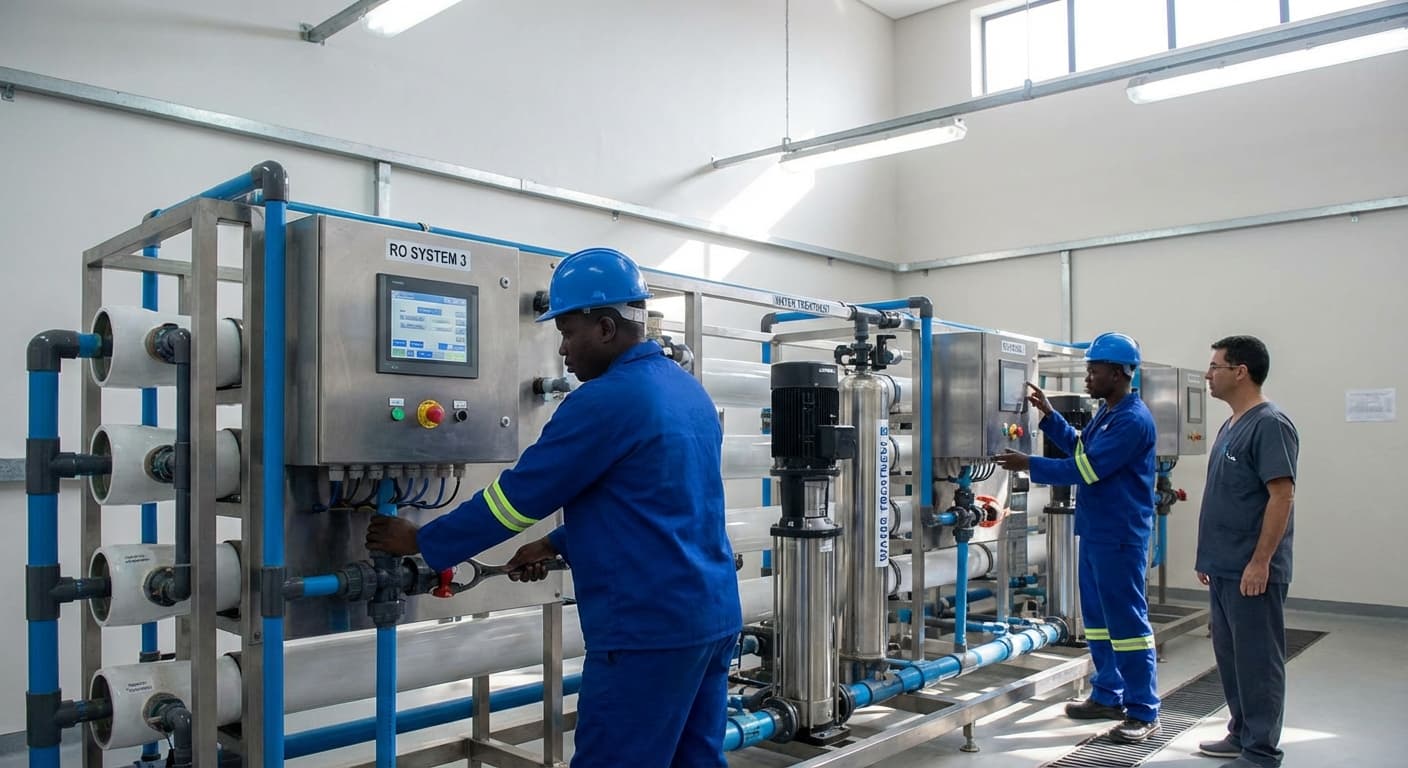
Dialysis RO/Water Treatment Plant Installation Service in Central African Republic
Engineering Excellence & Technical Support
Dialysis RO/Water Treatment Plant Installation Service High-standard technical execution following OEM protocols and local regulatory frameworks.
Advanced Reverse Osmosis Technology
Leveraging state-of-the-art Reverse Osmosis (RO) systems, our installations ensure the production of ultra-pure water, crucial for effective and safe dialysis treatments, meeting stringent international quality standards.
Robust & Climate-Resilient Design
Our water treatment solutions are engineered for durability and resilience in the Central African Republic's challenging climate, employing corrosion-resistant materials and designs to guarantee long-term operational reliability.
Integrated Power & Automation Solutions
We provide comprehensive installation services including integrated power supply management and automated control systems, ensuring uninterrupted and efficient operation of dialysis water treatment plants, minimizing human intervention and potential errors.
What Is Dialysis Ro/water Treatment Plant Installation Service In Central African Republic?
The Dialysis RO/Water Treatment Plant Installation Service in the Central African Republic (CAR) refers to the comprehensive process of designing, sourcing, installing, commissioning, and providing initial training for Reverse Osmosis (RO) and associated water treatment systems specifically tailored for dialysis facilities. This service is critical for ensuring the production of ultra-pure water, a non-negotiable requirement for hemodialysis procedures to prevent patient harm from impurities in tap water. The CAR presents unique logistical and infrastructural challenges that necessitate specialized expertise in delivering these complex systems.
| Who Needs This Service? | Typical Use Cases | ||
|---|---|---|---|
| Nephrology Departments in Hospitals: Public and private hospitals in the CAR requiring hemodialysis services for patients with end-stage renal disease (ESRD). | Dedicated Dialysis Clinics: Standalone facilities established to provide hemodialysis treatment. | Non-Governmental Organizations (NGOs) and Humanitarian Aid Organizations: Entities involved in establishing or supporting healthcare infrastructure, including dialysis units, in regions with limited resources. | Government Health Ministries: Agencies responsible for public health and the provision of essential medical services, including dialysis. |
| Establishment of New Dialysis Centers: Installing a complete water treatment system for a newly built or renovated dialysis facility. | Replacement or Upgrade of Existing Systems: Replacing outdated, inefficient, or non-compliant water treatment plants in operational dialysis centers. | Retrofitting Existing Facilities: Adapting existing water sources or infrastructure to accommodate a new RO dialysis water treatment system. | Emergency Preparedness and Response: Deploying temporary or mobile dialysis water treatment solutions in response to public health crises or natural disasters. |
Key Components of the Service:
- Needs Assessment and Site Survey: Evaluating existing water sources, quality, flow rates, and power availability at the dialysis facility. Identifying specific treatment needs based on water analysis and patient volume.
- System Design and Engineering: Developing a customized RO and water treatment system design, including pre-treatment stages (e.g., sediment filtration, activated carbon, water softening), RO membranes, post-treatment (e.g., UV sterilization, final polishing filters), and storage. Ensuring compliance with international dialysis water standards (e.g., AAMI, ISO).
- Procurement and Logistics: Sourcing high-quality RO membranes, pumps, filters, piping, control systems, and ancillary equipment. Managing importation, customs clearance, and transportation to the installation site in the CAR, often involving remote or challenging terrain.
- Installation and Plumbing: Expert assembly and connection of all system components, including electrical wiring, plumbing, and control interfaces. Ensuring leak-free connections and proper system integration.
- Commissioning and Performance Testing: Rigorous testing of the installed system to verify water quality parameters (e.g., conductivity, Total Organic Carbon (TOC), endotoxins, microbial counts) meet dialysis standards. Adjusting and calibrating the system for optimal performance.
- Water Quality Monitoring and Validation: Establishing protocols and providing equipment for ongoing water quality monitoring to ensure sustained purity.
- Operator Training: Comprehensive training for local biomedical engineers and technicians on the operation, routine maintenance, troubleshooting, and basic repair of the RO and water treatment plant.
- Documentation and Manuals: Providing detailed operation and maintenance manuals, schematics, and warranty information in appropriate languages.
Who Needs Dialysis Ro/water Treatment Plant Installation Service In Central African Republic?
Dialysis RO/Water Treatment Plant Installation Service in the Central African Republic is crucial for ensuring access to safe and reliable water for essential medical procedures. The Central African Republic, like many developing nations, faces challenges in maintaining consistent water quality, making dedicated water treatment for medical facilities a necessity. This service caters to a specific and vital segment of the healthcare infrastructure.
| Customer Type | Primary Need | Key Decision Makers/Influencers | Typical Department Involvement |
|---|---|---|---|
| Hospitals and Clinics with Dialysis Units | Reliable, purified water for hemodialysis to prevent complications and ensure patient safety. | Hospital Administrators, Chief Medical Officers, Heads of Nephrology/Dialysis, Biomedical Engineers. | Nephrology/Dialysis, Biomedical Engineering, Facilities Management, Procurement. |
| Government Health Ministries/Departments | Establishing and upgrading national healthcare infrastructure, ensuring quality standards for dialysis services across the country. | Minister of Health, Director of Public Health, Heads of Healthcare Infrastructure, Procurement Officers. | Healthcare Infrastructure, Procurement, Standards and Quality Assurance. |
| International Aid Organizations and NGOs | Providing essential medical equipment and infrastructure to underserved populations, often funding new or improved dialysis facilities. | Country Directors, Program Managers, Procurement Specialists, Technical Advisors. | Program Management, Technical Implementation, Procurement, Monitoring and Evaluation. |
| Private Healthcare Providers | Offering high-quality, specialized medical services to attract patients and maintain a competitive edge, requiring robust water treatment for specialized units. | Owners of Private Hospitals/Clinics, Medical Directors, Chief Financial Officers, Procurement Managers. | Medical Operations, Finance, Procurement, Facilities Management. |
| Medical Research Institutions | Ensuring pure water for research purposes, which may include studies related to kidney disease or water purification for medical applications. | Research Directors, Principal Investigators, Lab Managers, Procurement Officers. | Research Departments, Laboratory Management, Procurement. |
Target Customers and Departments for Dialysis RO/Water Treatment Plant Installation Service in Central African Republic:
- {"items":["Hospitals and Clinics with Dialysis Units","Government Health Ministries/Departments","International Aid Organizations and NGOs","Private Healthcare Providers","Medical Research Institutions"],"title":"Target Customers"}
- {"items":["Nephrology Departments","Dialysis Centers","Biomedical Engineering Departments","Facilities Management Departments","Procurement Departments","Infection Control Departments"],"title":"Target Departments within Organizations"}
Dialysis Ro/water Treatment Plant Installation Service Process In Central African Republic
This document outlines the comprehensive workflow for Dialysis RO/Water Treatment Plant Installation Services in the Central African Republic, from the initial client inquiry to the final execution and handover. The process is designed to ensure efficient planning, procurement, installation, and commissioning, adhering to international standards and local regulations, while accounting for the unique logistical challenges of the region.
| Phase | Key Activities | Deliverables | Considerations (Central African Republic) | Responsible Party |
|---|---|---|---|---|
| Receive client inquiry, understand project scope, discuss basic requirements, clarify client's existing infrastructure and water source. | Initial meeting minutes, preliminary understanding of project needs. | Language barriers, accessibility of client contact, communication infrastructure. | Service Provider Sales/Technical Team |
| Conduct detailed site visit to assess water quality, available space, power supply, existing plumbing, environmental conditions, and regulatory requirements. Gather precise measurements and photographic documentation. | Detailed site survey report, water quality analysis report (if not provided by client), preliminary site layout sketches. | Security, transportation of survey team, availability of local guides, potential for unforeseen site conditions, import restrictions on testing equipment. | Service Provider Technical Team, Project Manager |
| Based on the needs assessment, develop a detailed technical proposal outlining the proposed RO/Water Treatment system, including specifications, equipment list, installation plan, timelines, and a comprehensive quotation. Address potential challenges and mitigation strategies. | Detailed Technical Proposal, Formal Quotation, Project Schedule. | Accurate cost estimation for transportation, local labor, customs duties, potential currency fluctuations, local supplier availability. | Service Provider Engineering/Sales Team, Project Manager |
| Review and negotiate contract terms, payment schedules, warranties, and service level agreements (SLAs) with the client. Finalize and sign the contract. | Signed Contract Agreement, Payment Schedule. | Legal counsel expertise in local contract law, international payment mechanisms, clear definition of responsibilities and liabilities. | Service Provider Management, Client Management |
| Develop detailed engineering designs, including P&ID (Piping and Instrumentation Diagrams), electrical schematics, structural drawings, and equipment specifications. Obtain necessary client approvals. | Approved Engineering Drawings & Specifications. | Compliance with local building codes (if applicable), potential need for adapting designs to local materials and conditions, ensuring ease of future maintenance. | Service Provider Engineering Team |
| Source and procure all necessary equipment, materials, and components. Manage the complex logistics of shipping, customs clearance, and transportation to the installation site in the Central African Republic. | Procurement Orders, Shipping Manifests, Customs Clearance Documents, Delivery Confirmation. | Reliable freight forwarders, navigating customs regulations and potential delays, managing import duties and taxes, selecting secure transportation methods, potential for localized procurement of consumables. | Service Provider Procurement & Logistics Team |
| Mobilize the installation team to the site. Assemble and install the RO/Water Treatment plant according to the approved engineering designs. This includes plumbing, electrical connections, structural mounting, and any necessary civil works. | Assembled RO/Water Treatment Plant. | On-site team safety protocols, coordination with local labor (if applicable), managing limited infrastructure (power, water for testing), weather considerations, cultural sensitivity, security of equipment and personnel. | Service Provider Installation Team, Project Manager |
| Conduct rigorous testing of all system components and the integrated plant. Verify performance against design specifications, including water quality, flow rates, and operational parameters. Perform system adjustments as needed. | Commissioning Report, Test Results, Performance Validation Certificates. | Access to calibrated testing equipment, ensuring trained personnel are available for complex diagnostics, troubleshooting potential environmental impacts on performance. | Service Provider Commissioning Engineers |
| Provide comprehensive training to the client's designated personnel on the operation, maintenance, and basic troubleshooting of the RO/Water Treatment plant. Formally hand over the completed installation and documentation. | Training Manuals, Operation & Maintenance (O&M) Manuals, Training Certificates, Project Completion Certificate. | Language-appropriate training materials, practical demonstration sessions, assessing trainee comprehension, ensuring effective knowledge transfer for long-term sustainability. | Service Provider Technical/Training Team, Project Manager |
| Provide ongoing technical support, troubleshooting assistance, and scheduled maintenance services as per the contract. Offer spare parts management and remote monitoring solutions. | Service Reports, Maintenance Logs, Spare Parts Inventory, Performance Monitoring Data. | Establishing reliable communication channels for support requests, availability of spare parts within the country or efficient import process, planning for preventive maintenance visits, potential for capacity building of local maintenance technicians. | Service Provider After-Sales Service Team |
Dialysis RO/Water Treatment Plant Installation Service Process Workflow
- Inquiry & Initial Consultation
- Needs Assessment & Site Survey
- Proposal Development & Quotation
- Contract Negotiation & Agreement
- Design & Engineering
- Procurement & Logistics
- On-site Installation & Assembly
- Testing & Commissioning
- Training & Handover
- Post-Installation Support & Maintenance
Dialysis Ro/water Treatment Plant Installation Service Cost In Central African Republic
Installing a Reverse Osmosis (RO) and Water Treatment Plant for dialysis in the Central African Republic (CAR) involves a complex set of considerations that significantly impact the overall cost. The unique logistical challenges, limited infrastructure, and the need for specialized expertise in a developing nation like the CAR contribute to a higher price point compared to more established markets. This service typically encompasses the design, procurement, installation, commissioning, and initial training for operating the plant. The scale of the dialysis facility, the specific water quality issues in the chosen location, and the chosen technology all play crucial roles in determining the final expense. It's essential for healthcare providers to engage with reputable suppliers and experienced installation teams to ensure the long-term reliability and safety of the dialysis water supply.
| Service Component | Estimated Cost Range (CFA Francs - XAF) | Notes |
|---|---|---|
| System Design & Engineering | 3,000,000 - 10,000,000 XAF | Depends on complexity and customization |
| Equipment Procurement (RO System, Pre-treatment, Post-treatment) | 15,000,000 - 75,000,000 XAF | Varies significantly with capacity and technology |
| Logistics & Transportation (within CAR) | 5,000,000 - 20,000,000 XAF | Highly dependent on location and infrastructure |
| Installation & Labor | 8,000,000 - 30,000,000 XAF | Includes skilled personnel, travel, and accommodation |
| Commissioning & Water Quality Testing | 3,000,000 - 8,000,000 XAF | Ensuring compliance with dialysis standards |
| Training & Handover | 2,000,000 - 5,000,000 XAF | For local operational staff |
| Total Estimated Project Cost (Small to Medium Scale) | 36,000,000 - 148,000,000 XAF | Excludes potential import duties, taxes, and ongoing maintenance |
Key Pricing Factors for Dialysis RO/Water Treatment Plant Installation in CAR
- Plant Capacity and Technology: The volume of purified water required per day for the dialysis units dictates the size and complexity of the RO system and associated pre-treatment stages. Advanced filtration technologies (e.g., ultrafiltration, UV sterilization) will increase costs.
- Water Source Quality: The raw water source (borehole, river, municipal supply) will determine the extent of pre-treatment required (e.g., sediment filters, chemical dosing, softening). Poor quality water necessitates more robust and costly pre-treatment.
- Logistics and Transportation: Transporting heavy equipment and specialized components to remote locations within the CAR can be a significant expense due to poor road infrastructure and limited access. This includes customs duties and import taxes.
- Installation Complexity and Site Preparation: The existing infrastructure at the dialysis facility, including space availability, power supply stability, and plumbing, will influence installation time and cost. Extensive site preparation might be needed.
- Skilled Labor and Expertise: Sourcing and retaining qualified technicians and engineers for installation and commissioning in the CAR can be challenging and expensive, often requiring international expertise with associated travel and accommodation costs.
- Equipment Procurement and Lead Times: The availability of specific RO membranes, pumps, and control systems locally or the lead times for international shipping can affect overall project timelines and costs.
- Commissioning and Testing: Thorough testing and validation of the water treatment system to meet stringent dialysis water quality standards are crucial and contribute to the overall service cost.
- Training and Handover: Comprehensive training for local staff on the operation and maintenance of the plant is a vital component and adds to the service cost.
- After-Sales Support and Maintenance Contracts: While not strictly installation cost, initial agreements for after-sales support and preventative maintenance are often factored into proposals.
Affordable Dialysis Ro/water Treatment Plant Installation Service Options
Ensuring access to clean and reliable water is paramount for dialysis patients. Setting up a dialysis Reverse Osmosis (RO) or water treatment plant is a critical step, and finding affordable installation services is a priority. This guide explores cost-effective solutions, value bundles, and smart strategies to minimize expenses without compromising on quality or safety. We'll focus on options that deliver maximum value for your investment.
| Value Bundle/Strategy | Description | Potential Cost Savings | Key Benefits |
|---|---|---|---|
| Integrated System Packages | Bundled offerings that include the RO unit, pre-treatment filters, necessary plumbing, and basic installation. Often provided by specialized dialysis equipment suppliers. | 10-20% reduction compared to purchasing components separately. Reduced coordination effort. | Streamlined procurement, guaranteed compatibility, often includes basic warranty and support. |
| Modular/Scalable Systems | Install a core system with the option to add modules (e.g., additional RO membranes, advanced polishing filters) as your patient load or water quality demands increase. | Lower upfront cost. Pay for upgrades as needed, avoiding over-investment initially. | Flexibility, phased investment, adaptability to changing needs. |
| DIY Consultation & Professional Installation | Source your RO system and components from reputable manufacturers and then hire an independent, experienced dialysis water technician for installation and commissioning. | 20-30% savings on equipment costs. Potentially lower labor rates from independent technicians. | Greater choice in equipment, competitive pricing, specialized expertise for installation. |
| Refurbished or Certified Pre-owned Equipment | Acquire high-quality, previously used RO systems that have been professionally inspected, refurbished, and certified by a reputable vendor. | 30-50% savings on the initial equipment cost. | Access to premium brands at a fraction of the price, environmentally friendly option. |
| Local Service Provider Partnerships | Engage with local, reputable plumbing and water treatment companies that have experience or are willing to specialize in dialysis RO system installations. | Reduced travel costs for technicians. Potentially more competitive local pricing. | Faster response times for installation and service, support for local businesses. |
| Extended Warranty & Maintenance Plans (Negotiated) | When purchasing new systems, negotiate for extended warranties or bundled maintenance packages that offer discounts for long-term commitments. | Up to 15% discount on maintenance over time. Predictable operational costs. | Peace of mind, reduced risk of unexpected repair bills, proactive system upkeep. |
| Bulk Purchasing & Group Discounts | If multiple clinics or facilities are setting up RO systems simultaneously, explore opportunities for bulk discounts or group purchasing. | 5-15% reduction in overall costs. | Economies of scale, shared negotiation power. |
Key Considerations for Affordable Dialysis RO/Water Treatment Plant Installation
- Understanding Your Specific Needs: The size and complexity of your dialysis unit (home, clinic, or hospital) will significantly impact the required system and associated costs.
- RO System Type: Different RO technologies (e.g., single pass, double pass) offer varying levels of purification and price points.
- Pre-treatment Requirements: The quality of your incoming water (e.g., presence of sediment, chlorine, hardness) will dictate the necessity and cost of pre-treatment stages.
- Installation Complexity: Site accessibility, power availability, and plumbing requirements can influence labor costs.
- Ongoing Maintenance & Consumables: Factor in the long-term costs of filter replacements, membrane upkeep, and potential service contracts.
- Regulatory Compliance: Ensure the chosen system and installation meet local health and safety regulations for dialysis water.
- Scalability: Consider if your future needs might require system expansion, which can affect initial investment decisions.
Verified Providers In Central African Republic
Navigating healthcare in the Central African Republic (CAR) can be challenging. Ensuring you are connected with verified and reputable healthcare providers is paramount for safety and effective treatment. Franance Health has emerged as a leading entity in this space, offering a robust network of credentialed professionals and facilities. Their commitment to rigorous verification processes distinguishes them, providing a trusted pathway to quality healthcare in the CAR.
| Provider Type | Key Verification Criteria | Franance Health Assurance |
|---|---|---|
| Hospitals & Clinics | Accreditation status, facility standards, availability of essential equipment, infection control protocols. | Verified compliance with national and international health standards, ensuring a safe and functional environment. |
| Doctors & Specialists | Medical licenses, board certifications, educational background, professional experience, peer reviews. | Confirmation of legitimate medical qualifications and a proven track record in their respective fields. |
| Nurses & Allied Health Professionals | Nursing licenses/registrations, relevant certifications, training qualifications, background checks. | Ensured professional competence and adherence to ethical practice guidelines. |
| Laboratories & Diagnostic Centers | Accreditation, quality control procedures, equipment calibration, data integrity protocols. | Guaranteed accuracy and reliability of diagnostic services. |
Why Franance Health Credentials Matter:
- Rigorous Verification: Franance Health employs a multi-stage vetting process for all providers, scrutinizing licenses, certifications, professional histories, and adherence to ethical standards.
- Quality Assurance: This meticulous approach ensures that all listed providers meet high standards of medical expertise and patient care, mitigating risks associated with unqualified practitioners.
- Trust and Reliability: A Franance Health credential signifies a provider who has met stringent requirements, offering peace of mind to patients seeking medical assistance.
- Accessibility to Trusted Care: By partnering with Franance Health, individuals can access a network of reliable healthcare professionals and facilities, even in regions with limited healthcare infrastructure.
- Commitment to Patient Safety: Their core mission is to enhance patient safety and well-being by connecting them with genuinely qualified and ethical medical practitioners.
Scope Of Work For Dialysis Ro/water Treatment Plant Installation Service
This Scope of Work (SOW) outlines the requirements for the installation of a Dialysis Reverse Osmosis (RO) / Water Treatment Plant. It details the technical deliverables, standard specifications, and responsibilities of the vendor and the client to ensure a successful project execution. The project aims to provide purified water of medical grade for dialysis procedures, adhering to stringent international and local standards.
| Phase | Description | Key Activities | Deliverables | Client Responsibilities | Vendor Responsibilities |
|---|---|---|---|---|---|
| Detailed site assessment, system design finalization, and procurement planning. | Site survey, water analysis, final system configuration, equipment selection, Bill of Materials (BOM) finalization. | Finalized design drawings (P&ID, electrical, layout), approved BOM, project schedule. | Provide site access, available utility data (power, drainage), participate in design reviews. | Conduct site survey, perform water analysis, develop detailed design, procure equipment, create project schedule. |
| Sourcing, purchasing, and quality control of all plant components and consumables. | Ordering of RO membranes, filters, pumps, control panels, piping, valves, tanks, etc. Quality checks and pre-shipment inspections. | Procured equipment, fabrication of skid-mounted units (if applicable), pre-shipment inspection reports. | Review and approve vendor submittals and quality control documents. | Procure all specified equipment and materials, ensure quality compliance, arrange for pre-shipment inspections. |
| Ensuring the installation site is ready for equipment placement and utility connections. | Area preparation, foundation/support structures, drainage provisions, electrical power points, water inlet/outlet points. | Completed and approved installation site, accessible utility connections. | Prepare the installation area, provide necessary civil works and utility connections as per vendor specifications. | Provide detailed specifications for site preparation and utility requirements. |
| Physical installation of the RO/Water Treatment Plant equipment and interconnecting piping. | Skid mounting, piping connections (inlet, outlet, drains, backwash), valve installation, sensor and instrument mounting. | Installed and connected RO/Water Treatment Plant, all piping and connections completed. | Ensure safe access and working space for the installation team. Supervise installation progress. | Install the RO/Water Treatment Plant according to approved drawings, ensure leak-free connections, and proper component alignment. |
| Installation of electrical panels, wiring, control systems, and instrumentation. | Control panel installation, power wiring, signal wiring, sensor calibration, PLC programming (if applicable). | Fully wired and functional electrical and control system, calibrated instruments. | Provide qualified electricians and ensure electrical safety during installation. | Install and wire electrical panels, connect all instruments, program control system, and ensure proper functionality. |
| Initial checks and preliminary tests before introducing water and power. | Mechanical checks, electrical continuity tests, low-pressure system checks, flushing of piping. | System mechanically sound, piping flushed, initial electrical tests completed. | Witness pre-commissioning activities and verify all checks are satisfactory. | Perform all pre-commissioning checks, flush the system thoroughly, and conduct initial electrical tests. |
| Starting up the system and verifying performance against specified parameters. | System startup, initial water production, water quality testing (TDS, conductivity, microbial, etc.), flow rate verification, pressure testing, chemical dosing checks. | Certified water quality reports, performance test reports, system operating parameters log. | Provide access to the system, water samples for testing, and participate in performance tests. | Operate the system under load, conduct comprehensive performance and water quality testing, generate performance reports. |
| Training client personnel on operation, maintenance, and troubleshooting. | Theory sessions, practical demonstrations, hands-on exercises, O&M manual review. | Trained client operators and maintenance staff, signed training attendance sheets, O&M manual. | Ensure nominated personnel are available for training sessions. | Develop and deliver comprehensive training on system operation, routine maintenance, troubleshooting, and emergency procedures. |
| Final system handover and submission of all project documentation. | Final system inspection, submission of O&M manuals, as-built drawings, warranties, certificates (water quality, electrical safety, etc.). | Fully operational RO/Water Treatment Plant, complete set of project documentation, warranty certificates. | Conduct final inspection, review all submitted documentation, and accept the system. | Hand over the fully functional system, provide all specified documentation and warranties, and ensure client satisfaction. |
Project Objectives
- To install a fully functional RO/Water Treatment Plant capable of producing water meeting AAMI/ISO/local health authority standards for hemodialysis.
- To ensure the system is robust, reliable, and meets the required flow rates and water quality parameters.
- To provide comprehensive training to client personnel on system operation and maintenance.
- To ensure minimal disruption to existing hospital operations during the installation and commissioning phases.
- To deliver all required documentation and certifications for regulatory compliance.
Service Level Agreement For Dialysis Ro/water Treatment Plant Installation Service
This Service Level Agreement (SLA) outlines the guaranteed response times and uptime for the installation of a Dialysis Reverse Osmosis (RO)/Water Treatment Plant. This SLA applies to the initial installation phase, from site readiness to system commissioning and handover. It is intended to ensure minimal disruption and rapid resolution of any issues encountered during this critical period.
| Service Level Component | Uptime Guarantee | Response Time (during Installation Phase) | Resolution Time Target |
|---|---|---|---|
| System Installation & Commissioning | N/A (Focus on timely completion and functionality) | Initial on-site presence within 4 business hours of critical issue notification. | Issue resolution typically within 8-24 business hours, depending on complexity and parts availability. |
| Critical Component Malfunction (pre-commissioning) | N/A (Focus on rapid replacement/repair) | On-site diagnosis and proposed solution within 4 business hours of notification. | Replacement or repair of critical components within 12-24 business hours. |
| Minor Component Malfunction (pre-commissioning) | N/A (Focus on efficient troubleshooting) | Remote or on-site troubleshooting within 8 business hours of notification. | Resolution within 24-48 business hours. |
| Power/Electrical Integration Issues | N/A (Focus on safety and functionality) | Immediate response (within 2 business hours) for safety-related electrical issues. | Resolution within 4-8 business hours. |
| Plumbing/Water Flow Issues | N/A (Focus on functionality) | On-site assessment within 4 business hours of notification. | Resolution within 8-24 business hours. |
| User Training Session Scheduling | N/A (Focus on accessibility) | Confirmation of training schedule within 1 business day of request. | Training to be conducted within 5 business days of system handover. |
| Post-Installation Support (within 30 days of handover) | N/A (Focus on initial operational stability) | Remote support within 4 business hours for any functional questions or minor issues. | On-site support for significant issues within 24-48 business hours. |
Scope of Service
- Site assessment and preparation verification.
- Installation of RO/Water Treatment Plant components (membranes, pumps, filters, piping, electrical connections).
- Integration with existing facility infrastructure.
- System testing, calibration, and validation.
- User training for basic operation and maintenance.
- Handover and final documentation.
Frequently Asked Questions

Ready when you are
Let's scope your Dialysis RO/Water Treatment Plant Installation Service in Central African Republic project in Central African Republic.

Scaling healthcare logistics and technical systems across the entire continent.