
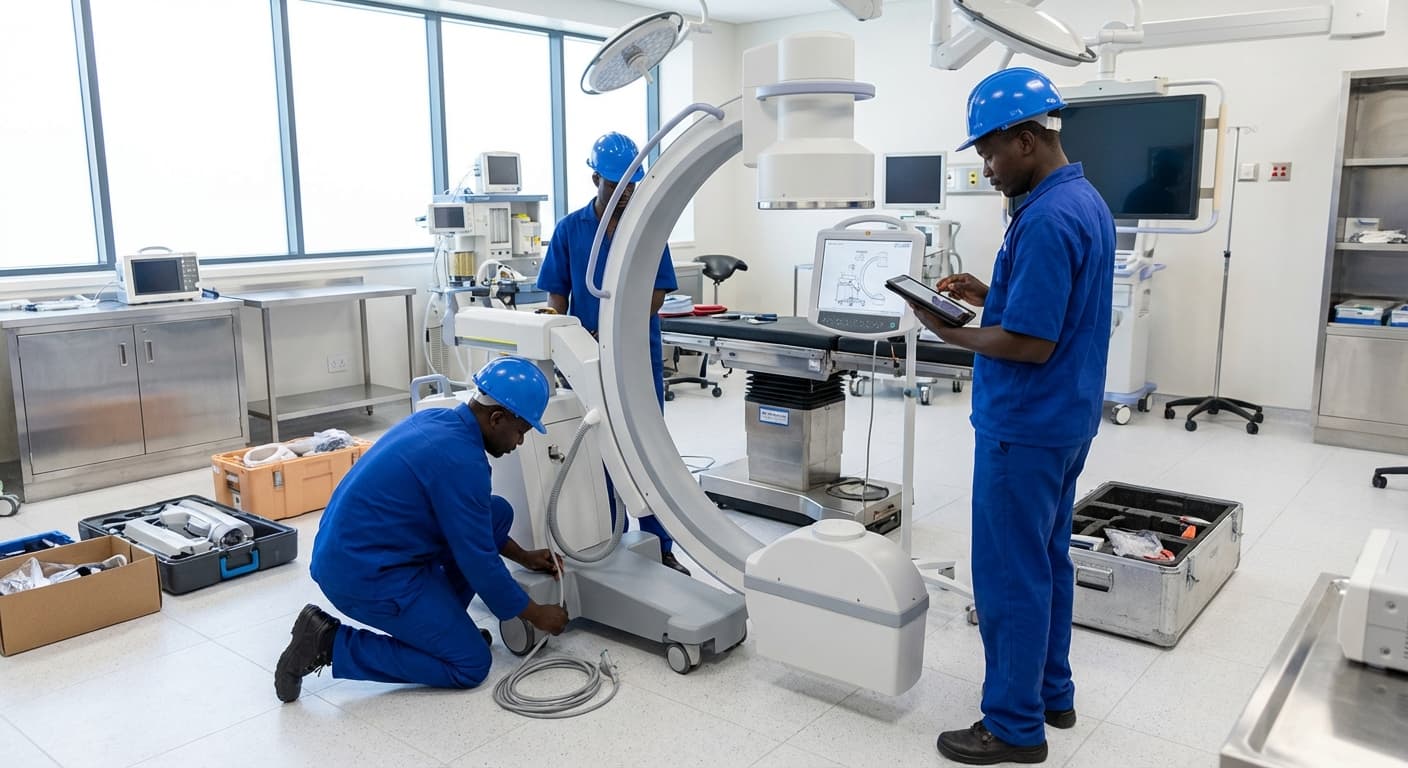
C-Arm Installation Service in Central African Republic
Engineering Excellence & Technical Support
C-Arm Installation Service High-standard technical execution following OEM protocols and local regulatory frameworks.
Expert Remote Diagnostics & Support
Leveraging advanced remote monitoring tools, our certified technicians can proactively diagnose potential issues and provide immediate support, minimizing downtime for your C-arm systems across remote Central African Republic locations.
Climate-Resilient Installation & Calibration
Our installation protocols are specifically designed to account for Central African Republic's challenging environmental conditions. We ensure precise calibration and optimal performance of your C-arm equipment, safeguarding against humidity, dust, and temperature fluctuations.
On-Site Technical Training & Certification
Beyond installation, we provide comprehensive on-site training for your biomedical staff. This empowers your local team with the knowledge and skills to operate, perform basic maintenance, and troubleshoot your C-arm systems efficiently, ensuring long-term operational success.
What Is C-arm Installation Service In Central African Republic?
C-Arm installation service in the Central African Republic refers to the specialized process of setting up, configuring, and calibrating a C-arm fluoroscopy imaging system within a medical facility. This service ensures the C-arm is operational, meets regulatory compliance, and is integrated seamlessly into the existing medical infrastructure for optimal diagnostic and interventional procedures. It encompasses the physical placement, electrical connections, software setup, image acquisition parameter optimization, and initial testing, often requiring specialized technical expertise due to the sophisticated nature of the equipment and potential logistical challenges in remote or developing regions.
| Who Needs C-Arm Installation Service? | Typical Use Cases | ||||||
|---|---|---|---|---|---|---|---|
| Hospitals and larger clinics in the Central African Republic requiring advanced imaging capabilities for diagnostic and interventional procedures. | Orthopedic surgery: Fracture reduction, hardware placement, joint replacement procedures. | Pain management: Epidural injections, nerve blocks. | Cardiovascular procedures: Angiography, stent placement (though less common in basic setups). | Urology: Lithotripsy, stent placement. | Gastroenterology: Biliary and pancreatic procedures. | Emergency departments: Rapid imaging for trauma and acute conditions. | Surgical centers performing minimally invasive procedures. |
Key Components of C-Arm Installation Service
- Site Assessment and Planning: Evaluating the installation site for power requirements, space, environmental conditions, and potential radiation shielding needs.
- Equipment Delivery and Unpacking: Safely transporting the C-arm system and its accessories to the facility and performing initial unboxing and inspection.
- Physical Placement and Mounting: Positioning the C-arm unit according to manufacturer specifications and ensuring proper stability and maneuverability.
- Electrical and Network Connectivity: Establishing secure power connections, grounding, and integrating the C-arm with hospital IT infrastructure (PACS/RIS) if applicable.
- Software Installation and Configuration: Loading and configuring the C-arm's operating system, imaging software, and user-specific settings.
- Calibration and Quality Assurance: Performing precise calibration of X-ray tube, detectors, and image processing parameters to ensure accurate image quality and dose management.
- Radiation Safety Checks: Verifying compliance with local radiation safety regulations and performing necessary shielding and exposure tests.
- User Training: Providing comprehensive training to medical staff on the operation, maintenance, and basic troubleshooting of the C-arm system.
- Post-Installation Support: Offering initial technical support and system verification after the installation is complete.
Who Needs C-arm Installation Service In Central African Republic?
When a medical facility in the Central African Republic requires the precise and expert setup of C-arm imaging equipment, C-Arm Installation Service becomes an essential partner. This specialized service ensures that these complex medical devices are not only physically placed but also correctly calibrated, tested, and integrated into the existing healthcare infrastructure. Proper installation is critical for accurate diagnostics, patient safety, and the longevity of the equipment, especially in regions where technical support might be less readily available.
| Department | Primary Uses of C-Arm | Why Professional Installation is Crucial |
|---|---|---|
| Orthopedics | Fracture detection, joint alignment, fracture fixation, spinal surgery guidance | Accurate positioning for precise surgical cuts and implant placement; reduces radiation exposure through optimal setup. |
| Surgery (General) | Foreign body localization, stent placement, biopsy guidance | Ensures clear imaging for critical decision-making during procedures; minimizes procedural time. |
| Trauma/Emergency | Rapid assessment of fractures and dislocations, intraoperative guidance for stabilization | Enables quick diagnosis and intervention in life-threatening situations; reliable operation under pressure. |
| Pain Management | Image-guided injections (epidural, facet joint), nerve blocks | Precise needle placement for effective pain relief; minimizes patient discomfort and risk of complications. |
| Urology | Cystography, retrograde pyelography, stent placement | Accurate visualization for urinary tract interventions; ensures proper device placement. |
| Cardiology (Interventional) | Angiography, stent deployment (in some cases) | Requires highly specialized setup for hemodynamic monitoring and precise catheter manipulation. |
Target Customers and Departments for C-Arm Installation Service in the Central African Republic
- {"title":"Hospitals (Public and Private)","description":"These are the primary institutions requiring C-arm imaging for a wide range of surgical and diagnostic procedures. Both large, well-established hospitals and smaller, more specialized clinics will benefit from professional installation."}
- {"title":"Surgical Centers and Operating Theaters","description":"Facilities focused on surgical interventions, including orthopedic, trauma, and general surgery, rely heavily on C-arms for real-time intraoperative imaging to guide procedures. Ensuring the C-arm is optimally positioned and functional is paramount for successful surgeries."}
- {"title":"Trauma and Emergency Departments","description":"In areas with high incidence of accidents or injuries, trauma centers need immediate and reliable access to C-arm imaging for rapid assessment and treatment of fractures, dislocations, and other urgent conditions."}
- {"title":"Orthopedic Clinics and Departments","description":"Orthopedic specialists utilize C-arms extensively for diagnosing and treating bone fractures, joint issues, spinal conditions, and for guiding orthopedic surgeries like joint replacements and fracture fixation."}
- {"title":"Pain Management Clinics","description":"These clinics often use C-arms for image-guided injections and nerve blocks, requiring precise placement of needles for therapeutic interventions."}
- {"title":"Veterinary Hospitals (Specialized)","description":"While not medical for humans, some advanced veterinary surgical facilities may also require C-arm installation for complex animal surgeries."}
- {"title":"International Aid Organizations and NGOs","description":"Organizations involved in providing medical support in the Central African Republic may procure and deploy C-arm equipment to remote or underserved areas, requiring professional installation and setup."}
- {"title":"Government Health Ministries and Agencies","description":"Entities responsible for public health infrastructure and equipment procurement for government-run facilities would be key clients."}
C-arm Installation Service Process In Central African Republic
This document outlines the comprehensive workflow for C-Arm installation services in the Central African Republic, from initial client inquiry to successful project execution. The process is designed to ensure efficiency, adherence to local regulations, and the highest quality of service.
| Phase | Key Steps | Description | Key Personnel Involved | Deliverables |
|---|---|---|---|---|
| Phase 1: Inquiry & Initial Consultation | Client Inquiry Received | The process begins with a client reaching out with a requirement for C-Arm installation. | Sales Representative, Client Representative | Initial understanding of client needs and project scope. |
| Needs Assessment & Quotation | Detailed discussion of C-Arm model, facility requirements, budget, and timeline. A preliminary quotation is provided. | Sales Representative, Technical Consultant, Client Representative | Confirmed project scope, preliminary quotation, and estimated timeline. | |
| Phase 2: Site Assessment & Planning | Site Visit & Technical Survey | A qualified technician visits the client's facility to assess power, space, radiation shielding, ventilation, and network infrastructure. | Field Service Engineer, Biomedical Engineer, Client's Facilities Manager | Detailed site survey report, identification of any infrastructural gaps. |
| Installation Plan Development | Creation of a detailed installation plan, including equipment placement, cabling routes, safety protocols, and regulatory compliance checks. | Project Manager, Lead Field Service Engineer, Client's IT/Facilities Team | Approved installation plan, risk assessment, and mitigation strategies. | |
| Phase 3: Logistics & Procurement | Equipment & Material Procurement | Sourcing of the C-Arm unit, accessories, and any necessary installation materials. This includes managing customs clearance and import procedures for the CAR. | Logistics Manager, Procurement Specialist, Customs Broker | Procured C-Arm and all required installation materials, cleared customs. |
| Transportation & Warehousing | Safe and secure transportation of equipment to the installation site in the Central African Republic. Temporary warehousing may be arranged if needed. | Logistics Manager, Transportation Partners | Equipment safely delivered to the designated site. | |
| Phase 4: On-Site Installation & Commissioning | Pre-Installation Preparations | Ensuring the site is ready as per the installation plan. This includes setting up temporary power, safety barriers, and tools. | Field Service Engineer, Installation Team | Site prepared for equipment installation. |
| C-Arm Installation | Physical installation of the C-Arm, including mounting, connection of power, and data cables, following manufacturer guidelines and safety standards. | Field Service Engineer, Installation Team | C-Arm physically installed and connected. | |
| System Configuration & Calibration | Configuring the C-Arm's software and hardware settings. Calibration to ensure optimal performance and image quality. | Field Service Engineer, Biomedical Engineer | C-Arm configured and calibrated. | |
| Testing & Quality Assurance | Comprehensive testing of all functionalities, including imaging modes, safety features, and integration with existing hospital systems. | Field Service Engineer, Quality Assurance Specialist, Client's Technical Staff | Successful test results, QA report. | |
| Phase 5: Training & Handover | User Training | Providing hands-on training to medical staff (radiologists, technicians) on the operation, basic maintenance, and safety procedures of the C-Arm. | Application Specialist, Field Service Engineer, Medical Staff | Trained medical staff, training materials provided. |
| Documentation & Handover | Providing all relevant documentation, including user manuals, service records, and warranty information. Formal handover of the installed C-Arm to the client. | Project Manager, Field Service Engineer, Client Representative | Complete documentation package, signed handover certificate. | |
| Phase 6: Post-Installation Support | Warranty Support | Providing support as per the warranty agreement for any defects or malfunctions. | Service Department, Field Service Engineer | Resolved warranty issues. |
| Preventive Maintenance | Offering scheduled preventive maintenance services to ensure the longevity and optimal performance of the C-Arm. | Service Department, Field Service Engineer | Scheduled maintenance completed, maintenance reports. | |
| On-Call Technical Support | Providing access to technical support for troubleshooting and immediate assistance when needed. | Technical Support Team, Field Service Engineer | Resolved technical issues. |
C-Arm Installation Service Workflow: Inquiry to Execution
- Phase 1: Inquiry & Initial Consultation
- Phase 2: Site Assessment & Planning
- Phase 3: Logistics & Procurement
- Phase 4: On-Site Installation & Commissioning
- Phase 5: Training & Handover
- Phase 6: Post-Installation Support
C-arm Installation Service Cost In Central African Republic
Installing a C-arm in the Central African Republic (CAR) involves a range of costs influenced by several key factors. These include the complexity of the installation, the specific C-arm model and its features, the geographical location within the CAR, the required modifications to existing infrastructure, and the expertise of the installation team. Due to the developing nature of healthcare infrastructure in many parts of the CAR, specialized technical support might be more limited or require significant logistical arrangements, impacting overall costs. It's crucial to obtain detailed quotes from reputable medical equipment suppliers and installation service providers operating in or serving the region.
| Cost Component | Estimated Range (Central African CFA Franc - XAF) |
|---|---|
| Basic C-Arm Installation (excluding equipment purchase) | 1,500,000 - 5,000,000 XAF |
| Complex Installation (significant infrastructure upgrades, advanced features) | 5,000,000 - 15,000,000+ XAF |
| Site Survey and Preparation (if extensive) | 500,000 - 2,000,000 XAF |
| Transportation and Logistics (especially for remote locations) | 300,000 - 1,000,000+ XAF |
| Post-installation Training | 400,000 - 1,500,000 XAF |
| Annual Maintenance Contract (estimated) | 1,000,000 - 3,000,000 XAF |
Key Pricing Factors for C-Arm Installation in the Central African Republic
- C-Arm Model and Specifications: Advanced features like digital radiography, large detector sizes, and specialized imaging capabilities will increase installation costs.
- Site Assessment and Preparation: The existing medical facility's infrastructure (e.g., power supply, radiation shielding, room dimensions) will determine the extent of necessary modifications.
- Geographical Location within CAR: Access to remote areas may incur higher transportation and logistical expenses for personnel and equipment.
- Labor and Expertise: The cost of qualified technicians, engineers, and project managers, especially those with experience in medical imaging equipment installation, will vary.
- Ancillary Equipment and Software: Integration of PACS (Picture Archiving and Communication System), printers, and other accessories can add to the overall expense.
- Training and Support: Post-installation training for medical staff and ongoing technical support agreements will be factored into the cost.
- Import Duties and Taxes: If the C-arm and installation components are imported, applicable duties and taxes will apply.
Affordable C-arm Installation Service Options
Acquiring and installing a C-arm is a significant investment for any healthcare facility. While the technology itself offers invaluable diagnostic and surgical capabilities, the installation process can add considerable cost and complexity. Fortunately, various affordable C-arm installation service options exist, often incorporating value bundles and strategic cost-saving measures to make the process more manageable. Understanding these options can help facilities optimize their budget without compromising on quality or safety.
| Cost-Saving Strategy | Description | Impact on Value |
|---|---|---|
| Value Bundles | Combining multiple services (e.g., installation, initial training, extended warranty) into a single package, often at a discounted rate compared to purchasing services individually. | Enhances overall value by providing comprehensive support and predictable costs, reducing the need for separate vendor negotiations. |
| Phased Installation | Breaking down the installation into smaller, manageable phases to align with budget cycles or operational availability. This can sometimes allow for staggered payments. | Improves cash flow management and allows facilities to start utilizing parts of the system sooner, potentially generating revenue. |
| Negotiating Package Deals | Working with C-arm vendors or third-party service providers to negotiate a lower price for installation when purchased alongside the C-arm unit or other medical equipment. | Directly reduces the upfront cost of installation and can lead to significant savings through bulk purchasing power. |
| Utilizing Manufacturer-Certified Technicians | While seemingly a standard cost, ensuring technicians are manufacturer-certified can prevent costly mistakes, rework, and ensure optimal system performance, thus saving money in the long run. | Minimizes the risk of system malfunctions, premature wear, and ensures compliance, avoiding expensive repairs or downtime. |
| Off-Peak Installation Scheduling | Scheduling installation during less busy periods or after operational hours, if feasible, can sometimes result in lower service rates from providers. | Can lead to direct cost reductions on labor if providers offer off-peak discounts. |
| Comprehensive Site Preparation by Facility | Performing as much of the preparatory work as possible (e.g., clearing space, ensuring power is ready) in-house can reduce the time and cost charged by external installers. | Reduces the labor hours billed by the installation service, leading to direct cost savings. |
| Extended Warranty & Maintenance Packages | Bundling an extended warranty and proactive maintenance plan with the installation can offer a more predictable cost of ownership and potentially avoid expensive emergency repairs. | Provides long-term cost certainty and can mitigate the financial impact of unexpected breakdowns, enhancing overall financial planning. |
Key Components of C-Arm Installation Services
- Site Assessment & Planning: Evaluating the installation space for power, radiation shielding, weight capacity, and accessibility.
- Logistics & Transportation: Safely moving the C-arm from the vendor to the installation site.
- Physical Installation: Assembling and connecting all components of the C-arm system.
- Calibration & Testing: Ensuring the C-arm meets performance specifications and safety standards.
- Operator Training: Providing essential training for medical staff on the proper and safe use of the C-arm.
- Radiation Safety Compliance: Ensuring the installation adheres to all local and national radiation safety regulations.
- Post-Installation Support: Offering initial troubleshooting and guidance after the system is operational.
Verified Providers In Central African Republic
Navigating the healthcare landscape in the Central African Republic (CAR) can be challenging. Ensuring access to qualified and trustworthy medical services is paramount for the well-being of individuals and communities. In this context, the credentials and reputation of healthcare providers become critically important. Franance Health stands out as a leading organization in the CAR, consistently demonstrating a commitment to high standards of care, ethical practices, and accessibility. Their verified providers offer a crucial layer of assurance in a region where such validation is often scarce.
| Provider Type | Franance Health Verification Mark | Key Benefits | Example Services |
|---|---|---|---|
| Hospitals & Clinics | Certified Facility | Equipped for advanced diagnostics and treatment, adherence to hygiene protocols. | Surgical procedures, emergency care, specialized consultations (e.g., cardiology, pediatrics). |
| General Practitioners | Verified Doctor | Comprehensive primary care, accurate diagnoses, appropriate referrals. | Routine check-ups, management of common illnesses, preventative health advice. |
| Specialist Physicians | Verified Specialist | Expertise in specific medical fields, advanced diagnostic capabilities. | Dermatology, Ophthalmology, Gynecology, Neurology, etc. |
| Paramedical Staff (Nurses, Technicians) | Certified Professional | Skilled in patient care, diagnostic support, and therapeutic interventions. | Patient monitoring, wound care, laboratory testing, radiology assistance. |
| Community Health Workers | Accredited Outreach | Local knowledge, accessibility for remote populations, health education. | Disease prevention campaigns, maternal and child health support, basic health screenings. |
Why Franance Health Credentials Matter
- Rigorous Vetting Process: Franance Health employs a comprehensive vetting process for all its affiliated providers, ensuring they meet stringent professional and ethical benchmarks.
- Qualified Medical Professionals: All healthcare professionals associated with Franance Health are fully licensed, certified, and possess the necessary expertise in their respective fields.
- Adherence to International Standards: Franance Health aligns its operational and medical practices with recognized international healthcare standards, promoting quality and patient safety.
- Focus on Accessibility: The organization is dedicated to making quality healthcare accessible to a wider population in the CAR, often overcoming logistical and financial barriers.
- Commitment to Patient Welfare: Franance Health prioritizes patient well-being, emphasizing compassionate care, transparency, and patient rights.
- Community Trust and Reputation: Through consistent delivery of reliable services, Franance Health has cultivated a strong reputation and earned the trust of communities across the Central African Republic.
Scope Of Work For C-arm Installation Service
This Scope of Work (SOW) outlines the services required for the professional installation of a C-Arm imaging system at [Client Facility Name]. The objective is to ensure a safe, compliant, and fully functional installation that meets all manufacturer specifications and industry standards. This includes all necessary site preparation, equipment placement, connection, testing, and documentation.
| Technical Deliverable | Standard Specification / Requirement | Verification Method |
|---|---|---|
| Site Readiness Report | Confirmation of adequate space, power, ventilation, and access as per manufacturer guidelines. Verification of structural integrity for equipment weight. Compliance with local building codes. | Site survey checklist, photographic evidence, written report. |
| C-Arm Unit Placement | Precise positioning of the C-Arm gantry, table, and associated workstations according to manufacturer's layout and ergonomic best practices. Securement of all components to prevent movement. | Visual inspection, measurement verification against layout drawings. |
| Electrical Connections | Installation of dedicated, properly grounded, and surge-protected power circuits. Compliance with local electrical codes (e.g., NEC, IEC) and manufacturer voltage/amperage requirements. Use of appropriate cable types and conduit. | Electrical panel inspection, voltage/grounding tests, visual inspection of wiring and outlets. |
| Data Network Cabling | Installation of network cabling (e.g., CAT6a or higher) from C-Arm to PACS/HIS. Compliance with network bandwidth and latency requirements. Proper termination and labeling of all network ports. | Network cable tester, continuity checks, visual inspection of terminations. |
| System Power-Up and Configuration | Successful system boot-up. Verification of core operating system and firmware. Initial system settings configured as per manufacturer's recommendations and client specifications. | System logs, on-screen display verification, preliminary diagnostics. |
| Functional Testing (Simulated Procedures) | Performance of a suite of simulated imaging procedures to test all operational modes (e.g., fluoroscopy, radiography). Verification of image quality, contrast, resolution, and artifact absence. | Test images, image quality assessment protocols, comparison to phantom images (if available). |
| Calibration and Alignment | Verification and adjustment of C-Arm geometry, detector alignment, and radiation output to manufacturer specifications. Compliance with radiation safety standards. | Alignment tools, radiation output measurements, image artifact analysis. |
| Integration with PACS/HIS | Successful transmission of test images to the Picture Archiving and Communication System (PACS) and/or Hospital Information System (HIS). Verification of DICOM compatibility and metadata accuracy. | PACS/HIS viewer confirmation, DICOM conformance statement review, metadata check. |
| Radiation Safety Compliance | Confirmation of compliance with all local, state, and federal radiation safety regulations. Verification of interlocks, shielding effectiveness, and dose monitoring systems. | Radiation survey meter readings, interlock function tests, compliance documentation review. |
| User Orientation and Training Documentation | Brief overview of system operation, basic troubleshooting, and safety features provided to designated clinical staff. Provision of all user manuals and relevant documentation. | Sign-off sheet from attendees, verification of documentation handover. |
| Final Acceptance Report | Formal documentation signed by both the installer and client confirming successful completion of all installation tasks and compliance with the SOW. | Signed acceptance form, final site inspection checklist. |
Key Service Components
- Site assessment and readiness verification.
- Unpacking and inspection of C-Arm system components.
- Positioning and securement of the C-Arm unit and associated equipment.
- Electrical and data cabling installation and connection.
- Integration with existing medical imaging network (if applicable).
- System power-up and initial configuration.
- Comprehensive functional testing and calibration.
- User orientation and basic operational training.
- Final site cleanup and debris removal.
- Submission of all required documentation.
Service Level Agreement For C-arm Installation Service
This Service Level Agreement (SLA) outlines the response times and uptime guarantees for the C-Arm Installation Service provided by [Your Company Name]. It defines the commitment to providing timely and reliable installation services, ensuring minimal disruption to your healthcare operations. This SLA is incorporated by reference into the Master Services Agreement between [Your Company Name] and [Client Name].
| Service Component | Response Time Target (during Business Hours) | Uptime Guarantee |
|---|---|---|
| Initial Response to Critical Incident: Acknowledgement of the issue and initiation of troubleshooting or dispatch of a technician. | 2 Business Hours | N/A (Uptime is affected by incidents) |
| On-Site Technician Arrival for Critical Incident: Dispatch and arrival of a qualified technician to the Client's facility to begin remediation. | 8 Business Hours | N/A (Uptime is affected by incidents) |
| Initial Response to Major Incident: Acknowledgement of the issue and initiation of troubleshooting or dispatch of a technician. | 4 Business Hours | N/A (Uptime is affected by incidents) |
| On-Site Technician Arrival for Major Incident: Dispatch and arrival of a qualified technician to the Client's facility to begin remediation. | 16 Business Hours | N/A (Uptime is affected by incidents) |
| Installation Completion Uptime: The C-Arm system will be fully operational and validated post-installation. | N/A | 99.5% within the first 30 days post-successful installation (excluding scheduled maintenance and Client-caused issues). |
Key Definitions
- C-Arm Installation Service: The professional service of setting up, configuring, and testing a C-Arm imaging system at the Client's designated facility.
- Downtime: The period during which the C-Arm system is not operational due to a failure in the installation process or a defect attributable to the installation service provided by [Your Company Name]. This excludes scheduled maintenance, power outages, or issues with the Client's existing infrastructure.
- Business Hours: Monday through Friday, 9:00 AM to 5:00 PM [Client's Time Zone], excluding public holidays.
- Critical Incident: An event where the C-Arm system is completely non-operational and cannot be used for patient imaging.
- Major Incident: An event where the C-Arm system is experiencing significant performance degradation or partial functionality loss, hindering efficient patient imaging.
- Service Credit: A monetary credit applied to the Client's account as compensation for failing to meet the agreed-upon response times or uptime guarantees.
Frequently Asked Questions

Ready when you are
Let's scope your C-Arm Installation Service in Central African Republic project in Central African Republic.

Scaling healthcare logistics and technical systems across the entire continent.