
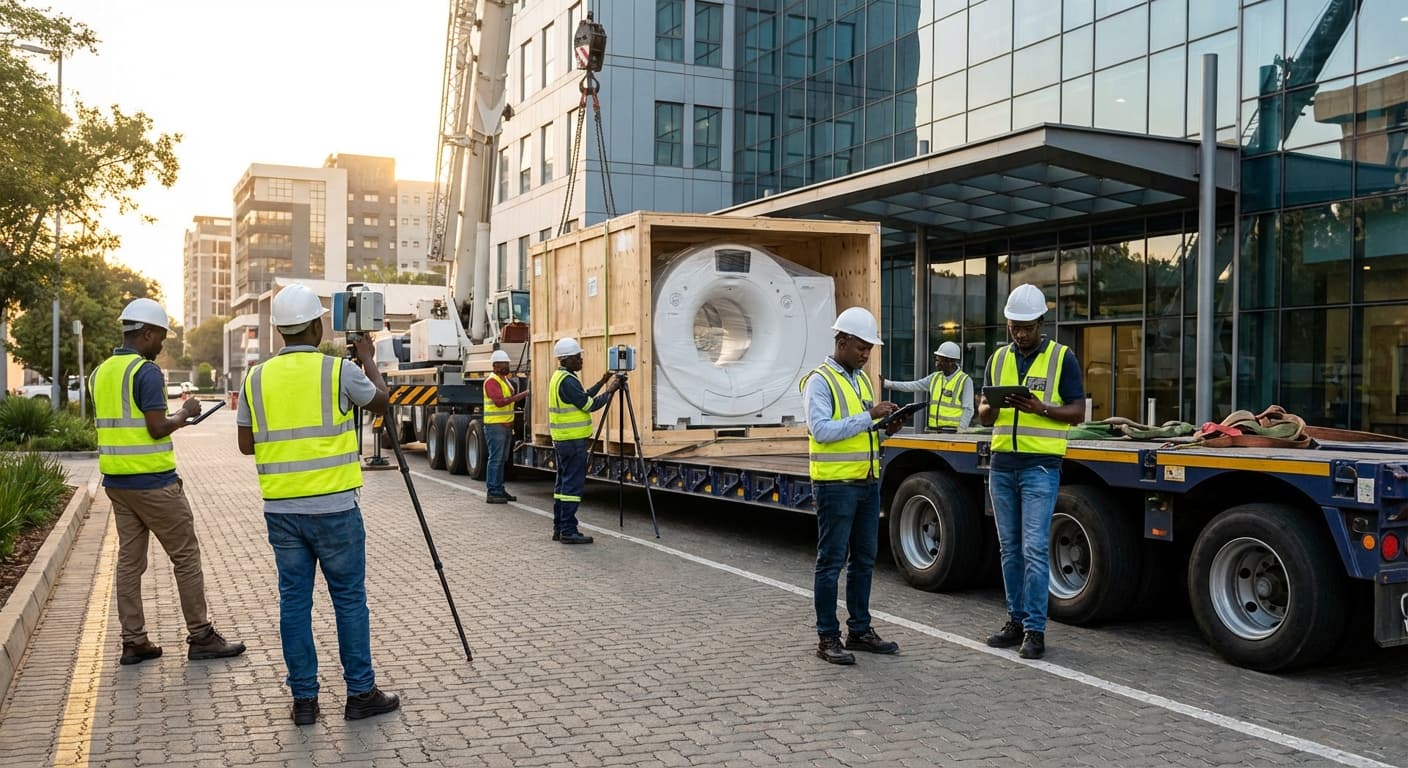
Route Survey & Rigging Plan Service for Heavy Medical Equipment in Central African Republic
Engineering Excellence & Technical Support
Route Survey & Rigging Plan Service for Heavy Medical Equipment High-standard technical execution following OEM protocols and local regulatory frameworks.
Precision Route Mapping & Obstacle Identification
Leveraging advanced LiDAR scanning and GIS technology, we meticulously survey all potential transport routes, identifying and mapping critical obstacles such as low bridges, narrow passages, weight-restricted infrastructure, and unpaved terrain. This ensures the safest and most efficient path for your heavy medical equipment.
Tailored Rigging & Load Securing Strategies
Our experienced rigging engineers develop bespoke lifting and lashing plans based on the specific dimensions, weight distribution, and fragility of each medical unit. We utilize specialized lifting equipment and techniques, ensuring secure transport and preventing any damage during transit and installation, even in challenging local conditions.
Environmental Risk Assessment & Mitigation
We conduct thorough environmental risk assessments, considering factors like seasonal road conditions, potential flooding, extreme temperatures, and local logistical challenges. Our service includes developing contingency plans and providing guidance on operational adjustments to mitigate these risks and guarantee on-time delivery.
What Is Route Survey & Rigging Plan Service For Heavy Medical Equipment In Central African Republic?
Route Survey & Rigging Plan Service for Heavy Medical Equipment in the Central African Republic (CAR) is a specialized logistical and engineering service focused on the safe and efficient transportation, installation, and deployment of oversized and exceptionally heavy medical apparatus within the unique operational environment of the CAR. This service addresses the complexities arising from the CAR's often underdeveloped infrastructure, remote locations, potential security challenges, and the intrinsic difficulties associated with handling sensitive, high-value medical technology.
| Who Needs This Service? | Typical Use Cases | ||||
|---|---|---|---|---|---|
| Hospitals and Healthcare Facilities: Central to ensuring the successful delivery and installation of large-scale medical imaging systems (MRI, CT scanners), linear accelerators, modular operating theaters, and advanced laboratory equipment, particularly in new constructions or expansions. | Government Health Ministries and Agencies: When procuring and deploying critical, high-value medical infrastructure to public health facilities across the CAR, especially in underserved or remote regions. This includes initiatives for disease control and public health improvement programs. | Non-Governmental Organizations (NGOs) and Humanitarian Aid Organizations: Involved in establishing or upgrading medical infrastructure in conflict-affected or disaster-prone areas of the CAR. This service is crucial for deploying specialized medical equipment to remote field hospitals and clinics. | International Development Banks and Funding Agencies: Overseeing the procurement and implementation of large medical equipment projects funded by international aid, requiring assurance of safe and effective deployment. | Equipment Manufacturers and Suppliers: Requiring specialized logistical and engineering support to deliver and install their complex, heavy medical equipment in challenging logistical environments like the CAR. | Construction and Engineering Companies: Undertaking projects involving the integration of heavy medical equipment into new or existing healthcare facilities, needing expert planning for access and installation. |
| Installation of MRI, CT Scanners, and PET Scanners: Due to their significant weight, size, and sensitivity to vibration and shock, these require meticulous route planning and precise rigging for placement within shielded rooms. | Deployment of Linear Accelerators for Radiotherapy: These complex and heavy machines necessitate specialized transport and lifting plans to ensure they are accurately positioned for clinical use, often involving basement installations. | Setting up Modular Operating Theaters or Diagnostic Imaging Centers: Often delivered as pre-fabricated units, these require careful route assessment and lifting strategies for positioning and integration. | Transport and Installation of Large-Scale Laboratory Equipment: Including biosafety cabinets, industrial-grade centrifuges, and complex analytical instruments requiring controlled environments and precise placement. | Relocation of Existing Heavy Medical Equipment: Within or between facilities in the CAR, demanding a re-evaluation of routes and rigging plans based on current conditions. | Delivery of Specialized Medical Equipment to Remote Clinics or Field Hospitals: Where infrastructure is minimal, requiring creative solutions for access and installation. |
Key Components of the Service
- Route Feasibility Assessment: Comprehensive analysis of potential transportation routes, evaluating road conditions (paved, unpaved, bridges, culverts), terrain, gradient, obstacles (overhead clearances, power lines, buildings), traffic patterns, and any temporary or permanent access restrictions. This includes detailed mapping and GPS data acquisition.
- Load Capacity & Structural Integrity Checks: Verification of the load-bearing capacity of bridges, overpasses, and other critical infrastructure elements along the proposed route. This may involve structural engineering assessments and calculations.
- Permitting & Authorization Acquisition: Navigating and securing all necessary permits from national, regional, and local authorities for oversized and overweight transport, as well as access permissions for sensitive areas (e.g., hospital grounds, research facilities).
- Risk Assessment & Mitigation Strategy Development: Identification of potential risks during transit and installation, including security threats, environmental factors (weather, natural hazards), equipment damage, and operational disruptions. Development of comprehensive mitigation plans and contingency procedures.
- Specialized Transport Planning: Selection and coordination of appropriate heavy-haul transport vehicles, specialized trailers (e.g., modular trailers, self-propelled modular transporters - SPMTs), and auxiliary equipment. This includes route optimization for vehicle dimensions and weight distribution.
- Rigging & Lifting Plan Development: Detailed engineering plans for the safe lifting, maneuvering, and precise positioning of the medical equipment at its final destination. This encompasses: a. Selection of appropriate lifting equipment (cranes, gantries, jacks). b. Calculation of load stresses and required lifting capacities. c. Design of lifting frames, slings, and spreader beams. d. Development of step-by-step lifting procedures with clear safety protocols and personnel assignments. e. Environmental considerations for lifting operations (wind, ground stability).
- Site Preparation & Access Engineering: Assessment and, if necessary, modification of the installation site to ensure adequate access, stable ground conditions for lifting operations, and clearance for equipment placement. This may involve temporary road construction, reinforcement of loading/unloading zones, or structural modifications to buildings.
- On-Site Supervision & Execution: Provision of experienced technical personnel to oversee and manage the entire transportation and installation process, ensuring adherence to the developed plans, safety standards, and optimal equipment handling.
- Documentation & Reporting: Comprehensive documentation of all surveys, plans, permits, risk assessments, and execution reports for client records and future reference.
Who Needs Route Survey & Rigging Plan Service For Heavy Medical Equipment In Central African Republic?
Navigating the complexities of transporting and installing heavy medical equipment in the Central African Republic (CAR) presents unique challenges. For organizations involved in such endeavors, specialized Route Survey & Rigging Plan Services are not just beneficial, but often critical for success, safety, and compliance. These services ensure that the chosen routes are navigable, the lifting and positioning are executed with precision, and the entire operation is meticulously planned and documented.
| Target Customer/Department | Key Needs & Responsibilities | How Route Survey & Rigging Plan Service Helps |
|---|---|---|
| Hospitals/Healthcare Facilities (Procurement, Facilities Management, Biomedical Engineering) | Acquiring and installing advanced medical equipment. Ensuring operational readiness. Managing infrastructure modifications. Minimizing disruption to patient care. | Identifies feasible access routes and potential obstacles. Develops safe and efficient rigging plans for installation, ensuring equipment integrity and minimal downtime. |
| Government Health Ministries/Agencies (Procurement, Infrastructure Development) | Equipping public hospitals and clinics nationwide. Overseeing national healthcare infrastructure projects. Ensuring equitable access to medical technology. | Facilitates planning for nationwide equipment deployment. Identifies logistical challenges in remote areas. Supports budget allocation for specialized transport and installation. |
| NGOs/International Aid Organizations (Logistics, Program Management, Health Projects) | Delivering critical medical equipment to underserved regions. Implementing health programs and disaster response. Ensuring the sustainability of healthcare interventions. | Overcomes logistical hurdles in challenging terrains. Provides a framework for safe and cost-effective equipment deployment. Enhances project planning and risk mitigation. |
| Medical Equipment Manufacturers/Suppliers (Logistics, Field Service Engineering) | Ensuring on-time delivery and professional installation of their equipment. Maintaining product warranty and performance standards. Managing global supply chains. | Provides detailed route analysis for delivery. Creates precise rigging and installation procedures to protect valuable assets. Offers documented evidence of safe and professional execution. |
| Logistics/Freight Forwarding Companies (Project Cargo, Special Operations) | Managing the transportation of oversized and heavy items. Ensuring compliance with international and local regulations. Providing end-to-end logistics solutions. | Offers expertise in navigating complex transport environments. Develops detailed plans for complex lifts and movements. Mitigates risks associated with specialized cargo handling. |
| Construction/Engineering Firms (Project Management, Site Operations) | Building and renovating healthcare facilities. Coordinating the integration of specialized equipment. Ensuring project timelines and safety standards. | Integrates equipment installation requirements into the construction schedule. Identifies structural considerations for rigging and placement. Ensures seamless handover of facilities. |
Who Needs Route Survey & Rigging Plan Service for Heavy Medical Equipment in Central African Republic?
- Hospitals and Healthcare Facilities undergoing expansion, renovation, or installation of new, large-scale medical machinery (e.g., MRI scanners, CT scanners, linear accelerators).
- Government Health Ministries and Agencies responsible for equipping public healthcare infrastructure across the CAR.
- Non-Governmental Organizations (NGOs) and International Aid Organizations involved in healthcare development, disaster relief, or specialized medical missions.
- Medical Equipment Manufacturers and Suppliers responsible for the final delivery, installation, and commissioning of their products at client sites.
- Logistics and Freight Forwarding Companies specializing in oversized and project cargo, particularly those undertaking healthcare-related shipments to the CAR.
- Construction and Engineering Firms contracted for the building or modification of healthcare facilities that require the precise placement of heavy medical equipment.
Route Survey & Rigging Plan Service For Heavy Medical Equipment Process In Central African Republic
This document outlines the comprehensive workflow for our Route Survey & Rigging Plan Service, specifically tailored for the transportation and installation of heavy medical equipment in the Central African Republic (CAR). Our service ensures safe, efficient, and compliant movement of critical medical assets, mitigating risks associated with complex logistical challenges, challenging terrain, and varying infrastructure in the CAR. The process is designed to be transparent and collaborative, from initial client inquiry to final execution and handover.
| Stage | Description | Key Activities | Deliverables/Outcomes | Responsible Party | Timeline (Indicative) |
|---|---|---|---|---|---|
| Understanding client needs and project scope for heavy medical equipment transport and installation in CAR. | Receive and review client inquiry, conduct initial virtual or in-person meeting, discuss equipment specifications, origin/destination, budget, and timeline. | Project brief, preliminary scope of work, non-disclosure agreement (if required). | Client & Service Provider | 1-3 Business Days |
| Gathering detailed information about the equipment, origin, destination, and potential routes within CAR. | Detailed equipment specifications (dimensions, weight, center of gravity), structural integrity of packaging, origin facility survey (access, load-out capabilities), destination facility survey (unloading bays, interior pathways, installation site). | Equipment data sheets, site survey reports, photographic evidence, preliminary CAD sketches of access points. | Service Provider (with Client input) | 3-7 Business Days (depending on site accessibility) |
| Identifying, assessing, and selecting the most viable and safe transportation routes within the CAR. | Analysis of road networks (condition, load limits, width/height restrictions), bridge capacities, potential obstacles (e.g., low underpasses, sharp turns, unpaved sections), security considerations, availability of suitable transport vehicles. | Identified primary and alternative routes, route maps with critical points marked, risk assessment of each route, preliminary cost estimates for transport. | Service Provider | 5-10 Business Days |
| Creating a detailed, step-by-step plan for the safe lifting, lashing, and movement of the heavy medical equipment. | Specifying lifting equipment (cranes, forklifts, jacks), rigging gear (slings, shackles, spreader bars), lifting points on equipment, load calculations, sequence of operations, safety protocols, emergency procedures, personnel roles and responsibilities. | Comprehensive Rigging Plan document, including diagrams, schematics, load charts, and safety checklists. | Service Provider | 7-14 Business Days |
| Ensuring the client is fully informed and approves of the proposed route and rigging plans. | Presenting route survey findings and rigging plan to the client, addressing any concerns or questions, incorporating client feedback. | Client sign-off on Route Survey Report and Rigging Plan. | Client & Service Provider | 3-5 Business Days |
| Obtaining necessary permits and ensuring compliance with local regulations in the CAR. | Liaising with relevant authorities for transportation permits, road usage permits, import/export documentation (if applicable), and adherence to any specific CAR regulations for heavy cargo movement. | All required permits secured, compliance documentation updated. | Service Provider (with Client support) | Variable (can be lengthy, requires proactive engagement) |
| Mobilizing resources and conducting final checks before operations commence. | Confirming transport vehicle availability and suitability, pre-mobilization of rigging equipment, final safety briefings for the operational team, site preparation at origin and destination, communication protocols establishment. | Mobilization plan, final equipment checks, assembled operational team. | Service Provider | 2-5 Business Days |
| Implementing the approved route survey and executing the rigging and transportation plan. | On-ground route verification (if necessary), securing the equipment for transport, supervised lifting and loading, convoy management, supervised unloading and positioning at the destination facility. | Successful and safe transport and placement of the medical equipment. | Service Provider | Variable (depends on distance and complexity) |
| Finalizing the project and providing all necessary documentation. | Site clean-up, equipment demobilization, final inspection with client representative, provision of a comprehensive project close-out report including survey data, rigging logs, incident reports (if any), and photographic evidence. | Project completion report, final invoice, handover of all project documentation. | Service Provider & Client | 2-3 Business Days |
Workflow Stages
- 1. Inquiry & Initial Consultation:
- 2. Site Assessment & Data Collection:
- 3. Route Feasibility & Optimization:
- 4. Rigging Plan Development:
- 5. Client Review & Approval:
- 6. Permitting & Regulatory Compliance:
- 7. Pre-Execution Preparations:
- 8. Execution (Route Survey & Rigging Operations):
- 9. Post-Execution & Handover:
Route Survey & Rigging Plan Service For Heavy Medical Equipment Cost In Central African Republic
Estimating the cost for a Route Survey & Rigging Plan Service for heavy medical equipment in the Central African Republic (CAR) is complex due to a confluence of unique logistical challenges, infrastructure limitations, and economic factors. This service is crucial for ensuring the safe and efficient transport and installation of specialized medical devices, which can range from large imaging machines (like MRI or CT scanners) to specialized surgical units. The pricing is highly variable and will depend on a multitude of factors, all contributing to the overall risk and effort involved. The CAR presents a particularly challenging environment for such operations, necessitating robust planning and execution to overcome potential obstacles.
| Service Component | Estimated Cost Range (XAF - Central African CFA Franc) | Notes |
|---|---|---|
| Route Survey (Initial Assessment & Data Collection) | 500,000 - 2,500,000 | Varies with route length, complexity, and need for detailed mapping/GPS data. |
| Rigging Plan Development (Detailed Engineering) | 750,000 - 3,000,000 | Dependent on equipment size, weight, rigging complexity, and required engineering calculations. |
| Transportation Logistics & Planning (Local) | 1,000,000 - 5,000,000+ | Covers specialized vehicle hire, fuel, driver fees, and coordination. Highly dependent on distance and road conditions. |
| Rigging Crew & Equipment Hire (Local) | 1,500,000 - 7,000,000+ | Includes skilled riggers, crane operators, and rental of specialized lifting equipment. Availability is a major factor. |
| Security Escort & Risk Mitigation | 800,000 - 4,000,000+ | Essential in CAR. Cost depends on the level of threat assessment and required escort personnel/vehicles. |
| Permits, Approvals & Administration | 200,000 - 1,000,000 | Covers application fees, administrative processing, and potential consultancy for navigating bureaucracy. |
| Insurance Premiums | Highly Variable (3-10% of total project value) | Based on the value of equipment, perceived risks, and chosen coverage levels. |
| Contingency (10-20% of total estimated costs) | Varies | Crucial for unforeseen issues, especially in a challenging environment like CAR. |
| Total Estimated Cost (Indicative Range) | 5,000,000 - 30,000,000+ XAF | This is a broad estimate. Specific project details will significantly alter the final cost. Consider this as a starting point for budgeting. |
Key Pricing Factors for Route Survey & Rigging Plan Service (CAR)
- Equipment Size, Weight, and Sensitivity: Larger, heavier, and more delicate equipment will require more specialized rigging, transportation, and planning, increasing costs.
- Route Complexity and Accessibility: The condition of existing roads, bridges, and the remoteness of the final destination significantly impact planning and execution. Poor infrastructure often necessitates specialized transport and potential road improvements.
- Distance to Destination: Longer transport distances inherently increase fuel, labor, and logistical costs.
- Security Situation and Risk Assessment: The prevailing security environment in CAR necessitates enhanced security measures, including escort services, risk mitigation strategies, and potentially insurance premiums, all of which add to the cost.
- Required Rigging Expertise and Equipment: Specialized cranes, lifting gear, and highly trained rigging crews are essential for heavy equipment. The availability and cost of these resources in CAR are key determinants.
- Permits and Approvals: Navigating local bureaucracy for necessary transport permits, road access approvals, and potentially customs clearance can be time-consuming and incur administrative fees.
- Survey and Assessment Duration: The complexity of the route and the equipment will dictate the time required for thorough surveys, including site assessments, clearance checks, and detailed rigging plans.
- Contingency Planning and Emergency Preparedness: Due to the inherent risks in CAR, comprehensive contingency plans for unforeseen events (e.g., breakdowns, security incidents, weather) are essential and factored into the pricing.
- Time Sensitivity of the Project: Urgent projects may incur additional costs due to expedited planning, resource allocation, and potential overtime for personnel.
- Local Partner and Supplier Costs: The reliance on local logistics providers, security firms, and specialized labor in CAR will influence the overall cost structure.
- Insurance Coverage: Comprehensive insurance for the equipment, transport, and personnel is vital and contributes to the overall service cost.
- Reporting and Documentation: The level of detail and comprehensiveness of the route survey reports and rigging plans can also influence pricing.
Affordable Route Survey & Rigging Plan Service For Heavy Medical Equipment Options
Navigating the logistics of installing heavy medical equipment requires a meticulous route survey and a robust rigging plan. Our service ensures a safe, efficient, and cost-effective installation by identifying potential obstacles, calculating load capacities, and developing a detailed execution strategy. We understand that budget is a crucial factor for healthcare facilities, which is why we offer flexible value bundles and implement strategic cost-saving measures.
| Cost-Saving Strategy | Description | Benefit |
|---|---|---|
| Early Engagement | Involving our team during the initial planning stages allows for proactive identification of issues and optimization of routes and rigging methods. | Reduces the need for costly last-minute adjustments or alternative solutions. |
| Multi-Equipment Discount | Bundling the route survey and rigging plan for multiple pieces of equipment at once. | Leverages economies of scale for planning and execution. |
| Standardized Equipment Utilization | Where feasible, recommending and utilizing standardized lifting and rigging equipment for multiple projects. | Reduces rental costs and familiarizes installation teams with equipment. |
| Digital Survey & Modeling | Utilizing advanced laser scanning and 3D modeling software to conduct surveys and create detailed plans. | Minimizes the need for multiple on-site visits and provides highly accurate data for precise planning. |
| Pre-Fabricated Rigging Components | Designing rigging solutions that can utilize pre-fabricated or modular components where appropriate. | Speeds up on-site assembly and reduces labor costs. |
| Clear Communication & Collaboration | Maintaining open lines of communication with facility management, contractors, and equipment manufacturers. | Prevents misunderstandings, delays, and rework, all of which contribute to increased costs. |
Value Bundles
- Basic Bundle: Includes a comprehensive route survey of up to 3 potential installation paths and a preliminary rigging plan outlining key equipment and access points.
- Standard Bundle: Expands on the Basic Bundle with detailed 3D path modeling, precise weight and center of gravity calculations, and a multi-stage rigging plan with equipment specifications.
- Premium Bundle: Our most comprehensive offering, featuring on-site assessment by a certified rigging engineer, detailed structural integrity checks, and a full project management integration for the rigging phase, including contingency planning and final sign-off.
Verified Providers In Central African Republic
Finding verified healthcare providers in the Central African Republic (CAR) is crucial for ensuring quality and trustworthy medical care. Franance Health stands out as a leading organization in this regard. Their rigorous credentialing process and commitment to excellence make them the best choice for individuals seeking reliable healthcare services within the CAR. This document outlines why Franance Health's credentials are so significant and what makes them the preferred option.
| Credential Type | Franance Health Verification Process | Importance for Patients in CAR |
|---|---|---|
| Medical License/Registration | Verification of current, valid medical license from the relevant national or regional licensing body. | Ensures the provider is legally authorized to practice medicine and meets minimum competency requirements. |
| Educational Qualifications | Validation of degrees, diplomas, and certifications from accredited medical institutions. | Confirms the provider has received appropriate academic training in their field of specialization. |
| Professional Experience | Review of work history, including previous positions, duration of practice, and areas of expertise. | Indicates the provider's practical skills and experience in managing various medical conditions. |
| Specialization Certifications | Confirmation of specialized training and board certifications in specific medical disciplines. | Guarantees that the provider possesses advanced knowledge and skills in their chosen area of medicine. |
| Background Checks (where applicable) | May include checks for any disciplinary actions or malpractice claims. | Provides an additional layer of assurance regarding the provider's professional conduct and integrity. |
| Continuing Medical Education (CME) | Encouragement and tracking of providers' engagement in ongoing professional development. | Demonstrates a commitment to staying updated with the latest medical advancements and techniques. |
Why Franance Health is the Top Choice for Verified Providers in CAR:
- Rigorous Vetting Process: Franance Health employs a comprehensive and multi-faceted approach to verify the credentials of every provider listed on their platform. This includes checking medical licenses, certifications, educational backgrounds, and professional experience.
- Focus on Quality of Care: Beyond basic verification, Franance Health prioritizes providers who demonstrate a commitment to high standards of patient care, ethical practices, and continuous professional development.
- Transparency and Accessibility: Franance Health ensures that patients have easy access to verified provider information, including their specializations, qualifications, and contact details, fostering trust and informed decision-making.
- Adherence to International Standards: The credentialing protocols at Franance Health are designed to align with international best practices in healthcare provider verification, offering peace of mind to both local and international patients.
- Commitment to Patient Safety: By meticulously vetting providers, Franance Health plays a vital role in enhancing patient safety and reducing the risks associated with seeking healthcare from unverified sources.
- Local Expertise and Network: Franance Health possesses deep understanding of the healthcare landscape in the Central African Republic, enabling them to identify and partner with the most reputable and capable medical professionals.
Scope Of Work For Route Survey & Rigging Plan Service For Heavy Medical Equipment
This Scope of Work (SOW) outlines the services required for the Route Survey and Rigging Plan for the transportation and installation of heavy medical equipment. The objective is to ensure safe, efficient, and compliant movement and placement of critical medical assets, minimizing risks to personnel, equipment, and infrastructure. This SOW details the technical deliverables and the standard specifications to be adhered to throughout the project lifecycle.
| Section | Description | Deliverables | Standard Specifications / Key Considerations |
|---|---|---|---|
| Comprehensive assessment of all potential transport routes from point of entry to final installation location. |
|
|
| Detailed planning for the lifting, moving, and positioning of each heavy medical equipment item. |
|
|
| Evaluation of the installation area to ensure it's suitable for equipment placement and rigging operations. |
|
|
| Compilation and submission of all survey data, plans, and risk assessments for review and approval. |
|
|
| Ensuring all personnel involved possess the necessary qualifications and adherence to strict safety protocols. |
|
|
Key Objectives
- Identify and mitigate all potential hazards along the designated transport routes.
- Develop comprehensive rigging and lifting plans for each piece of equipment.
- Ensure compliance with all relevant local, national, and international safety regulations and standards.
- Provide detailed documentation for client approval and record-keeping.
- Minimize downtime and disruption to hospital operations.
- Facilitate smooth and successful installation of the medical equipment.
Service Level Agreement For Route Survey & Rigging Plan Service For Heavy Medical Equipment
This Service Level Agreement (SLA) outlines the response times and uptime guarantees for the Route Survey & Rigging Plan Service provided for the transportation and installation of heavy medical equipment. This SLA is an addendum to the Master Service Agreement (MSA) between [Your Company Name] (Provider) and [Client Company Name] (Client).
| Issue Type | Initial Response Time Guarantee | Resolution Target | Uptime Guarantee |
|---|---|---|---|
| Critical Issue | 1 Business Hour | Within 4 Business Hours of initial response | N/A (Focus on immediate resolution) |
| Urgent Issue | 2 Business Hours | Within 8 Business Hours of initial response | N/A (Focus on timely resolution) |
| Standard Issue | 4 Business Hours | Within 24 Business Hours of initial response | N/A (Focus on efficient handling) |
| Service Availability (for access to planning tools/portals) | N/A | N/A | 99.5% during Business Hours |
Key Service Definitions
- {"item":"Route Survey: The process of assessing and documenting the optimal and safest transportation path for heavy medical equipment, considering factors such as road conditions, bridge weight limits, overhead obstructions, and traffic regulations."}
- {"item":"Rigging Plan: A detailed document outlining the procedures, equipment, and safety protocols required for the lifting, maneuvering, and positioning of heavy medical equipment at both origin and destination sites."}
- {"item":"Critical Issue: An event that significantly impedes the scheduled progress of the route survey or rigging plan development, preventing the delivery of essential deliverables within the agreed-upon timelines. Examples include critical system failures of survey equipment, unavailability of key personnel due to unforeseen circumstances, or inability to access critical survey data."}
- {"item":"Urgent Issue: An issue that impacts the immediate progress of the route survey or rigging plan development but can be worked around or resolved with minor delays. Examples include minor equipment malfunctions requiring troubleshooting or requests for minor clarification on existing plans."}
- {"item":"Standard Issue: An issue that does not immediately impact the progress of the survey or plan development and can be addressed within normal business hours. Examples include general inquiries, requests for documentation updates, or non-critical feedback."}
- {"item":"Business Hours: [Specify your company's standard business hours, e.g., Monday to Friday, 9:00 AM to 5:00 PM, excluding public holidays]."}
Frequently Asked Questions

Ready when you are
Let's scope your Route Survey & Rigging Plan Service for Heavy Medical Equipment in Central African Republic project in Central African Republic.

Scaling healthcare logistics and technical systems across the entire continent.