
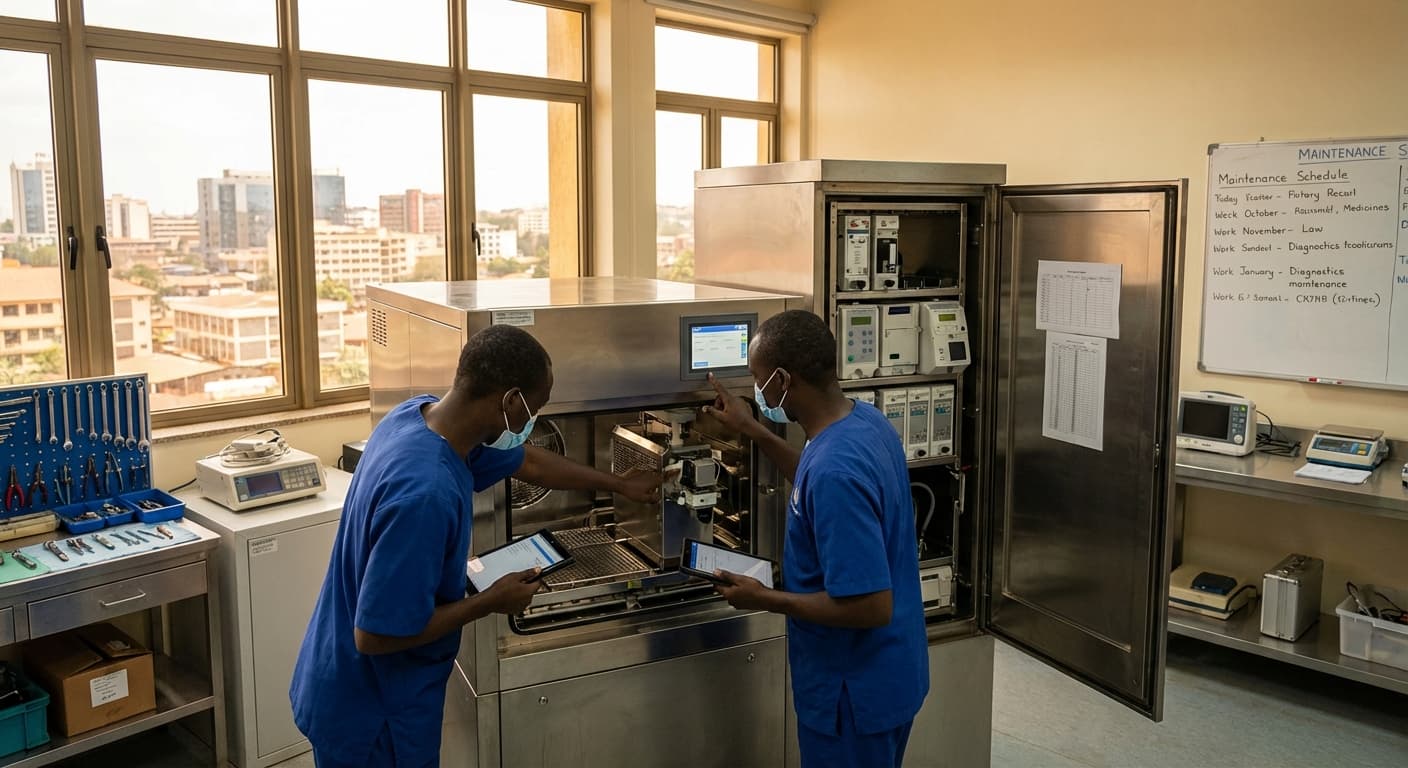
Total Cost of Ownership (TCO) & Lifecycle Budgeting Service in Central African Republic
Engineering Excellence & Technical Support
Total Cost of Ownership (TCO) & Lifecycle Budgeting Service High-standard technical execution following OEM protocols and local regulatory frameworks.
Predictive Cost Modeling for Infrastructure Projects
Leveraging advanced analytics and historical data specific to the Central African Republic's economic and logistical landscape, our TCO service provides granular, predictive cost models for critical infrastructure development. This includes factoring in import duties, local labor costs, volatile fuel prices, and remote access challenges to ensure accurate, long-term financial planning and risk mitigation.
Lifecycle Value Optimization for Resource Extraction
We specialize in optimizing the total cost of ownership for resource extraction operations in the CAR. Our service goes beyond initial capital expenditure, integrating operational efficiency, maintenance schedules, spare parts management, and end-of-life decommissioning costs. By identifying cost-saving opportunities throughout the entire lifecycle, we maximize asset value and profitability in challenging environments.
Resilience-Focused Budgeting for Public Services
Our TCO and Lifecycle Budgeting service for public services in the CAR emphasizes resilience against infrastructure degradation, supply chain disruptions, and potential security challenges. We develop comprehensive budgets that account for long-term maintenance, emergency preparedness, and the total cost of service delivery over decades, ensuring sustainable and reliable access to essential services for communities.
What Is Total Cost Of Ownership (Tco) & Lifecycle Budgeting Service In Central African Republic?
Total Cost of Ownership (TCO) and Lifecycle Budgeting services in the Central African Republic (CAR) represent a strategic approach to financial management that extends beyond initial acquisition costs. TCO quantifies the complete spectrum of expenses associated with an asset, system, or project throughout its entire operational lifespan, from procurement and implementation to maintenance, support, upgrades, and eventual disposal. Lifecycle Budgeting, intrinsically linked to TCO, involves the systematic forecasting and allocation of financial resources across all phases of an asset's existence. This service is critical for entities in the CAR grappling with resource constraints and the imperative for sustainable development. It facilitates informed decision-making by revealing the true economic impact of capital expenditures, promoting operational efficiency, and mitigating unforeseen financial burdens.
| Who Needs TCO & Lifecycle Budgeting in CAR? | Typical Use Cases | |||
|---|---|---|---|---|
| Government Ministries and Agencies (e.g., Ministry of Finance, Ministry of Infrastructure, Ministry of Health): For capital investments in public infrastructure (roads, bridges, hospitals), essential services (water treatment, power generation), and fleet management. | Procurement of large-scale infrastructure projects, including feasibility studies and long-term operational planning. | Acquisition of critical medical equipment and establishment of sustainable healthcare systems. | Management of national vehicle fleets and public transportation systems. | Investment in national security apparatus and defense equipment. |
| International Development Organizations and NGOs: For program implementation and project sustainability in sectors such as education, agriculture, and humanitarian aid. | Investment in educational facilities and technology to ensure long-term educational outcomes. | Deployment of agricultural machinery and irrigation systems for sustainable food production. | Provision of essential goods and services with a focus on long-term accessibility and affordability. | Management of fleets for logistical support and aid delivery. |
| Parastatal Organizations and State-Owned Enterprises (e.g., Électricité Centrafricaine, Société d'Exploitation des Transports): For assets critical to national economic functioning. | Replacement and modernization of power generation and distribution infrastructure. | Acquisition and maintenance of rolling stock and transportation networks. | Investment in telecommunications infrastructure and service delivery. | |
| Private Sector Enterprises (especially those involved in resource extraction, large-scale agriculture, or infrastructure development): For strategic investment planning and risk mitigation. | Acquisition of heavy machinery for mining operations and ongoing maintenance planning. | Investment in agricultural equipment and processing facilities for long-term yield optimization. | Development of commercial real estate and operational facilities with an eye on future expansion and maintenance. | |
| Financial Institutions and Lenders: To assess the long-term viability and risk associated with loan portfolios financing capital assets. | Evaluation of loan applications for significant infrastructure or industrial projects. | Risk assessment for financing large equipment purchases. |
Key Components of TCO & Lifecycle Budgeting Services in CAR
- Initial Acquisition Costs: Includes purchase price, taxes, duties, shipping, and initial installation.
- Operating Costs: Encompasses energy consumption, consumables, staffing, routine maintenance, and scheduled servicing.
- Maintenance and Repair Costs: Covers unplanned breakdowns, replacement parts, and specialized repair services.
- Upgrade and Enhancement Costs: Addresses modifications to improve performance, security, or functionality.
- Decommissioning and Disposal Costs: Includes dismantling, environmental remediation, and responsible waste management.
- Financing Costs: Interest payments on loans or leases associated with the asset.
- Training and Skill Development: Costs associated with educating personnel on the operation and maintenance of assets.
- Downtime Costs: Indirect costs incurred due to asset unavailability, such as lost productivity or revenue.
- Risk Assessment and Contingency Planning: Identification of potential risks and allocation of funds for unforeseen events.
Who Needs Total Cost Of Ownership (Tco) & Lifecycle Budgeting Service In Central African Republic?
In the Central African Republic (CAR), understanding the true expense of assets over their entire lifespan, known as Total Cost of Ownership (TCO) and Lifecycle Budgeting, is crucial for organizations striving for efficiency, sustainability, and effective resource allocation. This approach goes beyond the initial purchase price to encompass all costs associated with an asset, from acquisition and operation to maintenance, repair, and eventual disposal. While the CAR faces unique economic and infrastructural challenges, implementing TCO and lifecycle budgeting can unlock significant advantages for a wide range of entities.
| Target Customer/Entity | Relevant Departments/Functions |
|---|---|
| Government of CAR | Ministry of Finance and Budget, Ministry of Public Works and Infrastructure, Ministry of Transport, Ministry of Energy, Ministry of Health, Ministry of Education, Auditor General's Office |
| International Development Agencies (e.g., UN agencies, World Bank, African Development Bank) | Project Management Offices, Procurement Departments, Finance and Operations, Infrastructure Divisions |
| Mining and Extractive Industries | Asset Management, Operations, Finance, Procurement, Maintenance and Engineering, Capital Projects |
| Telecommunications Providers | Network Operations, Capital Expenditure Planning, Finance, Procurement, Asset Management |
| Transportation and Logistics Companies | Fleet Management, Operations, Procurement, Finance, Maintenance and Repair |
| Large Agricultural Enterprises | Farm Operations, Equipment Management, Finance, Procurement, Maintenance |
| Construction and Engineering Firms | Project Management, Estimating, Procurement, Fleet Management, Finance |
| Financial Institutions/Development Banks | Credit Analysis, Project Finance, Risk Management, Asset Valuation |
Who Needs TCO & Lifecycle Budgeting Service in CAR?
- Government ministries and agencies responsible for infrastructure, public services, and asset management.
- International development organizations and NGOs implementing projects and managing assets in the CAR.
- Large industrial enterprises with significant capital investments (e.g., mining, agriculture, energy).
- Telecommunications companies with extensive network infrastructure.
- Transportation and logistics companies managing fleets and equipment.
- Financial institutions and development banks involved in project financing and asset evaluation.
- Educational and healthcare institutions with long-term infrastructure and equipment needs.
- Companies involved in major construction and civil engineering projects.
Total Cost Of Ownership (Tco) & Lifecycle Budgeting Service Process In Central African Republic
This document outlines the typical workflow for a Total Cost of Ownership (TCO) and Lifecycle Budgeting service process within the Central African Republic (CAR), from initial client inquiry to project execution and final reporting. The process is designed to be comprehensive, ensuring all relevant costs and future expenditures are considered for optimal decision-making in asset acquisition and management.
| Phase | Key Activities | Deliverables | Key Stakeholders | Considerations for CAR Context |
|---|---|---|---|---|
| Client contacts service provider with a requirement for TCO and lifecycle budgeting. Understanding the client's objectives, the specific asset(s) or project(s) in question, and the desired timeframe. | Service Agreement / Scope of Work | Client (Decision Makers, Finance Department, Procurement) | Language barriers, potential need for local intermediaries, clarity on currency and inflation expectations. |
| Detailed discussions to understand the asset's intended use, operational environment, expected lifespan, and potential future upgrades or replacements. Gathering historical data on acquisition costs, operational expenses (energy, maintenance, labor), disposal costs, and any relevant market data. | Data Collection Plan, Initial Data Repository | Client (Operations, Maintenance, Finance, IT, HR) | Reliability of existing data, potential for informal record-keeping, importance of site visits and on-ground verification, understanding local infrastructure limitations (e.g., power stability). |
| Establishing a structured framework to capture all direct and indirect costs associated with the asset throughout its lifecycle. This includes acquisition, operation, maintenance, support, disposal, and potential downtime costs. | TCO Calculation Spreadsheet / Software Model | Service Provider (Analysts, Consultants) | Adapting standard TCO models to local economic conditions, considering import duties and taxes specific to CAR, factoring in potential currency fluctuations. |
| Extending the TCO to forecast all costs over the entire projected lifespan of the asset. This involves projecting future operational expenditures, maintenance schedules, potential technology obsolescence, and end-of-life disposal or decommissioning costs. | Lifecycle Cost Projection Report, Sensitivity Analysis | Service Provider (Analysts, Financial Modellers) | Accounting for projected inflation rates in CAR, assessing the availability and cost of spare parts and skilled labor over time, understanding local regulations on waste disposal and environmental impact. |
| Translating the TCO and lifecycle cost analysis into actionable budgets. Developing phased budgets that align with the asset's lifecycle, including capital expenditure (CAPEX) and operational expenditure (OPEX) projections. Identifying funding requirements and potential financing options. | Phased Budget Plan, Capital Expenditure Forecasts, Operational Expenditure Forecasts | Service Provider (Financial Analysts), Client (Finance Department, Budget Officers) | Understanding the CAR government's budgeting cycles and approval processes, identifying potential local funding sources or development partner support, considering foreign exchange controls. |
| Compiling all findings into clear and concise reports. Presenting the TCO and lifecycle budget to client stakeholders, explaining methodologies, key assumptions, and recommendations. Facilitating discussion and answering queries. | Final TCO & Lifecycle Budgeting Report, Executive Summary, Presentation Slides | Service Provider (Consultants, Project Managers), Client (Senior Management, Steering Committee) | Ensuring reports are accessible and understandable to non-technical stakeholders, providing clear justifications for cost estimations, adapting presentation style to local cultural norms. |
| Assisting the client in implementing the budget and operational plans. Providing guidance on procurement strategies, maintenance scheduling, and resource allocation based on the TCO analysis. Establishing mechanisms for ongoing cost monitoring and performance tracking. | Implementation Guidelines, Monitoring Framework, Performance Metrics | Service Provider (Consultants, Advisors), Client (Procurement, Operations, Finance) | Establishing practical monitoring systems with limited technological infrastructure, training local staff on cost tracking, adapting monitoring to the realities of the CAR operational environment. |
| Periodically reviewing the TCO and lifecycle budget against actual expenditure and performance. Identifying variances, understanding reasons for deviations, and making necessary adjustments to future projections and operational strategies. This is an iterative process. | Performance Review Reports, Updated Forecasts, Recommendations for Improvement | Service Provider (Consultants), Client (All relevant departments) | Ensuring continuous improvement by learning from actual operational experiences in CAR, adapting to unforeseen economic or political changes, maintaining long-term relationships for ongoing support. |
Total Cost of Ownership (TCO) & Lifecycle Budgeting Service Process Workflow (Central African Republic)
- Initial Inquiry & Scoping
- Needs Assessment & Data Gathering
- TCO Model Development
- Lifecycle Cost Analysis
- Budgeting & Financial Planning
- Reporting & Presentation
- Implementation Support & Monitoring
- Review & Refinement
Total Cost Of Ownership (Tco) & Lifecycle Budgeting Service Cost In Central African Republic
The Total Cost of Ownership (TCO) and Lifecycle Budgeting service, when applied in the Central African Republic (CAR), presents unique pricing considerations influenced by several factors. These factors are often amplified by the CAR's economic landscape, infrastructure challenges, and the specific nature of the projects or assets being evaluated. Accurate TCO and lifecycle budgeting are crucial for organizations operating in CAR to ensure long-term financial sustainability, mitigate unforeseen expenses, and make informed investment decisions. The pricing for these services will vary based on the complexity of the asset or project, the duration of the lifecycle being analyzed, the availability and reliability of data, the expertise of the consultants, and the overall economic stability and currency fluctuations within the CAR.
| Service Component/Complexity | Estimated Range (XAF) | Notes |
|---|---|---|
| Basic TCO Assessment (Simple Asset, Short Lifecycle) | 1,500,000 - 3,000,000 XAF | Covers essential initial purchase costs, basic operational expenses, and a short-term outlook. Data availability assumed to be reasonable. |
| Standard TCO Analysis (Moderate Asset/Project, Medium Lifecycle) | 3,000,000 - 7,000,000 XAF | Includes detailed operational costs, maintenance, potential upgrades, and a medium-term lifecycle (5-10 years). Requires moderate data gathering efforts. |
| Comprehensive Lifecycle Budgeting (Complex Asset/Project, Long Lifecycle) | 7,000,000 - 15,000,000+ XAF | Extensive analysis over a long lifecycle (10+ years), incorporating all direct and indirect costs, risk assessments, financing, obsolescence, and end-of-life. Significant data collection and advanced modeling required, especially in challenging CAR environment. |
| Specialized Modules (e.g., Sustainability, Risk, End-of-Life) | Additional 1,000,000 - 5,000,000+ XAF per module | Added on top of the base TCO analysis for deeper insights into specific aspects of the lifecycle. |
| Data Verification and Gap Filling | Variable (Hourly/Daily Rate) | If significant data gaps exist, consultants may charge separately for the effort to collect, verify, and estimate missing information. Hourly rates could range from 50,000 - 150,000 XAF. |
| On-site Consultation and Site Visits (within CAR) | Variable (Daily Rate + Expenses) | Daily rates for expert consultants can range from 100,000 - 300,000 XAF, plus travel, accommodation, and per diem expenses, which can be substantial in CAR. |
Key Pricing Factors for TCO & Lifecycle Budgeting Services in CAR
- {"title":"Scope and Complexity of the Asset/Project","description":"The size, intricacy, and number of components of the asset or project directly impact the time and resources required for analysis. A complex industrial facility will naturally incur higher TCO assessment costs than a simpler piece of equipment."}
- {"title":"Lifecycle Duration","description":"The longer the lifecycle being modeled (e.g., 20 years vs. 5 years), the more data points and projections are needed, increasing the cost of analysis. This includes considering obsolescence, upgrades, and end-of-life disposal."}
- {"title":"Data Availability and Quality","description":"Access to reliable historical data, maintenance records, operational costs, and market projections is critical. In CAR, data scarcity or poor quality can significantly increase the effort and cost associated with data collection, verification, and estimation."}
- {"title":"Consultant Expertise and Experience","description":"The reputation, specialized knowledge, and experience of the consulting firm or individual performing the TCO analysis are paramount. Consultants with specific experience in the CAR market or similar challenging environments will command higher fees."}
- {"title":"Economic Stability and Currency Fluctuations","description":"The Central African CFA franc (XAF) is influenced by regional economic factors. Uncertainty in economic stability and significant currency fluctuations can lead to higher contingency allowances in pricing and potentially higher overall costs."}
- {"title":"Infrastructure and Logistics","description":"The challenges of operating and accessing information within CAR can impact travel costs, communication, and the overall logistics of data gathering and site visits, which are often factored into service fees."}
- {"title":"Regulatory and Tax Environment","description":"Understanding and incorporating the local regulatory framework, taxes, tariffs, and import/export duties is essential and adds to the complexity and cost of the analysis."}
- {"title":"Technological Tools and Methodologies","description":"The sophistication of the software and analytical tools used by the service provider can influence efficiency and accuracy, and therefore cost. Specialized TCO software or advanced modeling techniques might be employed."}
- {"title":"Reporting and Deliverables","description":"The depth and format of the final report, including detailed breakdowns, scenario analysis, and presentation materials, will affect the pricing."}
Affordable Total Cost Of Ownership (Tco) & Lifecycle Budgeting Service Options
Our Affordable Total Cost of Ownership (TCO) & Lifecycle Budgeting service provides comprehensive solutions to help your organization understand and optimize the true cost of your assets and projects over their entire lifespan. We offer flexible value bundles and proven cost-saving strategies designed to maximize your return on investment and minimize unexpected expenses. By focusing on TCO and lifecycle budgeting, we empower you to make informed financial decisions, reduce waste, and improve operational efficiency.
| Cost-Saving Strategy | Description | Impact on TCO |
|---|---|---|
| Proactive Maintenance Planning | Implementing scheduled and condition-based maintenance to prevent costly breakdowns and extend asset life. | Reduces unexpected repair costs, minimizes downtime, and increases asset longevity. |
| Energy Efficiency Integration | Selecting and operating assets with lower energy consumption, incorporating renewable energy sources where feasible. | Significantly lowers operational costs over the asset's lifespan, contributing to sustainability goals. |
| Strategic Procurement & Vendor Negotiation | Leveraging bulk purchasing, long-term contracts, and competitive bidding to secure favorable acquisition and service costs. | Lowers initial capital expenditure and ongoing operational service costs. |
| Standardization & Simplification | Consolidating asset types, components, and maintenance procedures to reduce inventory, training, and complexity. | Reduces inventory holding costs, streamlines maintenance, and lowers training expenses. |
| Lifecycle Design & Obsolescence Management | Incorporating future-proofing, modular design, and planning for obsolescence to avoid costly replacements or upgrades. | Minimizes disruptive and expensive mid-life upgrades and extends the useful life of assets. |
| End-of-Life Optimization | Developing plans for responsible disposal, recycling, or remarketing of assets to recover residual value and minimize disposal fees. | Reduces final disposal costs and can generate revenue, offsetting overall lifecycle expense. |
Our TCO & Lifecycle Budgeting Service Value Bundles
- {"title":"Core TCO Assessment","description":"An in-depth analysis of direct and indirect costs associated with acquisition, operation, maintenance, and disposal of key assets or project phases. Ideal for organizations new to TCO principles."}
- {"title":"Lifecycle Budgeting Optimization","description":"Extends the Core Assessment by developing strategic budget plans for each stage of an asset's lifecycle, including proactive maintenance, upgrade planning, and end-of-life management. Perfect for long-term financial planning."}
- {"title":"Comprehensive TCO & Lifecycle Management Suite","description":"Our most robust offering. Includes initial assessment, detailed lifecycle budgeting, ongoing monitoring, predictive analytics for cost forecasting, and strategic recommendations for continuous improvement. Best for organizations seeking complete financial control and risk mitigation."}
- {"title":"Customized Solutions","description":"Tailored packages designed to address your specific industry needs, asset types, and organizational goals. Contact us to build a solution that fits your unique requirements."}
Verified Providers In Central African Republic
Ensuring access to reliable healthcare is paramount in the Central African Republic (CAR). Choosing verified providers is crucial for quality care and patient safety. Franance Health stands out as a leading organization in this regard, demonstrating a commitment to excellence through rigorous credentialing and a dedication to improving health outcomes across the nation. Their comprehensive approach not only verifies the qualifications and ethical standing of healthcare professionals and facilities but also invests in infrastructure, training, and accessible medical services. This holistic strategy positions Franance Health as the best choice for those seeking trusted and effective healthcare solutions in the CAR.
| Provider Type | Franance Health Verification Criteria | Benefits for Patients |
|---|---|---|
| Hospitals & Clinics | Licensing, accreditation, adherence to safety protocols, equipment maintenance, staff qualifications. | Access to well-equipped facilities, safe procedures, qualified medical teams, reliable diagnostics. |
| Doctors & Specialists | Medical degrees, board certifications, ongoing professional development, ethical conduct checks. | Treatment by highly trained and experienced physicians, accurate diagnoses, effective treatment plans. |
| Nurses & Allied Health Professionals | Nursing licenses, specialized training certifications, background checks, adherence to professional standards. | Receiving compassionate and skilled care from nurses and support staff, efficient patient management. |
| Pharmaceuticals & Medical Supplies | Supplier accreditation, product authenticity verification, secure storage and distribution practices. | Availability of genuine and safe medications, reliable access to essential medical supplies. |
Why Franance Health Credentials Matter:
- Rigorous vetting of medical professionals and facilities.
- Commitment to upholding high standards of care.
- Investment in healthcare infrastructure and training.
- Focus on accessibility and affordability of services.
- Enhancing patient trust and safety through transparency.
Scope Of Work For Total Cost Of Ownership (Tco) & Lifecycle Budgeting Service
This document outlines the Scope of Work (SOW) for providing Total Cost of Ownership (TCO) and Lifecycle Budgeting services. The objective is to equip [Client Name] with a comprehensive understanding of the financial implications associated with their assets/projects throughout their entire lifecycle, enabling informed decision-making, strategic planning, and effective resource allocation.
| Phase | Activities | Key Deliverables | Standard Specifications |
|---|---|---|---|
| Kick-off meeting to define project scope, objectives, and key stakeholders. Information gathering regarding existing assets/projects, business processes, and financial systems. Development of a detailed project plan, including timelines, milestones, and resource allocation. | Project Charter. Stakeholder Register. Detailed Project Plan. | Agreed upon by client and service provider. Typically includes a clear definition of the asset/project scope, data collection methodology, and communication plan. |
| Identify and collect all relevant cost data points across the lifecycle (acquisition, operation, maintenance, decommissioning). Review existing financial records, contracts, maintenance logs, and performance data. Validate data accuracy and completeness through interviews, site visits (if applicable), and cross-referencing. | Comprehensive Cost Data Repository. Data Validation Report. | Data should be collected using a consistent and auditable methodology. Specifications include data fields to be captured (e.g., purchase price, energy consumption, labor costs, spare parts, disposal fees) and validation techniques. |
| Develop a TCO model tailored to the specific asset/project. Incorporate all identified cost categories (direct, indirect, fixed, variable). Apply appropriate discounting rates for present value calculations. | Total Cost of Ownership (TCO) Model (spreadsheet/software). Key Cost Drivers Identification. | The model should be flexible and scalable. Standard specifications include the inclusion of specific cost categories, assumptions regarding inflation and discount rates, and the ability to perform sensitivity analysis. |
| Forecast costs for each stage of the asset/project lifecycle. Develop a multi-year lifecycle budget. Identify potential cost fluctuations and risks. | Lifecycle Budget Report. Cash Flow Projections. Risk Assessment Matrix. | Budgets should be presented in a clear, chronological format. Specifications include the level of detail for each budget year, the inclusion of contingency funds, and the identification of key assumptions. |
| Analyze TCO and lifecycle budget results to identify cost optimization opportunities. Develop actionable recommendations for cost reduction, performance improvement, and risk mitigation. Provide insights into the total economic impact of different scenarios. | TCO & Lifecycle Budget Analysis Report. Cost Optimization Recommendations. Scenario Analysis Results. | Analysis should be data-driven and objective. Recommendations should be specific, measurable, achievable, relevant, and time-bound (SMART).. |
| Present findings, analysis, and recommendations to stakeholders. Deliver a comprehensive final report summarizing the TCO and lifecycle budget. Conduct knowledge transfer sessions to enable ongoing internal utilization of the developed models and methodologies. | Final TCO & Lifecycle Budget Report. Presentation Deck. Knowledge Transfer Documentation. | The final report should be a standalone document. Specifications include a clear executive summary, detailed methodology, findings, recommendations, and appendices. Knowledge transfer should ensure the client can independently apply the methodologies going forward. |
Service Objectives
- To establish a robust framework for TCO and lifecycle budgeting aligned with [Client Name]'s strategic goals.
- To accurately identify, quantify, and forecast all direct and indirect costs associated with an asset/project from acquisition to disposal.
- To develop detailed lifecycle budgets that incorporate capital expenditures, operating expenses, maintenance costs, and potential disposal costs.
- To provide actionable insights and recommendations for cost optimization and risk mitigation.
- To enable proactive financial planning and budgeting to support long-term sustainability and return on investment (ROI).
- To establish a standardized methodology for future TCO and lifecycle budgeting exercises.
Service Level Agreement For Total Cost Of Ownership (Tco) & Lifecycle Budgeting Service
This Service Level Agreement (SLA) outlines the performance and availability commitments for the Total Cost of Ownership (TCO) & Lifecycle Budgeting Service. It defines the response times for various incident severities and the guaranteed uptime for the service.
| Severity Level | Description | Response Time Target | Uptime Guarantee Impact |
|---|---|---|---|
| Critical (Severity 1) | Complete service outage, significant impact on TCO/budgeting operations, no workaround available. | 15 minutes | Downtime counts towards the 99.9% availability target. |
| High (Severity 2) | Major functional degradation, significant impact on TCO/budgeting, limited workaround available. | 1 hour | Downtime counts towards the 99.9% availability target. |
| Medium (Severity 3) | Minor functional degradation, moderate impact on TCO/budgeting, workaround available. | 4 business hours | Downtime counts towards the 99.9% availability target if it impacts core functionality. |
| Low (Severity 4) | Cosmetic issues, minor functional impact, no significant impact on TCO/budgeting operations. | 8 business hours | Does not typically count towards the 99.9% availability target unless it escalates. |
Service Level Objectives
- Service Availability: The TCO & Lifecycle Budgeting Service will be available for 99.9% of the time, excluding scheduled maintenance windows.
- Response Times: The TCO & Lifecycle Budgeting Service provider will respond to incidents based on the severity levels defined below.
- Resolution Times: While resolution times are not guaranteed due to the complex nature of TCO and budgeting, the provider will make commercially reasonable efforts to resolve issues as quickly as possible, prioritizing critical incidents.
- Scheduled Maintenance: Planned maintenance will be communicated at least 48 hours in advance and will be performed during off-peak hours to minimize disruption.
- Unscheduled Downtime: Any unscheduled downtime will be investigated immediately, and the service provider will provide regular updates on the estimated time to resolution.
Frequently Asked Questions

Ready when you are
Let's scope your Total Cost of Ownership (TCO) & Lifecycle Budgeting Service in Central African Republic project in Central African Republic.

Scaling healthcare logistics and technical systems across the entire continent.