
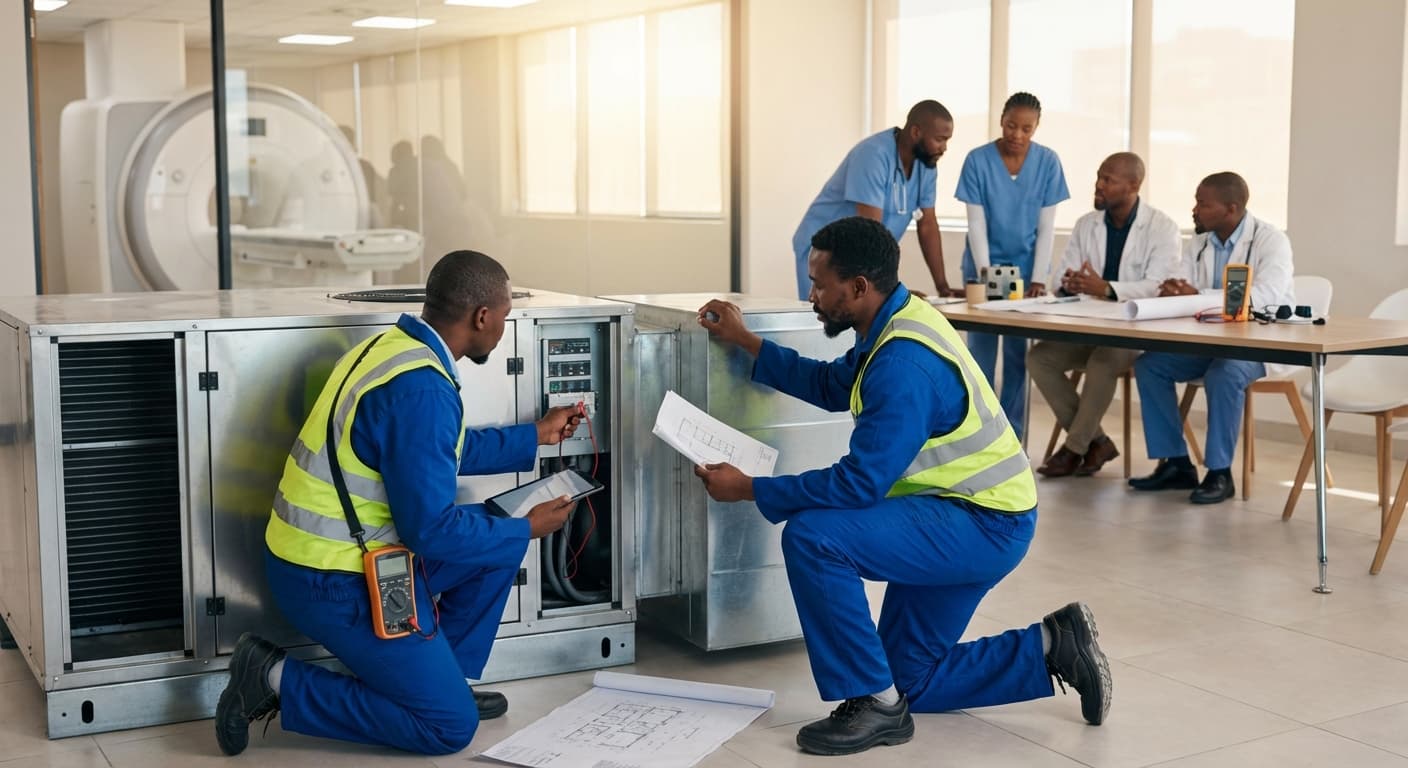
Site Readiness Assessment Service (Space/Access/HVAC/Power/Shielding) in Central African Republic
Engineering Excellence & Technical Support
Site Readiness Assessment Service (Space/Access/HVAC/Power/Shielding) High-standard technical execution following OEM protocols and local regulatory frameworks.
Strategic Site Selection for Telecommunications Expansion
Leveraging our in-depth understanding of Central African Republic's terrain and existing infrastructure, we identify optimal locations for new telecommunication sites. Our assessment meticulously analyzes factors like line-of-sight for satellite communication, accessibility for installation and maintenance crews, and proximity to power sources, ensuring maximum coverage and minimal deployment challenges.
Ensuring Robust Power and HVAC for Mission-Critical Infrastructure
We conduct comprehensive site readiness assessments focusing on the stability and capacity of local power grids and the availability of suitable HVAC solutions. For critical deployments in the Central African Republic, we evaluate existing power infrastructure, identify potential backup power requirements (generators, solar), and assess the feasibility of installing robust HVAC systems to maintain optimal operating temperatures for sensitive equipment, crucial in challenging climates.
Environmental and Security Assessment for Secure Data Centers
Our service includes a thorough evaluation of environmental factors and security considerations for potential data center locations in the Central African Republic. We assess risks related to natural hazards, identify necessary shielding requirements (e.g., for electromagnetic interference or radiation), and provide recommendations for physical security measures to safeguard valuable IT assets and ensure operational continuity.
What Is Site Readiness Assessment Service (Space/access/hvac/power/shielding) In Central African Republic?
A Site Readiness Assessment Service (Space/Access/HVAC/Power/Shielding) in the Central African Republic (CAR) is a comprehensive technical evaluation conducted to determine the suitability of a proposed physical location for the deployment of critical infrastructure, typically related to telecommunications, data centers, broadcasting, or other specialized operational facilities. This service systematically analyzes several key infrastructural and environmental parameters essential for the reliable and secure functioning of sensitive equipment.
Space/Access: Assesses the physical dimensions, layout, and environmental conditions of the proposed site. This includes evaluating available floor space, ceiling height, ingress/egress routes for personnel and equipment, and the capacity to accommodate future expansion. It also considers the structural integrity of the building or land parcel.
HVAC (Heating, Ventilation, and Air Conditioning): Evaluates the existing or proposed climate control systems. This involves determining the capacity to maintain optimal temperature and humidity levels within specified tolerances for sensitive electronic equipment, ensuring efficient heat dissipation and air quality control. For CAR, it is crucial to consider the ambient environmental conditions and potential challenges like dust ingress.
Power: Assesses the availability, reliability, and capacity of the electrical power supply. This includes evaluating grid power stability, available voltage and phase configurations, surge protection, and the feasibility of installing backup power systems such as generators and Uninterruptible Power Supplies (UPS). It also examines grounding and bonding infrastructure.
Shielding: Evaluates the site's susceptibility to and provision for electromagnetic interference (EMI), radio-frequency interference (RFI), and potentially radiation shielding (e.g., for certain broadcasting or medical imaging facilities). This involves identifying potential sources of interference and assessing the need for shielding measures to protect sensitive equipment and ensure signal integrity.
Who Needs It:
This service is critical for organizations planning to establish or upgrade any facility requiring a controlled and secure operational environment within the CAR. This includes, but is not limited to:
- Telecommunications Providers: For deploying base stations, switching centers, or data hubs.
- Internet Service Providers (ISPs): For establishing network infrastructure and points of presence.
- Data Center Operators: For constructing or expanding colocation or enterprise data facilities.
- Broadcasting Corporations: For setting up studios, transmission sites, or control rooms.
- Government Agencies: For critical IT infrastructure, command and control centers, or secure communication facilities.
- International Organizations and NGOs: For deploying essential operational and communication equipment in remote or challenging locations.
- Financial Institutions: For secure data processing centers and critical operational branches.
Typical Use Cases:
- New Infrastructure Deployment: Before acquiring a site for a new telecommunications tower, data center, or broadcasting facility, to confirm its technical viability and identify any necessary upgrades.
- Existing Facility Expansion: To assess the capacity of an existing site to accommodate additional equipment and ensure that power, HVAC, and space requirements can be met without compromising current operations.
- Disaster Recovery/Business Continuity Planning: To identify and validate potential alternate sites for critical operations, ensuring they meet the necessary readiness criteria.
- Security and Compliance Audits: To verify that a site meets specific security standards related to environmental control, power redundancy, and interference mitigation.
- Pre-Investment Due Diligence: For investors considering funding projects that involve significant physical infrastructure, to assess potential risks and hidden costs associated with site unsuitability.
- Rural or Remote Site Surveys: Particularly relevant in the CAR, to evaluate the feasibility of establishing operations in areas with potentially underdeveloped infrastructure, identifying specific challenges related to access, power, and environmental control.
| Category | Considerations in CAR | Implications of Unreadiness |
|---|---|---|
| Space/Access | Land availability, road infrastructure quality, potential for security considerations impacting access, physical building condition. | Delays in deployment, increased logistics costs, inability to physically install equipment, structural risks. |
| HVAC | High ambient temperatures and humidity, dust prevalence, potential for unreliable power impacting HVAC operation, need for robust filtration. | Equipment overheating and premature failure, data corruption, reduced operational lifespan of hardware, increased energy consumption. |
| Power | Unreliable national grid, frequent power outages, voltage fluctuations, limited availability of stable power sources, potential for generators to face fuel supply challenges. | Frequent system downtime, data loss, damage to sensitive electronics, inability to operate critical systems, dependence on costly and potentially unreliable backup solutions. |
| Shielding | Potential for interference from broadcast signals, rudimentary electrical installations, limited awareness of EMI/RFI best practices, environmental factors (e.g., proximity to certain geological formations or atmospheric conditions). | Signal degradation, data errors, compromised communication integrity, potential for equipment malfunction due to external electromagnetic noise. |
Key Components of Site Readiness Assessment Service:
- Space & Layout Analysis
- Structural Integrity Assessment
- Environmental Condition Evaluation (Temperature, Humidity, Dust)
- Access Route & Logistics Planning
- HVAC System Capacity & Performance
- Power Grid Availability & Stability
- Backup Power Solutions (Generators, UPS)
- Power Quality & Distribution
- Electrical Safety & Grounding
- EMI/RFI Source Identification
- Shielding Requirements & Assessment
- Potential for Future Expansion
Who Needs Site Readiness Assessment Service (Space/access/hvac/power/shielding) In Central African Republic?
Site readiness assessment is crucial for any organization undertaking projects that require reliable infrastructure and a secure environment. In the Central African Republic, where infrastructure development can be challenging, a thorough site readiness assessment is not a luxury but a necessity. This service ensures that a chosen location can adequately support the intended operations, minimizing risks and costly delays. It encompasses evaluating existing conditions related to space availability and suitability, physical access for personnel and equipment, HVAC systems for environmental control, power supply reliability, and shielding requirements for security or sensitive equipment.
| Target Customer Segment | Relevant Departments/Functions |
|---|---|
| Government Agencies & Ministries | Ministry of Public Works, Ministry of Communications, Ministry of Energy, Ministry of Health, Ministry of Defense, Local Administration |
| International Organizations & NGOs | Operations Department, Logistics Department, IT Department, Security Department, Project Management Office |
| Mining & Extractive Industries | Operations Management, Project Engineering, Facilities Management, Security, Supply Chain |
| Telecommunications Companies | Network Operations, Infrastructure Planning, Site Acquisition, Engineering, IT |
| Healthcare Providers | Facilities Management, IT Department, Biomedical Engineering, Operations Management, Security |
| Energy & Utilities Companies | Operations Department, Engineering Department, Facilities Management, Grid Planning, Security |
| Construction & Infrastructure Developers | Project Management, Engineering, Site Supervisors, Logistics, Procurement |
| Logistics & Warehousing Companies | Operations Management, Warehouse Management, Facilities Management, Security |
| Security & Defense Contractors | Operations, Security Management, Logistics, Facilities Management, Technical Support |
| Research & Development Institutions | Laboratory Management, IT Department, Facilities Management, Technical Operations |
Target Customers and Departments for Site Readiness Assessment Services in the Central African Republic
- {"item":"Government Agencies & Ministries"}
- {"item":"International Organizations & NGOs"}
- {"item":"Mining & Extractive Industries"}
- {"item":"Telecommunications Companies"}
- {"item":"Healthcare Providers"}
- {"item":"Energy & Utilities Companies"}
- {"item":"Construction & Infrastructure Developers"}
- {"item":"Logistics & Warehousing Companies"}
- {"item":"Security & Defense Contractors"}
- {"item":"Research & Development Institutions"}
Site Readiness Assessment Service (Space/access/hvac/power/shielding) Process In Central African Republic
The Site Readiness Assessment Service in the Central African Republic (CAR) is a critical process designed to ensure that proposed locations for new installations (e.g., telecommunications towers, renewable energy facilities, research stations) meet all necessary requirements for safe, efficient, and compliant operation. This service encompasses a thorough evaluation of Space, Access, HVAC (Heating, Ventilation, and Air Conditioning), Power, and Shielding. The workflow, from initial inquiry to the final execution of the assessment, is structured to be comprehensive and responsive, acknowledging the unique logistical and operational challenges present in CAR.
| Phase | Key Activities | Deliverables | Considerations for CAR |
|---|---|---|---|
| Phase 1: Inquiry and Scoping | Client submits request; Understand project scope and objectives; Define assessment parameters (Space, Access, HVAC, Power, Shielding). | Inquiry acknowledgement; Scope of Work (SOW) proposal. | Remote communication challenges; Understanding local land ownership/usage practices. |
| Phase 2: Initial Data Collection and Planning | Gathering of existing site data (maps, reports); Pre-assessment risk analysis; Logistics planning for on-site team; Permitting research (if applicable). | Preliminary site information document; On-site assessment plan. | Limited availability of reliable, up-to-date maps; Understanding of security protocols and local regulations. |
| Phase 3: On-Site Survey and Data Gathering | Space: Site dimensions, terrain, environmental constraints; Access: Road conditions, transport availability, entry points; HVAC: Existing climate data, potential for natural ventilation, power availability for cooling/heating; Power: Grid availability, generator suitability, solar potential, fuel logistics; Shielding: Electromagnetic interference (EMI) sources, required shielding effectiveness. | Raw survey data; Photographic and video evidence; On-site measurements. | Transportation infrastructure limitations; Security risks for personnel and equipment; Communication availability in remote areas; Local environmental conditions (heat, dust, rainfall). Coordination with local authorities for access and safety. |
| Phase 4: Analysis and Reporting | Data consolidation and verification; Technical analysis by specialists; Identification of deficiencies and risks; Development of mitigation strategies and recommendations. | Site Readiness Assessment Report (including technical findings, risk assessment, and recommendations). | Expertise to interpret data considering local conditions; Clear and concise reporting to bridge potential language barriers if applicable. |
| Phase 5: Client Review and Decision Making | Presentation of the assessment report; Discussion of findings and recommendations; Client makes informed decisions on site viability, modifications, or alternative sites. | Client acceptance or rejection of the proposed site; Decision on next steps. | Client's capacity to implement recommendations; Potential need for cost-benefit analysis of upgrades in the CAR context. |
| Phase 6: Post-Assessment Support (Optional) | Assistance with implementing recommended upgrades; Further technical consultation; Coordination with local contractors for modifications. | Implementation plans; Follow-up consultation reports. | Availability and reliability of local skilled labor and material suppliers. |
Site Readiness Assessment Workflow (Central African Republic)
- {"title":"Phase 1: Inquiry and Scoping","description":"The process begins with a formal inquiry from the client, detailing the proposed site and the nature of the intended installation. This phase involves understanding the client's specific needs and the project's scope."}
- {"title":"Phase 2: Initial Data Collection and Planning","description":"Upon acceptance of the inquiry, the service provider gathers preliminary information about the site. This includes satellite imagery, existing infrastructure reports, and any known geographical or environmental factors. A preliminary assessment plan is then developed."}
- {"title":"Phase 3: On-Site Survey and Data Gathering","description":"This is the core execution phase, involving a dedicated team traveling to the CAR to conduct a detailed on-site assessment. The team meticulously evaluates each readiness parameter."}
- {"title":"Phase 4: Analysis and Reporting","description":"All data collected during the on-site survey is meticulously analyzed by subject matter experts. A comprehensive report is then compiled, detailing findings, identified risks, and recommended mitigation strategies."}
- {"title":"Phase 5: Client Review and Decision Making","description":"The final report is presented to the client for review. This allows the client to make informed decisions regarding site suitability and potential investment in necessary upgrades or alternative locations."}
- {"title":"Phase 6: Post-Assessment Support (Optional)","description":"Depending on the client's needs, the service provider may offer ongoing support for implementation of recommendations or further consultation."}
Site Readiness Assessment Service (Space/access/hvac/power/shielding) Cost In Central African Republic
Assessing site readiness for projects in the Central African Republic (CAR) involves evaluating critical infrastructure components such as space, access, HVAC (Heating, Ventilation, and Air Conditioning), power, and shielding. The cost of such a service is highly variable and depends on several factors. These include the complexity of the site, the specific requirements of the project, the geographic location within CAR, the availability of qualified local personnel and specialized equipment, security considerations, and the overall duration and depth of the assessment. Given the developing infrastructure and unique operational environment in CAR, costs can be significantly higher than in more developed regions.
| Assessment Area | Estimated Cost Range (XAF - Central African CFA Franc) | Notes |
|---|---|---|
| Site Space & Layout Assessment | 500,000 - 2,500,000 XAF | Covers evaluation of available space, suitability for intended use, potential for expansion, and accessibility for construction/operations. Includes site visits and basic surveying. |
| Access & Logistics Assessment | 300,000 - 1,800,000 XAF | Focuses on road access, port/airfield proximity, internal site accessibility, and potential logistical challenges for equipment and personnel. Varies greatly with remoteness. |
| HVAC System Assessment | 700,000 - 3,500,000 XAF | Includes evaluation of existing HVAC infrastructure, load calculations, recommendations for upgrades or new systems, energy efficiency, and climate suitability. May require specialized HVAC engineers. |
| Power Infrastructure Assessment | 600,000 - 3,000,000 XAF | Evaluates grid availability, reliability, capacity, generator capacity, potential for solar or other renewables, and power quality. Can involve electrical engineers and specialized testing equipment. |
| Shielding Assessment (if applicable) | 1,000,000 - 7,000,000+ XAF | This is highly project-specific (e.g., for sensitive equipment, research facilities, or specialized industrial processes). Involves detailed analysis of materials, structural integrity, and potential for electromagnetic interference (EMI) or radiation shielding. May require specialized consultants. |
| Comprehensive Site Readiness Assessment (All Areas) | 3,000,000 - 15,000,000+ XAF | A package deal encompassing all the above. The upper range can be significantly higher for large-scale, technically demanding, or high-security projects requiring extensive travel, specialized personnel, and detailed reporting. |
Factors Influencing Site Readiness Assessment Costs in the Central African Republic
- Project Scope & Complexity: Larger, more complex projects requiring detailed engineering analyses will naturally incur higher assessment costs.
- Geographic Location: Accessibility to remote areas within CAR can drastically increase logistical costs (transportation, accommodation, security). Major urban centers like Bangui might have more readily available services but potentially higher overheads.
- Specific Assessment Needs: The depth and specificity of each assessment area (e.g., detailed HVAC load calculations vs. a general power audit) will impact pricing.
- Required Expertise: The need for specialized engineers (e.g., for advanced shielding analysis) or international consultants will drive up costs.
- Security Considerations: The prevailing security situation in different regions can necessitate additional security personnel and protocols, adding to the overall expense.
- Equipment & Technology: The use of advanced diagnostic equipment for HVAC, power, or structural integrity testing will influence the service cost.
- Timeframe: Urgent assessments or those requiring extended on-site presence will command higher fees.
- Local vs. International Providers: While local providers might offer cost advantages for basic services, international firms often bring specialized expertise and global standards, albeit at a premium.
- Reporting & Documentation: The level of detail and formality required for the final assessment report can affect pricing.
Affordable Site Readiness Assessment Service (Space/access/hvac/power/shielding) Options
Our Affordable Site Readiness Assessment Service is designed to provide a comprehensive evaluation of your facility's suitability for your specific project needs. We cover critical aspects such as Space, Access, HVAC, Power, and Shielding. Understanding your unique requirements and budget constraints, we offer flexible 'value bundles' and implement strategic cost-saving measures to ensure you receive high-quality assessment without breaking the bank. This service empowers you to make informed decisions about your site's preparedness, minimizing costly surprises and delays during implementation.
| Value Bundle | Included Services | Key Benefits | Estimated Price Range |
|---|---|---|---|
| Essential Readiness Bundle | Space, Access, Power (Basic Load Analysis) | Identifies fundamental site limitations, cost-effective for initial project scoping. | $750 - $1,500 |
| Comprehensive Site Fit Bundle | Space, Access, HVAC (Capacity & Condition), Power (Detailed Load Analysis & Recommendations) | Ensures your site can support immediate operational needs, addresses critical environmental controls. | $1,200 - $2,500 |
| Advanced Infrastructure Bundle | Space, Access, HVAC (Efficiency & Upgrades), Power (Redundancy & Future-Proofing), Shielding (Initial Assessment) | Ideal for projects with stringent uptime requirements or sensitive equipment, proactive infrastructure planning. | $2,000 - $4,000 |
| Full Spectrum Readiness Bundle | All components: Space, Access, HVAC, Power, Shielding (Detailed Analysis & Recommendations) | The most thorough assessment, providing a complete picture of site preparedness for complex or critical deployments. | $3,500 - $6,000+ |
Service Components Covered:
- Space Assessment: Evaluating available physical space, layout efficiency, and potential for expansion.
- Access Assessment: Analyzing ingress/egress points, traffic flow, and accessibility for personnel and equipment.
- HVAC Assessment: Reviewing existing heating, ventilation, and air conditioning systems for capacity, reliability, and environmental control suitability.
- Power Assessment: Determining power availability, capacity, distribution, and redundancy requirements.
- Shielding Assessment: Evaluating existing or required shielding for electromagnetic interference (EMI), radio frequency interference (RFI), or other environmental factors.
Verified Providers In Central African Republic
In the Central African Republic (CAR), ensuring access to reliable and trustworthy healthcare providers is paramount, especially given the unique challenges of the region. Franance Health stands out as a leading entity, distinguished by its rigorous credentialing process and commitment to quality care. This makes them the preferred choice for individuals and organizations seeking verified medical services.
| Credential Component | Franance Health Verification | Importance for Patients in CAR |
|---|---|---|
| Medical License & Registration | Thoroughly verified with relevant national and international bodies. | Ensures providers are legally authorized to practice and meet basic competency standards. |
| Educational Background & Degrees | Verified diplomas, certifications, and postgraduate training. | Confirms foundational knowledge and specialized expertise required for different medical fields. |
| Professional Experience & Work History | Detailed review of past employment, practice settings, and responsibilities. | Assesses practical application of skills and exposure to diverse patient cases. |
| Specialty Certifications | Verification of board certifications and sub-specialty training. | Guarantees advanced proficiency in specific medical areas, crucial for complex conditions. |
| Ethical Conduct & Disciplinary Records | Checks for any history of malpractice, misconduct, or ethical violations. | Protects patients from substandard or harmful practices, fostering trust. |
| Language Proficiency (if applicable) | Assessment of ability to communicate effectively with diverse patient populations. | Enhances patient understanding, adherence to treatment, and overall care experience. |
Why Franance Health Credentials Represent the Best Choice in CAR:
- Comprehensive Vetting Process: Franance Health employs a multi-faceted approach to vetting its providers. This goes beyond basic licensing to include verification of educational backgrounds, specialized training, professional experience, and adherence to ethical standards.
- Commitment to Quality and Safety: All Franance Health credentialed providers are held to high standards of medical practice, ensuring patient safety and the delivery of effective care. This includes checks for any disciplinary actions or malpractice claims.
- Local Expertise and Cultural Sensitivity: Franance Health prioritizes providers who possess a deep understanding of the local context in the CAR, including cultural nuances and common health challenges. This ensures more effective and respectful patient interactions.
- Access to Specialized Services: Through their network, Franance Health credentialed providers offer access to a wide range of medical specialties, from general practice to more complex surgical and diagnostic services, addressing diverse healthcare needs.
- Ongoing Professional Development: Franance Health often partners with or requires its credentialed providers to engage in continuous professional development, ensuring they remain up-to-date with the latest medical advancements and best practices.
- Transparency and Accountability: The credentialing process maintained by Franance Health offers a layer of transparency and accountability, giving patients greater confidence in the quality of care they receive.
Scope Of Work For Site Readiness Assessment Service (Space/access/hvac/power/shielding)
This document outlines the Scope of Work (SOW) for a Site Readiness Assessment Service, focusing on key infrastructure elements crucial for the successful deployment of [Specify Project/Equipment, e.g., a server rack, a new laboratory instrument, an MRI machine]. The assessment will evaluate the existing site conditions against specified technical requirements and provide actionable recommendations. The service encompasses the evaluation of Space, Access, HVAC, Power, and Shielding. Technical deliverables include a comprehensive report detailing findings, compliance status, and proposed remediation steps. Standard specifications will be adhered to, referencing relevant industry codes and best practices.
| Technical Deliverable | Description | Standard Specification Reference |
|---|---|---|
| Site Readiness Assessment Report | A detailed document summarizing findings for each assessment area, including measurements, observations, compliance status (Compliant/Non-Compliant/Requires Remediation), and identified risks. Includes photographic evidence where applicable. | Internal Company Standards, Client Project Requirements, ANSI/TIA standards for cabling infrastructure, NFPA 70 (National Electrical Code) for power, ASHRAE standards for HVAC. |
| Equipment Footprint and Clearance Analysis | Verification of physical space dimensions, including height, width, depth, and required clearances around the proposed equipment location for installation, operation, and maintenance. | Equipment manufacturer's installation and operation manuals, ANSI/NFPA standards for egress and safety. |
| Access Pathway Verification Report | Documentation of all entry and exit points, including doorways, corridors, elevators, and loading docks, confirming they meet the dimensional and load-bearing requirements for equipment transport and personnel access. | Building codes, ADA (Americans with Disabilities Act) accessibility guidelines, equipment manufacturer's shipping dimensions and weight. |
| HVAC System Compliance Report | Analysis of existing HVAC system performance against specified temperature, humidity, and air change rates. Includes recommendations for any required system modifications or supplemental cooling/heating. | ASHRAE Standards (e.g., 55 for Thermal Environmental Conditions for Human Occupancy, 62.1 for Ventilation for Acceptable Indoor Air Quality), Equipment manufacturer's environmental specifications. |
| Power Infrastructure Assessment | Evaluation of existing electrical panels, circuits, load calculations, grounding, and availability of UPS. Includes capacity, redundancy, and voltage stability. | NFPA 70 (National Electrical Code), IEEE standards for grounding and electrical safety, Equipment manufacturer's power requirements. |
| Shielding Requirements Verification | Assessment of current shielding (if any) and determination of necessary RF, EMI, or radiation shielding levels based on equipment specifications and environmental factors. | FCC regulations for RF emissions, IEC standards for electromagnetic compatibility (EMC), specific shielding standards relevant to the equipment type (e.g., NCRP for radiation). |
| Remediation Recommendations | Actionable steps and proposed solutions for any identified non-compliance issues, including estimated costs and timelines for implementation. | Industry best practices, relevant codes and standards, manufacturer recommendations. |
Key Assessment Areas
- Space: Ensuring adequate physical dimensions, clearance, and layout for equipment installation and operation.
- Access: Verifying pathways for equipment delivery, installation, maintenance, and emergency egress.
- HVAC (Heating, Ventilation, and Air Conditioning): Assessing temperature, humidity, airflow, and filtration to meet equipment environmental requirements.
- Power: Evaluating electrical capacity, distribution, redundancy, grounding, and uninterruptible power supply (UPS) capabilities.
- Shielding: Assessing any necessary electromagnetic, radio frequency (RF), or radiation shielding requirements.
Service Level Agreement For Site Readiness Assessment Service (Space/access/hvac/power/shielding)
This Service Level Agreement (SLA) outlines the terms and conditions for the Site Readiness Assessment Service provided by [Your Company Name] to [Client Company Name]. This SLA specifically covers the assessment of site readiness in the following critical areas: Space, Access, HVAC (Heating, Ventilation, and Air Conditioning), Power, and Shielding. It defines the expected response times for critical issues and outlines the uptime guarantees for our assessment services.
| Service Area | Response Time (Business Hours) | Uptime Guarantee (Assessment Service) |
|---|---|---|
| Critical Issue Identification (Initial Acknowledgment) | 1 Hour | N/A (This SLA does not guarantee uptime for the client's site infrastructure, but for the availability of our assessment service to be accessed and for its reporting mechanisms to function.) |
| Investigation/Troubleshooting of Assessment Tooling/Platform Issues | 2 Business Hours | 99.5% |
| Communication of Assessment Progress Updates (if scheduled) | As per agreed schedule | 99.5% |
| Delivery of Interim/Final Assessment Reports | As per agreed project timeline | 99.5% |
Scope of Service
- Site Readiness Assessment: This includes a comprehensive evaluation of the physical site to determine its suitability for the planned installation or deployment. The assessment will cover:
- Space: Verification of available physical space, including dimensions, layout, and any potential obstructions.
- Access: Evaluation of entry and exit points, including pathways for equipment delivery, personnel movement, and emergency egress.
- HVAC: Assessment of the existing heating, ventilation, and air conditioning systems to ensure they can maintain the required environmental conditions (temperature, humidity) for the intended equipment.
- Power: Analysis of the available electrical power infrastructure, including capacity, redundancy, voltage stability, and distribution points.
- Shielding: Evaluation of any necessary electromagnetic, RF, or other forms of shielding to meet project requirements.
- Deliverables: Upon completion of the assessment, a detailed report will be provided outlining findings, recommendations, and any identified risks or non-compliance issues.
- Service Hours: Standard service hours for active assessment activities are Monday to Friday, 8:00 AM to 6:00 PM local time, excluding public holidays.
Frequently Asked Questions

Ready when you are
Let's scope your Site Readiness Assessment Service (Space/Access/HVAC/Power/Shielding) in Central African Republic project in Central African Republic.

Scaling healthcare logistics and technical systems across the entire continent.