
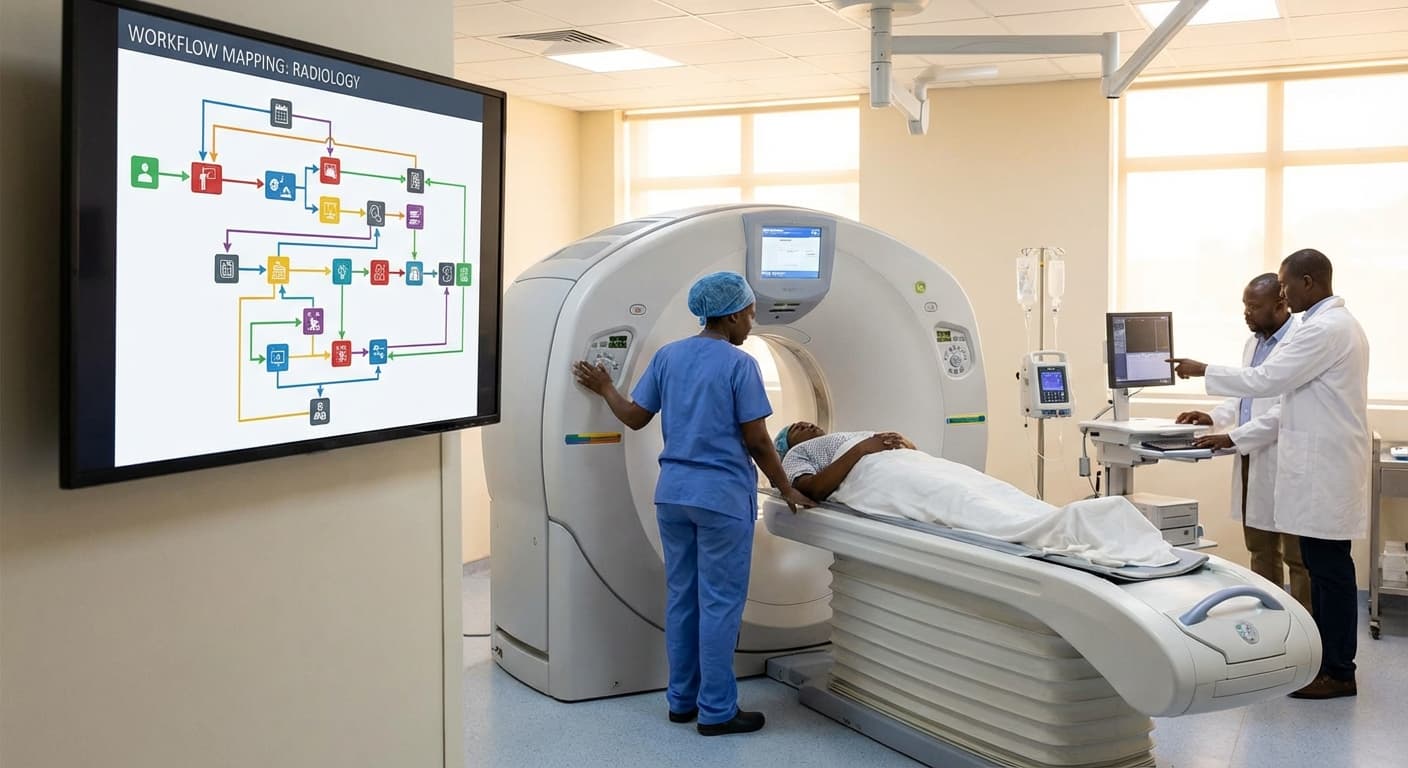
Department Workflow Mapping Service (Radiology/ICU/OT/Lab/Dialysis) in Central African Republic
Engineering Excellence & Technical Support
Department Workflow Mapping Service (Radiology/ICU/OT/Lab/Dialysis) High-standard technical execution following OEM protocols and local regulatory frameworks.
Optimized Patient Flow in Central African Republic Hospitals
Our service maps critical patient journeys across Radiology, ICU, OT, Lab, and Dialysis departments. We identify bottlenecks and inefficiencies, streamlining processes to ensure faster diagnoses, timely interventions, and improved patient outcomes in resource-limited settings.
Interdepartmental Coordination & Resource Allocation
We create visual workflows that highlight interdependencies between key departments. This facilitates better resource sharing, reduces wait times for critical tests and procedures (e.g., urgent radiology scans for ICU patients, timely lab results for OT), and enhances overall operational efficiency.
Data-Driven Performance Improvement for Healthcare Facilities
Through detailed workflow analysis, we provide actionable insights into departmental performance. This enables healthcare institutions in the Central African Republic to make informed decisions, implement targeted improvements, and ultimately elevate the quality of care delivered across critical services.
What Is Department Workflow Mapping Service (Radiology/icu/ot/lab/dialysis) In Central African Republic?
Department Workflow Mapping Service (Radiology/ICU/OT/Lab/Dialysis) in the Central African Republic (CAR) refers to a systematic methodology employed to document, analyze, and optimize the operational processes within specific high-demand clinical departments. This service focuses on understanding the sequence of tasks, resource allocation, information flow, and decision points involved in the delivery of services in departments such as Radiology, Intensive Care Units (ICUs), Operating Theaters (OTs), Laboratories, and Dialysis Units. The objective is to identify inefficiencies, bottlenecks, redundant steps, and areas for improvement in order to enhance patient throughput, improve diagnostic accuracy, reduce errors, optimize resource utilization (personnel, equipment, consumables), and ultimately elevate the quality and safety of patient care within the CAR's often resource-constrained healthcare infrastructure.
| Service Type | Who Needs It | Typical Use Cases |
|---|---|---|
| Radiology Workflow Mapping | Public and private hospitals, imaging centers, diagnostic clinics in CAR. | Optimizing patient scheduling for X-ray, CT, MRI, ultrasound. Streamlining radiologist interpretation and reporting. Improving equipment utilization and maintenance scheduling. Reducing patient wait times for imaging procedures and results. Enhancing image archiving and retrieval processes. Managing contrast media and consumable inventory. |
| ICU Workflow Mapping | Intensive Care Units within hospitals in CAR. | Improving patient admission and discharge protocols. Optimizing nurse-to-patient ratios and task delegation. Streamlining critical care team communication (physicians, nurses, respiratory therapists). Enhancing monitoring equipment utilization and alarm management. Optimizing medication administration processes. Ensuring efficient ventilator management and weaning protocols. Improving handoff procedures between shifts. |
| OT Workflow Mapping | Operating Theaters in surgical facilities across CAR. | Optimizing surgical case scheduling and room utilization. Streamlining patient preparation and anesthesia induction. Improving surgical team coordination and instrument/equipment setup. Enhancing sterilization and instrument processing workflows. Managing surgical supply chains and inventory. Optimizing post-operative recovery and transfer processes. Reducing operative times and improving patient safety during surgery. |
| Laboratory Workflow Mapping | Clinical laboratories, hospital labs, public health laboratories in CAR. | Streamlining specimen collection, transportation, and accessioning. Optimizing sample processing and testing workflows for various disciplines (hematology, chemistry, microbiology, etc.). Improving quality control and assurance processes. Enhancing turnaround times for test results. Optimizing reagent and consumable inventory management. Improving data entry and reporting systems. Ensuring proper handling and disposal of biological samples. |
| Dialysis Workflow Mapping | Dialysis centers and units within hospitals in CAR. | Optimizing patient scheduling for hemodialysis and peritoneal dialysis. Streamlining patient preparation and vascular access management. Enhancing dialysis machine setup, priming, and disinfection protocols. Optimizing fluid and electrolyte management during treatment. Improving medication administration and monitoring. Streamlining staff roles and responsibilities during dialysis sessions. Managing water treatment systems and dialysate preparation. Enhancing patient education and care plan adherence. |
Key Components of Department Workflow Mapping Service
- Process Identification and Segmentation: Deconstructing each departmental function into discrete, sequential, and parallel activities. This involves identifying distinct phases, such as patient admission/referral, examination/procedure, data acquisition, analysis, reporting, and patient discharge/transfer.
- Data Collection and Documentation: Employing qualitative and quantitative methods, including direct observation, interviews with stakeholders (clinicians, technicians, administrative staff, nurses), process flowcharting (using standard notations like BPMN), time-motion studies, and review of existing Standard Operating Procedures (SOPs) and patient records.
- Stakeholder Engagement: Actively involving all relevant personnel at various levels to ensure comprehensive understanding of current practices, identify challenges from diverse perspectives, and foster buy-in for proposed changes. This is crucial in the CAR context due to potential variations in training and experience.
- Bottleneck and Inefficiency Analysis: Utilizing analytical tools and techniques to pinpoint areas where delays, resource underutilization, or excessive task repetition occur. This may involve value stream mapping to differentiate value-adding activities from non-value-adding ones.
- Resource Allocation Assessment: Evaluating the availability, utilization, and accessibility of critical resources including personnel (skills, staffing levels), equipment (maintenance status, capacity), consumables, and physical space.
- Information and Communication Flow Mapping: Tracing the movement of patient information, test results, reports, and orders between different personnel, departments, and systems (if present). This highlights communication gaps or delays.
- Risk Assessment and Mitigation Planning: Identifying potential points of failure, medical errors, or safety breaches within the workflow and developing strategies to mitigate these risks. This is paramount in a context where error detection and correction mechanisms might be nascent.
- Optimization and Re-engineering: Developing and proposing revised workflows, SOPs, and operational strategies based on the analysis. This can involve process simplification, task redistribution, technology adoption (where feasible), and improved scheduling algorithms.
- Implementation Support and Monitoring: Assisting in the phased implementation of the recommended changes and establishing metrics for ongoing monitoring and evaluation of the new workflow's effectiveness and sustainability.
- Training and Capacity Building: Providing training to staff on new workflows, SOPs, and any new technologies or methodologies introduced as part of the optimization process.
Who Needs Department Workflow Mapping Service (Radiology/icu/ot/lab/dialysis) In Central African Republic?
In the Central African Republic (CAR), a nation facing significant healthcare infrastructure challenges, a Department Workflow Mapping Service is crucial for optimizing the efficiency and effectiveness of key medical departments. These departments, often operating with limited resources and personnel, can greatly benefit from a systematic analysis and redesign of their processes. This service helps identify bottlenecks, streamline operations, improve patient flow, enhance resource allocation, and ultimately elevate the quality of care delivered. The CAR's specific healthcare context, including its geographic distribution of facilities and the prevalence of certain diseases, makes a tailored workflow mapping approach particularly impactful. The goal is to build a more resilient and responsive healthcare system, even within the existing constraints.
| Target Department | Description of Need for Workflow Mapping | Specific Challenges in CAR Context |
|---|---|---|
| Radiology | Mapping the entire process from patient referral to report generation. Focus on equipment utilization, staff scheduling, image acquisition, processing, and interpretation to reduce wait times and improve diagnostic turnaround. Ensuring proper quality control and maintenance of imaging equipment. | Limited availability and maintenance of imaging equipment (X-ray, ultrasound). Shortage of trained radiographers and radiologists. Long distances to access services, leading to delays. Potential for inconsistent image quality due to aging equipment or lack of consumables. |
| Intensive Care Unit (ICU) | Analyzing patient admission, monitoring, treatment, and discharge processes. Optimizing the use of critical care equipment, medication administration, and staff-to-patient ratios. Ensuring timely intervention and efficient transfer to lower care levels. | High patient-to-staff ratios. Frequent equipment malfunctions or lack of spare parts. Shortage of critical care physicians and specialized nurses. Limited availability of essential medications and supplies. Challenges in continuous patient monitoring and data recording. |
| Operating Theatre (OT) | Mapping surgical scheduling, patient preparation, surgical procedures, and post-operative care. Streamlining sterilization processes, instrument management, and operating room utilization. Ensuring efficient staff allocation and reducing surgical delays. | Inconsistent supply chain for surgical instruments and consumables. Intermittent power supply affecting equipment. Limited availability of specialized surgical teams. Challenges in maintaining sterile environments. Long turnaround times between surgeries due to cleaning and preparation. |
| Laboratory | Analyzing sample collection, transport, processing, testing, and reporting workflows. Optimizing reagent and consumable management, equipment calibration, and quality assurance. Aiming for faster and more accurate diagnostic results. | Limited access to a wide range of diagnostic tests. Challenges in maintaining cold chain for samples and reagents. Frequent equipment breakdowns and lack of trained laboratory technicians. Inconsistent quality control due to resource limitations. Delays in sample transport from remote areas. |
| Dialysis | Mapping the patient dialysis schedule, treatment procedures, equipment maintenance, and post-dialysis care. Ensuring efficient patient throughput, water quality management, and staff training for safe and effective treatments. | Scarcity of functional dialysis machines. Shortage of trained nephrologists and dialysis nurses. Difficulties in sourcing essential dialysis supplies and medications. Irregular access to clean water and reliable electricity for dialysis machines. High cost of treatment and limited patient access. |
Who Needs Department Workflow Mapping Service in Central African Republic?
- Healthcare facilities in the Central African Republic (CAR)
- Hospitals (public and private)
- Central medical facilities
- Regional hospitals
- District hospitals
- Specialized clinics
- Non-governmental organizations (NGOs) operating healthcare programs
- Ministry of Health and Public Hygiene
- International health organizations providing support
- Healthcare administrators and managers
- Department heads and leads
Department Workflow Mapping Service (Radiology/icu/ot/lab/dialysis) Process In Central African Republic
This document outlines the Department Workflow Mapping Service process for key departments (Radiology, ICU, OT, Lab, Dialysis) within healthcare facilities in the Central African Republic (CAR), from initial inquiry to final execution. The service aims to optimize operational efficiency, identify bottlenecks, and improve patient care pathways within these critical units. The process is designed to be adaptable to the specific context and resource availability in CAR.
| Stage | Description | Key Activities | Responsible Parties (Examples) | Key Deliverables/Outcomes |
|---|---|---|---|---|
| Initiation of the service based on a request from a healthcare facility. | Initial consultation with facility leadership to understand their challenges, goals, and specific departmental needs (Radiology, ICU, OT, Lab, Dialysis). Discussion of current operational pain points. | Facility Management/Department Heads, Service Provider Representatives | Understanding of the facility's requirements, preliminary identification of target departments, confirmation of service feasibility. |
| Defining the boundaries and objectives of the workflow mapping project for each selected department. | Detailed discussions on the specific workflows to be mapped (e.g., patient journey in ICU, sample processing in Lab, imaging request to report in Radiology). Agreement on project timeline, resources, and key performance indicators (KPIs). | Service Provider Project Manager, Departmental Leads, Key Personnel from each department | Project charter, agreed-upon scope document, detailed project plan, stakeholder identification. |
| Gathering comprehensive information about current workflows and operational data. | Direct observation of processes, interviews with staff at all levels, review of existing documentation (SOPs, forms, reports), collection of quantitative data (patient volumes, turnaround times, resource utilization). | Service Provider Analysts/Consultants, Departmental Staff (nurses, technicians, doctors, administrators) | Raw data, process maps, interview transcripts, quantitative data sets, initial understanding of current state. |
| Translating collected data into clear and understandable visual representations of current processes. | Creation of detailed process flowcharts, value stream maps, or other visual models for each targeted department. Identification of all steps, decision points, actors, and information flows within each workflow. | Service Provider Analysts/Consultants, with input from departmental staff | Visual workflow diagrams (e.g., Swimlane diagrams, BPMN models), documented process narratives. |
| Analyzing the mapped workflows to pinpoint inefficiencies and areas for enhancement. | Reviewing the visual maps and collected data to identify delays, redundancies, waste (time, resources), communication breakdowns, and potential risks. Benchmarking against best practices where possible (considering CAR context). | Service Provider Analysts/Consultants, Departmental Leads | List of identified bottlenecks, quantified impact of inefficiencies, prioritized list of potential improvement areas. |
| Developing concrete, actionable recommendations for optimizing workflows and addressing identified issues. | Formulating specific proposals for process redesign, technology adoption (if feasible and appropriate for CAR), staff training, policy changes, or resource allocation adjustments. Developing phased action plans with clear responsibilities and timelines. | Service Provider Consultants, Departmental Leads, Facility Management | Report with detailed recommendations, prioritized action plan, proposed solutions tailored to CAR's context and resources. |
| Assisting the facility in putting the recommended changes into practice and tracking progress. | Providing guidance during the implementation of new processes, offering training to staff, helping to establish new SOPs, and setting up mechanisms for ongoing data collection and performance monitoring. Regular check-ins and support. | Service Provider Implementation Specialists, Departmental Champions, Facility Management | Implemented process changes, trained staff, initial performance data, updated SOPs. |
| Assessing the effectiveness of implemented changes and making further adjustments. | Measuring the impact of implemented recommendations against agreed-upon KPIs. Gathering feedback from staff and patients. Identifying areas for further refinement and continuous improvement. Final reporting. | Service Provider Consultants, Departmental Leads, Facility Management | Evaluation report on implemented changes, identified lessons learned, recommendations for ongoing optimization, sustained improvements in departmental efficiency and patient care. |
Department Workflow Mapping Service Stages
- Inquiry and Needs Assessment
- Scope Definition and Planning
- Data Collection and Analysis
- Workflow Mapping and Visualization
- Identification of Bottlenecks and Improvement Areas
- Recommendations and Action Planning
- Implementation Support and Monitoring
- Evaluation and Refinement
Department Workflow Mapping Service (Radiology/icu/ot/lab/dialysis) Cost In Central African Republic
The cost of Department Workflow Mapping services in the Central African Republic, specifically for departments like Radiology, Intensive Care Unit (ICU), Operating Theatre (OT), Laboratory, and Dialysis, can vary significantly. These services are crucial for optimizing efficiency, patient safety, and resource utilization within these critical hospital areas. Several factors influence the pricing, making it challenging to provide a single definitive figure. However, by understanding these contributing elements, healthcare providers can better estimate potential expenditures.
| Department Type | Estimated Cost Range (CFA) | Notes |
|---|---|---|
Key Pricing Factors for Department Workflow Mapping Services in Central African Republic
- {"title":"Scope and Complexity of the Department","description":"Larger, more complex departments with a higher volume of patient interactions, intricate processes, and a greater number of staff will naturally require more extensive mapping. For example, an ICU with multiple patient monitoring systems and a multidisciplinary team will be more complex than a smaller, specialized lab."}
- {"title":"Number of Workflows to Map","description":"The more distinct workflows within a department that need to be analyzed and documented, the higher the cost. This includes patient admission, diagnostic procedures, treatment protocols, equipment utilization, waste management, and communication channels."}
- {"title":"Duration of the Mapping Project","description":"Projects that require extended on-site observation, data collection, interviews, and analysis will naturally incur higher costs due to the consultant's time commitment."}
- {"title":"Consultant Experience and Expertise","description":"Highly experienced consultants with a proven track record in healthcare workflow optimization, particularly in similar settings or specialized departments, will command higher fees. Their deep understanding of best practices and ability to identify critical bottlenecks is invaluable."}
- {"title":"Data Collection and Analysis Tools","description":"The use of specialized software for process mapping, simulation, and data analysis can add to the cost. The complexity and sophistication of these tools will influence the price."}
- {"title":"Reporting and Deliverables","description":"The level of detail and format of the final reports, including detailed process maps, recommendations, implementation plans, and training materials, will impact the overall cost."}
- {"title":"Travel and Accommodation (if applicable)","description":"If consultants are based outside the immediate vicinity of the healthcare facility, travel and accommodation expenses will need to be factored into the total cost."}
- {"title":"Regulatory Compliance and Auditing Requirements","description":"If the mapping needs to adhere to specific national or international healthcare regulations or prepare for audits, this can add layers of complexity and time, thus affecting the price."}
- {"title":"Urgency of the Project","description":"Rush projects or those with tight deadlines may incur premium charges."}
Affordable Department Workflow Mapping Service (Radiology/icu/ot/lab/dialysis) Options
Our Affordable Department Workflow Mapping Service provides essential process optimization for critical hospital departments like Radiology, ICU, Operating Theatre (OT), Laboratory, and Dialysis. Understanding and streamlining these complex workflows leads to improved efficiency, reduced errors, enhanced patient care, and significant cost savings. We offer flexible options to suit your budget and needs, focusing on delivering tangible value.
| Cost-Saving Strategy | Description | Impact Areas |
|---|---|---|
| Reduced Rework and Errors | By clarifying processes and implementing standardized procedures, the likelihood of errors and the need for rework decreases significantly, saving time and resources. | All Departments |
| Improved Resource Allocation | Workflow mapping helps identify underutilized or overutilized resources (staff, equipment), leading to more efficient deployment and reduced unnecessary expenditures. | ICU, OT, Radiology, Dialysis |
| Shorter Turnaround Times | Streamlining processes, particularly in areas like lab testing and imaging, leads to faster results, enabling quicker clinical decisions and reduced patient length of stay. | Radiology, Lab, ICU, OT |
| Optimized Inventory Management | Understanding the flow of materials and supplies helps in forecasting needs accurately, minimizing stockouts and reducing waste from expired or obsolete inventory. | Lab, OT, Dialysis |
| Enhanced Staff Productivity | Clearer roles, responsibilities, and streamlined tasks empower staff to work more efficiently, increasing overall departmental productivity. | All Departments |
| Reduced Patient Waiting Times | Optimized patient flow, from admission to discharge or procedure completion, improves the patient experience and can free up capacity for more patients. | Radiology, ICU, OT, Dialysis |
| Leveraging Existing Technology | Identifying opportunities to better utilize existing IT systems and equipment can defer or eliminate the need for costly new investments. | All Departments |
Value Bundles:
- {"title":"Basic Workflow Documentation","description":"Identifies current processes, documents key steps, and highlights immediate bottlenecks. Ideal for departments needing a clear baseline understanding."}
- {"title":"Standard Workflow Optimization","description":"Includes basic documentation plus analysis of inefficiencies, identification of redundant steps, and recommendations for minor process improvements and technology integration."}
- {"title":"Comprehensive Workflow Redesign","description":"In-depth analysis, collaborative redesign sessions with stakeholders, development of optimized future-state workflows, change management planning, and post-implementation review. Best for departments facing significant operational challenges or seeking major strategic improvements."}
- {"title":"Department-Specific Modules","description":"Tailored packages focusing on unique challenges within Radiology (imaging turnaround times), ICU (patient handoffs, resource allocation), OT (scheduling, instrument sterilization), Lab (sample processing, result delivery), and Dialysis (patient scheduling, equipment maintenance)."}
Verified Providers In Central African Republic
In the Central African Republic (CAR), ensuring access to reliable and qualified healthcare providers is paramount. Franance Health stands out as a leading entity, offering a robust network of verified professionals and facilities. Their rigorous credentialing process and commitment to quality make them the optimal choice for individuals and organizations seeking trustworthy healthcare services in the CAR.
| Provider Type | Franance Health Verification Standard | Benefits to Patients |
|---|---|---|
| Doctors (General Practitioners & Specialists) | Verification of medical degrees, board certifications, active licenses, and peer reviews. | Access to qualified and experienced physicians, ensuring accurate diagnoses and effective treatment plans. |
| Nurses and Midwives | Verification of nursing diplomas/degrees, licenses, and relevant certifications (e.g., maternal care). | Skilled and compassionate nursing care, improved maternal and child health outcomes. |
| Hospitals and Clinics | Inspection of facilities for hygiene, equipment, adherence to safety standards, and administrative compliance. | Access to safe and well-equipped healthcare facilities that meet established standards of care. |
| Pharmacists and Pharmacies | Verification of pharmacy licenses, dispensing credentials, and drug sourcing practices. | Reliable access to legitimate medications and professional pharmaceutical advice. |
Why Franance Health is the Best Choice:
- Rigorous Verification Process: Franance Health employs a multi-stage credentialing system, meticulously vetting each healthcare provider's qualifications, licenses, and experience. This ensures that only competent and ethical professionals are part of their network.
- Commitment to Quality Care: Beyond basic verification, Franance Health prioritizes providers who demonstrate a consistent track record of high-quality patient care and adherence to best medical practices.
- Comprehensive Network: They offer access to a wide array of medical specialties and facilities across the CAR, addressing diverse healthcare needs.
- Trust and Reliability: By ensuring the credibility of their providers, Franance Health builds trust and provides a reliable pathway to essential medical services for the population.
- Patient-Centric Approach: Franance Health focuses on connecting patients with providers who prioritize their well-being and offer compassionate care.
Scope Of Work For Department Workflow Mapping Service (Radiology/icu/ot/lab/dialysis)
This Scope of Work (SOW) outlines the services to be provided for a comprehensive workflow mapping initiative across key hospital departments: Radiology, Intensive Care Unit (ICU), Operating Theatre (OT), Laboratory (Lab), and Dialysis. The objective is to systematically document, analyze, and optimize existing processes within each department to enhance efficiency, reduce errors, and improve patient care delivery. This document details the technical deliverables and standard specifications required for the successful execution of this project.
| Phase | Activity | Deliverables | Standard Specifications/Tools |
|---|---|---|---|
| Phase 1: Planning & Discovery | Project Kick-off & Stakeholder Identification | Project Charter, Stakeholder Register | Standard Project Management Templates, RACI Matrix |
| Phase 1: Planning & Discovery | Current State Workflow Data Gathering | Raw Data Transcripts, Interview Notes, Observation Logs | Standardized Interview Guides, Observation Checklists, Data Anonymization Protocols |
| Phase 2: Workflow Mapping | Develop Current State Workflow Maps | Detailed Workflow Diagrams (per department) | BPMN 2.0 (Business Process Model and Notation), Visio/Lucidchart/Draw.io |
| Phase 2: Workflow Mapping | Identify Key Performance Indicators (KPIs) & Metrics | List of Relevant KPIs for each workflow | SMART Criteria for KPI definition |
| Phase 2: Workflow Mapping | Gap Analysis & Bottleneck Identification | Gap Analysis Report, Bottleneck Identification Summary | Root Cause Analysis Techniques (e.g., 5 Whys, Fishbone Diagram) |
| Phase 3: Analysis & Recommendations | Develop Future State Workflow Concepts | Proposed Future State Workflow Diagrams (per department) | BPMN 2.0, Lean/Six Sigma Principles |
| Phase 3: Analysis & Recommendations | Formulate Recommendations for Improvement | Recommendations Report (including potential technology solutions, policy changes, training needs) | Cost-Benefit Analysis Framework, Change Management Considerations |
| Phase 3: Analysis & Recommendations | Stakeholder Review & Validation | Validated Workflow Maps, Approved Recommendations | Formal Sign-off Process, Presentation Slides |
| Phase 4: Documentation & Handover | Final Workflow Documentation Compilation | Comprehensive Workflow Mapping Report (including all deliverables) | Version Control System, Standardized Reporting Template |
| Phase 4: Documentation & Handover | Knowledge Transfer & Training (Optional) | Training Materials, Session Records | Train-the-Trainer Model, Participant Feedback Forms |
Project Objectives
- To create detailed, accurate, and standardized workflow maps for Radiology, ICU, OT, Lab, and Dialysis departments.
- To identify bottlenecks, redundancies, and areas of inefficiency within current departmental workflows.
- To provide actionable recommendations for process improvement and optimization.
- To establish a baseline for future process re-engineering and technology implementation.
- To ensure consistency in workflow documentation across all mapped departments.
- To facilitate better inter-departmental communication and understanding of integrated processes.
Service Level Agreement For Department Workflow Mapping Service (Radiology/icu/ot/lab/dialysis)
This Service Level Agreement (SLA) outlines the guaranteed response times and uptime for the Department Workflow Mapping Service. This service is critical for optimizing operational efficiency across various departments, including Radiology, Intensive Care Unit (ICU), Operating Theatre (OT), Laboratory, and Dialysis. Adherence to these service levels ensures timely access to and utilization of workflow mapping resources, thereby supporting improved patient care and resource management.
| Service Metric | Service Level Objective (SLO) | Measurement Period | Definition |
|---|---|---|---|
| System Uptime | 99.5% | Monthly | The percentage of time the workflow mapping service is available and operational during scheduled service hours. Scheduled maintenance is excluded. |
| Initial Response Time (Request for New Mapping/Update) | 4 Business Hours | Per Request | Time taken to acknowledge receipt of a request for new workflow mapping or an update to existing mapping, and to assign a resource for assessment. |
| Report Delivery (Standard Mapping) | 5 Business Days | Per Project | Time from initial request acknowledgment to delivery of the initial draft of the workflow map and associated documentation for a standard mapping project. |
| Report Delivery (Complex/Large-Scale Mapping) | 10 Business Days | Per Project | Time from initial request acknowledgment to delivery of the initial draft of the workflow map and associated documentation for complex or large-scale mapping projects (e.g., entire department-wide). Complexity to be mutually agreed upon at project initiation. |
| Data Update Latency (Real-time Data Feeds) | N/A (If applicable, specific real-time feed SLAs will be documented separately) | N/A | This service primarily focuses on documentation and analysis. Real-time data feed performance, if integrated, would be subject to separate agreements. |
Scope of Service
- Workflow mapping analysis and documentation for Radiology.
- Workflow mapping analysis and documentation for Intensive Care Unit (ICU).
- Workflow mapping analysis and documentation for Operating Theatre (OT).
- Workflow mapping analysis and documentation for Laboratory services.
- Workflow mapping analysis and documentation for Dialysis units.
Frequently Asked Questions

Ready when you are
Let's scope your Department Workflow Mapping Service (Radiology/ICU/OT/Lab/Dialysis) in Central African Republic project in Central African Republic.

Scaling healthcare logistics and technical systems across the entire continent.