
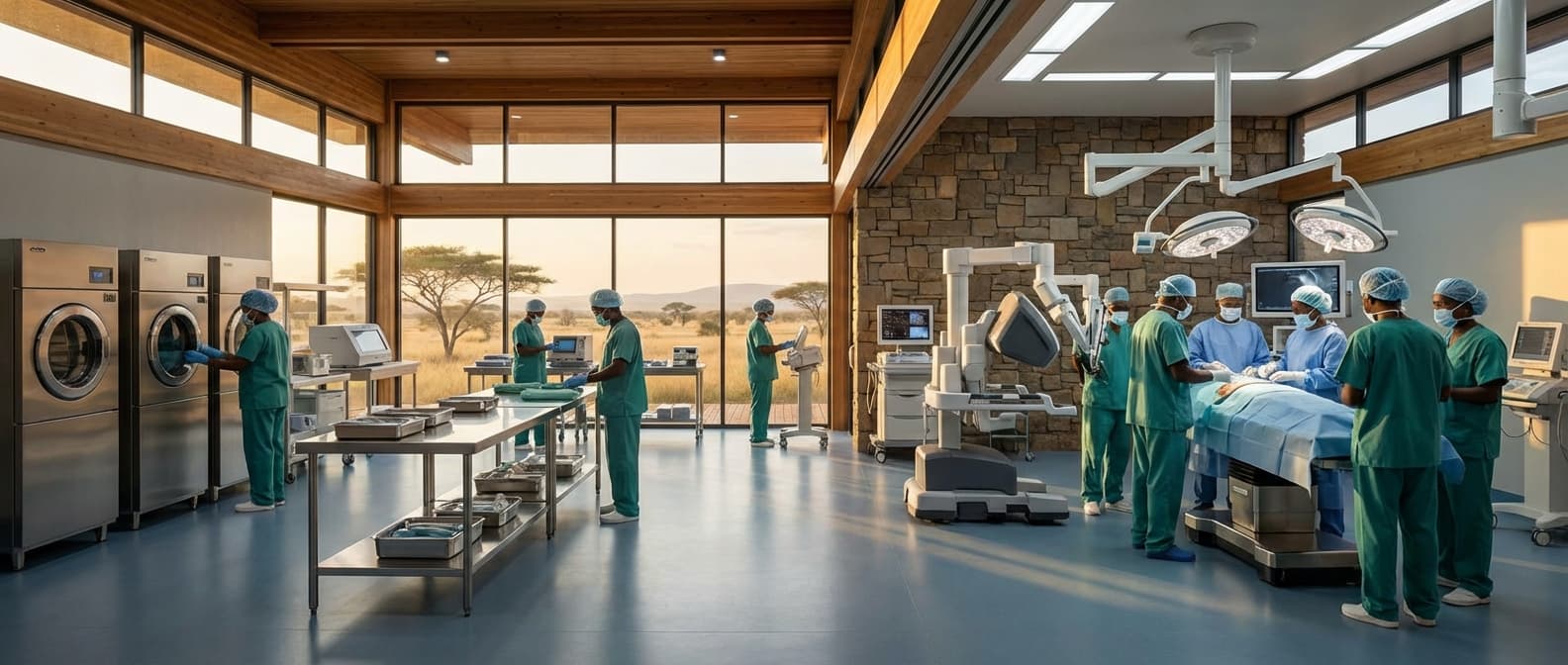
Operating Theatre Turnkey Build in Central African Republic
Engineering Excellence & Technical Support
Complete OR design, equipment integration and commissioning High-standard technical execution following OEM protocols and local regulatory frameworks.
Rapid Deployment & Clinical Readiness
Engineered for swift deployment in challenging environments, our turnkey operating theatres achieve full clinical readiness within [X] weeks. This includes pre-fabricated modular construction, integrated medical gas systems, and rapid sanitization protocols, ensuring immediate operational capacity to address critical healthcare needs.
Resilient Power & Environmental Control
Addressing potential infrastructure limitations, our solutions integrate robust, redundant power systems (including solar and backup generators) and advanced climate control for optimal surgical conditions. This ensures consistent temperature, humidity, and air purity, crucial for infection prevention and surgical team comfort, regardless of external grid stability.
Localized Training & Sustainable Operations
Beyond construction, we provide comprehensive on-site training for local medical and technical staff on equipment operation, maintenance, and sterile procedures. This focus on capacity building ensures the long-term sustainability and effective utilization of the facility, empowering local healthcare professionals and fostering medical independence.
What Is Operating Theatre Turnkey Build In Central African Republic?
An Operating Theatre Turnkey Build in the Central African Republic (CAR) refers to the complete, end-to-end provision and installation of a functional surgical suite. This service encompasses all aspects of the project, from initial design and architectural planning through to construction, equipment procurement and installation, commissioning, and handover. The objective is to deliver a fully operational operating theatre ready for immediate use by healthcare professionals. This comprehensive approach minimizes the burden on the client, ensuring compliance with relevant healthcare standards and the specific environmental and logistical challenges present in the CAR.
| Stakeholder Group | Primary Need for Turnkey Build | Typical Use Cases |
|---|---|---|
| Government Health Ministries | To establish or upgrade critical surgical infrastructure in underserved regions, improve healthcare access, and ensure adherence to national health standards. Turnkey solutions streamline the process and ensure project completion within budget and timeline constraints. | Development of new district hospitals, establishment of specialized surgical units (e.g., trauma, obstetrics), rehabilitation of existing facilities, response to public health emergencies requiring rapid surgical capacity. |
| Non-Governmental Organizations (NGOs) & Humanitarian Agencies | To rapidly deploy functional surgical facilities in crisis zones, remote areas, or for specific medical missions. Turnkey providers offer expertise in navigating logistical challenges, sourcing specialized equipment, and ensuring operational readiness in challenging environments. | Setting up mobile surgical units, establishing temporary or semi-permanent surgical centers in conflict-affected areas, implementing specialized surgical programs (e.g., for war surgery, maternal health), providing surgical services in areas with a severe lack of existing infrastructure. |
| Private Healthcare Providers (Emerging) | To establish high-quality private surgical facilities that meet international standards, attract medical professionals, and offer advanced procedures. Turnkey builds provide a complete solution, mitigating risks associated with complex construction and equipment procurement in the CAR. | Construction of new private hospitals with surgical departments, upgrading existing clinics to include full operating theatre capabilities, establishing specialized surgical clinics (e.g., for ophthalmology, orthopedics). |
| International Aid & Development Agencies | To fund and oversee the development of healthcare infrastructure as part of broader development programs. Turnkey solutions offer a managed approach to project execution, ensuring accountability and efficient use of donor funds. | Funding and implementation of hospital construction projects, support for public health system strengthening initiatives, disaster relief efforts involving the establishment of medical facilities. |
Key Components of an Operating Theatre Turnkey Build in the CAR:
- Site Assessment & Feasibility Study: Evaluating existing infrastructure, site suitability, power availability, water supply, and waste management systems.
- Architectural & Engineering Design: Developing detailed blueprints and specifications for the operating theatre space, including layout, airflow, lighting, and specialized medical gas systems.
- Civil Construction & Renovation: Building new structures or adapting existing ones to meet the stringent requirements of a surgical environment. This includes sterile environments, infection control measures, and appropriate finishes.
- MEP (Mechanical, Electrical, Plumbing) Systems: Installation and integration of critical systems such as HVAC (Heating, Ventilation, and Air Conditioning) with HEPA filtration, medical gas pipelines (oxygen, medical air, vacuum), medical-grade electrical power, backup generators, and potable water/wastewater management.
- Specialized Equipment Procurement & Installation: Sourcing and installing a full suite of surgical equipment, including operating tables, surgical lights, anesthesia machines, patient monitoring systems, sterilization equipment, and diagnostic imaging devices. This often involves navigating complex import regulations and supply chains within the CAR.
- IT & Communication Infrastructure: Setting up network connectivity, data management systems, and communication tools for seamless operational workflow.
- Commissioning & Validation: Rigorous testing and calibration of all installed systems and equipment to ensure they function optimally and meet all safety and performance standards. This includes air pressure differentials, temperature and humidity control, and equipment functionality checks.
- Training & Handover: Providing comprehensive training to clinical and technical staff on the operation and maintenance of the new facility and its equipment. A formal handover process confirms project completion.
- Regulatory Compliance & Certification: Ensuring all aspects of the build adhere to national healthcare regulations and international best practices for operating room design and safety, which can be particularly challenging in the CAR due to evolving or nascent regulatory frameworks.
Who Needs Operating Theatre Turnkey Build In Central African Republic?
Operating theatre turnkey builds are crucial for healthcare facilities in the Central African Republic (CAR) seeking to establish or upgrade their surgical capacity to international standards. These comprehensive solutions encompass design, construction, equipment installation, and commissioning, ensuring a fully functional and compliant operating room. The demand for such services is driven by the critical need to improve surgical outcomes, reduce infections, and provide advanced medical care in a region often facing significant healthcare infrastructure challenges.
| Customer Segment | Key Needs Addressed by Turnkey Build | Specific Departments Often Requiring Upgrades |
|---|---|---|
| Government Hospitals | Modernization of outdated facilities, increased capacity, adherence to international standards, improved patient safety. | General Surgery, Obstetrics & Gynecology, Trauma Surgery, Orthopedics. |
| NGO-Run Healthcare Facilities | Establishing surgical capabilities in remote or underserved areas, cost-effective comprehensive solutions, rapid deployment. | Maternity, General Surgery, Trauma Surgery, Primary Surgical Care. |
| Private Healthcare Providers | Attracting specialized surgeons, offering advanced procedures, enhancing reputation, meeting patient expectations for quality care. | General Surgery, Orthopedics, Ophthalmology, Urology, Plastic Surgery. |
| Military and Defense Healthcare | Robust and adaptable surgical facilities for various deployment scenarios, rapid response capabilities. | Trauma Surgery, General Surgery, Orthopedics. |
| International Aid Organizations | Quick establishment of essential medical infrastructure, humanitarian response, long-term health system strengthening. | Emergency Surgery, Obstetrics & Gynecology, General Surgery. |
Target Customers & Departments
- Government Hospitals: Central and regional public hospitals are primary beneficiaries, often lacking modern surgical facilities. Turnkey solutions enable them to expand services and handle a wider range of procedures.
- NGO-Run Healthcare Facilities: Non-governmental organizations operating clinics and hospitals in CAR frequently require turnkey solutions to establish or enhance their surgical capabilities, often in underserved areas.
- Private Healthcare Providers: Emerging private hospitals and clinics aiming to offer specialized surgical services and attract a higher patient demographic will invest in turnkey operating theatres.
- Military and Defense Healthcare: Military medical units may require state-of-the-art operating theatres for battlefield medicine and the treatment of military personnel.
- International Aid Organizations: Organizations involved in global health initiatives and disaster relief may commission turnkey builds to rapidly deploy functional surgical units.
- Maternity and Obstetrics Departments: Essential for safe childbirth and C-sections, these departments are a high priority for surgical facility upgrades.
- General Surgery Departments: Handling a broad spectrum of surgical interventions, from appendectomies to hernia repairs.
- Trauma and Emergency Surgery Departments: Crucial for immediate care following accidents, violence, and natural disasters.
- Orthopedic Surgery Departments: For the treatment of fractures, injuries, and degenerative bone conditions.
- Ophthalmology Departments: For sight-restoring procedures, often in high demand.
- ENT (Ear, Nose, and Throat) Surgery Departments: For a variety of common and specialized procedures.
Operating Theatre Turnkey Build Process In Central African Republic
Building an operating theatre in the Central African Republic (CAR) is a complex undertaking requiring meticulous planning and execution due to logistical, infrastructural, and regulatory challenges. This process typically involves a comprehensive turnkey approach, meaning the contractor handles all aspects from initial concept to final handover.
| Stage | Key Activities | Deliverables | Considerations for CAR |
|---|---|---|---|
| 1. Inquiry & Pre-Feasibility | Initial contact from client (hospital, government agency, NGO). Discussion of project scope, budget, and requirements. Site visit (if feasible) or remote assessment of existing infrastructure. Preliminary needs assessment: type of surgery, patient volume, essential equipment. | Project brief, preliminary budget estimate, feasibility report. | Understanding local healthcare needs and existing capacity. Political stability and security assessment. Accessibility of the proposed site. Local partner identification. |
| 2. Design & Planning | Detailed architectural and engineering design based on client requirements and international standards (e.g., WHO guidelines). Development of HVAC, electrical, plumbing, medical gas systems. Equipment selection and layout planning. Regulatory compliance checks (local and international). Budget finalization and project timeline development. | Detailed drawings (architectural, structural, MEP), equipment specifications, Bill of Quantities (BOQ), project execution plan, contractual agreements. | Adherence to strict sterile environment requirements. Power and water supply reliability. Availability of specialized building materials. Local building codes and regulations (if any). |
| 3. Procurement & Logistics | Sourcing of all materials, equipment, and specialized components. Negotiation with suppliers. Management of import/export procedures, customs clearance, and transportation to the CAR. Warehousing and inventory management at the site. | Procured materials and equipment, shipping manifests, customs clearance documents, site inventory. | Significant logistical challenges: border crossings, road conditions, security risks during transit. Potential for delays due to customs bureaucracy. Need for robust supply chain management and contingency planning. |
| 4. Construction & Installation | Site preparation and civil works (foundation, walls, roofing). Installation of MEP systems (HVAC, electrical, plumbing, medical gases). Interior finishing (sterile wall/floor/ceiling systems, lighting). Installation of specialized operating theatre equipment (lights, tables, booms, imaging). | Completed building structure, installed MEP systems, finished interior, installed medical equipment. | Shortage of skilled local labor requiring expatriate specialists. Challenges with on-site power and water for construction. Strict quality control for sterile environments. Use of durable, easy-to-clean materials. |
| 5. Commissioning & Training | Testing and validation of all installed systems and equipment to ensure they meet specifications and safety standards. Calibration of medical equipment. Training of hospital staff on the operation and maintenance of the new theatre and equipment. Development of Standard Operating Procedures (SOPs). | Commissioning reports, validation certificates, training materials, trained staff, SOPs. | Ensuring equipment functions optimally with potentially limited local technical support. Training must be comprehensive and culturally sensitive, considering language barriers. |
| 6. Handover & Post-Completion | Final inspection and acceptance by the client. Provision of as-built drawings and operation & maintenance manuals. Warranty period commencement. Establishment of a maintenance and support plan (if included in the contract). | As-built drawings, O&M manuals, warranty documentation, project completion certificate. | Establishing a sustainable maintenance plan is crucial given limited local capacity for complex repairs. Long-term support agreements may be necessary. |
Operating Theatre Turnkey Build Process in Central African Republic: Workflow from Inquiry to Execution
- Phase 1: Inquiry & Pre-Feasibility
- Phase 2: Design & Planning
- Phase 3: Procurement & Logistics
- Phase 4: Construction & Installation
- Phase 5: Commissioning & Training
- Phase 6: Handover & Post-Completion
Operating Theatre Turnkey Build Cost In Central African Republic
The cost of a turnkey operating theatre build in the Central African Republic (CAR) is a complex equation influenced by a multitude of factors, leading to a wide potential price range. "Turnkey" implies a complete, ready-to-use facility, encompassing design, construction, medical equipment installation, and often initial training. In the CAR, a nation with developing infrastructure and a unique economic landscape, these costs are significantly impacted by the following key drivers:
| Cost Component / Project Type | Estimated Range (USD) | Estimated Range (Central African CFA Franc - XAF) |
|---|---|---|
| Basic/Standard Operating Theatre (Single Room, Essential Equipment) | $150,000 - $400,000 | 80,000,000 - 215,000,000 XAF |
| Mid-Range Operating Theatre (2+ Rooms, Advanced Equipment, Enhanced Infrastructure) | $400,000 - $1,000,000 | 215,000,000 - 535,000,000 XAF |
| High-End/Specialized Operating Theatre (Multiple Theatres, State-of-the-Art Equipment, Integrated Systems) | $1,000,000+ | 535,000,000+ XAF |
| Design and Architectural Fees | 5% - 15% of Construction Cost | 5% - 15% of Construction Cost |
| Construction Materials (Local & Imported) | Highly variable, depending on quality and origin | Highly variable, depending on quality and origin |
| Medical Equipment (Core Set) | $70,000 - $500,000+ | 37,500,000 - 270,000,000+ XAF |
| HVAC and Sterilization Systems | $30,000 - $150,000+ | 16,000,000 - 80,000,000+ XAF |
| Electrical Systems (including backup power) | $20,000 - $100,000+ | 10,700,000 - 53,500,000+ XAF |
| Logistics, Transportation, and Import Duties | 10% - 30% of Equipment/Material Cost | 10% - 30% of Equipment/Material Cost |
| Installation and Commissioning of Equipment | $10,000 - $50,000+ | 5,350,000 - 26,750,000+ XAF |
| Contingency (Recommended) | 15% - 30% of Total Project Cost | 15% - 30% of Total Project Cost |
Key Pricing Factors for Turnkey Operating Theatre Builds in the Central African Republic:
- Project Scope and Size: The square footage of the operating theatre suite, the number of theatres, and the complexity of supporting areas (sterilization, recovery, pre-op, post-op, staff changing, etc.) are primary cost determinants.
- Quality of Materials and Finishes: Standard vs. high-spec finishes for flooring, walls, and ceilings (e.g., anti-microbial surfaces, seamless materials), as well as the quality of doors, windows, and lighting, will impact the budget.
- Medical Equipment Specification: This is often the largest single cost component. The type, brand, and sophistication of surgical lights, anesthesia machines, patient monitors, electrosurgical units, surgical instruments, imaging equipment (e.g., mobile C-arm), and sterilization equipment will vary drastically in price.
- Infrastructure Availability and Development: The CAR's infrastructure can be a significant challenge. Costs will increase if existing utilities (water, electricity, sewage) are unreliable or non-existent, requiring the contractor to install or significantly upgrade these systems. Backup power generation (generators) is almost always essential and adds substantial cost.
- Logistics and Transportation: Importing specialized materials, construction equipment, and medical equipment into the CAR can be expensive and time-consuming due to limited transportation networks and potential customs complexities. Remote locations further amplify these costs.
- Labor Costs and Expertise: While general labor might be relatively affordable, sourcing skilled construction labor and, critically, specialized medical equipment technicians and engineers can be challenging and more costly. International expertise may be required, adding further expense.
- Regulatory Compliance and Permitting: Navigating local building codes, health regulations, and obtaining necessary permits can involve fees and potential delays, influencing overall project cost.
- Security and Site Preparation: Depending on the location, security measures for the construction site and personnel may be necessary. Site preparation, including land clearing and foundation work, will also vary based on the terrain.
- Contingency Planning: Due to the inherent uncertainties in building projects within the CAR, a robust contingency budget is crucial to account for unforeseen issues, price fluctuations, and potential delays.
- Contractor's Overhead and Profit: The chosen contractor's business model, experience, and profit margins will be factored into the final price.
Affordable Operating Theatre Turnkey Build Options
Establishing an operating theatre is a significant undertaking, often associated with high costs. However, innovative 'turnkey build' solutions are emerging that offer more affordable pathways for healthcare facilities. These options streamline the entire process, from design to commissioning, providing a comprehensive and cost-effective approach. Value bundles are central to these affordable options, bundling essential components and services into pre-defined packages. This approach simplifies procurement, reduces negotiation time, and often leverages bulk purchasing power to lower overall expenses. Cost-saving strategies are embedded within these bundles and the turnkey model itself, focusing on efficiency, standardization, and smart resource allocation.
| Value Bundle Component | Description | Cost-Saving Strategy |
|---|---|---|
| Modular Construction | Pre-fabricated modules are built off-site in a controlled environment, then assembled on-site. | Reduces on-site labor, minimizes construction waste, accelerates project timeline, predictable costs. |
| Standardized Equipment Packages | Offers pre-selected, high-quality but cost-effective medical equipment and systems. | Leverages bulk purchasing, simplifies procurement, reduces individual specification and negotiation time, ensures compatibility. |
| Integrated Design & Engineering | A single provider handles all design, engineering, and regulatory compliance aspects. | Eliminates the need for multiple consultants, streamlines approvals, reduces design revisions, prevents costly errors. |
| Phased Installation & Commissioning | Breaks down the project into manageable phases with clear deliverables and timelines. | Allows for better cash flow management, identifies and resolves issues early, reduces risk of delays and associated cost overruns. |
| Remote Monitoring & Maintenance | Incorporates systems for remote monitoring of critical theatre functions and predictive maintenance. | Reduces the need for frequent on-site technician visits, allows for proactive issue resolution, minimizes downtime and associated revenue loss. |
Key Components of Affordable Operating Theatre Turnkey Build Options
- Pre-designed modular theatre layouts
- Integrated HVAC and air purification systems
- Essential medical gas installations
- Standardized lighting and imaging systems
- Basic surgical furniture and equipment
- Project management and installation services
- Commissioning and testing
Verified Providers In Central African Republic
In the Central African Republic (CAR), ensuring access to reliable and trustworthy healthcare services is paramount. When seeking medical attention, especially from international organizations or for specialized care, verifying the credentials of healthcare providers is crucial. Franance Health stands out as a premier organization in the CAR, offering a robust network of verified providers who meet stringent quality and ethical standards. Their commitment to excellence, transparent practices, and focus on patient well-being makes them the undisputed best choice for healthcare needs in the region.
| Provider Type | Verification Criteria | Benefits for Patients |
|---|---|---|
| Hospitals & Clinics | Accreditation, adherence to safety protocols, equipment standards, staff qualifications | Access to advanced medical technology, comprehensive treatment options, safe and sterile environments. |
| Specialist Doctors | Medical school graduation, board certification, relevant post-graduate training, peer review, ongoing professional development | Expert diagnosis and treatment for specific medical conditions, personalized care plans. |
| General Practitioners | Medical license, primary care training, commitment to patient education, experience in community health | First point of contact for general health concerns, preventative care, referral to specialists. |
| Nurses & Allied Health Professionals | Nursing/paramedical certifications, practical training, background checks, understanding of local healthcare landscape | Essential support care, patient monitoring, health education, rehabilitation services. |
Why Franance Health Providers are the Best Choice in CAR:
- Rigorous Credentialing Process: Franance Health implements a multi-stage verification process for all its affiliated healthcare professionals and facilities. This includes thorough background checks, validation of licenses and certifications, and assessment of clinical experience and specialization.
- Commitment to Quality and Safety: Providers associated with Franance Health adhere to internationally recognized standards of medical care, hygiene, and patient safety. This ensures that patients receive treatment in a secure and effective environment.
- Ethical Practice and Patient-Centric Approach: Franance Health prioritizes ethical conduct and a patient-first philosophy. Their providers are committed to providing compassionate care, respecting patient autonomy, and maintaining confidentiality.
- Access to Diverse Specializations: The network boasts a wide array of medical specialists, from general practitioners to surgeons and pediatricians, ensuring that patients can find the expertise they need for a broad range of health concerns.
- Cultural Sensitivity and Local Understanding: Franance Health emphasizes the importance of cultural sensitivity among its providers. Many are local professionals with a deep understanding of the community's needs and challenges, fostering trust and effective communication.
- International Collaboration and Best Practices: Franance Health actively collaborates with international health organizations, bringing global best practices and advanced medical knowledge to the CAR.
- Transparency in Services and Fees: Patients can expect clear communication regarding available services, treatment plans, and associated costs, promoting trust and preventing unexpected financial burdens.
Scope Of Work For Operating Theatre Turnkey Build
This document outlines the Scope of Work (SOW) for a turnkey operating theatre (OT) build project. It details the technical deliverables and standard specifications required to deliver a fully functional and compliant operating theatre. The project encompasses all phases from design and engineering to construction, installation, commissioning, and handover.
The objective is to construct a state-of-the-art operating theatre facility that meets stringent healthcare standards, ensuring patient safety, infection control, and optimal surgical conditions. The turnkey approach signifies that the contractor will be responsible for the complete project lifecycle, delivering a ready-to-use facility.
| Category | Standard Specification | Description |
|---|---|---|
| Air Handling Units (AHU) | ISO 14644-1 Class 7 / ISO 5 (specific zones) | HEPA filtration with a minimum of 99.97% efficiency for particles ≥ 0.3 µm. Minimum air changes per hour (ACPH) as per HTM 03-01 or equivalent international standards (e.g., 20-30 ACPH for general OT, higher for specialized areas). Positive pressure relative to adjacent areas. |
| Surgical Lighting | IEC 60601-2-41 | High illuminance levels (e.g., >100,000 lux at 1m), excellent color rendering index (CRI >95), adjustable color temperature, shadowless operation, and sterile handle design. |
| Medical Gas Pipeline System (MGPS) | HTM 02-01 / ISO 7396-1 | Provision for oxygen, medical air, vacuum, nitrous oxide, etc. Central alarm system for pressure and flow monitoring. Piped medical gases must meet purity standards and be delivered at specified pressures. |
| Wall & Ceiling Finishes | Antimicrobial & Seamless | Non-porous, non-shedding, easily cleanable, and resistant to disinfectants. Seamless junctions between walls, floors, and ceilings to prevent microbial growth. |
| Flooring | Antimicrobial & Seamless Vinyl/Epoxy | Coved skirting, coved junctions, anti-static properties, slip-resistant, durable, and resistant to chemicals and impact. |
| Electrical Installation | IEC 60364 Series / Local Regulations | Isolated power systems for surgical areas, UPS backup for critical equipment, surge protection, medical grade outlets, and emergency lighting compliant with relevant standards. |
| Noise Levels | < 45 dBA (typical) | Maximum ambient noise levels in the operating theatre to facilitate clear communication and minimize patient stress. Achieved through acoustic insulation and careful HVAC design. |
| Infection Control Features | Various | Touchless faucets, hand hygiene stations, easy-to-clean surfaces, flush-mounted fixtures, and consideration for waste management systems. |
| Laminar Airflow | ISO 14644-4 | Vertical or horizontal laminar flow diffusers above the surgical table to create a sterile air zone, minimizing airborne contamination. Air velocity between 0.3 to 0.5 m/s. |
| Door Systems | Automatic Sliding / Hermetic | Automatic, fast-acting, and hermetically sealing doors to maintain airflow and pressure differentials, minimizing air ingress/egress. |
Key Technical Deliverables
- Detailed Architectural & Structural Design Drawings
- MEP (Mechanical, Electrical, Plumbing) Design Drawings
- Medical Gas Pipeline System Design & Schematics
- HVAC System Design with Laminar Flow & HEPA Filtration
- Low Voltage Systems Design (Nurse Call, Data, Audio-Visual)
- Lighting Design (Surgical Lights, General & Emergency Lighting)
- Infection Control & Air Change Rate Calculations
- Acoustic Design & Noise Level Specifications
- Medical Equipment Integration Plan
- As-Built Drawings and Documentation
- Commissioning & Validation Reports
- User Manuals & Training Materials
- Snagging List & Rectification Report
- Final Handover Documentation Package
Service Level Agreement For Operating Theatre Turnkey Build
This Service Level Agreement (SLA) outlines the response times and uptime guarantees for the turnkey build and commissioning of an operating theatre. This SLA is an integral part of the contract between [Client Name] (the "Client") and [Provider Name] (the "Provider") for the Operating Theatre Turnkey Build Project (the "Project").
| Category | Service Level | Target Response Time | Maximum Resolution Time | Uptime Guarantee (Post-Commissioning) | Uptime Guarantee (During Commissioning/Acceptance Testing) |
|---|---|---|---|---|---|
| Critical Systems (e.g., Medical Gases, HVAC, Emergency Power, Surgical Lighting) | High Availability | 1 hour (24/7) | 4 hours | 99.9% per month | 100% (excluding pre-agreed testing windows) |
| Non-Critical Systems (e.g., Audio-visual, ancillary lighting, basic finishes) | Standard Availability | 4 hours (during business hours: 08:00 - 18:00, Mon-Fri) | 24 hours (or next business day) | 99.0% per month | 98% (excluding pre-agreed testing windows) |
| Overall Turnkey Build Availability (during commissioning and acceptance testing) | Project Completion & Functionality | N/A | As per project schedule and agreed milestones | N/A | 100% availability of completed and tested systems for acceptance testing |
Definitions
- Operating Theatre Turnkey Build: Refers to the complete design, construction, installation, and commissioning of a fully functional operating theatre, including all associated infrastructure, medical gas systems, HVAC, lighting, electrical, and finishes, ready for use.
- Downtime: Any period during which the operating theatre, or critical systems within it, are unavailable for use due to a failure or defect attributable to the Provider's work or equipment provided as part of the turnkey build. Scheduled maintenance or pre-agreed testing periods are excluded.
- Response Time: The maximum time allowed for the Provider to acknowledge a reported issue and begin diagnosing the problem.
- Resolution Time: The maximum time allowed for the Provider to restore full functionality of the affected system or component.
- Critical System: Any component or system whose failure would render the operating theatre unusable or pose a significant safety risk, including but not limited to, medical gas supply, HVAC (air filtration and temperature control), emergency power, and surgical lighting.
- Non-Critical System: Any component or system whose failure does not immediately render the operating theatre unusable but requires attention for optimal performance or comfort.
- Uptime: The percentage of time the operating theatre is available and fully functional for its intended use.
- Service Credits: Compensation provided to the Client by the Provider in the event of failure to meet the agreed-upon uptime guarantees.
Frequently Asked Questions

Ready when you are
Let's scope your Operating Theatre Turnkey Build in Central African Republic project in Central African Republic.

Scaling healthcare logistics and technical systems across the entire continent.