
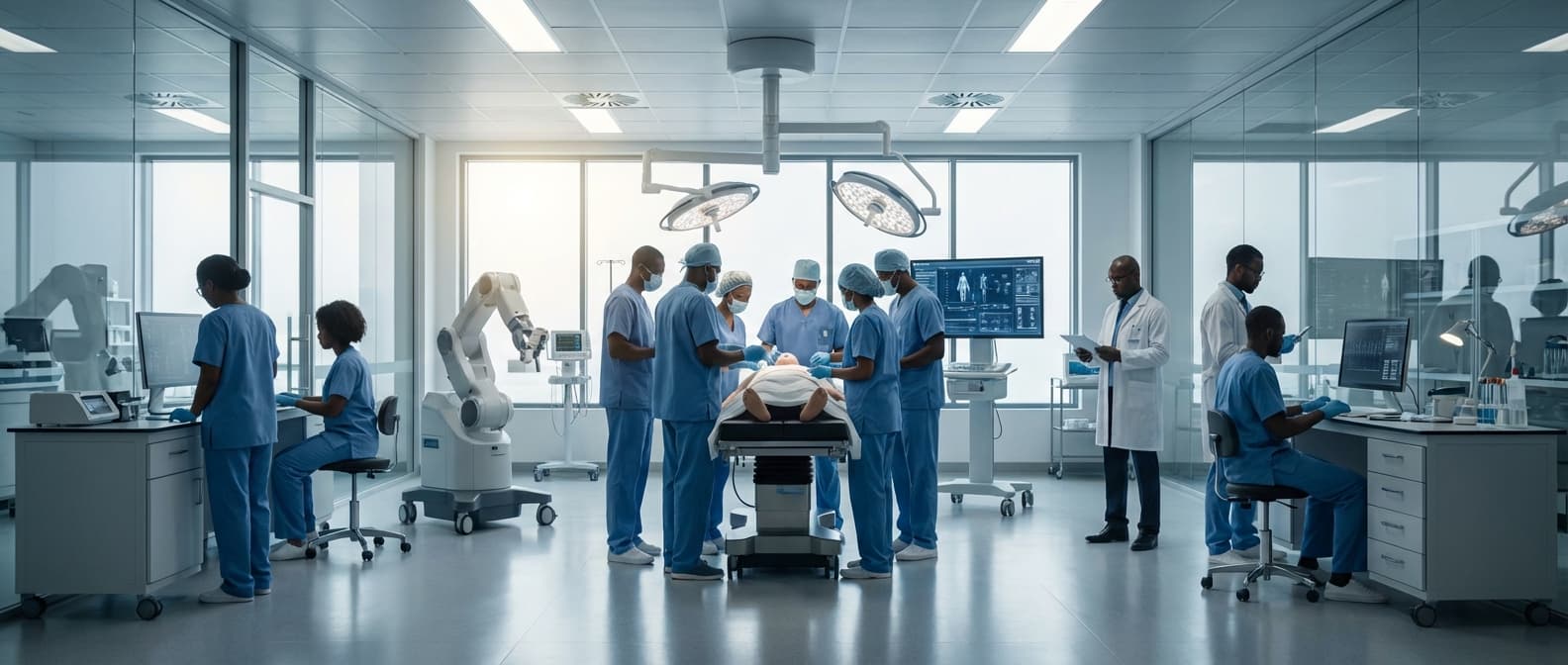
Managed Equipment Service (MES) in Central African Republic
Engineering Excellence & Technical Support
Long‑term equipment provision with uptime SLAs and lifecycle management. High-standard technical execution following OEM protocols and local regulatory frameworks.
Reliable Medical Equipment Uptime
Ensures critical medical devices are consistently operational through proactive maintenance and rapid on-site repairs, minimizing patient care disruptions in remote and challenging healthcare settings.
Optimized Spare Parts Logistics
Establishes efficient supply chains for essential spare parts, guaranteeing availability and timely delivery to overcome logistical hurdles and keep equipment functioning effectively across the Central African Republic.
Local Technical Capacity Building
Empowers local healthcare professionals and technicians with specialized training on operating and maintaining advanced medical equipment, fostering self-sufficiency and long-term sustainability of healthcare services.
What Is Managed Equipment Service (Mes) In Central African Republic?
Managed Equipment Service (MES) in the Central African Republic (CAR) refers to a comprehensive outsourcing model where a third-party provider takes responsibility for the procurement, installation, maintenance, operation, and eventual disposal of specialized equipment for various sectors. This service aims to optimize equipment lifecycle management, ensure operational continuity, and reduce the burden of capital expenditure and technical expertise for the client. MES often encompasses a service level agreement (SLA) that guarantees specific performance metrics, uptime, and response times. The scope can range from basic maintenance contracts to full-scale operational outsourcing, including consumables, spare parts management, and staff training.
MES is needed by entities in the CAR that require access to and reliable operation of critical equipment but may lack the in-house financial resources, technical capacity, or strategic focus to manage these assets independently. This includes government agencies, non-governmental organizations (NGOs), international organizations, and private sector enterprises operating in challenging environments where infrastructure and skilled labor can be scarce.
| Typical Use Case | Equipment Category | MES Involvement | Benefits for CAR Context |
|---|---|---|---|
| Healthcare Delivery | Medical Imaging (X-ray, CT scanners), Diagnostic Laboratories, Surgical Equipment, Ambulance Fleets | Procurement, installation, calibration, preventative maintenance, reactive repairs, spare parts management, operator training. | Ensures access to essential medical diagnostics and treatment capabilities, improves patient outcomes, reduces downtime of critical life-saving equipment, leverages economies of scale for procurement and maintenance. |
| Infrastructure Development & Maintenance | Construction Machinery (bulldozers, excavators), Road Maintenance Equipment, Water Pumping Stations, Power Generators | Fleet management, scheduled servicing, emergency repairs, fuel management, operator training, asset tracking. | Facilitates critical infrastructure projects, ensures operational continuity of essential services (water, power), minimizes project delays due to equipment failure, enhances safety standards. |
| Telecommunications and Connectivity | Base Stations, Network Infrastructure, Satellite Communication Equipment | Installation, network monitoring, fault diagnosis and repair, software updates, power supply management. | Ensures reliable communication networks, supports economic activity and information dissemination, improves access to digital services in remote areas. |
| Resource Exploration and Extraction | Geophysical Survey Equipment, Drilling Rigs, Heavy-duty Transport Vehicles | Specialized maintenance, on-site technical support, calibration, replacement of wear parts, logistics for spare parts. | Enables efficient and safe resource extraction, minimizes operational disruptions, ensures compliance with industry standards, reduces risk for the client by transferring technical operational burden. |
| Logistics and Humanitarian Aid | Refrigeration Units for Cold Chain, Trucks, Warehousing Equipment | Maintenance of temperature-controlled environments, fleet maintenance, inventory management systems integration. | Preserves critical supplies (e.g., vaccines, food), ensures efficient distribution of aid, reduces spoilage and loss. |
Who Needs Managed Equipment Service (MES) in CAR?
- Government Ministries (e.g., Ministry of Health, Ministry of Transport)
- Public Hospitals and Healthcare Facilities
- Non-Governmental Organizations (NGOs) involved in humanitarian aid and development
- International Organizations (e.g., UN agencies)
- Mining and Resource Extraction Companies
- Telecommunication Providers
- Agricultural Cooperatives and Large-scale farming operations
- Educational Institutions requiring specialized laboratory or technical equipment
Who Needs Managed Equipment Service (Mes) In Central African Republic?
Managed Equipment Service (MES) offers a comprehensive solution for organizations in the Central African Republic (CAR) looking to optimize their operational efficiency, reduce costs, and ensure the reliability of their essential equipment. In a region where access to specialized maintenance, spare parts, and advanced technology can be challenging, MES provides a vital lifeline. It shifts the burden of equipment management, from procurement and installation to ongoing maintenance, repair, and eventual replacement, to expert third-party providers. This allows organizations to focus on their core mission without being hindered by technical breakdowns or the complexities of managing a diverse equipment fleet.
| Customer Type | Key Departments/Functions Benefiting from MES | Primary Equipment Needs Addressed |
|---|---|---|
| Healthcare Facilities | Radiology, Laboratory, Surgery, General Wards, Administration | Medical imaging devices (X-ray, CT, MRI), laboratory analyzers, surgical equipment, patient monitoring systems, sterilization units, power generators. |
| Government Agencies | Public Works, Transportation, Health, Education, Defense | Construction machinery, road maintenance equipment, vehicles, communication systems, office equipment, specialized technical equipment for infrastructure monitoring. |
| NGOs/Humanitarian Aid | Logistics, Medical, Water & Sanitation, Shelter, Administration | Vehicles, generators, communication devices, water purification systems, medical supplies equipment, office machinery, sanitation equipment. |
| Educational Institutions | Science Labs, IT Departments, Engineering Faculties, Administrative Offices | Computer labs, scientific instruments, laboratory equipment, projectors, printers, copiers, specialized machinery for technical courses. |
| Telecommunications Companies | Network Operations, Field Maintenance, Data Centers | Base station equipment, transmission systems, power backup systems, fiber optic tools, testing and measurement equipment. |
| Energy and Utilities Providers | Operations, Maintenance, Power Generation, Distribution | Generators, transformers, power distribution equipment, maintenance tools, SCADA systems, testing equipment. |
| Large-Scale Agricultural Operations | Farm Management, Harvesting, Processing, Irrigation | Tractors, harvesters, irrigation pumps, processing machinery, vehicles, maintenance equipment. |
| Mining and Resource Extraction | Operations, Maintenance, Geology, Logistics | Heavy-duty machinery (excavators, drills), processing equipment, vehicles, safety equipment, specialized analytical instruments. |
Target Customers for Managed Equipment Service (MES) in CAR
- Healthcare Facilities (Hospitals, Clinics, Diagnostic Centers)
- Government Agencies (Ministries, Public Works, Infrastructure Projects)
- Non-Governmental Organizations (NGOs) and Humanitarian Aid Organizations
- Educational Institutions (Universities, Technical Colleges)
- Telecommunications Companies
- Energy and Utilities Providers
- Large-Scale Agricultural Operations
- Mining and Resource Extraction Companies
Managed Equipment Service (Mes) Process In Central African Republic
The Managed Equipment Service (MES) process in the Central African Republic (CAR) is a comprehensive approach to acquiring, maintaining, and operating essential medical equipment for healthcare facilities. This workflow ensures that facilities have access to reliable, up-to-date technology, often in challenging logistical environments. The process generally begins with an identified need and concludes with the equipment fully integrated and operational, along with ongoing support.
| Phase | Key Activities | Responsible Parties | Key Considerations (CAR Context) |
|---|---|---|---|
| Healthcare facility identifies a need for specific medical equipment. Initial discussions with potential MES providers. Site surveys and assessment of existing infrastructure. | Healthcare Facility Management, Ministry of Health, MES Provider | Limited access to information, potential for outdated equipment needs, infrastructure assessment is crucial (power, water, space). |
| Development of detailed technical specifications for the required equipment. MES provider proposes solutions, including equipment models, pricing, service level agreements (SLAs), and financing models. Contract negotiation and signing. | MES Provider, Healthcare Facility, Ministry of Health (for approval/oversight) | Ensuring equipment suitability for local conditions (climate, power fluctuations), alignment with national health priorities, transparent and fair procurement processes. |
| Procurement and shipping of equipment to CAR. Customs clearance and transportation to the designated healthcare facility. Site preparation and installation of equipment by trained technicians. Calibration and initial testing. | MES Provider (Logistics, Technicians), Customs Authorities, Local Transport Providers | Significant logistical challenges (road conditions, security, import duties), extended transit times, need for secure storage facilities, potential for damage during transit. |
| Training of healthcare professionals (doctors, nurses, technicians) on the operation and basic maintenance of the new equipment. Development of standard operating procedures (SOPs) for equipment use. Ongoing mentorship. | MES Provider (Trainers), Healthcare Facility Staff | Language barriers, varying levels of existing technical literacy, need for practical, hands-on training, potential for staff turnover requiring continuous training initiatives. |
| Regular preventive maintenance and scheduled servicing of the equipment. On-demand repair services for breakdowns. Supply of spare parts and consumables. Ensuring uninterrupted equipment availability. | MES Provider (Maintenance Technicians, Service Engineers), Healthcare Facility (for reporting issues, basic cleaning) | Ensuring rapid response times for repairs given potential remoteness, efficient spare parts management and supply chain, robust monitoring of equipment usage and wear. |
| Tracking equipment uptime, utilization rates, and service response times. Regular reporting to the healthcare facility and Ministry of Health on equipment performance and service delivery. Feedback mechanisms for continuous improvement. | MES Provider, Healthcare Facility Management, Ministry of Health | Need for standardized reporting formats, data accuracy and integrity, alignment with national health indicators, utilizing technology for remote monitoring where possible. |
| End-of-life assessment of equipment. Planning for decommissioning and disposal of old equipment. Assessment of needs for next-generation equipment and initiation of a new MES cycle. Responsible environmental disposal. | MES Provider, Healthcare Facility, Ministry of Health (for asset management) | Ethical and environmentally sound disposal of medical waste, planning for capital renewal and technology upgrades, ensuring continuity of service during replacement. |
Managed Equipment Service (MES) Workflow in CAR: Inquiry to Execution
- Inquiry and Needs Assessment
- Technical Specification and Procurement
- Logistics and Installation
- Training and Capacity Building
- Operation and Maintenance
- Performance Monitoring and Reporting
- Decommissioning and Replacement
Managed Equipment Service (Mes) Cost In Central African Republic
Managed Equipment Service (MES) costs in the Central African Republic (CAR) are influenced by a complex interplay of factors, making precise pricing difficult to generalize. The CAR's developing infrastructure, limited availability of specialized technicians, and ongoing security concerns significantly impact operational expenses. When considering MES for medical or specialized industrial equipment, potential clients should anticipate costs to be higher than in more developed economies due to these inherent challenges. The local currency, the Central African CFA franc (XAF), is used for all transactions. Pricing is often negotiated on a case-by-case basis, taking into account the specific equipment, the duration of the service contract, the level of support required, and the geographic location within the CAR.
| Service Component | Estimated Price Range (XAF/Month) | Notes |
|---|---|---|
| Basic Preventive Maintenance (Low Complexity Equipment) | 150,000 - 400,000 | Covers scheduled checks, lubrication, basic cleaning for less critical machinery. |
| Comprehensive Maintenance (Medium Complexity Equipment) | 400,000 - 1,200,000 | Includes preventive maintenance, minor part replacements, and some reactive support. |
| Full-Service MES (High Complexity Medical/Industrial Equipment) | 1,000,000 - 5,000,000+ | Includes all maintenance, guaranteed uptime, rapid response, spare parts, technician training, and remote monitoring (if applicable). Can be significantly higher for very specialized or critical systems. |
| Spare Parts Management Fee (Percentage of parts cost) | 10% - 25% | Covers sourcing, inventory management, and logistics for spare parts. Higher for imported parts. |
| Remote Monitoring & Support Fee (if applicable) | 50,000 - 200,000 | For equipment that can be monitored remotely, providing proactive issue detection and basic troubleshooting. |
| On-Demand Emergency Call-Out Fee (Excluding parts/labor) | 75,000 - 250,000 | Covers the dispatch of a technician for urgent repairs. May be included in higher-tier SLAs. |
| Technician Training (Per session/person) | 200,000 - 750,000 | Cost for training local staff on equipment operation and basic maintenance. |
Key Pricing Factors for MES in the Central African Republic
- Equipment Type and Complexity: High-value, complex, or specialized equipment requiring rare parts or highly skilled technicians will inherently incur higher MES costs.
- Service Level Agreement (SLA): The scope of services (e.g., preventive maintenance, corrective maintenance, uptime guarantees, spare parts management, training) directly affects pricing. More comprehensive SLAs demand higher fees.
- Duration of Contract: Longer-term MES contracts often offer better per-unit pricing due to economies of scale and commitment from both parties.
- Geographic Location: Service delivery to remote or challenging regions within the CAR can lead to increased logistical costs (transportation, accommodation for technicians, security), thus inflating the overall price.
- Availability of Spare Parts: The cost and lead time for acquiring genuine spare parts for specific equipment can be a significant driver of MES expenses. Local availability is often limited, necessitating international sourcing.
- Technician Expertise and Availability: The scarcity of locally trained technicians for specialized equipment means that international or expatriate expertise may be required, adding travel, visa, and higher salary costs.
- Infrastructure and Utilities: Reliable access to power, internet, and secure facilities for equipment storage and servicing can impact operational costs for the MES provider.
- Security and Risk Factors: The prevailing security situation in certain areas of the CAR can necessitate additional security measures for personnel and equipment, contributing to higher costs.
- Customization and Training: Bespoke service requirements or extensive training for local staff will be factored into the pricing.
- Exchange Rate Volatility: While the XAF is pegged to the Euro, international component costs might be subject to currency fluctuations, indirectly impacting MES pricing.
Affordable Managed Equipment Service (Mes) Options
Managed Equipment Service (MES) offers a way for organizations to outsource the management and maintenance of their critical equipment. This can lead to significant cost savings and operational efficiencies. Exploring affordable MES options involves understanding value bundles and implementing smart cost-saving strategies.
| Cost-Saving Strategy | Description | Potential Impact |
|---|---|---|
| Clear Needs Definition | Precisely identify essential equipment and service levels. | Avoids paying for unneeded services, reduces overall contract cost. |
| Negotiate Terms | Actively discuss pricing, SLAs, and inclusions. | Secures better rates and more favorable service conditions. |
| Volume Discounts | Inquire about reduced pricing for managing a large asset base. | Significant savings for organizations with many pieces of equipment. |
| Long-Term Contracts | Commit to extended partnership for potential rate reduction. | Can lead to lower per-unit costs over time. |
| Provider Comparison | Gather quotes from multiple MES vendors. | Ensures competitive pricing and identifies the best value. |
| Performance Review | Monitor provider adherence to SLAs. | Allows for renegotiation or change of provider if service is lacking. |
| Data Analytics | Leverage performance data for optimization. | Reduces downtime and extends equipment lifespan, lowering total cost of ownership. |
Cost-Saving Strategies for Affordable MES
- {"title":"Define Your Needs Clearly","description":"Before seeking MES, clearly define which equipment requires management, the criticality of each piece, and your desired service levels. This prevents overpaying for unnecessary services."}
- {"title":"Negotiate Contract Terms","description":"Don't accept the first offer. Negotiate pricing, service level agreements (SLAs), response times, and the scope of services included in the bundle."}
- {"title":"Leverage Volume Discounts","description":"If you have a large fleet of equipment, inquire about volume discounts. Providers may offer better rates for managing a significant number of assets."}
- {"title":"Consider Long-Term Contracts","description":"While flexibility is important, longer-term contracts can sometimes secure better pricing from MES providers who benefit from predictable revenue."}
- {"title":"Compare Multiple Providers","description":"Obtain quotes from several MES providers. This competitive process will highlight market rates and help you identify the most cost-effective options for your specific requirements."}
- {"title":"Regularly Review Performance","description":"Periodically review the MES provider's performance against the agreed-upon SLAs. If they are consistently underperforming, you may have grounds for renegotiation or seeking a new provider."}
- {"title":"Utilize Data Analytics","description":"If your MES includes data reporting, use this information to identify trends, predict potential failures, and optimize your equipment usage, further reducing costs."}
Verified Providers In Central African Republic
Finding verified healthcare providers in the Central African Republic (CAR) can be a daunting task, especially when seeking reliable and trustworthy medical services. Franance Health stands out as a leading credentialing body, meticulously vetting healthcare professionals and facilities to ensure they meet stringent quality and ethical standards. Their rigorous verification process is designed to protect patients and provide them with peace of mind. By adhering to international best practices and conducting thorough background checks, Franance Health guarantees that accredited providers possess the necessary qualifications, experience, and commitment to patient care. This dedication to excellence makes Franance Health-verified providers the indisputably best choice for individuals seeking quality healthcare in the Central African Republic.
| Category | Franance Health Verification |
|---|---|
| Medical Licensing & Credentials | Thoroughly checked and validated for all practitioners. |
| Professional Experience | Verified through references and documentation. |
| Clean Disciplinary Record | Background checks conducted to ensure no prior malpractice or ethical breaches. |
| Facility Standards (if applicable) | Assessed for hygiene, equipment, and adherence to safety protocols. |
| Continuing Education | Commitment to ongoing professional development is verified. |
| Patient Feedback Mechanisms | Providers are encouraged and often required to have systems for patient input. |
Why Franance Health Verification Matters:
- Ensures qualified and experienced medical professionals.
- Upholds international quality and safety standards.
- Promotes ethical medical practices.
- Provides transparency for patients seeking care.
- Reduces the risk of unqualified practitioners.
Scope Of Work For Managed Equipment Service (Mes)
This document outlines the Scope of Work (SOW) for a Managed Equipment Service (MES) contract. It details the technical deliverables, standard specifications, and service level agreements expected from the MES provider. The objective is to ensure the efficient, reliable, and cost-effective operation of the client's critical medical equipment.
| Deliverable | Description | Standard Specification/Metric | Reporting Frequency |
|---|---|---|---|
| Equipment Inventory and Asset Management | Establish and maintain a comprehensive, up-to-date inventory of all managed equipment, including serial numbers, purchase dates, warranty information, service history, and location. | 99.5% inventory accuracy. All new equipment added within 2 business days of acquisition. All equipment tagged with unique MES identifier. | Quarterly |
| Preventive Maintenance (PM) Program | Execute scheduled PMs according to manufacturer recommendations and/or established best practices to ensure optimal equipment performance and longevity. | 100% PM completion within scheduled windows. Adherence to manufacturer's PM protocols. Standardized PM checklists. | Monthly |
| Corrective Maintenance and Repair | Respond to equipment failures and breakdowns within agreed-upon response times and resolve issues to restore equipment to full operational status. | Response Times: Critical (1 hour), Urgent (4 hours), Routine (8 business hours). First-time fix rate of >90%. Uptime guarantee for critical equipment (e.g., 98%). | Weekly |
| Calibration and Performance Verification | Perform regular calibration and performance verification to ensure equipment accuracy and compliance with regulatory standards. | Calibration performed according to manufacturer specifications and/or regulatory requirements (e.g., FDA, ISO). Traceable calibration certificates provided. | As per manufacturer/regulatory schedule (e.g., Annual, Bi-Annual) |
| Parts and Consumables Management | Procure, stock, and manage necessary spare parts and consumables to support maintenance and repair activities. | Maintain stock levels for critical/frequently used parts to meet response time SLAs. Use of OEM or equivalent quality parts. Competitive pricing on parts. | Quarterly (inventory review) |
| Performance Reporting and Analytics | Provide regular reports on equipment performance, maintenance activities, costs, and key performance indicators (KPIs). | Reports to include: PM compliance, repair history, MTBF (Mean Time Between Failures), MTTR (Mean Time To Repair), asset utilization, cost analysis, compliance status. Standardized reporting template. | Monthly |
| Training and Support | Provide technical training to clinical staff on the proper use and basic troubleshooting of managed equipment. | Training sessions conducted as needed or upon introduction of new equipment. Training materials provided. Ongoing technical support available. | As required |
| Technology Refresh and Obsolescence Management | Advise on equipment lifecycle management, identify opportunities for technology upgrades, and manage the decommissioning and disposal of obsolete equipment. | Proactive identification of end-of-life equipment. Recommendations for replacement based on cost-benefit analysis and technological advancements. Environmentally responsible disposal practices. | Annual (strategic review) |
Key Technical Deliverables for MES
- Equipment Inventory and Asset Management
- Preventive Maintenance Program
- Corrective Maintenance and Repair Services
- Calibration and Performance Verification
- Equipment Decommissioning and Disposal
- Parts and Consumables Management
- Training and Support for Clinical Staff
- Performance Reporting and Analytics
- Compliance and Regulatory Adherence
- Technology Refresh and Obsolescence Management
Service Level Agreement For Managed Equipment Service (Mes)
This Service Level Agreement (SLA) outlines the guaranteed response times and uptime for the Managed Equipment Service (MES) provided by [Your Company Name] to [Client Company Name]. This agreement is effective from [Start Date] to [End Date].
| Equipment Type | Uptime Guarantee (%) | Response Time (Business Hours) | Resolution Time (Business Hours) |
|---|---|---|---|
| Critical Equipment | 99.9% | 1 Hour | 4 Hours |
| Non-Critical Equipment | 99.5% | 4 Business Hours | 8 Business Hours |
Definitions
- Managed Equipment Service (MES): The comprehensive service package encompassing monitoring, maintenance, repair, and management of designated equipment as detailed in the attached Equipment Schedule.
- Critical Equipment: Equipment identified as essential for the core operations of [Client Company Name] and requiring immediate attention in case of failure.
- Non-Critical Equipment: Equipment that, while important, has a less immediate impact on core operations.
- Downtime: Any period during which the equipment is non-operational or not performing to its specified performance metrics, excluding scheduled maintenance and events outside of [Your Company Name]'s control (Force Majeure).
- Response Time: The maximum allowable time from the reporting of an issue by [Client Company Name] to the initiation of corrective actions by [Your Company Name]. This includes acknowledgement and initial diagnosis.
- Resolution Time: The maximum allowable time from the reporting of an issue to the restoration of the equipment to full operational status.
- Uptime Guarantee: The percentage of time the equipment is expected to be operational and performing within its specified parameters.
Frequently Asked Questions

Ready when you are
Let's scope your Managed Equipment Service (MES) in Central African Republic project in Central African Republic.

Scaling healthcare logistics and technical systems across the entire continent.