
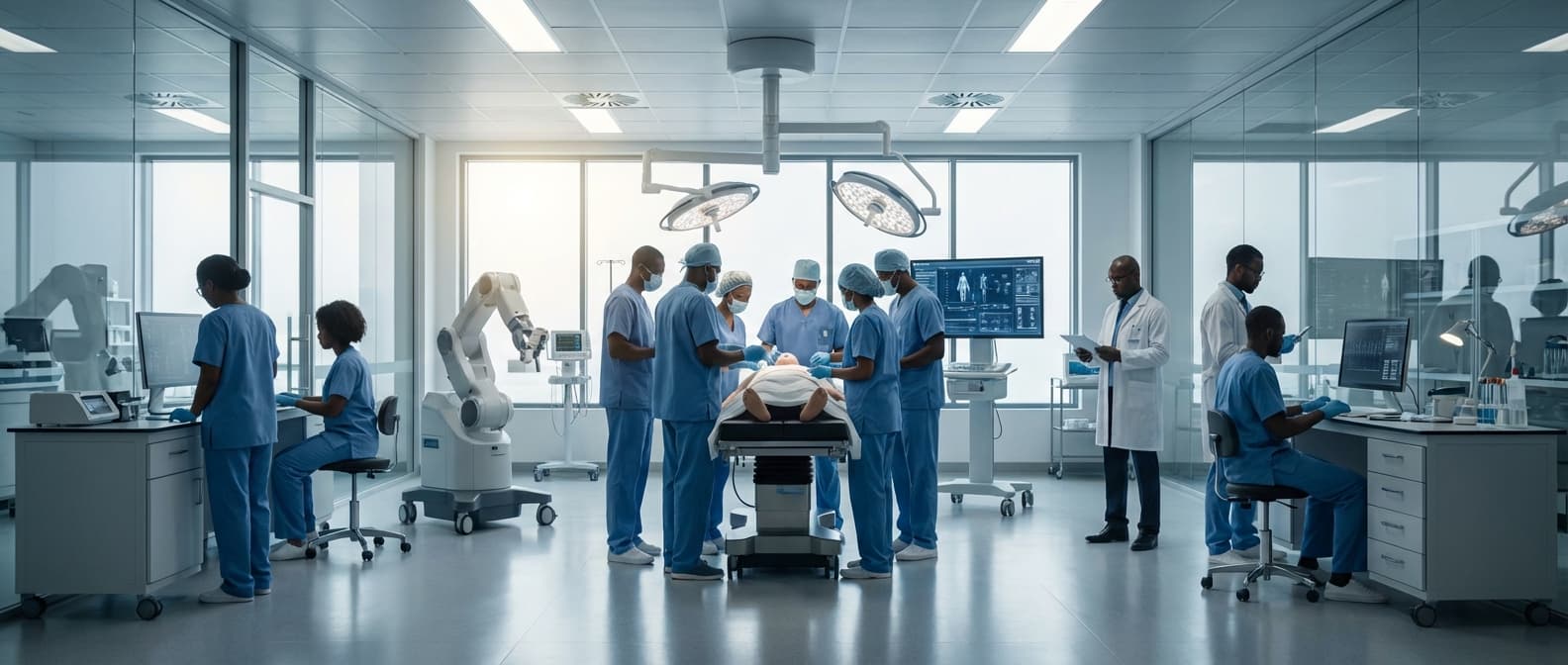
Biomedical Engineering Consulting in Central African Republic
Engineering Excellence & Technical Support
Equipment selection, procurement and implementation consulting High-standard technical execution following OEM protocols and local regulatory frameworks.
Medical Device Accessibility & Adaptation
Providing expert biomedical engineering consulting to assess the needs for accessible, durable, and cost-effective medical devices in Central African Republic. This includes adapting existing technologies for local conditions, ensuring proper maintenance infrastructure, and facilitating knowledge transfer for sustainable operation.
Healthcare Infrastructure Network Design & Implementation
Designing and implementing robust and resilient healthcare facility networks, encompassing power supply optimization, medical gas systems, waste management solutions, and essential IT infrastructure. Our focus is on creating functional and safe environments that support advanced medical practices, even in challenging logistical contexts.
Biomedical Training & Capacity Building
Developing and delivering specialized training programs for local technicians and healthcare professionals in the operation, maintenance, and repair of critical medical equipment. We empower local talent to ensure the long-term viability and effective utilization of biomedical technologies within the Central African Republic.
What Is Biomedical Engineering Consulting In Central African Republic?
Biomedical Engineering Consulting in the Central African Republic (CAR) refers to the provision of specialized technical expertise and advisory services related to medical devices, healthcare technology, and the infrastructure that supports them. This field integrates engineering principles with medical sciences to improve healthcare delivery, patient safety, and operational efficiency within healthcare facilities. In the CAR, where healthcare infrastructure and access to advanced medical technologies can be significantly challenged, these consulting services play a critical role in addressing specific needs and optimizing resource utilization. The consultants typically possess advanced degrees and extensive experience in areas such as medical device design, procurement, maintenance, validation, regulatory compliance, and the development of clinical engineering departments. They assist organizations in making informed decisions regarding technology acquisition, implementation, and management, ensuring that investments align with clinical requirements, budget constraints, and national health policies. Furthermore, they contribute to capacity building by training local biomedical technicians and engineers, fostering self-sufficiency in the long term.
| Entity Requiring Service | Typical Needs and Objectives | Illustrative Use Cases |
|---|---|---|
| Ministry of Public Health (CAR) | Developing national health technology strategies, standardizing medical equipment, improving regulatory frameworks for medical devices, and ensuring equitable access to essential technologies. | Assisting in the development of a national medical equipment inventory and maintenance plan. Providing expertise for the procurement of essential diagnostic imaging equipment for regional hospitals. Advising on the establishment of a national biomedical engineering regulatory body. |
| Public and Private Hospitals/Clinics (CAR) | Optimizing medical equipment utilization, establishing effective maintenance programs, ensuring patient safety, complying with quality standards, and managing the lifecycle of medical devices. | Developing a comprehensive preventive maintenance schedule for all medical equipment. Recommending upgrades or replacements for obsolete or poorly performing devices. Providing guidance on the safe use of new surgical equipment. |
| Non-Governmental Organizations (NGOs) and International Aid Agencies | Assessing the medical technology needs of specific projects, ensuring appropriate technology selection and implementation, and building local capacity for sustainable technology management. | Conducting a needs assessment for medical equipment for a new maternal health clinic. Overseeing the installation and training for a mobile X-ray unit in remote areas. Developing a training curriculum for local technicians in collaboration with an international health organization. |
| Manufacturers and Distributors of Medical Devices | Understanding local market requirements, navigating regulatory pathways, establishing service and support networks, and ensuring proper product deployment and user training. | Providing market intelligence on the demand for specific medical technologies. Assisting in the development of local service and repair infrastructure for their products. Training local clinical staff on the advanced features of their equipment. |
| Research and Academic Institutions | Advising on the selection and integration of research-grade medical equipment, ensuring compliance with safety standards, and contributing to the development of local biomedical engineering education. | Recommending laboratory equipment for a new medical research center. Advising on the technical specifications for a bio-signal acquisition system. Providing guest lectures on medical device regulation and maintenance. |
Key Aspects of Biomedical Engineering Consulting in the CAR
- Needs Assessment and Technology Planning: Evaluating existing healthcare infrastructure and identifying technology gaps to inform strategic procurement and deployment of medical equipment.
- Procurement Advisory: Assisting in the selection, tendering, and acquisition of medical devices, ensuring compliance with technical specifications, international standards, and cost-effectiveness.
- Installation, Commissioning, and Validation: Overseeing the proper installation, calibration, and functional validation of new medical equipment to ensure accuracy, reliability, and patient safety.
- Maintenance and Repair Strategy Development: Establishing preventive and corrective maintenance programs, including inventory management of spare parts and development of service contracts with manufacturers or third-party providers.
- Training and Capacity Building: Designing and delivering training programs for healthcare professionals and biomedical technicians on the operation, maintenance, and troubleshooting of medical equipment.
- Regulatory Compliance and Standards: Advising on adherence to national and international regulations pertaining to medical devices, quality management systems, and healthcare facility design.
- Infrastructure Development: Providing technical input for the design and renovation of healthcare facilities, focusing on power supply, environmental controls, and medical gas systems.
- Risk Management and Patient Safety: Implementing protocols and procedures to mitigate risks associated with medical technology use and enhance patient safety.
Who Needs Biomedical Engineering Consulting In Central African Republic?
Biomedical engineering consulting plays a crucial role in ensuring the availability, functionality, and safety of medical technology, especially in regions like the Central African Republic (CAR) where resources and expertise can be limited. Consultants can bridge critical gaps in knowledge and infrastructure, leading to improved healthcare outcomes. This expertise is vital for a range of stakeholders who are directly or indirectly involved in the healthcare ecosystem.
| Customer Type | Key Departments/Units Involved | Specific Needs Addressed |
|---|---|---|
| Government Ministries and Agencies | Ministry of Health, Ministry of Higher Education and Scientific Research, Ministry of Planning and International Cooperation | Policy development for medical technology, regulatory framework establishment, national health infrastructure planning, procurement strategies, training needs assessment, capacity building programs, accreditation standards. |
| Hospitals and Healthcare Facilities (Public & Private) | Procurement Department, Biomedical Engineering Department (if existing), Clinical Departments (e.g., Surgery, Radiology, ICU), Administration, IT Department, Maintenance and Facilities Management | Equipment selection and procurement, installation and commissioning, maintenance and repair strategies, lifecycle management, user training, inventory management, modernization of existing facilities, compliance with safety standards, medical device risk management. |
| Non-Governmental Organizations (NGOs) & International Aid Organizations | Program Management, Logistics and Procurement, Technical Support Teams, Health Program Coordinators | Needs assessments for medical equipment in specific projects, procurement of specialized equipment for humanitarian interventions, training of local staff on equipment use and maintenance, establishment of sustainable maintenance systems, project evaluation of medical technology impact. |
| Medical Equipment Manufacturers & Distributors | Sales and Marketing, Technical Support, Service Departments, Training Divisions | Market entry strategies, understanding local regulatory requirements, establishing effective distribution networks, providing after-sales service and training, product adaptation to local conditions, technical support for imported devices. |
| Research Institutions & Universities | Medical Schools, Science and Technology Departments, Research Laboratories, Biomedical Engineering Programs | Setting up research laboratories, selecting and maintaining research-grade equipment, developing curriculum for biomedical engineering programs, facilitating access to advanced medical technology for research, technical expertise for research projects. |
| Local Biomedical Technicians & Engineers | Individual Practitioners, Small Service Businesses | Advanced training and upskilling, access to technical documentation and troubleshooting guides, mentorship, understanding of new technologies, development of local repair and maintenance capabilities. |
| Financial Institutions & Donors | Project Evaluation Units, Investment Departments, Grant Management Teams | Technical due diligence for funding requests related to healthcare infrastructure and equipment, assessment of project sustainability, impact evaluation of medical technology investments, risk assessment for medical equipment financing. |
Target Customers for Biomedical Engineering Consulting in Central African Republic
- Government Ministries and Agencies
- Hospitals and Healthcare Facilities (Public & Private)
- Non-Governmental Organizations (NGOs) & International Aid Organizations
- Medical Equipment Manufacturers & Distributors
- Research Institutions & Universities
- Local Biomedical Technicians & Engineers
- Financial Institutions & Donors
Biomedical Engineering Consulting Process In Central African Republic
The biomedical engineering consulting process in the Central African Republic (CAR) follows a structured workflow, adapted to the unique operational and resource landscape of the region. This process aims to deliver effective, sustainable, and contextually relevant solutions for healthcare institutions, government bodies, and other stakeholders. It encompasses a series of well-defined stages, from the initial client inquiry to the successful execution and handover of projects.
| Stage | Key Activities | Deliverables | CAR-Specific Considerations |
|---|---|---|---|
| 1. Inquiry and Initial Assessment | Receive and acknowledge client inquiry. Conduct preliminary discussions to understand the client's needs, objectives, and the scope of the potential project. Initial assessment of the existing infrastructure, available resources, and regulatory environment in CAR. | Initial meeting notes, preliminary needs assessment report. | Engage with local contacts and authorities early. Assess the political stability and security situation in the proposed project area. Understand local cultural nuances and communication styles. Identify potential logistical challenges (e.g., transportation, accessibility). |
| 2. Proposal Development and Agreement | Develop a detailed project proposal outlining objectives, scope of work, methodology, timelines, deliverables, team expertise, and budget. Present the proposal to the client. Negotiate terms and finalize the contract/agreement. | Project proposal, signed contract/agreement. | Ensure cost-effectiveness and affordability given local economic conditions. Clearly outline responsibilities and risk mitigation strategies specific to CAR. Consider payment terms that are practical for local institutions. |
| 3. Project Planning and Scoping | Conduct in-depth site assessments and needs analysis. Develop detailed project plans, including work breakdown structures, resource allocation, risk management plans, and communication protocols. Finalize technical specifications and equipment requirements. | Detailed project plan, risk management plan, technical specifications, stakeholder engagement plan. | Prioritize needs based on immediate public health impact and resource availability. Adapt technical solutions to local maintenance capabilities and spare parts availability. Map out the supply chain for materials and equipment, considering customs and import regulations. |
| 4. Execution and Implementation | Procure equipment and materials. Install and commission medical devices. Implement technical solutions (e.g., laboratory setup, hospital infrastructure upgrades). Provide training to local staff. Conduct quality control checks. | Installed and functional equipment, trained personnel, progress reports, training materials. | Leverage local technicians and suppliers where possible. Implement robust training programs with a focus on practical skills and long-term sustainability. Address potential power supply issues with backup solutions. Ensure compliance with any specific CAR health regulations and standards. |
| 5. Monitoring, Evaluation, and Handover | Monitor project progress against the plan. Evaluate the effectiveness of implemented solutions and the impact on healthcare delivery. Conduct final testing and validation. Formally handover the project to the client with all relevant documentation and training. | Project completion report, evaluation report, handover documentation, final training certificates. | Assess the long-term sustainability of the solutions in the CAR context. Document lessons learned for future projects in similar challenging environments. Ensure proper knowledge transfer to enable local ownership and management. |
| 6. Post-Project Support and Follow-up | Provide ongoing technical support and troubleshooting. Offer maintenance and repair services as agreed. Conduct periodic follow-up assessments to ensure continued optimal performance and identify any new needs. | Post-project support plan, maintenance reports, follow-up visit reports. | Establish remote support mechanisms where feasible. Build local capacity for ongoing maintenance and repair to reduce reliance on external support. Maintain relationships with local stakeholders for future collaborations. |
Biomedical Engineering Consulting Workflow in CAR
- Phase 1: Inquiry and Initial Assessment
- Phase 2: Proposal Development and Agreement
- Phase 3: Project Planning and Scoping
- Phase 4: Execution and Implementation
- Phase 5: Monitoring, Evaluation, and Handover
- Phase 6: Post-Project Support and Follow-up
Biomedical Engineering Consulting Cost In Central African Republic
Biomedical engineering consulting costs in the Central African Republic (CAR) are highly variable, influenced by a complex interplay of local and international factors. Unlike more developed markets, the CAR presents unique challenges and opportunities that directly impact pricing. These include the limited availability of specialized local expertise, the need for extensive logistical planning and potential security considerations, and the prevailing economic conditions. Consultants often need to factor in higher operational costs for travel, accommodation, and sometimes the importation of specialized equipment or materials. Furthermore, the perceived risk associated with operating in the region can also influence pricing structures. Demand for biomedical engineering services, while growing, is often concentrated in specific areas such as public health initiatives, hospital infrastructure development, or regulatory compliance for medical device importation.
Pricing Factors:
- Scope of Work: The complexity, duration, and specific deliverables of the consulting project are paramount. This can range from a few days of advisory services to multi-year project management.
- Consultant Expertise & Experience: Highly specialized consultants with a proven track record, particularly those with experience in similar challenging environments, will command higher fees.
- Project Complexity & Risk: Projects involving new hospital construction, complex equipment procurement and installation, or specialized medical technology implementation will be more expensive than general advisory services.
- Logistics & Travel: Significant costs can be incurred for transportation within the CAR, accommodation, and per diems. Security measures for consultants may also be an added expense.
- Local vs. International Consultants: While local consultants may have lower direct overheads, the scarcity of specialized local expertise can sometimes make international consultants more accessible (though with higher associated travel and living costs).
- Regulatory Environment: Navigating local health and medical device regulations can require specialized knowledge and time, impacting cost.
- Urgency of the Project: Rush projects may incur premium pricing.
- Client Type: Government ministries, NGOs, international organizations, and private healthcare providers may have different budget expectations and procurement processes.
Pricing Ranges (in Central African CFA Franc - XAF):
Due to the limited market data and inherent variability, providing precise figures is challenging. The ranges below are estimations and should be considered indicative. It is crucial to obtain detailed quotes for specific projects.
- Daily Consulting Rates:
* **Junior Consultant/Local Expert:** 50,000 - 150,000 XAF per day
* **Mid-Level Consultant/Specialist:** 150,000 - 300,000 XAF per day
* **Senior Consultant/International Expert:** 300,000 - 700,000+ XAF per day (this can go significantly higher for highly sought-after specialists or complex, multi-disciplinary projects).
- Project-Based Fees: These are highly project-dependent. For example:
* **Feasibility Study for a New Clinic:** 2,000,000 - 10,000,000 XAF (depending on scale and complexity)
* **Medical Equipment Needs Assessment for a Hospital:** 1,500,000 - 8,000,000 XAF
* **Project Management for a Hospital Renovation:** 5-15% of the total project budget, with minimum fees applied.
* **Regulatory Compliance Review for Medical Devices:** 1,000,000 - 5,000,000 XAF
Important Considerations:
- Exchange Rate Fluctuations: While XAF is a stable currency, international consultants may price in USD or EUR, and fluctuations can impact the final cost.
- Negotiation: Rates are often negotiable, especially for long-term engagements or for organizations with strong existing relationships.
- Hidden Costs: Always inquire about what is included in the fee (e.g., travel, accommodation, per diems, taxes) to avoid unexpected expenses.
- Local Context: Engaging with local partners or understanding the local business environment can be crucial for effective and cost-efficient consulting.
| Consultant Level | Estimated Daily Rate (XAF) | Typical Applications |
|---|---|---|
| Junior Consultant / Local Expert | 50,000 - 150,000 | Basic data collection, administrative support, local market insights, basic advisory |
| Mid-Level Consultant / Specialist | 150,000 - 300,000 | Technical assessments, report writing, specific equipment evaluations, training support |
| Senior Consultant / International Expert | 300,000 - 700,000+ | Strategic planning, complex project management, high-level technical design, regulatory strategy, program evaluation |
Key Factors Influencing Biomedical Engineering Consulting Costs in CAR
- Scope and complexity of the project
- Expertise and experience of the consultant
- Project risks and logistical challenges
- Travel, accommodation, and per diem expenses
- Need for specialized equipment or materials
- Security considerations
- Regulatory and compliance requirements
- Urgency of the project
- Type of client (government, NGO, private sector)
- Availability of local versus international expertise
Affordable Biomedical Engineering Consulting Options
Biomedical engineering consulting can be a critical resource for startups and established companies alike, offering expertise in areas like product development, regulatory affairs, clinical trials, and market analysis. However, the perceived high cost can be a barrier. This guide explores affordable consulting options, focusing on value bundles and effective cost-saving strategies to make expert guidance accessible.
| Cost-Saving Strategy | Description | Implementation Tips |
|---|---|---|
| Leverage Freelance & Boutique Firms | Smaller, specialized firms or independent consultants often have lower overheads than large corporations, allowing them to offer competitive pricing. | Thoroughly vet freelancers for experience and track record. Seek references. Boutique firms often specialize, offering deep expertise in niche areas. |
| Phased Approach & Milestone-Based Payments | Break down large projects into smaller, manageable phases with clear deliverables. Negotiate payment based on the successful completion of each milestone. | Define project scope meticulously for each phase. Ensure clear acceptance criteria are agreed upon upfront. |
| Focus on Specific Expertise | Instead of a full-service firm, engage consultants for highly specific tasks where their unique expertise is most valuable. | Clearly define the exact problem you need solved. Avoid consultants who offer a broad range of services if you only need a narrow specialization. |
| On-Demand & Ad-Hoc Consulting | Utilize consultants for short-term, specific problem-solving sessions rather than long-term engagements. | Have your questions and data ready before calls. Maximize the value of each consultation by being prepared. |
| In-House Knowledge Transfer | Negotiate for consultants to not only solve a problem but also to train your internal team on how to manage similar issues in the future. | Request documentation and best practice guides. Schedule knowledge-sharing sessions as part of the engagement. |
| Explore Academic Partnerships | Universities with biomedical engineering departments may have faculty or graduate students offering consulting services at reduced rates, especially for projects aligned with research interests. | Check with university technology transfer offices or departmental contacts. Ensure clear project scope and IP agreements are established. |
| Utilize Online Consulting Platforms | Platforms connecting businesses with vetted consultants can offer competitive pricing and a wider selection of specialists. | Read reviews and testimonials carefully. Understand the platform's fee structure and dispute resolution policies. |
| Negotiate Retainer Agreements (with caps) | For ongoing needs, a retainer can secure consulting availability at a pre-agreed rate. Include clear caps on monthly hours/spend to control costs. | Define the scope of services covered by the retainer. Regularly review usage to ensure it remains cost-effective. |
Understanding Value Bundles in Consulting
- {"title":"What are Value Bundles?","description":"Value bundles are pre-packaged sets of services offered by consulting firms at a fixed price. They are designed to provide a comprehensive solution for specific needs, offering a more predictable and often cost-effective alternative to procuring individual services piecemeal."}
- {"title":"Benefits of Value Bundles","description":"Bundles often include a combination of services that are frequently used together, such as 'Design to Regulatory Submission' or 'Market Entry Strategy.' This integration can streamline workflows, reduce communication overhead, and ensure a holistic approach. They can also offer a discount compared to the sum of individual service costs."}
- {"title":"Examples of Biomedical Engineering Value Bundles","description":"Common bundles might include: \n- Product Development Sprint: Feasibility study, conceptual design, prototyping guidance, and initial IP assessment. \n- Regulatory Pathway Assessment: Identifying the appropriate regulatory classification, outlining required testing, and preparing pre-submission documentation. \n- Market Feasibility & Strategy: Competitor analysis, target market identification, pricing strategy, and initial go-to-market plan. \n- Quality Management System (QMS) Implementation: Gap analysis, QMS design, and initial documentation development."}
Verified Providers In Central African Republic
In the Central African Republic (CAR), where access to reliable healthcare can be a significant challenge, identifying verified providers is crucial for individuals seeking quality medical services. Franance Health stands out as a leading organization, recognized for its commitment to upholding stringent credentials and delivering exceptional healthcare. This document outlines why Franance Health represents the best choice for healthcare in the CAR.
| Attribute | Franance Health Verification | Significance for Patients |
|---|---|---|
| Official Accreditation | Ministry of Health Approved & Licensed | Guarantees adherence to national safety and quality standards; confirms legal and legitimate operation. |
| Medical Staff Qualification | Licensed Professionals with Ongoing Training | Ensures patients are treated by competent, skilled, and up-to-date medical experts. |
| Infrastructure & Equipment | Modern Facilities and Advanced Technology | Facilitates accurate diagnoses, effective treatments, and improved patient care outcomes. |
| Ethical Standards | Commitment to Patient Rights & Confidentiality | Provides assurance of respectful, transparent, and secure medical care. |
| Service Quality | Alignment with International Best Practices | Indicates a high standard of care comparable to global benchmarks. |
Franance Health Credentials and Why They Matter:
- Ministry of Health Accreditation: Franance Health facilities and personnel undergo rigorous vetting and regular inspections by the Central African Republic's Ministry of Health. This accreditation ensures adherence to national medical standards, safety protocols, and ethical practices. It is a fundamental requirement for legal operation and a primary indicator of legitimacy.
- International Standards Compliance: Beyond national requirements, Franance Health strives to align its operations with internationally recognized healthcare benchmarks. This includes best practices in patient care, hygiene, infection control, and medical record management, ensuring a higher level of service comparable to global standards.
- Qualified and Licensed Medical Professionals: All healthcare practitioners at Franance Health are fully licensed by the relevant medical boards within the CAR and often possess specialized international training. Their qualifications are continuously assessed, guaranteeing that patients receive care from competent and experienced professionals.
- State-of-the-Art Equipment and Technology: Franance Health invests in modern medical equipment and diagnostic tools, enabling accurate diagnoses and effective treatment. This commitment to technological advancement is essential for providing comprehensive care and improving patient outcomes.
- Patient-Centric Approach and Ethical Conduct: A core tenet of Franance Health is its unwavering dedication to patient well-being and ethical medical practice. This includes transparent communication, informed consent, patient confidentiality, and a compassionate approach to care.
- Community Engagement and Accessibility: Franance Health actively works to improve healthcare accessibility within the CAR, often establishing clinics in underserved areas and engaging with local communities to understand and address their specific health needs.
Scope Of Work For Biomedical Engineering Consulting
This document outlines the Scope of Work (SOW) for Biomedical Engineering Consulting services. It details the technical deliverables expected and the standard specifications that will guide the execution of the project. The consulting services aim to provide expert guidance and support in various aspects of biomedical engineering, ensuring compliance with relevant standards and best practices.
| Technical Deliverable | Description | Standard Specifications / References |
|---|---|---|
| Regulatory Strategy Report | Comprehensive report detailing the optimal regulatory pathway for a medical device, including classification, required submissions, and timelines. | 21 CFR Part 820 (Quality System Regulation), ISO 13485:2016, relevant FDA Guidance Documents, MDR (EU) 2017/745 |
| Design History File (DHF) Review and Gap Analysis | Thorough review of the DHF to ensure completeness, accuracy, and compliance with design control requirements. | 21 CFR Part 820.30, ISO 13485:2016 Clause 7.3 |
| Risk Management Plan and Report | Development and execution of a risk management process throughout the product lifecycle, including hazard identification and risk control measures. | ISO 14971:2019 (Medical devices — Application of risk management to medical devices) |
| Verification and Validation (V&V) Protocols and Reports | Detailed protocols for testing designed to verify design inputs are met (Verification) and that the device meets user needs and intended uses (Validation). | 21 CFR Part 820.30(f), ISO 13485:2016 Clause 7.3.6 |
| Usability Engineering File | Documentation of the usability engineering process, including user needs, use specifications, use-related risk analysis, and validation of usability. | IEC 62366-1:2015 (Medical devices — Part 1: Application of usability engineering to medical devices) |
| Quality Management System (QMS) Audit Report | Assessment of the existing QMS against applicable standards and regulations, with recommendations for improvement. | ISO 13485:2016, 21 CFR Part 820 |
| Intellectual Property (IP) Landscape Analysis | Research and analysis of existing patents and IP to inform product development and freedom-to-operate decisions. | USPTO Patent Search Databases, EPO Espacenet |
| Clinical Evaluation Plan and Report (CEP/CER) | Strategy and documentation for assessing the clinical safety and performance of a medical device based on clinical data. | MDR (EU) 2017/745 Annex XIV, MEDDEV 2.7/1 rev 4 |
| Technology Feasibility Report | Evaluation of the technical viability and potential of a proposed technology or product concept. | Internal company standards, industry best practices |
| Biocompatibility Assessment Report | Guidance on the selection of materials and assessment of their biocompatibility based on intended use and duration of contact. | ISO 10993 series (Biological evaluation of medical devices) |
Key Areas of Consulting Service
- Regulatory Affairs Strategy and Submission Support
- Product Development and Design Review
- Risk Management and Failure Mode and Effects Analysis (FMEA)
- Verification and Validation (V&V) Planning and Execution
- Usability Engineering and Human Factors Analysis
- Quality Management System (QMS) Implementation and Audit Preparation
- Intellectual Property (IP) Strategy and Patent Landscape Analysis
- Clinical Evaluation and Post-Market Surveillance
- Technology Assessment and Feasibility Studies
- Biocompatibility Testing and Material Selection Guidance
Service Level Agreement For Biomedical Engineering Consulting
This Service Level Agreement (SLA) outlines the guaranteed response times and uptime for biomedical engineering consulting services provided by [Your Company Name] to [Client Name]. This SLA is an addendum to the Master Service Agreement (MSA) dated [Date of MSA].
| Service Category | Response Time Guarantee (Business Hours) | Uptime Guarantee | Example Scenarios |
|---|---|---|---|
| Emergency Support | 1 hour | N/A (Focus on immediate response) | Critical equipment failure impacting patient care, immediate regulatory violation. |
| Urgent Support (Non-Emergency) | 4 business hours | 99.5% | Performance degradation of a key medical device, minor compliance issue. |
| Standard Support | 8 business hours | 99.8% | Routine equipment maintenance, software updates, non-critical system questions. |
Definitions
- Business Hours: Defined as Monday through Friday, 9:00 AM to 5:00 PM in the client's primary time zone, excluding national holidays.
- Emergency: A critical system failure or a regulatory non-compliance event that poses an immediate threat to patient safety, significant financial loss, or substantial operational disruption.
- Standard Support Request: Any request for assistance that does not meet the criteria for an Emergency.
- Response Time: The maximum time from when a support request is acknowledged by [Your Company Name] until a qualified biomedical engineer begins actively working on the issue.
- Resolution Time: The maximum time from when a support request is acknowledged until the issue is resolved or a clear path to resolution is communicated to the client.
- Uptime: The percentage of time that critical, agreed-upon biomedical systems and services are available and operational, as defined in the Scope of Services.
- Downtime: The percentage of time that critical, agreed-upon biomedical systems and services are unavailable or non-operational.
- Service Credit: A credit applied to the client's next invoice as compensation for failure to meet the guaranteed response times or uptime.
- Scheduled Maintenance: Planned downtime for system updates, upgrades, or preventative maintenance, communicated to the client in advance.
Frequently Asked Questions

Ready when you are
Let's scope your Biomedical Engineering Consulting in Central African Republic project in Central African Republic.

Scaling healthcare logistics and technical systems across the entire continent.