
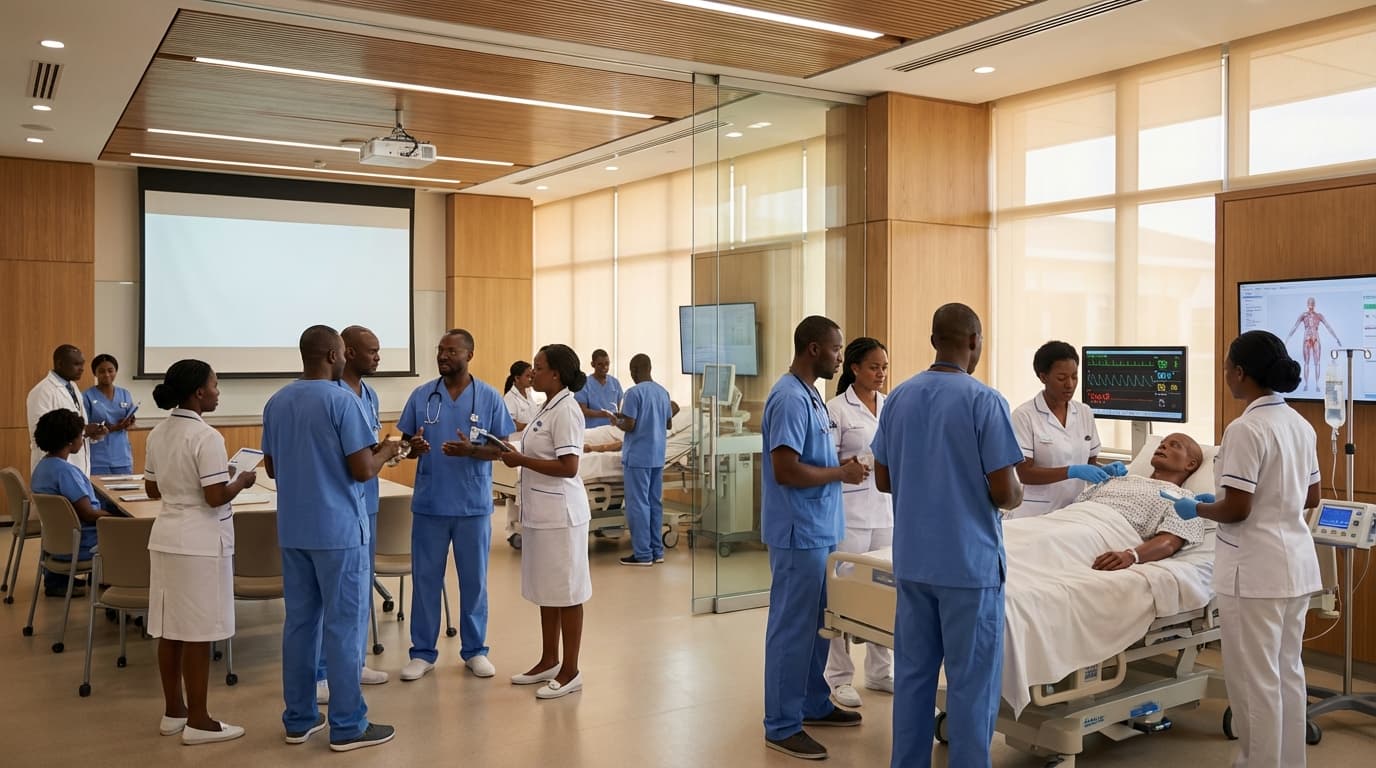
Equipment Training & Education in Cameroon
Engineering Excellence & Technical Support
Comprehensive equipment training and certification programs High-standard technical execution following OEM protocols and local regulatory frameworks.
Mobile Training Units
Deploying fully equipped mobile training units to remote agricultural regions, providing hands-on instruction on operating and maintaining essential farm machinery, including tractors, harvesters, and irrigation systems. This ensures accessibility and practical skill development for farmers across Cameroon.
Certified Instructor Program
Establishing a rigorous certification program for local trainers in equipment operation, safety protocols, and basic troubleshooting. This program empowers Cameroonian educators with the expertise to deliver high-quality, sustainable training initiatives, fostering a skilled workforce for the agricultural sector.
Interactive Simulation Labs
Developing and implementing interactive simulation labs that replicate real-world operational scenarios for complex agricultural and construction equipment. This allows trainees to practice maneuvers, identify potential issues, and develop decision-making skills in a safe and controlled virtual environment, reducing the risk of damage and injury.
What Is Equipment Training & Education In Cameroon?
Equipment training and education in Cameroon refers to the systematic provision of knowledge and practical skills necessary for the safe, efficient, and effective operation, maintenance, and troubleshooting of specialized machinery and tools across various sectors. This service encompasses theoretical instruction, hands-on practice, and ongoing competency assessment, aiming to enhance user proficiency and minimize operational risks and downtime. It is crucial for ensuring the longevity of equipment, optimizing productivity, and adhering to industry best practices and regulatory standards.
| Who Needs It? | Typical Use Cases |
|---|---|
| Industrial Operators: Personnel directly responsible for operating machinery in manufacturing, production, and processing plants. | Operation of CNC machines, industrial robots, automated assembly lines, and heavy machinery in factories. |
| Maintenance Technicians: Individuals tasked with the repair, servicing, and preventative maintenance of equipment. | Troubleshooting and repair of complex industrial equipment, preventative maintenance scheduling for machinery, calibration of measuring instruments. |
| Construction Workers & Supervisors: Teams involved in the deployment and operation of construction machinery. | Safe operation of excavators, bulldozers, cranes, concrete mixers, and scaffolding erection. |
| Healthcare Professionals: Staff operating medical equipment. | Usage and maintenance of diagnostic imaging equipment (MRI, CT scanners), laboratory analyzers, and surgical instruments. |
| Agricultural Workers: Individuals managing and operating agricultural machinery. | Operation of tractors, harvesters, irrigation systems, and processing equipment in the agricultural sector. |
| IT & Telecommunications Technicians: Personnel managing and deploying network infrastructure and computing hardware. | Installation and maintenance of servers, network routers, switches, and telecommunication towers. |
| Logistics & Warehousing Staff: Individuals operating material handling equipment. | Operation of forklifts, pallet jacks, conveyor systems, and automated storage and retrieval systems (AS/RS). |
| Energy Sector Personnel: Workers in oil, gas, and power generation industries. | Operation and maintenance of turbines, generators, drilling rigs, and power distribution equipment. |
Key Components of Equipment Training & Education
- Needs Assessment: Identifying specific equipment, skill gaps, and learning objectives for target personnel.
- Curriculum Development: Designing modular training programs tailored to equipment type, complexity, and industry context.
- Instructional Delivery: Employing a blend of theoretical lectures, practical demonstrations, simulated exercises, and on-the-job training.
- Competency Assessment: Evaluating trainee understanding and practical application through written examinations, skill tests, and performance reviews.
- Certification & Documentation: Issuing verifiable credentials and maintaining training records for compliance and professional development.
- Refresher & Advanced Training: Offering ongoing education to address technological advancements, new procedures, and reinforce existing skills.
- Safety Protocols Integration: Emphasizing hazard identification, risk mitigation, and the correct application of safety equipment and procedures.
Who Needs Equipment Training & Education In Cameroon?
Ensuring safe and efficient operation of equipment is paramount across various industries in Cameroon. Comprehensive equipment training and education are vital for individuals and organizations that utilize machinery, tools, and technology in their daily operations. This training not only enhances productivity and minimizes operational risks but also contributes to the longevity of equipment and the overall success of businesses.
| Industry/Sector | Target Customers | Key Departments Requiring Training |
|---|---|---|
| Agriculture | Farmers, Farm Managers, Agricultural Technicians | Tractor Operators, Harvester Operators, Irrigation System Technicians, Farm Equipment Maintenance |
| Construction | Construction Workers, Site Supervisors, Equipment Operators, Engineers | Heavy Equipment Operators (Excavators, Bulldozers, Cranes), Scaffolding Technicians, Safety Officers, Project Management |
| Manufacturing & Industrial | Factory Workers, Production Line Supervisors, Maintenance Engineers, Quality Control Staff | Machine Operators, Assembly Line Workers, Forklift Operators, Welding Technicians, Electrical & Mechanical Maintenance |
| Oil & Gas | Drilling Crews, Maintenance Personnel, Safety Supervisors, Field Technicians | Drilling Rig Operators, Wellhead Technicians, Safety Equipment Specialists, Pipeline Technicians, Petrochemical Plant Operators |
| Mining | Mine Operators, Maintenance Crews, Geologists, Safety Inspectors | Heavy Haul Truck Drivers, Excavator Operators, Driller Operators, Blasting Technicians, Mine Safety Officers |
| Transportation & Logistics | Truck Drivers, Warehouse Staff, Fleet Managers, Logistics Coordinators | Forklift Operators, Truck Drivers (Commercial), Warehouse Management Systems Operators, Loading Dock Personnel |
| Healthcare | Medical Technicians, Biomedical Engineers, Nursing Staff | Radiology Technicians (MRI, CT Scan), Laboratory Equipment Technicians, Sterilization Equipment Operators, Dialysis Technicians |
| Utilities (Water, Power, Telecommunications) | Field Technicians, Plant Operators, Maintenance Crews, Control Room Operators | Power Plant Operators, Water Treatment Plant Operators, Telecommunication Tower Technicians, Substation Technicians, Grid Control Operators |
| Government & Public Services | Municipal Workers, Road Maintenance Crews, Emergency Responders | Public Works Equipment Operators, Firefighting Equipment Specialists, Waste Management Equipment Operators |
| Education & Training Institutions | Vocational School Instructors, Technical College Lecturers, University Researchers | Instructors of specific equipment operation, Lab Technicians, Research Assistants |
Who Needs Equipment Training & Education in Cameroon? Target Customers & Departments
- Individuals operating heavy machinery.
- Technicians responsible for equipment maintenance and repair.
- Supervisors overseeing operational teams.
- Safety officers ensuring compliance and risk mitigation.
- New employees requiring familiarization with workplace equipment.
- Companies seeking to upgrade their workforce's skills.
- Government agencies involved in infrastructure development and public services.
- Educational institutions offering vocational and technical training.
Equipment Training & Education Process In Cameroon
The Equipment Training & Education Process in Cameroon is a structured workflow designed to ensure individuals and organizations acquire the necessary skills and knowledge to operate and maintain specific equipment effectively and safely. This process typically begins with an inquiry from a potential client and culminates in the successful execution of the training program, followed by post-training support.
| Stage | Description | Key Activities | Responsible Parties |
|---|---|---|---|
| Inquiry and Needs Assessment | Initial contact from a client seeking training for specific equipment. Understanding their requirements, existing skill levels, and desired outcomes. | Receive inquiry, conduct initial consultation, identify specific equipment, determine target audience, assess current knowledge gaps, define training objectives. | Prospective Client, Training Provider Sales/Consultation Team |
| Proposal Development | Based on the needs assessment, the training provider develops a tailored proposal outlining the training scope, methodology, duration, costs, and expected benefits. | Define training modules, select instructors, estimate resources (materials, equipment), develop detailed syllabus, prepare cost breakdown, create training schedule, draft proposal document. | Training Provider (Technical & Sales Teams) |
| Contract Negotiation and Agreement | Review and finalize the proposal, terms and conditions, payment schedules, and other contractual obligations between the client and the training provider. | Client reviews proposal, negotiate terms, finalize scope of work, sign contract/Memorandum of Understanding (MoU). | Prospective Client, Training Provider Management |
| Curriculum Design and Customization | Developing or adapting training materials to align with the specific equipment, industry standards, and the client's operational context. | Develop training manuals, presentations, practical exercises, case studies; customize content based on specific equipment models and client feedback. | Training Provider (Instructional Designers, Subject Matter Experts) |
| Logistics and Scheduling | Arranging all practical aspects of the training, including venue, equipment availability, instructor travel, and participant coordination. | Book training venue, ensure availability of training equipment, arrange instructor travel and accommodation, communicate schedule to participants, manage participant registration. | Training Provider (Operations/Logistics Team), Client (for participant coordination) |
| Training Delivery (Execution) | The actual delivery of the training program to the participants, encompassing theoretical and practical sessions. | Conduct classroom lectures, provide hands-on demonstrations, facilitate practical exercises, monitor participant progress, address queries. | Training Provider (Instructors), Participants |
| Assessment and Evaluation | Measuring the effectiveness of the training and the participants' comprehension and skill acquisition. | Administer theoretical tests, conduct practical skill assessments, gather feedback through surveys, observe performance during exercises. | Training Provider (Instructors, Assessors), Participants |
| Certification and Documentation | Issuing certificates of completion or competency to participants who meet the required standards, and providing relevant documentation. | Prepare and issue certificates, compile training records, provide summary reports to the client. | Training Provider (Administration/Certification Department) |
| Post-Training Support and Follow-up | Offering ongoing assistance and resources to participants and clients after the training is completed. | Provide technical support, answer follow-up questions, offer refresher courses, collect feedback for continuous improvement, maintain client relationships. | Training Provider (Support Team, Account Managers), Client |
Workflow Stages
- Inquiry and Needs Assessment
- Proposal Development
- Contract Negotiation and Agreement
- Curriculum Design and Customization
- Logistics and Scheduling
- Training Delivery (Execution)
- Assessment and Evaluation
- Certification and Documentation
- Post-Training Support and Follow-up
Equipment Training & Education Cost In Cameroon
Equipment training and education costs in Cameroon can vary significantly based on several factors. These include the type and complexity of the equipment, the duration and depth of the training, the qualifications and experience of the trainers, the location of the training (on-site vs. off-site), and the reputation and accreditation of the training provider. Demand for specific skills and the availability of specialized trainers also play a role in pricing. Generally, training for highly technical or specialized equipment will command higher fees. Furthermore, training delivered in major urban centers like Douala or Yaoundé might have slightly higher costs due to overheads compared to more rural areas. Providers range from vocational training centers, private educational institutions, to specialized equipment manufacturers or their local representatives offering bespoke training solutions.
| Training Type/Equipment Category | Typical Price Range (XAF) | Notes |
|---|---|---|
| Basic Office Software/Hardware (e.g., MS Office, Laptops) | 15,000 - 75,000 | Short courses (1-3 days), group training |
| Industrial Machinery (e.g., Welding, Fabrication) | 50,000 - 250,000 | Weeks to months, hands-on, certification may be extra |
| Medical Equipment (e.g., Imaging, Lab Devices) | 100,000 - 500,000+ | Highly specialized, often manufacturer-led, may include travel costs |
| IT & Networking Equipment (e.g., Servers, Routers) | 40,000 - 300,000 | Depends on vendor certification level (e.g., Cisco, CompTIA) |
| Agricultural Machinery (e.g., Tractors, Harvesters) | 30,000 - 150,000 | Practical operation and basic maintenance |
| Heavy Construction Equipment (e.g., Excavators, Cranes) | 60,000 - 350,000 | Operational skills and safety procedures |
| Specialized Scientific Equipment | 150,000 - 700,000+ | Often highly customized, involves advanced technical knowledge |
Key Pricing Factors for Equipment Training in Cameroon
- Type and Complexity of Equipment
- Duration and Depth of Training Program
- Trainer Qualifications and Experience
- Training Location (On-site vs. Off-site)
- Provider Reputation and Accreditation
- Demand for Specific Skills
- Availability of Specialized Trainers
- Geographical Location (Urban vs. Rural)
- Inclusion of Materials and Certification
Affordable Equipment Training & Education Options
Investing in proper equipment training is crucial for safety, efficiency, and productivity. Fortunately, there are numerous affordable options available, and understanding value bundles and cost-saving strategies can significantly reduce your investment without compromising quality. This guide explores accessible training and education pathways, highlighting how to maximize your budget.
| Strategy | Description | Benefits | Considerations |
|---|---|---|---|
| Value Bundles | Combining multiple training modules or courses into a package deal, often at a discounted price compared to purchasing them individually. This can include foundational training plus advanced modules, or training for multiple pieces of equipment. | Reduced overall cost, comprehensive skill development, streamlined training process. | Ensure the bundle covers all necessary skills and equipment. Check for flexibility in scheduling and content. |
| Group Discounts | Many training providers offer reduced rates for multiple participants from the same organization. The more people trained, the higher the discount. | Significant cost savings for larger teams, promotes consistent skill levels across the workforce. | Coordinate schedules for all participants. Ensure the training content is relevant to everyone attending. |
| Early Bird Registration | Signing up for courses or workshops well in advance of the scheduled date often unlocks discounted pricing. | Lower upfront cost, guarantees a spot in popular courses. | Requires proactive planning and commitment. Ensure training needs are confirmed before registering. |
| Subscription Services | Some online platforms offer monthly or annual subscriptions that provide access to a library of courses, allowing for continuous learning and upskilling at a predictable cost. | Cost-effective for ongoing training needs, access to a wide range of content, encourages a culture of learning. | Assess the breadth and depth of the content to ensure it meets your specific equipment and industry needs. |
| Train-the-Trainer Programs | Investing in training a few key personnel who can then train others within the organization. This creates internal expertise and reduces reliance on external trainers. | Long-term cost savings, tailored training to internal processes, builds internal capacity. | Requires selecting knowledgeable and effective internal trainers. Ongoing support for trainers may be needed. |
| Government Grants & Subsidies | Investigate if any local, regional, or national government programs offer grants or subsidies for workforce training and development, particularly for in-demand skills or industries. | Significant reduction or elimination of training costs, supports economic development. | Eligibility criteria can be strict. Requires research and application process. |
| Cross-Training Initiatives | Training employees on multiple pieces of equipment can increase versatility and reduce the need for specialized training for each machine. This can be structured as a bundled offering. | Increased workforce flexibility, optimized resource allocation, potential for bundled training discounts. | Ensure cross-training doesn't dilute expertise in core responsibilities. Requires careful planning to avoid overload. |
Key Affordable Equipment Training & Education Options
- Online Courses & Webinars: Accessible 24/7, these often cover theoretical knowledge, safety protocols, and basic operational procedures. Look for reputable providers offering specialized courses for your equipment.
- Manufacturer-Provided Training: Many equipment manufacturers offer introductory or refresher courses, sometimes included with a purchase or available at a reduced cost. Check their official websites or contact their sales representatives.
- Community Colleges & Vocational Schools: These institutions often have hands-on training programs for specific equipment types, providing practical skills at a fraction of the cost of private training centers.
- On-the-Job Training (OJT): Leveraging experienced in-house personnel to train new employees is a highly cost-effective method. Ensure trainers are well-versed and follow a structured curriculum.
- Apprenticeship Programs: For trades involving heavy machinery or specialized equipment, apprenticeships offer a combination of on-the-job experience and formal education, often with employers subsidizing training costs.
- Industry Associations & Certifications: Many industry bodies offer specialized training and certifications. While some may have membership fees, the training itself can be more affordable and recognized by employers.
- Open-Source Training Materials: For some types of equipment, particularly software or less complex machinery, you might find free or low-cost instructional videos, guides, and forums online.
Verified Providers In Cameroon
In the dynamic landscape of healthcare in Cameroon, identifying reliable and qualified healthcare providers is paramount. This is where Franance Health emerges as a leading name, offering a robust network of verified professionals who exemplify the highest standards of medical care. Franance Health's rigorous credentialing process ensures that all affiliated providers have undergone thorough vetting, guaranteeing their expertise, ethical conduct, and commitment to patient well-being. Choosing a Franance Health-verified provider means opting for transparency, quality, and peace of mind in your healthcare journey.
| Credential Aspect | Franance Health Verification | Benefit to Patients |
|---|---|---|
| Medical Licenses & Certifications | Mandatory verification against official Cameroonian medical boards and international accreditation bodies. | Ensures providers are legally qualified and possess up-to-date expertise in their respective fields. |
| Professional Experience & Specialization | Thorough review of educational background, residency, fellowship programs, and documented years of practice. | Guarantees that patients are treated by experienced specialists with the appropriate skills for their specific medical needs. |
| Background Checks & Criminal Records | Comprehensive checks to ensure no history of malpractice, fraud, or criminal offenses. | Protects patients from potentially harmful or unethical practitioners, fostering a safe healthcare environment. |
| Peer Reviews & Reputation Assessment | Evaluation of professional references and, where applicable, analysis of patient feedback mechanisms. | Provides an indicator of the provider's reputation within the medical community and among patients, highlighting those with a strong commitment to care. |
| Continuing Medical Education (CME) | Confirmation of active participation in ongoing professional development and training programs. | Assures patients that their providers are staying abreast of the latest medical advancements and treatment protocols. |
Why Franance Health Credentials Represent the Best Choice:
- Rigorous Verification Process: Franance Health employs a multi-faceted approach to verify the qualifications, licenses, and certifications of all its healthcare providers.
- Commitment to Excellence: Affiliated professionals are selected based on their proven track record, patient reviews, and dedication to continuous professional development.
- Ethical Standards: Franance Health prioritizes providers who adhere to the strictest ethical guidelines and patient-centered care principles.
- Accessibility and Convenience: The verified network offers access to a wide range of specialists and general practitioners across Cameroon, making quality healthcare more accessible.
- Patient Trust and Safety: By choosing a Franance Health-verified provider, patients can be confident in the quality and safety of the care they receive.
- Streamlined Healthcare Experience: Franance Health aims to simplify the process of finding trusted medical professionals, reducing stress and uncertainty for patients.
Scope Of Work For Equipment Training & Education
This Scope of Work (SOW) outlines the requirements for providing comprehensive training and educational services for the specified equipment. The objective is to ensure proficient operation, maintenance, and troubleshooting capabilities for the designated personnel. This SOW details the technical deliverables, standard specifications, and outlines the expected outcomes of the training program. The training will be tailored to the specific equipment models and the skill levels of the trainees. It will encompass theoretical knowledge, practical hands-on exercises, and assessment of learning.
| Category | Deliverable/Specification | Description | Acceptance Criteria |
|---|---|---|---|
| Training Program Design | Detailed Training Curriculum | A comprehensive curriculum document outlining modules, topics, learning objectives, and duration for each session. | Curriculum approved by the client prior to commencement; aligns with equipment's operational manual. |
| Training Delivery | Instructor-Led Training Sessions | On-site or remote delivery of training by qualified instructors, covering theoretical and practical aspects of the equipment. | Trainee attendance records; positive feedback on instructor's knowledge and delivery. |
| Training Delivery | Hands-on Practical Exercises | Structured practical sessions allowing trainees to operate, maintain, and troubleshoot the actual equipment under supervision. | Successful completion of assigned practical tasks; demonstration of proficiency in operating the equipment. |
| Training Materials | Participant Training Manuals | Comprehensive, up-to-date manuals for each trainee, including operational procedures, maintenance checklists, and troubleshooting guides. | Manuals are technically accurate, clearly written, and relevant to the equipment models being trained. |
| Training Materials | Presentation Slides | Visual aids used during instructor-led sessions, summarizing key concepts and procedures. | Slides are clear, concise, and visually engaging. |
| Training Materials | Assessment Tools | Quizzes, practical tests, and case studies designed to evaluate trainee comprehension and skill acquisition. | Assessment results demonstrate achievement of learning objectives. |
| Technical Deliverables | Post-Training Report | A report summarizing the training conducted, trainee performance, and any recommendations for further training or equipment optimization. | Report submitted within 5 business days of training completion. |
| Technical Deliverables | Certificate of Completion | Formal certificates issued to trainees who successfully complete the training program. | Certificates accurately reflect the training completed and are provided to all successful trainees. |
| Standard Specifications | Instructor Qualifications | Instructors must possess demonstrable expertise in the specific equipment, relevant certifications, and proven training experience. | Resumes and certifications of instructors provided for review and approval. |
| Standard Specifications | Equipment Availability for Training | Client to ensure the availability of the specified equipment in a safe and operational condition for the duration of the training. | Equipment accessible and functional as per the training schedule. |
| Standard Specifications | Training Environment | A suitable training environment with adequate lighting, ventilation, and space for practical exercises. | Training space meets health and safety standards. |
| Standard Specifications | Training Schedule Adherence | Training to be conducted as per the agreed-upon schedule, with minimal disruptions. | Training sessions commence and conclude on time. |
Key Objectives of Equipment Training & Education
- To equip trainees with the theoretical understanding of the equipment's functionality, principles of operation, and system architecture.
- To develop practical skills for operating the equipment safely, efficiently, and in accordance with manufacturer guidelines.
- To provide trainees with the knowledge and ability to perform routine maintenance, calibration, and basic troubleshooting procedures.
- To enhance the overall lifespan and performance of the equipment through proper usage and preventative care.
- To ensure compliance with relevant safety regulations and operational protocols.
- To foster a proactive approach to problem-solving and issue resolution related to the equipment.
Service Level Agreement For Equipment Training & Education
This Service Level Agreement (SLA) outlines the performance commitments for Equipment Training & Education services provided by [Your Company Name] (hereinafter referred to as 'Provider') to [Client Company Name] (hereinafter referred to as 'Client'). This SLA focuses on response times for support requests and uptime guarantees for the training platform.
| Service Component | Service Level Target | Measurement Method | Client Notification |
|---|---|---|---|
| Training Platform Uptime | 99.5% Uptime (excluding Scheduled Maintenance) | Monitored 24/7/365 by Provider's automated monitoring tools. Calculated monthly. | Scheduled Maintenance: At least 48 hours advance notice via email. Emergency Maintenance: Immediate notification via email and/or portal alert. |
| Critical Support Request Response Time (e.g., platform inaccessible for all users) | 1 Hour | Time from Client submitting request via designated support channel (e.g., ticket system, email, phone) to Provider's first acknowledgement. | N/A (tracked internally and communicated during resolution process) |
| High Priority Support Request Response Time (e.g., significant functionality impaired for multiple users) | 4 Business Hours | Time from Client submitting request via designated support channel to Provider's first acknowledgement. | N/A (tracked internally and communicated during resolution process) |
| Medium Priority Support Request Response Time (e.g., minor functionality issue affecting a single user, general 'how-to' questions) | 8 Business Hours | Time from Client submitting request via designated support channel to Provider's first acknowledgement. | N/A (tracked internally and communicated during resolution process) |
Key Definitions
- Uptime: Refers to the percentage of time the training platform is available and accessible for the Client's users.
- Downtime: Refers to the percentage of time the training platform is unavailable or inaccessible.
- Response Time: The maximum time allowed for the Provider to acknowledge and begin addressing a support request.
- Resolution Time: The maximum time allowed for the Provider to fully resolve a support request. (Note: This SLA primarily focuses on response times. Resolution times will be detailed in a separate incident management document or support process).
- Scheduled Maintenance: Planned periods of downtime for system updates, upgrades, or maintenance, communicated in advance to the Client.
- Emergency Maintenance: Unplanned periods of downtime required to address critical security vulnerabilities or system failures.
- Business Hours: Monday to Friday, 9:00 AM to 5:00 PM [Client's Time Zone], excluding national holidays.
Frequently Asked Questions

Ready when you are
Let's scope your Equipment Training & Education in Cameroon project in Cameroon.

Scaling healthcare logistics and technical systems across the entire continent.