
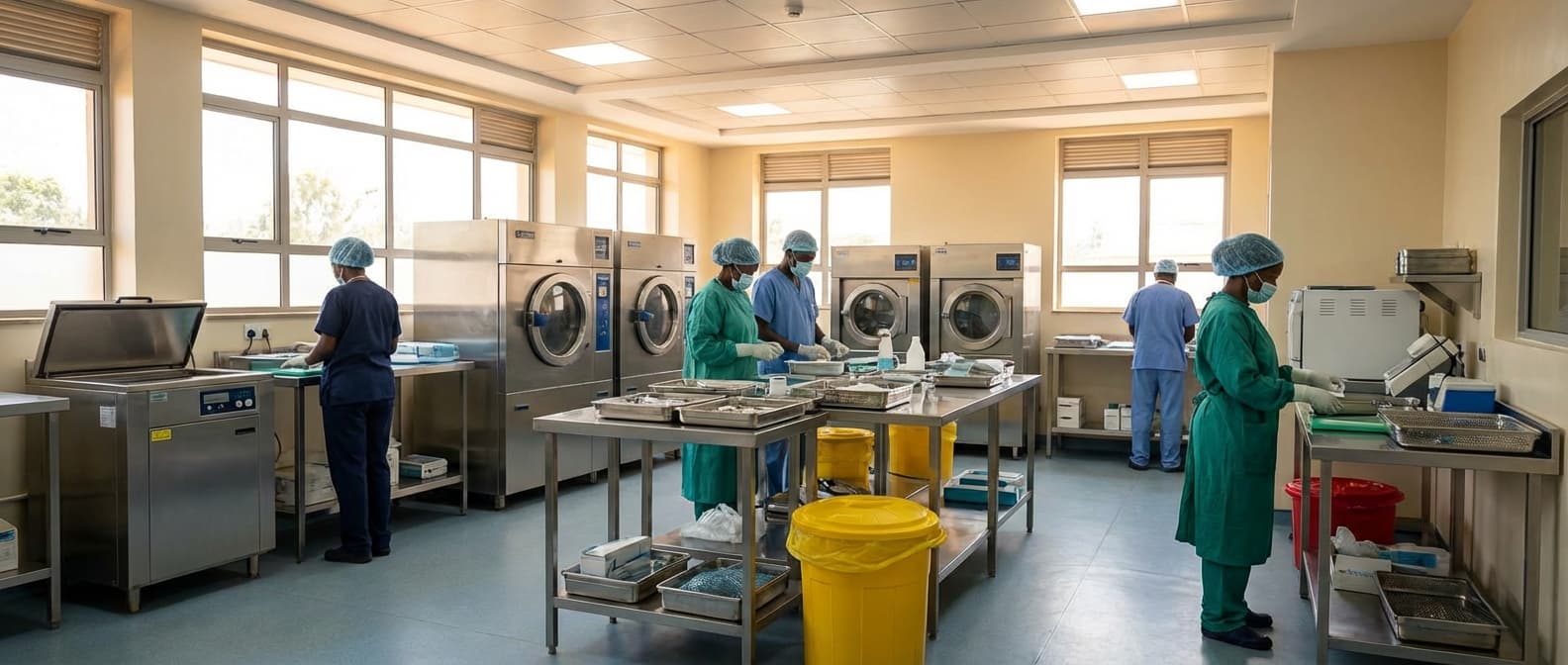
Infection-Control Readiness Support Service for Reusable Equipment in Cameroon
Engineering Excellence & Technical Support
Infection-Control Readiness Support Service for Reusable Equipment High-standard technical execution following OEM protocols and local regulatory frameworks.
Enhanced Sterilization Protocol Adherence
Leveraging a cloud-based platform, our service provides real-time monitoring of sterilization cycles and equipment usage. This ensures strict adherence to national and international standards, significantly reducing the risk of cross-contamination and healthcare-associated infections (HAIs) in Cameroonian healthcare facilities.
Proactive Maintenance & Calibration
Our trained biomedical technicians offer scheduled maintenance and calibration services for all reusable medical equipment. This proactive approach prevents equipment downtime, extends the lifespan of critical instruments, and guarantees their efficacy in disinfection and sterilization processes, thereby bolstering infection-control capabilities.
Mobile Data Collection & Reporting
We utilize a mobile application for streamlined data collection on equipment decontamination, sterilization, and inventory. This provides immediate access to crucial infection-control metrics, enabling swift identification of trends, targeted interventions, and comprehensive reporting for regulatory compliance and continuous quality improvement across Cameroon.
What Is Infection-control Readiness Support Service For Reusable Equipment In Cameroon?
Infection-Control Readiness Support Service (ICRSS) for Reusable Equipment in Cameroon refers to a specialized consultancy and implementation framework designed to bolster the capacity of healthcare facilities to safely and effectively manage reusable medical devices in alignment with national infection prevention and control (IPC) standards. This service is critical for mitigating healthcare-associated infections (HAIs) and ensuring patient safety by optimizing the decontamination, sterilization, and storage processes for instruments and equipment that are used on multiple patients. The service aims to bridge gaps in knowledge, infrastructure, and operational protocols related to the reprocessing of reusable medical items within the Cameroonian healthcare landscape.
| Target Audience | Typical Use Cases | ||||||
|---|---|---|---|---|---|---|---|
| Public and Private Hospitals: All levels, from tertiary to district hospitals, that utilize a significant volume of reusable medical and surgical instruments. | Surgical Departments: Ensuring surgical instruments are properly cleaned, disinfected, and sterilized to prevent surgical site infections (SSIs). | Maternity and Obstetrics Units: Reprocessing of delivery instruments, speculums, and other reusable devices. | Outpatient Clinics and Specialized Centers: Management of reusable instruments used in dental procedures, endoscopy, minor surgery, and diagnostic examinations. | Health Facilities with Limited Resources: Addressing critical deficiencies in IPC for reusable equipment where existing infrastructure or training may be suboptimal. | Healthcare Institutions undergoing Accreditation or Renovation: Meeting regulatory requirements and improving existing reprocessing workflows. | Facilities Experiencing High Rates of HAIs attributed to Reusable Equipment: Proactive intervention to identify and rectify root causes. | Training Institutions: Incorporating best practices for reusable equipment reprocessing into nursing and medical technician curricula. |
Key Components of Infection-Control Readiness Support Service for Reusable Equipment:
- Assessment and Gap Analysis: Comprehensive evaluation of existing IPC policies, standard operating procedures (SOPs) for sterilization and disinfection, infrastructure (e.g., dedicated reprocessing areas, water quality), equipment availability (e.g., sterilizers, washer-disinfectors), staff training, and supply chain management for consumables.
- Policy and Protocol Development/Refinement: Assisting facilities in developing or updating robust SOPs for the entire lifecycle of reusable equipment, from point-of-use cleaning to sterile storage, adhering to WHO guidelines and national regulations.
- Infrastructure Design and Optimization: Providing technical guidance on the design, layout, and retrofitting of sterile processing departments (SPDs) to ensure optimal workflow, separation of clean and dirty areas, adequate ventilation, and appropriate material selection.
- Equipment Procurement and Maintenance Guidance: Advising on the selection of appropriate sterilization and disinfection equipment based on facility needs, budget, and the types of instruments processed. Support may also include recommendations for preventive maintenance schedules and troubleshooting.
- Staff Training and Capacity Building: Developing and delivering tailored training programs for healthcare workers involved in reprocessing, including nurses, technicians, and support staff. Training covers principles of microbiology, decontamination methods, sterilization cycles, biological and chemical monitoring, handling of sterile supplies, and waste management.
- Quality Assurance and Monitoring Systems: Implementing systems for routine monitoring of sterilization processes (e.g., use of chemical indicators, biological indicators, process parameters), regular equipment calibration, and auditing of reprocessing practices.
- Supply Chain Management Support: Advising on the selection and procurement of quality disinfectants, detergents, sterilization wraps, and other consumables critical for effective reprocessing.
- Waste Management Integration: Ensuring that waste generated during the reprocessing of reusable equipment is managed according to established protocols, minimizing risks of cross-contamination and environmental hazards.
Who Needs Infection-control Readiness Support Service For Reusable Equipment In Cameroon?
Understanding who requires infection-control readiness support for reusable equipment in Cameroon is crucial for effective resource allocation and targeted service provision. This support is essential for any facility that utilizes reusable medical instruments, devices, and other equipment that comes into contact with patients. The primary need stems from the inherent risk of pathogen transmission if decontamination and sterilization processes are not adequately performed. This can lead to healthcare-associated infections (HAIs), increased morbidity and mortality, and prolonged hospital stays, all of which place a significant burden on the Cameroonian healthcare system and its patients.
| Target Customer/Department | Primary Need for Support | Specific Equipment Concerns | Impact of Inadequate Readiness |
|---|---|---|---|
| Hospitals (Tertiary/Secondary) | Maintaining high standards for complex procedures, managing high patient volumes, and ensuring compliance with national and international guidelines. | Surgical instruments, anesthesia equipment, endoscopes, ventilators, dialysis machines, diagnostic tools. | Increased HAIs, prolonged patient recovery, potential for outbreaks, reputational damage, increased costs. |
| Health Centers (Primary/Rural) | Overcoming resource limitations, ensuring basic infection prevention practices, and training staff on fundamental decontamination and sterilization techniques. | Syringes, needles, forceps, speculums, basic diagnostic tools, wound care instruments. | Risk of cross-contamination, spread of infectious diseases, compromised patient safety, limited access to safe care. |
| Surgical Centers/Operating Theatres | Strict adherence to sterile processing protocols for all surgical instruments and equipment to prevent surgical site infections (SSIs). | Scalpels, retractors, clamps, suction devices, trocars, rigid and flexible endoscopes. | High risk of SSIs, patient mortality, prolonged hospitalization, legal repercussions. |
| Maternity/Obstetric Units | Preventing transmission of infections to mothers and newborns, especially during delivery and postpartum care. | Delivery instruments, speculums, uterine forceps, perineal repair kits, newborn care equipment. | Puerperal infections, neonatal sepsis, increased maternal and infant morbidity, potential for long-term complications. |
| Dental Clinics | Ensuring sterilization of instruments used in oral procedures to prevent transmission of blood-borne pathogens and oral infections. | Dental drills, handpieces, explorers, probes, scalers, mirrors, impression trays. | Transmission of Hepatitis B, Hepatitis C, HIV, other oral infections, patient discomfort, legal issues. |
| Laboratories | Safe reprocessing of reusable diagnostic equipment and laboratory consumables. | Microscope slides, glassware, culture loops, pipettes, specimen collection devices. | Compromised diagnostic accuracy, laboratory-acquired infections, misdiagnosis, spread of infectious agents. |
Target Customers and Departments Requiring Infection-Control Readiness Support for Reusable Equipment in Cameroon
- Hospitals (all sizes: tertiary, secondary, primary)
- Health Centers (including rural and remote clinics)
- Surgical Centers and Operating Theatres
- Maternity and Obstetric Units
- Dental Clinics
- Specialized Clinics (e.g., Ophthalmology, Dermatology, Ear, Nose, and Throat)
- Laboratories (for processing reusable equipment)
- Rehabilitation Centers
- Non-governmental Organization (NGO) health facilities
- Faith-based Organization (FBO) health facilities
Infection-control Readiness Support Service For Reusable Equipment Process In Cameroon
This document outlines the workflow for the Infection-Control Readiness Support Service for Reusable Equipment Processes in Cameroon, guiding clients from initial inquiry to successful execution of the service. The service aims to enhance the safety and efficacy of reusable medical equipment sterilization and reprocessing by assessing current practices, identifying gaps, and providing tailored recommendations and training.
| Phase | Key Activities | Deliverables | Duration (Approx.) |
|---|---|---|---|
| Initial contact, needs assessment, preliminary discussion. | Understanding of client needs, initial service eligibility assessment. | 1-3 days |
| Develop proposal, review, contract signing. | Service proposal, signed service agreement. | 3-7 days |
| Request and review of relevant documentation. | Collected facility documents (policies, logs, etc.). | 2-5 days |
| Observation of processes, interviews, equipment evaluation. | Raw data, observational notes, staff feedback. | 3-10 days (depending on facility size) |
| Analysis of collected data, identification of strengths and weaknesses. | Identified gaps, areas of risk, and best practice adherence. | 5-10 days |
| Compile comprehensive report with actionable recommendations. | Detailed assessment report, prioritized recommendations. | 7-14 days |
| Present report, discuss findings, develop action plan. | Presentation slides, collaborative action plan. | 1-2 days |
| Deliver training, provide guidance, assist with protocol updates. | Trained staff, updated protocols, implementation guidance. | Ongoing (as per agreement) |
| Assess implementation progress, provide feedback, make adjustments. | Progress reports, adjusted action plans. | Ongoing (as per agreement) |
| Evaluate overall impact, final reporting. | Final service report, confirmation of achieved readiness. | 1-3 days |
Infection-Control Readiness Support Service Workflow
- {"title":"1. Inquiry and Initial Consultation","description":"Healthcare facilities interested in the service initiate contact via email, phone, or through a designated online portal. A brief needs assessment is conducted to understand the facility's size, type of reusable equipment handled, existing infection control protocols, and specific concerns. This stage culminates in a preliminary discussion to determine the suitability of the service and to gather essential information for proposal development."}
- {"title":"2. Proposal Development and Agreement","description":"Based on the initial consultation, a detailed proposal is drafted. This proposal outlines the scope of the assessment, methodologies to be employed, timelines, required resources from the facility, deliverables, and associated costs. Upon review and acceptance by the client, a formal service agreement is signed, solidifying the commitment and terms of engagement."}
- {"title":"3. Pre-Assessment Data Collection","description":"Prior to the on-site visit, the facility is requested to provide relevant documentation. This may include existing infection control policies and procedures, sterilization logs, equipment maintenance records, staff training materials, and facility layout plans related to reprocessing areas. This data allows for a more focused and efficient on-site assessment."}
- {"title":"4. On-Site Assessment and Data Gathering","description":"A team of infection control specialists conducts a comprehensive on-site assessment. This involves direct observation of the entire reusable equipment process – from decontamination, cleaning, disinfection, sterilization, to storage and distribution. Interviews with relevant staff (nurses, technicians, infection control practitioners) are conducted to understand practical implementation, challenges, and adherence to protocols. Equipment functionality and the condition of reprocessing areas are also evaluated."}
- {"title":"5. Data Analysis and Gap Identification","description":"Following the on-site visit, the collected data (both documentary and observational) is thoroughly analyzed. The assessment team identifies strengths, weaknesses, and critical gaps in the facility's infection control practices related to reusable equipment. This includes evaluating compliance with national and international guidelines, identifying potential risks, and pinpointing areas for improvement."}
- {"title":"6. Report Generation and Recommendations","description":"A comprehensive report is compiled, detailing the findings of the assessment. This report includes a clear summary of the current state, specific areas of non-compliance or risk, and evidence-based recommendations. Recommendations are prioritized based on their impact on patient safety and feasibility of implementation. The report may also include suggestions for infrastructure upgrades, equipment procurement, or workflow modifications."}
- {"title":"7. Feedback and Action Planning Session","description":"A dedicated meeting is held with the client's key stakeholders to present the assessment report and discuss the findings and recommendations. This session provides an opportunity for clarification, feedback, and collaborative development of an action plan. The action plan details the steps to be taken to address the identified gaps, assigns responsibilities, and sets realistic timelines for implementation."}
- {"title":"8. Implementation Support and Training","description":"The service may extend to providing support during the implementation phase. This can include delivering targeted training sessions for staff on updated protocols, best practices in decontamination, sterilization techniques, and effective use of reprocessing equipment. Guidance on procurement of necessary supplies or equipment may also be offered."}
- {"title":"9. Follow-up and Monitoring","description":"Depending on the service agreement, follow-up visits or remote monitoring may be scheduled to assess the progress of the action plan implementation. This helps ensure that recommendations are being adopted effectively and that sustainable improvements are being achieved. Feedback is provided, and further adjustments to the action plan are made if necessary."}
- {"title":"10. Final Review and Closure","description":"Upon successful implementation and demonstrable improvement in infection control readiness, a final review is conducted. The service is formally closed, and a final report may be provided summarizing the overall impact and achievement of objectives. The facility is equipped with the knowledge and tools to maintain a robust infection control process for reusable equipment."}
Infection-control Readiness Support Service For Reusable Equipment Cost In Cameroon
Providing infection-control readiness support services for reusable medical equipment in Cameroon is a vital undertaking to ensure patient safety and prevent healthcare-associated infections. The cost of such services is influenced by a multitude of factors, reflecting the local economic landscape, the complexity of the equipment, and the scope of the support required. These services typically encompass a range of activities, from initial assessment and training to ongoing maintenance, validation, and supply chain management for essential infection control consumables. Understanding these pricing dynamics is crucial for healthcare facilities in Cameroon to budget effectively and secure the necessary resources.
| Service Component/Category | Typical Local Currency Range (XAF) | Notes |
|---|---|---|
| Initial Equipment Assessment & Audit | 50,000 - 250,000 | Depends on facility size and number of equipment types. Includes on-site inspection and review of current practices. |
| Basic Training (per session/group) | 75,000 - 300,000 | Covers fundamental cleaning, disinfection, and sterilization principles for staff. Pricing varies by duration and number of participants. |
| Advanced/Specialized Training (per session/group) | 150,000 - 500,000+ | For specific equipment (e.g., endoscopes, autoclaves) or advanced sterilization techniques. May involve external trainers. |
| Equipment Maintenance (Preventive - per equipment) | 40,000 - 150,000 (annual/bi-annual) | Routine checks, lubrication, minor part replacements. Varies significantly by equipment type. |
| Equipment Repair (per incident) | 60,000 - 300,000+ | Excludes cost of major replacement parts. Highly dependent on the nature and complexity of the repair. |
| Sterilization Process Validation (per cycle/equipment) | 30,000 - 100,000 | Using biological and chemical indicators. More comprehensive validation may cost more. |
| Consumables Package (monthly/quarterly) | 100,000 - 1,000,000+ | Includes detergents, disinfectants, sterilizing agents, indicators, PPE. Dependent on facility size and usage. |
| Full Service Contract (annual, comprehensive) | 1,000,000 - 10,000,000+ | Bundles assessment, training, maintenance, validation, and potentially consumables. Varies massively by facility size, number of beds, and service level. |
| Travel & Logistics Surcharge (per visit, if applicable) | 20,000 - 100,000+ | For remote locations or extensive travel required. |
Key Pricing Factors for Infection-Control Readiness Support Services in Cameroon
- Scope of Services: The breadth and depth of the support provided are primary cost drivers. This can range from basic training on sterilization protocols to comprehensive programs including equipment maintenance, validation, consumables procurement, and ongoing auditing. More extensive services naturally incur higher costs.
- Type and Complexity of Reusable Equipment: Different types of medical equipment require varying levels of expertise and specialized tools for cleaning, disinfection, and sterilization. High-complexity equipment (e.g., surgical instruments, endoscopes, ventilators) will demand more specialized technicians and potentially more expensive consumables, leading to higher service fees.
- Frequency of Service: Whether support is offered on a one-time basis, monthly, quarterly, or annually impacts the overall cost. Regular, ongoing support often comes with service contracts that may offer slightly reduced per-service rates compared to ad-hoc interventions.
- Location and Accessibility: The geographical location of the healthcare facility within Cameroon can influence costs due to transportation expenses for technicians and equipment. Remote or hard-to-reach areas may incur additional travel and logistics surcharges.
- Training Requirements: The level of training provided to healthcare staff is a significant factor. Comprehensive, hands-on training programs for multiple staff members on various equipment and protocols will be more expensive than basic awareness sessions.
- Consumables and Reagents: The cost of essential infection control consumables (e.g., detergents, disinfectants, sterilizing agents, indicator strips, personal protective equipment) is often integrated into service packages. The quality and quantity of these consumables directly impact pricing.
- Validation and Certification: Services that include independent validation and certification of sterilization processes against national or international standards will command higher fees due to the expertise and documentation involved.
- Provider Expertise and Reputation: Experienced and reputable service providers with a proven track record in infection control may charge a premium for their specialized knowledge, skilled personnel, and reliable service delivery.
- Technology and Equipment Used by Provider: The sophistication of the tools and equipment used by the service provider for cleaning, disinfection, and sterilization validation can also influence costs. Advanced technologies might require a higher initial investment for the provider, which is then reflected in their pricing.
- Contract Duration and Volume: Longer-term service contracts and larger volumes of equipment serviced can sometimes lead to negotiated discounts. Providers may offer tiered pricing structures based on the volume of services or the number of facilities serviced.
Affordable Infection-control Readiness Support Service For Reusable Equipment Options
This service offers affordable infection-control readiness support specifically designed for organizations utilizing reusable equipment. We understand the critical need for robust infection prevention protocols to ensure patient safety and regulatory compliance. Our service focuses on providing comprehensive solutions that are both effective and economically viable, recognizing that many organizations operate with budget constraints. We achieve affordability through flexible value bundles and strategically implemented cost-saving measures that address the entire lifecycle of reusable equipment care, from cleaning and disinfection to storage and maintenance.
| Cost-Saving Strategy | Description | Impact on Affordability |
|---|---|---|
| Bulk Purchasing & Group Discounts: | By aggregating demand from multiple clients, we negotiate better pricing for consumables, cleaning agents, and specialized equipment, passing these savings onto our clients. | Direct reduction in the cost of essential supplies and equipment. |
| Digital Resource Library & Remote Support: | Leveraging online platforms for documentation, training, and consultations reduces travel costs and printing expenses, while enabling efficient knowledge transfer. | Minimizes overhead associated with physical resources and in-person service delivery. |
| Optimized Workflow Analysis: | We analyze existing reprocessing workflows to identify inefficiencies and recommend streamlined procedures, reducing labor time and resource utilization. | Decreases operational costs through improved efficiency and reduced waste. |
| Preventative Maintenance Focus: | Our service emphasizes proactive maintenance of reprocessing equipment to prevent costly breakdowns and extend the lifespan of valuable assets. | Avoids expensive emergency repairs and premature replacement of equipment. |
| Tiered Service Levels & Scalability: | Offering different levels of support ensures clients only pay for the services they need, with the flexibility to scale up or down as their requirements change. | Provides cost-effectiveness by aligning service provision with actual organizational needs. |
Value Bundles for Enhanced Infection Control Readiness
- Basic Readiness Package: Includes essential documentation templates, a foundational risk assessment guide, and access to a curated library of best practice resources for reusable equipment reprocessing. This bundle is ideal for organizations seeking to establish a baseline of infection control protocols.
- Standard Compliance Bundle: Builds upon the Basic package by adding customizable training modules for staff, a basic equipment audit checklist, and an initial consultation with an infection control specialist. This bundle supports organizations aiming to achieve and maintain compliance with relevant guidelines.
- Comprehensive Preparedness Suite: Offers the most extensive support, encompassing all features of the Standard bundle, plus advanced risk assessment tools, regular remote support sessions with specialists, a detailed equipment lifecycle management plan, and discounted access to specialized cleaning and disinfection efficacy testing. This bundle is for organizations prioritizing proactive and robust infection control.
- Customizable Solution: Organizations can select individual components or combine elements from different bundles to create a tailored support plan that precisely matches their unique needs and budget.
Verified Providers In Cameroon
In Cameroon, ensuring access to reliable and qualified healthcare providers is paramount. Verified providers offer a critical layer of trust and safety for patients seeking medical services. Franance Health stands out as a premier platform for identifying and accessing such accredited healthcare professionals. This document outlines the rigorous credentialing process employed by Franance Health and explains why their verified providers represent the best choice for your healthcare needs in Cameroon.
| Credentialing Component | Description | Franance Health's Verification Process |
|---|---|---|
| Medical Licenses & Certifications | Ensures providers have met the minimum educational and examination requirements for practice. | Franance Health verifies the validity and current standing of all national and international medical licenses and certifications held by practitioners. |
| Educational Background & Training | Confirms the completion of accredited medical schools and specialized training programs. | We meticulously review academic records, diplomas, and residency certificates from recognized institutions. |
| Professional Experience | Evaluates the practical experience and track record of healthcare professionals. | Franance Health assesses past employment history, references, and duration of practice in relevant fields. |
| Specialty Board Certifications | Validates advanced expertise in specific medical fields. | We confirm that specialists hold current board certifications from reputable national and international bodies. |
| Good Standing & Ethics Review | Ensures providers adhere to professional ethical standards and have no disciplinary actions. | Franance Health conducts checks with relevant professional regulatory bodies to confirm a clean record and adherence to ethical guidelines. |
| Continuing Medical Education (CME) | Confirms that providers stay up-to-date with the latest medical advancements and practices. | We require and verify evidence of ongoing professional development and participation in accredited CME programs. |
Key Benefits of Choosing Franance Health Verified Providers:
- Enhanced Patient Safety: Rigorous vetting reduces the risk of encountering unqualified practitioners.
- Access to Expertise: Connect with specialists and general practitioners with verified qualifications.
- Streamlined Healthcare Navigation: Easily find trusted providers in your area.
- Peace of Mind: A higher degree of confidence in the quality of care received.
- Transparency and Accountability: Franance Health promotes an accountable healthcare ecosystem.
Scope Of Work For Infection-control Readiness Support Service For Reusable Equipment
This Scope of Work (SOW) outlines the requirements for a comprehensive Infection-Control Readiness Support Service for Reusable Medical Equipment. The service aims to ensure that healthcare facilities have robust processes, trained personnel, and appropriate infrastructure in place to safely clean, disinfect, and sterilize reusable medical equipment, thereby minimizing the risk of healthcare-associated infections (HAIs). This SOW details the technical deliverables and standard specifications required to achieve these objectives.
| Category | Specification/Requirement | Description | Compliance Standard |
|---|---|---|---|
| SOP Development | Comprehensive coverage | SOPs must address collection, cleaning (manual/automated), disinfection (high-level/low-level), sterilization (steam, ETO, H2O2, etc.), packaging, storage, and transport. | AAMI ST79, CDC Guidelines for Disinfection and Sterilization in Healthcare Facilities, Manufacturer Instructions for Use (IFU) |
| Equipment Assessment | Risk-based approach | Evaluation of all reusable equipment to determine appropriate reprocessing methods based on Spaulding Classification and IFU. | AAMI ST79, Manufacturer IFU |
| Validation Testing | Documented and traceable | Regular validation of cleaning effectiveness (e.g., soil removal) and sterilization efficacy (e.g., Bowie-Dick, biological indicators) with documented results. | AAMI ST79, AAMI TIR12, Manufacturer IFU |
| Personnel Training | Competency-based | Training modules must cover theoretical knowledge and practical skills, with documented assessments of competency for all staff. | Certification Board for Sterile Processing and Distribution (CBSPD) recommended curriculum, Manufacturer Training Programs |
| Equipment Tracking | Unique identification | Implementation of a system capable of tracking each reprocessing cycle for every reusable item, including date, time, responsible personnel, and sterilization parameters. | ISO 13485 principles, Industry best practices |
| Quality Assurance | Data-driven | Establishment of KPIs such as reprocessing failure rates, HAI rates associated with equipment, and staff competency scores. Regular review and action planning. | Internal Quality Management System (QMS) requirements, Healthcare accreditation standards |
| Facility Design | Segregated workflow | Clear separation of contaminated, clean, and sterile areas with appropriate airflow, ventilation, and material handling. | ASHRAE standards for healthcare facilities, OSHA guidelines |
| Sterilization Parameters | Adherence to validated cycles | Strict adherence to validated cycle parameters (time, temperature, pressure) for all sterilization methods. Documentation of each cycle. | AAMI ST79, Manufacturer IFU |
| Disinfection Agents | EPA-registered and appropriate efficacy | Use of EPA-registered high-level disinfectants (HLDs) or sterilants as appropriate, with documented concentration checks and contact times. | EPA registration data, Manufacturer IFU |
| Documentation Management | Secure and accessible | All reprocessing records, validation reports, training logs, and QA data must be securely stored and readily accessible for audit purposes. | HIPAA requirements (where applicable for patient-related data), ISO 13485 principles |
Technical Deliverables
- Development and implementation of Standard Operating Procedures (SOPs) for the entire reprocessing lifecycle of reusable medical equipment (from point of use to storage).
- Assessment and recommendation of appropriate cleaning, disinfection, and sterilization technologies and equipment based on equipment type and risk assessment.
- Validation of reprocessing processes through biological and chemical indicator testing, and documentation of results.
- Training program development and delivery for all personnel involved in reusable equipment reprocessing, covering principles of infection control, specific equipment handling, and SOP adherence.
- Development and implementation of a comprehensive equipment tracking and inventory management system to ensure traceability and proper rotation of reprocessed items.
- Establishment of a quality assurance and performance monitoring program, including regular audits, data collection, and reporting on key infection control metrics related to reusable equipment.
- Design and implementation of a risk management plan for reprocessing reusable equipment, identifying potential hazards and mitigation strategies.
- Recommendations for facility layout, workflow optimization, and environmental controls within reprocessing areas to prevent cross-contamination.
- Provision of a detailed report summarizing findings, recommendations, and implementation plans, including a roadmap for continuous improvement.
- Development of a competency assessment framework for reprocessing staff.
Service Level Agreement For Infection-control Readiness Support Service For Reusable Equipment
This Service Level Agreement (SLA) outlines the guaranteed response times and uptime for the Infection-Control Readiness Support Service for Reusable Equipment. This service is designed to ensure that organizations have the necessary support to maintain a high level of readiness in managing the infection control of reusable medical equipment, thereby minimizing the risk of healthcare-associated infections.
| Service Component | Response Time Guarantee | Uptime Guarantee |
|---|---|---|
| On-Demand Technical Support (Critical Issues) | Within 1 hour (24/7/365) | N/A (Support is event-driven) |
| On-Demand Technical Support (Non-Critical Issues) | Within 4 business hours | N/A (Support is event-driven) |
| Proactive Monitoring & Reporting | Data available within 24 hours of collection | 99.5% Availability of Monitoring Platform |
| Assistance with Protocol Implementation/Validation | Scheduled within 2 business days of request | N/A (Service is scheduled) |
| Expert Advice & Best Practices Access | Access to knowledge base and scheduled consultations within 3 business days | 99.9% Availability of Knowledge Base and Consultation Scheduling System |
Key Service Components
- Proactive monitoring of infection control protocols for reusable equipment.
- On-demand technical support for infection control queries related to reusable equipment.
- Assistance with the implementation and validation of disinfection and sterilization processes.
- Troubleshooting of equipment-related infection control issues.
- Access to expert advice and best practices in reusable equipment infection control.
Frequently Asked Questions

Ready when you are
Let's scope your Infection-Control Readiness Support Service for Reusable Equipment in Cameroon project in Cameroon.

Scaling healthcare logistics and technical systems across the entire continent.