
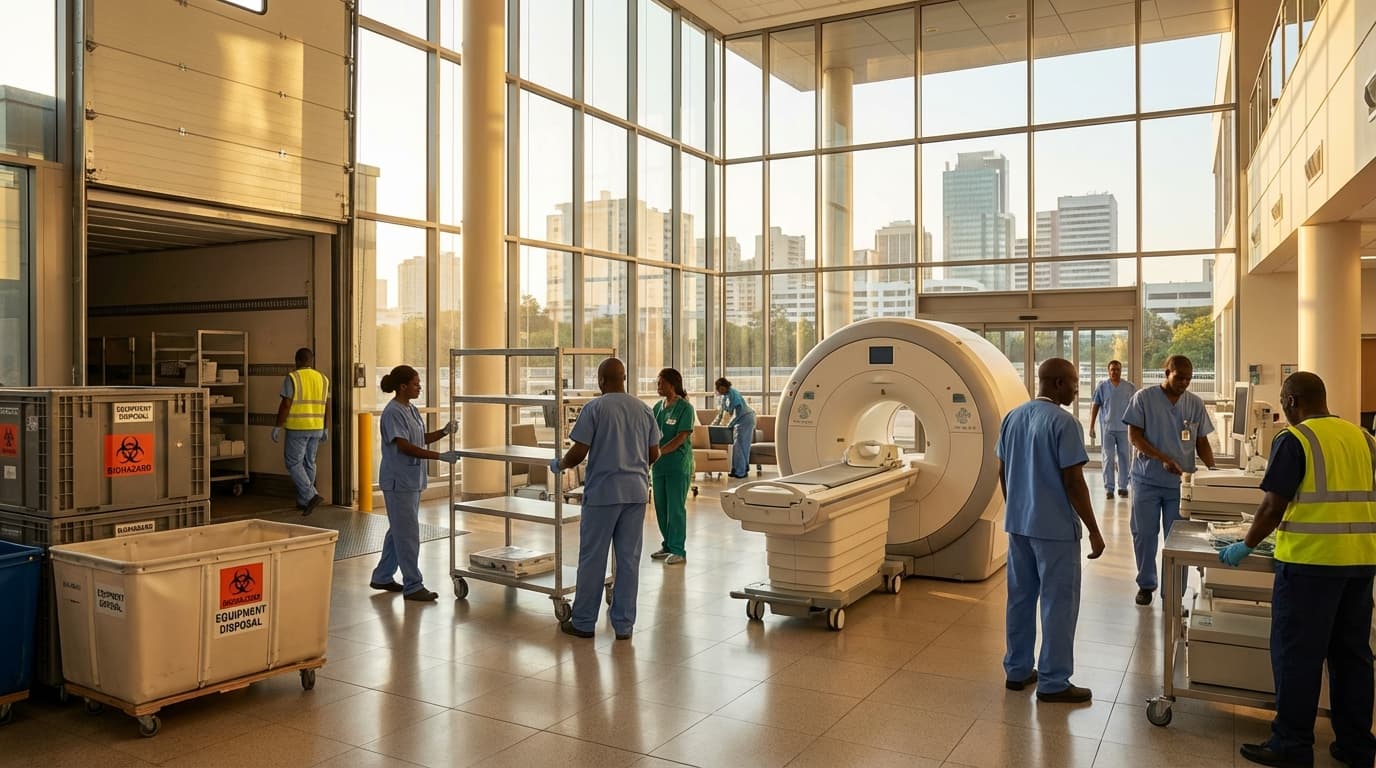
Medical Equipment Relocation Service (Move & Re-Install) in Cameroon
Engineering Excellence & Technical Support
Medical Equipment Relocation Service (Move & Re-Install) High-standard technical execution following OEM protocols and local regulatory frameworks.
Temperature-Controlled Logistics
Our specialized fleet ensures sensitive medical equipment, such as diagnostic imaging machines and laboratory freezers, are transported and maintained within precise temperature ranges to prevent degradation and ensure operational integrity upon re-installation.
Certified Decontamination & Sterilization Protocols
We adhere to rigorous decontamination and sterilization procedures for all medical equipment prior to relocation, using hospital-grade disinfectants and validated methods to meet stringent healthcare safety standards and minimize cross-contamination risks.
Expert Calibration & Testing Post-Installation
Our certified biomedical technicians meticulously re-install and calibrate all relocated medical equipment, conducting comprehensive functional tests and performance checks to guarantee optimal accuracy, reliability, and immediate readiness for patient care.
What Is Medical Equipment Relocation Service (Move & Re-install) In Cameroon?
Medical Equipment Relocation Service (Move & Re-Install) in Cameroon refers to a specialized logistical and technical service focused on the safe, compliant, and functional transfer of medical devices and machinery. This encompasses the entire lifecycle of relocation, from initial de-installation, secure packing, transportation, through to re-installation, calibration, and verification at a new site within Cameroon. The service is critical for healthcare facilities undergoing renovations, expansions, mergers, or the establishment of new branches, ensuring minimal disruption to patient care and adherence to regulatory standards.
| Who Needs This Service? | Typical Use Cases |
|---|---|
| Hospitals and Clinics (Public and Private) | Facility Renovation/Expansion: Moving equipment within or between departments during construction projects. Mergers and Acquisitions: Consolidating or relocating equipment from acquired facilities. New Facility Establishment: Setting up new medical centers or specialized clinics. Departmental Reorganization: Reconfiguring layouts for improved workflow or efficiency. Equipment Upgrades: Replacing old equipment and relocating functional older units to a new site. |
| Diagnostic Imaging Centers | MRI/CT Scanner Relocation: Requires specialized handling due to size, weight, and sensitivity to magnetic fields. X-ray Unit Moves: Involving careful de-installation and re-calibration of complex systems. |
| Laboratories (Medical and Research) | High-Precision Instrument Transfers: Moving sensitive analytical equipment like mass spectrometers or electron microscopes. Bio-safety Cabinet Relocation: Ensuring integrity of containment systems. |
| Government Health Ministries and Agencies | Public Health Facility Upgrades: Relocating equipment during national health initiatives or infrastructure improvements. Disaster Recovery Operations: Moving critical medical equipment to temporary safe locations during emergencies. |
| Medical Equipment Manufacturers and Distributors | Installation Support for New Sites: Providing end-to-end relocation services as part of a sales package. Relocation for Servicing or Upgrades: Moving equipment to and from specialized repair facilities. |
Key Components of Medical Equipment Relocation Service (Move & Re-Install) in Cameroon:
- Pre-Relocation Assessment: Site surveys to evaluate access, power requirements, environmental conditions, and existing infrastructure at both origin and destination.
- De-installation and Disconnection: Professional dismantling and disconnection of equipment from power, data, and utility lines by qualified technicians, adhering to manufacturer specifications.
- Specialized Packing and Crating: Utilization of custom-built crates, shock-absorbing materials, and anti-static packaging to protect sensitive medical equipment from damage during transit.
- Secure Transportation: Employing specialized vehicles equipped with climate control, air-ride suspension, and securement systems to ensure stability and environmental integrity during transport.
- Re-installation and Re-connection: Precise re-assembly and reconnection of equipment at the new location, ensuring proper integration with existing facility infrastructure.
- Calibration and Verification: Post-installation testing and calibration by certified technicians to confirm that equipment functions according to original performance specifications and regulatory requirements.
- Certification and Documentation: Providing comprehensive documentation, including certificates of installation, calibration reports, and compliance verification, for regulatory audits and facility records.
- Risk Mitigation and Insurance: Implementing stringent safety protocols and securing appropriate insurance coverage to protect against potential damage or loss during the relocation process.
- Training and Handover: Offering basic user training or refresher courses for on-site personnel on the re-installed equipment, if required.
Who Needs Medical Equipment Relocation Service (Move & Re-install) In Cameroon?
Navigating the complex process of moving and reinstalling medical equipment in Cameroon requires specialized expertise. This service is crucial for ensuring the continuity of patient care, minimizing downtime, and protecting valuable and sensitive equipment. The target audience for these services ranges from large-scale healthcare institutions to individual clinics and research facilities.
| Customer Type | Key Departments Involved | Specific Equipment Needs | Reasons for Relocation |
|---|---|---|---|
| Large Hospitals (e.g., Central Hospitals, University Hospitals) | Radiology/Imaging (X-ray, CT, MRI), Operating Theaters, ICU/CCU, Laboratories (Pathology, Biochemistry), Central Sterilization, Pharmacy, Emergency Departments, Outpatient Clinics | High-value, large-scale equipment: CT scanners, MRI machines, linear accelerators, surgical robots, sophisticated laboratory analyzers, large X-ray units. | Renovations, expansions, departmental restructuring, upgrades to newer technology, emergency preparedness/disaster recovery. |
| Medium to Small Hospitals & Private Clinics | General Practice, Minor Surgery Suites, Diagnostic Imaging (Ultrasound, X-ray), Laboratories, Pharmacy, Physiotherapy | Mid-range equipment: Ultrasound machines, dental units, basic X-ray machines, hematology analyzers, ECG machines, endoscopes. | Opening new branches, upgrading facilities, changes in ownership or management, equipment replacement. |
| Diagnostic Centers (Imaging & Pathology) | Radiology, Pathology, Biochemistry, Hematology, Microbiology | Specialized imaging equipment (Mammography, Bone Densitometry), automated laboratory analyzers, microscopes, centrifuges, incubators. | Relocation to larger facilities, consolidation of services, expansion of diagnostic capabilities, lease expiry. |
| Research Institutions & Universities | Biomedical research labs, teaching laboratories | Advanced analytical instruments (Mass Spectrometers, HPLC), PCR machines, microscopes, cell culture equipment, imaging systems. | Setting up new research programs, relocating labs due to funding or project changes, upgrading research infrastructure. |
| Government Health Agencies & NGOs | Mobile clinics, field hospitals, public health programs | Portable diagnostic equipment, basic medical supplies, sterilization units, specialized equipment for specific health campaigns (e.g., vaccination fridges). | Deployment for public health initiatives, setting up temporary medical facilities, responding to health crises, distribution to remote areas. |
Target Customers and Departments for Medical Equipment Relocation Services in Cameroon
- Hospitals (Public and Private)
- Clinics and Polyclinics
- Diagnostic Centers (Imaging, Pathology)
- Research Institutions and Laboratories
- Medical Training Facilities
- Government Health Agencies
- Non-Governmental Organizations (NGOs) with Healthcare Programs
- Pharmaceutical Companies (for demo/installation of R&D equipment)
Medical Equipment Relocation Service (Move & Re-install) Process In Cameroon
This document outlines the comprehensive workflow for a Medical Equipment Relocation and Re-installation Service in Cameroon. The process is designed to ensure the safe, efficient, and compliant movement and setup of sensitive medical devices. It covers all stages from the initial client inquiry to the final sign-off after successful re-installation.
| Stage | Key Activities | Responsible Party | Key Deliverables/Outcomes |
|---|---|---|---|
| Inquiry & Initial Consultation | Client expresses need, discuss requirements, equipment list, locations. | Client, Relocation Service Provider | Understanding of client needs, initial scope definition. |
| Site Assessment & Survey | On-site evaluation of origin and destination, identify challenges, resource needs. | Relocation Service Provider (Technicians, Logistics) | Detailed site reports, logistical requirements, safety considerations. |
| Quotation & Proposal | Preparation of service costs, timeline, terms, insurance. | Relocation Service Provider | Formal quotation and comprehensive proposal. |
| Contract & Agreement | Formalization of services, responsibilities, and pricing. | Client, Relocation Service Provider | Signed contract, agreed terms. |
| Planning & Logistics | Detailed scheduling, transport, packaging strategy, risk management. | Relocation Service Provider (Project Manager, Logistics Team) | Comprehensive relocation plan, optimized logistics. |
| Disassembly & Packaging | Careful dismantling and secure packaging of equipment. | Relocation Service Provider (Skilled Technicians) | Labeled and safely packaged medical equipment. |
| Transportation | Safe and secure transit of equipment using appropriate vehicles. | Relocation Service Provider (Transportation Team) | Equipment safely transported to destination. |
| Delivery & Unloading | Careful unloading and positioning of equipment at the destination. | Relocation Service Provider (Moving Crew, Technicians) | Equipment safely placed at designated locations. |
| Re-assembly & Installation | Professional re-assembly and setup of equipment. | Relocation Service Provider (Skilled Technicians) | Equipment assembled and initially configured. |
| Testing & Calibration | Verification of functionality, accuracy, and operational parameters. | Relocation Service Provider (Certified Technicians) | Tested and calibrated medical equipment, performance reports. |
| Client Demonstration & Training | Showcasing functionality and providing basic operational guidance. | Relocation Service Provider (Technicians) | Client understanding of equipment operation. |
| Final Inspection & Sign-off | Joint review and client acceptance of the relocation. | Client, Relocation Service Provider | Signed completion form, client satisfaction. |
| Post-Relocation Support | Addressing any immediate post-installation queries or issues. | Relocation Service Provider | Resolved immediate concerns, client assurance. |
Medical Equipment Relocation & Re-Installation Process
- Inquiry & Initial Consultation: The process begins with a potential client contacting the relocation service provider. This typically involves an initial discussion to understand the scope of work, the types and number of medical equipment to be moved, the origin and destination locations, and any specific requirements.
- Site Assessment & Survey: A thorough on-site assessment is crucial. Qualified technicians visit both the origin and destination sites to evaluate access points, available space, power requirements, environmental conditions (temperature, humidity), safety protocols, and potential logistical challenges. This informs the planning and resource allocation.
- Quotation & Proposal: Based on the site assessment and client requirements, a detailed quotation and proposal are prepared. This document outlines the services to be provided, timelines, costs, insurance coverage, and terms and conditions.
- Contract & Agreement: Upon acceptance of the quotation, a formal contract is signed, legally binding both parties to the agreed-upon terms and scope of work.
- Planning & Logistics: A detailed relocation plan is developed, including scheduling, transportation arrangements (specialized vehicles, climate-controlled transport), packaging materials, and staffing. Risk assessment and contingency planning are integral to this stage.
- Disassembly & Packaging (Origin Site): Trained technicians carefully disassemble complex medical equipment, ensuring proper labeling of all components and cables. Sensitive parts are meticulously packaged using specialized materials (anti-static bags, protective foam, shock-absorbent wrapping) to prevent damage during transit.
- Transportation: The packaged equipment is loaded onto specialized, often climate-controlled, vehicles. Throughout the transit, the equipment is secured to prevent movement and damage. Real-time tracking may be offered for high-value items.
- Delivery & Unloading (Destination Site): Upon arrival at the destination, the equipment is carefully unloaded, taking into consideration the site layout and accessibility. Strict safety protocols are followed during the unloading process.
- Re-assembly & Installation: Skilled technicians re-assemble the medical equipment according to manufacturer specifications. This includes connecting power sources, data cables, and any necessary accessories. Proper calibration and initial setup are performed.
- Testing & Calibration: Comprehensive testing is conducted to ensure the equipment is functioning correctly and accurately. This may involve running diagnostic tests, performing calibration procedures, and verifying operational parameters against manufacturer standards.
- Client Demonstration & Training (Optional): A demonstration of the re-installed equipment's functionality may be provided to the client. Basic operational training for relevant personnel can also be offered if included in the service agreement.
- Final Inspection & Sign-off: A joint inspection is performed by the relocation team and the client. Any discrepancies or issues are addressed. Once the client is satisfied with the re-installation and functionality, a formal sign-off is obtained, concluding the execution phase.
- Post-Relocation Support: The service provider may offer a period of post-relocation support to address any unforeseen issues or provide further assistance to the client.
Medical Equipment Relocation Service (Move & Re-install) Cost In Cameroon
Relocating medical equipment in Cameroon can be a complex and costly undertaking, requiring specialized handling to ensure the integrity and functionality of sensitive devices. The pricing for such a service, often termed 'Move & Re-Install,' is influenced by a multitude of factors, making it challenging to provide a single, definitive cost. These factors range from the type and size of the equipment to the distance of the relocation and the level of expertise required for re-installation. Understanding these elements is crucial for accurate budgeting and planning.
| Equipment Category (Examples) | Estimated Cost Range (XAF - Cameroonian Francs) | Notes |
|---|---|---|
| Small Laboratory Equipment (e.g., Centrifuges, Incubators) | 75,000 - 250,000 XAF | Local moves, basic packaging, standard re-installation. |
| Medium Imaging Devices (e.g., Portable X-ray, Ultrasound Machines) | 200,000 - 750,000 XAF | May require specialized transport, moderate dismantling/re-assembly, and calibration. |
| Large Imaging Machines (e.g., Fixed X-ray, CT Scanners, MRI - excluding de-installation from original site) | 1,000,000 - 5,000,000+ XAF | Extensive specialized transport, complex dismantling/re-assembly, professional calibration, and potentially site preparation. Costs can escalate significantly based on specific model and vendor support. |
| Surgical Equipment (e.g., Operating Tables, Anesthesia Machines) | 300,000 - 1,200,000 XAF | Requires careful handling, calibration, and potentially specialized lifting equipment. |
| Sterilization Equipment (e.g., Autoclaves) | 150,000 - 600,000 XAF | Depends on size and complexity, including water and power connections during re-installation. |
Key Pricing Factors for Medical Equipment Relocation in Cameroon
- Type and Size of Equipment: Larger, heavier, or more delicate equipment (e.g., MRI machines, CT scanners, X-ray units) will inherently cost more to move due to specialized transport, lifting equipment, and protective packaging. Smaller, less complex items will be more affordable.
- Distance of Relocation: Local moves within a city will be significantly cheaper than inter-regional or cross-border relocations. The cost of fuel, transport duration, and potential overnight stays for the moving crew increase with distance.
- Dismantling and Re-assembly Complexity: The intricacy of taking apart and putting back together medical devices is a major cost driver. Equipment requiring extensive calibration, specialized tools, or certified technicians for re-installation will command higher fees.
- Packaging and Protection: The need for custom crating, specialized padding, climate-controlled transport, and anti-vibration measures adds to the overall cost.
- Insurance Coverage: Adequate insurance for valuable medical equipment during transit is essential. The premium will be factored into the service cost.
- Manpower and Expertise: The number of trained personnel required for safe handling, lifting, and installation, along with the specific certifications or experience needed, directly impacts the pricing.
- Site Preparation and Accessibility: If the installation site requires modifications (e.g., power upgrades, specific ventilation) or if access is difficult (e.g., upper floors without elevators, narrow doorways), this can increase labor and time, thus raising costs.
- Logistics and Permits: For longer distances or specific types of equipment, special permits, escorts, or route planning might be necessary, contributing to the overall expense.
- Urgency of the Move: Expedited services often come with a premium charge.
- Service Provider's Reputation and Experience: Established companies with a proven track record in handling medical equipment typically charge more due to their reliability and specialized knowledge.
Affordable Medical Equipment Relocation Service (Move & Re-install) Options
Relocating medical equipment can be a complex and costly undertaking. Our Affordable Medical Equipment Relocation Service offers specialized solutions to move and re-install your valuable assets safely and efficiently, minimizing downtime and expense. We understand the critical nature of your equipment and strive to provide cost-effective options tailored to your specific needs.
| Value Bundle | Description | Benefits | Estimated Cost Savings |
|---|---|---|---|
| Standard Move & Re-Install | Includes professional packing, secure transportation, and basic re-installation of standard medical equipment. | Cost-effective for routine relocations. Ensures safe transit and operational setup. | Up to 15% savings compared to separate service providers. |
| Premium Move & Re-Install Plus | Includes all features of the Standard Bundle plus specialized handling for delicate equipment, on-site calibration checks, and extended on-site support. | Ideal for high-value or complex machinery. Minimizes risk of damage and ensures immediate operational readiness. | Up to 20% savings on complex moves due to reduced risk of errors and expedited setup. |
| Full-Service Relocation Package | Comprehensive solution covering de-installation, packing, transportation, re-installation, full system testing, and staff training on new placement. | Eliminates the need for multiple vendors. Ensures a seamless transition with minimal disruption to patient care. | Up to 25% savings through bundled services and optimized logistics. |
Key Services Offered
- Specialized packing and crating for sensitive medical devices
- Secure transportation with climate-controlled and shock-absorbent vehicles
- Professional de-installation and re-installation by certified technicians
- On-site assessment and planning to ensure a smooth transition
- Inventory management and documentation
- Insurance coverage for peace of mind
Verified Providers In Cameroon
In Cameroon's evolving healthcare landscape, identifying reliable and trustworthy healthcare providers is paramount. "Verified Providers in Cameroon" highlights the crucial role of credentials and expertise in ensuring quality patient care. This document focuses on Franance Health, a leading organization whose credentials and commitment to excellence make them the best choice for your healthcare needs in Cameroon. Their rigorous verification processes and dedication to patient well-being set a high standard for the industry.
| Category | Franance Health Verification Standard | Benefits to Patients |
|---|---|---|
| Medical Licenses | Up-to-date and valid licenses from the Cameroonian Ministry of Public Health and relevant professional councils. | Ensures providers are legally qualified and meet minimum competency standards. |
| Specialist Qualifications | Verification of specialist certifications, diplomas, and postgraduate training from accredited institutions. | Guarantees access to highly skilled professionals for specific medical conditions. |
| Facility Standards | Assessment of healthcare facilities for hygiene, safety, equipment, and operational protocols. | Provides a safe, clean, and well-equipped environment for diagnosis and treatment. |
| Ethical Conduct | Review of professional conduct records and adherence to medical ethics guidelines. | Promotes trust and confidence in the provider's integrity and patient care approach. |
| Patient Testimonials & Feedback | Consideration of anonymized patient feedback and satisfaction rates. | Offers insights into the provider's effectiveness and patient experience. |
Why Franance Health Credentials Matter
- Rigorous Vetting Process: Franance Health meticulously vets all its affiliated healthcare professionals and institutions.
- Professional Accreditation: They ensure all providers hold valid and current licenses and accreditations from recognized national and international bodies.
- Specialized Expertise: Franance Health prioritizes providers with demonstrated expertise in various medical fields, ensuring you receive specialized care.
- Commitment to Continuous Improvement: Their verification extends to a provider's dedication to ongoing training, research, and adherence to best practices.
- Patient-Centric Approach: Franance Health-approved providers are committed to ethical practices and a patient-first philosophy.
- Technological Integration: They often partner with facilities that utilize modern medical technology and diagnostic tools.
Scope Of Work For Medical Equipment Relocation Service (Move & Re-install)
This Scope of Work (SOW) outlines the requirements for the relocation and re-installation of medical equipment. It details the technical deliverables and standard specifications to ensure a safe, efficient, and compliant transition of sensitive medical devices from their current location to a new site. The objective is to minimize downtime and ensure the equipment is fully operational and calibrated at the new location.
| Phase | Activity | Technical Deliverables | Standard Specifications & Requirements |
|---|---|---|---|
| Phase 1: Planning & Preparation | Site Survey & Assessment | Detailed equipment inventory, site layout plan, risk assessment report. | Survey must include accessibility, power requirements, environmental conditions (temperature, humidity), network connectivity, and required clearances at both origin and destination. Vendor must provide a detailed equipment list with serial numbers, make, and model. Risk assessment to identify potential hazards and mitigation strategies. |
| Phase 1: Planning & Preparation | De-installation Plan | Written de-installation procedures for each equipment type, including disconnection protocols and any required software/data backup. | Procedures must adhere to manufacturer recommendations. Electrical, plumbing, and data connections to be safely terminated. Sensitive data on equipment to be backed up or securely wiped as per client requirements. |
| Phase 1: Planning & Preparation | Packing & Protection | Customized crating/packaging materials, shock-absorbing padding, climate-controlled transport options. | Materials must be anti-static where applicable. Packaging must protect against physical impact, vibration, and environmental factors. Use of specialized equipment cases for high-value or sensitive items. |
| Phase 2: Transportation | Secure Transport | GPS-tracked vehicles, certified transport personnel, documented chain of custody. | Vehicles must be equipped to handle medical equipment (e.g., liftgates, climate control). All personnel involved must have undergone background checks and received appropriate training. A detailed log of movements and handovers. |
| Phase 2: Transportation | Insurance | Comprehensive transit insurance covering full replacement value of all equipment. | Insurance policy details to be provided and approved by the client prior to commencement of work. Coverage must extend from pick-up to final re-installation and testing. |
| Phase 3: Re-installation & Commissioning | Equipment Re-installation | Correct re-assembly of equipment, connection to utilities and networks, adherence to site-specific requirements. | Re-installation must follow manufacturer’s guidelines and original setup configuration. All connections (electrical, water, gas, data) to be secure and compliant with local codes and standards. Verification of correct positioning and alignment. |
| Phase 3: Re-installation & Commissioning | Calibration & Testing | Pre- and post-relocation performance verification, calibration certificates, functional test reports. | All critical parameters must be tested to ensure equipment meets manufacturer specifications. Calibration to be performed by certified technicians if required. Test reports must be signed off by client representatives. |
| Phase 3: Re-installation & Commissioning | User Training (if applicable) | Refresher training for end-users on basic operations and any minor configuration changes. | Delivered by qualified personnel, focusing on essential functions and safety protocols. Duration and scope to be agreed upon by client. |
| Phase 4: Documentation & Handover | Project Completion Report | Detailed report including all test results, calibration certificates, photos of installation, and sign-off forms. | Report to serve as a record of successful completion, documenting all aspects of the relocation and re-installation process. Includes a punch list of any outstanding items and their resolution plan. |
| Phase 4: Documentation & Handover | Waste Disposal | Environmentally compliant disposal of packing materials. | All waste materials to be disposed of according to local environmental regulations. Certificates of disposal may be required. |
Key Objectives
- Safe and secure transportation of all designated medical equipment.
- Minimizing downtime for critical medical services.
- Ensuring the integrity and functionality of each piece of equipment post-relocation.
- Compliance with all relevant health, safety, and environmental regulations.
- Documentation of the entire relocation process.
- Seamless re-installation and verification of operational readiness.
Service Level Agreement For Medical Equipment Relocation Service (Move & Re-install)
This Service Level Agreement (SLA) outlines the guaranteed response times and uptime for the Medical Equipment Relocation Service (Move & Re-Install) provided by [Provider Name] to [Client Name]. This SLA is an addendum to the Master Service Agreement (MSA) dated [MSA Date].
| Equipment Category | Response Time (Business Hours) | Resolution Time Target (Business Hours) | Uptime Guarantee (Post-Re-installation) |
|---|---|---|---|
| Critical Equipment | 1 Hour | 4 Hours | 99.9% |
| Standard Equipment | 2 Hours | 8 Hours | 99.5% |
Definitions
- {"title":"Critical Equipment:","description":"Medical devices essential for patient care, life support, or critical diagnostic procedures. Examples include ventilators, MRI scanners, CT scanners, anesthesia machines, and surgical robots."}
- {"title":"Standard Equipment:","description":"Medical devices that are important for patient care and diagnostics but do not fall under the Critical Equipment category. Examples include patient monitors, infusion pumps, EKG machines, and standard diagnostic imaging equipment."}
- {"title":"Downtime:","description":"The period during which the relocated medical equipment is non-operational and unavailable for its intended clinical use due to issues arising directly from the relocation process (e.g., improper re-installation, damage during transit, configuration errors)."}
- {"title":"Response Time:","description":"The maximum time allowed for [Provider Name] to acknowledge a reported issue and commence troubleshooting or remedial actions after notification by [Client Name]."}
- {"title":"Resolution Time:","description":"The maximum time allowed for [Provider Name] to restore the relocated medical equipment to full operational status."}
- {"title":"Uptime Guarantee:","description":"The percentage of time the relocated medical equipment is guaranteed to be operational and available for clinical use after successful re-installation."}
Frequently Asked Questions

Ready when you are
Let's scope your Medical Equipment Relocation Service (Move & Re-Install) in Cameroon project in Cameroon.

Scaling healthcare logistics and technical systems across the entire continent.