
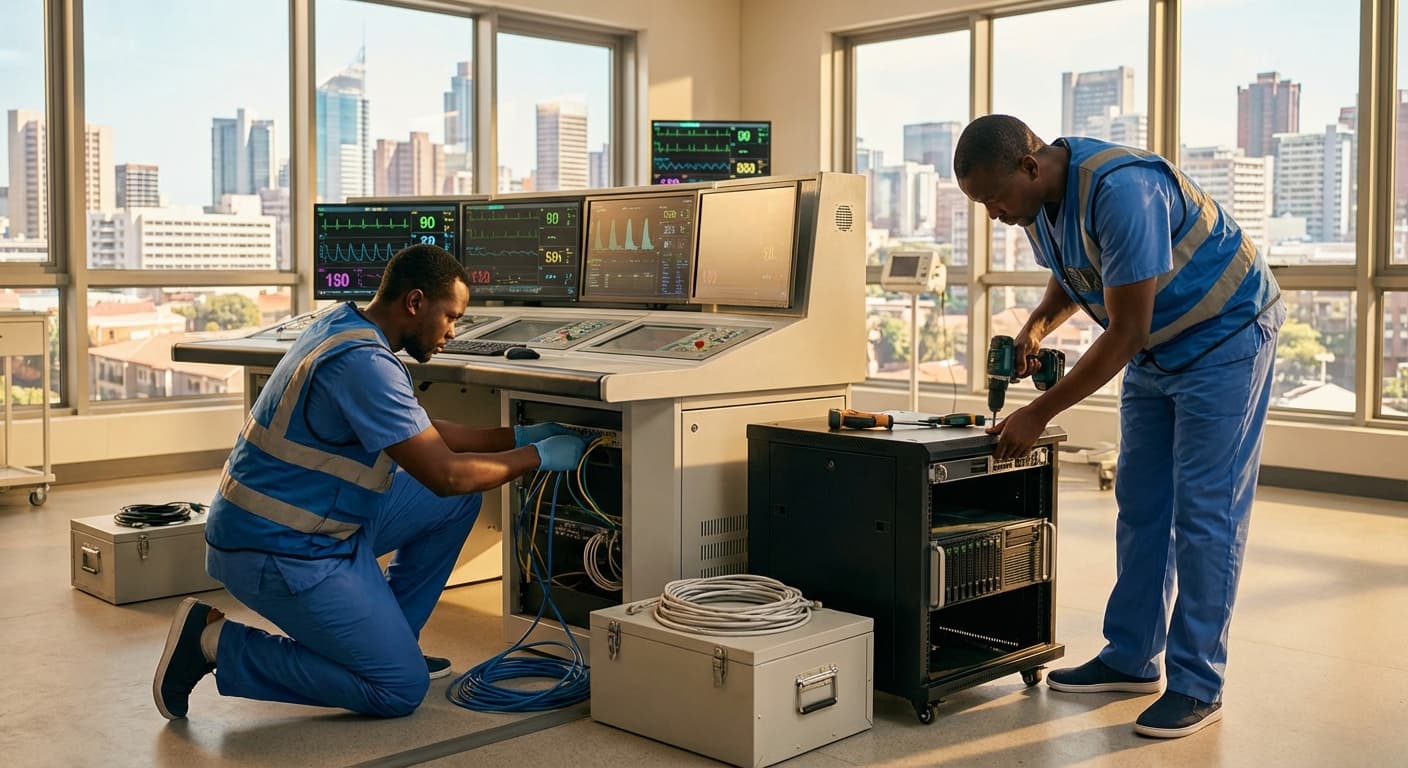
ICU Central Monitoring Station Installation Service in Cameroon
Engineering Excellence & Technical Support
ICU Central Monitoring Station Installation Service High-standard technical execution following OEM protocols and local regulatory frameworks.
Centralized Real-time Patient Data
Leverage our expert installation of state-of-the-art ICU central monitoring systems, enabling seamless, real-time collection and display of critical patient vitals across multiple beds from a single command center. Enhance decision-making and response times with immediate access to ECG, SpO2, BP, and respiration data for comprehensive patient oversight.
Robust Network Infrastructure & Data Security
We ensure the secure and reliable integration of your ICU monitoring network, employing robust cabling, network configuration, and cybersecurity protocols. Our installation guarantees uninterrupted data flow and protects sensitive patient information against unauthorized access, crucial for compliance and patient safety in Cameroon's healthcare landscape.
Expert On-site Deployment & Calibration
Our certified technicians provide meticulous on-site installation and calibration of all central monitoring units and associated hardware in Cameroon. We guarantee optimal system performance, minimize downtime, and ensure seamless integration with existing hospital infrastructure, delivering a fully operational and reliable ICU monitoring solution tailored to your facility's needs.
What Is Icu Central Monitoring Station Installation Service In Cameroon?
ICU Central Monitoring Station Installation Service in Cameroon refers to the comprehensive process of setting up and commissioning a centralized monitoring system designed for Intensive Care Units (ICUs). This service ensures that critical patient vital signs and data are continuously collected, displayed, and analyzed in a dedicated control room, enabling real-time oversight and rapid response by healthcare professionals. The installation encompasses the physical deployment of hardware, integration of patient monitoring devices (ventilators, defibrillators, infusion pumps, etc.), establishment of a robust network infrastructure, configuration of specialized software for data aggregation and alarming, and rigorous testing and validation to guarantee system functionality and reliability.
| Beneficiary Group | Need for Service | Typical Use Cases |
|---|---|---|
| Tertiary and Referral Hospitals in Cameroon: (e.g., Laquintinie Hospital, Hôpital Général de Douala) | To enhance patient safety, improve clinical decision-making, and optimize resource allocation by providing a consolidated view of critically ill patients. | Real-time monitoring of multiple ventilated patients' respiratory parameters, cardiac rhythms, and hemodynamic status from a single console. Facilitating prompt intervention for critical events like cardiac arrest or sudden decompensation. Enabling remote monitoring of patients by senior intensivists or specialists, especially in facilities with limited staffing. |
| New Hospital Construction Projects or Major Renovations: | To integrate advanced patient monitoring capabilities from the design phase, ensuring compliance with modern healthcare standards and future-proofing the infrastructure. | Establishing a fully integrated monitoring network for newly built ICU wards. Designing a scalable system that can accommodate future expansion of bed capacity and technological advancements. Ensuring interoperability with other hospital information systems (HIS) and electronic health records (EHR). |
| Hospitals Aiming to Enhance ICU Efficiency and Outcomes: | To reduce the incidence of medical errors, decrease response times to critical events, and support evidence-based practice through continuous data capture and analysis. | Implementing a system that alerts staff to subtle changes in patient condition before they become life-threatening. Generating performance reports for ICU workflow optimization. Supporting research initiatives through aggregated patient data. |
Key Components and Stages of ICU Central Monitoring Station Installation:
- Site Assessment and Planning: Evaluating the existing ICU infrastructure, network capabilities, and power requirements to design an optimal system layout and architecture.
- Hardware Installation: Deploying central monitoring workstations, servers, network switches, cabling, and associated power and cooling solutions.
- Device Integration: Connecting patient monitoring devices to the central station via wired or wireless networks, ensuring seamless data acquisition and interoperability.
- Software Configuration and Customization: Installing and configuring the central monitoring software, including setting up patient profiles, alarm parameters, data storage, and user access controls.
- Network Infrastructure Setup: Establishing a secure and reliable network (LAN/WAN) for data transmission between patient monitors and the central station, often incorporating redundant pathways.
- System Testing and Validation: Performing comprehensive testing to verify data accuracy, alarm functionality, network stability, and compliance with medical device regulations.
- User Training and Handover: Providing in-depth training to clinical staff and IT personnel on the operation, maintenance, and troubleshooting of the central monitoring system.
- Ongoing Support and Maintenance: Offering post-installation support, preventative maintenance, software updates, and technical assistance to ensure sustained system performance.
Who Needs Icu Central Monitoring Station Installation Service In Cameroon?
The installation of an ICU Central Monitoring Station (CMS) service is a critical investment for healthcare facilities in Cameroon seeking to enhance patient care, improve operational efficiency, and ensure timely medical interventions. A CMS allows for continuous, remote monitoring of multiple ICU patients, providing real-time data on vital signs to a central location. This significantly aids in early detection of critical changes, reduces the need for constant bedside monitoring by nurses, and facilitates quicker responses from medical teams. This service is particularly relevant for facilities aiming to elevate their critical care capabilities and meet international standards of patient safety and advanced medical practice.
| Department | Specific Needs Addressed by ICU CMS | Key Personnel Involved |
|---|---|---|
| Intensive Care Unit (ICU) | Continuous real-time monitoring of multiple patients' vital signs (ECG, SpO2, BP, respiration, temperature), alarms for critical changes, trend analysis, remote data access for physicians. | ICU Physicians, ICU Nurses, Nurse Managers, Biomedical Engineers, IT Support. |
| Cardiology Department | Enhanced monitoring for cardiac patients in the ICU, real-time ECG interpretation, early detection of arrhythmias and myocardial ischemia. | Cardiologists, Cardiac Nurses, ICU Physicians. |
| Pulmonology Department | Close monitoring of respiratory parameters for critically ill patients, detection of respiratory distress, optimization of mechanical ventilation. | Pulmonologists, Respiratory Therapists, ICU Nurses. |
| Nephrology Department | Monitoring of fluid balance, electrolyte levels, and vital signs for patients with acute kidney injury or undergoing dialysis in the ICU. | Nephrologists, ICU Physicians, ICU Nurses. |
| Anesthesiology Department | Monitoring of post-operative patients in the ICU, ensuring hemodynamic stability and detecting complications. | Anesthesiologists, ICU Physicians, ICU Nurses. |
| Infection Control Department | Data from CMS can contribute to understanding patient status and potential for complications related to infections, aiding in resource allocation and prevention strategies. | Infection Control Physicians, Public Health Specialists. |
| Biomedical Engineering Department | Installation, maintenance, calibration, and troubleshooting of the CMS hardware and software, ensuring system integrity and functionality. | Biomedical Engineers, Technicians. |
| Information Technology (IT) Department | Network integration, data security, software updates, user access management, and ensuring seamless data flow within the hospital's IT infrastructure. | IT Specialists, Network Administrators, Data Security Officers. |
Target Customers for ICU Central Monitoring Station Installation Service in Cameroon
- Tertiary Hospitals and University Teaching Hospitals: These facilities are typically equipped with comprehensive ICU units and serve as referral centers, making them prime candidates for advanced monitoring systems.
- Regional and District Hospitals with Specialized ICUs: Hospitals designated to handle severe cases or those with established, albeit potentially older, ICU units looking to upgrade their capabilities.
- Private Hospitals and Clinics with Critical Care Units: Healthcare providers in the private sector aiming to offer premium critical care services and attract patients seeking advanced medical treatment.
- Government-Owned Hospitals Undertaking Modernization Projects: Public hospitals that are part of government initiatives to improve healthcare infrastructure and patient outcomes.
- Non-Governmental Organization (NGO) Funded Healthcare Facilities: Organizations dedicated to improving healthcare access and quality in underserved areas may invest in such technology to maximize the impact of their resources.
- Emerging Medical Centers and New Hospital Developments: Brand new facilities looking to establish a state-of-the-art ICU from the outset.
Icu Central Monitoring Station Installation Service Process In Cameroon
This document outlines the comprehensive workflow for installing an ICU Central Monitoring Station service in Cameroon. The process is designed to ensure efficient, compliant, and successful implementation, from the initial client inquiry to the final handover and ongoing support.
| Stage | Key Activities | Responsible Parties | Deliverables/Outcomes | Estimated Timeline (indicative) |
|---|---|---|---|---|
| Client contacts service provider with interest in ICU central monitoring station installation. Initial discussion to understand basic needs, location, and scope. | Client, Service Provider Sales/Consultation Team | Understanding of client's general requirements, preliminary needs assessment. | 1-3 Business Days |
| On-site visit to evaluate existing infrastructure (power, network, space), identify specific equipment needs, and understand workflow. Detailed interviews with clinical staff and IT personnel. | Service Provider Technical Team, Client Clinical & IT Staff | Detailed site survey report, comprehensive list of equipment and software requirements, integration needs identified. | 3-7 Business Days |
| Based on the site assessment, the service provider develops a detailed technical proposal and a comprehensive quotation. This includes hardware, software, installation labor, training, and any applicable warranties. | Service Provider Technical & Sales Team | Formal proposal document, detailed quotation, project timeline overview. | 5-10 Business Days |
| Client reviews the proposal and quotation. Negotiations on terms, pricing, payment schedules, and service level agreements (SLAs). Contract signing upon mutual agreement. | Client Management, Service Provider Management | Signed contract, agreed terms and conditions, payment schedule. | 7-14 Business Days |
| Ordering of all necessary hardware and software components. Coordination of shipping and customs clearance to Cameroon. Internal stock management for readily available items. | Service Provider Procurement & Logistics Team | Acquired equipment and software, ready for shipment to site. | Varies based on lead times (e.g., 4-12 weeks for specialized equipment) |
| Preparation of the installation site. This may include minor electrical work, network cable installation, server rack setup, and ensuring all necessary permits/approvals are in place. | Client Facilities/IT Team, Service Provider Technical Team | Ready and compliant installation environment. | 1-2 Weeks |
| Deployment of hardware (servers, workstations, networking equipment) and software. Cabling, network configuration, system integration with existing hospital IT infrastructure (e.g., EMR/HIS). | Service Provider Installation Engineers, IT Specialists | Installed and connected hardware and software components. | 2-4 Weeks (depending on complexity and scale) |
| Rigorous testing of all system functionalities. Verification of data flow, alarm management, reporting capabilities, and integration with patient monitoring devices. Performance and stress testing. | Service Provider Testing Team, Client IT & Clinical Staff | Validated and functional ICU central monitoring station, test reports, and performance metrics. | 1-2 Weeks |
| Comprehensive training sessions for clinical staff (nurses, doctors) and IT support personnel on system operation, maintenance, and troubleshooting. Training materials provided. | Service Provider Trainers, Client End-Users | Proficient and trained end-users capable of operating the system effectively. | 3-5 Days |
| Formal handover of the installed system to the client. Provision of all relevant documentation, including user manuals, technical guides, warranty information, and as-built drawings. | Service Provider Project Manager, Client Project Lead | Completed installation, signed handover certificate, complete documentation package. | 1-2 Business Days |
| Ongoing technical support, remote monitoring, software updates, and hardware maintenance as per the service agreement. Troubleshooting and issue resolution. | Service Provider Support Team, Client IT Department | Sustained system performance, resolved issues, ongoing system health. | Ongoing (as per SLA) |
ICU Central Monitoring Station Installation Service Process in Cameroon
- Inquiry and Initial Consultation
- Site Assessment and Requirements Gathering
- Proposal and Quotation Development
- Contract Negotiation and Signing
- Procurement and Logistics
- Pre-Installation Preparation
- On-site Installation and Configuration
- Testing and Commissioning
- User Training
- Handover and Documentation
- Post-Installation Support and Maintenance
Icu Central Monitoring Station Installation Service Cost In Cameroon
Installing an ICU Central Monitoring Station (CMS) in Cameroon is a significant undertaking, involving specialized equipment, skilled labor, and adherence to stringent healthcare standards. The cost can vary widely depending on several key factors. These factors influence the overall complexity, the quality of components chosen, and the extent of the services required. Understanding these elements is crucial for accurate budgeting and procurement.
| Cost Component | Estimated Range (XAF - Cameroonian Francs) | Notes |
|---|---|---|
| Basic Central Monitoring System (Console Only) | 3,000,000 - 10,000,000 | For smaller ICUs with essential monitoring features. |
| Mid-Range Central Monitoring System (with 5-10 Bed Integration) | 10,000,000 - 30,000,000 | Includes a more robust system and initial bedside monitors. |
| High-End/Advanced Central Monitoring System (with 10+ Bed Integration) | 30,000,000 - 100,000,000+ | Features advanced analytics, large-scale integration, and top-tier brands. |
| Installation Labor & Project Management | 1,000,000 - 5,000,000 | Varies based on complexity, duration, and technician rates. |
| Network Cabling & Infrastructure Upgrades | 500,000 - 3,000,000 | Depends on existing network and required upgrades. |
| Import Duties, Taxes, and Logistics | 15% - 30% of equipment cost | Can be significant, variable by specific equipment and origin. |
| Site Preparation & Electrical Work | 200,000 - 2,000,000 | If modifications to the facility are needed. |
| Initial Training & Commissioning | 300,000 - 1,500,000 | Ensuring staff proficiency with the new system. |
Key Factors Influencing ICU Central Monitoring Station Installation Costs in Cameroon:
- Type and Brand of Central Monitoring System: High-end, feature-rich systems from reputable international brands (e.g., Philips, GE Healthcare, Draeger) will command higher prices than more basic or locally sourced alternatives. The complexity of features, such as advanced data analysis, integration with EMR systems, and remote monitoring capabilities, also impacts cost.
- Number of Patient Monitoring Beds to be Integrated: The more beds that need to be connected to the central station, the greater the cost. This includes the cost of individual patient monitors at each bedside, as well as the network infrastructure and cabling required to link them to the central console.
- Scope of Installation Services: This encompasses site assessment, system design and configuration, hardware installation (central console, servers, networking equipment), software installation and setup, network cabling and integration, initial system testing and calibration, and staff training. More comprehensive service packages will naturally increase the overall cost.
- Existing Infrastructure and Site Preparedness: If the healthcare facility has inadequate electrical power supply, insufficient network infrastructure, or requires significant modifications to accommodate the equipment, these remediation costs will be added. The need for specialized clean rooms or shielded environments can also increase expenses.
- Geographic Location within Cameroon: Installation costs might vary slightly based on the region. Major urban centers like Douala and Yaoundé may have a larger pool of qualified technicians and service providers, potentially leading to more competitive pricing, but also potentially higher labor costs. Remote or less accessible areas might incur additional transportation and logistical expenses for equipment and personnel.
- Import Duties, Taxes, and Logistics: Medical equipment imported into Cameroon is subject to customs duties and taxes. The cost of international shipping, freight, insurance, and local transportation to the site also contributes significantly to the final price.
- Maintenance and Support Contracts: While not strictly an installation cost, it's common to include the first year or a period of maintenance and support as part of the installation package. This ongoing service cost needs to be factored into the overall budget.
- Integration with Other Hospital Systems: If the CMS needs to be integrated with existing hospital information systems (HIS) or electronic medical records (EMR), this can add complexity and cost, requiring specialized software development or middleware solutions.
- Regulatory Compliance and Certification: Ensuring the installation meets local health regulations and any relevant international standards (if applicable) might require additional consulting or certification processes, adding to the expense.
Affordable Icu Central Monitoring Station Installation Service Options
Installing an ICU Central Monitoring Station (CMS) is a critical investment for any healthcare facility, ensuring continuous patient vital sign observation and timely intervention. While the initial outlay can seem substantial, there are various affordable service options and cost-saving strategies that make this essential technology accessible. This guide explores value bundles and practical approaches to minimize expenses without compromising on quality or functionality.
| Cost-Saving Strategy | Description | Potential Savings (Estimated) |
|---|---|---|
| Phased Implementation | Install the core CMS infrastructure first, and gradually add patient monitors and advanced features as budget allows. This allows for immediate critical monitoring while deferring less urgent upgrades. | 15-30% on initial outlay |
| Negotiate with Multiple Vendors | Obtain quotes from several reputable CMS providers and leverage competitive bidding to secure better pricing and contract terms. | 10-25% on equipment and installation |
| Leasing vs. Purchasing | Explore leasing options for patient monitors and central station hardware. This can reduce upfront capital expenditure and offer tax advantages. | Reduced upfront capital, predictable monthly costs |
| Utilize Existing Network Infrastructure | If your hospital already has a robust and reliable network, work with vendors to integrate the CMS with your existing infrastructure rather than installing a completely new one. | Significant savings on cabling and network hardware |
| Focus on Essential Features | Prioritize the core functionalities required for your ICU. Avoid over-investing in advanced features that may not be immediately necessary or frequently used. | 10-20% on hardware and software licenses |
| Consider Certified Pre-Owned Equipment | For less critical components or if budget is extremely tight, explore the option of purchasing certified pre-owned patient monitors from reputable suppliers. | Up to 50% on hardware |
| Bundle Training and Support | Negotiate for bundled training and support services. This ensures staff proficiency and proactive maintenance, preventing costly downtime and errors. | Reduced ad-hoc training and repair costs |
Understanding Value Bundles
- Integrated Systems: Bundles often include the central monitoring software, patient monitors, network infrastructure, and installation services as a single package. This simplifies procurement and can lead to volume discounts.
- Hardware & Software Packages: Some providers offer combinations of reliable patient monitors with their proprietary CMS software, ensuring seamless compatibility and reducing integration headaches.
- Training & Support Add-ons: Value bundles can incorporate comprehensive staff training on the CMS and ongoing technical support, which are crucial for maximizing the system's effectiveness and longevity.
- Scalable Solutions: Look for bundles that offer scalability. You can start with a core system and add more monitors or features as your needs and budget grow.
- Refurbished Equipment Options: Some vendors provide certified refurbished patient monitors and central station hardware at significantly reduced prices, offering substantial savings.
- Managed Services Contracts: Beyond initial installation, consider bundles that include long-term maintenance and upgrade plans. This can offer predictable budgeting and prevent unexpected repair costs.
Verified Providers In Cameroon
In Cameroon's burgeoning healthcare landscape, identifying reliable and ethical medical providers is paramount for individuals seeking quality care. Franance Health has emerged as a leading accreditation body, setting a high standard for healthcare professionals and facilities. This document outlines the rigorous credentialing process of Franance Health and explains why their verified providers represent the best choice for your health needs.
| Why Choose a Franance Health Verified Provider? | Benefits for Patients |
|---|---|
| Unwavering Commitment to Quality: Franance Health's rigorous standards ensure that verified providers are among the most competent and ethical in Cameroon. | Peace of Mind: Knowing your healthcare provider has undergone extensive vetting reduces anxiety and builds trust. |
| Evidence-Based Care: Certified professionals are committed to staying current with medical knowledge, offering you the most effective treatments. | Safer Healthcare Experience: Adherence to strict ethical guidelines and facility standards minimizes risks and promotes a secure environment. |
| Patient-Centered Approach: Verified providers are evaluated on their patient interaction and satisfaction, ensuring a positive healthcare journey. | Access to Expertise: Franance Health accreditation highlights specialists and facilities that have demonstrated excellence in their respective fields. |
| Transparency and Accountability: The accreditation process fosters transparency, and verified providers are accountable to Franance Health's standards. | Informed Decision-Making: Choosing a Franance Health verified provider empowers you to make a confident decision about your health. |
The Franance Health Credentialing Process:
- Comprehensive Background Checks: Franance Health conducts thorough verification of educational qualifications, professional licenses, and past disciplinary actions for all applicant providers.
- Clinical Competency Assessments: Providers undergo evaluations to ensure their practical skills and medical knowledge meet established benchmarks for their specialty.
- Ethical Practice Standards: Adherence to a strict code of ethics is a cornerstone of Franance Health certification. This includes patient rights, confidentiality, and responsible medical practice.
- Continuing Medical Education (CME) Requirements: Verified providers are mandated to participate in ongoing professional development to stay abreast of the latest medical advancements and best practices.
- Patient Feedback Mechanisms: Franance Health incorporates patient satisfaction surveys and feedback systems to monitor the quality of care delivered by their accredited professionals.
- Facility Inspections (for healthcare facilities): Accredited clinics and hospitals are subject to regular inspections to ensure they meet stringent standards for hygiene, equipment, and patient safety.
Scope Of Work For Icu Central Monitoring Station Installation Service
This Scope of Work (SOW) outlines the services required for the installation of an Intensive Care Unit (ICU) Central Monitoring Station (CMS). This includes the procurement, setup, configuration, testing, and commissioning of all necessary hardware and software components to establish a fully functional ICU CMS. The service provider will be responsible for ensuring seamless integration with existing ICU infrastructure and adherence to all relevant technical specifications and hospital standards.
| Technical Deliverable | Description | Standard Specification / Reference |
|---|---|---|
| ICU CMS Server Hardware | High-availability server(s) for data storage, processing, and management of patient monitoring data. | Server grade, redundant power supplies, sufficient RAM and storage capacity (e.g., enterprise-grade SSDs), specified CPU cores. |
| Workstation Hardware | High-resolution workstations for clinicians to view and manage patient data. | Minimum display resolution (e.g., 24-inch, 1920x1080), adequate processing power (e.g., Intel Core i5 or higher), sufficient RAM (e.g., 16GB). |
| Network Infrastructure | Secure and reliable network cabling, switches, and firewalls to connect all CMS components and bedside monitors. | Gigabit Ethernet, appropriate VLAN configuration, network segmentation, cybersecurity best practices. |
| Central Monitoring Software | Software platform for collecting, displaying, analyzing, and archiving patient vital signs and alarm data. | Vendor-specific CMS software, including EMR/HIS integration modules if required. Compliance with medical device software standards (e.g., IEC 62304). |
| Bedside Monitor Integration | Successful integration of all existing and new ICU bedside monitors with the CMS. | Support for common industry protocols (e.g., HL7, FHIR, proprietary vendor protocols), testing of data acquisition and synchronization. |
| Alarm Management System | Configuration and testing of alarm parameters, notification rules, and escalation procedures. | Customizable alarm thresholds, audible and visual alerts, integration with hospital communication systems (e.g., pagers, mobile devices). |
| Data Archiving and Retrieval | Implementation of a robust data archiving solution for long-term storage and easy retrieval of patient data. | Compliance with data retention policies, secure storage, efficient search and reporting capabilities. |
| User Access Control and Security | Implementation of role-based access control and data encryption to protect patient privacy. | HIPAA/GDPR compliance, secure authentication mechanisms, audit trails. |
| System Documentation | Comprehensive documentation including installation guides, configuration manuals, user manuals, and troubleshooting guides. | Clear, concise, and accurate documentation. As-built diagrams of network and system architecture. |
| Test Reports | Detailed reports of all testing phases, including unit testing, integration testing, and user acceptance testing. | Traceability to test cases, documented results, sign-off by hospital representatives. |
| Commissioning Report | Formal report detailing the successful installation, configuration, and testing of the entire CMS. | Signed by the service provider and hospital stakeholders, confirming system readiness. |
Key Project Phases
- Site Survey and Planning
- Hardware Procurement and Delivery
- System Installation and Cabling
- Software Installation and Configuration
- System Integration and Testing
- User Training
- Commissioning and Handover
- Post-Installation Support
Service Level Agreement For Icu Central Monitoring Station Installation Service
This Service Level Agreement (SLA) outlines the response times and uptime guarantees for the installation service of the ICU Central Monitoring Station. This SLA is intended to ensure the timely and reliable deployment of the critical monitoring infrastructure.
| Service Component | Response Time Objective (during Business Hours) | Uptime Guarantee |
|---|---|---|
| Critical System Failure (Total loss of monitoring capability) | 1 hour (from notification) | 99.9% during operational hours |
| Major System Malfunction (Loss of monitoring for a significant number of beds or core functionalities) | 2 hours (from notification) | 99.5% during operational hours |
| Minor System Issue (Intermittent issues, loss of monitoring for a single bed, or non-critical functionality) | 4 hours (from notification) | 99.0% during operational hours |
| Configuration or Software Update Assistance | 8 business hours (from request) | N/A (This is a scheduled service, not an emergency response) |
| Routine Maintenance and System Checks | Scheduled in advance, with notification provided 48 hours prior. | N/A (Scheduled downtime for maintenance is expected and planned for) |
Scope of Service
- Installation of the ICU Central Monitoring Station hardware and software.
- Configuration and testing of all connected patient monitoring devices (e.g., ECG, SpO2, NIBP, Respiration).
- Integration with existing hospital IT infrastructure (if applicable and specified in the project scope).
- Initial user training for authorized hospital staff.
- On-site support during the installation period.
Frequently Asked Questions

Ready when you are
Let's scope your ICU Central Monitoring Station Installation Service in Cameroon project in Cameroon.

Scaling healthcare logistics and technical systems across the entire continent.