
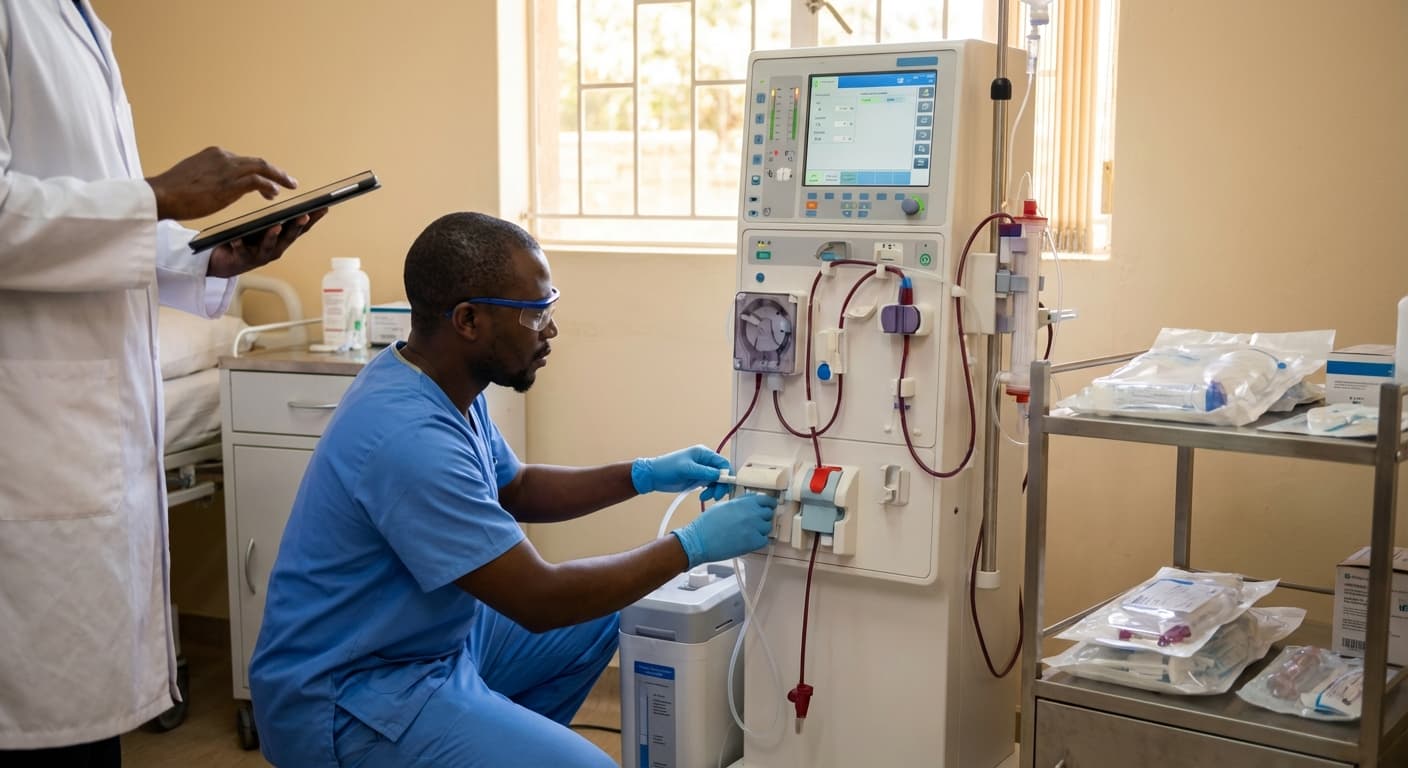
Hemodialysis Machine Installation Service in Cameroon
Engineering Excellence & Technical Support
Hemodialysis Machine Installation Service High-standard technical execution following OEM protocols and local regulatory frameworks.
Expert Installation & Calibration
Our certified technicians ensure seamless hemodialysis machine installation, adhering to international standards and performing precise calibration for optimal patient safety and treatment efficacy in Cameroon.
Comprehensive Site Assessment & Planning
We conduct thorough site assessments to guarantee ideal power, water, and waste management infrastructure, minimizing downtime and ensuring your hemodialysis facility in Cameroon is fully prepared for operation.
On-Site Training & Support
Receive expert, hands-on training for your biomedical staff on machine operation and basic maintenance, empowering your team and ensuring reliable service delivery for hemodialysis patients across Cameroon.
What Is Hemodialysis Machine Installation Service In Cameroon?
Hemodialysis machine installation service in Cameroon refers to the comprehensive process of setting up and commissioning hemodialysis machines within healthcare facilities across the nation. This service is critical for enabling renal replacement therapy for patients suffering from end-stage renal disease (ESRD). It involves the physical placement, connection to essential utilities, calibration, testing, and initial user training for hemodialysis equipment. The objective is to ensure that the machines are operational, safe, and compliant with established medical and technical standards, thereby facilitating effective patient treatment.
| Who Needs Hemodialysis Machine Installation Service? | Typical Use Cases | |||||
|---|---|---|---|---|---|---|
| Hospitals (public and private): Especially those with nephrology departments or establishing new dialysis units. | Dialysis centers: Dedicated facilities offering hemodialysis services to outpatients. | Rehabilitation centers: Facilities that may offer temporary or long-term dialysis care. | Remote or underserved healthcare facilities: Where specialized medical equipment is being introduced for the first time. | Manufacturers and distributors of hemodialysis equipment: As part of their product delivery and support services. | Government health ministries and agencies: When procuring and deploying dialysis machines for public health initiatives. | Emergency response units or field hospitals: Requiring rapid deployment of life-sustaining medical equipment. |
| Establishment of new dialysis units within existing hospitals. | Expansion of capacity in existing dialysis centers. | Replacement of outdated or malfunctioning hemodialysis machines. | Deployment of mobile dialysis units for specific campaigns or disaster relief. | Introduction of advanced hemodialysis technologies requiring specialized installation. | Setting up dialysis facilities in regions with limited access to renal care. | Ensuring compliance with evolving regulatory and safety standards for medical equipment. |
Key Components of Hemodialysis Machine Installation Service
- Site assessment and preparation: Evaluating the designated installation area for power, water, drainage, and environmental conditions.
- Machine delivery and unboxing: Safely transporting and unpacking the hemodialysis unit.
- Physical placement and mounting: Positioning the machine in its operational location, potentially including wall or floor mounting.
- Utility connections: Connecting the machine to specialized water treatment systems (e.g., reverse osmosis), electrical outlets, and waste disposal systems.
- Internal plumbing and fluid pathways: Ensuring proper connections for dialysate preparation, delivery, and waste fluid management.
- Electrical safety testing: Verifying that the machine meets all electrical safety regulations and standards.
- Functional testing and calibration: Performing diagnostic tests to confirm all operational parameters are within specification, including flow rates, pressures, and temperature.
- Water quality testing: Verifying that the treated water meets strict purity standards for hemodialysis.
- Disinfection and sterilization protocols: Implementing and verifying appropriate disinfection procedures for the machine's internal components.
- User training: Providing initial operational and basic maintenance training to healthcare personnel (nurses, technicians) responsible for the machine's use.
- Documentation and certification: Completing all necessary installation records, test reports, and certifications for compliance and future reference.
Who Needs Hemodialysis Machine Installation Service In Cameroon?
This document outlines the primary beneficiaries and departments within Cameroon that require Hemodialysis Machine Installation Services. The service is crucial for ensuring the operational readiness of medical facilities equipped to treat end-stage renal disease (ESRD).
| Customer Segment | Key Departments Involved | Typical Needs/Considerations |
|---|---|---|
| Public Hospitals (e.g., Central Hospitals, University Teaching Hospitals) | Nephrology Department, Engineering/Biomedical Department, Procurement Department, IT Department | High patient volume, need for robust and reliable machines, integration with existing infrastructure, staff training, ongoing maintenance contracts. |
| Private Hospitals | Nephrology Department, Biomedical Engineering Department, Administration, IT Department | Focus on patient comfort and advanced features, efficient space utilization, streamlined installation process, potential for specialized training. |
| Specialized Nephrology Clinics | Nephrology Unit, Technical/Biomedical Staff, Clinic Management | Dedicated dialysis facilities, precision in installation for optimal patient care, specialized training for their technicians, adherence to international standards. |
| Regional Health Centers | Dialysis Unit Staff, Regional Medical Administration, Maintenance Technicians | Serving a wider geographic area, need for durable and easy-to-maintain machines, basic to intermediate functionality, training for local technicians. |
| Military and Paramilitary Health Facilities | Medical Corps, Biomedical Engineering Unit, Logistics Department | Serving personnel, potential for mobile or compact unit installations, rapid deployment capabilities, robust equipment for diverse environments. |
| NGO Clinics | Clinical Operations, Technical Support, Program Management | Serving underserved populations, cost-effectiveness is a key factor, simpler operational requirements, training for non-specialized staff, sustainable maintenance solutions. |
Target Customers & Departments for Hemodialysis Machine Installation Services in Cameroon
- Hospitals (Public and Private)
- Specialized Nephrology Clinics
- Regional Health Centers with Dialysis Units
- Military and Paramilitary Health Facilities
- Non-Governmental Organization (NGO) Clinics Providing Healthcare Services
Hemodialysis Machine Installation Service Process In Cameroon
This document outlines the typical workflow for Hemodialysis Machine Installation Services in Cameroon, from the initial client inquiry to the final execution and handover. The process is designed to ensure a smooth, efficient, and compliant installation of vital medical equipment.
| Phase | Key Activities | Responsible Party | Deliverables/Outcomes |
|---|---|---|---|
| Pre-Installation | Initial inquiry, needs assessment, site survey, proposal generation, contract negotiation, equipment procurement. | Client, Service Provider | Needs identified, site feasibility confirmed, quotation provided, signed contract, ordered equipment. |
| Installation | Site preparation, equipment delivery, physical installation, system testing, calibration, water purification integration. | Service Provider, Client (for site prep) | Machine physically installed, all systems functional, calibrated, and integrated. |
| Post-Installation | User training, final inspection, sign-off, documentation handover, ongoing support. | Service Provider, Client | Trained staff, approved installation, complete documentation, ongoing operational support. |
Hemodialysis Machine Installation Service Process
- Inquiry & Needs Assessment: Client expresses interest in hemodialysis machine installation. Service provider gathers initial information about the client's facility, existing infrastructure, machine model (if known), and specific requirements.
- Proposal & Quotation: Based on the needs assessment, a detailed proposal is prepared, outlining the scope of work, deliverables, timeline, and associated costs. This includes equipment, labor, materials, and any necessary certifications.
- Site Survey & Technical Assessment: A qualified technician or engineer visits the client's site to conduct a thorough assessment. This involves evaluating the installation space, power supply, water purification system compatibility, waste disposal, and accessibility for equipment delivery and maintenance.
- Contracting & Agreement: Upon acceptance of the proposal, a formal contract is signed, clearly defining the terms and conditions, payment schedule, warranty, and responsibilities of both parties.
- Equipment Procurement & Logistics: The service provider procures the hemodialysis machine and any necessary accessories or ancillary equipment. Arrangements are made for safe transportation and delivery to the client's site.
- Pre-Installation Preparation: The client's site is prepared according to the technical assessment. This may include modifications to electrical outlets, plumbing, ventilation, or structural reinforcements. The installation area is cleared and made ready.
- On-Site Installation: The installation team arrives at the site and commences the physical installation of the hemodialysis machine. This involves unboxing, component assembly, connection to power, water, and drainage systems.
- System Testing & Calibration: Once installed, the machine undergoes rigorous testing to ensure all functions are operational. This includes performance checks, safety feature verification, and calibration of sensors and flow rates.
- Water Purification System Integration (if applicable): If a new water purification system is being installed or integrated, it is thoroughly tested and connected to the hemodialysis machine, ensuring water quality meets strict medical standards.
- User Training: The client's clinical staff (nurses, technicians) receive comprehensive training on the operation, basic maintenance, and troubleshooting of the hemodialysis machine.
- Final Inspection & Sign-off: A final inspection is conducted by the service provider and the client to verify that the installation is complete, functional, and meets all agreed-upon specifications. The client formally signs off on the installation.
- Documentation & Handover: All relevant documentation, including user manuals, warranty information, service reports, and compliance certificates, is provided to the client. The machine is officially handed over.
- Post-Installation Support & Maintenance: The service provider typically offers post-installation support, including troubleshooting assistance, scheduled maintenance, and access to spare parts, to ensure the long-term reliability of the equipment.
Hemodialysis Machine Installation Service Cost In Cameroon
The cost of installing a hemodialysis machine in Cameroon can vary significantly due to a range of factors. These include the complexity of the installation, the specific type and model of the hemodialysis machine, the required site preparation, and the expertise of the installation service provider. It's crucial for healthcare facilities to obtain detailed quotes from multiple reputable suppliers and service providers to ensure competitive pricing and quality service. The installation process often involves ensuring proper water purification systems are in place, electrical connections are adequate, and the treatment room meets all necessary safety and hygiene standards. Additional costs might arise from necessary plumbing modifications, specialized ventilation, and the training of medical staff on the operation and maintenance of the new equipment. Understanding these variables is key to budgeting accurately for hemodialysis machine installation in Cameroon.
| Service Component | Estimated Cost Range (XAF) |
|---|---|
| Basic Hemodialysis Machine Installation | 1,500,000 - 3,000,000 |
| Installation with Advanced Water Treatment System | 2,500,000 - 5,000,000 |
| Comprehensive Installation (Machine, Water, Site Prep, Training) | 4,000,000 - 8,000,000+ |
| Site Preparation (Plumbing & Electrical Upgrades) | 500,000 - 2,000,000 |
| Water Purification System Installation | 700,000 - 3,000,000 |
| Staff Training & Commissioning | 300,000 - 1,000,000 |
Key Pricing Factors for Hemodialysis Machine Installation in Cameroon
- Type and Model of Hemodialysis Machine: Advanced or specialized machines may incur higher installation costs due to more complex requirements.
- Site Preparation: This includes necessary modifications to the treatment room, such as plumbing, electrical upgrades, and ventilation systems.
- Water Purification System: Ensuring a robust and compliant water purification system is essential and can be a significant part of the overall installation cost.
- Installation Service Provider: The reputation, experience, and geographical location of the service provider can influence pricing.
- Ancillary Equipment: Installation of associated equipment like patient chairs, trolleys, and monitoring devices.
- Training and Commissioning: The cost of training medical staff on the operation, maintenance, and troubleshooting of the machine.
- Transportation and Logistics: For machines and components being transported to remote or less accessible locations.
- Warranty and Maintenance Packages: Initial installation often includes or is bundled with warranty and ongoing maintenance agreements, affecting the upfront cost.
- Regulatory Compliance and Certification: Costs associated with ensuring the installation meets local health regulations and obtaining necessary certifications.
Affordable Hemodialysis Machine Installation Service Options
When considering hemodialysis machine installation, understanding the available service options and their associated costs is crucial for healthcare facilities, especially those operating with budget constraints. This guide explores affordable installation service options, focusing on value bundles and effective cost-saving strategies. The aim is to empower decision-makers with knowledge to secure necessary services without compromising quality or patient care.
| Service Component | Standard Installation | Value Bundle (Typical Inclusions) | Cost-Saving Strategy |
|---|---|---|---|
| Machine Setup & Plumbing Connection | Basic physical placement and water/dialysate line connection. | Includes initial calibration, water quality testing, and system priming. | Bundle discount; DIY plumbing if certified technicians are available and regulations permit. |
| Electrical Wiring & Power Supply | Connecting the machine to the facility's power grid. | Includes surge protection assessment and installation, and dedicated circuit verification. | Bundle discount; utilize existing, compliant power outlets if suitable. |
| Calibration & System Testing | Ensuring the machine operates within specified parameters. | Comprehensive diagnostic checks, performance validation, and initial patient simulation runs. | Bundle discount; phased testing with internal clinical staff oversight. |
| Staff Training | Basic operational overview for clinical staff. | In-depth training on machine operation, troubleshooting, infection control, and basic maintenance for nurses and technicians. | Bundle discount; train-the-trainer programs for in-house sustainability. |
| Post-Installation Support | Limited on-site presence after initial setup. | Extended on-site support for a defined period (e.g., 1-2 weeks), remote technical assistance, and priority service calls. | Bundle discount; negotiate a longer support period as part of a larger package. |
| Documentation & Certification | Basic setup log. | Comprehensive installation report, calibration certificates, and compliance documentation for regulatory bodies. | Bundle discount; request digital copies to reduce printing costs. |
Key Considerations for Affordable Hemodialysis Machine Installation
- Defining your specific needs: Number of machines, type of machines, existing infrastructure, and desired timeline.
- Researching reputable service providers: Look for experience, certifications, and customer testimonials.
- Understanding the scope of work: Installation, calibration, testing, training, and ongoing maintenance.
- Comparing quotes from multiple vendors: Don't settle for the first offer.
- Negotiating payment terms: Explore options like phased payments or discounts for upfront payment.
- Considering refurbished or reconditioned equipment: Can significantly reduce capital expenditure.
- Leveraging existing in-house expertise: If your facility has trained biomedical technicians, they might be able to assist.
- Exploring manufacturer-provided installation: Often bundled with new machine purchases.
- Investigating government grants and funding opportunities: Especially for non-profit or underserved facilities.
Verified Providers In Cameroon
Finding reliable healthcare providers is paramount for individuals and families in Cameroon. Verified providers offer a level of assurance that traditional options may lack. Franance Health stands out in this regard, not only by offering access to a network of credentialed professionals but also by emphasizing the rigorous vetting process that underpins their selection. This dedication to verification ensures that patients receive care from qualified, ethical, and competent practitioners. The "best choice" argument for Franance Health stems from this unwavering commitment to quality, safety, and patient well-being, making them a trusted partner in navigating the Cameroonian healthcare landscape.
| Credentialing Aspect | Franance Health Approach | Patient Benefit |
|---|---|---|
| Licensing and Registration | Verifies current and valid medical licenses and professional registration in Cameroon. | Ensures providers are legally authorized to practice medicine. |
| Educational Background | Confirms degrees, diplomas, and specialized training from recognized institutions. | Guarantees a solid foundation of medical knowledge and expertise. |
| Professional Experience | Assesses years of practice and any relevant specializations or fellowships. | Indicates practical experience and depth of knowledge in specific areas. |
| Reputation and Disciplinary History | Conducts background checks and inquires about any past disciplinary actions. | Mitigates risks by identifying potentially problematic practitioners. |
| Continuing Professional Development (CPD) | Encourages and, where possible, verifies participation in ongoing training and education. | Ensures providers stay updated with the latest medical advancements and practices. |
Why Franance Health Credentials Represent the Best Choice:
- Rigorous credentialing process ensures all listed providers meet high professional standards.
- Focus on ethical practice and patient safety is a cornerstone of their verification.
- Access to a diverse range of specialists and general practitioners.
- Peace of mind for patients knowing they are engaging with vetted professionals.
- Streamlined process for finding and booking appointments with trusted doctors.
- Commitment to continuous monitoring and updating of provider credentials.
Scope Of Work For Hemodialysis Machine Installation Service
This Scope of Work (SOW) outlines the requirements for the installation of hemodialysis machines at [Client Facility Name]. The service encompasses all necessary activities to ensure the safe, efficient, and compliant integration of the hemodialysis machines into the client's existing infrastructure. This includes site preparation, equipment delivery and unboxing, physical installation, utility connections, initial testing, and training. The objective is to deliver a fully functional and operational hemodialysis unit ready for patient use, adhering to all relevant industry standards and regulations.
| Item | Description | Technical Specifications/Standards | Deliverable | Acceptance Criteria |
|---|---|---|---|---|
| Site Assessment | On-site evaluation of the installation location to determine space, environmental conditions, power, water, drainage, and ventilation requirements. | Adherence to manufacturer's installation guidelines, local building codes, and healthcare facility standards (e.g., infection control protocols). | Site assessment report detailing findings, recommendations, and any required modifications. | Client sign-off on the site assessment report, confirming feasibility of installation. |
| Equipment Delivery | Safe transportation and delivery of hemodialysis machines and associated accessories to the designated installation site. | Packaging integrity to prevent damage during transit. Secure handling procedures. | Delivered hemodialysis machines and accessories. | Confirmation of received items against the packing list, with no visible damage. |
| Physical Installation | Placement and secure mounting of hemodialysis machines in their final operational positions. | Adherence to manufacturer's clearance requirements, ergonomic considerations, and electrical grounding standards (e.g., IEC 60601 series). | Properly installed and secured hemodialysis machines. | Machines are stable, level, and accessible for operation and maintenance. |
| Utility Connections | Connection of hemodialysis machines to required utilities: power, purified water, wastewater drainage, and medical air (if applicable). | Electrical: Compliant with local electrical codes and facility grounding protocols. Dedicated circuits recommended. Water: Purified water supply meeting AAMI standards (e.g., resistivity, microbial limits). Drainage: Appropriate pipe sizing and slope for wastewater. Air: Medical grade air supply at specified pressure. | All utility connections made and leak-free. | Confirmation of stable and appropriate utility supply parameters for each machine. |
| System Configuration | Initial setup and configuration of machine parameters, including fluid pathways, dialysate composition, and safety settings. | Configuration according to manufacturer's recommendations and client's clinical protocols. Compliance with relevant medical device regulations. | Configured hemodialysis machines with all user-defined parameters set. | Verification of correct configuration settings against documented parameters. |
| Calibration and Testing | Performance verification of all machine functions, including flow rates, pressures, temperature, conductivity, and alarms. | Pre-installation testing (PIT) and post-installation testing (POST) as per manufacturer's protocols and ISO 13485 quality management system principles. | Fully calibrated and tested hemodialysis machines. | Successful completion of all specified test sequences with documented results exceeding defined tolerances. |
| User Training | Training for designated clinical staff on the operation, basic maintenance, and troubleshooting of the installed hemodialysis machines. | Training content aligned with manufacturer's operational manual and best practice guidelines. Competency assessment of trainees. | Trained clinical staff capable of operating and performing basic functions of the machines. | Attendance records and feedback forms from trained personnel. |
| Documentation | Provision of all relevant documentation, including installation reports, test results, user manuals, and warranty information. | All documentation in English, clearly legible, and organized. Includes manufacturer's original documentation. | Complete set of handover documentation. | Client sign-off on receipt of all documentation. |
Key Activities and Deliverables
- Site Assessment and Preparation
- Equipment Delivery, Unpacking, and Inspection
- Physical Installation of Hemodialysis Machines
- Utility Connections (Electrical, Water, Drainage, Air)
- System Configuration and Calibration
- Pre-Installation and Post-Installation Testing
- User Training and Familiarization
- Documentation and Handover
Service Level Agreement For Hemodialysis Machine Installation Service
This Service Level Agreement (SLA) outlines the performance standards and guarantees for the Hemodialysis Machine Installation Service provided by [Your Company Name] to [Client Name]. It details response times for critical issues and uptime guarantees for the installed hemodialysis machines.
| Service Element | Target Response Time (during Business Hours) | Target Response Time (outside Business Hours) | Resolution Target (Initial Diagnosis/Escalation) | Uptime Guarantee |
|---|---|---|---|---|
| Critical Issue (Machine Failure) | 2 Business Hours | 4 Business Hours (contact initiated) | 8 Business Hours (for initial diagnosis/repair plan) | 98% Uptime (monthly average) |
| Major Issue (Performance Impairment) | 4 Business Hours | 8 Business Hours (contact initiated) | 24 Business Hours (for initial diagnosis/repair plan) | 99% Uptime (monthly average) |
| Minor Issue (Non-critical, e.g., software glitch, query) | 8 Business Hours | Next Business Day | 48 Business Hours (for initial diagnosis/resolution plan) | Not directly applicable, but timely resolution contributes to overall operational efficiency. |
| Preventive Maintenance Scheduling | Notification 1 week in advance | N/A | N/A | N/A |
Key Definitions
- Installation Service: The process of delivering, setting up, configuring, and testing hemodialysis machines at the client's designated facility.
- Downtime: Any period during which a hemodialysis machine is inoperable and unable to perform its intended function, as determined by the client and confirmed by [Your Company Name]'s technical support.
- Critical Issue: A malfunction or failure of a hemodialysis machine that renders it completely unusable or poses a direct risk to patient safety.
- Major Issue: A malfunction or failure of a hemodialysis machine that significantly impairs its performance but does not render it completely unusable or pose an immediate risk to patient safety.
- Minor Issue: A cosmetic defect, a non-critical operational glitch, or a question regarding machine functionality that does not impact patient care.
- Business Hours: [Specify your business hours, e.g., Monday to Friday, 8:00 AM to 5:00 PM, excluding public holidays].
Frequently Asked Questions

Ready when you are
Let's scope your Hemodialysis Machine Installation Service in Cameroon project in Cameroon.

Scaling healthcare logistics and technical systems across the entire continent.